6
Report on the annual AAAS Forum on Science and Technology Policy
YOSHIKO YOKOO
General Unit
1
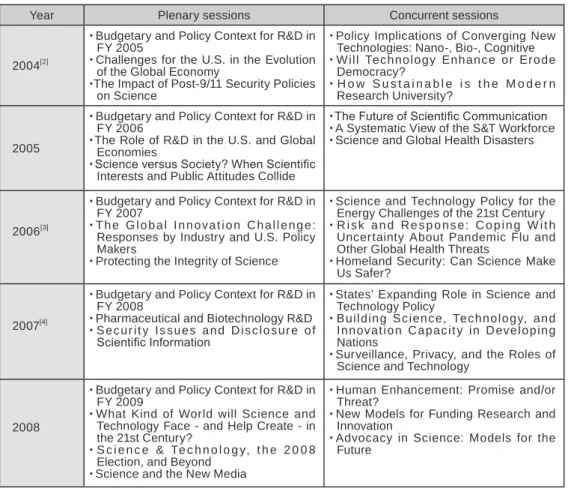
Figure 1 : Session topics from 2004 to 2008
Source: AAAS Forum on Science and Technology Policy website.[1] Please refer to References[2-4] for previous forums.
Introduction
From 8th to 9th of May 2008, the AAAS[NOTE1]
(American Association for the Advancement of Science) held the Forum on Science and Technology Policy in Washington D.C. The forum aims to provide interested persons the opportunity to understand and discuss priority issues facing the U.S. community of science, technology and higher education. Participants in the forum are scientists, engineers, policy makers, students, and others who
are interested in science and technology policy.
This year’s forum had more than 400 participants, including John H. Marburger, the Director of the Office of Science and Technology Policy (and Science Advisor to the President), who gave his seventh consecutive keynote address, as well as concerned parties from government, universities, research-related institutions, and think-tanks.
The plenary sessions covered topics as follows;
“Budgetary and Policy Context for R&D in FY 2009”, “What Kind of World will Science and Technology Face - and Help Create - in the 21st
Year Plenary sessions Concurrent sessions
2004[2]
・Budgetary and Policy Context for R&D in FY 2005
・Challenges for the U.S. in the Evolution of the Global Economy
・The Impact of Post-9/11 Security Policies on Science
・Policy Implications of Converging New Technologies: Nano-, Bio-, Cognitive
・W ill Tec hnolo gy Enhanc e or Ero de Democracy?
・H o w S u s t a i n a b l e i s t h e M o d e r n Research University?
2005
・Budgetary and Policy Context for R&D in FY 2006
・The Role of R&D in the U.S. and Global Economies
・Science versus Society? When Scientific Interests and Public Attitudes Collide
・The Future of Scientific Communication
・A Systematic View of the S&T Workforce
・Science and Global Health Disasters
2006[3]
・Budgetary and Policy Context for R&D in FY 2007
・T h e G l o b a l I n n o v a t i o n C h a l l e n g e:
Responses by Industry and U.S. Policy Makers
・Protecting the Integrity of Science
・Science and Technology Policy for the Energy Challenges of the 21st Century
・R i s k a n d R e s p o n s e: C o p i n g W i t h Uncertainty About Pandemic Flu and Other Global Health Threats
・Homeland Security: Can Science Make Us Safer?
2007[4]
・Budgetary and Policy Context for R&D in FY 2008
・Pharmaceutical and Biotechnology R&D
・S e c u r i t y I s s u e s a n d D i s c l o s u r e o f Scientific Information
・States’ Expanding Role in Science and Technology Policy
・Building Sc ienc e, Tec hnolo gy, and Inn ovat i o n C apac i t y in D eve l o pin g Nations
・Surveillance, Privacy, and the Roles of Science and Technology
2008
・Budgetary and Policy Context for R&D in FY 2009
・What Kind of World will Science and Technology Face - and Help Create - in the 21st Century?
・S c i e n c e & Te c h n o l o g y, t h e 2 0 0 8 Election, and Beyond
・Science and the New Media
・Human Enhancement: Promise and/or Threat?
・New Models for Funding Research and Innovation
・Advocacy in Science: Models for the Future
[NOTE1]
The AAAS is one of the largest international non-profit organizations with more than 140 thousand members that consist of scientists, engineers, science educators, policy makers, and others, and it is the publisher of the journal “Science”. (Excerpt from reference[4])
[NOTE2]
Mandatory budget is expenditure that the government is obliged by law, such as pensions, health insurance, bond, and others. Discretionary budget that includes R&D funds is expenditure where the amount is decided according to the appropriation act that congress passes each year.
[NOTE3]
A program that was revealed in the president's budget request on February 2006 and at the same time by the Office of Science and Technology Policy (OSTP). To increase the competitiveness of the U.S., the program emphasizes the increase in support for basic research in physical science and engineering, and basic improvements in mathematics, science, and engineering education from elementary to higher educations. The core for supporting basic research is to double the funding over a ten-year period for agencies such as the NSF, DOE Science and NIST.
[NOTE4]
A legislature enacted in August 2007 for promoting investment into innovation and education for increasing the competitiveness of the U.S. This was in response to recommendations in the National Academies report “Rising Above the Gathering Storm”. It promotes the increase in support for basic research, strengthening of science, engineering and mathematics education, and promoting high-risk and high-reward innovation research.
Century?”, “Science and Technology, the 2008 Election, and Beyond”, and “Science and the New Media”. In recent years, the session on R&D budget has always started with the keynote address and the analysis of R&D budgets for the subsequent fiscal year, and presentations on policy background followed. However, this year, only the keynote address and budget analysis were presented, and then, a separate session, “What Kind of World will Science and Technology Face - and Help Create - in the 21st Century?”, which focused on the global outlook, took place. Other characteristics of this forum were as follows: the main focus was the presidential election and beyond; all the topics were issues in peacetime, that is, no issues on existing threats such as national security and infectious diseases were seen; and there was focus on science technology in general rather than specific areas. Figure 1 shows the session topics of the past five forums.
Keynote address
John H. Marburger, the Director of the Office
of Science and Technology, first mentioned expected involvement of scientific community in the incoming presidential administration. He made a point that those who may be eligible for senior positions and be involved in science and technology policymaking under the new administration would have to prepare. He also said that the scientific community should take actions by considering appropriate candidates who would be willing to take such difficult positions, before the incoming administration begins to function.
For the allocation of R&D budget, he reiterated that the U.S. lacks management framework and various stakeholders are involved in policymaking process, while many other countries have such frameworks for budget allocation. As an example, he referred to earmarks, which reflect intentions of congress and relevant parties. He questioned whether allocations were optimized, recognizing each earmark was worthwhile. He added that the overall picture shows that the percentage of R&D funding in the discretionary budget is remarkably stable although the mandatory budget is pressuring the discretionary budget.[NOTE2]
2
As for prioritization, he criticized the 2008 R&D budget allocation by congress for not reflecting the priorities in the ACI[NOTE3] (American Competitiveness Initiative), or the America C O M P E T E S A c t[ N O T E 4 ]
( A m e r i c a C r e a t i n g Opportunities to Meaningfully Promote Excellence in Technology, Education, and Science Act) as indicated in the president's message. He pointed out that appropriate allocation would be important because it would be difficult for the incoming administration to match the increase during the Bush administration which increased R&D budget compared to the eight years before that. He further mentioned that there is a large and unhealthy imbalance among funds for biomedical research and others although federal support for biomedical research has been left unchanged for half a decade.
Presentation on federal R&D budgets for FY 2009
Kei Koizumi of AAAS presented his analysis of
the FY 2009 R&D budget as follows: In February 2008, the President proposed a $3.1 trillion budget for FY 2009 in his budget message. It remains flat from the previous year. R&D budget (research, development, and facility) is $147.4 billion, which also remains flat in recent years. Among these, research budget peaked in FY 2004 and shows decreasing trends.
The FY 2009 budget proposal mentions a significant boost for basic research in physical sciences in accordance to the ACI and America COMPETES Act. Budgets for the National Science Foundation (NSF), Department of Energy (DOE) Office of Science, and National Institute of Standards and Technology (NIST) are to be significantly increased (Figure 2). They could make up for the shortage and double the funds over a ten-year period as stipulated in the ACI.
There are also increases for the Department of Defense (DOD) and National Aeronautics and Space Agency (NASA). Budget for the National Institute of Health (NIH) is flat, and those for
[NOTE5]
Earmarks, in U.S. politics, refer to congressional provisions that specify certain spending priorities to specific projects. Earmarks do not exist at the point of the FY 2009 President's budget request to congress.
Therefore, R&D funds may appear to be reduced when this is compared to the FY 2008 appropriation with earmarks, which was approved by congress. However, this does not mean that the funds were actually reduced. For this reason, the science advisor to the President, John H. Marburger mentioned that the AAAS budget analysis is flawed at the 2007 forum.[4] Then, for the FY 2009 budget analysis, the AAAS calculated the funding increase and decrease per agency excluding earmarks, and showed that DOD Science & Technology had 5.6% increase, while USDA had 1% decrease.
3
Figure 2:Changes in U.S. FY 2009 R&D budget per agencies (compared to previous fiscal year)
Source:Presentation by Kei Koizumi (AAAS) [1]
DOE: Department of Energy NSF: National Science Foundation DOT: Department of Transportation DOD: Department of Defense
NASA: National Aeronautics and Space Agency NIST: National Institute of Standards and Technology DHS: Department of Homeland Security
NIH: National Institute of Health VA: Department of Veterans Affairs
NOAA: National Oceanic and Atmospheric Administration EPA: Environmental Protection Agency
USGS: U.S. Geological Survey USDA: U.S. Department of Agriculture
the Environmental Protection Agency (EPA), Department of Defense Science and Technology (DOD S&T), and U.S. Department of Agriculture (USDA) decrease. However, the latter two eliminates earmarks, and therefore, shows decrease compared to the FY 2008 budget (appropriation) which includes earmarks.[NOTE5]
He also analyzes the trends in world R&D i n v e s t m e n t s . T h e U . S . s t i l l l e a d s R & D performance, but Asian countries such as China and India are dramatically increasing their R&D investments and beginning to show their presence.
Also shown are the sharply increasing trends with Japan, South Korea, and China in R&D investments as percentage of GDP.
The president's budget request proposes budget allocation in accordance to the ACI, but he provided the prospect that there were possibilities that congress would cut ACI-related increases in order to allocate resources to other programs unless the gross budget ceiling would be raised.
Other presentations
4-1 Science and technology in the 21st century In the session, “What Kind of World will Science and Technology Face - and Help Create - in the 21st Century?”, presentations with long-term perspectives were given on global-scale issues and on new societies that science could create.
They indicated the need to tackle global scale issues in climate change and energy by rallying the knowledge of science and technologies from around the world.
James Canton of the Institute for Global Futures provided predictions of the world with an interdisciplinary approach by analyzing multi- tiered trends to understand complex future societies. He envisioned the future as follows:
The risk factors would be energy, population, food, water, health, poverty, climate change, terrorism and so on. Among these, energy and water could be priority issues that would need to be tackled.
Innovation would be the key in solving these issues, and science would be the driving force of innovation. Furthermore, he presented an outlook of science where nano-, bio-, info-, quantum, and cognitive sciences would converge.
M e l i n d a K i m b l e o f t h e U n i t e d N a t i o n s
Foundation cited future threats to planetary sustainability, such as water stress, random urbanization, socioeconomic disparities and climate change. With such bleak outlook of the future, she emphasized the necessity of appropriate and effective policies on the basis of scientific evidence, and global cooperation and coordination to salvage the endangered planetary sustainability.
Christopher T. Hill of George Mason University predicted a transition from the current “scientific society” to a “post-scientific society”. This “post- scientific society” was described as a society where issues such as climate change, energy supply and demand, creating wealth and economic growth would be solved through the global science and technology community working together. He reminded the audience that science would still play an important role in a post-scientific society. The background for this transition is globalization, increased science and technological capabilities around the world and internationally diversified scientific and technological human resources.
4-2 Recommendations for the presidential election and beyond
At the session for “Science and Technology, the 2008 Election, and Beyond”, presentations were given on the 2008 presidential election and beyond, and on issues for the incoming administration, as well as on actions that scientists should take.
Some of the important issues that were discussed in this session are summed up as; health care, climate change, and energy. Furthermore, the scientific community was encouraged to be more actively involved in the science and technology policymaking in the incoming administration.
Peter R. Orszag, the Congressional Budget Office Director, mentioned health care and climate change as the major issues for the incoming administration.
He indicated the possibility of continuously growing health care costs because of rising medical cost per patient as technology improves, and the increasing numbers of Medicare and Medicaid beneficiaries. With climate change, he made a point that we should try to reduce small risks that could cause catastrophic conditions in the future.
Robert C. Cresanti of Ocean Tomo, LLC.
emphasized that the next administration should seek policies to transform tax-supported research
4
results into tangible and intangible assets, and to make use of intellectual properties to serve economic growth. As for administration, he pointed out that the current issue was the decline in investment for coordination among science- and-technology-related government agencies. He also mentioned the lack of engagement of the scientific community with the inner circle of the administration.
Gilbert S. Omenn of the University of Michigan said that the new administration should reorder priorities in the current policies affected by previous changes such as 9/11 and Iraqi War.
He set priorities for the new administration as follows: 1) Address long-deferred issues, such as energy, global environment, the economy, the workforce, education, health, and infrastructure.
2) Create renewed strategic plans for defense, space, homeland security, and intelligence. 3) Repair/revive international relationships. 4) Make clear the critical contributions from science and technology to the nation's future and strengthen the base for research and innovation and policy advice.
John Edward Porter, former U.S. Representative, urged scientific community to try to have science and technology issues heard by candidates in the presidential and congressional elections. Some of the issues he suggested are as follows: Identify and prepare the list of potential nominees for top science and technology related positions. Sign on to “sciencedebate2008”[NOTE6] to have presidential candidates debate on science issues. Invite Representatives and Senators to campus to see what’s happening in research.
Ernest J. Moniz of MIT brought up how the change of administration could affect the continuity of a research project, giving examples in energy related research. He said as follows:
Basic research programs that have broad support
from scientific community have a high possibility of surviving the transition of administrations.
H o w e v e r, d e v e l o p m e n t o r d e m o n s t r a t i v e researches endorsed by administration are vulnerable to administration change, and such investments would fail to come to fruition. He added out that demonstration projects under conventional government agency structures had uncertainties about resources arising from the annual appropriations. And he also pointed out the necessity of comprehensive discussion considering policies other than energy.
4-3 Science and the new media
Presentations were given on the possibilities and the current state of the new media as means of science communication, and focused on blogs and virtual worlds, which came from improvements and spread of the internet. It was indicated that these could become highly usable in the future.
Adam Bly of Seed Media Group indicated the importance of designs, based on his experience in publishing general scientific journals and planning scientific exhibitions in art museums. He added that the interaction between scientists and artists would give birth to a new form of expressions.
As for blogs, he said that his website for science blogs had increased access from abroad, where global discussions were beginning to take place.
He recognized that this was a new movement in communication between scientists and the public.
He further provided view that the blog would be a useful means for peer review of research, enhancing public understanding of science and technology, science education, and others.
As a blogger herself, Sheril R. Kishenbaum of Duke University highly valued the blogs as a means to transmit information and fill the gap between policy and expert knowledge of science.
[NOTE6]
Non-committed activity that calls for debate on science and technology by potential presidential candidates. The site calls for participation, and will be held even if there is only one candidate participating, by setting the date, time and place of debate. Supporters are being continuously sought though the website, with individuals such as leading scientists including Nobel prize laureates, government leaders, university and academic leaders, and organizations such as the AAAS, The Council on Competitiveness, and The National Academy of Sciences. Sheril Kirshenbaum, who presented at the session “Science and the New Media”, is a member of the acting committee of this activity.
She characterized blogs as a tool for speedy and interactive communication with a very wide range of readers. With these characteristics, one example that demonstrated the power of the blog is how
“Science Debate 2008” was organized in a few months.
Anthony Crider of Elon University introduced the experience of creating SciLands, a virtual island that provides the opportunities to get familiar with science and technology, within the virtual world of Second Life. The SciLands has the planetarium that he developed there, and other facilities that have been set up, such as by universities, museums, and NASA. Citing that many children have participated in the virtual world, and that NASA is calling for organizations to participate in the development of tools and operation, he said that the virtual world would play a major role in future science education.
4-4 New models of funding
Presentations were given on the different types of funding adequate to research and development stages, and on a variety of funding organizations in the U.S. For the research and development stages, transformative research[NOTE7], with its importance being emphasized, and venture business were mentioned. For funding organizations, foundations, prizes and awards, and state governments were mentioned. It was indicated that the diverse funding system was supplementing funds from the federal government.
John C. Crowley of the American Academy of Arts and Sciences said that under the current funding constraints, researches that appear to yield results are easy to be funded. Therefore, to promote transformative research that is difficult to yield results, it is necessary to revise the review process. Specifically, he emphasized the evaluation of new ideas and creativity, considering the length of time needed to yield results.
Stephen A. Merrill of The National Academies introduced the various prizes according to their
characteristics. Then, he mentioned that apart from helping to achieve research objectives, the prizes promote participation into the research field, attract investors, and educate the public.
However, he indicated issues in organizing the prize that involves large sums of money and effort. He further mentioned the need to deepen understandings of factors that promote or obstruct the effect of prizes.
Suzan M. Fitzpatrick of the James S. McDonnell Foundation, [She was absent from the meeting, and her presentation was introduced by moderator Donna J. Dean of Lewis Burke Associates LLC.]
showed how many philanthropic foundations, with diverse policies, are funding research in the U.S.
It was mentioned that the general characteristics of funding by foundations are in taking risks, and supporting ideas prior to broader acceptance, such as topics where government is reluctant to support or topics in their early stages of research.
D a n B e rg l u n d o f t h e S t a t e S c i e n c e a n d Te c h n o l o g y I n s t i t u t e i n d i c a t e d t h a t t h e characteristics of funding by state governments are basically mission oriented. The objectives are to improve research capabilities with a focus on economic development. He cited an example of the Research Triangle Park in North Carolina, which showed significant progress in 40 years, and said that it is yet to yield results, but taking or not taking actions would have greatly changed the future of the state.
Ravi Kapur of Anudeza Consulting Group stated that venture capital had become risk-averse, and therefore, to fund entrepreneurs, the effectiveness of funding by government should be improved. He said, “If we continue to focus on increased money for idea generation, and not enough on innovation for conversion to commerce, we will run the risk of subsidizing innovation for the rest of the world”.
He also stated that the federal government should carefully consider the disparity in allocating funds into basic research and into innovation.
[NOTE7]
Research concept revealed in the “2020 Vision for the National Science Foundation” by the NSF in 2005.
It aims to “revolutionize existing fields, create new subfields, cause paradigm shifts, support discovery, and lead to radically new technologies”. Specifically, research by Albert Einstein, Barbara McClintock, and Charles Townes are mentioned.
Yoshiko YOKOO
General Unit, Science and Technology Foresight Center
Studies on energy and science and technology human resources at the National Institute on Science and Technology Policy.
Currently in charge of performing prospective survey of future science and technologies.
(Original Japanese version: published in June 2008)
Conclusion
Presentations showed a strong intention to make a fresh start and discuss future science and technology policy as the Bush administration is about to come to an end after such significant incidents as 9/11 and the Iraqi War. In the background is the sense of urgency that the superiority of the U.S., which held the lead in science and technology, could be undermined in seeing the rapid growth of China and India. The presentations had frequent mentioning of China and India, while there was no mentioning of Europe or Japan.
Many presentations picked up the climate change issue, where a AAAS Board Statement was released at the 2007 forum[4] and the energy issue, which was the session topic at the 2006 forum,[3] as the priority issue in science and technology that the new administration should tackle. The science and technology policy appears to need a long-term view in solving problems for establishing a sustainable society.
Before the coming presidential election, the AAAS is actively involved in various activities to have the views of the scientific community reflected in policies. For example, their website has the page “S&T in the 2008 Election” that provides information on policies and views of candidates from both parties. The AAAS annual meeting that was held in February 2008 had
session for discussion on science and technology policy, inviting science and technology advisers to Senators Hillary Clinton and Barack Obama.
Then, the forum promotes individual scientist and the science community to not only speak out to presidential candidates and politicians, but to take actions and to be actively involved in the process of making science and technology policies. With distinctive political process in each country, it is interesting to see the big difference in the scientific communities of the two countries.
References
[1] A n nu a l A A A S For u m on Scie nc e a nd Technology Policy website: http://www.aaas.
org/spp/rd/forum.htm
[2] Igami, M.: “S cience and Technology Policy Trends in the United States - Repor t on the AAAS Annual Forum on Science and Technology Policy -”, Science & Technology Trends - Quarterly Review , No.13, 2004.
[3] Urashima, K.: “Report on the Annual AAAS Forum on Science and Technology Policy”, Science & Technology Trends- Quarterly Review No.21, 2006.
[4] Mitsumori, S.: “Report on the AAAS Forum on Science and Technology Policy”, Science
& Tech nology Trends- Quarterly Review, No.25, 2007.
[5] Science Debate 2008 website: http://www.
sciencedebate2008.com
5
About SCIENCE AND TECHNOLOGY FORESIGHT CENTER
I
t is essential to enhance survey functions that underpin policy formulation in order for the science and technology administrative organiztions, with MEXT and other ministries under the general supervision of the Council for Science and Technology Policy, Cabinet office (CSTP), to develop strategic science and technology policy.N
ISTEP has established the Science and Technology Foresight Center (STFC) with the aim to strengthen survey functions about trends of important science and technology field. The mission is to provied timely and detailed information about the latest science and technology trends both in Japan and overseas, comprehensive analysis of these trends, and reliable predictions of future science and technology directions to policy makers.B
eneath the Director are six units, each of which conducts surveys of trends in their respective science and technology fields. STFC conducts surveys and analyses from a broad range of perspectives, including the future outlook for society.T
he research results will form a basic reference database for MEXT, CSTP, and other ministries. STFC makes them widely available to private companies, organizations outside the administrative departments, mass media, etc. on NISTEP website.The following are major activities:
1. Collection and analysis of information on science and technology trends through expert network
STFC builds an information network linking about 2000 experts of various science and technology fields in the industrial, academic and government sectors. They are in the front line or have advanced knowledge in their fields.
Through the networks, STFC collects information in various science and technology fields via the Internet, analyzes trends both in Japan and overseas, identifies important R&D activities, and prospects the future directions. STFC also collects information on its own terms from vast resources.
Collected information is regularly reported to MEXT and CSTP.
Furthermore, STFC compiles the chief points of this information as topics for “Science and Technology Trends” (monthly report).
2.Reserch into trends in major science and technology fields
Targeting the vital subjects for science and technology progress, STFC analyzes its trends deeply, and helps administrative departments formulate science and technology policies.
The research results are published as articles for “Science Technology Trends” (monthly report).
3.S&T foresight and benchmarking
S&T foresight is conducted every five years to grasp the direction of technological development in coming 30 years with the cooperation of experts in various fields.
International Benchmarking of Japan’s science and engineering research also implemented periodically.
The research results are published as NISTEP report.
Life Science Research Unit
Information and Communications Research Unit
Environment and Energy Research Unit
Nanotechnology and Materials Research Unit
Monodzukuri, Infrastructure, and Frontier Research Unit General Unit
• General planning and coordination
• Life sciences
• Information and Communication technologies
• Environmental sciences
• Energy
• Nanotechnology
• Material science
• Monodzukuri (Manufacturing) technology
• Social Infrastructure
• Frontier : Space and Oceans
Units comprise permanent staff and affliated fellows
The Center's organization and responsible are reviewed as required
*
*
Organization of the Science and Technology Foresight Center
Director