• 検索結果がありません。

High-resolution analysis of cell-state transitions in yeast suggests widespread transcriptional tuning by alternative starts

N/A
N/A
Protected

Academic year: 2021

シェア "High-resolution analysis of cell-state transitions in yeast suggests widespread transcriptional tuning by alternative starts"

Copied!
38
0
0

読み込み中.... (全文を見る)

全文

(1)

transcriptional tuning by alternative starts

Author Minghao Chia, Cai Li, Sueli Marques, Vicente Pelechano, Nicholas M. Luscombe, Folkert J.

van Werven journal or

publication title

Genome Biology

volume 22

number 1

page range 34

year 2021‑01‑14

Publisher BMC 

Rights (C) 2021 The Author(s).

Author's flag publisher

URL http://id.nii.ac.jp/1394/00001759/

doi: info:doi/10.1186/s13059-020-02245-3

Creative Commons Attribution 4.0 International(https://creativecommons.org/licenses/by/4.0/)

(2)

R E S E A R C H Open Access

High-resolution analysis of cell-state

transitions in yeast suggests widespread transcriptional tuning by alternative starts

Minghao Chia 1,2 , Cai Li 1,3 , Sueli Marques 4 , Vicente Pelechano 4 , Nicholas M. Luscombe 1,5,6 and Folkert J. van Werven 1*

* Correspondence: folkert.

[email protected]

Minghao Chia and Cai Li contributed equally to this work.

1
The Francis Crick Institute, London, UK

Full list of author information is available at the end of the article

Abstract

Background: The start and end sites of messenger RNAs (TSSs and TESs) are highly regulated, often in a cell-type-specific manner. Yet the contribution of transcript diversity in regulating gene expression remains largely elusive. We perform an integrative analysis of multiple highly synchronized cell-fate transitions and quantitative genomic techniques in Saccharomyces cerevisiae to identify regulatory functions associated with transcribing alternative isoforms.

Results: Cell-fate transitions feature widespread elevated expression of alternative TSS and, to a lesser degree, TES usage. These dynamically regulated alternative TSSs are located mostly upstream of canonical TSSs, but also within gene bodies possibly encoding for protein isoforms. Increased upstream alternative TSS usage is linked to various effects on canonical TSS levels, which range from co-activation to repression.

We identified two key features linked to these outcomes: an interplay between alternative and canonical promoter strengths, and distance between alternative and canonical TSSs. These two regulatory properties give a plausible explanation of how locally transcribed alternative TSSs control gene transcription. Additionally, we find that specific chromatin modifiers Set2, Set3, and FACT play an important role in mediating gene repression via alternative TSSs, further supporting that the act of upstream transcription drives the local changes in gene transcription.

Conclusions: The integrative analysis of multiple cell-fate transitions suggests the presence of a regulatory control system of alternative TSSs that is important for dynamic tuning of gene expression. Our work provides a framework for understanding how TSS heterogeneity governs eukaryotic gene expression, particularly during cell-fate changes.

© The Author(s). 2021, corrected publication 2021. Open Access This article is licensed under a Creative Commons Attribution 4.0

International License, which permits use, sharing, adaptation, distribution and reproduction in any medium or format, as long as you

give appropriate credit to the original author(s) and the source, provide a link to the Creative Commons licence, and indicate if

changes were made. The images or other third party material in this article are included in the article's Creative Commons licence,

unless indicated otherwise in a credit line to the material. If material is not included in the article's Creative Commons licence and

your intended use is not permitted by statutory regulation or exceeds the permitted use, you will need to obtain permission directly

from the copyright holder. To view a copy of this licence, visit http://creativecommons.org/licenses/by/4.0/. The Creative Commons

Public Domain Dedication waiver (http://creativecommons.org/publicdomain/zero/1.0/) applies to the data made available in this

article, unless otherwise stated in a credit line to the data.

(3)

Introduction

The ends of messenger RNAs (mRNAs) produced by RNA polymerase II (Pol II) are formed at the site where transcription is initiated, generating the transcript start site (TSS), and at the site where polyadenylation occurs, also known as the transcript end site (TES) [1, 2]. Where Pol II starts transcribing and where polyadenylation sites are selected is fundamental to how mRNAs are generated and how gene expression is regu- lated. It is therefore surprising that the choice of TSS and TES is highly heterogeneous with most genes expressing multiple transcript isoforms, thereby leading to a high degree of transcript diversity [3]. Despite all efforts to understand how alternative TSSs and TESs control gene expression and overall protein expression, the physiological importance for transcript heterogeneity remains largely elusive.

Transcript heterogeneity is hypothesized to play important roles in development, health, and disease [4]. For instance, throughout the Drosophila life cycle, more than 40% of developmentally expressed genes alter their TSS usage [5]. In mice and humans, the average gene has at least four alternative promoters, hence TSSs [6]. Stage-specific differences in alternative TSS expression were detected in more than 5000 genes during mouse cerebellar development [7]. A recent study showed that the choice of alternative promoters was correlated with patient survival usage across many cancers [8]. Besides TSS heterogeneity, many studies have also uncovered the importance of alternative TES selection in gene regulation. Developmental or cell-type-specific alternative polya- denylation events in C. elegans affect where and when genes are expressed [9 – 11]. Like- wise, mutations associated with cancer promote the usage of new TESs leading to truncated mRNA isoforms and aberrant protein expression [12, 13]. Thus, alternative TSSs and TESs are a hallmark of development and disease.

Changes in the usage of TSSs or TESs can affect gene expression with various out- comes. Differential TSS/TES usage can either generate mRNAs with differing untrans- lated regions (UTRs), or more rarely, transcripts encoding truncated protein isoforms [3, 14]. In the former case, changes in the 5′ or 3′ UTR sequence can influence mRNA transcript stability, localization, and translation efficiency [15, 16]. Small open reading frames (ORFs) in 5 ′ extended leader sequences can titrate ribosomes away from productive translation of the full-length ORF impacting protein production [17 – 22].

Different studies have used budding yeast to profile and characterize the diversity of alternative transcripts [3, 23–25]. A median of 26 transcript isoforms per gene were observed during regular growth conditions [3]. Frequently, stress or nutrient source shifting induce changes in TSS and TES usage, thereby regulating gene expression to suit the needs of the cell [3, 26, 27]. There are many single locus studies showing how transcription from upstream alternative TSSs results in gene repression in cis via transcription-coupled chromatin changes [17, 18, 28, 29]. This process, known as transcriptional interference, is widespread in yeast, but also present in mammalian cells [28, 30 – 32]. Conversely, examples of upstream transcription activating downstream promoters have also been reported [33, 34]. Thus, TSS/TES usage changes can have varying outcomes on gene expression. However, the extent to which this mode of regulation occurs genome-wide is less well understood.

The budding yeast gametogenesis program, during which a diploid cell gives rise to

four haploid spores, is an attractive model for studying the function of transcript

heterogeneity on a genome-wide scale, because the program shares many features with

(4)

a typical cell differentiation program. Like many developmental programs, during yeast gametogenesis, transcription is highly regulated by stage and DNA sequence-specific transcription factors [35 – 39]. The program can be divided into two synchronized cell- fate transitions, which can be controlled by an inducible expression system of two transcription factors, Ime1 and Ndt80 [40, 41]. Importantly, there is evidence of wide- spread expression of 5′ extended transcript isoforms that control protein expression in a cell-fate stage-specific manner during yeast gametogenesis [18, 19, 42]. Genome-wide examination of the cell-fate-specific changes in transcript isoform usage may reveal regulatory principles evoked by transcript heterogeneity, perhaps not observed under regular asynchronous growth conditions.

Here, we performed a multifaceted time-course analysis to identify regulatory princi- ples linked to transcript isoform usage changes. Specifically, we examined transcript isoform usage levels during three highly synchronized cell-fate transitions that are part of the yeast gametogenesis program and the mitotic cell cycle. We found that the usage of alternative TSSs, and to lesser degree, TESs, changes dynamically during each cell- fate transition. Thousands of alternative TSS and TES clusters, upstream or down- stream of the canonical TSSs, were upregulated in a stage-specific manner. Importantly, increased upstream alternative TSS usage was associated with a wide range of effects on canonical TSS usage levels, ranging from co-activation and co-expression to repres- sion of canonical transcripts. We identified several regulatory features that explain various effects of alternative start usage on regulating gene expression. Our data suggest that TSS heterogeneity has a widespread function in tuning gene expression.

Results

Synchronizing three distinct cell-fate transitions in yeast

To investigate how transcript diversity is regulated during cell-state transitions, we profiled different cell-fate transitions in yeast covering the gametogenesis program and re-entry into the mitotic cell cycle (Fig. 1a). A major benefit of the yeast model is that we can synchronize yeast gametogenesis and re-entry into the mitotic cell cycle, allowing for precise cell stage-specific measurements and minimizing effects caused by asynchronous cell populations. To obtain a high synchrony of three distinct cell fates, we used an engineered yeast strain that expressed the master regulatory transcription factor for entry into gametogenesis, IME1, from an inducible promoter (pCUP-IME1) [41]. The same strain also harbored the transcription factor NDT80, which controls meiotic divisions and spore formation, under control of a different inducible promoter (pGAL-NDT80, Gal4-ER) [40]. We designed a master time course with periodic sampling across three distinct cell-fate transitions: (Transition 1:) gametogenesis up until meiotic prophase by inducing Ime1 expression (pCUP1-IME1, +Cu), (Transition 2:) meiotic divisions followed by spore formation by inducing Ndt80 expression (pGAl1-NDT80, Gal4-ER, + β-estradiol), and (Transition 3:) re-entry into the mitotic cell division cycle (from meiotic prophase (6 h (h) in sporulation medium (SPO)) to nutrient-rich medium (YPD)). We defined these three cell-fate transitions as T1, T2, and T3, respectively (Fig. 1a).

To determine that cells underwent T1, T2, and T3 synchronously, we measured the

synchrony of pre-meiotic DNA replication (T1), meiotic divisions (T2), and budding

(5)

Fig. 1 (See legend on next page.)

(6)

(T3) (Fig. 1b). Indeed, we found that most cells duplicated their DNA at 4 h in SPO (2 h after Ime1 induction), completed meiotic divisions at 9 h in SPO (2 h after Ndt80 in- duction), and displayed newly formed buds 2 h after shifting to rich nutrient conditions.

These data confirm that our experimental system allows for synchronous progression through three distinct cell-state transitions.

Quantitative profiling of transcript heterogeneity across multiple cell-fate transitions We generated quantitative datasets of TSS and TES usage levels over multiple time points for each cell-fate transition (T1, T2, and T3). Specifically, we adopted high- throughput sequencing approaches to measure usage levels of TSSs (TSS-seq) and TESs (TES-seq) (Fig. 1c) [20, 43–45]. In addition, we measured mRNA expression at matching time points (mRNA-seq). To complement TSS-seq and TES-seq datasets, we also used an orthogonal method called transcript isoform sequencing (TIF-seq) on pooled samples of matching time points: prior to meiosis (pm), T1, T2, and T3 respect- ively [3]. The main utility of TIF-seq is that it matches the start and end of transcripts

(See figure on previous page.)

Fig. 1 Profiling of transcript heterogeneity during three synchronized cell-fate transitions. a Schematic overview of the master time-course used for this study. Diploid cells harboring both IME1 fused to the CUP promoter and NDT80 expressed from the GAL promoter together with Gal4 fused to the estrogen receptor ( pCUP-IME1 and GAL4.ER pGAL-NDT80 ) (FW2795) were grown in rich medium (YPD) overnight. Saturated cultures were pelleted, washed, and resuspended (OD

600

= 2.5) in sporulation medium (SPO). Samples were collected at the indicated time points, spanning the pre-meiotic (pm) cell-state and three different cell-fate transitions. Then, 50 μ M CuSO

4

was added 2 h after the cells were transferred to SPO to induce IME1 expression and drive cells to enter meiosis (transition 1). Subsequently, 1 μ M β -estradiol was added 6 h after transfer to SPO to induce NDT80 expression, which in turn induced meiotic divisions and spore formation (transition 2). In parallel, at 6 h in SPO, cells were returned to the mitotic cell cycle (transition 3) by transferring cells to YPD. b Evidence for synchrony of cell-fate transition 1, 2, and 3. For transition 1 (T1), the kinetics of pre-meiotic DNA replication was determined by flow cytometry analysis of DNA content (left panel). Samples were taken at indicated time points and fixed, and DNA content was measured by propidium iodide staining. For transition 2 (T2), kinetics of meiotic divisions was determined. Samples were taken at the indicated time point and fixed in ethanol, nuclei were stained with DAPI, and DAPI masses were counted. Cells that harbored two, three, or four DAPI masses were classified as cells undergoing meiosis I or meiosis II (% meiosis). In total, 200 cells were counted at each time point. For transition 3, budding kinetics was determined by cell morphology (right panel) for 200 cells per time point. Results are representative of three independent, biological repeats. c Schematic of sample collections, TSS-seq and TES-seq methods and other methods were used. In short, we performed mRNA-seq after total RNA extraction. In addition, poly(A) + RNA was purified from aliquots of the same total RNA, was fragmented, and was used as inputs for TSS-seq or TES-seq. For TSS seq, the fragments were dephosphorylated and treated with a decapping enzyme so that only bona fide mRNA 5 ′ ends were competent for ligation. A custom oligo was ligated to these ends and fragments were converted to cDNA libraries for sequencing. For TES-seq, fragments harboring the 3 ′ ends were converted to cDNA using a biotinylated, anchored oligo d(T) primer with a GsuI restriction enzyme site. cDNA was then captured on streptavidin beads and the poly(A) tails were shortened by GsuI, before library amplification and sequencing.

For TIF-seq, equal amounts of total RNA from each time point spanning the pre-meiotic stage (pm) and each

cell-fate transition (T1 – 3) were pooled. For MNase-seq, cells at selected time points were harvested to profile

chromatin structure. The data represented are from n = 3 biological repeats. d Distribution of the numbers of

unique TSSs/TESs at single nucleotide resolution per gene. e Overview of mRNA-seq (gray), TSS seq (red), and

TES seq (blue) data at the RAD16 locus of different time points representing the different transitions (T1, T2, and

T3). The scale of mRNA-seq, TSS-seq, and TES-seq values are depicted at the top of the panel. Scale (bp) are

shown. f Distribution of the number of TSS/TES clusters per gene. g Percentage of TSS/TES clusters for each

transition supported by TIF-seq. Weakly expressed TSSs/TESs (TPM < 10) are compared to the highly expressed

ones (TPM ≥ 10). h Expression heatmap of genes known to be expressed early in gametogenesis (T1: RFA2 ,

REC102 , REC104 , IME2 ), expressed after Ndt80 induction (T2: CLB3, CLB4, SPO12, SSP2 ) or expressed during mitotic

growth (T3: RPL3, RPL27a, RPL32, RPL38 ). The pre-meiotic state (pm) is included as reference. mRNA-seq and TSS-

seq and TES-seq data for each time point were scaled between 0 and 1 across the time course

(7)

by sequencing the junction of circularized cDNAs spanning the 5′ and 3′ of transcripts, and can therefore precisely identify transcript isoforms [3, 46]. Finally, we determined nucleosome positions by micrococcal nuclease digestion of chromatin followed by high-throughput sequencing (MNase-seq) on selective time points across all three tran- sitions [47]. The MNase-seq dataset allowed us to determine how the chromatin state is altered during each cell-fate transition. The combination of these methods provides a high-resolution view of transcript isoform diversity and chromatin states over multiple distinct cell-fate transitions (Fig. 1a, see materials and methods for how TSSs/TESs were filtered and assigned to genes).

At the single nucleotide level, we found that on average 38 TSSs and 39 TESs per gene were located within one kilobase (kb) upstream or downstream of the ORF in the sense orientation, which was in the range of what a previous study had showed [46] (Fig. 1d and Additional file 1: Fig. S1a). Individual TSSs and TESs often clustered together. For ex- ample, we detected about 256 TSS and 95 TES sites at the single nucleotide resolution at the RAD16 locus, but most of them clustered within a few narrow regions (Fig. 1e).

Therefore, we applied a computational method to define these TSS/TES clusters and identified 11,685 distinct TSS and 13,380 TES clusters respectively, with approximately half of the genes harboring two or more TSS (or TES) clusters (Fig. 1f and Additional file 1:

Fig. S1b). Per time point, we identified between 7320 and 9412 TSS clusters and between 8437 and 11,382 TES clusters (Additional file 1: Fig. S1c). There was a good overlap be- tween the TSS-seq/TES-seq and TIF-seq datasets (Additional file 1: Fig. S1e). At least 50% of TSS and TES clusters were detected in the TIF-seq dataset, even though TIF-seq was sequenced with lower read depth and displayed an over-representation of shorter fragments (Additional file: Fig. S1d). For the TSS/TES clusters with high expression (Tags Per Million reads (TPM) > = 10), more than 90% of them were supported by TIF-seq (Fig. 1g). Additionally, the three independent biological replicates in this study highly cor- related with each other (Additional file 2). The TSS-seq and TES-seq datasets correlated well with the RNA-seq dataset (TSS-seq vs RNA-seq and TES-seq vs RNA-seq) (Fig. 1h and Additional file 1: Fig. S1f, S1g and Additional files 3, 4 and 5). However, it is worth noting that genes with relatively low expression levels for the RNA-seq correlated less well with TSS-seq and TES-seq, which could be due to noise in the data. Nevertheless, these data indicate that our TSS-seq and TES-seq datasets can be largely used for quantitative estimates of steady state levels of TSS and TES usage.

Alternative TSSs and TESs are highly regulated by cell-fate-specific transcription factors The terms main and alternative TSS and TES have been used in various ways. To avoid ambiguity, we defined these terms as the following. The main TSS or TES is the most highly expressed cluster prior to a cell-fate transition (PT, Fig. 2a). For T1, this was the most highly expressed TSS or TES cluster at the 2 h SPO time point, and for T2 or T3, the 6 h SPO time point. Alternative TSSs or TESs are the TSS or TES clusters expressed prior to or during cell-fate transitions, different from the main TSS/TES.

Our definitions were fixed within each individual cell-fate transition (T1, T2, or T3).

Our analysis across three cell transitions revealed widespread usage of alternative

TSS and TES clusters. For each cell-fate transition, we observed ~ 5800 alternative and

main TESs, and ~ 3500 alternative and ~ 5800 main TSSs (Fig. 2b). Most alternative

(8)

Fig. 2 (See legend on next page.)

(9)

TSSs were expressed upstream of annotated ORFs, but a subset of genes harbored TSSs within the gene body (Additional file 1: Fig. S2, left panel). The median position of main TSSs was 75 bp (T1) and 77 bp (T2 and T3) upstream of the AUG of the match- ing ORF, while that of the alternative TSSs upregulated during cell-fate transitions (2 fold or more) were at 170 bp (T1), 173 bp (T2) and 112 bp (T3) respectively (Fig. 2c, Additional file 1: Fig. S2, right panel). A similar trend was observed for alternative TESs suggesting that increased 5′ and 3′ UTR lengths are characteristic of most alternative transcript isoforms expressed during cell-fate transitions.

Alternative TSSs and TESs were highly regulated across the three cell-fate transitions.

Weighted gene correlation network analysis (WGCNA), which identifies the gene expression network based on expression correlation among genes across different time- points of the master time course, revealed 13 co-expression TSS modules and 15 TES modules, each consisting of at least one hundred genes (Additional file 1: Fig. S3a and S3b) [48]. The top three co-expression modules of TSSs and TESs were specifically up- regulated during T1, T2, and T3 respectively (Additional file 1: Fig. S3a). Alternative TSSs and TESs were well represented in each expression module. In line with this observation, we found that transcription factors involved in regulating alternative and main TSSs were similar. The Ume6 binding motif was detected near main and alterna- tive TSSs which were upregulated in T1, which is in line with the function of Ume6 together with Ime1 in activating transcription of the so-called “early” meiotic genes during yeast gametogenesis [49]. The binding motif of Ndt80, a transcription factor essential for activation of the middle and late meiotic genes, was enriched for T2 TSSs [50]. Given that expression of Ime1 and Ndt80 were controlled from heterologous promoters for T1 and T2 in order to obtain a highly synchronous cell population, there

(See figure on previous page.)

Fig. 2 Alternative TSSs and TESs are pervasive expressed during T1, T2, and T3. a Schematic depicting the main and alternative TSSs (red) and TESs (blue) nearby a gene prior to and during cell-fate transitions (top).

Definition of main and alternative TSS and TES (bottom). The main TSS/TES for T1 was defined as the most used TSS/TES in pre-meiotic cells (2 h). The main TSS/TES for T2 and 3 was defined as the most used TSS/

TES during meiotic prophase (6 h). Any other TSS/TESs associated with the same gene were classed as alternative. TSS/TES clusters were only defined for a transition if they had a minimum level of expression (TPM ≥ 1) and were in the same orientation as the gene. b Number of distinct main (m) or alternative (a) TSS/TES clusters associated with genes for each cell-fate transition (T1, T2, and T3). c Distribution of 5 ′ (left) and 3 ′ (right) UTR lengths for main (m) or alternative (a) TSSs and TESs. The 5 ′ UTR length is defined as the distance given in number of nucleotides from the apex of a TSS cluster to the AUG of an annotated ORF.

The 3 ′ UTR length is defined as the distance given in number of nucleotides from the apex of a TES cluster to the stop codon of an annotated ORF. Violin plots were scaled to a constant width. The alternative TSSs/

TESs which were external to the ORF sequence and upregulated (two-fold or more) during T1 ( n = 1118 for TSSs, and n = 1343 for TESs), T2 ( n = 1079 for TSSs, and n = 1320 for TESs), or T3 ( n = 1052 for TSSs, and n = 1611 for TESs) were used for this analysis. For the main TSSs/TESs n = 5016 and 5285 data points were used.

The median position of main TSSs was 75 bp (T1) and 77 bp (T2 and T3), while that of the alternative TSSs upregulated during cell-fate transitions (2-fold or more) were at 170 bp (T1), 173 bp (T2) and 112 bp (T3) respectively. d Formulas for calculating alternative TSS/TES usage and alternative TSS/TES usage changes.

Alternative TSS/TES usage for a gene was calculated by taking the alternative TSS/TES values divided over

the sum of the main TSS/TES and alternative TSS/TES values. Alternative TSS/TES usage change was

calculated by taking the difference in alternative TSS/TES usage between the transition (T) time point and

the reference time point prior (PT) to transition. e Boxplots of alternative TSS and TES usage across different

time points in T1, T2, and T3 using the formula defined in d. Negative controls (3 h, mock treated (3M) and

7 h, mock treated (7M)) representing cells which were shifted to SPO, but without inducing T1 or T2, were

included. The alternative TSSs/TESs upregulated (two-fold or more) during T1, T2, or T3 were used for the

analysis. f Similar to e, except that violin plots of changes in alternative TSS usage at different time points

are displayed. Samples were compared using the Wilcoxon rank-sum test and * denotes p < 0.05

(10)

is a possibility that this can lead to mis-regulation of a subset transcripts. However, both synchronization methods have been used to study gene regulation during gameto- genesis, and gave rise to viable spores that were indistinguishable from the wild-type [40, 41, 51]. Lastly, motifs of the transcriptional repressor Tod6 and transcriptional activator Sfp1 were proximal to the T3 TSSs (Additional file 1: Fig. S3c). Both transcription factors are known to regulate transcription of ribosomal protein gene promoters, and their activities are controlled by nutrient sensing kinases [52 – 54].

To test whether transcription factors directly control alternative TSS/TES usage, we compared TSS and TES changes between T1- and T2-induced cells (3H and 7H) and mock-treated cells of the matching time point (3M and 7M). We found that the vast majority of alternative TSSs and TESs were expressed in Ime1 and Ndt80-induced cells but not in the mock-treated cells for the same time period (3H versus 3M, and 7H ver- sus 7M) (Additional file 1: Fig. S3d). We conclude that main and alternative TSSs/TESs are widely expressed through the action of cell-fate specific transcription factors.

Increased main to alternative TSS usage is a common feature of cell-fate transitions Next, we determined how alternative TSS and TES usage contributed to gene expres- sion. Specifically, we computed the relative TSS and TES usage levels by taking the ratio of alternative versus the total TSSs/TESs levels of the same gene at the same time point (Fig. 2d). An increased ratio means elevated relative alternative TSS or TES usage, while a lower ratio indicates a decrease in relative usage. Proportional increases in expression from both alternative and main TSSs (e.g., if TSSs were not regulated inde- pendently) would result in an invariant ratio. Strikingly, we found that alternative TSS usage increased significantly during T1, T2, and T3 (Fig. 2d, e). For example, approxi- mately 200–300 genes had alternative TSSs whose usage increased by at least 50% for T1, T2, and T3 respectively. In contrast, alternative TES usage changed by a smaller magnitude across the three transitions (Fig. 2e). Only 100 – 150 genes had alternative TESs whose usage increased 50% more than the main TES. The extent of increase of TSS was also significantly larger than TES (Fig. 2f, Wilcoxon rank sum test, p < 0.05).

These increases were not seen for uninduced cells (Fig. 2e, see time points 3M and 7M). We conclude that there is a large shift from main to alternative TSS usage during cell-fate transitions. For remainder of the manuscript, we decided to focus on this remarkable observation.

Increased upstream alternative TSS usage is linked with a range of outcomes on main TSS usage

During yeast gametogenesis, many noncoding RNAs and mRNA isoforms are expressed.

A class of transcripts called long undecodable transcript isoforms (LUTIs) initiate upstream of canonical promoters and are widely expressed [17 – 19]. A well-studied gene regulated by a LUTI is the kinetochore component NDC80 [17, 18]. During early gameto- genesis, transcription from the main NDC80 TSS is repressed by transcription through the NDC80 promoter, which initiated from the upstream alternative TSS (NDC80

LUTI

).

Additionally, many other examples where transcription of intergenic noncoding RNAs or

5′ extended mRNA isoforms repress downstream promoters of protein coding genes have

been reported [17, 18, 26, 28, 32, 55, 56]. While many LUTIs and noncoding RNAs have

(11)

been functionally dissected and characterized, a more systematic analysis of how tran- scription from upstream alternative transcription isoform influences gene expression has been lacking. Close interrogation of our high-resolution time course allowed us to capture these regulatory events.

Our TSS-seq data was consistent with our previous work on the NDC80 locus, indicat- ing that we can identify these regulatory events genome wide [17, 18] (Fig. 3a). During T1, the NDC80 upstream alternative TSS was strongly upregulated and concomitantly the main TSS in the NDC80 promoter was downregulated, while in T2 and T3, the TSS switching effects were reversed. Cells that were not induced for T1 and T2 but exposed to sporulation medium for the same time (Fig. 3a, “no T main” and “no T UA”, 3 h in SPO for T1 and 7 h in SPO for T2, respectively) did not display TSS usage changes at the NDC80 locus, demonstrating that these effects are cell fate specific.

Having established that we could capture gene regulation events accompanying alter- native TSS expression, we next examined how increased alternative TSS usage corre- sponded with expression changes from the matching downstream main TSS. We selected genes that showed upregulation (2-fold or more) of an upstream alternative TSS for at least one time point during the cell-fate transition. Surprisingly, expression from main TSSs changed with various outcomes in response to increased expression from an alternative TSS (Fig. 3b). For example in T1 at 3 h in SPO, 153 genes were downregulated, 87 genes were upregulated, and 184 genes did not change significantly.

Genes in T2 and T3 showed a similar trend, but a slightly greater proportion of them were upregulated in expression (Fig. 3b). Genes with co-upregulated main-alternative TSS pairs in T1 and T3 were enriched for cell-fate transition specific biological pro- cesses (e.g., “double-strand break repair” during meiotic prophase (T1) and “ribosome biogenesis ” during vegetative growth (T3)) (Additional file 8: Table S2). Downregula- tion of the main TSS in the presence of increased upstream alternative usage was not generally linked to specific biological processes. In contrast to increased alternative TSS usage, downregulation (2-fold or more) of some alternative TSSs was accompanied by downregulation of the main TSS, which suggests that some of these pairs of main and alternative TSSs could be co-regulated (Additional file 1: Fig. S4a). Additionally, at closely spaced tandem pairs of genes (< 200 bp apart), there was no clear effect of in- creased expression of upstream adjacent genes on expression of the main TSS of the downstream gene (Additional file 1: Fig. S4b). We conclude that upstream alternative TSS usage correlates with a range of effects on main TSS usage, from gene activation to gene repression. While our analysis does not establish a direct causative effect, our data suggest expression from the main TSS for many genes is influenced by transcrip- tion from upstream alternative TSSs, as reported in single-locus studies.

TSS switching events are linked to various gene regulatory outcomes

Switching between main and alternative TSSs is reminiscent of the regulation we

previously described at the NDC80 locus (Fig. 3a, T1), where the alternative upstream

transcript becomes the dominantly expressed isoform. To profile the effect on expres-

sion from the main TSS during such TSS shifts, we defined TSS switching by selecting

TSS pairs where the alternative TSS is upregulated (2-fold or more), and its expression

level must be at least equal or more than that of the main TSS (Fig. 3c). Across all

(12)

Fig. 3 (See legend on next page.)

(13)

transitions, we identified 109, 93, and 86 genes with TSS switching events in T1, T2, and T3 respectively. TSS switching events were linked to various degrees of downregu- lation of the main TSS. For example, the main TSSs of NDC80 displayed a decrease of 5-fold in presence of expression from alternative upstream TSS, while the majority of main TSSs displayed a marginal decrease (2 folds or less).

We also assessed how previously reported LUTI-regulated genes (380 genes in total) behaved in our dataset (Fig. 3d) [19]. For a large fraction of genes (109 out of 380 genes) regulated by LUTI, we did not detect an alternative upstream TSS. It is possible that some alternative TSSs were not measured in our dataset because of technical limi- tations. For example, initiation of transcription from alternative TSSs could be spread over a large region in promoters, making it less sensitive for detection by TSS-seq.

Surprisingly, the majority of previously defined LUTI-regulated genes (189 genes) that harbored an alternative TSS in our dataset displayed no TSS switching (Fig. 3d). This suggests that either most LUTI-regulated genes do not switch expression from protein coding TSS to the LUTI TSS. As a caveat, we cannot rule out the impact of noise in the TSS-seq data for the examples in which we observed little to no change in main TSS signals in the presence of increased upstream alternative TSS expres- sion. Nevertheless, our analysis indicates that increased expression from upstream alternative TSSs is linked to various outcomes on the expression of the matching main TSSs and is not always associated with gene repression.

(See figure on previous page.)

Fig. 3 Increased upstream alternative TSS usage has varying effects on expression from the main TSS. a Main and upstream alternative TSS expression changes at the NDC80 locus during T1, T2, and T3. Negative controls representing mock-treated samples for T1 and T2 (no induction of transition (No T) for main TSS and upstream alternative TSS (UA)) were included. The y -axis represents TPM values of the main and alternative TSSs. b Schematic of main and upstream alternative (UA) TSS pairs relative to their associated ORF (left). A subset of genes in which the alternative TSS was strictly upstream of the main TSS was used for the analysis. Increased expression from upstream alternative TSSs was linked to different outcomes on expression of the downstream main TSS (Right). Violin and overlaid boxplots showing increased expression from upstream alternative TSSs was linked to different outcomes on expression of the downstream main TSS. The dataset was drawn from upstream alternative TSSs paired with a downstream main TSS of the same gene. Observations were only included if the upstream alternative TSS was upregulated by twofold or more (FDR < 0.05), and the log

2

fold change of the downstream main TSS was plotted on the y -axis. “ T1 ” refers to transition 1 and represents the following comparisons: 3 h, 4 h, 5 h, or 6 h vs 2 h SPO. “ T2 ” refers to transition 2 and represents the following comparisons: 7 h, 8 h, or 9 h vs 6 h SPO. “ T3 ” refers to transition 3 and represents the following comparisons: 15 min, 60 min, or 120 min YPD vs 6 h SPO. The horizontal dashed lines mark log

2

fold changes of 1 or − 1. The data represents TSS pairs from 546, 565, and 460 genes from T1, T2, and T3 respectively, and is an average of 3 biological repeats. c Violin plots representing log

2

fold changes of main TSSs at the same time when a “ TSS switching ” event occurred. A switching event was counted when upstream alternative TSS expression increased by twofold or more (transition time point vs prior transition, FDR < 0.05). In addition, the TPM of an upstream alternative TSS had to be greater or equal to that of the downstream main TSS (TPM) at the same time point. The log

2

fold change of the downstream main TSS was plotted on the y -axis. “ T1 ” refers to transition 1 and represents the following comparisons: 3 h, 4 h, 5 h, or 6 h vs 2 h SPO. “ T2 ” refers to transition 2 and represents the following comparisons: 7 h, 8 h, or 9 h vs 6 h SPO. “ T3 ” refers to transition 3 and represents the following comparisons:

15 min, 60 min, or 120 min YPD vs 6 h SPO. The horizontal dashed lines mark log

2

fold changes of 1 or − 1.

The data represents TSS pairs from 109, 93, and 86 genes from T1, T2, and T3 respectively and is an average

of 3 biological repeats. d The number of TSS switching events in a set of 380 genes were selected from

Cheng et al. [19]. The number of genes with a single TSS is displayed. In addition, the number of genes

with multiple TSSs with TSS switching events are shown. e Main and alternative TSS expression changes for

example loci. Depicted are TSS switching events for SWI4 , ORC1 , POP1 , RAD16 , RAD2 , and PCL1 . f Similar as e,

except that co-regulation events are displayed for MCM2 , SPO75 , and SUM1

(14)

TSS usage changes are dynamic and temporal

Gene regulation via expression from alternative TSSs is dynamic and cell-fate transition specific. Like NDC80, SWI4 and POP4 exhibited TSS switching in T1 (Fig. 3e, Additional file 1: Fig. S4c and S4d). At these loci, an upstream alternative TSS was upregulated, and the main TSS was downregulated concomitantly during T1. In T2 and T3, SWI4 and POP4 TSS switching was rapidly reversed. In comparison, the RAD16 and CLB2 genes showed a different switching pattern. Predominance of the alternative TSS after switching was maintained till the end of T2, indicating that expression from the alternative TSS could persist over multiple cell-fate transitions.

We observed T2-specific switching for ORC1 and RAD2, while POP1 and PCL1 showed strong switching events during T3 (Fig. 3e and Additional file 1: Fig. S4c). These exam- ples illustrate that TSS switching not only occurs in a stage-specific manner but can also be spread across multiple stages (e.g., RAD16 and CLB2) or controlled within a tight developmental window (e.g., POP1 and PCL1).

Co-regulation of isoforms also occurs in a stage-specific manner (Fig. 3f, Additional file 1: Fig. S4c and Fig. S4d). Representative examples are the MCM2 and BDF2 genes where the main and alternative TSSs were both upregulated in T1 and then downregulated in T2. A similar pattern was observed for the SPO75 and SWD1 genes except that the alternative and matching main TSSs were co-upregulated in T2 (Fig. 3f, Additional file 1: Fig. S4c and S4d). At the SUM1 locus, the expression of the main and alternative TSSs followed each other throughout all three fate transitions.

Thus, the regulation of alternative-main TSS pairs is dynamic and can be coupled to shape gene expression at specific time points.

Cell-fate transitions feature increased TSS usage within gene bodies

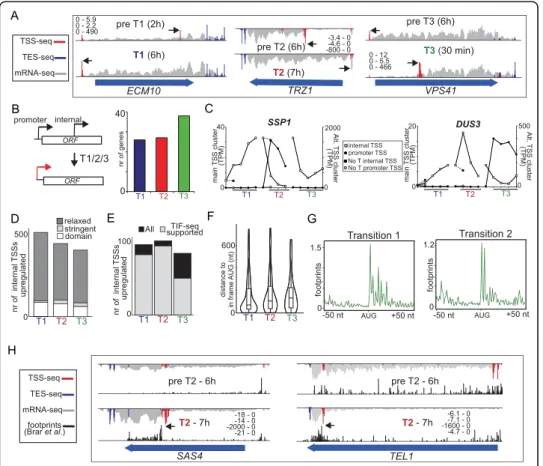
TSS switching events were not limited to “conventional” promoter regions only but also occurred in regions downstream of the main TSS (Additional file 1: Fig. S2, labeled “in- ternal”). We observed a subset of genes that displayed expression of a TSS within the coding sequence. Among these, about 30 to 40 genes showed transition-specific TSS switching, where the internal TSS was expressed prior to the transition but decreased during the transition while expression of the upstream TSS encoding for the full-length transcript concomitantly increased (e.g., ECM10, TRZ1, and SPO22,) (Fig. 4a, b and Additional file 1: Fig. S5a). We identified examples of genes where an internal TSS was upregulated during cell-fate transitions (e.g., SSP1 and DUS3), and dynamic switching occurred between the full-length transcript and the internal TSS in a cell-fate-specific manner (Fig. 4c).

The production of truncated transcripts and protein isoforms via internal transcrip-

tion during T2 was also reported previously [14]. To systemically dissect how internal

TSSs are regulated across the different cell-fate transitions, we classified internal TSSs

with relaxed (two-fold or more upregulated) and stringent cutoffs for each fate transi-

tion (Fig. 4d). The stringent cutoff was met when the expression levels were at least

one third that of the full-length mRNA at the same time point, and the matching trun-

cated transcript isoform contained an ORF that was more than 300 bp long (e.g.,

VPS41) (Fig. 4a). Nearly 500 internal TSSs were induced per transition, of which a sub-

stantial fraction remained after a stringent cutoff (Fig. 4d). The expression of internal

(15)

TSSs was also supported by our TIF-seq dataset (Fig. 4e). Additionally, a subset of trun- cated transcript isoforms overlapped with coding sequences of specific protein do- mains, suggesting that encoded truncated proteins may have specialized cellular functions (Fig. 4d, labeled “ domain ” ).

Several studies in yeast have shown that cryptic promoters exist within gene bodies, driving expression of short transcript isoforms and can encode for truncated proteins [14, 26, 57–63]. In our dataset, we found that many transcripts emanating from internal

Fig. 4 Widespread dynamic regulation of alternative TSSs within ORFs during cell-fate transitions. a Integrative Genomics Viewer (IGV) tracks showing examples of internal TSSs whose levels changed during cell-fate transitions (T1, T3, and T3). The scale for TSS-seq, TES-seq, and mRNA-seq values are displayed for ECM10 , TRZ1 , and VPS41 . b Number of TSS switching events of genes that showed expression of main TSSs within the ORF sequences and which showed TSS switching during T1, T2, or T3 to canonical TSSs in the promoter sequence. Switching events were defined as in Fig. 3c. c Examples of switching events between TSSs expressed in ORFs (internal TSSs) and TSSs in promoters. Negative controls representing mock-treated samples for T1 and T2 (no induction of transition (T) for main TSS and upstream alternative TSS (UA)) were included. The y -axis represents TPM values of the internal and promoter TSS. d Numbers of TSSs expressed within ORFs (internal TSSs). Different cutoffs were used to define internal TSSs. Relaxed cutoff: internal TSSs increasing by 2-fold or more during transition. Stringent cutoff: internal TSSs belonging to putative transcripts encoding for an ORF that is at least 300 nucleotides in length and whose expression levels are at least one third that of the full-length mRNA at the same time point. Domain cutoff: internal transcripts with a predicted PFAM domain. The “ stringent ” and “ domain ” categories are subsets of the “ relaxed ” category. e Numbers of internal TSSs (stringent cutoff) identified by TSS seq, supported by transcripts with 5 ′ ends identified by TIF-seq. f The distribution of 5 ′ UTR length for the associated transcripts originating from internal TSSs approximated by computing the distance to the first in-frame AUG. n = 96/101/84 TSSs for T1/

T2/T3 respectively. g Meta-profiles of ribosome footprints for internal TSSs (stringent cutoff). The ribosome

footprint dataset was from Brar et al. [21]. h Examples of genes ( SAS4 and TEL1 ) that display expression from

an internal TSS and whose internal transcripts are bound by ribosomes. The data for, and scales for TSS-seq,

TES-seq, mRNA-seq, and the matching time-point for the ribosome footprint dataset are shown

(16)

TSSs harbored an in-frame AUG not far from the internal TSS (Fig. 4f). Ribosomes were associated with truncated transcript isoforms initiating from internal TSSs when we compared a ribosome profiling dataset that covered the T1 and T2 cell-fate transi- tions with our dataset (Fig. 4g) [21]. For example, SAS4 and TEL1 showed clear ribo- some footprint signals in the same region and at the same time when the truncated transcript isoform was expressed (Fig. 4h). Interestingly, the truncated transcript isoform of TEL1 solely covered the FATC domain of the Tel1 protein, a domain that is important for mediating protein-protein interactions (Fig. 4h). Like TEL1, TOR1, the catalytic subunit of TORC1 and TORC2 in yeast, also showed expression of truncated transcript isoform solely encoding for the Tor1 FATC domain (data not shown).

Promoters controlling transcription from internal TSSs shared features with canon- ical promoters. We observed nucleosome-free regions (NFR) aligned with the internal TSS, and nucleosome periodicity (+ 1, + 2 nucleosomes and so on) downstream of the internal TSS (Additional file 1: Fig. S5b). Like the co-expression modules for T1 and T2, we found that the transcription factors Ume6 and Ndt80 were enriched upstream of internal TSSs (Additional file 1: Fig. S5c). Importantly, the expression of internal TSSs relied on the induction of Ime1 and Ndt80 expression, indicating that these in- ternal transcripts are directly regulated by these transcription factors (Additional file 1:

Fig. S3d). The promoter sequences of internal TSSs upregulated in T3 were enriched for the Sfp1 motif, suggesting that this transcription factor regulates truncated mRNA isoforms during return to the mitotic cell cycle (T3). Thus, similar to transcription upstream of canonical TSSs, the expression of transcripts with internal TSSs is also dynamically controlled, possibly by the same transcription factors that regulate the former. The short transcript isoforms, in turn, have the potential to be translated into truncated protein isoforms, diversifying the proteome during cell-state changes.

Determinants of gene regulation via the use of alternative TSSs

Our analysis showed that increased upstream TSS usage is associated with a range of effects on expression of the downstream main TSS (Figs. 3b and 4b). Are there features in the dataset that can explain these outcomes? To examine this systematically, we ag- gregated the data obtained from three pairs of comparisons representing each cell-fate transition: T1 (6h vs 2 h SPO), T2 (8h vs 6 h SPO) and T3 (60 min YPD vs 6 h SPO).

We focussed on two features in the dataset: alternative TSS levels and distance between alternative-main TSS pairs, as both features have been described to affect gene expres- sion, in multiple studies [34, 42, 64].

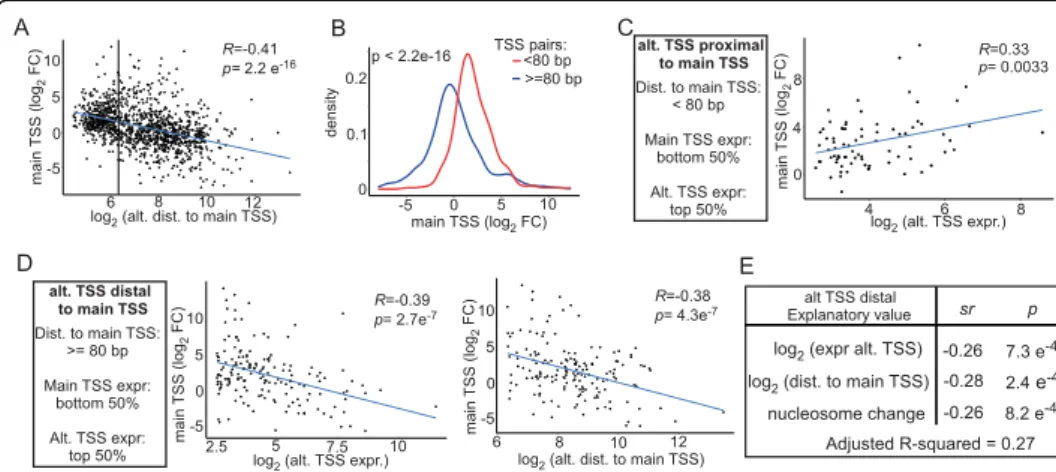
We found that main and alternative TSSs in close proximity were more likely to be

co-regulated. For closely spaced alternative and main TSS pairs of less than 80 bp apart,

increased alternative TSS usage correlated with increased main TSS usage, while ex-

pression of more widely spaced alternative and main TSS pairs correlated inversely in-

stead (Fig. 5a, b). Moreover, genes which had shorter distances (< 80 bp) between the

tandem TSSs displayed a positive correlation between alternative TSS expression levels

and main TSS expression changes (Additional file 1: Fig. S6a). This correlation was

strengthened at genes with relatively low main TSS expression prior to transition

(≤ 50th percentile), and a relatively high alternative TSS expression during transi-

tion (≥ 50th percentile) (Fig. 5c and Additional file 1: Fig. S6a). The positive trend

(17)

was weakened or even absent when we relaxed the criteria for the alternative TSS and main TSS expression levels (Additional file 1: Fig. S6a). This suggests that co- regulation between closely spaced TSSs occurs mostly when the expression from the alternative TSS is relatively high.

Second, we observed that expression from upstream alternative TSSs was linked to re- pression of the main TSS at genes when the distance between main and upstream alterna- tive TSS was relatively large (≥ 80 bp) (Fig. 5d, Additional file 1: Fig. S6a and S6b). A stronger negative correlation between alternative TSS expression levels and main TSS ex- pression changes was observed when we subsetted for genes with relatively low main TSS expression (≤ 50th percentile) and high alternative TSS expression (≥ 50th percentile) than without subsetting (Fig. 5d, left graph and Additional file 1: Fig. S6b). For this subgroup of genes, increasing distances between main TSS and alternative TSS were correlated with repression of the main TSS expression (Fig. 5d, right panel). The negative relationship weakened when we relaxed the alternative and main TSS expression levels and was absent when upstream alternative and main TSS were spaced 80 bp or less (Additional file 1: Fig.

S6b and Fig. S6c). Our analysis suggests that the distance between main and alternative

Fig. 5 Features explaining main TSS usage changes upon increased alternative TSS usage levels. a Scatter plot

of main TSS expression changes (transition versus prior transition state, log

2

, fold change) against distances

between the upstream and downstream TSS (log

2

, nucleotides). The data presented is for T1 (6h vs 2 h in SPO),

T2 (8h vs 6 h in SPO), and T3 (60 min YPD vs 6 h SPO) for a total of 1173 data points. A vertical line indicates the

distance of 80 bp between main and upstream alternative TSSs. The Pearson correlation coefficient and its p

value are displayed. b Density plots of main TSS expression changes (transition versus prior transition state,

log2, fold change). The data was taken from three comparisons representing T1 (6h vs 2 h in SPO), T2 (8h vs 6 h

in SPO), and T3 (60 min YPD vs 6 h SPO). The red density plot indicates main and upstream alternative TSSs

pairs with < 80 bp distance between them (382 pairs), while the blue plot indicates the pairs with ≥ 80 bp

distance between them (791 pairs). Main TSS changes from these two groups follow different distributions

(Kolmogovov-Smirnov test, p < 0.05). c Scatter plot of main TSS expression changes (transition versus prior

transition state, log

2

, fold change) against expression levels of alternative TSS (log

2

). Main and upstream

alternative TSS pairs selected for alternative TSS which were proximal to the main TSS (< 80 bp), the alternative

TSS value after transition was relatively high ( ≥ 50th percentile), and the main TSS value prior to transition was

relatively low ( ≤ 50th percentile), representing 78 pairs. d Same as a and b, except that the data only includes

genes whereby the alternative TSS is distal ( ≥ 80 bp) to the main TSS, the alternative TSS value after transition is

relatively high ( ≥ 50th percentile) and the main TSS value prior to transition is relatively low ( ≤ 50th percentile),

representing 164 pairs. e Multiple regression explaining fold change of main TSSs during cell-fate changes ( Y =

log

2

) by different variables. The genes chosen for this model fit the criteria in d, representing 164 pairs. The

three different explanatory variables are given. The semi-partial correlation coefficients ( sr ) represent the

strength of the linear relationship between Y and the specific explanatory variable that remains after controlling

for the effects of the other explanatory variables (i.e., the unique effect). The p values reported in the table are

for the unique effects of the explanatory variables

(18)

TSS, and alternative TSS expression levels are key determinants that influence how the main TSS responds when upstream TSS usage is increased.

The distance between TSSs was also reflected in the chromatin structure and transcription factor binding. Genes with a TSS of less than 80 bp upstream of the main TSS tended to have wider NFR and a defined peak for transcription factor binding (Additional file 1: Fig. S7a). On the other hand, genes with an alternative TSS of more than 80 bp upstream from the main TSS tended to have narrower NFRs around the main TSS, a second NFR nearby the upstream TSS, and displayed a broader peak for transcription factor binding. It is worth noting that upstream alternative TSS did not show a clear enrichment for the TATA binding sequence, suggesting that their transcription is regulated via TATA-less promoters.

A linear model for gene regulation by upstream alternative TSSs

At genes with relatively large distance between alternative and main TSS, we observed that increased alternative TSS usage and further increase in distance between main and alternative TSS was linked to repression of the main TSS (Fig. 5d). Transcription initi- ating upstream of canonical promoters is known to alter chromatin state and represses promoters in numerous examples [18, 26, 28, 29, 65]. We found that changes in nucleosome occupancy in the region between the main and alternative TSS were con- sistent with decreased main TSS expression (Additional file 1: Fig. S7b). To dissect these different variables, we performed multiple regression analysis that accounts for relationships between different explanatory variables. This allowed us to delineate the semi-partial correlations (sr) between the response variable (main TSS levels) and a specific explanatory variable (e.g., nucleosome occupancy) (Fig. 5e) .

We identified a negative correlation between main TSS expression changes and upstream expression levels (first variable). The distance between the two promoters (second variable) also negatively correlated with our response variable likely because we already subsetted for genes ’ relatively large ( ≥ 80 bp) distances (Fig. 5d). The combined model revealed that increased nucleosome occupancy was negatively correlated with changes in expression of the main TSS (Fig. 5e). Collectively, these three variables explained a significant part of the variation (adjusted R-squared = 0.27) in main TSS responses across the three cell-state transitions. We propose that a balance between ex- pression levels of different TSSs of the same gene, the distance between tandem TSSs, and chromatin structure are key determinants for the regulation of gene expression via transcription of upstream alternative TSSs.

Transcriptional repression via upstream alternative TSSs requires specific chromatin regulators

Our analysis and modeling did not establish causative relationships between upstream

transcription, repression of transcription from the main TSS, and chromatin state. If

the repression of the main TSS and changes in chromatin structure were the conse-

quence of upstream transcription, certain chromatin factors are likely required for me-

diating gene repression. Disrupting chromatin factors may therefore affect the extent of

repression driven by transcription from upstream alternative TSSs. Indeed, several reg-

ulators for chromatin have been described in facilitating repression via transcription of

upstream noncoding RNAs or 5′ extended transcript isoforms [18, 26, 28, 29, 31, 66].

(19)

These include Set2-directed histone lysine 36 methylation, histone deacetylation directed by SET3C, and chromatin assembly by FACT.

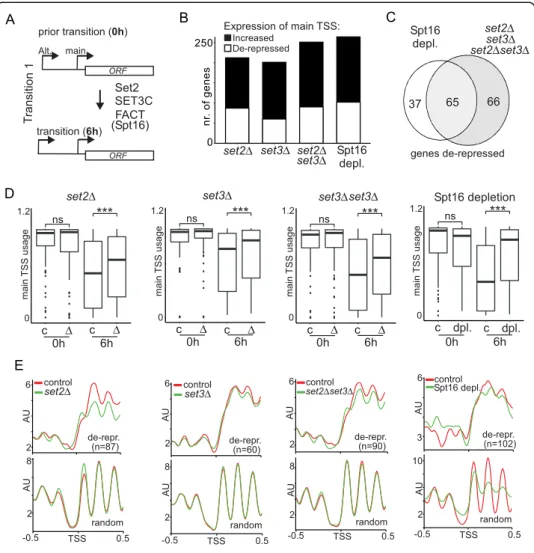
To test whether the chromatin state contributes to repression of transcription of the main TSS in the presence of upstream transcription, we generated deletion and depletion mu- tants and measured TSS usage and chromatin state (MNase-seq) during T1 (6h SPO) (Fig. 6a and Additional file 6). Importantly, cells harboring set2 Δ and set3 Δ single or double deletions entered meiosis and underwent premeiotic DNA replication, allowing for T1- specific transcriptome measurements (Additional file 1: Fig. S8a). Since FACT (Spt16) is es- sential for cellular growth, we depleted Spt16 using the auxin-induced degron (SPT16-AID) (Additional file 1: Fig. S8b). Importantly, these cells underwent premeiotic DNA replication even through Spt16 was depleted during entry into T1 (Additional file 1: Fig. S8c-e) [67].

To better capture locus-specific changes in gene expression in a backdrop of globally altered transcription in these chromatin mutants, we calculated the relative main TSS usage levels for each gene by dividing the main TSS signal over the sum of all TSSs as- sociated with the same gene during T1 (6h SPO). Approximately 200 genes displayed increased main TSS expression in each of the deletion (set2 Δ , set3 Δ , and set2 Δ set3 Δ ) and depletion (Spt16) mutants compared to WT (Fig. 6b). A subset of these genes showed significant de-repression of expression from the main TSS, indicating that chromatin regulators (Set2, Set3, and FACT) were required for mediating repression.

We observed a good overlap between genes de-repressed after Spt16 depletion and genes affected by set2 Δ and set3 Δ single and double mutants (Fig. 6c). As expected, main TSS usage was significantly higher in T1 (6h SPO) among the genes identified as

“de-repressed” in mutants compared to the control (Fig. 6d). Importantly, these differ- ences were not observed prior to T1 (0h SPO) (Fig. 6d). Therefore, these de-repression events in these mutants occurred in the context of transition-specific gene regulatory programs. We posit that the failure to establish a repressive chromatin in the presence of upstream transcription results in leaky or aberrant expression from the main TSS.

We examined chromatin structure and observed a wider NFR near the main TSS during T1 in set2 Δ and set3 Δ single and double mutants, compared to the control at gene pro- moters that showed de-repression. This phenomenon was not observed at a matching number of randomly selected promoters. Depletion of Spt16 had a pronounced effect on chromatin structure at gene promoters that were de-repressed (Fig. 6e). We observed a wider NFR and the loss of regularly spaced nucleosome arrays flanking the main TSS, while the chromatin structure of randomly selected genes was disrupted to a lesser extent and regular nucleosome arrays were still visible. We further found that about 30% of de- pressed genes showed a significant occupancy change in chromatin structure of main TSS and 0.5 kb upstream. In conclusion, disrupting chromatin factors (Set2, Set3, and FACT) that mediate transcription coupled chromatin changes, affected the repression directed by transcription from upstream alternative TSSs, indicating that the effect of upstream tran- scription on repression of main TSS usage is direct.

Messenger RNAs originating from upstream alternative TSSs have a variety of translation efficiencies

While there was a good overlap with genes expressing LUTIs and our TSS-seq

dataset, we also found many genes that displayed expression from an upstream

(20)

Fig. 6 Chromatin factors mediate repression exercised by upstream alternative TSSs. a Schematic for determining how chromatin factors (Set2, Set3, and FACT) contribute to repression of the main TSS through transcription from alternative upstream TSSs. In short, cells harboring deletions ( set2Δ (FW5767), set3Δ (FW5770), and set2Δ set3Δ (FW2912)) or depleted for Spt16 deletion (FVW6083) were compared to the control (FW2795) at the end of transition 1 (SPO 6 h). All these cells also had the pCUP-IME1 and GAL4.ER pGAL-NDT80 alleles. The Spt16 depletion allele ( SPT16-AID, FVW6083) harbored pCUP-TIR1 , while its matching control (FW6109) did not. Genes with upstream alternative TSSs were considered for this analysis. b Numbers of genes that displayed increased relative expression of the main TSS (black) or showed de- repression of the main TSS (white) (deletion or depletion mutants versus control). Genes within the de- repression category were selected for having increased relative expression of their main TSS in the different mutants and the main TSS was downregulated in the presence of expression of an upstream alternative TSS in control cells. The de-repression category is a subset of the “ increased relative expression ” category.

Statistically significant changes in TSS usage were determined using the Cochran – Mantel – Haenszel (CMH)

test on three independent repeats. c Venn diagram showing the number of genes de-repressed after Spt16

depletion and overlapped with genes de-repressed in the set2Δ , set3Δ , or set2Δ set3Δ deletion mutants. d

Box and whisker plots of main TSS usage of genes under the de-repression category. The main TSS usage

was calculated by dividing the main TSS value (TPM) over the sum of all TSSs values associated with the

same gene for the same time point (0 h or 6 h in SPO). *** p < 0.0001. The number of data points

corresponds to 87, 60, 90, and 102 genes for set2Δ , set3Δ , set2Δset3Δ , and Spt16 depletion, respectively. e

Meta-profiles of MNase-seq signals for set2Δ , set3Δ , and set2set3Δ cells or Spt16 depleted cells (green) and

control cells (red) at the end of T1 (6h SPO). The signals were centered on the main TSS. The top panels

show the profiles for de-repressed genes and the bottom panels for the same number of randomly

selected genes (87, 60, 90, and 102 genes for set2Δ , set3Δ , set2set3Δ , and Spt16 depletion, respectively)

(21)

alternative TSS which were not identified as expressing LUTIs (Fig. 3). LUTIs are typically translationally inert due to the presence of small ORFs in their 5′ leader sequence [17, 19, 42]. Perhaps, a subset of transcripts produced from upstream TSSs have protein coding potential.

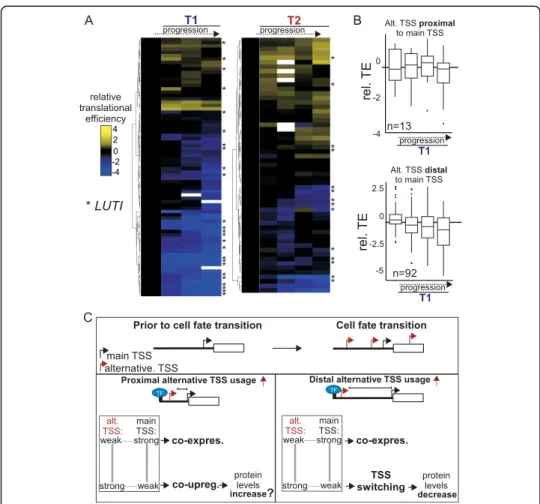
To examine how upstream alternative transcripts are translationally controlled, we se- lected genes that underwent TSS switching, which ensures that the dominantly expressed transcript at these genes is initiated from the upstream alternative TSS (Fig. 3c). Subse- quently, we examined translation efficiency using a published ribosome profiling dataset [21]. Consistent with previous work, we found a set of genes showing a decrease in trans- lation efficiency as defined by ribosome footprinting (Fig. 7a) [19]. Many of these genes expressed LUTIs (Fig. 7a, genes marked with asterisks). This was particularly clear for the T1 transition, but less so for the T2 transition. A subset of genes showed no reduction in translation efficiency, suggesting that the upstream alternative transcript was translated (Fig. 7a). Interestingly, alternative TSSs that were more distal to the main TSS (≥ 80 bp) displayed decreased translational efficiency for T1, while proximal alternative TSSs showed no decrease (Fig. 7b). Perhaps, alternative TSSs proximal to the main TSS are less likely to harbor a small ORF in the 5 ′ leading sequence, while longer 5 ′ leading sequences reduce translation efficiency because of the presence of upstream small ORFs in the lead- ing sequences which repress full-length protein production [42]. Interestingly, for T2, many genes showed no decrease in translational efficiency and there was little difference in translation efficiency between proximal and distal TSSs (Additional file 1: Fig. S8e).

Our data suggest that the transcript isoforms emanating from upstream alternative TSSs possess different translation efficiencies.

Discussion

In higher eukaryotes including human cells, mRNA isoforms are pervasively expressed often in a cell-type-specific manner [6, 65, 68]. Yet the regulatory significance of tran- script isoform heterogeneity remains largely elusive. Our integrative genomic analysis of three distinct synchronized cell-fate transitions in yeast demonstrates that alternative TSS levels are pervasively upregulated during cell-fate transitions. Remarkably, expres- sion from alternative TSSs located upstream in promoters was linked to expression of the main TSS with a range of outcomes, from co-regulation to repression.

Alternative TSS usage is highly regulated during cell-state transitions

Our study indicates that TSS usage changes is highly pervasive and likely a key regula-

tor of gene expression. First, a large fraction of genes showed upregulation of alterna-

tive TSSs when new cell-fate transitions were induced (Fig. 7c). Surprisingly, we found

that transcription within coding regions was also induced, potentially coding for trun-

cated protein isoforms. It is worth noting that we measured steady state levels of TSS

usage, which could underestimate the number of TSSs. In particular, the TSSs from

noncoding transcripts and transcripts with premature stop-codons or short upstream

open reading frames are likely to be discarded rapidly via RNA degradation pathways

[43, 69, 70]. Second, increased upstream alternative TSS usage correlated with a wide

range of outcomes, ranging from repression to co-activation from the main TSS. Third,

these outcomes can be explained by specific features in the data set. Alternative

(22)

TSSs that were distal to main TSSs and were relatively highly expressed tended to repress expression from the main TSS. Conversely, alternative TSSs that were proximal to the main TSSs tended to be co-regulated. Fourth, differential TSS usage is highly dynamic, and reversible.

What drives changes in TSS usage? Our analysis suggests that specific transcrip- tion factors drive these usage changes. Alternative TSS usage depended on the ex- pression of the transcription factors Ime1 and Ndt80 for T1 and T2 respectively.

Specific motif sequences were enriched upstream of alternative TSSs. For example, the Ume6 motif and binding was enriched near alternative TSSs upregulated dur- ing T1, while the Tod6 and Sfp1 motifs were enriched proximal to those upregu- lated during T3. We propose that a combination of different transcription factors directs differential TSS usage.

Fig. 7 Genes expressing upstream alternative TSSs display a wide range of translational efficiencies. a

Comparison of translation efficiencies (TE) across the cell-fate transitions T1 and T2 of genes that displayed a

TSS switching event as described in Fig. 3c. TE values were obtained from Brar et al. [21]. We set the first time

point of T1 (or T2) to 0 and other values being the TE differences between a later time point and the first time

point. White colors indicate missing values. Asterisks after the gene labels indicate genes expressing LUTIs as

defined by Cheng et al. [19]. b Box plots of TE values obtained from Brar et al. [21] for genes identified in T1

with TSS switching, separating into cases where the tandem TSSs were proximal to each other (< 80 bp, top

panel) and cases where the tandem TSSs were distal to each other ( ≥ 80 bp, bottom panel). c Model for how

transcription of the main TSSs and translational output are affected/regulated by alternative upstream TSSs. Top

panel shows where alternative TSSs can be induced upon entering a cell-fate transition. Bottom panel shows

how upstream alternative TSSs can influence expression from the main TSS during a cell-fate transition

(23)

Multiple gene regulatory roles for increased alternative TSS usage

We provide evidence that upstream transcription influences transcription from the main TSS with a wide range of outcomes during all three cell-state transitions that we examined. Few genes displayed TSS switching behavior like at the NDC80 locus that we had described previously [17, 18]. Thus, the NDC80 gene is on the extreme of the spectrum of outcomes. The majority of genes displayed co-existence or co-upregulation of main and alternative TSSs. Although our TSS-seq data showed good reproducibility over three biological repeats (Additional file 2), we cannot rule out the role of experi- mental noise in why we observed co-existence of main and alternative TSSs for some gene loci. Further functional analysis and the use alternative techniques such as fluores- cent in situ hybridization (FISH) or northern blot will be essential for studying the rela- tionships between main and alternative TSSs more closely.

Previous work suggested that transcript isoform switching events are pervasive during yeast gametogenesis [19]. Many genes expressing long upstream transcript isoforms (LUTIs) displayed reduced protein levels compared to matching mRNA levels because ribosomes were stalled at the extended leader sequence [19]. The decrease in ribosome footprint signals was used to identify transcript switching events, and in this way many genes with transcript isoform switching were identi- fied during yeast gametogenesis. While ribosome profiling can accurately measure translation efficiency of a given mRNA, it cannot discriminate between the iso- forms produced. However, our TSS-seq analysis discriminated between the steady state levels of different transcript isoforms.

Even though many long isoforms are likely translationally inert, our analysis also sug- gests that upstream transcript isoforms may be translated, especially for genes where the alternative TSS is proximal to the main TSS (Fig. 7c). We propose that transcription from upstream transcript isoforms can have a wide range of outcomes on expression from the main TSS, and upstream transcript isoforms themselves are possibly translated with vari- ous translational efficiencies. We speculate that this multi-layered regulation allows for precise control of gene expression without the involvement of new regulatory proteins such as additional transcriptional repressors or transcriptional activators.

We also found that many TSSs were expressed and regulated in a cell-fate- specific manner within gene bodies. These internal transcripts have the potential to be translated into truncated protein isoforms because many of the internal TSSs were positioned directly upstream of an internal start codon and overlap with ribosome protected fragments and often covered conserved protein domains.

Perhaps, short truncated proteins have specific functions during cell-state transi- tions. Several studies that have demonstrated that initiation of transcription within gene bodies generates truncated RNA isoforms [14, 58, 63, 71–73]. Yet, only a few studies have demonstrated a biological function of truncated protein isoforms [14, 74]. Our results warrant a more systematic approach to dissect the biological function of internal transcripts and short protein isoforms.

Model for gene regulation by upstream alternative starts

Two features explain, at least in part, how alternative TSS usage is linked to transcrip-

tion from the main TSS. First, the distance between two TSSs is a key consideration. If

Fig. 4 Widespread dynamic regulation of alternative TSSs within ORFs during cell-fate transitions
Fig. 5 Features explaining main TSS usage changes upon increased alternative TSS usage levels
Fig. 6 Chromatin factors mediate repression exercised by upstream alternative TSSs. a Schematic for determining how chromatin factors (Set2, Set3, and FACT) contribute to repression of the main TSS through transcription from alternative upstream TSSs
Fig. 7 Genes expressing upstream alternative TSSs display a wide range of translational efficiencies

参照

関連したドキュメント

Using the fixed point alternative we can prove our main result, a generalized theorem of stability for Jensen’s functional equation (see also [5, 10, 11, 12]):.

The categories of prespectra, symmetric spectra and orthogonal spec- tra each carry a cofibrantly generated, proper, topological model structure with fibrations and weak

Key words and phrases: Linear system, transfer function, frequency re- sponse, operational calculus, behavior, AR-model, state model, controllabil- ity,

Oscillatory Integrals, Weighted and Mixed Norm Inequalities, Global Smoothing and Decay, Time-dependent Schr¨ odinger Equation, Bessel functions, Weighted inter- polation

From here they obtained a combinatorial in- terpretation for the Kronecker coefficients when λ is a product of homogeneous symmetric functions, and µ and ν are arbitrary skew

Some new oscillation and nonoscillation criteria are given for linear delay or advanced differential equations with variable coef- ficients and not (necessarily) constant delays

While conducting an experiment regarding fetal move- ments as a result of Pulsed Wave Doppler (PWD) ultrasound, [8] we encountered the severe artifacts in the acquired image2.

Keywords: alternative set theory, biequivalence, vector space, monad, galaxy, symmetric Sd-closure, dual, valuation, norm, convex, basis.. Classification: Primary 46Q05, 46A06,