著者 Asano Tomoya, Masuda Daisuke, Yasuda Michiko, Nakashita Hideo, Kudo Toshiaki, Kimura Makoto, Yamaguchi Kazuo, Nishiuchi Takumi
journal or
publication title
Plant Journal
volume 53
number 3
page range 450‑464
year 2008‑02‑01
URL http://hdl.handle.net/2297/9895
doi: 10.1111/j.1365-313X.2007.03353.x
CONFIDENTIAL
AtNFXL1, an Arabidopsis homologue of the human transcription factor NF-X1, functions as a negative regulator of the trichothecene phytotoxin-
induced defense response.
Journal: The Plant Journal Manuscript ID: TPJ-00751-2007.R1 Manuscript Type: Full Paper
Date Submitted by the Author: n/a
Complete List of Authors: Asano, Tomoya; Kanazawa University, Advanced Science Research Center
Masuda, Daisuke; Kanazawa University, ASRC
Yasuda, Michiko; RIKEN, Environmental Molecular Biology Laboratory
Nakashita, Hideo; RIKEN, Environmental Molecular Biology Laboratory
Kudo, Toshiaki; RIKEN, Environmental Molecular Biology Laboratory Kimura, Makoto; RIKEN, Discovery Research Institute (DRI), Plant
& Microbial Metabolic Engineering Research Unit Yamaguchi, Kazuo; Kanazawa University, ASRC Nishiuchi, Takumi; Kanazawa university, ASRC
Key Words: trichothecene, phytotoxin, microarray, transcription factor, Fusarium, defense response, SA biosynthesis
CONFIDENTIAL
AtNFXL1, an Arabidopsis homologue of the human transcription factor NF-X1, functions as a negative regulator of the trichothecene phytotoxin-induced defense response.
Tomoya Asano1, 2, Daisuke Masuda1, Michiko Yasuda3, Hideo Nakashita3, Toshiaki
Kudo3, Makoto Kimura4, Kazuo Yamaguchi1, 5 and *Takumi Nishiuchi1, 5
1Division of Functional Genomics, Advanced Science Research Center, Kanazawa
University, 13-1 Takaramachi, Kanazawa 920-0934, Japan; 2Shigeta Animal
Pharmaceuticals Inc., 4569-1, Komoridani, Oyabe City, Toyama Prefecture, 932-0133
Japan; 3Environmental Molecular Biology Laboratory, RIKEN, 2-1 Hirosawa, Wako,
Saitama 351-0198, Japan; 4Plant & Microbial Metabolic Engineering Research Unit,
Discovery Research Institute (DRI), RIKEN, 2-1 Hirosawa, Wako, Saitama 351-0198, Japan;
5Division of Life Science, Graduate School of Natural Science and Technology,
Kanazawa University, Kanazawa 920-1192, Japan
*Author for correspondence (e-mail: [email protected])
total word count: 7,134
6 7 8 9 10 11 12 13 14 15 16 17 18 19 20 21 22 23 24 25 26 27 28 29 30 31 32 33 34 35 36 37 38 39 40 41 42 43 44 45 46 47 48 49 50 51 52 53 54 55 56 57 58 59
CONFIDENTIAL
Running title: Trichothecene-inducible AtNFXL1 gene
key words: phytotoxin, trichothecene, transcription factor, defense response
6 7 8 9 10 11 12 13 14 15 16 17 18 19 20 21 22 23 24 25 26 27 28 29 30 31 32 33 34 35 36 37 38 39 40 41 42 43 44 45 46 47 48 49 50 51 52 53 54 55 56 57 58 59
CONFIDENTIAL
Abstract
Trichothecenes are a closely related family of phytotoxins produced by phytopathogenic
fungi. In Arabidopsis, expression of AtNFXL1, a homologue of the putative human
transcription repressor NF-X1, was significantly induced by application of type A
trichothecenes, such as T-2 toxin. An atnfxl1 mutant growing on medium lacking
trichothecenes showed no phenotype, whereas a hypersensitivity phenotype was
observed in T-2 toxin-treated atnfxl1 mutant plants. Microarray analysis indicated that
several defense-related genes (i.e. WRKYs, NBS-LRRs, EDS5, ICS1, etc.) were
upregulated in T-2 toxin-treated atnfxl1 mutant compared to wild type plants. In
addition, enhanced salicylic acid (SA) accumulation was observed in T-2 toxin-treated
atnfxl1 mutant plants, which suggests that AtNFXL1 functions as a negative regulator of
these defense-related genes via an SA-dependent signaling pathway. We also found that
expression of AtNFXL1 was induced by SA and flg22 treatment. Moreover, the
atnfxl1 mutant was less susceptible to a compatible phytopathogen, Pseudomonas
syringae pv. tomato strain DC3000 (Pst DC3000). Taken together, these results indicate
6 7 8 9 10 11 12 13 14 15 16 17 18 19 20 21 22 23 24 25 26 27 28 29 30 31 32 33 34 35 36 37 38 39 40 41 42 43 44 45 46 47 48 49 50 51 52 53 54 55 56 57 58 59
CONFIDENTIAL
that AtNFXL1 plays an important role in the trichothecene response, as well as the
general defense response in Arabidopsis.
6 7 8 9 10 11 12 13 14 15 16 17 18 19 20 21 22 23 24 25 26 27 28 29 30 31 32 33 34 35 36 37 38 39 40 41 42 43 44 45 46 47 48 49 50 51 52 53 54 55 56 57 58 59
CONFIDENTIAL
Introduction
Trichothecenes are a major type of mycotoxin, and are important in human health due to
the risk of ingesting contaminated food (Kimura et al., 2006). Phytopathogenic fungi
capable of producing trichothecenes are found throughout the world, and include certain
species of Fusarium, Myrotherium and Stachybotrys (Eudes et al., 2001). The
production of mycotoxins by these species of phytopathogenic fungi is determined by
genetic factors and environmental growth conditions. Trichothecenes have a
sesquiterpenoid ring structure, and can be classified according to the presence or
absence of characteristic functional groups (Shifrin and Anderson, 1999). Type A
trichothecenes, such as T-2 toxin, and type B trichothecenes, such as deoxynivalenol
(DON), are natural contaminants of certain agricultural commodities, as well as
commercial foods (Sudakin, 2003). Among the trichothecenes, type A trichothecenes
are highly toxic at low concentrations.
Trichothecenes inhibit peptidyltransferase activity in eukaryotic cells by
binding to the 60S ribosomal subunit. The antiproliferative activity of trichothecenes is
presumed to be a consequence of their ability to inhibit protein synthesis (Shifrin and
6 7 8 9 10 11 12 13 14 15 16 17 18 19 20 21 22 23 24 25 26 27 28 29 30 31 32 33 34 35 36 37 38 39 40 41 42 43 44 45 46 47 48 49 50 51 52 53 54 55 56 57 58 59
CONFIDENTIAL
Anderson, 1999). Thus, trichothecenes also function as phytotoxins. Specific disruption
of a trichothecene synthase gene (Tri5) in F. graminearum resulted in a strain that was
less virulent in the infection of wheat compared to wild type strains (Desjardins et al.,
2000). For this reason, Desjardins et al. have suggested that in certain Fusarium species,
trichothecenes act as virulence factors in the infection of plants (Desjardins et al., 2000).
Trichothecene-producing Fusarium species have strain-specific trichothecene
metabolite profiles (Ward et al., 2002), and these trichothecene chemotypes are also
believed to play a role in the virulence of individual strains of Fusarium.
Recently, we reported that type A trichothecenes, such as T-2 toxin, have an
elicitor-like activity in Arabidopsis thaliana at a concentration of 1 µM (Nishiuchi et al.,
2006). Type A trichothecene-inducible lesions were also formed in SA-, jasmonic acid
(JA)- and ethylene (ET)-mutants, and in SA-deficient NahG transgenic plants
(Nishiuchi et al., 2006). These results implied that T-2 toxin-induced cell death has little
to do with these host defense pathways; rather, the toxin contributes directly to the
virulence of necrotrophic phytopathogens. In contrast to T-2 toxin, 10 µM DON
inhibited protein translation in Arabidopsis cells, whereas it failed to activate the
6 7 8 9 10 11 12 13 14 15 16 17 18 19 20 21 22 23 24 25 26 27 28 29 30 31 32 33 34 35 36 37 38 39 40 41 42 43 44 45 46 47 48 49 50 51 52 53 54 55 56 57 58 59
CONFIDENTIAL
elicitor-like signaling pathway (Nishiuchi et al., 2006), which suggests that Fusarium
utilizes DON as a non-defense-inducing translational inhibitor during the spread of
disease in host plants (Bai et al., 2001). Thus, the role of type B trichothecenes in
virulence might be different from that of type A trichothecenes. Urban et al. reported
that the DON-producing, wheat-attacking fungal pathogens F. graminearum and F.
culmorum can infect the flowers of Arabidopsis contaminated with DON (Urban et al.,
2002).
We recently reported that AtNFXL1 is upregulated in T-2 toxin-treated
Arabidopsis (Masuda et al., 2007). AtNFXL1 encodes a putative transcription factor
with similarity to the human transcription repressor NF-X1 (Lisso et al., 2006). Human
NF-X1 was identified as a binding factor for the conserved X1 box regulatory element
in the proximal promoters of class II MHC genes, and contains a nuclear localization
signal (NLS), a RING-CH finger domain, several NF-X1-type zinc (Zn) finger domains,
and an R3H domain (Song et al., 1994). Song et al. suggested that NF-X1 is involved in
regulating disease states by suppressing the expression of class II MHC genes (Song et
al., 1994). The RING-CH finger domain is implicated in the targeting of proteins for
6 7 8 9 10 11 12 13 14 15 16 17 18 19 20 21 22 23 24 25 26 27 28 29 30 31 32 33 34 35 36 37 38 39 40 41 42 43 44 45 46 47 48 49 50 51 52 53 54 55 56 57 58 59
CONFIDENTIAL
ubiquitination (Lorick et al., 1999). The yeast NF-X1 homologue, FAP1, was identified
in a genetic screen for suppressors of rapamycin toxicity (Kunz et al., 2000). FAP1
interacted physically with a FK506-binding protein 12 (FKBP12) in vivo and in vitro,
and suppressed the cytotoxic effects of rapamycin (Kunz et al., 2000). Strombakis et al.
suggested that the Drosophila NF-X1 homologue, shuttle craft (stc), is essential for
embryogenesis by regulating the activity of a subset of genes that play a role in either
the guidance or spatial maintenance of axon tracts (Strombakis et al., 1996). Taken
together, these results suggest that the NF-X1 family of proteins has unique functions in
different organisms.
In this paper, we demonstrated that atnfxl1mutant plants exhibit a hypersensitivity
phenotype to a type A trichothecene, T-2 toxin. Microarray analysis revealed that many
defense-related genes are upregulated in the atnfxl1 mutant in the presence of
trichothecenes, compared to wild type plants. High levels of SA accumulated in T-2
toxin-treated atnfxl1 mutant plants compared to wild type plants, which suggests that
AtNFXL1 functions as a negative regulator of defense-related genes via an
SA-dependent signaling pathway. In addition, we found that the expression of AtNFXL1
6 7 8 9 10 11 12 13 14 15 16 17 18 19 20 21 22 23 24 25 26 27 28 29 30 31 32 33 34 35 36 37 38 39 40 41 42 43 44 45 46 47 48 49 50 51 52 53 54 55 56 57 58 59
CONFIDENTIAL
is induced by application of SA. Moreover, the atnfxl1 mutant was less susceptible to
the compatible phytopathogen Pst DC3000. Thus, AtNFXL1 also appears to play an
important role in the defense response to compatible phytopathgens in Arabidopsis.
Results
AtNFXL1 belongs to the NF-X1 family of proteins
Based on its predicted amino acid sequence, AtNFXL1 encoded a protein with a
molecular weight of 130 kDa that has similarity to the human transcription repressor
NF-X1 (Supplemental Figures 1a and b). AtNFXL1 contains several functional regions
and domains, including an NLS, a RING-CH finger domain, and nine NF-X1-type Zn
finger domains (Supplemental Figure 1a). These domains are also conserved in Oryza
sativa OsNF-X1, Homo sapiens NF-X1, Drosophila melanogaster STC, and
Saccharomyces cerevisiae FAP1. The R3H domain, which is involved in binding of
single stranded RNA, is present only in NF-X1 family proteins of non-plant eukaryotes
(Supplemental Figure 1a). Phylogenetic analysis indicated that plant NF-X1-like
proteins are more closely related to human NF-X1 than to FAP1 or STC (Supplemental
6 7 8 9 10 11 12 13 14 15 16 17 18 19 20 21 22 23 24 25 26 27 28 29 30 31 32 33 34 35 36 37 38 39 40 41 42 43 44 45 46 47 48 49 50 51 52 53 54 55 56 57 58 59
CONFIDENTIAL
Figure 1b). AtNFXL1 contains an intron in its 5’UTR (data not shown). The NF-X1-type
Zn finger domains are unique motifs, and the Zn finger repeats are conserved in
AtNFXL1 (Supplemental Figure 1c) . It has been reported that a green fluorescent
protein (GFP)-AtNFXL1 fusion protein localizes to the nucleus in onion epidermal cells
(Lisso et al., 2006). We also examined the localization of a GFP-AtNFXL1 fusion
protein in Arabidopsis, and found that GFP-AtNFXL1 localizes to the nucleus in
Arabidopsis T87 suspension cultured cells (Supplemental Figure 2).
The atnfxl1 mutant displays a hypersensitivity phenotype to the type A trichothecene, T-2 toxin.
We recently demonstrated that AtNFXL1 is a trichothecene-inducible gene (Masuda et
al., 2007). To determine the function of AtNFXL1, we investigated the trichothecene
response of atnfxl1 (atnfxl1-1) mutant plants. The atnfxl1-1 mutant was generated by
transferred-DNA (T-DNA) insertion at position +2,082 (relative to the first basepair of
the initiation codon at +1) of the open reading frame of AtNFXL1 (Munich Information
Center for Protein Sequence designation At1g10170), as previously described (Figure
6 7 8 9 10 11 12 13 14 15 16 17 18 19 20 21 22 23 24 25 26 27 28 29 30 31 32 33 34 35 36 37 38 39 40 41 42 43 44 45 46 47 48 49 50 51 52 53 54 55 56 57 58 59
CONFIDENTIAL
1a; Lisso et al., 2007). In wild type plants, AtNFXL1 was weakly expressed in the
absence of T-2 toxin, whereas it was induced by 1µM T-2 toxin treatment, as previously
reported (Figure 1b; Masuda et al., 2007). In the atnfxl1 mutant, we observed a
truncated transcript of AtNFXL1 (Figure 1b). The deduced amino acid sequence of the
truncated mRNA in the atnfxl1 mutant lacked two of the nine NF-X1-type Zn finger
domains. Therefore, it is likely that the truncated form of atnfxl1 mRNA in mutant
plants does not encode a functional protein. The atnfxl1 mutant exhibited no apparent
phenotype on MS agar medium alone (without trichothecene) compared to wild type
plants (Figures 1c and 1d). In addition, general phenotypes, such as growth rate, organ
development, and morphology of untreated atnfxl1 mutant were similar to wild type
plants (data not shown). In contrast, atnfxl1mutant exhibited a severe growth defect on
MS medium containing 0.1 µM T-2 toxin (Figures 1c and 1d). As previously reported
(Masuda et al., 2007), cell death was not induced when seedlings were transferred to
0.1-1 µM T-2 toxin-containing medium. The T2 segregation ratio of the
toxin-hypersensitivity phenotype was nearly 1:3 in self-pollinated offspring of
heterozygous atnfxl1 plants, which indicated that the mutation was inherited as a single
6 7 8 9 10 11 12 13 14 15 16 17 18 19 20 21 22 23 24 25 26 27 28 29 30 31 32 33 34 35 36 37 38 39 40 41 42 43 44 45 46 47 48 49 50 51 52 53 54 55 56 57 58 59
CONFIDENTIAL
recessive trait. As shown in Figure 1d, the growth defects of DON-treated atnfxl1
mutant were similar to DON-treated wild type plants.
To determine whether the T-2 toxin-sensitive phenotype of atnfxl1 mutant
plants was due to a defect in AtNFXL1, we carried out a complementation analysis.
Introduction of a complementation plasmid containing the promoter and the coding
sequence of AtNFXL1 (AtNFXL1 promoter::AtNFXL1, see Experimental Procedures)
into atnfxl1 mutant plants clearly rescued the hypersensitivity phenotype in the presence
of 0.1 µM T-2 toxin in 7 of 8 plant lines (Figures 1c and 1d). These results demonstrated
that the hypersensitivity to T-2 toxin of atnfxl1 mutant plants was due to a defect in
AtNFXL1.
Defense-related genes are upregulated in trichothecene-treated atnfxl1 mutant plants.
We performed a transcriptome analysis of approximately 14,880 genes to obtain the
expression profiles of putative AtNFXL1-regulated genes. This analysis was carried out
using two independent wild-type plants, and two independent mutant plant lines. As
6 7 8 9 10 11 12 13 14 15 16 17 18 19 20 21 22 23 24 25 26 27 28 29 30 31 32 33 34 35 36 37 38 39 40 41 42 43 44 45 46 47 48 49 50 51 52 53 54 55 56 57 58 59
CONFIDENTIAL
seen in Figure 1b, atnfxl1 mutant plants displayed no visible phenotype in the absence
of trichothecenes. In accordance with this result, none of the genes we examined were
upregulated more than 3-fold in atnfxl1 mutant plants compared to wild type plants in
the absence of trichothecenes (data not shown). A single gene was down-regulated
greater than 3-fold in atnfxl1 mutant plants compared to wild type plants (data not
shown). These results indicated that in the absence of trichothecenes, AtNFXL1 has a
minor effect on the global regulation of gene expression.
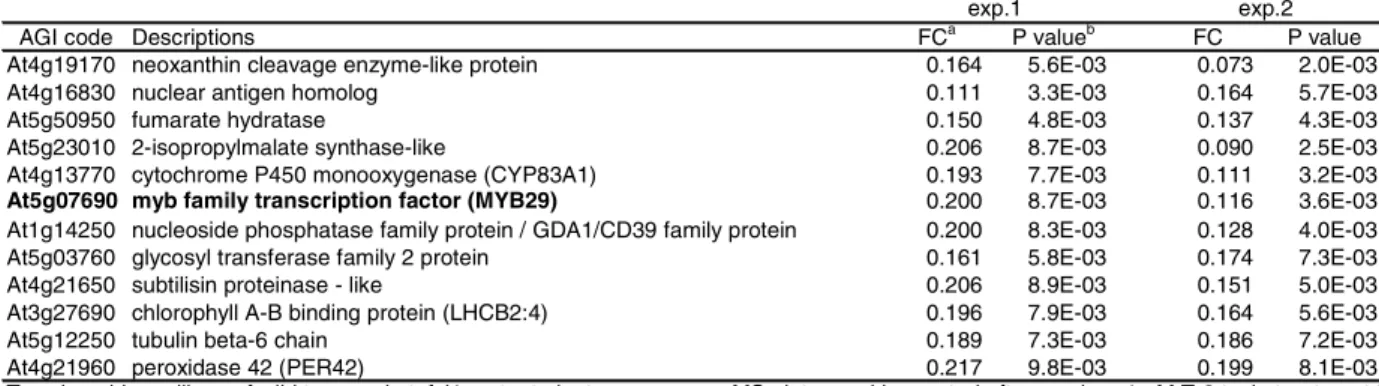
In contrast, in 1 µM T-2 toxin-treated atnfxl1 mutant plants, 130 genes were
upregulated greater than 3-fold compared to T-2 toxin-treated wild type plants (Table 1).
As seen in Table 1, 18 of the upregulated genes were putative transcriptional regulators.
In particular, 8 WRKY family genes were upregulated in T-2 toxin-treated atnfxl1 mutant
plants. WRKY transcription factors play pivotal roles in the plant defense response
(Eulgem et al., 2000), and expression of some WRKY family genes confers enhanced
disease resistance in Arabidopsis and tobacco (Asai et al., 2002; Liu et al., 2004; Chen
and Chen, 2002). .
The largest category of putative AtNFXL1-regulated genes (28 genes) encoded
6 7 8 9 10 11 12 13 14 15 16 17 18 19 20 21 22 23 24 25 26 27 28 29 30 31 32 33 34 35 36 37 38 39 40 41 42 43 44 45 46 47 48 49 50 51 52 53 54 55 56 57 58 59
CONFIDENTIAL
cellular communication and signal transduction factors (Table 1). This category
included 9 genes that encode serine/threonine protein kinases, including a Pto-like
kinase, and 7 genes that encode receptor-like protein kinases, which suggests that these
genes function as components of AtNFXL1-regulated defense signaling pathways.
Several defense-related genes also appeared to be regulated by AtNFXL1, including 5
genes that encode disease resistance proteins, as well as EDS5 and ICS1. EDS5 was
identified as an essential component of SA-dependent signaling in resistance to Pst
DC3000 in Arabidopsis(Nawrath et al., 2002). ICS1encodes an isochorismate synthase,
and is required for biosynthesis of SA (Wildermuth et al., 2001). These results
suggested that AtNFXL1 is involved in SA-dependent defense signaling pathways in
trichothecene-treated Arabidopsis.
Table 2 lists the genes that were down-regulated greater than 3-fold in T-2
toxin-treated atnfxl1 mutant plants compared to wild type plants. The list of genes
included LHCB2-4, which suggests that hyperactivation of the defense response affects
the expression of phytosynthesis-related genes.
To validate the results of the microarray analysis, we selected 6 genes that
6 7 8 9 10 11 12 13 14 15 16 17 18 19 20 21 22 23 24 25 26 27 28 29 30 31 32 33 34 35 36 37 38 39 40 41 42 43 44 45 46 47 48 49 50 51 52 53 54 55 56 57 58 59
CONFIDENTIAL
were upregulated, and 1 gene that was down-regulated in T-2 toxin-treated atnfxl1
mutant plants, and analyzed them by real time PCR. As shown in Table 3, we obtained
similar results using real time PCR, although the magnitude of the expression change of
some of the genes was greater than what was observed by microarry analysis.
Enhanced SA accumulation in T-2 toxin-treated atnfxl1 mutant plants.
Microarray analysis revealed that defense-related genes, including genes involved in SA
biosyntheis, were upregulated in atnfxl1 mutant compared to wild type plants. PR-1
(At2g14160), which is regulated in an SA-dependent manner, was not present on the
Agilent Arabidopsis 1 microarray. When we examined the expression of PR-1 by
RT-PCR, we found that PR-1 was weakly induced 24 hours (hr) after T-2 toxin
treatment in both wild type and atnfxl1 mutant, as previously described (Masuda et al.,
2007). The T-2 toxin-induced expression of ICS1was enhanced in atnfxl1 mutant plants
compared to wild type plants (Figure 2a). These results suggested that SA biosynthesis
is activated in atnfxl1 mutant plants. We next measured free and total SA levels in wild
type and atnfxl1 mutant plants in the presence or absence of T-2 toxin. As seen in
6 7 8 9 10 11 12 13 14 15 16 17 18 19 20 21 22 23 24 25 26 27 28 29 30 31 32 33 34 35 36 37 38 39 40 41 42 43 44 45 46 47 48 49 50 51 52 53 54 55 56 57 58 59
CONFIDENTIAL
Figures 2b and 2c, T-2 toxin-induced SA accumulation was enhanced in atnfxl1 mutant
plants compared to wild type plants. Taken together, these results suggested that
enhanced SA accumulation in atnfxl1 mutant plants leads to the induction of
defense-related genes (Table 1).
SA and flg22 activate the transcription of AtNFXL1.
To investigate the expression pattern of AtNFXL1 in more detail, we generated
transgenic plants carrying an AtNFXL1 promoter:: -glucuronidase (GUS) gene fusion
construct. As shown in Figure 3a, in seedlings of AtNFXL1::GUS transformants, in the
absence of trichothecene, GUS activity was present in the vascular bundle and
meristematic tissue. AtNFXL1 promoter activity was increased up to approximately
18-fold by 0.1µM T-2 toxin treatment compared to mock (no trichothecene) treatment
(Figures 3a, 3b and 3d). Treatment with 2.5 µM DAS induced an 8-fold increase in
promoter activity, while treatment with 10 µM DON resulted in a 3-fold induction of
promoter activity (Figure 3d). Since AtNFXL1 is predicted to play a role in defense
signaling, including SA-dependent signaling, we also investigated whether other
6 7 8 9 10 11 12 13 14 15 16 17 18 19 20 21 22 23 24 25 26 27 28 29 30 31 32 33 34 35 36 37 38 39 40 41 42 43 44 45 46 47 48 49 50 51 52 53 54 55 56 57 58 59
CONFIDENTIAL
elicitors and defense-related signals affected the expression of AtNFXL1. AtNFXL1
promoter activity was increased approximately 5-fold by flg22, a peptide elicitor
derived from phytopathogenic bacteria (Figure 3d). SA treatment induced an
approximate 40-fold increase in GUS activity in AtNFXL1 promoter::GUS
transformants (Figure 3a, 3c, and 3d), and 1-aminocyclopropane-1-carboxylic acid
(ACC) and methyl jasmonate (MeJA) induced a 2.5-fold and 3.2-fold increase in
promoter activity, respectively (Figure 3d). These results suggested that AtNFXL1 plays
a role not only in the action of trichothecenes, but also in the general defense response
ofArabidopsis.
The atnfxl1 mutant is less susceptible to Pst DC3000.
To determine whether AtNFXL1 is involved in disease resistance to phytopathogens,
wild type and atnfxl1 mutant plants were inoculated with the compatible pathogen Pst
DC3000. As shown in Figure 4a, the growth of Pst DC3000 in atnfxl1 mutant plants
was slower than in wild type plants, which indicated that atnfxl1 mutant plants are less
susceptible to Pst DC3000. The reduced susceptibility to the compatible pathogen Pst
6 7 8 9 10 11 12 13 14 15 16 17 18 19 20 21 22 23 24 25 26 27 28 29 30 31 32 33 34 35 36 37 38 39 40 41 42 43 44 45 46 47 48 49 50 51 52 53 54 55 56 57 58 59
CONFIDENTIAL
DC3000 was not observed after complementation with wild type AtNFXL1(Figure 4b).
These results indicated that the reduced susceptibility phenotype of atnfxl1 mutant is
due to a defect in AtNFXL1. These results also provided further evidence that AtNFXL1
functions not only in the trichothecene response, but also in the general defense
response in Arabidopsis.
Discussion
The action of trichothecenes in host plants can not simply be attributed to
general toxicity, such as inhibition of translation. For example, we previously reported
that some type A trichothecenes have an elicitor-like activity in infiltrated Arabidopsis
leaves (Nishiuchi et al., 2006). Both DON and DAS preferentially inhibit root
elongation, whereas T-2 toxin-treated seedlings exhibit dwarfism and aberrant
morphological changes (Masuda et al., 2007). In contrast, neither feature was observed
in seedlings treated with a general translational inhibitor, cycloheximide (CHX).
These results indicate that the action of trichothecenes in plants differs significantly
according to molecular species, and highlight the importance of examining the site of
6 7 8 9 10 11 12 13 14 15 16 17 18 19 20 21 22 23 24 25 26 27 28 29 30 31 32 33 34 35 36 37 38 39 40 41 42 43 44 45 46 47 48 49 50 51 52 53 54 55 56 57 58 59
CONFIDENTIAL
action of trichothecenes in host plants. In this study, we demonstrated that AtNFXL1 is
an important regulator of trichothecene action in Arabidopsis. Our results may provide a
key to understanding the molecular mechanism of phytotoxic trichothecenes in host
plants.
AtNFXL1 was upregulated not only by type A trichothecenes, but also SA and
flagellin (Figure 3). SA, in particular, drastically induced the expression of AtNFXL1.
We identified several putative AtNFXL1-regulated genes using microarray analysis,
including many defense-related genes, such as WRKYs, RLKs, and NBS-LRRs (Table 1).
Since these genes are putative regulators of defense signaling pathways in Arabidopsis,
it is likely that AtNFXL1 functions as a component of these pathways, particularly the
SA-dependent signaling pathway. Dong et al. reported that many of the Arabidopsis
WRKY family genes are induced by pathogen-infection and/or SA treatment, including
the putative AtNFXL1-regulated WRKY genes that we identified in the current study
(Dong et al., 2003). Overexpression of WRKY6 and WRKY53 results in a dwarfed
phenotype in transgenic plants (Robatzek and Somssich, 2002; Ulker and Somssich,
2004); thus, upregulation of these two genes in atnfxl1 mutant plants may contribute to
6 7 8 9 10 11 12 13 14 15 16 17 18 19 20 21 22 23 24 25 26 27 28 29 30 31 32 33 34 35 36 37 38 39 40 41 42 43 44 45 46 47 48 49 50 51 52 53 54 55 56 57 58 59
CONFIDENTIAL
the severe growth defects of these plants in the presence of type A trichothecenes. EDS5,
which is an essential component of SA-dependent signaling in resistance to Pst DC3000
in Arabidopsis (Nawrath et al., 2002), and ICS1, which encodes an isochorismate
synthase that is required for biosynthesis of SA (Wildermuth et al., 2001), were also
upregulated in T-2 toxin-treated atnfxl1 mutant plants. In fact, AtNFXL1appeared to be
involved in the negative regulation of SA biosynthesis in response to T-2 toxin (Figures
2b and 2c), and possibly other elicitors and infectious pathogens as well. In this manner,
AtNFXL1 may act to suppress the hyperactivation of defense responses to elicitors or
pathogens. In support of this hypothesis, atnfxl1 mutant plants displayed less
susceptibility to the compatible phytopathogen Pst DC3000 (Figure 4). The atnfxl1
mutant could not repress the defense response induced by type A trichothecenes,
resulting in severe growth defects in trichothecene-treated Arabidopsis seedlings. This
phenotype was similar to that of the constitutive defense response mutant cpr1
(Bowling et al., 1994).
Lisso et al. reported that AtNFXL1 is induced by salt stress and osmotic stress,
and thatatnfxl1 mutant plants display reduced survival rates after salt stress compared
6 7 8 9 10 11 12 13 14 15 16 17 18 19 20 21 22 23 24 25 26 27 28 29 30 31 32 33 34 35 36 37 38 39 40 41 42 43 44 45 46 47 48 49 50 51 52 53 54 55 56 57 58 59
CONFIDENTIAL
to wild type plants (Lisso et al., 2006). In addition, certain salt-responsive genes, such
as COR15A, KIN1, and RAB18, showed weaker expression levels in atnfxl1 mutant
under salt stress compared to the wild type plants (Lisso et al., 2006). The expression of
COR15A, KIN1, and RAB18is also induced by ABA in Arabidopsis (Baker et al., 1994;
Kurkela and Franck, 1990; Lang and Palva, 1992). In contrast, transgenic
35S::AtNFXL1 plants exhibited an enhanced survival rate under salt stress, and higher
expression of salt-responsive genes. These results indicate that AtNFXL1 functions as a
positive regulator of expression of salt-inducible genes under salt stress conditions
(Figure 5). We demonstrated that AtNFXL1 negatively regulates the expression of
several defense-related genes in trichothecene-treated Arabidopsis plants (Figure 5).
Thus, it seems likely that AtNFXL1 has opposing functions in the salt stress response
and defense response. ABA plays a negative role in defense signaling pathways,
including SA-, JA-, and ET-dependent signaling pathways (Mauch-Mani and Mauch,
2005). Therefore, AtNFXL1-controlled stress signaling might depend on components of
both the defense and the ABA signaling pathways.
Human NF-X1 binds directly to cis-elements in target genes in vitro, and
6 7 8 9 10 11 12 13 14 15 16 17 18 19 20 21 22 23 24 25 26 27 28 29 30 31 32 33 34 35 36 37 38 39 40 41 42 43 44 45 46 47 48 49 50 51 52 53 54 55 56 57 58 59
CONFIDENTIAL
regulates transcription through these elements in vivo (Song et al., 1994; Gewin et al.,
2004). However, activation or repression domains have not been identified in any
NF-X1 family protein to date. AtNFXL1 contains a RING-CH finger domain, which is
a binding motif for the ubiquitin-conjugating enzyme E2s (Lorick et al., 1999). Thus,
AtNFXL1 may function as a repressor by mediating the degradation of its binding
partners. NF-X1 exists as two isoforms: NFX1-123 and NFX1-91. Recently it was
shown that NFX1-123 and c-Myc function cooperatively to activate the hTERT
promoter, whereas NFX1-91 repressed hTERT promoter activity (Gewin et al., 2004).
These results raise the possibility that NF-X1 family proteins function as negative
regulators of their targets. In support of this hypothesis, Lisso et al. reported that
another Arabidopsis NF-X1-like protein, AtNFXL2, is a negative regulator of the salt
stress response (Lisso et al. 2006). It has been reported that some elicitor-responsive
RING-H2 finger proteins have roles in plant defense signaling pathways (Takai et al.,
2002; Serrano and Guzman, 2004). Thus, the RING-CH finger domain of AtNFXL1
may have a role in regulating the stability of defense-related target proteins.
NF-X1 represses INF- -inducible expression of class II MHC genes in
6 7 8 9 10 11 12 13 14 15 16 17 18 19 20 21 22 23 24 25 26 27 28 29 30 31 32 33 34 35 36 37 38 39 40 41 42 43 44 45 46 47 48 49 50 51 52 53 54 55 56 57 58 59
CONFIDENTIAL
INF- -treated cells, whereas it has no effect on the expression of these genes in
untreated cells (Song et al. 1994). In addition, FAP1 was identified as a suppressor of
rapamycin toxicity. FAP1 physically interacts with FKBP12 in vivo and in vitro to
suppress the function of rapamycin, and FAP1 is targeted to the nucleus by rapamycin
treatment. In the current study, we showed that atnfxl1 mutant plants are hypersensitive
to the type A trichothecene, T-2 toxin (Figure 2), but display no phenotype in the
absence of chemical. Taken together, these results suggest that AtNFXL1, NF-X1, and
FAP1 are together involved responding to chemical stimuli, but have no apparent
phenotype in the absence of chemicals.
In summary, we have presented evidence that the trichothecene-inducible
geneAtNFXL1 negatively regulates many defense-related genes, at least in part through
the regulation of SA biosynthesis (Figure 5). Additional studies that investigate how
atnfxl1 mutant behave when challenged by necrotrophic pathogens, such as
trichothecene-producing fungi, are needed. While we have not established a
Fusarium-Arabidopsis pathosystem for interaction studies, it has been reported that A.
thaliana is susceptible to type B DON-producing species of Fusarium (Uraban et al.,
6 7 8 9 10 11 12 13 14 15 16 17 18 19 20 21 22 23 24 25 26 27 28 29 30 31 32 33 34 35 36 37 38 39 40 41 42 43 44 45 46 47 48 49 50 51 52 53 54 55 56 57 58 59
CONFIDENTIAL
2002). Studies to determine whether Arabidopsis is susceptible to T-2 toxin-producing
fungi such asFusarium spoichiomerdes are ongoing, and will further our understanding
of the role of AtNFXL1 in host plant resistance to trichothecene-producing fungi.
Experimental procedures
Plant growth and trichothecene treatment
The Columbia (Col-0) ecotype of Arabidopsis thaliana (L.) Heynh was used as the wild
type plant in this study. Sterile seeds were sown on Murashige and Skoog (MS) medium
that contained 3% (w/v) sucrose and 0.3% (w/v) gelrite (San-Ei Gen F.F.I., Inc.) in
plastic petri dishes, and then stratified for 2 days (d) at 4ºC in the dark. Plants were
grown at 22ºC under long day conditions (16 hours (hr) light/8 hr dark cycles or
continuous light) in a growth chamber. A T-DNA insertion mutant (atnfxl1-1) of
AtNFXL1 (N501399) was obtained from the Arabidopsis Biological Resource Center,
Ohio State University, Columbus, Ohio. For trichothecene or defense-related molecule
treatment, Arabidopsis seeds were sown on MS agar medium containing the indicated
6 7 8 9 10 11 12 13 14 15 16 17 18 19 20 21 22 23 24 25 26 27 28 29 30 31 32 33 34 35 36 37 38 39 40 41 42 43 44 45 46 47 48 49 50 51 52 53 54 55 56 57 58 59
CONFIDENTIAL
substance, and plants were continuously grown. Alternatively, Arabidopsis plants were
first grown on MS medium without treatment, and then transferred to MS medium
containing the indicated molecules. Additional details of each treatment are noted in the
text or figure legends.
Generation of transgenic plants
A region of the AtNFXL1 promoter (-795 basepairs relative to the start site at +1) was
amplified by PCR using primers 1
(5’-GCGAAGCTTACTGGTTAGATTGGTTTAAG-3’) and 2
(5’-GCGGGATCCATTCTGCCTTGACTCCACAAA-3’), and then introduced into the
HindIII and BamHI sites of pBI121. For complementation analysis, a SacI fragment of
the F14N23 BAC clone containing the promoter region and coding region of AtNFXL1
was introduced into the SacI site of pSMAH621. Plasmids were introduced into wild
type or atnfxl1 mutant plants by in planta transformation, as previously described
(Asano et al., 2004). Several independent transformants were obtained, and detailed
analysis was carried out on T2 and T3 plants.
6 7 8 9 10 11 12 13 14 15 16 17 18 19 20 21 22 23 24 25 26 27 28 29 30 31 32 33 34 35 36 37 38 39 40 41 42 43 44 45 46 47 48 49 50 51 52 53 54 55 56 57 58 59
CONFIDENTIAL
Reverse transcription-polymerase chain reaction (RT-PCR) analysis
In a total volume of 20 µl, cDNAs were synthesized from 1 µg of total RNA using
SuperScript III reverse transcriptase (Invitrogen) with a oligo(dT)16 primer, and then 0.5
µl of the cDNA was subsequently used for PCR analysis. All PCR reactions were
performed in a total volume of 10 µl, for 24-28 cycles under the following conditions:
denaturation, 94ºC, 30 seconds (s); annealing, 55ºC, 30 s; extension, 72ºC, 30 s. The
following gene-specific primers were used: AtNFXL1 120-438, 5’-
CCCATATGCCTCCTAATACAGATAGAAATTC-3’ and
5’-ACGTCGACCTCAGGAGCATTATTTCTTCTATG-3’; AtNFXL1 2363-3568, 5’-
CGCCATATGCATGTGGTCGTATAACCGCTA-3’ and
5’-GACGTCGACCTCACATACCTTCTCCCAGT-3’; ACT2/8, 5’-
CATCACACTTTCTACAATGAGCT-3’ and 5’-CGACCTTAATCTTCATGCTGC-3’.
Real time PCR analysis
Real time PCR was performed using the LightCycler Quick System 350S (Roche
6 7 8 9 10 11 12 13 14 15 16 17 18 19 20 21 22 23 24 25 26 27 28 29 30 31 32 33 34 35 36 37 38 39 40 41 42 43 44 45 46 47 48 49 50 51 52 53 54 55 56 57 58 59
CONFIDENTIAL
Diagnostics K.K., Tokyo, Japan) with SYBR Premix Ex Taq (TAKARA BIO INC.,
Shiga, Japan). The PCR reaction contained 1 x SYBR Premix Ex Taq, 0.2 µM of each
primer, and the appropriate dilution of cDNA in a final volume of 20 µl. The following
PCR program was used: initial denaturation, 95ºC, 10 s; 40 cycles of 95ºC, 5 s and 60ºC,
20 s with a temperature transition rate of 20ºC/s; melting curve analysis, 95ºC, 0 s, 65ºC,
15 s, and an increase to 95ºC with a temperature transition rate of 0.1ºC/s. To generate a
standard curve, homologous standards were used as external standards in all
experiments. Template DNA was quantified using the second derivative maximum
methods of the LightCycler Software Ver.3.5 (Roche Diagnostics), then normalized to
Actin2/8 mRNA. The following gene-specific primers were used: At5g25930, 5’-
ACATTGCTCCAGAATACGC-3’ and 5’-CATCGCCTCAGTCGTG-3’; WRKY15,
5’-TGCTCGAAGAAAAGAAAGATAAAAC-3’ and 5’-
AGTAACAATCAACATGGACG-3’; At5g41750,
5’-AAAGGAACAGGTACTGAATCT-3’ and 5’-
TGTAGTAACCTAACAGGAGGTAT-3’; Hsf21, 5’-GCCAGCTTAACACATATGGT-3’
and 5’-TCTGATTATTCATTCTCACTCGT-3’; EDS5, 5’-GGTACATTGCTGGCGG-3’
6 7 8 9 10 11 12 13 14 15 16 17 18 19 20 21 22 23 24 25 26 27 28 29 30 31 32 33 34 35 36 37 38 39 40 41 42 43 44 45 46 47 48 49 50 51 52 53 54 55 56 57 58 59
CONFIDENTIAL
and 5’-GTATGCCTCCAGGCGA-3’; At3g60420,
5’-AGATCAAGGTGGCTATTGAA-3’ and 5’- CTCAAAGGCTTGTGCAG-3’; MYB29,
5’-TTCTCGCGGCAACAAG-3’ and 5’- GCTGGTTATCTCCGGTACA-3’; Actin2/8,
5 -GGTAACATTGTGCTCAGTGGTGG-3 and
5 -AACGACCTTAATCTTCATGCTGC-3 ; ICS1, 5’-
ATGAGATTCAGCCTCGCTGT-3’ and 5’-TGATGGATCTCCAATCGTCA-3’; PR-1,
5’- ATTACTTCATTAGTATGGCTTCT-3’ and 5’-CTTGTCTGGCGTCTCC-3’. All kits
were used according to the manufacture’s protocols.
Microarray analysis
Ten-day-old seedlings of wild type and atnfxl1 mutant plants were grown on MS plates
and harvested after mock or 1 µM T-2 toxin treatment for 24 hr. Samples for microarray
analysis were taken at the middle stage of the light period. Total RNA was prepared
from T-2 toxin-treated or untreated Arabidopsis shoots using a guanidine
hydrochloride–phenol-chloroform extraction method, as previously described
(Nishiuchi et al., 2006). The quality of RNA was assessed using the RNA 6000 Nano
6 7 8 9 10 11 12 13 14 15 16 17 18 19 20 21 22 23 24 25 26 27 28 29 30 31 32 33 34 35 36 37 38 39 40 41 42 43 44 45 46 47 48 49 50 51 52 53 54 55 56 57 58 59
CONFIDENTIAL
LabChip Kit (Bioanalyzer 2100; Agilent Technologies, Inc.), then the microarray
experiment was carried out using the Agilent Arabidopsis 1 Oligo Microarray (Agilent
Technologies, Inc.), according to the Agilent 60-mer Oligo Microarray Processing
Protocol (Agilent Technologies, Inc.). Total RNA (5 µg) from wild type and atnfxl1
mutant plants was used to prepare Cy3- and Cy5-labeled cDNAs, respectively, using a
Fluorescent Direct Labeling Kit (Agilent Technologies). The two different fluorescently
labeled cDNAs were combined and purified using an RNeasy RNA purification Kit
(Qiagen Inc.). Following hybridization and washing, arrays were scanned under
maximum laser intensity with both the Cy3 and Cy5 channels using an Agilent
microarray scanner (G2565BA; Agilent Technologies). Images were analyzed with
Feature Extraction Software (version 7.0; Agilent Technologies). Two independent
experiments were carried out using different plant samples to demonstrate the
reproducibility of the microarray analysis. Upregulated or downregulated genes were
designated as such if a 3-fold or greater change in expression relative to wild type plants
was observed. All changes in gene expression were statistically significant (P<0.01).
6 7 8 9 10 11 12 13 14 15 16 17 18 19 20 21 22 23 24 25 26 27 28 29 30 31 32 33 34 35 36 37 38 39 40 41 42 43 44 45 46 47 48 49 50 51 52 53 54 55 56 57 58 59
CONFIDENTIAL
SA measurement.
SA and SAG levels in mock- or T-2 toxin-treated samples were measured as described
previously (Nakashita et al., 2002).
GUS assays
For GUS staining, plants were continuously treated with the indicated substance for 8
days. TheAtNFXL1 promoter::GUS transformants were fixed in 90% acetone at -20oC,
then incubated in a solution containing 0.5 mM K4[Fe(CN)6], 0.5 mM
K4[Fe(CN)6].3H2O, 1 mM EDTA, and 1 mM X-Gluc in 100 mM phosphate buffer
(pH7.2) at 37 oC for 2 hr. Samples were destained by a series of ethanol washes. For the
fluorometric assay, 8-day-old plants were transferred to medium containing the
indicated substance, incubated for 24 hr, and then subjected to quantification of GUS
activity. The fluorometric assay of GUS activity was performed as previously described
(Nishiuchi et al., 1995).
Bacterial Infection
6 7 8 9 10 11 12 13 14 15 16 17 18 19 20 21 22 23 24 25 26 27 28 29 30 31 32 33 34 35 36 37 38 39 40 41 42 43 44 45 46 47 48 49 50 51 52 53 54 55 56 57 58 59
CONFIDENTIAL
The PstDC3000 infection assay was performed as previously described (Yasuda et al.,
2003).
Visualization of the GFP-AtNFXL1 fusion protein.
The entire coding region of AtNFXL1 was amplified from cDNA by PCR using the
following primers: 5’-CACCATGAGCTTTCAAGTCAGGCG-3’ and
5’-TCACTCACATACCTTCTCCC-3’. The PCR fragment was inserted into the pENTRTM/D-TOPO entry vector (Invitrogen Inc, Germany), then introduced into pH7WGF2 (Karimi et al., 2002). Protoplasts of Arabidopsis T87 suspension culture cells were transiently transfected with the GFP-AtNFXL1 plasmid using the polyethylene glycol (PEG) method (Abel and Theologis, 1994). GFP was visualized by microscopy (BX-50; Olympus Optical, Tokyo) using a built-in BX-FLA epifluorescent unit.
Acknowledgement
We thank Dr. Hiroaki Ichikawa for kindly providing the binary vector, pSMAH621
containing the hygromycin-resistance gene (hpt) as a selection marker.
6 7 8 9 10 11 12 13 14 15 16 17 18 19 20 21 22 23 24 25 26 27 28 29 30 31 32 33 34 35 36 37 38 39 40 41 42 43 44 45 46 47 48 49 50 51 52 53 54 55 56 57 58 59