Case study investing the HR of three children with autism spectrum disorders before and
after episodes of stereotyped behavior in the school environment
著者 SHIBAGAKI Masamitu, SAWATA Takenori
雑誌名 研究紀要
号 18
ページ 109‑116
発行年 2017‑03
URL http://id.nii.ac.jp/1084/00000487/
Ⅰ Introduction
Autism spectrum disorder (ASD) is a neurodevelopmental variant, diagnosed on the basis of altered social communication, restricted and stereotyped interests and sensory behavior (APA, 2014)2). ASD had, moreover, been identified on the basis of a multidisciplinary may diagnosis by a pediatrician, each of whom independently applied DSM-V standards (APA, 2014)2). A diagnosed symptom in these standard was stereotyped behavior. ASD do the stereotyped behavior without object or aim. The stereotyped behavior did, moreover, repeatedly and could see by the study of the stereotyped behavior of Hutt and Hutt (1965)4). They reported that stereotyped behavior decease heart rate (HR). They, moreover, reported that the level of stereotyped behavior is related to a chronically level of arousal. Stereotyped behavior may serve to maintain arousal within acceptable limits. Sroufe, Stuecher and
Case study investing the HR of three children with autism spectrum disorder before and after episodes of stereotyped behavior in the school environment
Abstract
We reported the case study investing the HR of three children with autism spectrum disorder (ASD) (three boys, 11 yr., 12yr. and 15 yr.) before and after episodes of stereotyped behavior in the school environment. The research is based upon the arousal hypothesis of stereotyped behavior. The analysis showed that the high HR before episodes of stereotyped behavior significantly decreased or tended to decrease compared that after episodes of the stereotyped behavior in subject A, B and C, except for the speaking to himself as stereotyped behavior of subject C. They, moreover, showed that the low HR before episodes of stereotyped behavior significantly increased or tended to increase compared that after episodes of the stereotyped behavior in subject A, B and C, except for the speaking to himself as stereotyped behavior in subject B. The purpose of the study seems to have been met.
Key word:stereotyped behavior, three children with autism spectrum disorder, school environment, heart rate
Masamitsu SHIBAGAKI* and Takenori SAWATA**
* Department of Human Science Kansai University of International Studies and
** Faculty of Education Toyama University
(研究ノート)
関西国際大学研究紀要 第18号 Case study investing the HR of three children with autism spectrum disorder before and after episodes of stereotyped behavior in the school environment
Stuzer (1973)7) reported that finger flicking as stereotyped behavior was associated with the HR. We can often see the behavior in the children with ASD. It was included scream, finger jigging, hold his and her eye.
Sugita, Era and Oota (2001)8) found the relationship between the stereotyped behavior and the arousal in the children with ASD. They described the arousal hypothesis of autism regulation for understanding the stereotyped behavior. By the hypothesis the organism have the regulation of the arousal for making best condition to the external stimulation. As for the children with ASD over and none response to the external stimulation were found, because their arousal regulation was not work. The stereotyped behavior of the children with ASD might make the best condition of the arousal regulation to the external stimulation. It was considered that they used the stereotyped behavior for the arousal regulation.
Hayashi and Katada (1998)3) reported that most periods of frequent eye-poking of stereotyped behavior were accompanied by a deceleration in the HR that was regarded as on oculo cardiac reflex.
The arousal regulation was found by the HR variability. The relationship between the HR and the stereotyped behavior was found in the stereotyped behavior without the movement of the breathing (Sroufe, et. al., 1973)7).
The different described results were reported to the HR variability in the stereotyped behavior of the children with ASD. It was the HR increasing or decreasing after the episodes of the stereotyped behavior compared that before the stereotyped behavior. The reason of the different reports was the difference of the kind of the stereotyped behavior (Adrian, Ornitz & Barthelemy, 1987)1). As another reason the arousal level was supposed.
It is too difficult that we can found when stereotyped behaviors happen. We, however, thought that the HR variability of the subjects was investigated in the school environment, because the stereotyped behavior often happened.
Our prediction was the following. We expected that a decrease in the HR appear when arousal is higher. But, an increase in the HR appear when arousal is lower.
In observing the stereotyped behavior of school children with ASD, some teachers check for distraction of stereotyped behavior, short or long duration span of stereotyped behavior.
These manifestations of stereotyped behavior impairment can be observed behaviorally.
There is, however, a manifestation that cannot be visually grasped so easily
In the present study we reported a single-subject design study investing the HR of three children with ASD before and after episodes of stereotyped behavior in the school environment. We, moreover, studied the arousal hypothesis of the stereotyped behavior in children with ASD.
Ⅱ Method
2.1. Subjects
The subjects were three (A, B, and C) schoolers (3 boys) whose ages were 11 yr., 12 yr., and 15 yr.. Full scale IQ’s were A=30 and B=42, derived children from the administered rating of the Wechsler Intelligence Scale for Children-III (Wechsler, 1998)9) to these subjects by consulting psychologist. For subject C, an IQ value was not obtained, since the subject could not perform the subtests.
Subject A showed no spontaneous speaking, very interesting of CD and video, sensory to the external noise, and finger jigging as the stereotyped behavior. Subject B showed no spontaneous speaking, echolalia, sensory to the external noise, panic, and repetitive jumping and speaking to himself as the stereotyped behavior. Subject C showed echolalia, panic, speaking to himself and finger flicking as the stereotyped behavior.
ASDs for whom doctors made the diagnosis of etiologically ASD were selected. They were examined by the child psychiatrist who determined the clinical diagnoses.
Developmental histories and medical examination were obtained in all subjects. They met DSM-V criteria American Psychiatric Association2); (a) lack of responsiveness to other people; (b) impairment in verbal and nonverbal communication; (c) bizarre responses to environment.
They were attending a school in special education for children with developmental disorders.
2.2 Procedure
The HR was recorded in school environment. The HR was measured with running computer parts (POLAR RS400) attached on the chest and hand. R-R interval lengths were recorded and transformed to instantaneous HR.
The HR recording was performed in the school environment of the day from November to December for 5 days of the separate day for subject A and C, and 7 days of the separate day for subject B.
Amount of time HR was recorded from 8:30 to 15:30 per day. The HR was recorded on separate days. Stereotyped behavior frequency and length were over 15 per day and 6 seconds. Children engaged in stereotyped patterns of behavior for a considerable part of the days
2.3. Behavioral observation
In the school environment of three subject videotape recording were made. The experimenter observed the subjects with note and stop watch. In this note, the time and the behavior were written. On the other day, the stereotyped behavior was analyzed with videotape recording. Two independent observers recorded behavior of the three subjects, and
関西国際大学研究紀要 第18号 Case study investing the HR of three children with autism spectrum disorder before and after episodes of stereotyped behavior in the school environment
interrater agreement was always greater than 95% for each frequency category (Sroufe et al., 1973)7).
2.4. Data analysis
The HR variability to the stereotyped behavior was defined as the difference between the HR before and that after an epoch of the stereotyped behavior. The mean HR for 6 beat-by- beat HRs after an epoch of stereotypy was compared with the immediately preceding 6 beat- by-beat of the mean HR (Hutt, Forrest & Richer, 1975)5). The high and low HR value before an epoch of the stereotyped behavior was defined as the difference between the mean HR for 6 beat-by-beat HRs before an epoch of the stereotypy and the mean HR during the school environment of the day.
The HR increasing and decreasing after an epoch of the stereotyped behavior was, moreover, defined as the difference between the mean HR before and that after an epoch of the stereotyped behavior.
Finally, the data was analyzed with personal computer.
T-test of the difference between the mean HR before and that after an epoch of the stereotyped behavior was applied.
Ⅲ Result
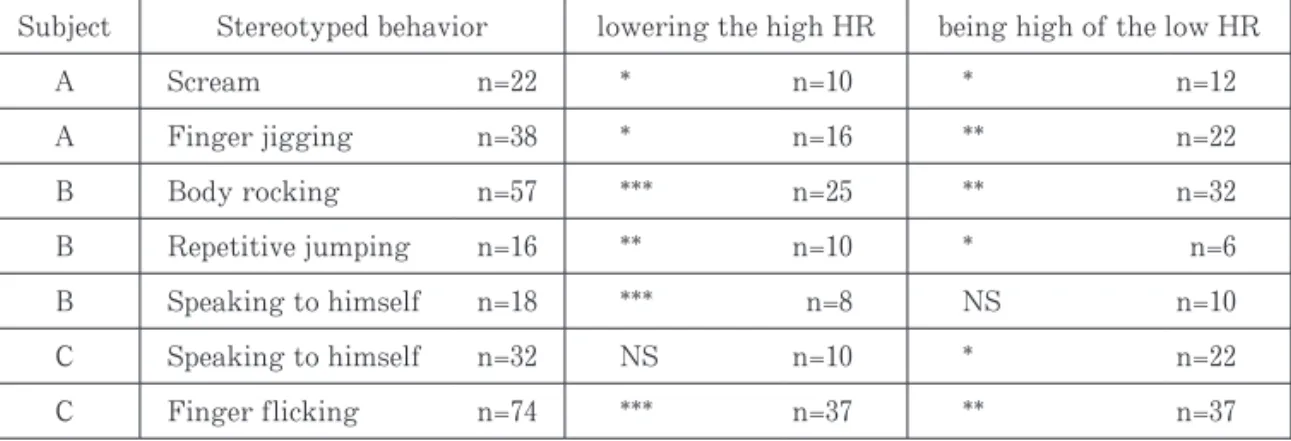
Table 1 shows the stereotyped behavior of subject A, B and C. It, moreover, shows the comparison between the mean HR before and that of after an epoch of the stereotyped behavior of subject A, B and C. In subject A, 22 and 38 in scream and finger jigging as the stereotyped behavior were analyzed (Table 1). In subject B, 57, 16 and 18 in body rocking, repetitive jumping and speaking to himself as the stereotyped behavior were analyzed. In subject C, 32 and 74 in the speaking to him-self and finger flicking as stereotyped behavior were analyzed. The mean HR before and after an epoch of stereotyped behavior, the HR of
Table 1 Comparison between mean HR before and that after an epoch of the stereotyped behavior.
Subject Stereotyped behavior lowering the high HR being high of the low HR
A Scream n=22 * n=10 * n=12
A Finger jigging n=38 * n=16 ** n=22
B Body rocking n=57 *** n=25 ** n=32
B Repetitive jumping n=16 ** n=10 * n=6
B Speaking to himself n=18 *** n=8 NS n=10
C Speaking to himself n=32 NS n=10 * n=22
C Finger flicking n=74 *** n=37 ** n=37
*p<.10, **p<.05, ***p<.01, NS: not significant
an epoch of the stereotyped behavior and the mean HR in the school environment of the day were calculated. The high and low HR value before an epoch of the stereotyped behavior were calculated compared that in the school environment of the day.
3.1. Subject A
When the mean HR before an epoch of scream as the stereotyped behavior was high (or low) compared that in the school environment of the day, the mean HR after an epoch of the behavior tended to decrease (t=1.50, df=8, p<.10) (or tended to increase (t=1.97, df=10, p<.10)) compared that before an epoch of the behavior. When the mean HR before an epoch of finger jigging as the stereotyped behavior was high (or low) compared that in the school environment of the day, the mean HR after an epoch of the behavior tended to decrease (t=1.80, df=14, p<.10) (or significantly increased (t=2.10, df=20, p<.05)) compared that before an epoch of the behavior.
3.2. Subject B
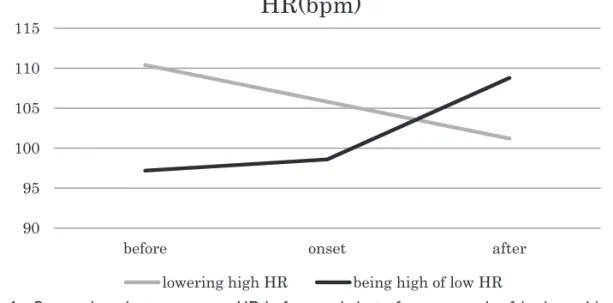
When the mean HR before an epoch of body rocking as the stereotyped behavior was high (or low) compared that in the school environment of the day, the mean HR after an epoch of the behavior significantly decreased (t=3.14, df=23, p<.01) (or increased (t=2.18, df=29, p<.05)) compared that before an epoch of the behavior (Fig. 1). When the mean HR before an epoch of repetitive jumping as the stereotyped behavior was high (or low) compared that in the school environment of the day, the mean HR after an epoch of the behavior significantly decreased (t=2.87, df=8, p<.05) (or tended to increase (t=1.78, df=4, p<.10)) compared that before the behavior. When the mean HR before an epoch of speaking to himself as the stereotyped behavior was high (or low) compared that in the school environment of the day, the mean HR after an epoch of the behavior significantly decreased (t=4.19, df=6, p<.01) (or
Fig. 1 Comparison between mean HR before and that after an epoch of body rocking as stereotyped behavior in subject B.
90 95 100 105 110 115
before onset after
HR(bpm)
lowering high HR being high of low HR
関西国際大学研究紀要 第18号 Case study investing the HR of three children with autism spectrum disorder before and after episodes of stereotyped behavior in the school environment
did not significantly increase) compared that before an epoch of the behavior.
3.3. Subject C
When the mean HR before an epoch of speaking to himself as the stereotyped behavior was high (or low) compared that in the school environment of the day, the mean HR after an epoch of the behavior did not significantly decreased (or tended to increase (t=1.60, df=20, p<.10)) compared that before an epoch of the behavior. When the mean HR before an epoch of finger flicking as the stereotyped behavior was high (or low) compared that in the school environment of the day, the mean HR after an epoch of the behavior significantly decreased (t=4.34, df=35, p<.01) (or increased (t=2.06, df=35, p<.05)) compared that before an epoch of the behavior.
Ⅳ Discussion
This is a single-subject design study investing the HR of three children with ASD before and after episodes of stereotyped behavior in the school environment. The research is based upon the arousal hypothesis of stereotyped behavior.
Our prediction was the following. We expected that a decrease in the HR appear when arousal is higher. But, an increase in the HR appear when arousal is lower. This suggests that when the children are higher, the HR decease. This, moreover, suggests that, when the children are lower, the HR increase
The approach used in this study is a noninvasive method and allows continuous monitoring of autonomic cardiogram control throughout the school environment. This study had an interesting aim, to measure the HR as related to stereotyped behavior in vivo.
In the present study, stereotyped behavior frequency was over 15 per day. In subject B, 16 and 18 in the repetitive jumping and the speaking to himself as the stereotyped behavior were, however, analyzed. Why was the low stereotyped behavior frequency analyzed?
Because the accident of the HR recording happened such as no good attaching the running computer parts on the chest and hand.
Notwithstanding varying ages, varying magnitudes of retardation of the present subjects and small case, the main finding was that a decrease in the HR appeared when arousal was higher. But, an increase in the HR appeared when arousal was lower.
Limitations of the study and future directions should, however, be discussed. The subjects were required to add in the future study, because the sample of the three children was small case. The arousal hypothesis should be presented with a lot of the subjects with ASD.
For this small case report, the discussion needs to be toned down in its conclusions. This report did not have evidence to conclude that there is a class of repetitive behaviors which is automatically elicited by elevations of arousal and that these have an adaptive function (Hutt, et. al., 1975)5). They served this role through the monotony induced by the repetitive
motor behavior as well as by blocking further novel sensory input. Our data did not speak at all to how or why the HR changed.
Finger flicking during very high arousal may be a mechanism for energy release or, in keeping with Lacey’s theory (1967)6) about the function of HR acceleration, part of an effort to block out environment input. Taken together, these data suggest that the child may use finger flicking to modulate arousal level (Sroufe et al., 1973)7).
The purpose of this paper was to establish the association between the stereotyped behavior of children with ASD and the arousal hypothesis of Sugita, et al. (2001)8). The analysis showed that the high HR before an epoch of stereotyped behavior significantly decreased or tended to decrease compared that after an epoch of the stereotyped behavior in subject A, B and C, except for the speaking to him-self as the stereotyped behavior of subject C. They, moreover, showed that the low HR before an epoch of stereotyped behavior significantly increased or tended to increase compared that after an epoch of the stereotyped behavior in subject A, B and C, except for the speaking to him-self in subject B. The purpose of the study seems to have been met.
However, the mean high HR before an epoch of the speaking to him-self as the stereotyped behavior did, significantly, not decrease compared that after an epoch of the behavior of subject C. The mean low HR before an epoch of the speaking to him-self as stereotyped behavior did, significantly, not increase compared that after an epoch of the stereotyped behavior of subject B.
Sugita et al. (2001)8) reported the child with ASD giving a scream. The child was measured the HR. The mean HR before an epoch of the scream was no different compared that after an epoch of the scream. They suggested that the reason for no different was the effect of the respiration of the scream. In the present study, the speaking to himself was the function of respiration. It was suggested that the speaking to him-self as stereotyped behavior may sometimes not do the arousal hypothesis. The arousal hypothesis of stereotyped behavior in children with ASD may be consider to change (Willemsen-Swinkels, Buitelaar, Dekker &
Engeland, 1998)10). A type of the stereotyped behavior may, moreover, have the arousal hypothesis.
Ⅴ Acknowledgment
We are indebted to three subjects for our success of this study.
【References】
1)Adrien, J.L., Ornitz, E., Barthelemy, C. Sauvage, D. & Lelord, G. (1987) The presence or absence of certain behavior associated with infantile autism in severely retarded autistic and non-autistic retarded children and very young normal children. Journal of Autism and Developmental Disorders, 17, 407-416.
関西国際大学研究紀要 第18号
2)American Psychiatric Associations (2014) Diagnostic and Statistical Manual of Mental Disorders, Fifth Edition, Washington. DC, Author.
3)Hayashi, E. & Katada, A. (1998) Correlation the stereotyped behavior of eye-blocking and heart rate responses in youth with autistic disorder. Japanese Journal of Special Education (Japanese with English abstract), 36, 13-20.
4)Hutt, C. & Hutt, S.J. (1965) Effects of environmental complexity on stereotyped behavior of children. Animal Behavior, 13, 1-4.
5)Hutt, C., Forrest, S.J. & Richer, J. (1975) Cardiac arrhythmia and behavior in autistic children.
Acta Psychiatrica Scandinavica, 51, 361-372.
6)Lacey, J.I. (1967) Somatic response patterning and stress: some revisions of activation theory. In M.H. Apley & R. Trumbull (Eds), Psychological Stress Issues in Research, New York, Appleton- Century-Crofts.
7)Sroufe, L.A., Stuecher, H.U. & Stutzer, W. (1973) The functional significance of autistic behavior for the psychotic child. Journal of Abnormal Child Psychology, 1, 225-240.
8)Sugita, N., Era, S. & Oota, S. (2001) Stereotyped behavior and arousal shift in a child with autism and severe intellectual disorders. Japanese Journal on Developmental Disabilities (Japanese with English abstract), 22, 317-323.
9)Wechsler, D. (1998) In T. Azuma, K. Ueno, K. Fujita, H, Maekawa, T. Ishikuma, & H, Sano (Japanese Transl.) Wechsler Intelligence Scale for Children. Third Edition Tokyo: Nihon Bunka Kagakushia Co., Ltd.
10)Willemsen-Swinkels, S.H.N., Buitelaar, J.K., Dekker, M. and Engeland, H. (1998) Subtyping stereotypic behavior, mood, and heart rate. Journal of Autism and Developmental Disorder, 28, 547- 557.
Send correspondence to Masamitsu Shibagaki, Ph.D., Department of Human Science, Kansai University of International Studies, Sizu, Miki-City, Hyogo Prefecture, 673-0521, Japan.