• 検索結果がありません。

Modeling the Linguistic Situation in the Philippines

N/A
N/A
Protected

Academic year: 2021

シェア "Modeling the Linguistic Situation in the Philippines"

Copied!
16
0
0

読み込み中.... (全文を見る)

全文

(1)

Philippines

著者(英) Lawrence A. Reid

journal or

publication title

Senri Ethnological Studies

volume 98

page range 91‑105

year 2018‑03‑16

URL http://doi.org/10.15021/00009006

(2)

91

Edited by K IKUSAWA Ritsuko and Lawrence A. R EID

6. Modeling the Linguistic Situation in the Philippines

Lawrence A. Reid

University of Hawai‘i National Museum of the Philippines

Abstract

This paper explores various problems in modeling the Philippine linguistic situation.

Simple cladistic models are valuable in modeling proposed genetic relationships based on the results of the comparative-historical method, but are problematic when dealing with the languages of Negrito groups that adopted Austronesian languages. They are also problematic in dealing with networking as the result of dialect chaining, and widespread lexical borrowing from non-Austronesian languages, each of which creates special problems in modeling the Philippine linguistic situation.

6.1. Introduction

In order to understand the problems involved with modeling the linguistic situation in the Philippines, it is necessary to introduce some facts about the country. The Philippines has a population of over 100,000,000 spread over 7,000 islands. The major islands have a wide variety of geographical features, with high mountain ranges, wide river plains and valleys. Ethnologue (Simons and Fennig 2017) lists 175 indigenous Philippine languages that are spoken by two phylogenetically distinct groups, the so-called “Southern Mongoloid” and the “Negritos”.

All Philippine languages belong to the Austronesian language family. Despite

proposals to the contrary (e.g., Donohue and Denham 2010: 231; 248), there is no

linguistic evidence, for prehistoric contact between either of the two phylogenetically

distinct groups in the Philippines and any other known linguistic phylum, such as Austro-

Asiatic or any other island or mainland non-Austronesian Southeast Asian group. There

has been no evidence produced for any linguistic substratum in the languages of the

Philippines from any non-Austronesian group that may have occupied the country prior

to the in-migration of people speaking Austronesian languages. Application of the

historical-comparative method suggests around 15 distinct subgroups (referred to by Blust

1991: 77 as ‘microgroups’). Published evidence for these groups is summarized by Blust

(1991). Blust provides lexical evidence that implies that some constitute a larger grouping

that he labels Greater Central Philippines, leaving around eight other subgroups, Bashiic

(3)

(Batanic), Bilic, Central Luzon, Kalamianic, Minahasan, North Mangyan, Northern Luzon and Sangiric. 1) An additional recently described language isolate, Manide with its closely related Negrito language Inagta-Alabat (Lobel 2010), appears to constitute another member of the Philippine microgroups. The Greater Central Philippines consists of Central Philippines, Manobo, Danaw, Gorontalo-Mongondow, Palawanic, South Mangyan and Subanon subgroups. Within these groups there are a number of language and dialect chains, and extreme dialectal diversity (see Maps 6-1 and 6-2 for the approximate geographical distributions of these groups).

The question is how best to model the linguistic situation? The answer depends upon several factors, the most important of which is what we are trying to model.

Family trees have traditionally been used to reveal language relationships that are revealed through the application of the historical-comparative method. Networking models have been suggested as ways to show language and dialect chaining. The image of a river has been used to show both direct inheritance and indirect inheritance or affinal relationships, where the main channel shows directly inherited relationships, and larger or smaller tributaries show indirectly inherited relationships (Andersen 2003: 4–5). New Bayesian phylogenetic models are now being used to supplement other models (Gray et al. 2009). Some important facts are missed by all models. What is needed are models that can reveal the effects of a wide range of significant events in the history of a language and a language family (see Kalyan and François, chapter 5 for a suggested non-cladistic method).

6.2. Modeling Linguistic Events in Philippine Prehistory

There are a wide range of events in Philippine prehistory that have resulted in the current Philippine linguistic situation. The major event was the first arrival of Austronesian speakers into the country, which brought the language that has now dispersed throughout the Indonesian and Malaysian areas, west to Madagascar, and east throughout the Oceanic area.

6.2.1 The Arrival and Spread of Austronesian-speaking Populations.

There is overwhelming and incontrovertible evidence that Proto-Austronesian (PAN) was spoken in what is now Taiwan. Archeological evidence suggests that in-migrations of various populations from mainland Asia at around 5000BP contributed to the formation of the parent language (note the extensive, early Neolithic Tapengkeng archaeological excavations in the Taiwan Science Park, Tainan dated to 4800–4200BP, Tsang and Li 2015). Blust (1999) claims that 10 subgroups had developed in Taiwan by the time that one of them, Malayo-Polynesian (MP), migrated south to the Philippines, and eventually through Borneo and Sulawesi to Oceania. Archaeological evidence places the date of the first movement into the Northern Philippines at around 4000BP (Bellwood 2007, with dates questioned by Anderson 2005).

Blust’s tree diagram of the first order branches of Austronesian, based on shared

phonological developments, shows a rake-like structure, as in Figure 6-1.

(4)

An alternative model proposed by Sagart (2004) suggests a nested structure, based on proposed innovations in numerals. Note that although MP languages reflect PAN, none of them are spoken in (mainland) Taiwan. The evidence suggests that the changes that distinguish MP languages from their sister languages in Taiwan could have developed in the Batanic Islands of the northern Philippines (Ross 2005) in that these languages appear

Map 6-1 Some northern Philippine language subgroups (Simons and Fennig 2017, used by permission)

(5)

Map 6-2 Some southern Philippine language subgroups (Simons and Fennig 2017, used by permission)

(6)

to be more conservative than other languages of the northern Philippines and reflect features of PAN that are lost in languages further south. “Other things being equal, the speech of a community that remains in the same location will be subject to fewer innovations than the speech of a community which changes location.” Ross (2005: 15) (See Map 6-3).

Blust (1999) claims that around 1,000 years after the dispersal of Philippine languages, there was a ‘great extinction’, with one language expanding and wiping out all other languages in the Philippines, in a bid by its speakers to find new agricultural land. Subsequently, this language differentiated into the different subgroups found today in the Philippines. Blust labels this hypothetical language Proto-Philippines, and although Blust is careful not to model this scenario, it can be modeled using a tree diagram that

Figure 6-1  Proto-Austronesian first order subgroups (reproduced from Blust 1999)

F1 Atayalic F2 East Formosan F3 Puyuma F4 Palwan F5 Rukai

F6 Tsouic F7 Bunun F8 Western Plains F9 Northwest Formosan MP Malayo-Polynesian

Austronesian

F1 F2 F3 F4 F5 F6 F7 F8 F9 MP

Map 6-3 The position of Batanic in relation to Taiwan and the Philippines (constructed by the author) Taiwan Orchid Island

Batanes Islands

Luzon

Philippines

(7)

captures the claims made by Blust, as in Figure 6-2.

The evidence Blust provides consists solely of a considerable number of shared lexical items that are not found outside the Philippines, and two proposed semantic innovations said to be found solely in the Philippines. Blust’s proposals build upon earlier work by Zorc (1986) that proposed a set of lexical cognates that supposedly only have reflexes in Philippine languages. Zorc (pers. comm. Nov. 14, 2016) states,

“Normally, innovations should be indicative of subgrouping. However, they can arise in an environment where different language communities develop close trade or societal ties

… This is theoretically important because we have innovations that do NOT define a subgroup …I am convinced that ... people interact when they are in geographical proximity and adapt to one another in terms of language, culture, cuisine, trade, etc. This could then account for so-called “innovations” that spread across genetic boundaries” (see Zorc n.d.). There is no reported phonological or morphosyntactic evidence that distinguishes Blust’s Proto-Philippines from Proto-Malayo-Polynesian (PMP), suggesting that the supposedly unique innovations are the result of the spread of such forms through the country as a result of various trading relationships over the centuries, and the cross- subgroup dialectal spread common in networked languages. Blust’s putative Proto- Philippines is doubted by many scholars (see Ross 2005: 12–13 for a critique), but is accepted by some younger scholars. Pawley (2006) likewise notes that from the archaeological evidence, there was no pause during which a homogeneous Proto

Figure 6-2 Proto-Malayo-Polynesian and the Proto-Philippines hypothesis (based on Blust 1999) Chamorro Austronesian

F1 F2 F3 F4 F5 MP F6 F7 F8 F9

??1500BC

P1 P2 P3 P4 P5 P6 P7 P8 F9

P1 Bashiic P2 Northen Luzon P3 Central Luzon

P4 Inati P5 Kalamian P6 Greater Central Phil.

P7 Bilic P8 Sangiric P9 Minahasan

??3000BC

GNB Celebes CEMP

Proto-Philippines

*1

st

Philippines Extinction

(8)

Philippines could have developed. He also notes that since there was no pause, the innovations that are attributed to ‘Proto-Philippines’ must have diffused over a dialect network that extended over the whole of the Philippines and nearby areas. I also consider that Philippine languages constitute part of a network of language subgroups that developed as each regional group gradually differentiated itself from the MP dialect network that rapidly spread south through the Philippines following initial settlement in Batanes or northern Luzon.

The concept of a language network, following Ross (1988: 8 Ross’s “linkage”), follows from what is known from the archaeological record of the rapid spread of a Neolithic culture, from the northern Philippines south. Linguists assume that the carriers of this Neolithic culture were speakers of MP languages. Comparing some of the oldest Neolithic dates from the north of the Philippines (e.g., Andarayan in the Cagayan Valley of northern Luzon, associated with rice at around 4000–3700BP, Spriggs 2003: 67) to those associated with the earliest Lapita settlements in western Oceania suggests that PMP speakers had travelled from northern Luzon to New Britain in less than 500 years.

The earliest Lapita sites in the Bismarck Archipelago found in New Britain are dated at 3550BP (Specht and Gosden 1997). Spriggs similarly claims that the spread from northern Luzon to East Timor took only about 300 years. “It would seem that the movements out of Taiwan were rapid after about 4000BP and by 3800BP dialects of PMP were spoken everywhere from the Philippines to eastern Borneo, Sulawesi, and south to East Timor” (Spriggs 2011: 511).

The rapid spread of speakers of PMP from the north of the Philippines into western Oceania is confirmed by lexicostatistical studies done by Blust (1993: 245), in which he compared reconstructed basic lexicon (the Swadesh 200 list) of PMP with that of Proto- Oceanic and found that they share 88% of their reconstructed basic lexicon. They probably also shared much of their morphology and syntax. This implies that there must have been a chain of mutually intelligible dialects across the Philippines and into Oceania by 3500BP. This dialect chain ultimately developed into multiple languages with adjacent languages forming subgroups with fuzzy borders. This is modeled in Figure 6-3 by a broken double line, with vertical lines marking the subgroups that are distinguished today by uniquely shared innovations. Figure 6-3 also models what was probably the situation in Taiwan some 4,000 years ago. There would not have been the discrete languages that we find today, but probably a set of dialect chains, here labeled Northern, Central, Southwestern and East Formosan, each of which eventually dispersed into relatively discrete subgroups of languages. Since there is no current language in Formosa that can be uniquely identified as PMP, its ancestral state, here identified as Pre-PMP, is indicated as the source from which PMP developed. There is pronominal evidence at least for this language, based on internal reconstruction (Reid 2016).

6.2.2 Prior Languages in the Philippines before the Arrival of Austronesian speakers.

There are about 27 Negrito groups in the Philippines still retaining their identity as distinct from non-Negritos groups (see Map 6-4). The archaeological evidence is clear;

Negritos inhabited the Philippines for many thousands of years before the Austronesians

(9)

arrived from Taiwan. It is assumed that today’s Negritos are the descendants of the earliest human populations in the Philippines, with archaeological evidence from Callao caves in northern Luzon, dated to c. 67000 BP (Mijares et al. 2010), and from Tabon caves in Palawan, dated to c. 47000 BP (Détroit et al. 2004). Recent excavations and new radiocarbon dates from a site in northern Palawan provide an 11,000-year sequence of human occupation (Ochoa et al. 2014).

We do not know what languages they spoke before their contact with their new neighbors, but it is assumed that because of the immense amount of time since their first arrival, multiple probably very distinct languages were used, although regional groups could well have spoken related languages. Today Negrito groups no longer speak their traditional languages; they have all switched to speaking MP languages, sometimes only remotely related to their closest MP language. The position of the languages spoken by Negrito populations in relation to other Philippine languages is instructive of their probable history (Headland and Reid 1989; Reid 2013). Inati, the language of the Ati Negritos spoken in the island of Panay appears to be an isolate among Philippine languages, and similarly Manide with its closely related Negrito language Inagta Alabat appears to be an isolate also (Lobel 2010). Although while they cannot be shown to be genetically closely related to any other Philippine language, they have borrowed heavily from the languages that currently surround them.

In modeling this situation, we are faced with a problem. A tree diagram implies that there is an unbroken transmission of the language from speakers of the proto-language to those who speak today’s daughter languages. Where a language has been adopted by a group and then transmitted to its daughters requires a modification of the model. Tree diagrams appropriately model the fact that Negrito languages share innovated features with the other members of the group to which they appear to be related as though they were inherited, but fails to indicate the mode of transmission. In a previous publication

Figure 6-3 The Proto-Malayo-Polynesian language network (constructed by the author) Austronesian

East Formosan

MALAYO-POLYNESIAN

Northern Pre-MP

1500-2000BC

Central Southwest

P1 P2 P3

GNB Celebes CEMP

P4 P5 P6 P7 P8 P9 Chamorro

(10)

Map 6-4 Negrito languages in the Philippines (from Reid 2013)

(11)

(Reid 2013) these have been modeled with a broken line in the tree that indicates the unique relationship that many Negrito languages have with non-Negrito languages. They are often first-order members of the group, apparently having learned their languages very early in the development of that group, and then either to avoid contact with the group, or to re-establish their own self-identity as Negritos, they separated from them long enough to not share in other developments that took place in other members of the group. Figure 6-4 provides a cladistic representation of PMP, with the Negrito language Inati added using a broken line. This language has a unique (for the Philippines) reflex of PMP *R (Inati /d/, Pennoyer 1986–87), and appears to have acquired their language from MP migrants very early in the movement of these people through the Philippines.

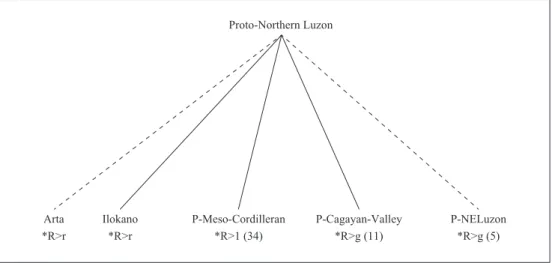
Figure 6-5 provides a similar model for the Northern Luzon languages, which has a Negrito language, Arta, as a first order branch of the subgroup.

Arta, spoken by fewer than a dozen people in Quirino Province, while having the same reflex of PMP *R as Ilokano (Arta, Ilk /r/), does not have any of the other innovations which characterize Ilokano (Reid 1989). Figure 6-5 also shows another Negrito first order branch, a group of fairly closely related languages spoken along the Northeastern coast of Luzon, which cannot be grouped clearly with any of the other branches of the subgroup (Robinson and Lobel 2013). These two Negrito language groups are marked by broken lines, indicating that they acquired their languages from their parent language not by the normal method of transmission, but by acquiring it through contact.

6.2.3 Development of Trading Networks

While tree diagrams and chained language diagrams can effectively model certain facts

Figure 6-4   A cladistic representation of part of PMP with a Negrito group as a first order branch, with  numbers of languages in each group in parentheses (constructed by the author)

Proto-Malayo-Polynesian

Inati P-Bashiic

(3)

P-NLzn (47)

P-CLzn (10)

P-CPhil (52)

P-Kalamianen (2)

Chamorro

(12)

about the historical development of languages, they do not model the kind of extensive networking resulting from trade. In the Philippines, this has possibly resulted in the kind of data that Blust (1999) uses to construct his “Proto-Philippines”, large numbers of words that have so far not been found to have cognates outside the Philippines. Many of these are probably words that have moved because of trade and been widely adopted. 2)

Today there are a number of provinces in the southern Philippines that have adopted Islam, including Tawi-Tawi, Basilan, Sulu, Lanao del Sur, and Magindanao, that currently constitute the Autonomous Region in Muslim Mindanao (ARMM), and which are negotiating with the Philippine government to form an independent Islamic province, Bangsamoro. The religion and the culture associated with it moved into the southern Philippines from Indonesia in the 14 th century. The languages that have been affected by this show extensive lexical change, as well as some morphosyntactic features that have been adopted from languages further south, features that are discussed in Donohue (2007).

6.2.4 Subsequent Events

For a thousand years or more, the Chinese have been trading with the Philippines, with large numbers of Chinese settling in the Philippines with many still retaining their home languages. This has also resulted in extensive lexical borrowing, in several cultural areas, such as cooking and kinship terminology (Chan-Yap 1980).

From 1521–1898 Spain occupied the Philippines with expected effects on Philippine languages, primarily in their lexicons; the Filipino-English dictionary with some 30,000 basic and derived entries published by the Filipino Language Commission (Komisyon ng Wikang Filipino) is said to have 5,210 (27.15%) Spanish words (Komisyon sa Wikang Filipino 2000: 702). Only a few Spanish grammatical forms, however, currently form

Figure 6-5   A  cladistic  representation  of  Proto-Northern  Luzon  with  Negrito  groups  as  first  order  branches  (constructed by the author)

Proto-Northern Luzon

Arta

*R>r

Ilokano

*R>r

P-Meso-Cordilleran

*R>1 (34)

P-Cagayan-Valley

*R>g (11)

P-NELuzon

*R>g (5)

(13)

part of Filipino [Tagalog] syntactic structures. A number of Spanish or Portuguese creoles also developed, such as Chabacano, currently spoken in Zamboanga City. Spanish borrowings also form a substantial part of many languages, especially of lowland languages as a result of the centuries of Spanish influence in these areas.

When Americans replaced the Spanish, they introduced a policy of educating the masses, and English was the language that was required to be taught in the schools and learned by everybody. In fifty years, the Americans succeeded in replacing Spanish and instituted the process of indigenous language replacement, a process that was reinforced with the establishment of a national language, Filipino, based on Tagalog, the language of Manila and surrounding provinces (Gonzalez 1980). All Philippine languages today contain extensive borrowings from English, and some have introduced a number of English consonant phonemes into their inventory (Reid 2005). The Filipino-English dictionary (Komisyon sa Wikang Filipino 2000: 702) is said to contain 1,907 (9.93%) of English loan words.

6.3. Conclusion

Modeling the linguistic situation in the Philippines would seem to require a number of different types of models. There are a number of significant linguistic events in Philippine history and pre-history some of which can be modeled by a tree diagram.

Trees can display the languages that are grouped according to shared innovations, such as phonology. While these trees imply unbroken transmission from parent to child, they do not adequately capture transmission where groups such as Negritos give up their original languages and adopt the language of their in-migrant neighbors. Neither can trees adequately display the effect of dialect and language chaining where subgroups merge into one another.

The rapid move south of MP speakers from the northern Philippines into Oceania can best be modeled with a network diagram, such as that proposed by Ross (1988).

Other events, such as the extensive lexical shifting and borrowing associated with events such as the development of trading networks across the Philippines, the Islamization of the southern Philippines, the movement of Chinese traders into the Philippines, and the occupation of the Philippines by Spanish and Americans, have all significantly affected Philippine languages but cannot be modeled by tree or network diagrams.

Notes

1) While Sangiric languages are not all spoken in the Philippines, other Sangiric languages as well as Minahasan languages are spoken in Sulawesi and are considered to be related to languages in the Philippines (Zorc 1986; Sneddon 1989; Blust 1991).

2) Other explanations also exist for this body of shared forms, including the possibility that they

are remnants of PMP forms that have been lost, or not recorded in non-Philippine languages

many of which have only small dictionaries or only limited word lists available for comparison.

(14)

References

Andersen, H.

2003 Introduction. In Henning Andersen (ed.) Language Contacts in Prehistory. Studies in Stratigraphy (Current Issues in Linguistic Theory 239), pp. 1–10. Amsterdam and Philadelphia: John Benjamins.

Anderson, A.

2005 Crossing the Luzon Strait: Archaeological Chronology in the Batanes Islands, Philippines and the Regional Sequence of Neolithic Dispersal. Journal of Austronesian Studies 1(2): 25–46.

Bellwood, P.

2007 The Prehistory of the Indo-Malaysian Archipelago. Rev. ed. Canberra: Australian National University E Press. http://epress.anu.edu.au/pima_citation.html (Accessed Oct.

15, 2014) Blust, R.

1991 The Greater Central Philippines Hypothesis. Oceanic Linguistics 30(2): 73–129.

1993 Central and Central-Eastern Malayo-Polynesian. Oceanic Linguistics 32(2): 241–294.

1999 Subgrouping, Circularity, and Extinction: Some Issues in Austronesian Comparative Linguistics. In E. Zeitoun and P. J.-k. Li (eds.) Selected Papers from the Eighth International Conference on Austronesian Linguistics (Symposium Series of the Institute of Linguistics Preparatory Office 1), pp. 31–94. Taipei: Academia Sinica.

Chan-Yap, G.

1980 Hokkien Chinese Borrowings in Tagalog (Pacific Linguistics). Canberra: Australian National University.

Donohue, M.

2007 Word Order in Austronesian from North to South and West to East. Linguistic Typology 11(2): 349–391.

Donohue, M. and T. Denham

2010 Farming and Language in Island Southeast Asia: Reframing Austronesian History.

Current Anthropology 51(2): 223–256.

Détroit, F., E. Dizon, C. Falguères, S. Hameau, W. Ronquillo, and F. Sémah

2004 Upper Pleistocene Homo Sapiens from the Tabon Cave (Palawan, the Philippines):

Description and Dating of New Discoveries. Comptes Rendus Palevol 3(8): 705–712.

Gonzalez, A. B.

1980 Language and Nationalism: The Philippine Experience Thus Far. Quezon City: Ateneo de Manila University Press.

Gray, R. D., A. J. Drummond, and S. J. Greenhill

2009 Language Phylogenies Reveal Expansion Pulses and Pauses in Pacific Settlement.

Science 323(5913): 479–483.

Headland, T. and L. A. Reid

1989 Hunter-gatherers and Their Neighbors from Prehistory to the Present. Current

Anthropology 30(1): 43–66.

(15)

Komisyon sa Wikang Filipino (Filipino Language Commission).

2000 Diksyunaryong Filipino-English. Manila: Komisyon sa Wikang Filipino.

Lobel, J.

2010 Manide: An Undescribed Philippine Language. Oceanic Linguistics 49(2): 478–510.

Mijares A. S., F. Détroit, P. Piper, R. Grün, P. Bellwood, M. Aubert, G. Champion, N. Cuevas, A.

De Leon, and E. Dizon

2010 New evidence for a 67,000-year-old human presence at Callao Cave, Luzon, Philippines. Journal of Human Evolution 59(1): 123–132. DOI: 10.1016/j.jhevol.2010.

04.008 (Accessed Sept. 21, 2014)

Ochoa, J., V. Paz, H. Lewis, J. Carlos, E. Robles, N. Amano, M. R. Ferreras, M. Lara, B. Vallejo, Jr., G. Velarde, S. A. Villaluz, W. Ronquillo, and W. Solheim, II

2014 The Archaeology and Palaeobiological Record of the Pasimbahan-Magsanib Site, Northern Palawan, Philippines. Philippine Science Letters 7(1): 22–36.

Pawley, A.

2006 Origins of the Filipinos: Linguistic and Archaeological Evidence. Paper presented at the 9th Philippine Linguistics Congress (9 PLC), 2006. Diliman, Quezon City, University of the Philippines, January 25–27.

Pennoyer, F. D.

1986–87 Inati: The Hidden Negrito Language of Panay, Philippines. Philippine Journal of Linguistics 17(2)–18(1): 1–36.

Reid, L. A.

1989 Arta, Another Philippine Negrito Language. Oceanic Linguistics 28(1): 47–74.

2005 A Cross-Generational View of Contact-related Phenomena in a Philippine Language:

Phonology. In J. S. Quakenbush and D. T. Dayag (eds.) Sociolinguistics and Language Education in the Philippines and Beyond: Festschrift in Honor of Ma. Lourdes S.

Bautista, pp. 383–399. Manila: Linguistic Society of the Philippines and the Summer Institute of Linguistics.

2013 Who are the Philippine Negritos? Evidence from Language. Human Biology 85(1–3):

329–358.

2016 Accounting for Variability in Malayo-Polynesian Pronouns: Paradigmatic Instability or Drift? Journal of Historical Linguistics 6(2): 130–164.

Robinson, L. and J. Lobel

2013 The Northeastern Luzon Subgroup of Philippine Languages. Oceanic Linguistics 52(1):

125–168.

Ross, M. D.

1988 Proto Oceanic and the Austronesian Languages of Western Melanesia (Pacific Linguistics, Series C-98). Canberra: Pacific Linguistics.

2005 The Batanic Languages in Relation to the Early History of the Malayo-Polynesian Subgroup of Austronesian. Journal of Austronesian Studies 1(2): 1–24.

Sagart, L.

2004 The Higher Phylogeny of Austronesian and the Position of Tai-Kadai. Oceanic

Linguistics 43: 411–444.

(16)

Simons, G. F. and C. D. Fennig (eds.)

2017 Ethnologue: Languages of the World, 20th ed. Dallas: SIL International. http://www.

ethnologue.com (Accessed Feb. 20, 2017) Sneddon, J. N.

1989 The North Sulawesi Microgroups: In Search of Higher Level Connections. In J. N.

Sneddon (ed.) Studies in Sulawesi Linguistics, part 1 (NUSA: Linguistic Studies of Indonesian and Other Languages in Indonesia 31), pp. 83–107. Jakarta: Badan Penyelenggara Seri NUSA.

Specht, J. and C. Gosden

1997 Dating Lapita Pottery in the Bismarck Archipelago, Papua New Guinea. Asian Perspectives 36(2): 175–199.

Spriggs, M.

2003 Chronology of the Neolithic Transition in Island Southeast Asia and the Western Pacific: A View from 2003. The Review of Archaeology 24: 57–80.

2011 Archaeology and Austronesian Expansion: Where are We Now? Antiquity 85(328):

510–528. http://faculty.washington.edu/plape/pacificarchaut12/Spriggs%202011.pdf (Accessed Sept. 20, 2012)

Tsang, C.-h. and K.-t. Li

2015 Archaeological Heritage in Tainan Science Park of Taiwan. Tainan: National Museum of Prehistory.

Zorc, R. D.

1986 The Genetic Relationships of Philippine Languages. In P. Geraghty, L. Carrington, and S.

Wurm (eds.) FOCAL II: Papers from the Fourth International Conference on Austronesian Linguistics, pp. 147–173. Canberra: Pacific Linguistics.

n.d. North Bisayan: An Axis, Not a Subgroup. Unpublished paper, available at http://zorc.

net/publications/. (Accessed Sept. 10, 2012)

Figure 6-1  Proto-Austronesian first order subgroups (reproduced from Blust 1999)F1  AtayalicF2  East FormosanF3  PuyumaF4  PalwanF5  RukaiF6  TsouicF7  BununF8  Western PlainsF9  Northwest FormosanMP  Malayo-PolynesianAustronesianF1F2 F3F4 F5 F6 F7F8F9 MP
Figure 6-2  Proto-Malayo-Polynesian and the Proto-Philippines hypothesis (based on Blust 1999)ChamorroAustronesianF1F2F3F4F5MPF6F7F8F9??1500BCP1P2P3P4P5P6P7P8 F9P1    BashiicP2    Northen LuzonP3    Central LuzonP4    InatiP5    KalamianP6    Greater Centr
Figure 6-3  The Proto-Malayo-Polynesian language network (constructed by the author)AustronesianEast FormosanMALAYO-POLYNESIANNorthernPre-MP1500-2000BCCentral SouthwestP1P2P3GNBCelebes CEMPP4P5P6P7P8P9 Chamorro
Figure 6-5 provides a similar model for the Northern Luzon languages, which has a  Negrito language, Arta, as a first order branch of the subgroup.
+2

参照

関連したドキュメント

Keywords: homology representation, permutation module, Andre permutations, simsun permutation, tangent and Genocchi

To this aim, we propose to use categories of fractions of a fundamental category with respect to suitably chosen sytems of morphisms and to investigate quotient categories of those

Standard domino tableaux have already been considered by many authors [33], [6], [34], [8], [1], but, to the best of our knowledge, the expression of the

The edges terminating in a correspond to the generators, i.e., the south-west cor- ners of the respective Ferrers diagram, whereas the edges originating in a correspond to the

(Construction of the strand of in- variants through enlargements (modifications ) of an idealistic filtration, and without using restriction to a hypersurface of maximal contact.) At

We have seen that Falk-Soland’s rectangular branch-and-bound algorithm can serve as a useful procedure in solving linear programs with an addi- tional separable reverse

In the situation where Γ is an arithmetic group, with its natural action on its associated symmetric space X, the horospherical limit points have a simple geometric

We present sufficient conditions for the existence of solutions to Neu- mann and periodic boundary-value problems for some class of quasilinear ordinary differential equations.. We