An Outline of Valency‑Reducing Operations in Chukchi
著者(英) Tokusu Kurebito
journal or
publication title
Senri Ethnological Studies
volume 77
page range 177‑189
year 2012‑03‑27
URL http://doi.org/10.15021/00002534
177
Edited by Wataru Nakamura and Ritsuko Kikusawa
An Outline of Valency-Reducing Operations in Chukchi
Tokusu Kurebito
Research Institute for Languages and Cultures of Asia and Africa, Tokyo University of Foreign Studies
This paper is an exploration of the valency-reducing operations in Chukchi. Our purpose is to deepen our theoretical understanding of the voice system in Chukchi, focusing on the morpho logical processes that mark the relationship between intransitive verbs and transitive verbs: the antipassive, the refl exive and the anticausative.
In Chukchi, noun incorporation is also related to valency-reducing operations. When an object is incorporated into the verb stem, the number of core arguments the verb takes is reduced by one, and the verb is detransitivized. So, we will also briefl y introduce object incorporation in Chukchi.
Key words: Chukchi, transitive, intransitive, antipassive, anticausative, refl exive, object incorporation
1. Introduction
2. Chukchi as a polysynthetic language 3. Verb classes
4. Object incorporation and valency change 5. Valency-reducing operations
5.1. Antipassive 5.2. Refl exive 5.3. Anticausative 6. Final remarks
1. Introduction
Chukchi,1) belonging to the Chukchi-Kamchatkan language family, is spoken by about 6400 people living mainly on Chukotka and its adjacent areas in far northeast Siberia, of the Russian Federation.
In the present paper, I will examine the valency-reducing operations in Chukchi, that is to say to outline the relationship between intransitive and transitive verbs. Data are from my
fi eldwork on Chukchi.
The valency-increasing operation is more than a valency-reducing operation. The mor- phological causative not only applies to intransitive verbs, but also applies to transitive verbs.
Besides transitive formation from intransitive verbs, there are two ways to increase valency:
the morphological causative and the analytic causative. The morphological causative is the most productive.
Previous studies have described and discussed the antipassive, such as Nedjalkov (1979) and Kozinskyet al. (1993), but little substantial work has been done on the anticausative so far. I have described the valency-increasing operations in detail, but only briefl y touched upon valency-reducing operations (Kurebito 2008a and 2008b).
Chukchi has valency-reducing derivations as well as valency-increasing ones. There are three types of valency-reducing derivations in Chukchi: the antipassive, the refl exive, and the anticausative. These forms are derived by adding the prefi x ine-(its allomorphs areine-/ena-), and the suffi xes -tku(its allomorphs are -tku/-tko), -twaand-ett(its allomorphs are-et/-at) to a transitive verb stem.
2. Chukchi as a polysynthetic language
Chukchi is an absolutive-ergative language. The subject of an intransitive verb and the direct object of a transitive verb take the absolutive case, while the subject of a transitive verb takes the ergative case. Chukchi does not have a distinct ergative marker. The instrumental case marker has the same form as the ergative case marker.
Intransitive verbs in Chukchi agree with the subject (S), and transitive verbs agree with the subject (S/A) and object (O/IO)2)in person and number. Agreement is shown by prefi xes, suffi xes and circumfi xes which may indicate person, number, and mood, as well as subject and object features.
Chukchi is a polysynthetic language, structurally very complex. Two or more word stems can combine into one word, or many affi xes may occur in a single word. Sometimes a word in Chukchi may be the functional equivalent of a whole sentence in another language.
See the following two examples.
(1) t-ə-kuk-iməl-nilu-ɣʔek-Ø
1SG.S-E-pot-water-wash-1SG.S-PAST
‘I washed out the pot with water.’
(2) n-ə-lɣe-ra-ŋaw-ə-n-raɣt-an-ŋ-ə-qen
IMPF-E-very-want-woman-E-TR-go home-TR-want-E-3SG.S
‘He really wants to bring the woman home.’
In (1), the transitive object kukk‘cookpot’ and the instrument iməl ‘water’ are incorpo-l rated into the transitive verb nilu‘wash’. This incorporative complex verb is infl ectable as an intransitive. (2) also has the core argument reduced, with the whole complex word infl ectable as an intransitive. But it’s structure is different from (1): to the basic verb stemraɣt ‘go home’ t
the circumfi xr-...-an (< r-...-at) is added, and the transitive verb ‘to bring’ is derived, with the object noun ŋaw‘woman’ incorporated into the new transitive verb. Moreover, the lexical circumfi x ra-...-ŋ ‘to want’ is added to this incorporative complex word.
In Chukchi, there are some affi xes which express substantive concrete verbal meanings, such as the circumfi x ra-...-ŋ ‘to want’ above, that in other languages would occur as inde- pendent words. In the following example, -ɣərke ‘gather’ functions as a free-standing verb.
(3) ləɣe-wʔej-ɣərke-lʔet-ɣʔet-Ø very-grass-gather-much-3PL-PAST
‘They gathered a lot of grass.’
3. Verb classes
Chukchi has three classes of verbs: intransitive verbs, which are infl ectable only as intransi- tives, but can be used transitively when they take valency-increasing morphological marking (e.g.,jəlqett‘sleep’); transitive verbs, which are infl ectable only as transitives, but can be used intransitively when they take valency-reducing morphological marking (e.g., piri ‘catch’);
and ambitransitives (or labile verbs), which are infl ectable either way, and can be used as transitives and intransitives without morphological change (e.g., mle‘break’). (4) and (5) are examples of verbs that have been made intransitive/transitive by the addition of morphological marking.
(4) ŋinqej ats-ə-ɣʔe-Ø boy.(ABS.SG) hide-E-3SG.S-PAST
‘The boy hid.’
(5) ŋinqej t-ə-r-ats-ə-ŋat-ɣʔan-Ø
boy.(ABS.SG) 1SG.S-E-TR-hide-E-TR-3SG.O-PAST
‘I made the boy hide.’
Chukchi does not have a benefactive marker. But intransitive verbs can be used as transi- tive verbs when they have to express a benefi ciary meaning. Compare the following two sentences.
(6) əllʔa puture-ɣʔi-Ø mother.(ABS.SG) sing-3SG.S-PAST
‘The mother sang a song’
(7) əllʔa-ta puture-nin-Ø nenenə mother-ERG dance-3SG.S/3SG.O-PAST child.(ABS.SG)
‘The mother danced for the child.’
In (6),puture ‘dance’ is an intransitive verb, but if the speaker needs to express a benefi -
ciary meaning such as (7), the verb can be infl ected as a transitive.
What must be noted is that not all intransitive verbs can be infl ected as transitives to express a benefi ciary meaning. So we must determine what kind of intransitive verbs can express benefi ciary meaning and what kind of intransitive verbs can not express a benefi ciary meaning.
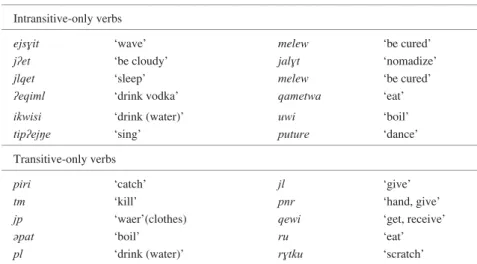
See the examples of intransitive and transitive verb in Table 1 above.
Note that Chukchi has suppletive verb pairs which are synonymous. Their only differ- ence is that one stem is transitive and the other is intransitive. Examples are listed in Table 1 above. For example, qametwa‘eat (intr)’ vs. ru ‘eat (tr)’, ikwisi ‘drink (intr)’ vs.pll‘drink (tr)’,qt ‘go (intr)’ vs. t jtt‘go (tr)’, waŋe‘sew (intr)’ vs.tni‘sew (tr)’, and uwi ‘boil (intr)’ vs.
əpatt‘boil (boil)’ are all synonymous, differing only in transitivity. These suppletive verbs cannot change their transitivity by adding morphological affi xes as shown in the following two examples (8) and (9).
(8) q-ə-qametwa-ɣe
IMPR.2SG-E-eat-2SG.S
‘You eat.’
(9) q-ə-nu-ɣən
IMPR.2SG-E-eat-2SG.S/3SG.O
‘You eat it.’
Table 2 shows a group of ambitransitve verbs in Chukchi. As we mentioned above, Chukchi transitive verbs and intransitive verbs are infl ected differently from each other. So, these ambitransitive verbs can be identifi ed as transitive or intransitive by their infl ectional affi xes.
The following two examples of the ambitransitive verb mle ‘break’ show this verb
Table 1
Intransitive-only verbs
ejsɣit ‘wave’ melew ‘be cured’
jʔetʔʔ ‘be cloudy’ jalɣt ‘nomadize’
jlqet ‘sleep’ melew ‘be cured’
ʔeqiml ‘drink vodka’ qametwa ‘eat’
ikwisi ‘drink (water)’ uwi ‘boil’
tipʔejŋe ‘sing’ puture ‘dance’
Transitive-only verbs
piri ‘catch’ jl ‘give’
tm ‘kill’ pnr ‘hand, give’
jp ‘waer’(clothes) qewi ‘get, receive’
əpat ‘boil’ ru ‘eat’
pl ‘drink (water)’ rɣtku ‘scratch’
infl ected as an intransitive in (10), and infl ected as a transitive in (11).
(10) ott-ə-lɣən mle-ɣʔi-Ø stick-E-ABS.SG break-3SG.S-PAST
‘The stick broke.’
(11) t-ə-mle-ɣʔen-Ø ott-ə-lɣən 1SG.S-E-break-3SG.O-PAST stick-E-ABS.SG
‘I broke the stick.’
According to Kozinsksy et al.(1988: 660), the ambitransitive (labile) verbs comprise about 15% (ca. 300 items) of the Chukchi verbal lexicon.
4. Object incorporation and valency change
As we mentioned above, the noun incorporative formation is very productive in Chukchi.
Object incorporation is the most frequent type. When an object is incorporated into the verb stem, losing the status of a syntactic argument, the number of core arguments the verb takes is reduced by one, and the whole incorporative complex predicate takes an intransitive marker.
Compare the following transitive sentence (12a) and intransitive sentence (12b).
(12a) ʔətt-e piri-nin-Ø melota-lɣən 3) dog-ERG catch-3SG.S/3SG.O-PAST hare-ABS.SG
‘The dog caught the hare.’
(12b) ʔətt-ə-n milute-piri-ɣʔi-Ø dog-E-ABS.SG hare-catch-3SG.S-PAST
‘The dog caught a hare.’
In (12a), the object melota‘hare’ takes the absolutive case, while the subject ʔətt‘dog’
takes the ergative case. But in (12b), the objectmilute‘hare’ is incorporated into the verbpiri
‘catch’. So the valency has changed, and the verbal complex is infl ected as an intransitive.
Compare the following two causative sentences.
Table 2
Ambitransitive (labile) verbs
iw ‘say’ tulʔet ‘steal’
peɣlatko ‘knock’ winret ‘help’
mle ‘break’ walom ‘hear’
ejp ‘close’ rrʔəlet ‘move’
ir ‘hit’ male ‘wipe’
ʔir ‘cross’ ilɣtew ‘wash’
(13a)ŋinqej t-ə-n-terɣa-k-wʔan-Ø
boy.(ABS.SG) 1SG.S-E-CAUS-cry-E-CAUS-3SG.O-PAST
‘I made the boy cry.’
(13b) t-ə-ŋenqaj-ə-n-terɣa-k-wʔak-ØØ 4)
1SG.S-E-boy-E-CAUS-cry-E-CAUS-1SG.S-PAST
‘I made a boy cry.’
In (13a), the direct object (causee) ŋinqej‘boy’ is not incorporated into the verb stem terɣa‘cry’. In contrast, in (13b), the direct object (causee)ŋenqaj ‘boy’ is incorporated into j the verb stemterɣa‘cry’. So, the number of core arguments is reduced, and the verbal com- plex is infl ected as an intransitive.
If a ditransitive verb takes both a direct and an indirect object, only the direct object can be incorporated into the verb, in which case the logical indirect object is promoted to direct object. Thus, the valency does not change in this situation. See the following pair.
(14a)əllʔat-a nanan-ɣtə 5) jəl-nin-Ø miməl mother-ERG child-DAT give-3SG.S/3SG.O-PAST water.(ABS.SG)
‘Mother gave the water to the child.’
(14b) əllʔat-a nenenə miml-ə-jəl-nin-Ø
mother-ERG child.(ABS.SG) water-E-give-3SG.S/3SG.O-PAST
‘Mother gave some water to the child.’
These two examples are both transitive sentences. In (14a), the three-place verb jəl
‘give’ takes the direct object miml ‘water’, which is marked by the absolutive case, and thel indirect object nanana ‘child’, which is marked by the dative case. In contrast, in (14b) the direct object mimll‘water’ is incorporated into the verb stem jəl ‘give’, and the indirect object l nanana (< nenenə) ‘child’ is promoted to the direct object, which we know because it is marked by the absolutive case. In (14b), although one core argument (direct object) is reduced, another core argument (indirect object) is left. Thus, the valency does not change in (14b).
Note that, also in possessive incorporation, the head noun is incorporated, while the modifi er is left out of the incorporative complex, and is marked by absolutive case, being raised to object. So the valency does not change. Compare the following two examples (15a) and (15b).
(15a)nenen-in mənɣ-ə-t t-ə-ɣtew-net-Ø
child-POSS hand-E-ABS.PL 1SG.S-E-wipe-3PL.O-PAST
‘I wiped the child’s hands.’
(15b) t-ə-mənɣ-ə-ɣtak-wʔan-Ø nenenə 1SG.S-E-hand-E-wipe-3SG.O-PAST child.(ABS.SG) ‘I wiped a child’s hands.’
5. Valency-reducing operations
Chukchi does not have passives, but there are three types of valency-reducing operations: the antipassive, the refl exive and the anticausative. These are formed by adding the prefi xin(e)-, the suffi x -tku, the suffi x -twaand the suffi x-etto a transitive verb stem. We will demonstrate the details below.
5.1. Antipassive
Antipassive is most common in Chukchi. There are two ways to mark antipassive: the prefi x -in(e) and the suffi x -tku. See the examples in Table 3 below.
In an antipassive (intransitive) sentence, the subject is in the absolutive case, while the object is in an oblique case (instrumental, locative or dative). See the transitive sentences and the corresponding antipassive sentences below.
(16a) tumɣ-e rəlwen-nin-Ø nelɣ-ə-n friend-ERG burn-3SG.S/3SG.O-PAST skin-E-ABS.SG
‘The friend burned the skin.’
(16b) tumɣətum ine-nlwet-ɣʔi-Ø nelɣ-e friend.(ABS.SG) AP-burn-3SG.S-PAST skin-INS
‘The friend burned a skin.’
(17a) əllɣ-e kənʔu-nin-Ø peswaaq
father-ERG catch-3SG.S/3SG.O-PAST female.reindeer.(ABS.SG) ‘The father caught the female reindeer.’
Table 3
Transitive Antipassive
ejmit ‘catch’ ine-ejmi ‘catch (intr)’
rlwet ‘burn’ ine-rlwet ‘burn (intr)’
piri ‘clutch’ ine-piri ‘clutch (intr)’
ʔemet ‘pull’ ine-ʔemet ‘pull (intr)’
lʔu ‘fi nd’ ine-lʔu ‘fi nd (intr)’
knʔu ‘catch’ ine-knʔu ‘catch (intr)’
penr ‘rush’ penr-tku ‘rush (intr)’
tenti ‘tread on’ tenti-tku ‘tread on (intr)’
ilɣtew ‘wash’ ilɣtew-tku ‘wash (intr)’
pelo ‘nibble’ pelo-tku ‘nibble (intr)’
kpl ‘hit’ kpl-tku ‘hit (intr)’
ukwet ‘kiss’ ukwet-tku ‘kiss (intr)’
swi ‘cut’ swi-tku ‘cut (intr)’
(17b) əllɣ-ə-n ine-kənʔu-ɣʔi-Ø peswaaq-ə-k
father-E-ABS.S AP-catch-3SG-PAST female.reindeer-E-LOC
‘The father caught a female reindeer.’
Although (16a) and (17a), which are transitive sentences, and (16b) and (17b) which are antipassive sentences withine- are similar in meaning, there are a few pragmatic differences:
the most obvious difference is that the transitive has a defi nite meaning and the antipassive has an indefi nite meaning. Why these two example marked by different case marking is a yet unsettled question.
In the following pair of examples, the transitive sentences are in (18a), (19a) and the corresponding antipassive sentences are found in (18b), (19b) with-tko. There are also a few pragmatic differences between the transitive sentence and the anstipassive sentence as for the antibassive within(e)-.
(18a)ʔəttʔ-e penr-ə-nen-Ø melota-lɣən
dog-E-ERG rush-E-3SG.S/3SG.O-PAST hare-ABS.SG
‘The dog rushed the hare.’
(18b) ʔəttʔ-ə-n penr-ə-tko-ɣʔe-Ø melota-ɣtə dog-E-ABS.SG rush-E-AP-3SG.S-PAST hare-DAT
‘The dog rushed to a hare.’
(19a)qora-ta tenti-nin-Ø rewəmrew
reindeer-ERG tread-3SG.S/3SG.O-PAST stone.(ABS.SG) ‘The reindeer trod on the stone.’
(19b) qora-ŋə tenti-tku-ɣʔi-Ø rewəm-ə-k reindeer-ABS.SG tread-AP-3SG-PAST stone-E-LOC
‘The reindeer trod on stone.’
In Chukchi, the causative formation can use the circumfi x te-...-ŋ6), etymologically related to ‘make’. The use of this circumfi x as a causative marker is semantically parallel the English analytic causative ‘make’ and French ‘faire’. However, this circumfi x cannot be added to a transitive verb stem directly. Note that te-...-ŋ must be added after the transitive prefi xr- is fi rst added to the intransitive verb stem. For example,wakʔo‘sit down’vs.te-r- wakʔo-ŋ‘make to sit down’,jlqet‘sleep’ vs.te-r-jlqet-ŋ‘make to sleep’.
It is interesting that there is another antipassive in Chukchi. Thus antipassive marker in(e)- and the causative marker te-...-ŋ are added to the intransitive verb stem. This antipas- sive functions causatively but is not as strong as the normal causative. See Table 4 for some examples of the causative formation and the antipassive formation.
In the following examples, (20a) and (21a) in an antipassive (intransitive) sentence, the subject is in the absolutive case, while the object is in an oblique case. See the transitive sentences (20a) and (21a) and the corresponding antipassive sentences which function causa-
tively in (20b) and (21b), respectively.
(20a)əllʔa-ta te-n-waŋe-ɣ-nen-Ø7) ŋeekək
mother-ERG CAUS-TR-sew-CAUS-3SG.S/3SG.O-PAST daughter.(ABS.SG)
‘The mother made her daughter (to) sew.’
(20b)əllʔa t-ena-n-waŋe-ŋ-ɣʔe-Ø ŋaakka-ɣtə
mother.(ABS.SG) CAUS-AP-TR-sew-CAUS-3SG.S-PAST daughter-DAT
‘The mother had her daughter (to) sew.’
(21a) əlləɣ-e te-n-jen-ŋ-ə-rk-ə-nin-Ø ekək father-ERG CAUS-TR-come-CAUS-E-PRES-3SG.S/3SG.O son.(ABS.SG)
‘The father makes his son come.’
(21b)əlləɣ-ə-n t-ine-n-jen-ŋ-ə-rkən akka-ɣtə
father-E-ABS.SG CAUS-AP-TR-come-CAUS-3SG.S-PRES son-DAT
‘The father had his son come.’
5.2. Refl exive
An other type of valency-reducing derivation is the canonical refl exive. The refl exive is formed by adding the suffi x-etand-tku to a transitive verb stem, just as with the antipassive construction. See examples in Table 5.
An example of a transitive sentence is seen in (22a), with its corresponding refl exive sentence in (22b), with the added morpheme -tku.
(22a) t-ə-lpiw-ɣʔen-Ø ottə-lɣən 1SG.S-E-cut-3SG.O-PAST wood-E-ABS.SG
‘I cut the wood.’
(22b) t-ə-lpiw-tku-ɣʔek-Ø 1SG.S-E-cut-REFL-1SG.S-PAST
‘I cut myself.’
Table 4
Intransitive Causative Antipassive
wakʔkk oʔʔ ‘sit down’ te-r-wakʔkk o-ʔʔ ŋ te-ine-r-wakʔkk o-ʔʔ ŋ
jet ‘come’ te-r-jet-ŋ te-ine-r-jet-ŋ
ikwisi ‘drink’ te-r-ikwisi-ŋ te-ine-r-ikwisi-ŋ
jlqet ‘sleep’ te-r-jlqet-ŋ te-ine-r-jlqet-ŋ
waŋe ‘sew’ te-r-waŋe-ŋ te-ine-r-waŋe-ŋ
qametwa ‘eat’ te-r-qametwa-ŋ te-ine-r-qametwa-ŋ
uwi ‘boil’ te-r-uwi-ŋ te-ine-r-uwi-ŋ
5.3. Anticausative
Another type of valency-reducing derivation is the anticausative. These forms are derived by adding the prefi x-ine (its allomorphs are-ine/-ena), and the suffi xes-tku (its allomorphs are -tku/-tko),-twa and -ett(its allomorphs are-et/-at) to a transitive verb stem, see Table 6 below.
Originally,-twais free-standing verb and means ‘to be’. The following example clearly shows that this is not a suffi x but a free-standing verb.
(23) minŋkə n-ə-twa-tore where IMPF-E-be-2PL.S
‘Where are you (PL) ?’
The following examples, (24a) and (25a) are transitive sentences. In contrast, in (24b) and (25b), the agent is removed from the structure and the sentences become intransitive.
(24a)əllʔa-ta uwi-rk-ə-nin ənneen
mother-ERG boil-PRES-E-3SG.S/3SG.O fi sh.(ABS.SG) ‘The mother in cooking the fi sh.’
(24b) ənneen owe-twa-rk-ə-n fi sh.(ABS.SG) boil-AC-PRES-E-3SG.S
‘The fi sh is cooked.’
Table 5
Traisitive Refl exive
qetw ‘stab’ qetw-et ‘stab (oneself)’
ejup ‘prick ’ ejup-et ‘prick (oneself)’
lpiw ‘cut’ lpiw-tku ‘cut (oneself)’
ittil ‘hit’ ittil-tku ‘hit (oneself)’
tenʔe ‘wash’ tenʔe-tku ‘wash (oneself)
piw ‘stab’ piw-tku ‘stab (oneself)’
Table 6
Transitive Anticausative
jme ‘hang’ jme-twa ‘hang (intr)’
jl ‘give’ jl-twa ‘give (intr)’
rpʔaw ‘dry’ rpʔaw-twa ‘dry (intr)’
piri ‘hold’ piri-twa ‘hold (intr)’
uwi ‘boil’ uwi-twa ‘boil (intr)’
ret ‘bring’ ret-twa ‘bring (intr’
jp ‘wear’ jp-twa ‘wear (intr)’
piŋku ‘put out’ piŋ-twa ‘go out’
(25a) əllenjut-e jəp-rk-ə-nen ɣəm-nin məsəkw-ə-n younger.brother-ERG wear-PRES-E-3SG.S/3SG.O I-POSS shirt-E-ABS.SG
‘The younger brother is wearing my shirt.’
(25b) ɣəm-nin məsəkw-ə-n jəp-ə-twa-rk-ə-n I-POSS shirt-E-ABS.SG wear-E-AC-PRES-E-3SG.S
‘My shirt is being worn (by somebody).’
So far, we have found just three transitive verbs that may appear as anticausative verbs formed by adding the suffi x-et. These are shown in Table 7.
See the following examples where (26b) and (27b) — as with (24b), and (25b) — the agent is removed from the structure and the sentences become intransitive.
(26a) t-ə-pela-ɣʔen-Ø ekək-Ø 1SG.S-E-leave-3SG.O-PAST son-ABS.SG
‘I left the son.’
(26b) ekək-Ø pela-t-ɣʔe-Ø8) son-ABS.SG leave-AC-3SG.S-PAST
‘The son stayed.’
(27a) t-ejp-ɣʔen-Ø qerɣəsʔ-ə-n 1SG.S-close-3SG.O-PAST window-E-ABS.SG
‘I closed the window.’
(27b) qerɣəsʔ-ə-n ejp-et-ɣʔi- Ø window-E-ABS.SG close-AC-3SG.S-PAST
‘The window closed.’
6. Final remarks
In this paper, I have examined the valency-reducing operations in Chukchi. Chukchi has valency-reducing derivations as well as valency-increasing ones. There are three valency- reducing derivations: antipassive, refl exive and anticausative. The antipassive appears to be unique in that it originates in the causative form while also retaining a weakened causative meaning.
Table 7
Transitive Anticausative
pela ‘leave’ pela-et ‘leave (intr)’
ejp ‘close’ elp-et ‘close (intr)’
tejwŋ ‘divide’ tejwŋ-et ‘divide (intr)’
The data presented in this paper seems suffi cient to provide a direction in the study of voice in Chukchi. Through our study of valency-reduction in Chukchi, we can deepen our theoretical understanding of the voice system of Chukchi, and thus, increase our knowledge of morphosyntactic processes. Further data and analysis will defi nitely provide more insights.
Abbreviations
ABS absolutive INS instrumental
AC anticausative LOC locative
AP antipassive O object
AUX auxiliary verb PAST past time
CAUS causative PL plural
DAT dative POSS possessive
E epenthesis PRES present time
ERG ergative S subject
IMPF Imperfective SG singular
IMPR imperative TR transitivizer
Notes
1) The phonemic inventory of Chukchi is as follows: Short vowels: /i, e, a, o, u, ə/, Long vowels: /ii, ee, aa, oo, uu/, Consonants: /p, t, k, q,ʔ, s,ɣ, w, j, r, l, m, n, ŋ/. Chukchi has vowel harmony.
Leaving aside the neutral vowel /ə/, the vowels can be divided into two groups on the basis of vowel harmony, by using the articulatory feature of high vs. low. In vowel harmony, the lower of a pair of vowels is ‘dominant’, and the higher of a pair of vowels is ‘recessive’, as seen here: Dominant vowels: /e, a, o, ee, aa, oo/, Recessive vowels: /i, e, u., ii, ee, uu/. If a word contains at least one morpheme with dominant vowels, then all morphemes with recessive vowels must be changed into the corresponding dominant ones (i>e,e>a,u>o), irrespective of whether they are root or affi x (see Kurebito 2008a: 61–70 for details).
Morphophonological processes are also numerous, which create an environment for various assimilations, dissimilations and metatheses of consonants, as well as insertion and deletion of the neutral vowel əat morphological boundaries.
2) Hereafter, I will use Subject to refer to Subject or Agent, and Object to refer to Direct Object or Indirect Object.
3) In this word, the absolutive marker -lɣənis a dominant morpheme. So, the noun stemmilute‘hare’
following the vowel harmony rule, changes to the dominant morpheme melota.
4) In this word, the verb stemterɣaɣɣ ‘cry’ is a dominant morpheme. So, following the vowel harmony rule, the morpheme ŋinqej‘boy’ changes to ŋenqaj.
5) In this word, the dative case-ɣtətt is a dominant morpheme. So, the noun stem nenenə ‘child’
following the vowel harmony rule, changes to the dominant form nanana.
6) For details, see Kurebito (2008b).
7) The transitive marker r-changes to n-when in medial position.
8) To avoid a vowel sequence, the e/aof -et/-ta-is deleted when affi xed to a stem ending in a vowel.
References
Kozinsky, I. Š, V. P. Nedjalkov and M. S. Polinskaja
1993 Antipassive in Chukchee: Oblique object, object incorporation, zero object, In Passive and Voice, ed. by M. Shibatani, 651–706. Amsterdam and Philadelphia: John Benjamins.
Kurebito, Tokusu
2008a A study of vowel harmony in Mongolian and Chukchi: Directionality vs. dominance. In Altaistic Studies, ed. by The Altaistic Conference of Japan, 61–70. Tokyo: Daito Bunka University Gogaku Kyöiku kenkyüjo, Tokyo, Japan.
2008b Valency-changing in Chukchi. In Linguistic Typology of the North, Vol. 1, ed. by Tokusu Kurebito, 73–86. Tokyo: Research Institute of Languages and Cultures of Asia and Africa, Tokyo University of Foreingn Studies.
Nedjalkov, I. V.
1979 Čukotskij antipassiv i vtoričnaja [Chukchi antipassive and secondary transitivization]a , In XIV Pacifi c Science Congress, 266–268. Moscow.