INTRODUCTION
Characteristic properties of cordierite are well known as, i) ultra low thermal expansion and ii) anisotropy of the thermal expansion coefficient (Hochella Jr. et al, 1979, Ikawa et al., 1986). For these thermal properties, they are durable against high temperature and/or thermal change of environments. And a cordierite based polycrystalline ceramics, NEXCERA™, enables very high precision measurement when this ceramics is used as a material of an instrument. NEXCERA™ has been developed as a cutting edge material with almost zero thermal expansion coefficient around the room temperature and supe- rior mechanical properties (Nose et al., 2001).
In order to develop these excellent thermal properties, NEXCERA™ has been analyzed with several points of view, i) the thermal expansion properties within extended temperature range, ii) characteristics of microstructures us- ing analytical electron microscope and SEM, and iii) finding an improved sintering conditions.
The purpose of present study is to acquire fundamental data which will be fed back to improve the ceramics making full use of characteristics of cordierite.
THERMAL EXPANSIBITY
The textural change of cordierite and interstitial amor- phous phase was not found in situ experiment of high tem- perature transmission electron microscopy (TEM) up to 800°C. Only the diffraction contrast of cordierite slightly changes during experiment (Toh et al., 2011). This result suggests that a small amount of lattice modification. In or- der to examine the temperature range in which the thermal expansion coefficient is almost zero, the high temperature X-ray diffraction (XRD) have been carried out.
In the present study, XRD experiment was carried out on a powder and a bulk sample. A powder sample was prepared by crushed bulk sample using an agate mortar, then the pow- der of the small particle size (2-5 μm) was separated by elu- triation. A bulk sample experiment was using thinned and polished specimen. The XRD measurements were carried out using a Rigaku Ultima IV diffractometer with heating and cooling specimen stage. The main experimental conditions are listed in Table 1. After taking the XRD pattern the Riet- veld analysis with RIETAN-FP software (Izumi and Momma, 2007) was applied for refinement of lattice parameters.
Thermal and Structural Properties of
Ultra Low Thermal Expansion Cordierite Ceramics
Shoichi T oh
1), Kensaku H attori
2), Seiichiro U ehara
3), and Jun S ugawara
2)(Received May 22, 2014)
Abstract
The important crystallographic properties of cordierite are its low thermal expansivity and an anisotropy of thermal expansion coefficient. These properties are also durable against the thermal changes of environment, Krosaki Harima Corporation designed the ceramics, NEXCERA™. Some microscopic experiments have been carried out from different angles of view for the purpose of clarifying a reason to cause the thermal characteristics of this ceramics. An in-situ X- ray powder diffraction experiments under low to high temperature, demonstrate the low expansivity of cordierite lattice parameters. Volume fraction of cordierite in the cordierite ceramics composed of cordierite and interstitial amorphous phase is almost ninety percent estimated with backscattered electron images (BSE) images using Scanning Electron Microscope (SEM). By taking the thermal expansion coefficient and the volume fraction into consideration, the possi- bility that the thermal expansion of cordierite is suppressed by the existence of the amorphous is suggested. In addition, the amorphous phase may affect the change in the volume thermal expansion of the whole ceramics.
Key Words: Cordierite, Ceramics, Low thermal expansion, Volume fraction, NEXCERA™
1) Department of Applied Physics, Faculty of Science, Fukuoka University, 19-1, Nanakuma 8-Chome, Jonan-ku, Fukuoka, 814-0180, Japan 2) Krosaki Harima Corporation, 1-1, Higashihamamachi, Yahatanishi-ku, Kitakyushu City, Fukuoka, 806-8586, Japan
3) Department of Earth and Planetary Sciences, Faculty of Science, Kyushu University, 6-10-1, Hakozaki, Higashi-ku, Fukuoka, 812-8581, Japan
Corresponding author; S. Toh, [email protected]
Figures 1 and 2 show examples of the results both of the XRD pattern measured at 25°C and the Rietveld analy- sis of a powder sample and that of a bulk sample, respec- tively. In each figures, the top pattern is XRD intensities and the below one shows residual substances of the fitting by the Rietveld analysis. The results of the analysis indicate that
the value RB and RF, which are factors reflecting the accu- racy of the crystal structure parameter adopted by the pres- ent simulation, are low enough and imply that the fitting goes well in both cases. On the other hand, the value R
wpof the bulk sample showed clearly higher value (8.232) than that of powdered sample (6.210). This is more likely to be caused by the diffraction intensities of the bulk sample be- ing higher than the powdered one. Since the S value, that is a substantial fitting parameter, is approximately one in the case of the powdered sample, the fitting was performed with high precision. In contrast, it may be necessary to take more examination of a crystal structure parameter, because the S value of the bulk sample was a relatively high.
In the present article, the value of thermal expansion shown in figures 3, 4 and 5 are normalized against the lat- tice parameters at 25°C.
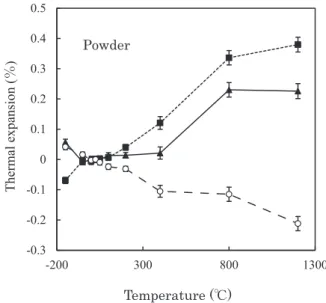
The changes of lattice parameters along a, b and c-axis of the powder and the bulk samples are shown in figures 3 and 4, respectively. In the case of powdered sample, the length along the a- and b-axis increases with heating and that of c-axis decreases (Fig. 3). These tendencies are con- sistent with the real cordierite measured by XRD (Ikawa et al., 1986) and MD simulation (Miyake, 2005). In the case of bulk sample, the length along the a- and b-axis also in- creased with heating although a slight drop are seen at 400°C and that of c-axis shows decrease slightly (Fig. 4).
The tendency of the temperature change is similar in both type of samples, but the values of expansion coefficients are slight different. These results indicate that the variation in thermal expansion coefficient of cordierite in the bulk sam- ple is smaller than that of the powdered sample.
Rwp = 8.232S = 2.3457RB = 2.874RF = 2.222
Intensity
2θ (deg)
Figure 2. An example of result of the XRD and the Rietveld analysis of the bulk sample measured at 25°C. The top pat- tern is XRD intensities and the below one shows residual substances of the fitting by the Rietveld analysis.
Rwp = 6.210S = 0.8216RB = 2.801RF = 2.086
Intensity
2θ (deg)
Figure 1. An example of result of the XRD and the Rietveld analysis of the powdered sample measured at 25°C. The top pattern is XRD intensities and the below one shows residual substances of the fitting by the Rietveld analysis.
0.3
0.2
0.1 0 0.1 0.2 0.3 0.4 0.5
200 300 800 1300
Therm al expansi on ( % )
Temperature ( ℃ ) Powder
Figure 3. Change of the thermal expansion along a- (▲), b- (■) and c-axis (○) for a powdered sample.
Voltage (kV) 40
Current (mA) 40
Scan range (deg) 4 80
Temperature range ( ℃ ) 150 +1200 Heating rate ( ℃ /min) 10
Specimen heating apparatus Rigaku SHT1500
Table 1. Main experimental conditions of X-ray diffraction
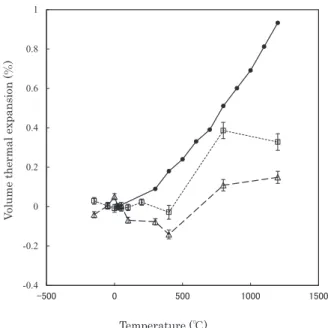
Figure 5 shows the volume thermal expansion of macro- scopic ceramics specimen, cordierite in the powdered sample and cordierite in the bulk sample. The result of a macroscopic measurement of the ceramics shows monotonous increase. That of powdered sample and bulk sample also increases with heat- ing although slightly decrease at 400°C and 1200°C for pow- dered sample and 100°C, 300°C and 400°C for bulk sample.
This figure shows that volume thermal expansion of cordierite in the bulk sample tends to be smaller than that of the pow- dered sample. Furthermore, volume thermal expansion of pow- dered sample is similar to the macroscopic measurement data.
VOLUME FRACTION
The microtexture of NEXCERA™ using TEM and SEM become clear that this ceramics is mainly composed of cordierite crystals of about 1-3 μm in diameter and amor- phous is distributed as interstitial phase. In order to evaluate the effect of the amorphous phase on thermal expansion properties, a volume fraction between cordierite crystals and amorphous phase has been measured. In the present study, NEXCERA™ that has been sintered under atmo- spheric condition was measured.
Twenty-one BSE images were taken using Zeiss UL- TRA 55 SEM in the EsB (Energy selective Backscatter) mode. As an example, one of these images is shown in Figure 6. In this figure, gray regions show cordierite, and white re- gions are amorphous phase. Since the images taken by the EsB mode are insensitive to the surface structure, the texture, which reflected only a difference in the chemical composi- tion, can be shown in these images. The binarization was performed with deciding the threshold so that the area ratio of both phases in the original image was maintained (Fig. 7).
0.3
0.2
0.1 0 0.1 0.2 0.3 0.4 0.5
200 300 800 1300
Therm al expansi on ( % )
Temperature ( ℃ ) Bulk
Figure 4. Change of the thermal expansion along a- (▲), b- (■) and c-axis (○) for a bulk sample.
0.4
0.2 0 0.2 0.4 0.6 0.8 1
㻙㻡㻜㻜 㻜 㻡㻜㻜 㻝㻜㻜㻜 㻝㻡㻜㻜
Temperature (℃)
Volume thermal expansion (%)