I. Introduction: Asylum Politics and Greek-Albanian Relation
The connection between asylum policy and international relations is often disregarded as ‘just obvious.’ Also, the logic of asylum is sometimes recognized in a limited context of the international relations in the past, when only ‘political’
refugees mattered, in which they were considered only in respect of their role as a bargaining chip between the states concerned.
The politics of asylum, in reality, has not always been so blatant. Asylum is offered, in general, as a result of complex political judgments from the competent authority (sometimes, authorities), over the careful thought including consideration as to whether this state act creates an undesirable relation with the country where the relevant individual fled from. The decision making is often difficult because it comes along with the complexity. Here, the complexity does not only mean that disorder is brought about by the involvement of various relevant ministries and agencies in the decision making processes, but also means that the ‘causal link’, between government decision (of offering asylum) and its reflection to the country the asylum-seeker comes from, is not given from the beginning but is only predictable. There is an absolute lack of information in this phase of asylum decision. In this sense, the politics of asylum may well be deemed as an aspect of high politics in international relations.
Political tactics also need to be included when considering asylum politics.
In the state of war, for larger sphere of influence against each other, the asylum offering by the state, as an effective card in the diplomacy, works gained powers
Balancing Immigration and Security Concerns
– the case of Greece –
Midori Okabe*
The Journal of Social Science 54 COE Special Edition [2005]
pp.27-48
and firmer defense to a country. Especially, when ethnicity or nationality is in question, the conflicts over greater territory are combined with resistance or partisan movements on the grassroots level, for which the act of asylum means the state’s protection of her ‘nationals’ .
However, when the war becomes ‘severe,’ at some point the leaders of countries consider the act of asylum itself as useless, since the battle over territories has at this stage turned out to be more direct and straightforward; the intention of the state becomes more focused on getting the larger territory as her own than receiving her ‘nationals’ into her territory in existence. Asylum politics therefore produces the most significant effect when the two countries in conflict still maintain the minimum balance of power, and have the intention to use asylum policy as a means to render psychological damage to their enemy.
Looking from a different angle, we also recognize that asylum politics stop exerting any positive effect to the countries which are ‘not’ in the state of war, be it literal or indirect. Very often, the involvement of countries in the asylum act, which desire to keep the harmonious relations, can be detrimental to peace maintained so far. A country in a very fragile position in terms of the balance of power with another country, which happens to be her neighbor, and when she needs to keep the balance just as it is, therefore tends to remain silent when the entry of a foreigner could be recognized as an asylum case.
As the increased international human flow through various channels has been evident in the world since the 1980s, asylum has been regarded in a different context for those seeking an alternative understanding. In most cases, it is ‘apolitically’ interpreted. For them, asylum is merely one of the options for their ’survival’, lying ahead of them. Nowadays, those who wish to migrate will do so in any case. From their logic, asylum means a philanthropic measure offered unilaterally from the state. The possible change in the mutual balance between the two relevant countries is not always fully taken care of.
The problem shared by most migrant-receiving countries today, where,
in most cases, the number of asylum appeals has been dramatically increased
over decades, is that the conventional logic of asylum, as is described above,
is no longer adequate and may already be obsolete, to fully tackle the current influx of asylum appeals. This does not mean, however, that a country like Greece, where the conventional asylum policy has been non-existent, or unseen, can suddenly establish ‘contemporary’ policy in this regards by ignoring all historical background with relations to other countries. Although Greece has turned into a migrants-receiving country from a migrants-sending country, as some other countries on the globe, the course towards adopting sound political measures will and should vary, according to the historical past, discipline(s) in high politics, and overall direction in the running of each country.
In this light, this paper will address how asylum policy is shaped in a country like Greece, where the policy has almost been non-existent until quite recently, and which experienced war(s), cease-fire, and the rehabilitation of friendship with her former enemy through (economic as well as political) cooperation.
The Greek-Albanian relation is examined here as a most relevant and interesting instance, since we will find how intriguingly high political relations can affect the outline and the dynamism of asylum policy making, which might not be so evident in other migrant-receiving countries in Europe today. The two countries had long been in conflict up until 1987, and the human flows between the two countries, already during the mid-1980s, were not evidently exposed as that of ‘asylum-seekers,’ partly because the people who move did not make an appeal, also because the Greek government approved a set percentage of Albanian refugees of ‘Albanian’ national /cultural background.
This paper will try to analyze the developments seen in migration (including asylum) policy making in Greece, by exploring the historical background of disturbance the two countries had suffered from during and after the W.W. II. To my understanding, this historical context had molded the bases of Greek policy as is seen today, which is often criticized as flawed in terms of human rights, as well as being a little rather unsophisticated.
The absence of migration/asylum policies which satisfactory meet the
present necessity both of foreign as well as “national” residents in Greece is
rooted in complex backgrounds. The notorious and thus disgraceful reputation
of Greece in this regards is that the administrative body as well as the whole legal and political system violates human rights of the foreign residents, whether or not they possess legal status. The European Court of Human Rights recently condemned Greece for the “inhumane and humiliating treatment” of a Syrian refugee in 2001, which had unveiled how poor the asylum-seekers are treated in Greek detention center to the whole EU states (Samatas, 2003). Besides, the imperfect and inefficient performance on the side of the civil service regarding immigration control is often pointed out, which is, though, in part, a little more difficult that it at first appears to be when we think of the very complicated geographical features of the country, with over 100 border crossing points both at mountains and by the sea (Samatas, 2003).
Other claim is vested on the Greek backwardness to provide for sufficient legal /political measures, although the immigration as phenomenon had been familiar way before W.W. II, while the EU member states in the north have experienced it since 1945. It is often attributed to the Greek indefference and even unwillingness to asylum/refugee protection as well as immigrant reception until quite recent times (Baldwin-Edwards, 1997).
All three points, the rough treatment of “Aliens” in terms of human rights,
the malfunctioning of the national/local administrative body, and the overall
apathy towards migrants ensued until quite recently, can be critical factors
which depict the inconsistency found in Greek immigration policy of today. This
paper will explore more in depth; by trying to depict international relations as a
historical background which might have enabled the aforementioned three points
to be realized. Bearing this in mind, I will first describe a little introduction
of the vulnerable picture of the region detected in the Balkans, with Greece in
the centre. As was mentioned earlier, the high political international relations,
especially during and after, or even before the Cold War, often have vital impacts
on migration control of a state. Greece is, among others, a country which is
particularly sensitive to global instability during the Cold War period, and has
been tossed about by waves of power games which had taken place both among
the (then) great powers as well as on the regional level, which might result in the
regional battle for territorial expansion in the Balkan. In this context, a Greek case can well be inspected by looking at Greek-Albanian relations, where the
‘national’ relations were reflected by and large in the migration policies of the two countries.
II. Migration to Greece
Until quite recently, Greece had experienced more emigration than immigration. There are some 6 million Greek nations living abroad according to OECD (SOPEMI, 2003). In the 1990s, like other south European countries, Greece has become characterized as an immigrants-receiving country. The rapid economic growth along with the drastic reform of economic structure, with efforts to meet the fiscal criteria set by the (then) European Community for membership, needed a huge amount of labor force. The change had attracted cheaper labors even from outside of the domestic market. Today, the foreign population, including illegal immigrants, is estimated to be 7.5-9.5% of the total population (SOPEMI, 2003). Apart from the retired people of Greek origin who return from U.S. or Canada (so-called “repatriates”), most of the immigrants come from the Balkan region.
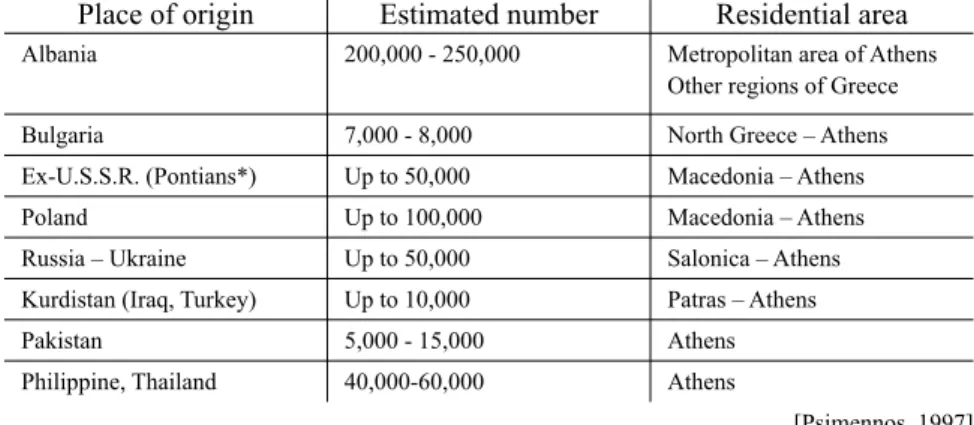
Among them, the Albanians are worth noting. Currently, over 200,000 Albanians reside in Greece, succeeded by Poles, Philippines/ Thais, Bulgarians, etc (see Table 1.). A more recent study indicates that the outstanding dominance of Albanians amounts up to approximately as much as 65% (Fakiolas, 2003).
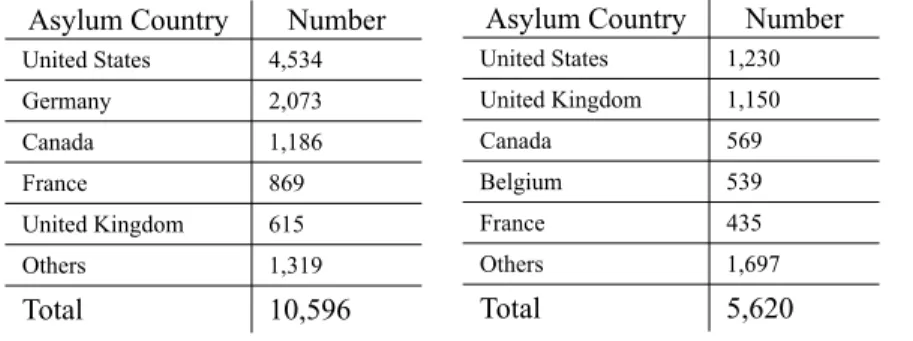
Most Albanians came to Greece, if not to Italy, neither through formal asylum procedure nor as legally authorized economic migrants, but by using the illegal channel in the way being smuggled into the black labor market. Table 2 and 3 show how few Albanians use the formal channel of asylum appeal for their entry into Greece.
What has driven many Albanians to be illegal migrants? Several explanations
for this can be found. First, the geographical proximity: the two countries are
connected by land. Also, combined with the shared historical experience of
having followed the common masteries, from ancient Greek era up to the time
of the Ottoman Empire, the Greeks and the Albanians have many things alike in culture. In addition, inter-marriage has surely taken place over the long history, hence ethnic and cultural assimilation had developed accordingly. Although this
“proximity” has become one of the major triggers for the conflict that has not yet abated in the region (which I will come back to explore later), it helped the Albanians to think of Greece as their major destination. In most cases, according to their minds, they do not even think they need to make official appeals (either politically or economically) to the Greek authority for the permission to enter, because they are Greek, or akin to Greek, when you get right down to it.
Table 1. Immigrant/ Refugee Population in Greece
Place of origin Estimated number Residential area
Albania 200,000 - 250,000 Metropolitan area of Athens
Other regions of Greece
Bulgaria 7,000 - 8,000 North Greece – Athens
Ex-U.S.S.R. (Pontians*) Up to 50,000 Macedonia – Athens
Poland Up to 100,000 Macedonia – Athens
Russia – Ukraine Up to 50,000 Salonica – Athens
Kurdistan (Iraq, Turkey) Up to 10,000 Patras – Athens
Pakistan 5,000 - 15,000 Athens
Philippine, Thailand 40,000-60,000 Athens
[Psimennos, 1997]
* Pontians, or Pontic Greeks are ethnic Greeks who had returned from regions around the Pontic Mountain, but the residents of the CIS (mainly Georgia, Uzbekistan and Kazakhstan).
Their “repatriation” began remarkable in the late 1980s, marked a peak in 1993 (25,500 persons returned to Greece), but soon declined to around 4,000 by 1999. Most of them are deemed to be settled in the Northern part, e.g. Macedonia or Thrace. (SOPEMI, 2003, Psimennos, 2001)
Table 2. Refugees and Asylum Seekers in Greece –Main Nationalities (in 2002)
Refugees Asylum-Seekers
Country of Origin Number
Iraq 950
Turkey 629
Iran 392
Afghanistan 137
Lebanon 64
[Extracted from UNHCR, 2002]
Table 3. Refugees and Asylum Seekers from Albania –Main Countries of Asylum (in 2002)
Refugees Asylum-Seekers
Asylum Country Number
United States 4,534
Germany 2,073
Canada 1,186
France 869
United Kingdom 615
Others 1,319
Total 10,596
[Extracted from UNHCR, 2002]
Second, as closely interlinked with the first reason, is the political factor. As being neighbors, with a shared history of once being parts of a single territory, the two nations hold similar landownership problems, to sort out which land belongs to whom. The problem is yet to be solved, and in many cases has become one of the major causes for the conflicts, some of which are still on- going. It is said that when the Albanians influx started in 1980s, most of them were the Greek-minority residing in northern part of Albania. They sought refuge in a real sense, which was by all means acceptable to the Greek authority at the time, as they are ethnically Greek, had intention to be settled in Greece,
Country of Origin Number
Iraq 2,567
Afghanistan 1,238
Iran 411
Pakistan 250
Turkey 211
Asylum Country Number
United States 1,230 United Kingdom 1,150
Canada 569
Belgium 539
France 435
Others 1,697
Total 5,620
and in practice obtained the Greek nationality after their entry. Soon later, the ethnic Albanians followed the tide. And this time, they were not welcomed by the Greek authority, unless they prepared sufficient documents to certificate their qualification of entry. Some of them immigrated as labor force, as a status officially guaranteed by the bilateral contract between Albania and Greece, but others, and most of them, were undocumented sneaked into Greece through
“informal” national borders as mountains or the sea.
III. Greek migration policy
The Greek migration policy, as a political measure to respond to the recent change seen in the trends of inflow/outflow of migration, is mainly characterized in two ways. First, it is in the stage of “catching up” with others, that Greece has recently become the immigrant–receiving country for about two decades.
Their membership to the European Union (then European Community) of course had an effect for the transformation of Greek legal/political structure on the regulation of migration. Second, in the course of its institutionalization, Greece has gradually mitigated the distinctive line of Greeks and Aliens. The two aspects were interlinked and have thus constituted the Greek legislation and policy of the present day, on which I will explore further.
The origin of the Greek legal measure to deal with (inwards) migration
[Greece and the surrounding regions]
can be traced back to 1929. The Law 4310, enacted at that time, first expressly stipulated the treatment of ethnic-Greek in the text (article 8.) It is very interestingly read from the legislation that the rule of distinguishing “us” from
“them” is based on ethnic grounds, which facilitates the operation to discern
“non-Greeks”, but, curiously enough, which is totally powerless to verify “who is a Greek.” Psimmenos finely describes this particular aspect of Greek ethno- centered character found in the legislation, as follows:
….Law 4310/1929 defined as a non-Greek any person who has proved to the authorities that he/she is ‘not’ (article 8). The above mentioned law has followed an ethnically centred approach to assimilate the then groups of refugees that arrived in the country during the Balkan wars (Poulopoulou 1986), from Asia Minor (Poulton 1991), and from Egypt and the Maghreb countries, during the 1950’s (Kassimati 1999). On the other hand, the definition of who was a Greek of Greek origins [sic], was not defined and it was left to authorities to decide upon the matter…..[I]mmigration Law 4310/1929 saw migrants as either considered to be of Greek origin or as migrants who belonged to a different nationality and were considered to be Alien. (Psimmenos, 2001)
The law was amended in 1991 (Law 1975/1991), and this time, the opportunity was not yet offered to those who reside in Greece and are neither of Greek origin nor even political refugees, to obtain Greek nationalities.
Psimmenos explains the objective of this legislation by citing the words of
Triandafyllidou, as the intention of Greece was more to facilitate the expulsion
of illegal immigrants and strengthen tighter immigration control on the border,
in order to keep pace with European integration in terms of establishing the
European (or Schengen) area of free movement with stricter controls against its
external world. Greece was then a co-signatory of the 1990 Dublin Convention
(ratified by Greece in Law 1996/1991) and of the 1990 Schengen Treaty, to
which she was first given merely an observer status. The law had enabled Greek
authority, not only the national government but also the local police and other jurisdictions, to expel as much as 125 million foreigners who illegally resided in Greece at that time (Psimmenos, 2001), and there was no sign seen until 1995 to recognize the status of non-Greeks by setting up substantive enactments.
After the Greek government gradually reacted to the societal needs to legalize the de facto immigrants’ status in winter 1995, a new law (Law 2434/1996) was laid down the following year, which sufficed the need to a certain extent (Papantoniou- Frangouli and Leventi, 1999). In fact, Law 2434/1996 requested the making of the Presidential Decree(s) to put the regularization procedure into practice, and the two Presidential Decrees (358/1997, 59/1997) had been thus followed, after a series of jumbling periods towards the promulgation.
The two decrees first offered the opportunity to non-Greek residents, who are neither ethnic-Greeks nor asylum-seekers/refugees, to obtain a legal justification to live and work in Greece, even though on a temporary basis. The decision in practice, however, has been commanded on a case-by-case basis by the competent authorities, including the Ministry of Labor, the Ministry of Public Order, and the Ministry of Foreign Affairs, along with local institutions.
The so-called “regularization” process had thus been implemented, and the measure had been reinforced by the second regularization executed in 2001, according to the renewed Aliens Law of 2910/2001 (Fakiolas, 2003).
The purpose of regularization, in principle, is to give illegal migrants the
right to reside legally in the host country. Another purpose, in most cases not
openly stated but tacitly understood, is to facilitate the administrative task to
grasp how large the illegal population the country holds at the moment; in the
regularization programme, the illegal migrants are expected to show up and
make appeals to the authority for legal permits. Since the latter aspect, that is,
the (hidden) intention on the administrative side is already seen by the illegal
migrants, and they know that not all applicants to this programme will be given
the “Green cards,” they tend to be reluctant to comply with the government’s
request, for fear of failing to obtain the legal status and thus being deported to
their homelands. In the Greek case, less than 50% applied for registration for the first regularization procedure, and over 50% for the second, slightly increased because of the simplification of the application procedure for the latter. It is estimated that only approximately 10% of the applicants have achieved the legal status at each phase (Papantoniou-Frangouli and Leventi, 1999, Fakiolas, 2003).
The legal measure as above is therefore not highly appreciated as an effective tool. It is often criticized so from the international institution (as OECD), and sometimes it is recognized even by the civil servants themselves.
Still, a country where the legal structure is not fully matured to satisfy the societal balance of integrating and deporting foreigners, in comparison to the factual situation she faces, sometimes deliberately leaves the undocumented and unauthorized people live in the country for a while. The regularization works as a makeshift in such a country, although she needs serious surgery soon afterwards, otherwise she will not survive. But why could not a certain country avoid the regularization procedure? Was it deliberate or not that Greece did not prepare the systematized asylum and immigration policy until recently? If it was, then, why did Greece have to tread the thorny path in the first place?
VI. Greek –Albanian Relation since WWII
The Greek-Albanian relation is roughly described as a series of conflicts.
The conflicts have been a part of a contest over the territorial demarcation within the Balkan region, as G. Xhudo states that “[t]he Balkans have, throughout the area’s history, been plagued by protracted warfare, shifting borders, irredentist claims, and drives for territory, often at a neighbor’s expense” (Xhudo, 1995).
Often, it is deemed as a part of the “West” because of the tie it has with NATO
and EU, Greece is expected to play a leading role for the stability of the whole
region by U.S. and by U.N. The expectation is frequently given away by
ceaseless friction between Greece and Albania, even after the collapse of former
Yugoslavia in the early 1990s, when the expectation from the ‘West’ marked
a peak. The antagonism is rooted because of the history, partially primordial
desired struggle over who was to have the territory in the region, and gradually,
in line with the imminent threat of communism, in the plot of the colonial and post-colonial major powers as to who is to protect Greece and draw profits from it as much as possible, and of increasing its power by controlling Greece (and Albania). In other words, the major powers, namely Great Britain, Italy and Germany, and then U.S. and the former U.S.S.R., capitalized on the regional dispute between Greece and Albania over territory, which had lasted since the collapse of the Ottoman Empire, and their involvement has so far made the Greek- Albanian relations more complex than ever, which has had ominous implications on the migration issue.
The Greek-Albanian dispute developed during the W.W. II, when Greece was apparently, but in a very fragile way, supported by Great Britain. Britain, who placed a lot of emphasis on achieving the military base on the strategically important point on the coast of the Eastern Mediterranean, the place where she perhaps also believes she shares a cultural heritage, had dismissed Albania to be occupied by Italy, then by Germany, and finally by the Communist regime.
Kuniholm eloquently describes the British intention towards Greece, which had also been threatened by Italy, Germany, and by the Soviet regime during the W.W.
II, as follows;
….As far as the British were concerned, the forces of war reaffirmed the value of securing sea communications in the Eastern Mediterranean. Thus, as the war progressed, as the German Army began to fall back, and as the Red Army pushed inexorably westward, the British transferred their preoccupations from German back to Russian intentions in the area. The safeguarding of Britain’s imperial lifeline in the Mediterranean remained an axiom of her strategic thinking (Kuniholm, 1980).
In contrast with the British keenness towards Greece, the Britain assigned
modest importance to Albania. After her independence in 1912, with the
confirmation of its border having been made in 1921 as is recognized today
(Martin, Martin and Pastore, 2002), Albania has suffered from instability
brought on both from inside and from outside; the demographical structure of the
inhabitants were multi-ethnic, multi-religious and multinational. According to Martin, as of 1921, the majority was Muslim (about 70%), and the minority were dominated by Greek-Orthodoxies and Roman-Catholics (ibid.). Although the religious diversity did not turn out to be an evident obstacle for the maintenance of a national bond, it worked at least as a discreet catalyst to the constant vulnerability of society. The outside world, though did not dare to capture the national territory any more, the great amount of which had already been taken away, had stopped posing using its influence, as it saw that Albania was no more useful as a card for the counteracting games among the Powers.
The Greek-Albanian relation became tenser with the increased complexity, involved by the “third country”, very often such major powers as Great Britain, U.S, U.S.S.R and even China. In most cases their involvement was direct to the region of dispute, but there were also times when the conflict between communist and anti-communist regime had a tremendous impact on the course of Greek foreign policy.
In general, the Balkans on the Eastern Mediterranean, including Greece, has long been one of the primary concerns for the Great Powers over centuries.
In particular, during and after the WWII, the British tactics for the balancing of power, along with the uprising of the Soviet communist regime and its growing broadness towards dilation of its territory, had exposed the increased disorder in this region, and this created a negative impact to the Greek-Albanian relation.
The rise of the communist regime had brought about a huge concern to the
West especially in the early 1940s, especially after the Axis (Italy and Germany),
and in part the British failure (to Greece) and unwillingness (to Albania) of the
occupation in the region created a high level of disorder and disruption taken
over, in Greek case, soon after its liberation in October 1944, and in Albania,
starting already from a few years earlier, when Italian invasion to the country
was implicitly recognized by Britain as fait accompli in 1936. Soon afterwards,
Albania was almost taken to the Communist camp, and in Greece, the communist
movement began gaining a civil support. Greek communism, represented by the
Greek Communist Party (KKE), gained special support from citizens for its role
in the resistance (Kuniholm, 1980).
As the way of commitment of each major power differed, which was most discernable in the attitudes of U.K. and U.S. since the end of WWII, Greek society became further divided. A ‘schism’ (Kuniholm, ibid.) developed within the society and prevented the Creation of the “Greek national” along with the territorial line and cast away the national and ethnic questions on the border. In other words, while Greece was politically divided into pieces and each of them strengthened the tie with its supporter (the Great Britain, U.S.S.R., U.S.A.), the society as a whole was hurled into chaos, which soon evolved into a civil conflict during the latter half of 1940s. The aftermath was a ‘pat and neat’ conflict resolution by the Powers on the surface, with a real quagmire at the bottom which would jeopardize the ‘peaceful’ situation at any moment.
V. Greek Immigration Policy as a Balancing Act
One of the concrete flashpoints of Greek-Albanian struggle was the territorial question; of whether ‘the Great Albania’ or ‘the Greece with Northern Epirus’ was realized.
In fact, the Northern Epirus has experienced an agonizing history over decades. After the German invasion, already in 1942, the region was suffered from the quadruple occupation by Germany, Italy, Albania and Bulgaria (Macedonia). The resistance began, in the form of nationalist rebellion, and very often mixed with communist partisans, which had resulted in the worst disaster.
The outcomes were just lingering disputes and irredentist movements of the
inhabitants as are witnessed even today. The memory of massacre, sometimes
exaggerated as ‘genocide’, of Greek nationals by Albania has frequently been
used by Greek radical nationalists (Wall Street Journal Europe, Sep. 13, 1994a),
although the contrary case, that is, the inhumane action taken by Greece to the
Albanian citizens (including refugees) holds more attention by the world (Wall
Street Journal Europe, Sep. 13, 1994b), as this often taken the form of accusation
from U.S., who backs Mr. Berisha, the President of Albania, or by the U.N
(Xhudo, 1995).
Below the surface, the conflict between the two countries continued, hidden but obstinate, until 1987, when the heads of both countries declared the end of
‘the State of War’ against each other. Greece, failed to create an opportunity to resolve the question of establishing a Greek national identity, as mentioned above, it has increasingly been accused by the Western European countries for her attitude towards refugees or other foreign nationals. The pressure was accepted, since the countries were (and are) adherents to the humanitarianism, as well as the members of the (then) European Economic Community (EEC), to which Greece had strongest desire to accede.
Apart from the membership to NATO, Greece thought it indispensable to be a member of the EEC for her stability in the Balkans. Surrounded by the communist countries, in an isolated location not only in terms of military but also economy, Greece has sometimes become a target for the economic sabotage from the communist world, since the exclusion from the international trade network with neighbors meant the gradual decay of the national economy. The fragile political situation in the region, with Yugoslav isolation and Bulgarian reaction towards Greece in turn, offered no credit to Greece for the stabilized regional prosperity that all could enjoy. Greece, then, thought that the EEC, although not being a defense provider, ‘could contribute substantially to stabilization in the postwar world’ (Hatzivassiliou, 1995).
[Northern Epirus (as of 2004)]
Albania, on her part, has been way behind in terms of development by the time the agreement of the cease-fire was declared, due to the isolationist policy taken by Berisha. His calculation and expectation for support from U.S.S.R.
was betrayed without mercy; moreover, his turning towards China (to form a communist alliance) had only brought about a very modest leverage effect.
Already in the 1980s, many Albanian people had flooded into the neighboring countries, mostly to Italy, but also to Greece, and this was the time, in retrospect, when Greece needed to change, or even could have changed, the discipline of Greek refugee policy.
Looking into the past, the rule of asylum, or refugee concerned with how to deal with a person in exile. In most cases, the reason people fled from their homelands were political ones at that time. For the states concerned, accepting such people as ‘refugees’ meant the official approval that they had been persecuted from the state they resided in, which were often regarded as a blatant accusation against the state concerned. The more fragile was the bilateral relation, the more increasingly was the hatred produced. Thus, the declaration of offering asylum to an individual, as long as he/she possesses the nationality of a country, so sensitively associated with the way to build up the inter-national relation between the two concerned (Honma, 1974).
To Greece, Albania has long been its ‘enemy’ until 1987, when people in exile from the country, as long as they were conducive to the Greek society, were fairly offered the status of refugee, while the ethnic Albanians and often Muslims were the exception, partly because they were considered to be dissidents, but also because their reception meant the amicable settlement with her enemy country. As mentioned before, already in the 1980s, before the cease- fire of 1987, Albanians began migrating to Greece. At that time, Greece had no aboveboard political means to receive Albanian citizens of ‘Albanian’ ethnic, religious, and cultural identity.
Apart from the inter-national political framework, people started migrating,
as happened in every parts of the world by that time, not only because of political
reasons, but also because of economic reasons. The individual motivation let
people move even to a country which was in the war with their homeland. As the War ends, the situation is now creating pressure on Greece to change the jurisprudence in the formation of law regarding the inter-national human flows.
Today numerous approaches to the bilateral and regional cooperation have started; many programmes have been launched, sometimes bilateral, in other cases in the framework of Europe. Founded by the ‘Treaty on Friendship, Cooperation, Good Neighborliness and Security,’ the two countries promised to head for efforts towards confidence-building. In this framework, the two have started to increase cooperation in terms of economy, defense, environment, etc.
to enhance cultural mutual understanding. In this context, the inter-national migration between the two countries has, for the first time and at last, been understood as a shared problem caused by the structural disparity of wealth (to live ‘humanely’ as a human). The ‘migrants’ are no longer ‘pawns’ for the power game played by the two countries, but now are recognized as victims produced by the two governments’ failure in administration.
VI. Conclusion – future perspectives after EU Enlargement –
Greek migration policy is finely constructed in the process where the regional dispute, with frequent involvement by the great powers over decades, had been settled over a long period. The immatureness of the policy itself has been derived, not only from the backwardness for the policy formation and often inappropriate treatment on the administrative side, but also from the unprepared- ness for the altered jurisprudence itself to catch up with the newly born cooperation between the two, which had been in a combat situation until 1987.
Meanwhile, Greek involvement in the European Union (European
Community at that time) had a tremendous effect in the molding of Greek
migration policy. For Greece, although it was merely an economic community at
first, EC placed a lot of importance for the domestic stability in the region even
in terms of high politics. Albania, on the other hand, which failed to get support
from the Communist powers over the decades, being geographically isolated
due to the Tito’s policy, has only been suffered by the economic (and political)
exhaustion which made the beeline.
Until quite recently, the EU has started launching aid projects to Albania, and, after the fifth Enlargement, the expectation of Albania to achieve the membership by the ‘next’ Enlargement reaches on a highest note. The two countries have now shared a common sense of reliability to the EU, not just as an economic last resort, but as an indispensable catalyst for the political stability in the region. The policy which regulates migratory flows has thus followed the course, and in this sense, we can expect the favorable future for both countries, although the success has yet to be achieved for the time being.
* For the completion of this article, the auther would like to express her special
gratitude to Dr. Tatiana Papadopoulou and Mr. Stavros Tsiepas of Ministry
of Foreign Affairs in Athens, as well as Dr. Nicholas Sitaropoulos, a legal
research officer at the National Commision of Greece for Human Rights (as
of March 2004). The auther would also thankful to the kind assistance from
the Ministry of Public Order, Greece. The views expressed and mistakes to be
found in this article, however, are thoroughly those of the author alone, which
do not reflect any of the institution she belongs to neither.
Reference
Baldwin-Edwards, M. (1997), ‘The Emerging European Immigration Regime: Some Reflections on Implications for Southern Europe,’ Journal of Common Market Studies, vol.35, no.4, December.
Crisp, J. (2003), ‘Refugees and the Global Politics of Asylum,’ The Political Quarterly.
De Greiff, P. and C. Cronin eds. (2002), Global Justice and Transnational Politics, Cambridge, Massachusetts, MIT Press.
Documents (2003): ‘The Greek Presidency of the Council of the European Union: the Challenge of Asylum and Immigration,’ International Journal of Refugee Law, vol.14, no.4.
Escandell, X. (2004), ‘The Impact of Political Engagement on Social and Political Tolerance towards Immigrants in Southern Europe,’ CCIS (the Center for Comparative Immigration Studies) working paper, no. 96, April.
Fakiolas, R. (2003), ‘The Second Legalization of the Illegal Immigrants in Greece,’ The International Migration Review, Winter 37, 4.
Hatzivassiliou, E. (1995), ‘Security and the European Option: Greek Foreign Policy, 1952-1962,’
Journal of Contemporary History, vol.30.
Honma, H. (1974). Seiji Boumei no Houri (The jurisprudence of political asylum), University of Waseda Press, Tokyo.
Kuniholm, B.R. (1980), The Origins of the Cold War in the Near East: Great Power Conflict and Diplomacy in Iran, Turkey and Greece, Princeton, New Jersey; Princeton University Press.
Martin, P., S. Martin and F. Pastore (2002), ‘Best Practice Options: Albania,’ International Migration, vol.40 (3) Special Issue 1.
Melis, B. (2001), Negotiating Europe’s Immigration Frontiers, The Hague: Kluwer Law International.
Papantoniou-Frangouli, M. (2000), ‘The Legalization of Aliens in Greece’, The International Migration Review, Fall 34, 3.
Psimennos, I. (2002), ‘Pathways of Immigration Control; Organisational Culture and Identity Processes in Greece,’ Second report prepared for the EC Fifth Framework Programme: “Does implementation matter? Informal administration practices and shifting immigrant strategies in four member states (IAPASIS)”, funded by European Commission, Research DG.
Psimennos, I. and K. Kassimati, (2002). ‘Immigration Control Pathways: Organizational Culture and Work Values of Greek Welfare,’ EC Fifth Framework Programme: “Does implementation matter? Informal administration practices and shifting immigrant strategies in four member states (IAPASIS)”, funded by European Commission, Research DG.
Rich, P. (2003), ‘The politics of immigration and asylum,’ British Journal of Politics and International Relations, vol.5, no.2, May.
Samatas, M. (2003), ‘Greece in “Schengenland”: blessing or anathema for citizens’ and foreigners’
rights?’ Journal of Ethnic and Migration Studies, vol. 29. no.1, January.
Balkans,’ East European quarterly, XXXII, no.4, January.
Xhudo, G. (1995), “Tension among Neighbors: Greek-Albanian Relations and Their Impact on Regional Security and Stability,” Studies in Conflict and Terrorism, vol. 18.
Primary Source, Newspaper article
SOPEMI (2003), Trends in International Migration, OECD.
UNHCR (2002), UNHCR Statistical Yearbook.
Wall Street Journal Europe (1994a), “An Albanian Trial Abuses Greek Rights….” Brussels, Sep.13.
Wall Street Journal Europe (1994b), “But Ethnic Groups in Greece Suffer Too….” Brussels, Sep.13.
安全保障と出入国管理の接近
̶アルバニア系移民に対するギリシャ政策̶
< 要 約 >
岡部 みどり
本稿は、主にアルバニア系外国人を対象としたギリシアの移民政策の形成過程に関 する分析である。今日のギリシアにおいては、少なくともアルバニア系外国人のため の包括的な移民政策はつい最近まで実質的にほぼ存在しなかった。これは、ギリシア 在住のアルバニア人が稀少だからというわけではなく(現在、アルバニア人はギリシ ア在住外国人の大多数を占めている)、また、彼らの存在が政治的・経済的・社会的 にギリシア国内で問題視されて「いない」から、というわけでも決してない(現在、
アルバニア人のほとんどは不法入国という形で国内に入り込み、多くは違法麻薬の売 買その他闇市場で活動を行っていると言われている)。
ギリシア移民政策の主な研究は、この原因を、外国人受容に関する国内文化的価値 観に派生する制度上の準備不足だと捉える。ここでは、特に、ギリシアがつい最近ま でむしろ移民の送出国であったことや、ギリシア社会が、半ば血統主義的な国民規定 意識を共有しつつ、これまで外国人の社会統合を発展付けるような文化的構築を遂げ てこなかったことが理由とされている。本稿では、これに対して、ギリシアが関わっ てきた対外関係、とりわけ外交上の二国間(あるいは多国間)関係が、外国籍居住者 の受容及び移民政策の策定に、その基底において重要な影響を与えてきたことを論ず る。
ギリシア・アルバニア両国は近年(1987年)まで戦争状態にあったが、この時期は、
特に、北エピルス地方を巡る両国間の領土問題が過熱し、このため両国間の人の移動 に関して国家保護の対象となるのは、明らかに「政治的迫害」を受けた(あるいは受 ける恐れがある)と判断されうる、条約が規定するところの通常の「難民」のみであっ
両国間の著しい経済格差が明らかになるに伴い、いわゆる「経済難民」と言われるア ルバニア人が、80年代末既にギリシアに流入し始めた。そして、戦争終結後の今日、
ギリシア国内における「アルバニア人」は、「敵国に帰属する政治的存在」から「貧 しい国から入国し、ギリシア国内労働市場で不法に就労している外国人」と明確に認 識されるようになった。一連の歴史を追った結果、ギリシアの今日の移民政策の「未 熟さ」は、それまで敢えて規定することが出来なかった(政治亡命者以外の)アルバ ニア人居住者のための法制度作りが、戦争後の両国間の信頼醸成の進展とともに、現 在やっと可能になった段階と解釈することが妥当であろうと考えられる。そして、ギ リシアにおけるアルバニア人移民のための法基盤の整備は、この歴史的文脈を反映し た、両国間の政治・経済その他社会的分野における協力の進展だけでなく、スタビラ イザーとしてのEUの役割、また、EUの努力による東地中海地域の政治的安定の確 保が担保されることでますます両国にとって望ましいものに近づいていくだろう。