Emergence of Modern Ballisdcs:
The Problem of Exchange of Knowledge in 18th Century Europe
-foru'fAJlMA Scki-Ko* a lrrstilutu trf -\lathcrnatics
Abrtsc'g lhc devclo,p€lt ofthp Bslistics
caoplay a! importaot role in thc hisory ofscicacc
andtccbnology wbeo we conrider thc rclation bcts,e€o
the€rnpirical sndy
andtheorttical ono. ln thb shrdy,
wechi€fly compare two math€riatioirn6' $udi6
andknow
thediffererrce bdwe€a
thcscw!y6 of arulyzrag
real aodhighty political objects.
Thcrc
are severalpotsibilities of
exchaDgeof Scientific Knowlcdgc ahhor4h usrully
the his3oriaDofruthcmsrics hrs
a
teadercy
toundcrlirc thc dis€oDtinustio!
betrvccoBriti$ marhcDstics sod Contitcntal
ooeia the
l Stb Cetrnn.y.l. Purpose and Range of the Study
Here I indicate purpose and range ofmy study. It is a kind of complement to the traditional view and way of historiography in lTth-l8th Century. We have some typical
cases of conflicts: l) Newton and Leibniz's priority race on the discovery ofcalculus and 2) George Barkley and Continental Mathematicians discussion over the existence and utilization of infrnitesimal small quantity.
And I feat my purpose and range more profoundly. There is one question: is there any other way in order to represent a new historiography of l8th Century? Main appropriate material is an example that can express the reception atrd conflict and exchange of Knowledge in this era, c'est-adire: Ballistics or Artillerie problem. There are some possibilities to contribute this new way of historiography. And this snrrrly does not only concerned history of the exact science but also more general situation of
Central Europe in the half of lSth Century: Military, Modern State, matlematician in the society, intemational transition of new devices.
2. What is Ballistict?
Firstly I underline the origin of word It came from an ancient Greek verb, BdX.l.ew that has meaning of to throw. Simply, that shrdy had treat€d the exact trajectory of
,l?
r'r\,
tZ<,dtj+taltutnt,.\o lrrzri rr, r, ,or J6fr{rfir
nBtllq n' lr,zrlldd ljr
1,,in!4r}"t\,dt rt t.ar 'cr|1rsin,'Jy,rrnl,"?/.vld,anjirl rr,lrri,',;rba \hurhtn mt)l,t t)rr),,1r.,r1:, alrr)t,tn,rr lw
r,r:rrrI'rrrldttflrti'ii,J6r!:',rl.r\/li:rrI':itl5,r'lrr,!xtt)),nr'rrL):i2,,)l'r'-rLuL au){ nlrM'
,t..rh)'jt tllnt )*.1' tt!'!{rt !,r, /ri oiBrri/irirFtrr,?,r3ni! ilrit,r.)ul rnr rxrht) !arllnri}.rJlt
:?3ir?illsff ,neboly' 10 e?ltegramg egbrl?on)l 10 cgrt6drxa lo fl')tdor'l ed'l'
eqo'tn:'l lrulnef dlSl ri
tlt ', , ,J t,
{bulz,rdllo e$aEtl bda i?oqrll'l .l
rll oJ lr! )rntq(fl(,,lr) bri) t; ?i ll r.htl? (6lo 1!n$r bfld ,zrj.F!q rlBciboi | :.,1r1I
it'ttt1t-t .,m,r ovtrl t'tt Oul,r:j rli.,1i-dtf In' (rlqrry,irr',,'dlr t6',/bnrw'Ir h,rrortibrrl
;,u lrr:.rle :,'lo lrrv<,:raib rrl, nr, 1:,r;1 /J'lrir.i z'._in de-l bl't; netwln ( | ./.raiftno,) lo zt?,t!
't'rr',zits sit ttto rrc,tttn:)?tb .
t11;1)nttnt )tltt;l'L lfhrrliJno ) Ln! y:rllltitl x$o9o {! b,xj
.{rillltu,p ilrjrfl . l,jj.lrii,rlitrilfl ilo rt()i}6sili,u brli zi :ncnl. )rjt ttti .t t\rtl l -rlbrrrr,iiorq crorr rgo,jl bar;,rrrFuq {.1r ltrlJ I.btlA
ill!M 'l,4ino3J drr I lo vdq$rgoir()izirl wen 6 ln1/r'ttl'r1 ()1 tllro
^i /dr,r rrrl!{) trr6 9r9dt I,flr, lginxo3 bra nrlilqg)er _,ill /ziql? nAl tndl tklarlti)ae ts /r ItjiJ:rlrrfl 'Jtsrlqo1qq6
rlidT .rrteldo:q ei\',\'ii\ \l.10 .')i\,r\\r)t1 rertb.s-r4e r .6 rr 4rli ni rql,l , ,,n)l I'r 'rprr6rtrx,
.:Jt
)o /L:tt, /atll blJ.{
.{rlqsllorl.]lr l 'lo Ys.r/ )rttlt )tDAtttn( ) ot t'1itil$h/-)1r ,2 tltt .lr)nr)irorJiirlri]fnol?t('rritlDrtdt!ntt!.\arreedt'lo{|.,l,ritlblrliTnoaiktotant
irl ;l1;i'ril&nrrlt6m ,eld? nrlll)tvl .{r/Jrlrl/ :vrulo'r:) rlrlJl k)llli{lrdl r,i..torrj.i lljrlrrr'l
..%ittb ! k, nt)ili2nuri lBroirirnglni .{t9,rx.,2 .rrlr
lrrilrills[ ?i tidv, .!
v,:r-i,(ill .dr1v irsri) Joxirn6 n6 nloir 3rnrr rl .br.,w k, ni3iru ?rlt ,nritebfls I {ilzI.l-
1o ?olleimr 116z? lalJ brsrr, b,,d {nrl, tcdi ,,lqrni2
.,r11 \ ,'r t., gnrfls?m 26rl rLdt
something to be thrown from the Roman Ages, but it became a compound domain of military problem and has been called one sort of Mixed Mathematics.It is an archaic word that was used until the end of l8m Century very frequently. After knowing this word, we must not regard confrontation between pure and mixed mathematics as pure and the difference between pure and applied one nowadaysr. So, modern ballistics has 4 types of contain: Internal, Transition, External, Terminal ballistic. More precisely the archaic study in l8th Century was discussing Internal and one part of Transition are.
Ballistics had changed its meaning from theory to experimental sciences. Until the end of 17th Century, Gerolamo Cardano and Galileo Galilei had argued the projectile theory but, in this age, the theoretical aspect of ballistic problem had been too
minimized. Especially Galileo had been satisfied with the trajectory parabola about this too difficult curve2.
The study inl6th Century was too simple. Does High speed projectile truly draw a idealized parabolic curve? So as to answer this problem, we needed to wait the research of Isaac Newton.
3. Newton's Principia (1726,3rd ed.) as a Philosophical Beginning Firstly, we note one phrase of Principia, the 3'd vol.
In the preceding books I have laid down the principles of philosophv,' principles not philosophical but mathematical; such, namely, as we may build our reasoning upon in philosophical inquiries. These principles are the laws and conditions of certain motions, and powers and forces, which chiefly have respect to philosophy; but lest they should have appeared of themselves dry and barren, I have illustrated them here and there with some philosophical scholiums, giving an account of such things as are of more general nature, and which philosophy seems chiefly to befounded on; such as the density and the resistance of bodies
I There is a more detailed explication of the difference in Kagaku Academy to Yuyona Kagaku (2011),7'h
Chapter, by Sayaka OKI in Japanese. She treats the argument of political arithmetic there. In French Encyclopddie, Mixed Mathematics has been treated
asbroader meaning including Social and States problems.
2 Galileo, Discorsi
eDimostrazioni Matematiche Intorno
aDue Nuove Scienze (1638), the
4'hday.
\rE
spaces void of all bodies, and the motion of light and sounds. (above Principia, p. 386, trans. By Florian Cajori, California, 1934.lunderlined the important points in using Italic font. These fonts are not existed in the original Text.)
Here I analyze the detailed state and content of ballistics in Principia. Generally, in 3rd Book, Newton discussed the system of the world in popular language like ut a pluribus legeretuf . But more mature consideration was needed for understanding this part.
Because it is for those who had first mastered the earlier 2 books. It is not until the readers understood them that they can enter into this applied problem. Even for Newton, this ballistic problem needed a careful and complete understanding of New Mechanics.
A physical point of view, Newton explained that air resistance is simply proportion to a square of flying object's velocity. The Modification about this simple description became a key to new ballistics in 18th Century.
4. Movement of Continent at the beginning of lSth Century
Here we must recognize earlier study of ballistics in the Continent. Important Person is Jacques Cassini (1677-1756), son of Giovanni Domenico Cassini, successor of
Observatoire de Paris. His famous work is Traitd de la grandeur et de lafigure de la terre (1720) that was focused on the size estimating problem of the Earth, really frequently freated in this 6poque.
Fig.l. Jacques Cassini (left) and Giovanni Domenico Cassini (right)
,')
3 Eng. Translation: As it is lable to be] read by many people.
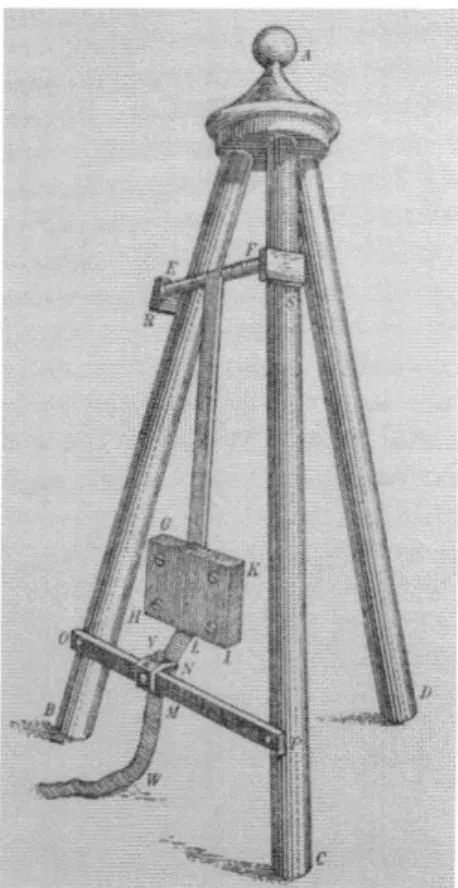
Jacques Cassini's new device has some remarkable features and it has common to the Ballistic Pendulum by B. Robins, later known. On the other word, it can be seen as
French version of Ballistic Pendulum. It was taken up to a problem in Acad6mie Royale des Sciences. In those days, J. Cassini was a core member of French Academy. But this tradition of study disappeared suddenly in the beginning of 18ft Century. We can verifr it by the comparaison of descriptions of I'Encyclopddie (1751-72) with I'Encyclopddie mithodique. This disappear and revive in later Robins' work is a truly enigmatical problem.
So, I discussed the structure of J. Cassini's device technically. It was presented in the conference of French Academy in 17O7.Its structure consists of T style timbering which is attached to one strong metal "D part" and used in order to measure the
oscillation of D part. It can express a force of the impact of attacked flying body. It has primitive and small structure but is enough to measure the speed of bullet.
Fig.2. J. Cassini Device
5. New Principles by B. Robins
De hors de Cassini's invention, new suggest and approach to measuring the velocity of bullet has been created in England. That is New Principle of Gunnery QTaQ written by Benjamin Robins (1707-1751). This book has several important and remarkable points, but especially a modification of Newton's mathematical assertion. Robins has denied it like this: resistance of air is not always proportional to the square of the speed
))c
of attacked body. Particularly, in the neighbor speed of Mach I and supersonic, a resistance value can be changed drastically. We will return on the problem after showing Robins' life.
6, Benjamin Robins end his character
He is a technician of British East India Company and pious Newtonian, a mathematically gifted person. His main concerning in this age was measuring air resistance when the speed of flying body passed sound of speed "supersonic". As I
had already noted thaq he insisted on the incorrectness about the former theory of
projectile in Pniz cipia, r x rr2. He has invented, that is called, "Ballistic Pendulum and its function is in order to determine the nozzle velocity of a bullet. Its structue is quite resembled to J. Cassini's one. Firstly, a sturdy lead plate is fixed in bottom ofmachine.
The stength of detachable plate is valuable. Secondly, its utilization is like that: to set up nearby the gun barrel and measure the oscillation after shooting.
Fig. 3. Robins' Ballistic Pendulum
\ J.\
After inventing the instrument Robins researched the change of bullet speed inside of
zone of Canon evidentially. His mathematical style of New Principle of Gunnery is a naturally traditional one.
Fig. 4. Prop. 7, Chap.l inNew Pinciple of Gunnery
In Fig. 4,I show an example of inner ballistics problem here in order to represent the decreasing of a nozzle pressure. He persisted in the archaic style here, 7ft
Proposition in lst Chapter. At first, a bullet has started from the base DAC to point B Via F and M while a hyperbolic curve KHQ represents a state of inner pressure. Robins' originalities and some tricks are like these 5 points:
1. Application and renovation of Principia l-7. Prop. 39, concerning the resistance of
air against flying object.
2. More precisely, division of resistant coefficient ofhigh speed that is more than 1700 ft. /s from law speed body when treating a moving body through resistant media.
3. Division of inner ballistics from exterior one when a bullet reached or nearly reached sonic speed.
4. Precise determination of nozzle velocity by renovating Ballistic Penduluma.
a Robins uses the word, fint velocityin original text.
\ I\-
5. Introduction of 'air column' and quantitative approach on the measure of air resistance.
Robins' approach was completely new one and we can make a distinguish line from the research of 16fr andl7ft Century.
7. L. Euler's new translation and Theoretical Innovation
After Robins' new work, translation into German was projected by Leonhard Euler. German version's name is Neue Grundsritze der Artillerie (1745)5. Euler has just arrived at Berlin in 1741, and he began to insist on the importance of Robins' work to Prussian King, Frederick the 2d (1712-1786)6. He praised Robins' contribution but was discontented with Robins' method. He felt that one needed analytical rewriting and he started it up. Euler's description and rewriting has several features.
l. His work is not only an additional but also a completely rewriting into analytical one. In the l't Book, Prop. 6, he argued the orbit of bullet after leaving out from a nozzle. Nowadays, it belongs to Exterior Ballistics ProblemT.
2. Basic character of his Analysis is compound of a simple propositions' group.
3. From careful consideration of the case horizontal projectile of a supersonic flying
object8.
And then, numerical analysis that Euler has adopted is like these, b: falling altitude corresponding at nozzle velocity, ft: coefficient28845 feet, c: diameter of bullet, n:
relative density between bullet and air.
. 3b(b + h)x eb(b + h)(zb + h)xz
- 4nc a2n2c2h2
From this result, thirdAnmerkung', 'annotation' starts in adding these inclinatory conditions. 1: horizontal distance, g: degree of shot, A, B, C: coefficients.
5 Eng. Translation: NewPrinciples of Gunnery, justas same
asoriginal one.
6 His German common name 'Friedrich der Gro8e' is came from his character
asan Enlightened Despot.
7 [Euler 1745]; EOO II
14.p.366.
8 After drawing
thehorizontal component, it
seemsto nearly straight line. lDid
\$
)(=+o.tanqI#*Btan **W
-atan ' cosq + Eq -Btan r-c(l+cosclz) *"' cosg
From this equation, lead to the best high range can be computede.
8. Possibilities of relationship with hydrodynamics in 18th Century (1)
We argued Robins' and Euler's systematic and not brief work. But there are other works about general problem about the hydrodynamics in this age. One Euler's article, IE226l Principes generaux du mouvement des Jluides, presented in 1755, and published
in 1757 is, as we know, the first recommendation of famous Euler Equation about hydrodynamicslO. After this research, he had two possibilities in order to treat ballistic problem: Euler equation of hydrodynamics or a former empirical equation. It is a really important that common and structural limit of hydrodynamics study in 18ft Century was concerning about the concept of Viscosity.
Even the most powerful mathematicians and physicists could not think
hydromechanics' problems without the condition of ideal fluid. Critical mathematical defeats are treatises of trigonometric function and boundary condition because they are needed for the purpose of solving partial differential equations. So, here, I briefly compare the difference between the Euler Equation and the Navier-Stokes one in 19th
Centuryll.
Firstly, i component of force of viscosity for a unit volume,
W :,t*(#. #) :,(r'u, * *o*"\,
then with an only consideration of no contractive fluid and eliminating div u.
9 島
fdP.391.
10 Eng.TranslatiOn:ε
θ′θra/Prin■
たs Of■0′ぶ′″οremθ″ム
1l Claude‐Louis Navier(1785‐ 1863)was a French cngineer and Physicist whO specialized in
hydrOdynamics.The famOus Na宙
e←StOkes equations are namcd aftcr him and GcOrge Gabriel StOkes(Irish,1819‑1903).
、よヘ
Therefore,the equation needed
ρ {髪 +(υ ・
∂υ
∂ t+
ヽ t r ノ ヽ
υ
1
︐
′
S
▽
=一▽ P+η ▽ 2υ +ρ ∫
.And then, the Navier-Stokes Equation was finally derived:
(υ 。 ▽ )υ =― 上▽ P tt ν ▽ 2υ 十∫。
ρ
The difference between this one and Euler's old one of fluid is only the existence of
terms of vrscosity. This point is an important Merlonal that can divide hydrodynamics study in l8th from newer one. In turn to ballistic problem, should we consider it a merely experimental law? We could treat it as a milestone for the accomplishment and application of a more sophistical equation in the domain of hydrodynamics. We need more systematic and detailed research about this bridge between empirical problem and theoretical problem.
9. Conclusion
So, we can here note several important conclusions. Firstly, new attempt on
ballistics research has started up from Newton's inheritance and it has rooted from some philosophical states, but it needed a more mature situation about mathematics of the half of 186 Century although the existence of J. Cassini's interesting approach. Secondly, in the 3'd generation from Newton, Leibniz, ballistics problem has become communicative and political issue in order to satisfy Modern State demand, especially Prussia's case.
Fusion of two groups knowledge has already been promoted through new fianslation and analytical rewritingl
2.Before the complement of Euler Equation in l8th Century, we need veriff if there were some influences from ballistic problem. It has possibility to be remained chiefly at the position of experimental law. In same time, ballistic problem contains
mathematically and technically more severe condition and difficulty: it could have opened the door to the hydrodynamics study in 19ft Century.
12