IRRIGATION MANAGEMENT PROBLEMS DERIVED FROM ORGANIZATIONAL
EVALUATION OF A WATER USERS ASSOCIATION AT THE KPONG IRRIGATION SCHEME IN GHANA
IEKO KAKUTA
Faculty of International Relations, Asia University, 5-24-10, Sakai, Musashino-shi, Tokyo 180-8629, Japan. Email: [email protected]
Abstract
This study examines the problems in Water Users Association (WUA) C1’s management of the Kpong Irrigation Scheme (KIS) in Ghana, using 13 evaluation indicators derived from theories of common-pool resources management. The evaluation shows that WUA C1 lacks the distributional share system and water control ability indicators even though C1 has good irrigation facilities, which enable independent water management within WUA. The reason is that KIS has been managed by Joint System Management (JSM) in which the KIS Office of Ghana Irrigation Development Authority (GIDA) operates and maintains the main canal, drainages, and roads, while WUA C1 operates and maintains the branch canal and lower-level canals. However, the KIS Office cannot fully operate and maintain the irrigation facilities due to lack of funding. JSM is common practice in irrigation management transfer (IMT). However, this management system can be detrimental to the WUA’s water control ability.
Keywords: Common-pool resources management, irrigation management transfer (IMT), Joint System Management (JSM), WUA
Ⅰ. INTRODUCTION
Joint System Management (JSM) is common in irrigation management transfer (IMT), where the government or private enterprise [i.e., Scheme Management Entity (SME)] manages the main canal, drainage, and road, while the beneficiary farmers [i.e., Water Users Association (WUA)] oversee the lateral canals and lower-level canals. This study examines the problems of irrigation management, specifically JSM, based on the case study of WUA AK/C1 (the official name; hereafter WUA C1) at Kpong Irrigation Scheme (KIS), owned by Ghana Irrigation Development Authority (GIDA) in Ghana, using the theories of common-pool resources (CPR) management proposed by Ostrom (1990) and Freeman (1989, 1992).
The rest of this paper is organized as follows. First, the analytical framework and methodology of the study are presented. Next, the irrigation system and WUA are described. Then, the performance of the irrigation system is evaluated. Finally, the appropriateness of JSM is considered.
Ⅱ. ANALYTICAL FRAMEWORK AND METHODOLOGY
1) Theories of CPR Management
It is necessary to have an appropriate analytic framework to evaluate irrigation system management. Because the water and the irrigation system that delivers it to beneficiary farmers are considered to be CPRs
usually managed by locals, the author applies Ostrom’s design principles of long-enduring CPRs (1990) and Freeman’s distributional share system model (1989, 1992) to assess efficacy.
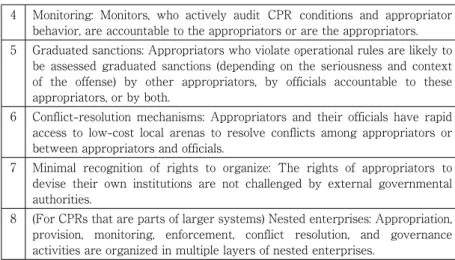
According to Ostrom [9], although there are differences among CPR settings, long-enduring and self-governing CPR institutions (e.g., irrigation systems, community forests, common pastures) share eight design principles (see Table 1). Ostrom was awarded a Nobel Prize in economics in 2009 for her research on CPR management. If a CPR institution does not share these eight design principles, it cannot avoid free-riders who break its rules and appropriate resources without fulfilling their obligations as members of the institution. This results in deterioration and dysfunction of the CPR institution, finally leading to the depletion and destruction of the managed resources. In an irrigation system, this causes deterioration of irrigation facilities and water shortages at the tail end and, consequently, the irrigation project fails. Avoiding free-riders is key to sustainably managing CPR [9]ⅰ.
ⅰ For a detailed explanation of the eight design principles of long-enduring CPR institutions, see Ostrom (1990: 88-102).
────────────
Table 1. Ostrom’s design principles illustrated by long-enduring common- pool resources (CPR) institutions
1 Clearly defined boundaries: Individuals or households who have rights to withdraw resource units from the CPR must be clearly defined, as must the boundaries of the CPR itself.
2 Congruence between appropriation and provision rules and local conditions:
Appropriation rules restricting time, place, technology, and/or quantity of resource units are related to local conditions and to provision rules requiring labor, material, and/or money.
3 Collective-choice arrangements: Most individuals affected by the operational rules can participate in modifying the operational rules.
Meanwhile, Freeman’s distributional share system model is formulated to apply to irrigation systems and WUAs. However, its conceptional model is equivalent to Ostrom’s design principles. Freeman [1][2] presents six essential characteristics of an effective WUA (see Table 2).
4 Monitoring: Monitors, who actively audit CPR conditions and appropriator behavior, are accountable to the appropriators or are the appropriators.
5 Graduated sanctions: Appropriators who violate operational rules are likely to be assessed graduated sanctions (depending on the seriousness and context of the offense) by other appropriators, by officials accountable to these appropriators, or by both.
6 Conflict-resolution mechanisms: Appropriators and their officials have rapid access to low-cost local arenas to resolve conflicts among appropriators or between appropriators and officials.
7 Minimal recognition of rights to organize: The rights of appropriators to devise their own institutions are not challenged by external governmental authorities.
8 (For CPRs that are parts of larger systems) Nested enterprises: Appropriation, provision, monitoring, enforcement, conflict resolution, and governance activities are organized in multiple layers of nested enterprises.
Source: Ostrom (1990: 90)
Table 2. Freeman’s six essential characteristics of an effective WUA 1 Leaders of the local organization should not be cosmopolitan outsiders but
irrigators representing the various reaches of the local canal system.
2 Leadership and staff of the local organization are responsible to local members.
3 Water delivery is dependent on the fulfillment of organizational obligations (i.e., distributional share system).
4 The water share system should remove head and tail distinctions in service queues (i.e., distributional share system).
5 Water resource control of members is high.
6 Propensity of members to support the local organization is high.
Source: Freeman (1989: 25), amended by author based on Lepper (2007: 50) and Freeman (2009)
Freeman [1] states that a sense of fairness must be shared among WUA members to manage an irrigation system sustainably in the long run.
Hence, the six characteristics in Table 2, especially a distributional share system (the third and fourth characteristics) are essential. A distributional share system has three aspects: (1) share of water, (2) share of cost, and (3) share of vote [2]. According to Freeman, there are three conditions to make WUAs successful. First, each member’s share of water should be equivalent to his/her share of cost; that is, the amount of water received by each member is roughly proportionate to the share of system costs paid by each member [2]. A WUA should have a rule that if a member receives more benefits (e.g., water in a timely way) than other members, he/she must pay more management costs (e.g., via an irrigation service fee, or labor, materials, etc.). If the member receives less water than others, his/
her management cost should be less [3]. Second, a WUA should remove head and tail distinctions in the service queue, which ensures that it provides the same volume of water per unit area in the command area of the irrigation system. Third, conflicts in a WUA are resolved based on each member’s share of vote: if a member’s share of cost is larger, his/her share of vote in the WUA will also be larger [2]ⅱ.
There are case studies of successful irrigation systems that have distri- butional share systems and Freeman’s (1989, 1992) essential characteristics of effective WUAs (Freeman [2]; Maass and Anderson [7]; Martin and Yoder [8]; Siy [10]; Kakuta [5].) This study assesses the performance of WUA C1, using Freeman’s essential characteristics of effective WUAs and Ostrom’s design principles. Among Ostrom’s eight design principles,
ⅱ For more explanation of Freeman’s six essential characteristics of an effective WUA, see Kakuta (2017).
────────────
the second (congruence between appropriation and provisional rules and local conditions) is considered to be equivalent to Freeman’s third essential characteristic, namely that water delivery is dependent on the fulfillment of organizational obligations (i.e., the distributional share system).
2) Research Method
The author uses the field data gathered from surveys of various stakeholders involved in WUA C1 in KIS in August and September 2017 for three weeks. The survey was conducted by using Rapid Rural Appraisal, especially semi-structured interviews, based on anthropological research methods. The interviews asked about respondents’ activities in the WUA, farm, and social settings as well as their social and family relations. Interviewees consisted of the eleven officials of WUA C1, two members of Interim Committee in KIS, two officials of the KIS Office, and two officials of the GIDA Headquarters.
The field data were qualitative rather than quantitative since they were basically collected through semi-structured interviews. Hence, the performance of WUA C1 is evaluated by the interpretation of those qualitative field data.
Ⅲ. DESCRIPTION OF KIS AND WUA C1
1) Description of KIS
The Kpong Irrigation Scheme (KIS) irrigated about three thousand hectares: fifteen-hundred for rice farming and twelve-hundred for banana farming [11]. KIS was a gravity irrigation system with Kpong Dam as the water source. Irrigation facilities consisted of the main canal, branch canals,
lateral canals, main drainage, branch drainages, and lateral drainages along with access roads (see Figure 1). The condition of access roads along the branch canals were in poor condition, preventing cars from driving on some portions.
In KIS, the canals reached to each WUA (i.e., branch canal group) and each farm; each WUA had an inlet from the main canal to the branch canal that irrigated the entire WUA. The branch canal had inlets to lateral canals that irrigated each Block (irrigation unit) under the WUA. The lateral canal had inlets to each farm. If water management was effective, each WUA, Block, and farm could manage its irrigation facilities independently, without the influence of neighboring WUAs, Blocks, or farms. In developing countries, there are many irrigation systems that deliver water from a Figure 1. Map of Kpong Irrigation Scheme (KIS)
Source: MASAPS-KIS, JICA
common inlet to many farms via paddy-to-paddy irrigation, resulting in water shortages and conflicts. From this perspective, KIS had an excellent irrigation system.
In August 2017, 2,611 [12] beneficiary farmers dwelled in the neighboring villages of KIS (Akuse, Asutsuare, Osuwem, etc.). The majority of the beneficiary farmers in KIS were Osudoku (76%) and other ethnicities comprised less than a quarter of the beneficiary farmers [Ewe (19%), Akan (3%), etc.] [13]. The reason is that when the KIS farm lots were distributed, the Osudoku, who were native to the area, were given priority.
The KIS had been using an irrigation system since 1998. From 1998 to 2016, KIS had been managed by JSM, in which the KIS Office of GIDA operated and maintained the main canal, main drainage, and the roads along the main canal (referred to as the main roads), while the Osudoku Agriculture Cooperative Society (OACS), a group of beneficiary farmers, operated and maintained seventeen branch canals and below (branch canals, lateral canals, branch drainages, lateral drainages, and access roads, or branch roads). The OACS’ responsibilities included financing agricultural credit to farmers and managing the irrigation facilities.
Under OACS management, there were many problems, such as a low collection rate of Irrigation Service Charges (ISC), leading to a lack of funding that caused poor maintenance and repair of irrigation facilities.
This led to water shortage at the tail portion of the system. Other issues included lack of leadership among farmers – making it difficult to organize communal labor to clean canals and maintain roads -- and lack of communi- cation among farmers, causing water conflicts. There was not a regularly scheduled meeting to discuss water distribution planning in KIS [11].
However, a new law L.I.2230 (WUA law) was created on May 2016,
which decreed that the beneficiary farmers should found a WUA and manage the branch canals and below at the irrigation schemes that the GIDA had previously managed [14]. In December 2016, the GIDA decided to put in place a new KIS management plan. It was decided to dissolve the OACS and establish twelve new WUAs (namely, C1, C2, C3, C4, M1- M9, C5, WSC, C6, NLLC, SLLC, CY, CZ) in its place [12]. Under the new management plan, twelve WUAs would operate and maintain each branch canal and below on behalf of the OACS, while the main canal, drainage, and roads would be operated and maintained by a newly established private enterprise called the Scheme Management Entity (SME). The KIS Office would supervise the whole operation and maintenance (OM) and management of KIS [11].
In October 2016, the Interim Committee of seventeen branch canals was founded to establish twelve WUAs. In KIS, the World Bank’s Ghana Commercial Agricultural Project (GCAP) collaborated with the Project for Enhancing Market-Based Agriculture by Smallholders and Private Sector linkages in Kpong Irrigation Scheme (MASAPS-KIS) under the Japan International Cooperation Agency (JICA) to support the founding of these WUAs [12]. In September 2017, the most upstream WUA C1 and WUA C2 had been founded as the Pilot WUAs, while it was planned that the remaining ten WUAs would be established by the end of 2017. However, the nature of SME was still unknown as of September 2017.
Under the new management plan, the WUA was expected to manage the water in the branch canals and below, including cleaning, collecting ISCs from WUA members, settling conflicts, and holding the WUA General Assembly, Management Committee, and Block Meetings. The WUA was also responsible for coordinating with higher bodies such as the Interim
Committee of twelve WUAs in the KIS, KIS Office, and SME.
2) Description of WUA C1
In Branch C1, when KIS had started in 1998, each beneficiary farmer had been allocated one hectare of plot in KIS. Gradually, some farmers had purchased or rented the other members’ plots and increased their farm size.
In 2016, the WUA C1 was designated as a Pilot WUA for the establish- ment of twelve WUAs in the GCAP, World Bank, and MASAPS, JICA.
Since then, many activities have been conducted to facilitate the establish- ment of WUA C1. Since WUA C1 is located at the most upstream portion of the KIS, it had a water allocation advantage. Eighty-eight beneficiary farmers farmed in the 107-hectare irrigation area. WUA C1 subdivisions were Blocks (Lateral) 1, 2, 3, 4, 5, and 6 [12]. Under the blocks, there were sections. Block 2, 4, and 6 were subdivided in Section A, B, and C. Block 5 was subdivided in Section A, B, C, and D. Blocks 1 and 3 were not part of a section (see Figure 2). In the entire KIS, not just C1, irrigation facilities consisted of a decentralized organizational structure; this was a superior point in the irrigation system’s design plan.
As of September 2017, the branch canal level (i.e., below the main canal), was managed by the C1 Provisional Management Committee (PMC). At first the Founders’ Committee was established in the beginning of 2017. In July 2017, an election was held for eleven Members of the PMC. There was one member from Block 1 and two members from each of Blocks 2, 3, 4, 5, and 6. PMC consisted of a Chairman, Vice Chairman, Secretary, Treasurer, and other executive members. It also had four Committees (i.e., Dispute Settlement Committee, Agricultural Committee, Sanitation Committee,
and Welfare Committee) [12] (See Figure 3). These PMC and Committee members were elected at the Founders Meeting on July 10, 2017, which sixty-seven of eighty-eight WUA members attended.
Each Block (Lateral) had five Lateral Representatives (LR) and chose a Chairman, Secretary, and Organizer from the these representatives. (Block 1 has only one representative.) Each Lateral Representative was elected from each Section. The Block Chairman also served as a Member of PMC.
Some of the Lateral Representatives served as the Section Chairman of their own Section. Above WUA C1, there was an Interim Committee consisting of representatives from the seventeen branch canals.
In September 2017, the Chairman and other PMC members were enthusiastic, as the WUA C1 had just been organized. Because WUA C1 received lots of assistance from the MASAPS-KIS, JICA, and GCAP, farmers were encouraged to manage the WUA by themselves. Moreover, communication between the KIS Office and WUA C1 had much improved Figure 2. Map of WUA C1
Source: MASAPS-KIS, JICA
compared with the time of OACS.
Ⅳ. EVALUATION OF THE ORGANIZATIONAL PERFORMANCE OF WUA C1
Hereafter, this study examines the organizational performance of WUA C1 using the indicators derived from the models of Freeman and Ostrom
Interim Committee PMC, WUA C1
Chairman &
Members
Block 1 (Chairman)
Block 2 (Chairman &
4LRs) Section A
Section B
Section C
Block 3 (Chairman & 4
LRs)
Block 4 (Chairman & 4
LRs) Section A
Section B
Section C
Block 5 (Chairman & 4
LRs) Section A
Section B
Section C
Section D
Block 6 (Chairman & 4
LRs) Section A
Section B
Section C Dispute
Settlement Committee
Agricultural Committee
Sanitation
Committee Welfare
Committee Branch canal groups in KIS
Figure 3: Organization Chart of WUA C1
Source: Author’s survey, 2017
(see Table 3).
1) Evaluation of source of leadership of WUA C1
Freeman points out that leaders should be irrigators representing the various reaches of the local organization. Freeman’s model stipulates a
“local leader” who can serve and even unite beneficiary farmers and other stakeholders [2].
Mr. A (assumed name) was elected as C1 Chairman in March 2017, when the PMC was established. During OACS management, from 2013 to 2017, he served as an Executive Member and C1 Branch Chairman. Mr. A is a local farmer and owns farmland in the most downstream area (Block 6) of C1. He owns a large farm (one hectare) in C1 and rents fourteen additional hectares of farmland in C2, C3, C4, C5, and M1-M9 in KIS. He also runs a Table 3. Indicators for evaluation of the organizational performance of WUA
No Indicator
1 Source of leadership
2 Responsibility of leader and staff
3 Share system of water delivery and obligation (distributional share system) 4 Head and tail distinction (distributional share system)
5 Water resource control ability 6 Member’s support to WUA 7 Clearly defined boundaries 8 Collective choice arrangement 9 Monitoring
10 Graduated sanctions
11 Conflict resolution mechanisms
12 Minimal recognition of rights to organize 13 Nested enterprise
Source: Freeman (1989: 25) and Ostrom (1990: 90) arranged by author
leasing business of hand tractors. His wife is a rice trader. Both husband and wife engage in agribusiness.
Mr. A comes from a local traditional elite family whose clan is powerful in the Osudoku Traditional Area; they belong to his clan’s Royal Family.
Mr. A holds an executive position as Traditional Councilor and his father also served as a clan executive.
He has a good reputation, especially among Block 6 farmers, as “a good opinion leader of Osudoku” who can mobilize people. He is known as someone who “can talk to people courteously,” “can talk gently and patiently,” and “does not get angry but stays calm.” People said that he is a good leader who is “hardworking for people,” “smart,” “concerned about the entirety of Osudoku” and helps people, even those outside of his family, to solve problems.
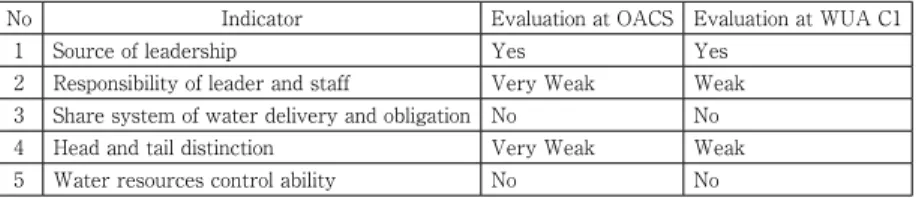
Based on Mr. A’s family background, clan leadership, personality, and skills, he is considered a good local leader in C1. Therefore, indicator 1 of Table 3 was evaluated as “yes.”
2) Evaluation of staff responsibility of WUA C1
Freeman notes that WUA leadership and staff are responsible to local members, not to the central government. To encourage leaders and staff to serve their local members, they should not be appointed by the irrigation agency, but instead selected by a general election held in the WUA.
Moreover, they should be paid by local members, not by the government [2].
In WUA C1, leaders were elected at the branch level and at each block level.
At each block level, five officers were elected. In the beginning of 2017, these officers held the Founders’ Committee to elect the eleven candidates
for chairman (Mr. A) and the other PMC members for the C1 branch canal.
From Block 1, one member was elected, while from Block 2 through 6, two members were elected per each block. In July 2017, those candidates were formally approved by C1 farmers at the C1 Founders Meeting. (Sixty-seven of eighty-eight WUA members attended this meeting.)
These PMC members were mostly traditional elites who came from royal families and served as executives of their own clan, such as Traditio- nal Councilor, Deputy Chief, or Head of Family. Going forward, it will be important to carefully observe whether these traditional elites serve mainly for their own family or for all the WUA C1 farmers (see Table 4).
Table 4. The Provisional Management Committee (PMC) members at WUA C1
No Position N B S Commu
nity Ethnics Position in clan Notes
1 Member - 1 - Akuse Korean n/a Bok Nam
Kim Farms 2 Member/
Chief, Dispute Settlement Committee
Mr. C 2 A Akuse Osudoku Assistant to
Head of Family 1998-2002 OACS President 1998-2000 KIS seed grower 3 Treasurer Ms. D 2 A Osuwem Osudoku Husband=
Clan Secretary 2013-2016 OACS Treasurer 4 Member/
Member, Dispute Settlement Committee
- 3 - Akuse - - Ghana Prisons
Service
5 Member - 3 - Akuse - - Ghana Prisons
Service 6 Member/
Member, Dispute Settlement Committee
Mr. B 4 A Akuse From Great
Accra 1982 Wife=Queen Mother/
Father’s brother= Head of Family
1998~C1 member 2009-2013 OACS C1 Branch Organizer 2013-2017 OACS C1 B4
Chairman 7 Vice Chairman/
Member, Dispute Settlement Committee
Mr. H 4 C Akuse From Volta
1975 n/a 1998~B4
Chair 2011-2013 OACS C1 Branch Chairman 2013-2017 OACS C1 Branch Vice Chairman 8 Secretary Mr. G 5 B Asutsu
are Osudoku Deputy Chief 2010~OACS C1 Branch Secretary 2013-2017 OACS Organizer 2013~OACS C1 B5 Secretary
9 Member - 5 D - - - -
10 Member Mr. I 6 B Akuse Osudoku Head of Family - 11 Chairman Mr. A 6 C Lubuse Osudoku Traditional
Councilor 2013-2017 OACS C1 Branch Chairman Note: N= Assumed name, B= Block, S= Section
Source: Author’s survey, 2017
Meanwhile, some PMC members (Mr. B, Mr. H (assumed name)) were outsiders who had migrated to the area in 1970s to 1980s, but they had high reputation of “hardworking for local people”. It seems that their industrious manner was the reason they were elected.
Some of the PMC members had served as the OACS Branch Officers at the time of OACS.
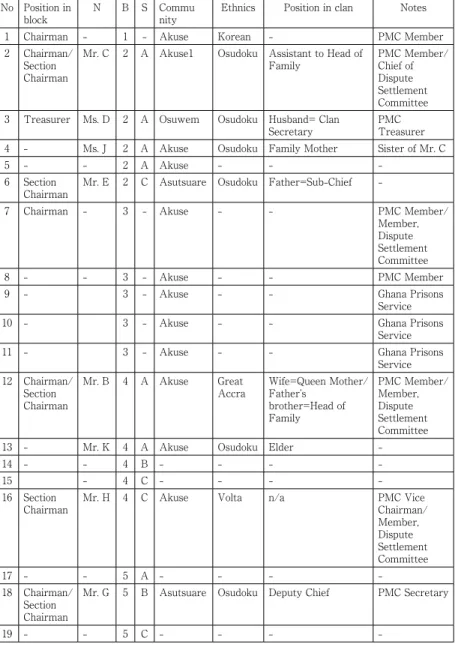
On the other hand, at the block level, one lateral representative (LR) at Block 1, and 5 LRs at each block from Block 2 to 6 were to be elected at each block election. Most of them were also traditional elites such as Head of Family, Elder, Family Mother (see Table 5).
Table 5. Lateral Representative (LR) at WUA C1
No Position in
block N B S Commu
nity Ethnics Position in clan Notes
1 Chairman - 1 - Akuse Korean - PMC Member
2 Chairman/
Section Chairman
Mr. C 2 A Akuse1 Osudoku Assistant to Head of
Family PMC Member/
Chief of Dispute Settlement Committee 3 Treasurer Ms. D 2 A Osuwem Osudoku Husband= Clan
Secretary PMC
Treasurer 4 - Ms. J 2 A Akuse Osudoku Family Mother Sister of Mr. C
5 - - 2 A Akuse - - -
6 Section
Chairman Mr. E 2 C Asutsuare Osudoku Father=Sub-Chief -
7 Chairman - 3 - Akuse - - PMC Member/
Member, Dispute Settlement Committee
8 - - 3 - Akuse - - PMC Member
9 - 3 - Akuse - - Ghana Prisons
Service
10 - 3 - Akuse - - Ghana Prisons
Service
11 - 3 - Akuse - - Ghana Prisons
Service 12 Chairman/
Section Chairman
Mr. B 4 A Akuse Great
Accra Wife=Queen Mother/
Father’s brother=Head of Family
PMC Member/
Member, Dispute Settlement Committee
13 - Mr. K 4 A Akuse Osudoku Elder -
14 - - 4 B - - - -
15 - 4 C - - - -
16 Section
Chairman Mr. H 4 C Akuse Volta n/a PMC Vice
Chairman/
Member, Dispute Settlement Committee
17 - - 5 A - - - -
18 Chairman/
Section Chairman
Mr. G 5 B Asutsuare Osudoku Deputy Chief PMC Secretary
19 - - 5 C - - - -
20 - - 5 D - - - PMC Member
21 - - 5 D - - - Retired
policeman/
Member, Dispute Settlement Committee 22 Section
Chairman Ms. F 6 A Osuwem Osudoku Husband=Head of
Family -
23 Secretary/
Section Chairman
Mr. I 6 B Akuse Osudoku Head of Family PMC Member
24 - - 6 B - - - -
25 - - 6 B - - - -
26 Chairman/
Section Chairman
Mr. A 6 C Lubuse Osudoku Traditional Councilor PMC Chairman
Note: N=Assumed name, B=Block, S=Section Source: Author’s survey, 2017
At the block level, while some LRs were very active, others had problems. Mr. B (assumed name), the PMC Member and the LR of Block 4 Section A is very active. He is a strong Block 4 leader, especially as Chairman of Section A. He is an outsider who migrated from Great Accra in 1982, but Section A farmers said that he is “hardworking” and “assists his neighbors.” Mr. K (assumed name), the LR of Block 4 Section A, said that Section A LRs, Mr. B and he, met almost every day to exchange information.
Meanwhile, there was some organizational weakness at Block 2. For example, Mr. C (assumed name), the Chairman of Block 2, did not attend the block meeting, only the Founders Meeting of C1. Only Mrs. D (assumed name), Treasurer of WUA C1, was active for Block 2, serving as a proxy for the Chairman to conduct the block meeting. Furthermore, even though there were three sections in Block 2, four out of five LRs, including Block Chairman, came from Section A. One of them was Ms. J (assumed name),
the Block Chairman’s sister. It appeared difficult to find a person who was willing to be an LR in Block 2. In Block 2 Section C, it did not appear that Section Chairman Mr. E (assumed name) was elected at the block meeting, but instead was nominated by Treasurer Mrs. D. Some LRs (e.g., Mr. E and Ms. J, the sister of Block Chairman) did not recognize themselves as LRs and considered themselves as just ordinary members. In Block 2, while only Treasurer Mrs. D was active, other LRs were unaware of their responsibilities and were not active at WUA activities.
In Section A of Block 6, Section Chairman Mrs. F (assumed name) asked the Block Chairman Mr. A (i.e., C1 Chairman) if she could resign because she did not understand her task and was too busy to attend the meeting.
Mr. A requested that she stay in the position, however, and told her that she did not need to attend all meetings.
In WUA C1, branch level PMC members were active at WUA activities.
Meanwhile, at block level, it seemed difficult to find a person wanting to become an LR, leading to some inactive LRs. Therefore, indicator 2 was evaluated as “weak.”
3) Evaluation of Distributional Share system of WUA C1
Freeman points out that the distributional share system is the core of any effective WUA. This means that water distributions is dependent on the fulfillment of organizational obligations. Moreover, the water share system should remove the head and tail distinction in the service queue.
Additionally, a member’s share of the system management cost should be proportionate to his/her share of water and share of vote [2].
Meanwhile, WUA C1 lacked a distributional share system, which Free- man points out as the heart of any effective WUA and successful irrigation
management. There were free-riders who received water without fulfilling their duties of Irrigation Service Charge (ISC) payment and communal labor for canal cleaning and there was no effective sanction in place to avoid these free-riders.
a. Share of cost at the WUA C1 1: ISC payment
In KIS, the ISC was set at 260 GHS per hectare annually. Since this ISC was a fixed rate per area, it was an unfair system for farmers who experi- enced water shortages downstream. Under OACS management, the ISC collection rate in the entire KIS varied from 10.85% to 105.56%, and the average rate was as low as 40%. Meanwhile, the ISC collection rate in Branch C1 was above the average KIS rate (91.1% in 2014, 86.0% in 2015, decreasing to about 40% in 2016), likely reflecting the sufficient water supply in the Branch C1 area.
There were still some members who did not pay the ISC because of an ineffective ISC collection system. Under OACS management, most farmers paid the ISC in rice to the OACS Task Force, which consisted of the executive members of OACS at the drying floor of OACS. Then, the Task Force paid the collected ISC to the KIS Office. Because the OACS did not issue the receipts of ISC payments, however, some farmers who did not trust the OACS directly paid the ISC in cash to the KIS Office. There was no follow-up regarding ISC collection by OACS for farmers who did not show up to the drying floor, meaning that the free-riders were left alone.
After WUA C1 was organized, farmers were asked to pay the ISC directly to WUA C1’s bank account. To ensure ISC payment, the PMC members planned to ask farmers to show receipt of their ISC payment before land preparation and, if the farmer could not, PMC would take over
his/her tractor until the farmer paid. However, this sanction was flawed because farmers could potentially rent another machine.
b. Share of cost at the WUA C1 2: communal labor
WUA C1 members were also responsible for participating in communal labor. WUA C1 engaged in communal labor two times annually before the farming season to clean branch and lateral irrigation and drainage canals.
At the branch canal level, WUA members worked together at each Section or at each Block. At the lateral canal level, the cleaning portion was divided and assigned to each individual farmer. To maintain branch and lateral drainages, WUA C1 members sprayed chemicals and cut weeds together.
Generally, WUA C1 could adequately maintain branch and lateral canals and drainages through communal labor.
Although the canal cleaning was the duty of every WUA member, some members did not clean the lateral canals assigned to him/her, or did not perform well (i.e., did not cut weeds sufficiently). Hence, weeds hindered the water flow, causing shortages at the tail portion of C1, such as Block 6 Section A. During OACS, the absent farmer was charged a penalty of GHS15~20, but OACS could not collect the penalty.
WUA C1 increased the penalty to GHS 50 and this was written into WUA bylaw. This decreased the number of absentee farmers. In some cases, PMC Member warned a farmer who violated the bylaw, and the farmer cleaned his portion later. In the other cases, the Dispute Settlement Committee could solve the problem by collecting the penalty from the violator. Compared with the time of OACS, attendance for communal labor improved, though there were still some who did not participate.
c. Share of water allocation in WUA C1
There were fewer water shortage problems at WUA C1 than other branch canals because C1 is located at the most upstream of KIS. Water distribution was largely equitable, but there were some water shortages at the downstream portion of Blocks 4, 5, and 6, mainly because of the breakdown of reservoir gates in 2016, which had not yet been fixed. At the tail portion, especially Block 6 Section A, the members always suffered from irrigation water shortage because adequate supply could not reach the area.
To cope with these shortages, some Blocks introduced rotation irrigation, e.g., Block 2 Section C, Block 4, Block 5 Section D, and Block 6. At Block 2 Section C, four members conducted rotation irrigation, with the rule that each farmer took water for one day from downstream to upstream. At Block 4, farmers conducted rotation irrigation from downstream to upstre- am (Section C -> Section B -> Section A). However, Section A farmers sometimes broke the rules and took water on Section C’s scheduled day.
Later, since the volume of water increased after they cleaned the lateral canal, they stopped the rotation. There were still some members, however, who stole water at nighttime. At Block 5 Section D, they conducted a rotation irrigation from the downstream to upstream. Some farmers did not follow the rules, leading to water disputes. At Block 6, Block Chairman Mr. A set a rotation irrigation schedule due to continual water shortages, especially in Section A because they are located at the tail portion of C1.
At Section A, the farmers could take their share of water on Tuesday. This reduced water shortages but did not solve the issue.
Despite efforts to facilitate equal water distribution, differences in water allocation between head and tail portions still existed at WUA C1, and
downstream members were disadvantaged.
d. Share of vote at WUA C1
Eleven PMC members who managed at the C1 level and twenty-six LRs who managed at block level were elected from each block. The distribution of representatives was mostly equitable, though it was somewhat unequal for officers in C1.
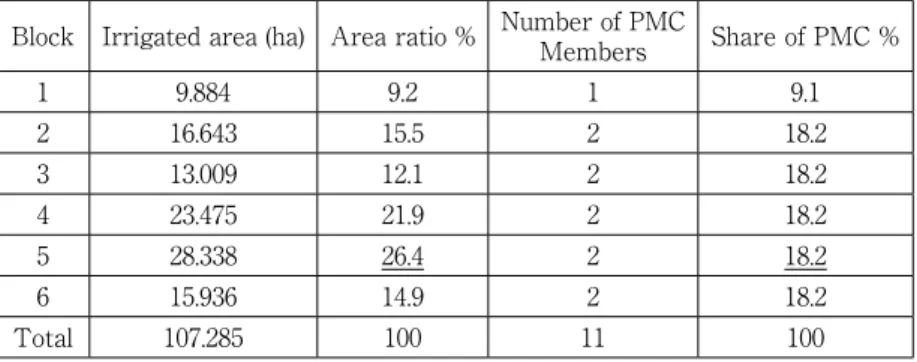
Although Block 5’s irrigated area was larger than other blocks, they had the same number of PMC members (two) and LRs (five) as other blocks.
This meant that they had fewer officers than appropriate for their portion of the irrigated area and, therefore, that their share of vote was less than the other blocks (see Table 6).
Table 6: C1 share of PMC Member per irrigated area
Block Irrigated area (ha) Area ratio % Number of PMC Members Share of PMC %
1 9.884 9.2 1 9.1
2 16.643 15.5 2 18.2
3 13.009 12.1 2 18.2
4 23.475 21.9 2 18.2
5 28.338 26.4 2 18.2
6 15.936 14.9 2 18.2
Total 107.285 100 11 100
Source: Author’s survey, 2017
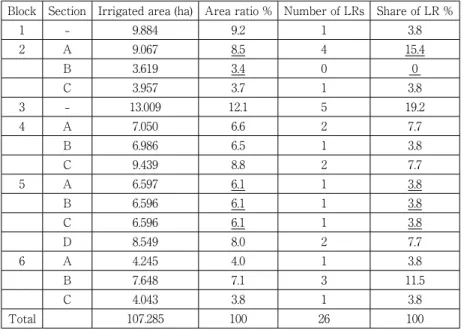
Meanwhile, Block 2 had enough PMC members. However, the distribu- tion of the number of LRs among sections was unfair. In Block 2, Section A had more officers than its share (four LRs), while Section B did not have any officers. As mentioned above, the selection procedures of LRs in Block
2 seemed problematic (see Table 7).
Table 7: C1 share of Lateral Representative per irrigated area
Block Section Irrigated area (ha) Area ratio % Number of LRs Share of LR %
1 - 9.884 9.2 1 3.8
2 A 9.067 8.5 4 15.4
B 3.619 3.4 0 0
C 3.957 3.7 1 3.8
3 - 13.009 12.1 5 19.2
4 A 7.050 6.6 2 7.7
B 6.986 6.5 1 3.8
C 9.439 8.8 2 7.7
5 A 6.597 6.1 1 3.8
B 6.596 6.1 1 3.8
C 6.596 6.1 1 3.8
D 8.549 8.0 2 7.7
6 A 4.245 4.0 1 3.8
B 7.648 7.1 3 11.5
C 4.043 3.8 1 3.8
Total 107.285 100 26 100
Source: Author’s survey, 2017
Consequently, WUA C1 did not have a distributional share system. In the aspect of the share of cost, WUA C1 could not avoid free-riders who took water without performing their organizational obligations (i.e., ISC payment and canal cleaning). In terms of share of water, WUA C1 could have relatively equitable water distribution. However, there was some water shortage downstream, hence head and tail inequities still existed.
The share of vote was mostly equitable. There was unfair vote distribution at Blocks 5 and 2, however, this problem could easily be solved if the concerned members discuss within WUA C1 and Block 2. Indicator 3 was
evaluated as “no” and indicator 4 as “weak.”
4) Evaluation of water resources control ability of WUA C1
Freeman states that among the six essential characteristics, if the first four are fulfilled, then the remaining two (water resources control ability and the propensity of members to support the local organization) will be realized. He points out that if the WUA has good water resources control, it can deliver sufficient irrigation water in a timely manner to all members [3]. To have high water control ability, ideally the WUA owns and controls the entire irrigation system from the water source (e.g., dam) to the down- stream part.
However, as mentioned above, the KIS had been managed by JSM, in which the KIS Office managed the main canal, drainage, and roads, while WUAs managed branch canals, drainages, roads, and below. WUA C1 lacked the water resources control ability because of this JSM arrange- ment.
a. Water resources control ability at branch canal level and below managed by WUA C1
As mentioned above, WUA C1 conducted communal labor 2 times per year before the farming season to clean branch and lateral irrigation and drainage canals. Generally, WUA C1 could maintain the branch and lateral canal fairly by this communal labor. However, since some members did not cut weeds sufficiently, it caused water shortage at the tail portion of C1, such as in Block 6 Section A.
To maintain branch drainage and lateral drainages, WUA C1 members sprayed chemicals and cut weeds together. Again, C1 could adequately
maintain drainages through communal labor.
As mentioned above, because each C1 Block had its own inlet from the branch canal, and each farm plot had its own inlet from the lateral canal, it was possible to easily manage water independently at the block and farm level. Namely, each farmer could take water directly from the lateral canal to his/her farm when he/she needed water, not affected by the neighbors, if there was no water shortage.
b. Water resources control ability at main canal level managed by KIS Office
Meanwhile, the KIS Office could not effectively operate and maintain the main canal, drainages, and roads because of a lack of funding.
The KIS Office was unable to clean the main canal in 2015 and 2016 because of inadequate funding. Consequently, sediment accumulated at the bottom of the main canal and grass grew inside, causing a water shortage downstream. Hence, all the KIS beneficiary farmers of the seventeen branch canal groups had to perform extraordinary communal work to dredge mud and cut grass at the main canal twice, once in 2016 and once in August 2017. Most C1 branch farmers participated in communal labor, while only half of the C6 branch farmers attended, claiming that cleaning the main canal was the duty of the KIS Office. Because of this poor mainte- nance of the main canal and the difficult, voluntary work involved in cleaning it, some farmers refused to pay the ISC, and the collection rate decreased from 86% to 40% in 2016 at C1 Branch.
It was said that the main drainage canal was not dredged for eight years because the KIS Office could not procure the heavy equipment due to a budget shortage. This caused the drainage canal to overflow at Block 2 and
4 in C1. In addition, in June 2017 water flowed out of the drainage canal and damaged a farm just prior to rice harvesting at Block 6 Section B. The owner of the farm refused to pay the ISC.
In addition, vehicles could not travel some portions of the main road because the KIS Office could not procure heavy equipment for road maintenance. Consequently, after the rice harvest, the farmers had to hire laborers to carry rice bags from their farms to the main road where the cars could enter. This caused extra labor costs for the farmers. The KIS Office was also unable repair the broken facilities such as irrigation canals, drainages, gates, etc., due to lack of funding and staff.
Regarding the water management of the main canal, KIS Office staff handled the operation of gates from the main canal to the branch canals.
Due to KIS Office restructuring, the number of water management staff was decreased from ten in 2014 to one in 2017. It took two days to monitor the main canal and the gates of the entire KIS, meaning that the staff could not respond quickly to farmers’ requests, such as to open and close gates or deal with overflow issues. Complaints from farmers increased. Although illegal operation of the main canal gates decreased after the WUA C1 was founded, some farmers still opened the gates illegally or broke the gate keys.
The management of irrigation facilities taken over by the WUA C1 were mostly adequate. KIS Office facility management was insufficient, however, due to lack of funding. Hence, the WUA C1 could not deliver sufficient water in a timely manner to the members. Consequently, the JSM arrange- ment in KIS reduced the WUA C1’s control of water resources. Therefore, indicator 5 was evaluated as “no.”
5) Evaluation of members’ support to WUA C1
At the time of field survey on September 2017, the officers of WUA C1 were highly motivated. For example, PMC members accepted the increased ISC rate. They planned to take over the plots of ISC non-payers.
They were willing to operate and maintain the branch and lateral canals of C1 by themselves. Officers were confident about the WUA management.
Members were also mostly cooperative with the Officers (e.g., Block 4).
Under OACS management, they lacked bylaws, and leadership was weak. Officers were unable to charge penalties and they could not control free-riders. Farmers did not participate in canal cleaning, or pay the ISC or fines.
Morale was high among officers and members because the WUA C1 had just been established, and they expected much of the new WUA. If WUA management was not successful as they expected, their morale would decrease. At this moment, indicator 6 was evaluated as “yes,” but it is necessary to pay attention to future developments.
Hereafter, Ostrom’s model is used to assess the WUA C1’s organizational performance.
6) Evaluation of clearly defined boundaries of WUA C1
Ostrom states that individuals or households that have the right to withdraw resource units from the CPR must be clearly defined, as must the boundaries of the CPR itself (see Table 1). Freeman (2009) defines
“organizational boundaries in terms of water share ownership.” The WUA must clearly define members who are entitled to receive water and required to fulfill organizational obligations, such as paying the ISC [3].
The boundaries of local organizations and WUA C1 membership were clearly defined. In 1998, the farmers who maintained farms under KIS were registered as members by the KIS Office. While the population rate of native people (Osudoku) was 55% and many other ethnic groups had come in Akuse area, Osudoku were given priority for plots allocated in the KIS. For this reason, the membership rate of Osudoku was 76% in the KIS.
Those who could not get plots became tenant farmers or farm labors. The economic situation of farm labors seemed severe.
Meanwhile, most “landowners” (who rented the plots from KIS Office) opposed membership of tenant farmers to the WUA for fear that the tenants take away their plots. Therefore, the landowners made an annual tenancy contract and did not sublease the plots more than ten to twenty years.
Originally, the boundaries of organizations were clear at KIS. However, re-registration of KIS membership was ongoing and not yet finished as of March 2017. Not all beneficiary farmers were members of WUA C1. It was not easy to re-register, farmers needed to pay the ISC for 2015 and 2016 prior to re-registering. As per a KIS Office rule, every five years beneficiary farmer had to re-register for membership, and if he/she could not complete ISC payment, the KIS Office would take over his/her plot.
The KIS Office was unable to enforce this rule before. Now, the KIS Office planned to implement the rule to follow the new law L.I. 2230. Although the due date of ISC payments had been postponed many times, there were still some farmers who did not pay their balance.
Among farmers who did not pay their ISC balance, there were some who refused to pay because the KIS Office did not effectively operate and maintain the main canal, drainage, and roads. Others could not pay for
economic reasons: the price of rice was low in 2015 and 2016. Meanwhile, farming costs increased because road conditions were not good, so farmers could not reach their farms by vehicle and had to hire labors to carry their harvested rice from the farms to the main road. The profitability of rice farming decreased. Moreover, a shortage of farm equipment (such as tractors and combines) prevented farmers from renting the machines on time, and it caused delays in farming activities. In 2016, the price of rice was so low so that rice traders could not sell it. Because farmers could not borrow cash from rice traders, some farmers could not start framing during the next season. Farmers suffered from poor farm management.
Some tenant farmers also had problems because landowners did not pay the ISC to the KIS Office and could not re-register KIS membership, which made them concerned that they would be unable to continue farming. PMC members of C1 discussed a plan to recommend those tenants to the KIS Office as new members of WUA C1, but they had not yet decided.
Many other people wanted to get farm plots in and around KIS because of the attractiveness of rice farming. Some of them were businesspeople who planned to operate large farms. On the other hand, WUA C1 farmers wanted to give priority to the native people. They wanted to recommend people who would attend WUA meetings, participate in canal cleanings, pay the ISC, and generally act responsibly.
KIS membership, once clear, became more flexible. Hence, indicator 7 was evaluated as “weak.”
7) Evaluation of collective-choice arrangement in WUA C1
In the third design principle, Ostrom states that most individuals affected by the operational rules can participate in modifying these rules (see Table
1). Freeman (2009) points out that “at the level of the local commands, the collective choice arrangements are in the conceptual models mostly about administering the three-sided share system.” Most WUA members can participate in modifying the rules of the share system such as benefits received (i.e., water distribution), member obligations such as ISC payments, and voting privileges [3].
At WUA C1, the Founders Meeting was equivalent to the WUA General Meeting. Attendance rates were high: 88.6% in May 2017, 76.1% in July 2017, and 64.8% in August 2017. WUA C1 planned to have the General Meeting in September or October 2017 to formally begin WUA activities, in which members would approve bylaws, annual budget, and the work plan for 2018.
WUA C1 also had officers’ meetings; the Provisional Management Committee (PMC) at the branch level and Lateral Representative meetings at the block level were held seven times from December 2016 to August 2017. Most officers attended meetings regularly. At PMC, they discussed WUA bylaws, budget, ISC collection, the work plan, etc.
At the block level, there was a block meeting for all members. However, block meetings were inconsistent. At Block 2, the Treasurer Mrs. D conducted the block meeting. At Blocks 4 and 5, the block meeting had not yet been held, though it had been planned in the latter. Block 6 planned to hold one on September 2, 2017, but it was postponed because Chairman Mr. A could not attend.
However, the WUA C1 had limited ability to modify operational rules.
The intake operation for water distribution from the main canal to the branch canal was overseen by KIS water management staff. WUA C1 could not improve the operation and maintenance of the main canal,
drainage, and road because it fell under KIS Office jurisdiction and required significant funding. Since WUA C1 could not modify those important operational rules, indicator 8 was evaluated as “weak.”
8) Evaluation of monitoring at WUA C1
Ostrom states that monitors, who actively audit CPR conditions and appropriator behavior, are accountable to the appropriators or are appropri- ators themselves (see Table 1). If a clear share system arrangement exists, the WUA should be able to monitor whether water is being properly delivered to each member as planned, whether members have paid the ISC and fulfilled their obligations to the WUA, and whether collectors have remitted the ISC to the WUA.
a. Monitoring of water allocation at WUA C1
As previously mentioned, there was a shortage of water management staff in KIS, including in C1. Therefore, it took two days to monitor the whole irrigation system, and the KIS staff could not sufficiently monitor the gates. Some farmers illegally opened gates, or broke the gate keys.
The KIS Office could not fix the breakdown of facilities such as canals, drainages, and gates quickly due to lack of staffing and funding. This made it difficult to monitor and maintain proper delivery of irrigation water in C1.
b. Monitoring of the ISC payment at WUA C1
Previously, the OACS Task Force monitored members’ ISC payments when they brought rice to the drying floor. There, the Task Force collected the ISC, and paid the ISC to the KIS Office. However, all farmers
did not come on collection day, and there was no follow-up for absent farmers. Some OACS members believed that “Government money should be collected by the government.” The KIS Office did not make non- payment information available to OACS, so officers did not know who paid or did not pay. OACS could not avoid the free-riders.
In the new management plan of the WUA C1, the farmer would pay the ISC directly to the bank account of C1. The farmer would get three copies of the receipt and keep one for his or herself, one for WUA, and one for the KIS Office. WUA C1 request that farmers show receipt of ISC payment, and if the farmer failed to do so, WUA C1 would not allow them to start farming. Through this method, it was expected that WUA C1 could monitor the ISC payment of each member.
c. Monitoring of the attendance of communal labor at WUA C1
At WUA C1, canal cleaning was monitored by communal labor Task Forces. Their oversight was relatively effective. For example, the Task Force at Block 4 Section A was composed of the Section Chairman Mr.
B and four other members who monitored cleaning of the lateral canals.
Two out of seven members were absent, so the Task Force directed the two absentee members to clean the canals. At Block 5, the Block Chairman Mr. G, the PMC Member, and five Section C members comprised the Task Force, and together oversaw canal cleaning. Since 15-20% of the canal cleaning was unsatisfactory, the Task Force hired labors to complete cleaning, and let the farmers to pay the labor cost and the penalty of GHS 20.
d. Monitoring of the remittance of ISC to WUA C1
OACS sold the collected ISC rice to the market, and paid the cash to the KIS Office and a bank to repay the loan. OACS did not issue receipts to the farmers, however, so farmers who doubted that the OACS properly handled the collected ISC paid cash directly to KIS Office. WUA C1 planned for farmers to pay directly into its bank account, people hoped to avoid ISC misuse.
Though water allocation monitoring, ISC payments, and participation in canal cleaning improved under WUA C1 management, it was not sufficient.
Indicator 9 was still evaluated as “weak.”
9) Evaluation of graduated sanctions at WUA C1
Ostrom states that appropriators who violate operational rules are likely to be assessed graduated sanctions by other appropriators, by officials accountable to these appropriators, or by both (see Table 1).
Absence from communal labor was to be sanctioned with fines in WUA C1. Under OACS, the fine had been GHS 20. Under WUA C1, the fine was increased to GHS 50. According the new rule of WUA C1, if a farmer did not pay the fine, he/she could not farm for one year. If the farmer delayed paying the fine, it would increase to GHS 100. For example, at Block 6 the fine was set as GHS 50, but because everyone participated in communal labor, they did not need to collect the fine. At Block 4 Section A, the task Force ordered the two absentees to clean the canal, but they did not clean.
When the Task Force warned them to impose GHS 50, they apologized.
The Task Force forgave them and did not collect the fine.
If a farmer broke the rule of irrigation rotation, he/she would be sanc- tioned. At Block 4 the person would be imposed the fine of GHS 50. All
members obeyed the rule and they did not need to collect the fine.
At WUA C1, the fine for the absence during communal labor became gradually more severe. A warning was effective to sanction the offender in a minor offense. However, it is still unclear whether the new rule for the non-payment of ISC (i.e., not allowing the offender to cultivate the farm) would be effective or not. Hence, indicator 10 was evaluated as “weak.”
10) Evaluation of conflict resolution mechanism at WUA C1
Ostrom points out that appropriators and officials have rapid access to low-cost local arenas for the resolution of conflicts among appropriators or between appropriators and officials (see Table 1).
At the time of OACS, conflict resolution was not enough. Regarding absence during communal labor, although there was a KIS Office guideline to pay a fine of GHS 20, the absentee farmers did not pay it. The OACS Task Force waited at the drying floor to collect ISC rice. However, there was no sanction for the farmers who did not show up on that date. The Task Force covered only a portion of KIS farmers. Since some OACS officers did not pay the ISC nor follow the rules, they could not force the farmers to pay the ISC. The KIS Office also did not take any action for non-payment. Despite a regulation that the KIS Office would take over the plot of the farmer who did not pay, the KIS Office could not enforce this rule. Under OACS management, there were rules but farmers did not follow them. The OACS was too large, making it difficult to enforce penalties. Although the Dispute Settlement Committee existed in OACS, it was not effective.
Conflict resolution improved under WUA C1. A bylaw was created increasing the fine for failing to participate in communal labor from GHS
20 to GHS 50 and it was enforced more strictly. For example, a Block 5 farmer who refused to pay the fine of GHS 20 was sent to the Dispute Settlement Committee. The committee decided not to allow the offender to farm, so the farmer promised to pay after the harvest, and started farming late. At Block 2 Section C, a farmer did not clean his portion of the lateral canal. This was discussed at the block meeting and the Treasurer Mrs. D admonished the farmer, then the farmer promised to change his attitude.
At Block 4 Section A, two out of seven members were absent from canal cleaning. When the Section Chairman Mr. B ordered them to clean the canal, they did not follow. Then, the Chairman warned them that he would impose the fine of GHS 50. They apologized and the Chairman forgave them. Later, they cleaned the lateral canal.
The WUA C1 could improve the issues of poor lateral canal cleaning. In one example, a Block 6 farmer could not finish the canal cleaning before farm season, and the officer (LR) did not allow him to farm. The farmer shouted to protest, but the Block Chairman (C1 Chairman Mr. A) stopped him, giving him two days to finish the cleaning. The farmer obeyed.
Farmers often protested the rule shouting because delayed farming reduced yields.
Regarding non-payment of the ISC, the C1 Task Force planned to request that farmers show receipt of ISC payment at land preparation.
They planned to take over the farm machines until the farmer paid.
The fear was that farmers just rented other machines. Also, if farmer’s cultivation was delayed, the WUA C1 could not introduce simultaneous cultivation. This sanction seemed difficult to apply.
Meanwhile, it was said that the illegal opening of the intake gate at the main canal had decreased since the WUA C1 was established. However,
illegal checking still existed. For example, at Block 4 Section A, many farmers took water illegally at night. Although the LR consulted with the Section Chairman, he was told to “be patient because we have enough water.” This problem remained unsolved.
Water disputes often occurred when a farmer wanted to harvest, but a neighbor’s irrigated water damaged the farmer’s harvest. For example, at Block 4 Section C, Section Chairman Mr. H let the farmer harvest his rice first, because the neighbor could wait for irrigation. At Block 4 Section A, this problem happened every year, so that the neighbor promised to build a wall between the farm plots. However, the tenant did not build the wall as promised. When the farmer consulted with Section Chairman, he told him to “keep quiet until we hold the meeting.” At Block 5 Section B, two farmers fought over water because of a shortage. The Block Chairman Mr. G closed the upstream gate, prioritizing downstream irrigation and ordering the members to obey the rotation rule.
The Dispute Settlement Committee in WUA C1 was established in 2017. Since then, they held two meetings. The committee consisted of five members including an ex-policeman and prison officer. In one case handled by the committee, a landowner tried to take the farmland from the tenant and sublease the land to another farmer. The committee arbitrated the disputes and made the landowner admit the mistake and pay the penalty of GHS 20. In another case, a Block 2 farmer irrigated water when the neighbor harvested rice. The Treasurer, who was the victim, brought the case to the police. The committee then took back the case and made the offender apologize. The committee warned the offender that she would lose her cultivation right next time, and made the offender pay the penalty of GHS 200.
Since WUA C1 was established, the ability of conflict resolution seemed to increase than before. Conflicts still existed regarding members not attend canal cleanings, inadequate canal cleaning, water disputes, etc., but the WUA C1 could settle those disputes independently. It is still unclear whether the penalty for ISC non-payment planned by the C1 Task Force would work effectively. It was hard to assess this sanction before enforcement started. Indicator 11 was evaluated as “weak.”
11) Evaluation of minimal recognition of rights to organize within WUA C1
Ostrom states that the rights of appropriators to devise their own institutions are not challenged by external governmental authorities (see Table 1).
As previously mentioned, in Ghana, the WUA’s right to organize was guaranteed by the Law L.I.2230 beginning in May 2016. GIDA ordered the establishment of the WUA on September 2016 [14]. From this point on, the WUA C1 was legally authorized by the WUA Law.
WUA C1 covered a smaller area than OACS so that it could focus on managing its own branch canal. While the OACS took charge of many tasks including agricultural credit, the WUA C1 focused on water manage- ment. WUA C1 also had a decentralized organization in which there were blocks under WUA C1, and sections under the blocks. Each section had a leader (Section Chairman), and a section served as the unit of communal labor, meetings, and rotation irrigation. This allowed each section to manage independently. Consequently, PMC members could oversee WUA management easier than under OACS.
WUA C1 needed sufficient financial management capacity, so it planned