Proposal of a Remote Watching System Utilizing a Smartphone and Sensors
Daichi Kato, and Hiroyuki Yamagishi, Hidekazu Suzuki, Eiji Konaka, and Akira Watanabe Graduate School of Science and Technology Meijo University, Nagoya 468-8502, JAPAN
Email: [email protected], [email protected], [email protected], [email protected], [email protected]
Abstract—There is an increasing tendency that elderly people live separately from their children or relatives with the advance of low-birth-rate, aging society and the changes in living en- vironment. Under such circumstances, a number of systems to remotely watch vulnerable people by utilizing sensor devices and communication functions have been proposed. Existing systems to watch vulnerable people are, however, mainly aiming at health management or obtaining merely locational information of vulnerable people, and they are not able to perform a high-level observation to grasp the actual situation of those people. In this paper, we introduce a new system to remotely watch conditions of vulnerable people while they are walking or driving a car, by utilizing various types of sensors embedded in a smartphone.
In our system, information obtained is periodically sent to and accumulated in the management server on the Internet, and watching people can observe their vulnerable relatives from anywhere and cope with emergency situations promptly.
I. INTRODUCTION
With the advance of aging society and the changes in living conditions, the environment surrounding elderly people has been changing. In 2010, the ratio of elderly people exceeded 25% of the entire population of Japan. The cases that elderly people live separately from their children or relatives are also increasing, and more than 20% of the entire households are reported to be those of elderly people. Meanwhile, the number of aged people who drive a car to enjoy leisure is also increasing. However, since it is often the case that the physical condition of those elderly people is weakened, there is a rather high possibility of their encountering traffic accidents.
The death rate of elderly people by traffic accidents is quite high and it is reported that the rate is over 45% of the total deaths due to traffic accidents.
From such a fact, creation of a system to watch vulnerable people remotely even when they are out of home is urgently required. Targeted people here are not only elderly people but also children, medical patients and handicapped people, and the same watching system can be applied to all those people. We call our targeted people the vulnerable, and we aim at realizing a system capable of watching the vulnerable comprehensively.
Of late, because of the development of information tech- nologies, smartphones having high-level calculation capabil- ities despite of their small size and light weight are easily available on the market, and it has become possible to connect with networks at any time and from anywhere. A variety
of sensors are embedded in smartphone, and we are able to obtain locational and environmental information. Accordingly, we have now such environment at hand where we can realize a system by which we watch vulnerable people at any time and from anywhere, by collecting information obtained through sensors via networks and analyze it.
There are already a number of studies to watch the vulner- able, but they usually assume that the vulnerable constantly stay at home, and there are actually few services that take into account the situation where the vulnerable go out of home. And even in the case of services which consider such a situation, they can’t watch the conditions of the vulnerable or detect abnormality.
Such being the situation, we propose in this paper a system to remotely comprehend conditions and behavior of the vulner- able through various sensors embedded in a smartphone. When a vulnerable person is driving a car, we also get information about the functional conditions and moves of the vehicle such as breaking and acceleration. Furthermore, we obtain information on the health conditions of a vulnerable person in conjunction with health-related sensors. Such information is sent to the management server at regular intervals and stored in the database, which watching family members can browse at any time from home terminals.
Hereinbelow, we describe the existing services/systems in Chapter 2, configuration of our proposed system in Chapter 3, operation of our system in Chapter 4, implementation in Chapter 5, and finally the summary in Chapter 6.
II. EXISTINGSERVICES/SYSTEMS
The following are existing systems similar to our proposed system.
A. Home Health Care Project conducted by NEDO
As one of the existing personal health assistance systems, there exists a project called “High-efficiency Health Measure- ment Device Development Project” conducted by NEDO (New Energy and Industrial Technology Development Organization) [1]. In this system, health-related information obtained at home by health measurement devices such as blood pressure monitor and thermometer is gathered in the gateway device and sent to the management server. In the management server, collected health information is analyzed and stored. Such The 11th International Symposium on Communications & Information Technologies (ISCIT 2011)
978-1-4577-1295-1/11/$26.00©2011IEEE 36
information stored by the server can be read from home and medical institutions. Such devices that comply with the design guideline of CONTINUA need to be used so that they can be mutually connected with health-related devices. The shortcomings of this system are that the system assumes that the targeted people always stay at home and do not take into account the situation where those people go out of home.
B. sensor functions Support
As a system to realize health services, Wellness Support[2]
is commercialized. Various data obtained by health devices such as body composition meter and blood pressure monitor and from the passometer function of a mobile phone are collected and stored in the server of Wellness Support through the mobile phone. Health-instructing organizations or health care-related companies can combine them with their own services by getting access to the server in order to provide their services in an efficient manner. This is a service intended for companies, and users can get instructions from professional people by just sending data stored in the terminal. However, this service is mainly offered to people for their own health management and is not intended to watch vulnerable people.
C. Ubiquitous Watching-Information Net
As a system to watch the vulnerable, we have Ubiquitous Watching Information Net (Higo-Yu Net)[3] conducted by NPO Kumamoto-machizukuri. They provide vulnerable people with smartphones to carry with them, and through the smart- phone it is possible to trace their location even if they go out of home. At the same time, this system intends to vitalize local communities by collecting and sharing information about the location of elderly people through a communication network.
This system also deals with the wandering behavior of elderly people. It can get the information about the route an elderly person is wandering. However, the data collected by this system is locational information only and thus, the amount of information is limited. Also, there is no mechanism of detecting abnormal conditions of vulnerable people on the side of the system and it is not possible to provide information to watching-side people promptly.
D. Kuden-cho Project
As a system to watch conditions of elderly people, Kuden- cho Project[4] has been proposed. In this system, multiple sensors such as motion sensors and door sensors within the residence of elderly person are installed. Opening and closing of doors, human motions and illumination light-ups are de- tected by the installed sensors, and the information obtained is sent to Administration Center to indicate the health conditions of the relevant elderly person. If any abnormality takes place in their living conditions, the situation is automatically detected, and staff member of a hospital, fire department or volunteer group will call up or visit the relevant person to check his or her health conditions. As a similar system, we have also
“Tateyama Mimamori Eye”[5]. However, all of these systems assume that the targeted persons are within their residence and
do not take into account the situation where they are out of home.
E. SafetyRec
As a system to support safe driving of drivers, tere is a system called “SafetyRec”[6]. In this system, such moves of a car as breaking, turning right or left, changes in position and speed are measured by the sensors embedded in a smartphone in order to determine the safety degree of the driving. If any abnormal behavior is detected, the situation is recorded by the camera of the smartphone. However, this system is essentially intended for driver’s future reference and not intended to watch driver’s health conditions.
III. CONFIGURATION OF OURPROPOSEDSYSTEM
A. Configuration of our System
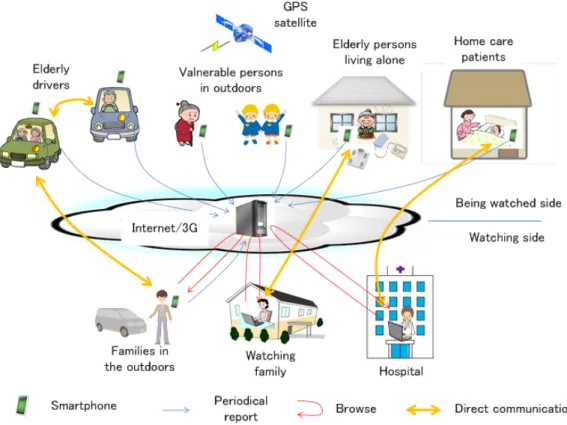
In this paper, we propose a system to remotely watch a vulnerable person even in the case of his or her being out of home, by utilizing communication and sensor functions of a smartphone carried by the person. The configuration of our proposed system is shown in Fig. 1. The behavior or driving condition of the person is determined by various sensors installed in the smartphone. The present location, moving route and speed are traced by GPS.
The results of measurement by health devices such as pulse monitor and scale are recorded in the smartphone by way of bluetooth communication. These data are sent from the smartphone to the management server at a periodical interval and accumulated for each person in his or her database. Such information in the database can be browsed by getting access to the management server. In the management server, the information received is compared with the past data to see if there is any abnormal behavior or symptoms to the relevant person. If any abnormality is detected, an alarming e-mail is sent from the server to the (watching) person registered in advance. In this way, watching-side people can understand the conditions of the vulnerable person promptly. Also, the vulnerable person himself or herself can look back his or her own private life and health management later-on. In this paper, we focus on the portion of sensing technologies applied to the smartphone to judge the behavior of the vulnerable, out of our proposed system.
B. Grasping of the condition of a vulnerable person
The ways of grasping conditions by sensor devices installed in a smartphone are switched for the occasions of walk- ing/staying at home, and of driving. One of the methods of switching is to make it automatically based on the moving speed.
1) Sensing at the occasion of walking and staying at home:
When the person is walking and staying at home, the moves of the smartphone are the moves of the person himself/herself.
Thus, the state of the person (walking, running, sleeping, sitting, falling down, etc.) is determined from the information obtained through various types of sensors. At the same time, the location and moving route of the person are identified
37
Fig. 1. Configuration of our proposed system.
by GPS. When the person is at home, health conditions of the person can also be grasped by collecting the results of measurements by a scale and pulse monitor.
2) Sensing at the occasion of driving a car: At the time when the person is driving a car, the information that can be obtained from the smartphone is mainly that of the moves of the car, but not those of the person. Therefore, we consider that the information obtained by sensors is that of the car, and we detect the condition of the car (such as that of speed, turning to right or left, shaking, clashing, etc.). Also, at the occasion of driving, moving speed, in addition to locational information, is obtained from GPS.
C. Health management of a vulnerable person
In the case where the person can use health management devices (hereinafter “HMD”) capable of making bluetooth communication, the functions of such devices are also used in conjunction with those of the smartphone. Body composition meter and blood pressure monitor are considered to be among HMDs. HMDs need to be linked to the smartphone in advance.
Then, when HMDs are operated with the smartphone at hand, measured data are sent to the management server through the smartphone with a touch on a button.
D. Reporting to the server
Reporting to the server can be done by either 3G or Wi-Fi.
Wi-Fi is preferred, if that is available. Sensor data are sent to the server by UDP after adjusting to XML format. The reasons for adjusting to XML format are as follows.
• It is easy to distinguish data received.
In the management server, it is necessary to assort re- ceived data by type. Therefore, it is required to send data received by the smartphone to the server after making the matching with an appropriate type. By enclosing by the tag, it is easy to make the matching of the data received with the data type.
• It is easy to expand.
It is possible that the amount of the sensor data stored in the smartphone is increased in future. You can flexibly cope with such expanded situation.
• It is possible to make stratified data structure definitions.
There are cases where one single user uses multiple sensors, or multiple sensor information is obtained from one single sensor. By making data structure definitions in a stratified manner, you can describe data obtained by one single sensor altogether, and also make classification depending on the types of the sensor data.
E. Security
In transmitting data from a smartphone to the management server, security technologies to prevent from information fal- sification or leakage are important. Thus, in our proposed system, we secure security through authentication by our original technology “DPRP” (Dynamic Process Resolution Protocol)[7]and encryption by “PCCOM” (Practical Cipher COMmunication)[8].
Generally, it is difficult to secure security by UDP, but in
38
Fig. 2. Operation of the proposed system.
our proposed system, we can realize it by DPRP and PCCOM.
Because these protocols are implemented in IP layer, they can deal with any application. It is also possible to secure security in the end-to-end communication after alarm detection.
F. Operation of our proposed system
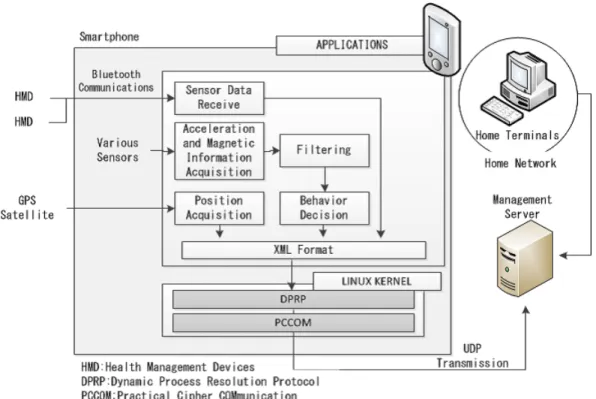
Operation of our proposed system is shown in Fig. 2. In this Figure, the operation on the side of the smartphone is mainly described. In the smartphone, conditions of the relevant person are grasped by constantly obtaining sensor information.
Because a lot of noises are included in the information obtained from various sensors, it is not possible to correctly grasp the person’s walking condition or the instance of falling down, without filtering the data. Thus, filtering of the obtained data is required to correctly determine the behavior of the person. The results of behavior determination are reported to the server at the periodical intervals, together with obtained locational information and the data collected from HMD. On the side of the management server, the information received is accumulated in the database. Such information can be browsed from home terminals or smartphones by getting access to the management server.
IV. IMPLEMENTATION
In order to realize our proposed system, we have imple- mented trial modules as described below. In this trial system, we chose an Android terminal. The configuration of the trial module within the Android terminal is shown in Fig. 3 The notching frames indicate JAVA classes. In Fig. 3, the number of steps is counted byPassometer,locational information is de- termined byLocationGPS,andConnectionBluetooth,receives
Fig. 3. Module configuration in the Android terminal.
sensor information sent from HMD. The collected sensor in- formation is accumulated inRegenesisData.The accumulated data are converted to XML format by ConnectionUDP and sent to the server at regular intervals.
Since our proposed system is intended for watching vulner- able persons, it is necessary to keep applications activated all the time. Accordingly, we implemented these functions in a manner that all functions can be operated in the background.
A. Walk counting by Passometer
A three-axis accelerometer is equipped with the smart- phone. The passometer module counts the number of walks using accelerometer measurements. The measured three-axis acceleration is synthesized and an effect of the gravity is
39
Fig. 4. Synthesized acceleration value Row datar and Filtered data.
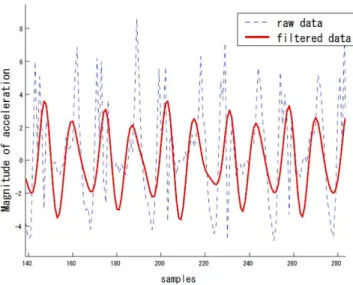
eliminated. Frequency of walking is approximately from 1 to 2 [Hz], however, the raw measurement of the accelerometer contains high-frequency noises. In order to realize accurate counting, suitable bandwidth of walking should be extracted through Butterworth filter. Fig. 4 shows the measured raw data (blue dashed line) and the filtered data (red solid line). The horizontal and vertical axes denote the sampling index and the magnitude of acceleration, respectively. This figure shows that the filter can reduce the noise and can extract the acceleration caused by walking. The passometer module counts the number of walks by detecting the magnitude of acceleration is above upper threshold and below lower threshold.
B. Acquisition of locational information by LocationGPS In LocationGPS, locational information is obtained at reg- ular intervals using the GPS function of the smartphone. As a lot of power of batteries is consumed when GPS is used, we added a function whereby the intervals of GPS acquisition are freely set according to the needs of users.
C. Acquqisition of health information by ConnectionBluetooth ConnectionBluetoothgrasps health condition of the relevant person by receiving the sensor information sent from HMD.
In our trial system, we made it possible to receive information from PC by making serial port communication with bluetooth from PC instead of HMD.
D. Data renewal by RegenesisData
RegenesisDatacollects sensor data obtained. We entered the data received in the file at regular intervals so that the restart of the process by Android OS is not affected.
E. Transmission of data by ConnectionUDP
ConnectionUDPcollects the sensor data obtained and make UDP transmission at regular intervals after converting to XML format. Fig. 5 shows the transmitted data of passometer and
Fig. 5. Transmitted data in XML format.
Fig. 6. The cumulative number of passometer browsed.
locational information obtained from the sensors, which are converted to XML format. From Fig. 5, we can see that the data are converted to proper XML format.
F. Viewing of data at the home terminal
The information sent by the smartphone is stored in the management server. When a viewer gets access to the man- agement server form a home terminal, the cumulative number of steps can be browsed at the home terminal as shown in Fig.6 . We have confirmed that both moving route and passometer are properly shown.
V. SUMMARY
In this paper, we described our proposed system to remotely watch vulnerable persons as well as the results of the imple- mentation of a trial system. In the future, we will undertake additional implementations so that detection of more detailed behavior of vulnerable people is realized, utilizing various sensors attached to a smartphone.
REFERENCES
[1] K.Kashiwagi, “Communication protocol on health instrument and the standardization trend,” Journal of Information Processing Society of Japan, Vol. 50, pp.1215–1221, 2009.
40
[2] Wellness Support. [Online]. Available:http://www.nttdocomo.co.jp/binary/
pdf/corporate/technology/rd/technical journal/bn/vol17 2/vol17 2 011jp.pdf#page=1 [3] Ubiquitous Network and watch. [Online]. Avail-
able:http://portal.higoyou.net/
[4] Project Kuden Town. [Online]. Available:http://www.ur- net.go.jp/rd/kudencho/index.html
[5] Mami charm and fresh eye. [Online]. Available: http://www.tateyama- mimamori-eye.com/hns/index.html
[6] Safety Rec.[Online]. Available: http://www.datatec.co.jp/safetyrec/
[7] H. Suzuki and A .Watanabe, “Implementation and its evaluation of dynamic process resolution protocol in flexible private network,” IPSJ Journal, Vol. 47, no. 11, pp. 2976–2991, Nov. 2006.
[8] S. Masuda, H. Suzuki, N. Okazaki, and A. Watanabe, “Proposal for a practical cipher communication protocol that can coexist with nat and firewalls,” IPSJ Journal, Vol. 47, no.7, pp. 2258–2266, Jul. 2006.
41
Daichi Kato, Hiroyuki YAMAGISHI, Eiji Konaka , Hidekazu SUZUKI, and Akira WATANABE
Meijo University, JAPAN
1
Proposal of a Remote
Watching System Utilizing a
Smartphone With Sensors
Research background and purpose
• In Japan,lifestyle is now changing, because of the aging society
•
Elderly people and their families sometimes live separately
•
Elderly people sometimes drive their cars for social participation
-However,
they are likely to cause an accident, because their attention is rather dull
• There are few services for people who want to watch elderly people
• We think it is very important that we can watch the elderly at anytime and from anywhere
• We propose here the watching system of elderly people utilizing a smartphone.
2
Existing technology :Kuden-cho Project
Source : Kuden-cho Project “http://www.sokie.com/kuden2/index.html ” 3
However, this system is valid only when the elders are in the house.
It does not take into account when the elders go out.
•
There are human presence sensors, door sensors, light sensors in the house, and actions of the residents, such as opening and shutting of doors, switching on and off of lights can be detected
•
Such information is sent to the server in the security center
•
When a warning is detected, a watcher or volunteer make phone calls
or visit the house
Existing technology : SafetyRec
4
The purpose of this system is to improve their driving skills.
It is not applicable to watching systems as it is.
•
Driving information, such as operations of brakes and the accelerator can be detected by a smartphone
•
This system is developed by the venture company in Japan and is called SafetyRec
•
Scores of driving operations are shown in the display
•
Drivers can look back their skills at a later
Source :SafetyRec“http://www.datatec.co.jp/safetyrec”
Proposed System Configuration
5
• Expected that the vulnerable has a smartphone
•
Sensors in a smartphone get various kinds of information
• Sensors Data
•
The collected information is sent to the server on the server on the Internet periodically
•
Relatives can browse the conditions of the vulnerable at anytime and from anywhere by Accessing to the terminal
•
The server always checks
the received data
6
Watching family Families in the outdoors
Smartphone Periodical report Browse
Elderly drivers Valnerable persons in outdoors
Valnerable side
Hospital
Watching side
Direct communication
Internet/3G Management
Server
The sensing with the Smartphone
Gradient sensor
WiFi 3G
smartphone Acceleration sensor
Magnetic sensor
Bluetooth
The acquisition of the positional information
measurement results from healthcare devices can be collected
Thermometers, scales, heart rate, blood pressure monitors
detects the action of the vulnerable
Pedometer, sleep, get up, fall down stairs, running, walking,
Mobile networks, Wireless LAN
The transmission to a server
GPS
Grasp operation status
Body shake, brake / accelerator Operations, conflict
7
Operation when an alarm is detected
8
•
Operation when an alarm is detected in the server
•
When the server detects the alarm, it sends an alarm mail to the watcher.
•
It also sends an alarm report packet to the smartphone of the vulnerable.
•
The smartphone also changes their state to the standby mode to
communicate with the watcher.
9
Implementing Configuration
•
ButterworthFilter
• Sensor data is collected by Sensing module and is delivered to this module
•
Passometer
• Detects counts walk steps
•
LocationGPS
• GPS data is collected
•
ConnectionBluetooth
• Healthcare data is collected
•
TimeControl
• The results are stored with XML format, and sent to the server with UDP protocol.
The sensing at the time of the walk
•
Synthesis of three-axis accelerometer
→ 𝑎
𝑥𝑥𝑥 = 𝑎𝑥2 + 𝑎𝑥2 + 𝑎𝑥2 − |𝐺⃗|•
The frequency of walking is about from 0.5 to 2 hertz.
•
If appropriate threshold value is set, we can get walk count from this data.
Xaxis Y axis
Z axis 1G=9.8m/s2
raw data filtered data
Sample
Magnitude of acceleration
10
View of the pedometer
•
The walk counts obtained in a smartphone is sent to the server, and stored in the data base per person.
•
When the watcher browses the server, the server program makes this picture, and sends it to the terminal.
•
We can see the graph of the specified day in the past.
•
The history of the pedometer might become useful data for the health check of the vulnerable.
11
Location History
• The location information obtained in a smartphone consists of latitude and longitude.
• These values are sent to the server periodically, and stored in the data base.
12
Conclusion.
• We have shown the watching system called TLIFES.
• I focused on the functions of a smartphone this time.
• I showed the state of implementation.
• We will make further implementation in future and make evaluations in actual use.
13
Thank you
14