Asian Pacific Conference for Materials and Mechanics 2009 at Yokohama, Japan, November 13-16
CHARACTERISTICS OF SINGULAR STRESS DISTRIBUTION AT A VERTEX IN TRANSVERSELY ISOTROPIC
PIEZOELECTRIC DISSIMILAR MATERIAL JOINTS
Md. Shahidul Islam, Hideo KOGUCHI
Graduate School of Nagaoka University of Technology, 1603-1 Kamitomiokamachi, Nagaoka, Niigata.
[email protected] BACKGROUND
Stress singularity field occurs at a vertex on an interface due to a discontinuity of materials.
The stress singularity field near the vertex of two-phase materials is one of the main factors being responsible for debonding under mechanical or thermal loadings. It is very important for maintaining the reliability of intelligent materials to make clear the distribution of stress near the vertex. In recent years, intelligent or smart structures and systems have become an emerging new research area. Piezoelectric material, due to its characteristic direct-converse piezoelectric effect, has naturally received considerable attentions [1]. In this paper, stress singularity at a vertex in transversely isotropic piezoelectric dissimilar material joints are analyzed. Eigen analysis based on FEM is used for analyzing the stress singularity field in piezoelectric dissimilar material joints.
METHODS
In the absence of body forces and free charges, the equilibrium equations of piezoelectric materials are expressed as follows [2]:
!ij, j =0 (1)
di,i =0 (2)
The constitutive relations are shown as follows:
!ij =cijkl"kl #ekijEk (3) di =eikl!kl +"ikEk (4) The elastic strain-displacement and electric field-potential relations are presented as follows:
!ij= 1
2(uj,i+ui,j) (5)
Ei =!",i (6) where σij and εij are the stress and strain which are the mechanical field variables. di and Ei are the electric displacement and eclectic field, respectively. cijkl is the elastic constant, eikl (ekij) and χik are the piezoelectric constant and electric permittivity (dielectric constant), respectively. ui is the elastic displacement and ψ is the electric potential.
The eigen equation was formulated for determining the order of stress singularity as follows [3]:
p2[ ]A +p B[ ]+[ ]C
( ){ }U ={ }0 (7) Where p represents the characteristic root, which is related to the order of singularity, λ, as λ=1-p. [A], [B] and [C] are matrices composed of material properties, and {U} represents the elastic displacement and electric potential vector.
The elastic displacement, uj, and electric potential, ψ, are expressed by the following equations.
Asian Pacific Conference for Materials and Mechanics 2009 at Yokohama, Japan, November 13-16
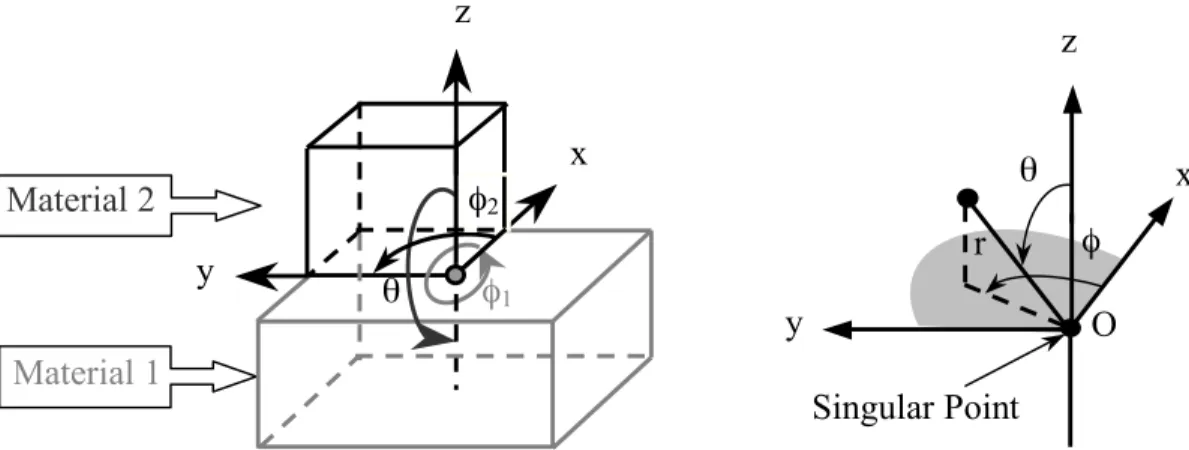
uj(r,!!,!")=bi(!,!")r1#$ (8)
!(r,!",!#)=q(",!#)r1$% (9)
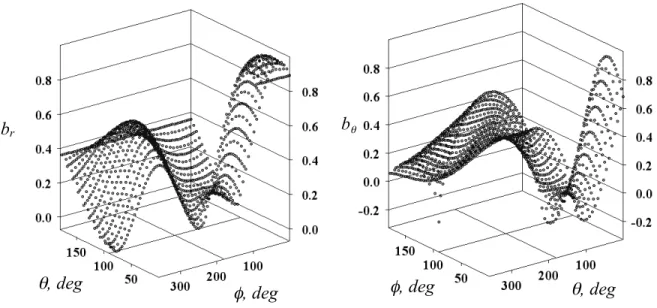
where r represents the distance from the stress singular point, bi(θ, φ) the angular function of elastic displacement, q(θ, φ) the angular function for electric potential, andλ the order of stress singularity.
In the present paper, the order of singularity is investigated varying the material constants. A ratio of material constants to a specified material constant is introduced as follows.
c
cn =S,!!!!!!!!! !
!n =S,!!!!!!!!!!!&!!!!!!!!!! e
en =S! (10) Where en, χn and cn represent the referential piezoelectric, dielectric and elastic constants respectively. e, χ and c represent the new piezoelectric, dielectric and elastic constants respectively. The value of S varies from 0.0001 to 10000.
RESULTS
Figure 1 Singular point of 3D piezoelectric joint in x-, y-, z-coordinates Table 1 Material properties of piezoelectric materials
Elastic Constant / 1010 N/m2 Piezoelectric Constant / C/m2
Dielectric Constant / 10-10 C/Vm Material
c11 c12 c13 c33 c44 e31 e33 e15 χ11 χ33
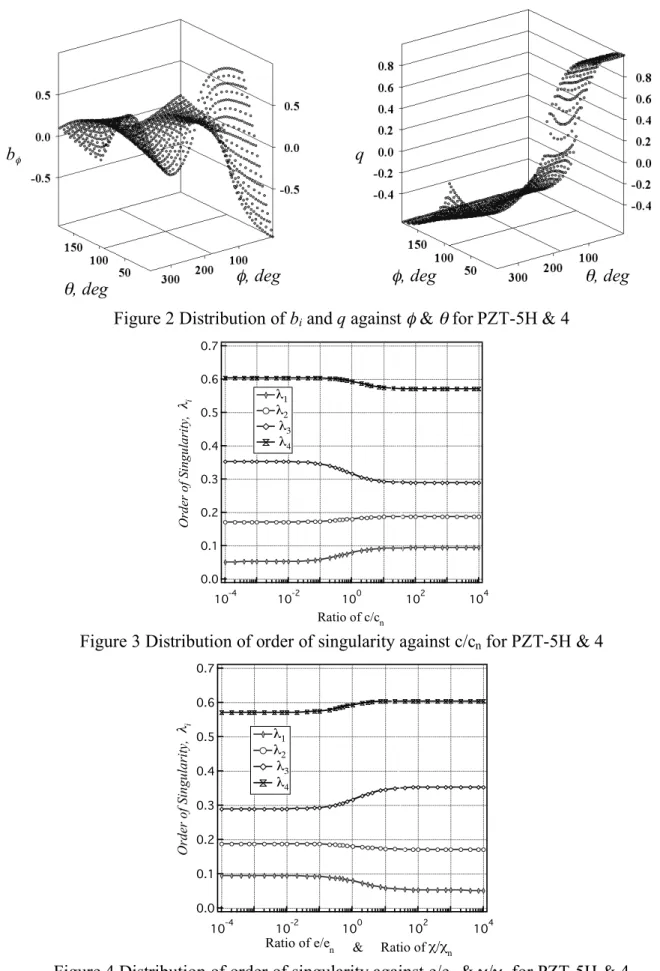
PZT-4 13.9 7.78 7.43 11.3 2.56 -6.98 13.8 13.4 60.0 54.7 PZT-5H 12.6 5.50 5.30 11.7 3.53 -6.50 23.3 17.0 151 130 Angular functions obtained from eigen equation, Eq. 7, are examined. Distributions of angular function on a θ-φ plane are shown in Fig. 2 and a variation of the order of stress singularity with S are shown in Figs. 3 and 4. From these figures, it is found that the value of the angular function increases as approaching to the edge of the interface. The order of stress singularity by varying elastic constant varies in an opposite way to that by varying piezoelectric and dielectric constants.
z
y
x θ
r φ
O Singular Point Material 1
Material 2
z
x y
φ2
φ1
θ
Asian Pacific Conference for Materials and Mechanics 2009 at Yokohama, Japan, November 13-16
Table 2 The order of stress singularity of piezoelectric bimaterials
Material Combination The order of singularity
Material 1 Material 2 1 2 3 4
p 0.4079 0.6853 0.8218 0.9210
PZT-5H & PZT-4 λ 0.5921 0.3147 0.1782 0.0790
CONCLUSION
From the numerical results, the following conclusions can be drawn for the piezoelectric bimaterial joints.
1. Larger value of the angular function occurs at the free edge in the material joint than the inner portion of the joint.
2. It is suggested that delamination of the interface may occur at the interface edge of the piezoelectric material joints.
REFERENCE
1. Ding, H., and Chenbuo, “On the Green’s functions for two-phase transversely isotropic piezoelectric media”, Int. J. of Solids and Struct., vol. 34, No. 23, 3041-3057, 1997.
2. Liew, K. M., and Liang, J., “Modeling of 3D piezoelectric and elastic bimaterials using the boundary element method”, Computational Mechanics, vol. 29, 151-162, 2002.
3. Pageau, S. S., and Biggers, S. B., “Finite Element Evaluation of Free-Edge Singular Stress Fields in Anisotropic Materials”, Int. Journal for Numerical Methods in Engineering, Vol.
38, 2225-2239, 1995.
4. Zikung, W., and Bailin, Z., “The general solution of three-dimensional problems in piezoelectric media”, Int. J. of Solids and Struct., vol. 40, 105-115, 1995.
br bθ
θ, deg φ, deg φ, deg θ, deg
Asian Pacific Conference for Materials and Mechanics 2009 at Yokohama, Japan, November 13-16
Figure 2 Distribution of bi and q against φ & θ for PZT-5H & 4
!"#
!"$
!"%
!"&
!"'
!"(
!")
!"!
Order of Singularity, !i
)!*& + )!*( + )!! + )!( + )!&
Ratio of c/cn
!1
!2 !3 !4
Figure 3 Distribution of order of singularity against c/cn for PZT-5H & 4
!"#
!"$
!"%
!"&
!"'
!"(
!")
!"!
Order of Singularity, !i
)!*& + )!*( + )!! + )!( + )!&
Ratio of e/en & Ratio of "/"n
!1
!2 !3 !4
Figure 4 Distribution of order of singularity against e/en & χ/χn for PZT-5H & 4 q
bφ
φ, deg
φ, deg θ, deg
θ, deg