III 章 分担研究報告
The economic impact of universal health coverage in Japan
Takashi Oshio, Hitotsubashi University※
Key points
Japan’s UHC reduced income inequality as a byproduct of equal access to health services.
Its success has been supported by a young population and high economic growth.
UHC is now burdened by the aging population and structural changes in the economy.
1. Introduction
Japan instituted universal health coverage (UHC) in 1961, by passing a law implementing Citizens’ Health Insurance (CHI) plans (Campbell, Ikegami, and Tsugawa, 2014). This law did not unify the health insurance programs created before World War II; it kept employees and their dependent family members covered by their existing plans. The biggest change was that all other citizens were covered by municipality-provided health insurance plans, thereby making the coverage of healthcare insurance mandatory and universal. The new system ensured the same access to health services as the existing plans for employees; the insured were entitled to go to any physician or hospital they chose and could receive the same procedures and medications.
UHC in Japan established a foundation for the subsequent development of the healthcare systems and social well-being. However, it now faces several challenges, which puts a strain on its sustainability (Ikegami et al., 2011). In the following presentation, we will briefly discuss the economic impact of UHC, including how it has affected household income, income inequality, and the government’s fiscal position in Japan. The presentation is based on a report by Oshio, Miake, and Ikegami (2014).
The bottom line is that the effectiveness and economic impact of Japan’s UHC have depended heavily on the demographic and macroeconomic conditions of the economy.
※ This paper was compiled from the discussions of the research team on Social and Economic Impact of UHC, consisting of Professor Takashi Oshio, Dr. Reiko Hayashi of National Institute of Population and Social Security Research, Dr. Yuki Murakami of OECD, and Dr. Yusuke Tsugawa of Harvard University.
When Japan was “young” and growing at a rapid pace in the 1960s and 70s, UHC as a whole made a substantial contribution to the transfer of income from the rich to the poor and reduced income inequality at the national level. However, the aging population and changing economic structures have required adjustments to the current UHC scheme.
2. Success: favorable impact on household income and income distribution
Japan was quite “young” when it instituted UHC. In 1960, the proportion of people aged 65 and older was only 5.7 percent of the population and the average age was 28.5, compared to 24.1 percent of the population and 45.1 years of age in 2012. A young population structure provided favorable conditions for establishing of UHC because it controlled the transfer of income from the young to the old via social security programs. Public pension programs had not matured yet, and healthcare benefits to the elderly had not started to mount.
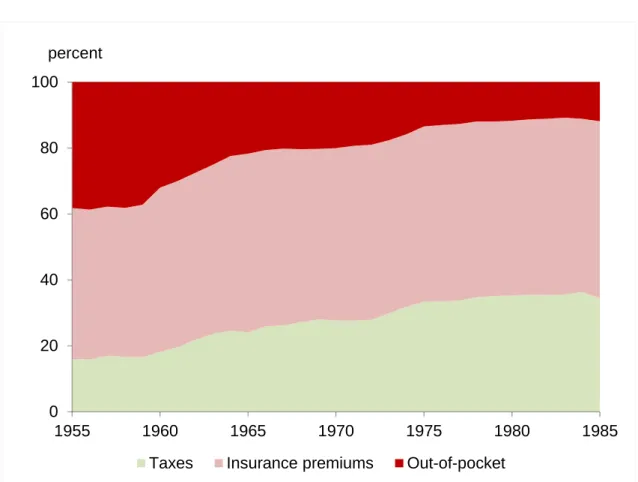
With the expanded coverage of health insurance plans, UHC reduced people’s reliance on out-of-pocket spending to purchase health services. When UHC was expanded to the private sector, national and local governments were obliged by law to utilize more tax revenues to finance spending on the costs of health services. As seen in Figure 1, the proportion of out-of-pocket spending in overall health expenditures gradually declined from 38.7 percent in 1955, to 10.5 percent in 1982. Along with this change in spending, the expansion of UHC had two important implications for household income and income distribution.
First, health services became more evenly accessible. Figure 2 compares the concentration curves of healthcare benefits, which were provided by public healthcare insurance, between 1952 (before the establishment of UHC) and 1967 (after its establishment). The concentration curve graphs the cumulative proportion of healthcare benefits against the cumulative proportion of households ranked by income (van Doorslaer et al., 2000). We observe that the curve for 1952 is located below the diagonal, indicating that the receipt of healthcare benefits was distributed in favor of richer households. By comparison, the curve for 1967 is located close to the diagonal, indicating a relatively even distribution of benefits.
We also can calculate the concentration index, which indicates the degree of inequality in the distribution of health care and is measured as twice the area between the concentration curve and the diagonal. The index declined from 0.145 in 1952 to –0.001 in 1967.
The second implication, related to the first one, is the increasing importance of income transfer via taxation and the social security programs. Figure 3 confirms this by showing
healthcare benefits in kind and benefits in cash by income class in 1967, compared to social security costs, which are the sum of social security contributions (premiums) and an estimated portion of taxes to finance overall social security benefits.
We can see three noteworthy findings in this figure. First, spending for healthcare benefits dominated social security benefits except for the lowest income groups, reflecting a limited number of public pension recipients in the younger population. Second, healthcare benefits exist within a relatively limited range across income groups, reflecting an equal access to healthcare services. This is consistent with the shape of the concentration curve for 1967 in Figure 2.
Third, the observed relationship between social security benefits and costs across income groups suggests income transfer from the rich to the poor—that is, the net benefits were positive for the poor and negative for the rich. To be sure, it may be controversial whether, and to what extent, income redistribution should be expected from social security programs, which were originally designed to reduce peoples’ exposure to social risks. However, the fact that UHC had the favorable byproduct of reducing income inequality in Japan should be remembered; it has important implication for countries that do not have a rigorous taxation system.
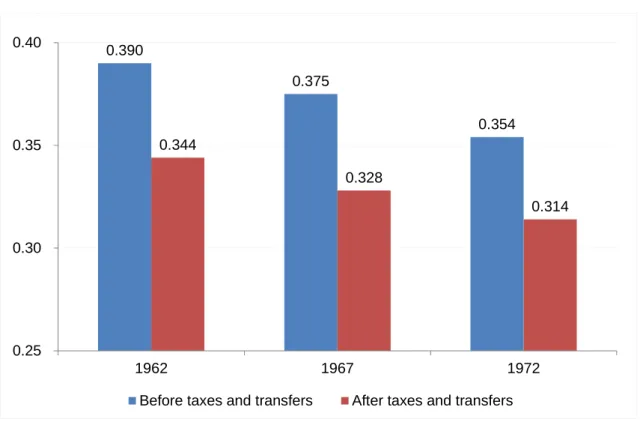
Income redistribution by UHC has contributed to a reduction in overall income inequality, which is measured by the Gini index. Figure 4 shows the changes in the official estimates of the Gini index over the decade after the establishment of UHC, beginning at its initial stage. For both types of income—before and after taxes and transfers, the figure shows that income inequality successfully declined during that period. The main driver of the reduction in income inequality was rapid economic growth, which raised the mean household income.
Also, the relatively equal development across areas and the nationwide income redistribution of tax revenues across local governments favored equitable income redistribution (Tachibanaki, 2004).
UHC was another main contributor to equitable income redistribution. The MHLW (2013a) decomposed the reduction in the Gini index after income redistribution into those attributable to taxation and social security programs for 1967 and 1972. This decomposition showed that social security programs explained about 70 and 50 percent, respectively in each year, of the reduction in the Gini index. Considering that public pension benefits had not matured at the time, this underscores that healthcare programs substantially mitigated
income inequality in a market economy.
Finally, we can argue that a gradual introduction of UHC was helped by rapid economic growth. Between 1955 and 1970, the real gross domestic product (GDP) increased at nearly a 10 percent rate and kept overall healthcare expenditures below 3 percent of the GDP until 1973 (compared to 7.3% in 2013; NIPSS, 2012). Rapid economic growth also raised government revenues through taxes and social security contributions, which sustained sufficient fiscal space for health care benefits.
3. Challenges: pressures from the aging population and changing economic structure
Japan’s UHC was successfully established in the 1960s and had favorable effects on household income and income distribution. Half a century later, however, it is facing several challenges because of the aging population and structural changes in the economy. The proportion of people aged 65 and over has been rising rapidly and is 26.1 percent as of 2014, making Japan the “oldest” country in the world. At the same time, the economy has experienced a reduction in the self-employed and farmers, as well an increase in non-regular employees. These secular changes have reduced fiscal space for UHC and put a strain on the existing scheme of health care insurance.
Aging affects the fiscal space on both the expenditure and revenue sides. On the expenditure side, a rising proportion of the elderly naturally raised total health expenditures because the elderly consume more healthcare services than the young population and their share of benefits. Indeed, as seen in Figure 5, the share of healthcare benefits for the elderly (aged 70 and older) to the total benefits rose from 15.2 percent in 1975 to 46.4 percent in 2012, and an increase in benefits for the elderly explained more than half of the increase in total benefits. On the revenue side, the elderly tend to have a lower income so that the amount they contribute is less. Moreover, lower rates of income tax and healthcare insurance contributions are applied to public pension income for the elderly. At the same time, health insurance has become similar to pensions in that they have led to large-scale income transfers from the young to elders (Figure 6), because funding is on a pay-as-you-go basis. Increasing income transfers between age groups have made the health care insurance less sustainable under an aging population.
The government was not aware of the potential pressures of the aging population on UHC until the 1980s. Indeed, it made health care for the elderly free of charge at the national
level in 1973 (until ten years later), along with other, generous reforms in social security programs. Since then, the government has gradually become more concerned about its deteriorating fiscal position and its causes: population aging and lower economic growth.
Policymakers have tried to reduce the fiscal burden on the general budget by forcing health insurance plans to contribute more to the health expenditures of the elderly. However, they have faced increasing resistance from the employers and the employees, who are members of the employment-based plans, because they are already contributing nearly half of their premium revenue to the funding pool to finance the elderly’s health expenditures.
Decreased growth in government revenues, due to a prolonged economic slowdown, and mounting healthcare and other social security benefits for the elderly have increased dependence on government bond issues. According to the latest official projections by the MHLW (2012c), the ratio of healthcare benefits to the GDP will grow from 7.3 percent in 2012 to 8.9 percent in 2025. Without any substantial increase in tax rates or social security premiums, fiscal space for UHC will likely continue to shrink.
Shrinking fiscal space has been accompanied by a change in the structure of income transfer related to UHC. Healthcare insurance programs are pay-as-you-go in nature because people are most exposed to health risks when they are old and pay more premiums and taxes when they are young. Figure 7 shows the comparison of healthcare costs (the sum of the copayment plus out-of-pocket spending) and benefits by age group. When the population was young in the initial stage of UHC, the magnitude of this inter-generational transfer of income was relatively limited at the national level and dominated by intra-generational transfer. However, the population’s aging has accelerated the inter-generational transfer and reduced fiscal space because the elderly did not accept reduced benefits easily and the young usually were opposed to higher taxes and premiums.
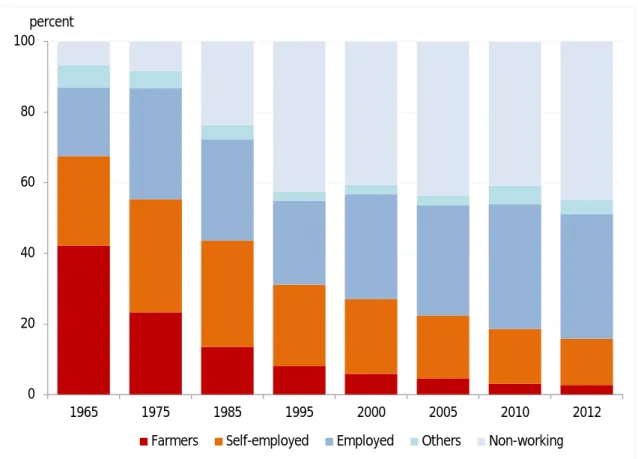
Another key challenge to UHC has come from structural changes in the labor market. Japan has not established a unified system of healthcare insurance, and citizens are covered by either employee-based plans (for employees and their family dependents) or municipality-based plans (for others). The latter plans, that is, CHI plans, originally were supposed to cover self-employed workers, farmers, and their family dependents.
Industrialization of the economy has reduced the proportion of these types of individuals in the total population, and hence the structure of CHI group membership.
The CHI plans are now absorbing an increasing number of non-regular employees, who are
not covered by employer-provided health insurance plans, which conflicts with their original purpose. The rising proportion of non-working people, most of whom are retired or unemployed, makes the CHI plans less sustainable. Moreover, the uneven rates of aging and economic growth across regions have led to a wider disparity in the premium rates of CHI plans, which are municipality-based and exposed to the fiscal positions of local governments. The current system does not provide municipalities with strong incentives to enhance efficiency because CHI-plan deficits usually are funded by subsidies from the central government. The increasing presence of members with low incomes and a lack of incentives to enhance efficiency put a strain not only on the CHI plans but also on the country’s healthcare plans as a whole, because more subsidies are needed to fill the revenue shortages of the CHI plans.
4. Conclusion: implications from Japan’s experience in UHC
We have briefly summarized the impact of UHC in Japan over the past half a century from an economic viewpoint. Japan’s experience with UHC provides important lessons—both positive and negative—for countries that are in the initial stage of establishing healthcare and other social security programs.
On the positive side, UHC is expected to create a favorable byproduct. The goal of universal health coverage is to ensure that all people obtain the health services they need without suffering financial hardship when paying for them. The system, which Japan established to finance their UHC program, had another important effect: it indirectly reduced income inequality via contributions and benefits. This income transfer worked effectively, during the initial stage of establishing UHC, because the population was young.
Therefore, income distribution should be a key contributor to social well-being and to the people’s support of economic development.
At the same time, we should remember that the sustainability of UHC depends largely on demographic and economic conditions. One of the most formidable, albeit foreseeable, challenges is the aging population, and it is advisable to make the system as robust as possible in advance, to counter its stress on the economy. Japan’s experience clearly reveals that once a population starts to shrink and the economy stops expanding, the fiscal sustainability of the system will decline. In addition, changes in industry and labor market structures are likely to have substantial effects on UHC programs that differ from their original goals. This is especially the case, given that UHC has a history of expanding from
the public to the private sectors and has not been unified at the national level.
It is politically challenging to reform UHC once these changes are realized, as evidenced by Japan’s experience. Under conditions of an aging population and low economic growth, any reform in UHC should take the form of a zero-sum game. It would be advisable to design a system that is sufficiently robust to withstand demographic and economic pressures, using projections that are as precise as possible.
References
Campbell, J. C., Ikegami, N., and Tsugawa, Y. (2014). The political-historical context of Japanese health care. In N. Ikegami (ed.) Universal Health Coverage for Inclusive and Sustainable Development: Lessons from Japan. (pp.15–26), Washington: World Bank Group.
Ikegami, N., Yoo, B.-K., Hashimoto, H. et al. (2011). Japanese universal health coverage:
evolution, achievements, and challenges. Lancet, 378 (9796), 1106–1115.
Ministry of Health, Labour and Welfare (MHLW). (2012a). National Medical Expenditures http://www.e-stat.go.jp/SG1/estat/List.do?lid=000001127463 (accessed January 2015).
Ministry of Health, Labour and Welfare (MHLW). (2012b). Survey of the Citizens’ Health Insurance. http://www.e-stat.go.jp/SG1/estat/GL08020101.do?_toGL08020101_ (accessed January 2015).
Ministry of Health, Labour and Welfare (MHLW). (2013a). Survey of Income Redistribution http://www.e-stat.go.jp/SG1/estat/List.do?lid=000001114582 (accessed January 2015).
Ministry of Health, Labour and Welfare (MHLW). (2013b). On the revisions to the projections of social security costs.
http://www.mhlw.go.jp/seisakunitsuite/bunya/hokabunya/shakaihoshou/dl/shouraisuikei.pdf (accessed January 2015).
National Institute of Population and Social Security Research (NIPSS). (2012). The Financial Statistics of Social Security in Japan http://www.ipss.go.jp/ss-cost/j/fsss-h24/fsss_h24.asp (accessed January 2015).
Oshio, T., Miake, N., and Ikegami, M. (2014). Macroeconomic context and challenges for maintaining universal health coverage in Japan. In N. Ikegami (ed.) Universal Health Coverage for Inclusive and Sustainable Development: Lessons from Japan. (pp.27–40), Washington: World Bank Group.
Tachibanaki, T. (2004). Confronting Income Inequality in Japan: A Comparative Analysis of Causes, Consequences, and Reform. Cambridge: MIT Press.
Van Doorslaer, E., Wagstaff, A., van dear Burg, H. et al. (2000). Equity in the delivery of health care in Europe and the US. Journal of Health Economics, 19, 553–583.
Figure 1: Changes in funding sources for health expenditures: 1955–1985
Source: MHLW (2012a).
0 20 40 60 80 100
1955 1960 1965 1970 1975 1980 1985
Taxes Insurance premiums Out-of-pocket percent
Figure 2: Concentration curves of healthcare benefits: 1952 vs. 1967
Note: Income is before taxes and transfers.
Source: The author’s calculations were based on MHLW (2013a).
0.0 0.2 0.4 0.6 0.8 1.0
0.0 0.2 0.4 0.6 0.8 1.0
Cumulative proportion of households ranked by income Cumulative proportion of healthcare benefits
1952 1967
Figure 3: Social security benefits and costs by income class in 1967
Note. Social security costs indicate the sum of social security contributions (premiums) and the estimated portion of taxes to finance overall social security benefits.
Source: MHLW (2013a).
0 50 100 150 200
Healthcare benefits in kind Benefits in cash Social security costs thousand yen, annual
Household income class (thousand yen, annual)
Figure 4: Declining Gini index after the establishment of UHC: 1962–1972
Source: MHLW (2013a).
0.390
0.375
0.354 0.344
0.328
0.314
0.25 0.30 0.35 0.40
1962 1967 1972
Before taxes and transfers After taxes and transfers
Figure 5: Increasing healthcare benefits for the elderly
Note: Benefits for those aged 70 years and above before 1997, are the author’s estimation based on the reports from the MHLW (2012a) and NIPPS (2012).
Sources: MHLW (2012a) and NIPPS (2012).
0 10 20 30 40 50
0 10 20 30 40 50
1975 1980 1985 1990 1995 2000 2005 2010
Benefits for those aged 0-69 years
Benefits for those aged 70 years and above (right scale)
trillion yen percent
Figure 6: Healthcare payments and benefits by age group in 2011
Source: MHLW (2012b).
0 200 400 600 800 1000 1200
Premium Copayment
Heathcare expenditures thousand yen (annual)
Age group
Figure 7: Changing membership composition of Citizens’ Health Insurance (CHI)
Source: MHLW (2012b).
0 20 40 60 80 100
1965 1975 1985 1995 2000 2005 2010 2012
Farmers Self-employed Employed Others Non-working percent
Impact of the Recent Socioeconomic Changes on Equity, Effectiveness, and Efficiency of the
Universal Health Coverage in Japan
Hideo Yasunaga1, Naoki Kondo2, Toshiaki Iizuka3, Haruko Noguchi4, Yusuke Tsugawa5, Akihiro Nishi6, Hideki Hashimoto7, Kenji Shibuya8
1. Department of Clinical Epidemiology and Health Economics, School of Public Health, The University of Tokyo
2. Departments of Health and Social Behavior, School of Public Health, The University of Tokyo;
3. Graduate School of Economics, The University of Tokyo;
4. Faculty of Political Science and Economics, Waseda University;
5. Harvard University Interfaculty Initiative in Health Policy;
6. Yale Institute for Network Science;
7. Departments of Global Health Policy, Graduate School of Medicine, The University of Tokyo
Summary
This study team will analyze the impact of recent socioeconomic changes on equity, effectiveness, and efficiency of universal health coverage (UHC) in Japan using national health-related databases, with a special focus on the following aspects: 1) impact of two recent crises on healthcare in Japan (i.e., economic downturn precipitated by the global financial crisis in 2008, and the Great East Japan Earthquake in 2011), and 2) recent changes to Japan’s healthcare system that were not fully examined in the Lancet Special Series on Japan, 2011, including (i) input-output analysis on efficiency of primary care and acute care, and (ii) overview of the current long-term care system in Japan.
1. Background
The Lancet Special Series on Japan: Universal Health Care at 50 years (2011) and the Japan–World Bank Partnership Program on Universal Health Coverage (2014) described the historical background, current status, and sustainability of Universal Health Coverage (UHC) in Japan. However, in the last several years we have witnessed various socioeconomic changes in Japan, and the impacts of these changes on equity, effectiveness, and efficiency of UHC remains unclear.
Two recent crises in Japan may have affected the sustainability of its national healthcare system. One was the economic crisis in Japan following the 2008 global financial crisis, and the other was the earthquake and tsunami disaster that hit northeast Japan in 2011. The authors aim to clarify the impacts of these crises on healthcare delivery, access, and
outcomes and to examine how Japan’s UHC system alleviated the impact of these crises through comparisons with similar situations in other countries (e.g. European countries under economic crisis and subsequent austerity measures and policy change). The study will provide new insight into how such crises can affect UHC and how countries should prepare robust UHC systems to protect against such shocks, which will provide useful lessons for any country that has established—or is in the process of introducing—a UHC system.
In addition, several issues related to recent changes to the healthcare system were not completely investigated in the Lancet Special Series on Japan in 2011. Primary and long-term care systems are pivotal healthcare pillars in “super-aging” societies where integrated community healthcare and welfare programs are coordinated to deliver services.
In the present study, the authors will examine (i) equity, effectiveness, and efficiency of Japan’s primary and acute care systems, and (ii) details of the current long-term care system in Japan.
2. Data sources
In this study, the authors will perform secondary analyses of the following large healthcare databases in Japan:
A. Comprehensive Survey of Living Conditions (国民生活基礎調査) B. National Health and Nutrition Survey (国民健康・栄養調査) C. National Census (国勢調査)
D. Report of Vital Statistics: Occupational and Industrial Aspects(人口動態職業・産業別 統計)
E. Japan Gerontological Evalusation Study (JAGES) (日本老年学的評価研究)
F. Longitudinal Survey of Newborns in the 21st Century (21世紀新生児縦断調査デ ータ)
G. Survey of Physicians, Dentists and Pharmacists (医師調査医師・歯科医師・薬剤師調 査)
H. Survey of Medical Institutions/ Hospital Report (医療施設調査・病院報告) I. Diagnosis Procedure Combination (DPC) inpatient data (DPCデータ) J. Patient Survey (患者調査)
K. All-Japan Utstein Registry (救急蘇生統計)
L. Specific health checkup and health insurance claims data from Federation of National Health Insurance and Japan Health Insurance Association (国保・協会けんぽの特定健 診・レセプトデータ)
M. Survey of Institutions and Establishments for Long-term Care (介護サービス施設・事
業所調査)
N. Survey of Long-term Care Benefit Expenditures (介護給付費実態調査)
3. Impact of the two crises on UHC in Japan
3.1. Impact of the economic downturn after the global financial crisis in 2008 Naoki Kondo, Associate Professor
(i) Using data from the Comprehensive Survey of Living Conditions and the National Health and Nutrition Survey, the authors will analyze annual trends in socioeconomic disparities in health indicators and health behaviors, and changes in these trends before and after various exogenous shocks (including the 2008 global financial crisis). Trends will be analyzed at the national and prefectural levels.
(ii) The authors will also perform similar analyses with cause-specific mortality as the outcome variable, using data from the National Census and Report of Vital Statistics:
Occupational and Industrial Aspects.
(iii) Using 2010 and 2013 panel data from the Japan Gerontological Evaluation Study (JAGES), the authors will analyze changes in health status of the elderly (activities of daily living and nursing care needs) and disparities in access to healthcare based on self-administered questionnaires.
(vi) Using the Longitudinal Survey of Newborns in the 21st Century (2001 and 2010 cohorts) the authors will evaluate the impacts of the 2008 global financial crisis on the health and health care utilization of children of various socioeconomic statuses.
3.2. Impact of the Great East Japan Earthquake in 2011 Hideo Yasunaga, Professor, and Toshiaki Iizuka, Professor
The authors will gather data from the Survey of Physicians, Dentists and Pharmacists;
Survey of Medical Institutions/ Hospital Report; Diagnosis Procedure Combination (DPC) inpatient data; Patient Survey; and All-Japan Utstein Registry. They will use this data to analyze changes in the distribution of healthcare resources (including medical institutions and healthcare providers) and access to healthcare services before and after the 2011 earthquake and tsunami disaster. For instance, using Patient Survey data the authors will analyze annual trends in hospital admission rates for stroke and acute myocardial infarction in secondary medical areas.
4. Issues related to recent changes in the healthcare system
4.1. Input-output analysis on efficiency of primary care and acute care Hideo Yasunaga, Professor
Using the Survey of Medical Institutions/Hospital Report, Diagnosis Procedure Combination inpatient data, Patient Survey, and specific health checkup and health insurance claims data from the Federation of National Health Insurance and Japan Health Insurance Association, the authors will perform input-output analysis on the efficiency of primary care and acute care services. In hospital-level analysis, the authors will use
“hospital standardized mortality ratio (HSMR)” as the output indicator, and healthcare resources (healthcare providers and medical devices) as the input indicators. In secondary medical area–level analysis, we use “effective coverage” as the output, and local healthcare resources (healthcare providers and medical facilities) as the inputs. Effective coverage is measured using (i) the gap between positive rates in screening tests and the rates of receiving treatment, and (ii) the gap between health guidance for smokers and their visits to smoking cessation clinics.
4.2. Overview of long-term care in Japan Toshiaki Iizuka, Professor
Using the Survey of Institutions and Establishments for Long-term Care and the Survey of Long-term Care Benefit Expenditures, the authors will interpret and review the long-term care system in Japan. In an analysis of P4P (pay for performance) in long-term care, the authors will analyze the impact of “contingency fees” on improving the quality of nursing care.
5. Expected outcomes of the project
This study is expected to provide evidence on how we can better prepare for social, economic, and demographic crises through a robust UHC system. The roles of government, healthcare providers, and citizens in the community will be further discussed to glean policy lessons for emerging countries that will soon face similar challenges.
厚生労働科学研究費補助金(厚生労働科学特別研究事業)
分担研究報告書
UHC の実践的手法と教訓に関する研究
橋本 英樹 東京大学大学院医学系研究科保健社会行動学教室教授 渋谷 健司 東京大学大学院医学系研究科国際保健政策学教室教授
津川 友介 ハーバード大学医療政策学、世界銀行グループコンサルタント[研究協力者]
(関係省庁若手グループの協力を得て執筆)
【概要】
日本・世界銀行共同研究プログラムの成果等をさらに発展させ、保健医療政策の立 案・実行に携わる当事者である技術系行政官の視点で、国際的に情報の発信が乏し くブラックボックスとなっており言語化されていない分野に焦点を当て、UHC の 実現に向けた実践的な提言を行う。
提言は、以下の3つの方針に沿って、まとめていく。
・ 『健康長寿社会』を見据えた持続可能な保健医療制度の提言
・ 『部分最適(partial optimization)』から『全体最適(total optimization)』へ
・ 『後ろ向き(retrospective)』から『前向き(prospective)』へ
研究・検討においては、WHO Health Systems Frameworkとして提唱しているThe six building blocks of a health systemに沿って、知識を体系化する。
1. はじめに
UHC に関する日本・世界銀行共同研 究プログラム(以下、「共同プログラム」) が発足し、日本政府と世界銀行の共同 研究チームが編成され、これまでの我 が国の医療政策等についてレビューし、
昨年、日本のUHC に関わる経験を10 のテーマで分析した研究成果がまとめ られた。
当グループとしては、これまでの共同 プログラムやその他の医療政策に関す る文献や研究を発展させ、その成果を 参考にしながら、以下の3つの方針の もと、G8における提言や学術雑誌への
論文の投稿を見据えてまとめる。
これらの視点及びより現実に則した考 察・提言は、日々試行錯誤しながら実 際に保健医療政策の立案・実行に携わ る当事者である技術系行政官こそ、本 領を発揮できる領域である。
(1)『健康長寿社会』を見据えた持続可能 な保健医療制度の提言
我が国は世界一の長寿国であり、50年 以上前に達成した国民皆保険や 2000 年から施行されている介護保険等の保 健医療福祉制度(社会保障制度)が健 康・平均寿命の延伸に大きく寄与し、
同時に社会保障制度の整備に伴う健康 な労働人口の増加は高度経済成長を支 えてきたという正のスパイラルがあっ たと考えられる。
こうした日本においても、2016年 G8 サミットから10 年後の 2025年には、
団塊世代が 75 歳を迎えることを踏ま え、地域包括ケアシステムの構築等、
将来にわたって持続可能な制度改革が 行われつつある。
高齢化は、先進国のみならず低・中所 得国においても、ほぼ例外なく全世界 的に進展していくが、それらの国々に おける高齢化対策の政策的優先度は高 いとは言えない。
また、経済成長として享受されること が多い人口ボーナスの恩恵が受けられ ず、国家の経済が未成熟で社会保障制 度が未整備のまま、高齢化及び生産年 齢の人口の減少に直面する国々が出て くると見込まれ、UHCの持続可能性が 問われている。
先行研究においては、社会保障制度に 関する検証や考察は多いが、人口動態 の変化や高齢化も勘案しマクロ・ミク ロの視点から UHC を総合的にレビュ ーし、その結論に基づき高齢化社会に 対応した望ましい UHC について知識 を体系化している取組は少ない。これ らの課題及び取組みは世界で日本が最 初に経験するものであり、その知見は 世界各国の対策に資するものである。
以上から、本グループでは、人口動態・
高齢化の問題に特化して、健康長寿社 会における理想的な高齢化社会対応型 UHCについて、検討していく。
(2)『部分最適(partial optimization)』
から『全体最適(total optimization)』へ
我が国においては、世界に先駆けて高 齢化が進展したことから、政策・制度 面で参照すべき他国の UHC 等の社会 保障制度は存在しなかった。また、社 会保障制度はその財源確保が経済状況 と密接に関連するとともに、制度その ものが政治経済社会の状況を反映して 構築・運用されるため、目の前の問題 解決に資する資源配分(部分最適)が 図られてきた。
一方で、近年、社会保障のうち、とり わけ保健医療分野においては、IT技術 の活用が積極的に図られ、財源を含め た医療資源の効果的な配分という政策 判断においても「全体最適化」が可能 となりつつある。
我が国においては、等しく国民に対し 必要な医療を提供するという方針のも と取り組みが進められてきた。また、
我が国におけるITの活用等による「部 分最適」から「全体最適」への移行の 例は、これから UHC 等の社会保障制 度を設計し実行していく国々にとって、
制度創設の初期段階から全体最適化を 指向した制度設計の参考になる。この ように、我が国が UHC のロールモデ ルになることは、国際社会における責 務である。
そのためには、我が国の成功体験や失 敗体験を、より長期的かつ大局的な視 点で、まとめていく。
(3)『後ろ向き(retrospective)』から『前 向き(prospective)』へ
多くの先行研究は、過去の出来事につ いてレビューや検証等を行っているも のが多い。本グループでは、現在直面 している喫緊の課題やその解決策につ いて、今後どのような対策を取るべき か等について、日頃保健医療制度の立 案・実施に携わる行政官が、これまで 言語化されていなかった領域等につい て、実践的な課題や対策に関する知見 を体系的にまとめていく。
2.研究・検討の進め方
知識の体系化にあたっては、既存の国際 的なUHCの枠組みに沿って整理すること が望ましい。WHOは、2007年に、
“Everybody's Business: Strengthening
Health Systems to Improve Health Outcomes: WHO's Framework for Action”
等において、The WHO Health Systems Frameworkとして、The six building blocks of a health systemを提唱している。
一方、Health Systemに関するフレームワ ークとしては、世界銀行研究所のヘルスシ ステムに関するFlagship Courseのために ハーバード大学が開発した、Flagship Approach(世銀・ハーバードモデル)も知 られる。
また、現在、WHOにおいては、UHCの 必須要素として、以下のようなものを掲げ ている。
本グループとしては、これらのフレーム ワークを日本の文脈に沿って活用・検討し、
提言や学術論文としてまとめていく。
Fig 1. The WHO
http://www.who.int/healthsystems/strategy/everybodys_business.pdf Fig 2. Harvard/The World Bank Flagship Approach
Fig 1. The WHO
http://www.who.int/healthsystems/strategy/everybodys_business.pdf Fig 2. Harvard/The World Bank Flagship Approach
Fig 1. The WHO Health Systems Framework
http://www.who.int/healthsystems/strategy/everybodys_business.pdf Fig 2. Harvard/The World Bank Flagship Approach
Health Systems Framework
http://www.who.int/healthsystems/strategy/everybodys_business.pdf Fig 2. Harvard/The World Bank Flagship Approach
Health Systems Framework
http://www.who.int/healthsystems/strategy/everybodys_business.pdf Fig 2. Harvard/The World Bank Flagship Approach
http://www.who.int/healthsystems/strategy/everybodys_business.pdf Fig 2. Harvard/The World Bank Flagship Approach
http://www.who.int/healthsystems/strategy/everybodys_business.pdf
Fig 3
Health systems financing
Health workforce
Essential medicines
Health information and resources
National health policies
Health systems service delivery
3.総論
●日本型
【 日 本 型
concept of Japan’
1.目的
本研究の目的は、研究グループ4の総論 として、日本の医療制度の全体像を分析・
評価した上で、
日本型
グループ内の他の研究チームで詳解される 政策オプション
モデルを
2.方法 医療制度分析
の代表的なフレームワークとしては、
の6 Building Blocks
かに、世界銀行研究所のヘルスシステムに 関する
ド大学が開発した、
銀・ハーバードモデル)が挙げられる。
WHO
Fig 3. Essentials of universal health coverage Health systems financing
Health workforce Essential medicines
Health information and resources National health policies
Health systems service delivery
総論
●日本型UHCのマクロ分析 日 本 型 UHC
concept of Japan’
1.目的
本研究の目的は、研究グループ4の総論 として、日本の医療制度の全体像を分析・
評価した上で、主に政策担当者の視点 日本型UHCの特徴、長所や
グループ内の他の研究チームで詳解される 政策オプションを踏まえた日本型
モデルを、LMIC
2.方法 医療制度分析
の代表的なフレームワークとしては、
6 Building Blocks
かに、世界銀行研究所のヘルスシステムに 関するFlagship
ド大学が開発した、
銀・ハーバードモデル)が挙げられる。
WHO モデルでは、医療制度を
Essentials of universal health coverage Health systems financing
Health workforce
Essential medicines and health technologies Health information and resources
National health policies Health systems service delivery
のマクロ分析
UHC の キ ー コ ン セ プ ト concept of Japan’s UHC model
本研究の目的は、研究グループ4の総論 として、日本の医療制度の全体像を分析・
主に政策担当者の視点 特徴、長所や課題を
グループ内の他の研究チームで詳解される を踏まえた日本型
LMICをはじめ世界
医療制度分析Health Systems Analysis の代表的なフレームワークとしては、
6 Building Blocks(WHO
かに、世界銀行研究所のヘルスシステムに Flagship Courseのためにハーバー ド大学が開発した、Flagship Approach 銀・ハーバードモデル)が挙げられる。
モデルでは、医療制度を
Essentials of universal health coverage Health systems financing
and health technologies Health information and resources
Health systems service delivery
のマクロ分析
の キ ー コ ン セ プ ト/Key UHC model】
本研究の目的は、研究グループ4の総論 として、日本の医療制度の全体像を分析・
主に政策担当者の視点から 課題を抽出し、
グループ内の他の研究チームで詳解される を踏まえた日本型 UHC
をはじめ世界に提示する
Health Systems Analysis の代表的なフレームワークとしては、WHO WHOモデル)のほ かに、世界銀行研究所のヘルスシステムに のためにハーバー Flagship Approach(世 銀・ハーバードモデル)が挙げられる。
モデルでは、医療制度を 6つの構 Essentials of universal health coverage
and health technologies
/Key
本研究の目的は、研究グループ4の総論 として、日本の医療制度の全体像を分析・
から、
し、
グループ内の他の研究チームで詳解される
UHC の
に提示する。
Health Systems Analysis WHO モデル)のほ かに、世界銀行研究所のヘルスシステムに のためにハーバー
(世 銀・ハーバードモデル)が挙げられる。
つの構
成要素
②医療従事者、
チン・技術、
ガバナンス、に分けそして、これらの構成 要素からなる医療制度の最終目標を、「健康 とその公平性の向上」とし、それをニーズ に応じて、財政的に公平で、資源の効率的 な利用によって達成すること、としている。
また、その最終目標を達成す
指標として、「効果的な医療へのアクセスや カバレージ(適用拡大)を質や安全性を確 保しつつ達成すること」、としている
一方、世銀・ハーバードモデルでは、医 療制度のうち、政策としてコントロールで きる要素を
knob)
⑤行動、として整理し、その最終目標は対 象集団の健康状態、満足度、リスク保障の 3 点の向上としている。なお、中間指標と しては、効率、質、アクセスの
ている
1 Marc J. Roberts, William Hsiao, Peter Berman, Michael R. Reich, Getting health reform right: a guide to improving performance and equity.
Oxford University Press. 2008.
成要素(Building blocks) 医療従事者、
チン・技術、⑤
ガバナンス、に分けそして、これらの構成 要素からなる医療制度の最終目標を、「健康 とその公平性の向上」とし、それをニーズ に応じて、財政的に公平で、資源の効率的 な利用によって達成すること、としている。
また、その最終目標を達成す
指標として、「効果的な医療へのアクセスや カバレージ(適用拡大)を質や安全性を確 保しつつ達成すること」、としている
一方、世銀・ハーバードモデルでは、医 療制度のうち、政策としてコントロールで きる要素を 5 つの政策オプション
knob):①財政、
行動、として整理し、その最終目標は対 象集団の健康状態、満足度、リスク保障の 点の向上としている。なお、中間指標と しては、効率、質、アクセスの
ている1。
Marc J. Roberts, William Hsiao, Peter Berman, Michael R. Reich, Getting health reform right: a guide to improving performance and equity.
Oxford University Press. 2008.
(Building blocks):
医療従事者、③情報、④
⑤財政、⑥リーダーシップ・
ガバナンス、に分けそして、これらの構成 要素からなる医療制度の最終目標を、「健康 とその公平性の向上」とし、それをニーズ に応じて、財政的に公平で、資源の効率的 な利用によって達成すること、としている。
また、その最終目標を達成す
指標として、「効果的な医療へのアクセスや カバレージ(適用拡大)を質や安全性を確 保しつつ達成すること」、としている
一方、世銀・ハーバードモデルでは、医 療制度のうち、政策としてコントロールで
つの政策オプション 財政、②支払、
行動、として整理し、その最終目標は対 象集団の健康状態、満足度、リスク保障の 点の向上としている。なお、中間指標と しては、効率、質、アクセスの
Marc J. Roberts, William Hsiao, Peter Berman, Michael R. Reich, Getting health reform right: a guide to improving performance and equity.
Oxford University Press. 2008.
:①医療提供体制、
④医療材料・ワク リーダーシップ・
ガバナンス、に分けそして、これらの構成 要素からなる医療制度の最終目標を、「健康 とその公平性の向上」とし、それをニーズ に応じて、財政的に公平で、資源の効率的 な利用によって達成すること、としている。
また、その最終目標を達成する過程の中間 指標として、「効果的な医療へのアクセスや カバレージ(適用拡大)を質や安全性を確 保しつつ達成すること」、としているⅱ
一方、世銀・ハーバードモデルでは、医 療制度のうち、政策としてコントロールで つの政策オプション(Control
支払、③組織、④規制、
行動、として整理し、その最終目標は対 象集団の健康状態、満足度、リスク保障の 点の向上としている。なお、中間指標と しては、効率、質、アクセスの3点を挙げ
Marc J. Roberts, William Hsiao, Peter Berman, Michael R. Reich, Getting health reform right: a guide to improving performance and equity.
Oxford University Press. 2008.
医療提供体制、
医療材料・ワク リーダーシップ・
ガバナンス、に分けそして、これらの構成 要素からなる医療制度の最終目標を、「健康 とその公平性の向上」とし、それをニーズ に応じて、財政的に公平で、資源の効率的 な利用によって達成すること、としている。
る過程の中間 指標として、「効果的な医療へのアクセスや カバレージ(適用拡大)を質や安全性を確
ⅱ、ⅲ。 一方、世銀・ハーバードモデルでは、医 療制度のうち、政策としてコントロールで (Control
規制、
行動、として整理し、その最終目標は対 象集団の健康状態、満足度、リスク保障の 点の向上としている。なお、中間指標と 点を挙げ
Marc J. Roberts, William Hsiao, Peter Berman, Michael R. Reich, Getting health reform right: a guide to improving performance and equity.
また、世銀・ハーバードモデルでは、こ のほかに、医療制度の分析や政策立案に資 する以下のコンセプトやツールを提示して いる。
1)政策サイクル
医療改革者が各段階で取り組まなくては ならない重要な課題をサイクルで説明 2)倫理思想
改革のアジェンダ設定のために、政策の
これら二つのモデルには相違点もあるも のの、以下の基本構成は共通している。
・ 医療制度を、それ自体が目的ではなく、
目的のための手段としていること
・ 最終目
スク保障の要素を含めていること
・ 手段としての政策オプションを中間指 標、最終目標と分けて明示しているこ と
本研究では、これらのフレームワークに 共通する基本的考え方をおさえつつ、日本 また、世銀・ハーバードモデルでは、こ のほかに、医療制度の分析や政策立案に資 する以下のコンセプトやツールを提示して いる。
1)政策サイクル
医療改革者が各段階で取り組まなくては ならない重要な課題をサイクルで説明 2)倫理思想 (Ethical Theory)
改革のアジェンダ設定のために、政策の
これら二つのモデルには相違点もあるも のの、以下の基本構成は共通している。
医療制度を、それ自体が目的ではなく、
目的のための手段としていること 最終目標に健康改善、満足度向上、リ スク保障の要素を含めていること 手段としての政策オプションを中間指 標、最終目標と分けて明示しているこ と
本研究では、これらのフレームワークに 共通する基本的考え方をおさえつつ、日本 また、世銀・ハーバードモデルでは、こ のほかに、医療制度の分析や政策立案に資 する以下のコンセプトやツールを提示して
1)政策サイクル(Policy Cycle)
医療改革者が各段階で取り組まなくては ならない重要な課題をサイクルで説明
(Ethical Theory)
改革のアジェンダ設定のために、政策の
これら二つのモデルには相違点もあるも のの、以下の基本構成は共通している。
医療制度を、それ自体が目的ではなく、
目的のための手段としていること 標に健康改善、満足度向上、リ スク保障の要素を含めていること 手段としての政策オプションを中間指 標、最終目標と分けて明示しているこ
本研究では、これらのフレームワークに 共通する基本的考え方をおさえつつ、日本 また、世銀・ハーバードモデルでは、こ のほかに、医療制度の分析や政策立案に資 する以下のコンセプトやツールを提示して
(Policy Cycle)
医療改革者が各段階で取り組まなくては ならない重要な課題をサイクルで説明
(Ethical Theory)
改革のアジェンダ設定のために、政策の
これら二つのモデルには相違点もあるも のの、以下の基本構成は共通している。
医療制度を、それ自体が目的ではなく、
目的のための手段としていること 標に健康改善、満足度向上、リ スク保障の要素を含めていること 手段としての政策オプションを中間指 標、最終目標と分けて明示しているこ
本研究では、これらのフレームワークに 共通する基本的考え方をおさえつつ、日本 また、世銀・ハーバードモデルでは、こ のほかに、医療制度の分析や政策立案に資 する以下のコンセプトやツールを提示して
医療改革者が各段階で取り組まなくては
改革のアジェンダ設定のために、政策の
目標設定と優先順位付けに求められる倫 理思想
3)政治分析
医療改革のサイクルにそれぞれのステッ プで重要な、体系的な政治分析の基礎 4)医療制度診断
療制度診断の体系的な方法
これら二つのモデルには相違点もあるも のの、以下の基本構成は共通している。
医療制度を、それ自体が目的ではなく、
標に健康改善、満足度向上、リ 手段としての政策オプションを中間指 標、最終目標と分けて明示しているこ
本研究では、これらのフレームワークに 共通する基本的考え方をおさえつつ、日本
の医療政策の具体的な課題解決に資するよ うな形で適用することとする。具体的には、
以下の
○ステップ
まず日本の医療制度の最終目標の分析と して、共通要素である、
足度、
UHC
特定する。
○ステップ
目標設定と優先順位付けに求められる倫 理思想
3)政治分析
医療改革のサイクルにそれぞれのステッ プで重要な、体系的な政治分析の基礎 4)医療制度診断
「診断ツリー」を用いた、実践的な医 療制度診断の体系的な方法
の医療政策の具体的な課題解決に資するよ うな形で適用することとする。具体的には、
以下の 3 段階に沿って分析を進める。
○ステップ 1:最終目標の達成度評価 まず日本の医療制度の最終目標の分析と して、共通要素である、
足度、③リスク保障を評価し、特に日本型 UHC に関連する主要な特徴、長所や課題を 特定する。
○ステップ 2:医療制度診断
目標設定と優先順位付けに求められる倫
(Political Analysis)
医療改革のサイクルにそれぞれのステッ プで重要な、体系的な政治分析の基礎 4)医療制度診断 (Diagnostic Tree)
「診断ツリー」を用いた、実践的な医 療制度診断の体系的な方法
の医療政策の具体的な課題解決に資するよ うな形で適用することとする。具体的には、
段階に沿って分析を進める。
:最終目標の達成度評価 まず日本の医療制度の最終目標の分析と して、共通要素である、①
リスク保障を評価し、特に日本型 に関連する主要な特徴、長所や課題を
:医療制度診断
目標設定と優先順位付けに求められる倫
(Political Analysis)
医療改革のサイクルにそれぞれのステッ プで重要な、体系的な政治分析の基礎
(Diagnostic Tree)
「診断ツリー」を用いた、実践的な医 療制度診断の体系的な方法
の医療政策の具体的な課題解決に資するよ うな形で適用することとする。具体的には、
段階に沿って分析を進める。
:最終目標の達成度評価 まず日本の医療制度の最終目標の分析と
①健康状態、
リスク保障を評価し、特に日本型 に関連する主要な特徴、長所や課題を
:医療制度診断
目標設定と優先順位付けに求められる倫
医療改革のサイクルにそれぞれのステッ プで重要な、体系的な政治分析の基礎
「診断ツリー」を用いた、実践的な医
の医療政策の具体的な課題解決に資するよ うな形で適用することとする。具体的には、
段階に沿って分析を進める。
:最終目標の達成度評価 まず日本の医療制度の最終目標の分析と
健康状態、②満 リスク保障を評価し、特に日本型 に関連する主要な特徴、長所や課題を
特定された課題について、「診断ツリー」
を 用 い た 医 療 制 度 診 断 に よ り 原 因 (Root Cause)を分析する。その際、質やアクセス 等の指標にも配慮する。
○ステップ 3:政策オプション及びガバナ ンス
課題の原因となっている要素に対して必 要 な 政 策 オ プ シ ョ ン を 、 ① Health financing and technology 財政・支払・
医療技術、②Human Resources for Health 医療人材、③Health system delivery and information 医療情報・医療介護提供体制 に分けて概要を示す(これらの各論の詳細 は本研究班のそれぞれの研究チームが詳述 する)。
3.平成27年度の研究イメージ
1)ステップ1:日本型UHCの特徴の抽出 まず、日本のヘルスシステムの最終目標
(①健康状態、②満足度、③リスク保障)
の達成度評価を行い、③リスク保障の基盤 である日本型 UHC の特徴、長所、課題を文 献検索(行政文書、世銀レポートを組む)
および過去から現在に渡る行政担当者のイ ンタビュー等により抽出する抽出する。
○ヘルスシステムの最終目標の達成度評価 イメージ
①健康指標
平 均 寿 命 (WHO) 、 健 康 寿 命
(GBD2010)、乳幼児死亡率(WHO)、年 齢調整がん死亡率(OECD)等の健康指標 において、日本は世界最高レベルを誇っ ているように、少なくともマクロの健康 水準について、日本の健康状態は優れて
いる。また健康格差についても低いと言 える。
②満足度
満足度については、日本医療政策機構 が2007年から行っている調査によると、
項目によって異なっており、「診断・治療 等の技術の質」や「医療の安全性」につ いては比較的満足しているものの、「制度 決定プロセスの公正さ」や「市民参加の 度合い」などガバナンスに関連する項目 については、不満の度合いが大きい。た だし、総じて高いとは言えないものの、
近年改善傾向にある。2
③リスク保障
リスク保障について、日本は非西洋社 会で初めて1961年に国民皆保険(UHC)
を達成し、すべての国民に公的な医療保 険を提供してきた。その保険給付内容に ついても、必要かつ適切な医療は基本的 に保険診療で確保することを理念とし、
包 括 的 な 保 険 給 付(Comprehensive benefit package)を実現している。また、
費用負担についても、窓口負担は最大3 割とし、更に、重大疾病事故への対応 (Catastrophic coverage)として月額一定 以上の負担は保険で賄う保障を行ってい る。すなわち、これまで日本の医療制度 は手厚いリスク保障を提供してきた。し かも、医療費のGDP比はOECDの中位 程度と比較的低いコストでこうした保障 を実現してきた。
2
http://www.hgpi.org/report_events.html?article=2 58
○ 日 本 の ヘ ル ス シ ス テ ム お よ び 日 本 型 UHCの長所
日本のヘルスシステムの最終目標達成 度の主な長所は、①世界最高水準の健康 状態、②国民皆保険による手厚いリスク 保障の提供、および、比較的低いコスト での提供が挙げられる。
○日本型UHCの特徴
このうち、②の基盤である日本型 UHC の特徴の現時点でのイメージ:
日 本 型 UHC の キ ー コ ン セ プ ト/Key concept of Japanese UHC model:
Solidarity based, equity oriented, national single fee schedule model, to simultaneously pursue three birds: 1) free/open access for patients, 2) professional freedom of private providers, and 3) overall cost control
・公平性への社会的・政治的コンセンサ ス
・法制度の整備
・中央政府の権限の大きさおよび地方政 府のコミットメント
・医療提供体制における民間セクターの 寄与
・社会保険と税負担のミックスによる公 平な財政調整のメカニズム
・全国一律の診療報酬制度によるステイ クホルダーの利害調整、資源配分、コ スト抑制
・日本型 UHC を可能にしたプレイヤー
と ガ バ ナ ン ス ( 主 要 な Player/Institutionをまとめる)
等
○日本型 UHC の課題
日本の UHC が提供してきた手厚いリ スク保障は世界最速かつ最高水準の高齢 化などから想定される総医療費の伸びや 財政事情などから持続性に大きな問題を 抱えている。上記特徴で特定される国民 のコンセンサスとしての国民皆保険の維 持が日本社会の合意とすれば(例:社会 保障制度改革推進法や社会保障国民会議 報告書など)、「UHCの持続可能性」その ものが、日本の医療制度の最終目標にお ける最大の課題と言える。
2)ステップ2:医療制度診断
現在および将来の日本のヘルスシステ ム に と っ て 最 大 の 課 題 で あ る 日 本 型 UHC の持続可能性の原因をシステム診 断し、処方箋としての政策アプローチを 検討する。持続性が課題となっている原 因は、医療給付側の要因と医療負担(財 源)側の要因に大別できる。これらにつ いてさらに原因を遡る医療制度診断を行 い、その根本かつコントロール可能な原 因に対して政策オプションを検討してい くこととする。
詳細は今後、各チームも含め検討してい くが、現段階の粗いイメージを以下に示 す。