1. Introduction
A detonator is a device used to trigger explosive in all kind of blasting engineering. Detonators can be found in either electrical or non-electrical form. Detonators vary in size and strength. The mainly detonators used for civil applications are #6 and #8 blasting caps
1). There are so many different types of blasting caps with different prima- ries and sizes that it is nearly impossible to put a number to a detonator any more.
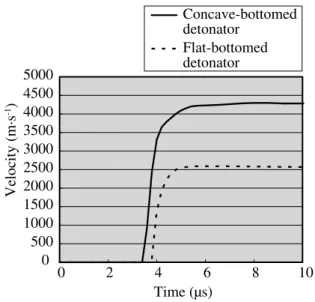
Simulation of the detonation of a detonator is compli- cated, involving a detonation causing a shock wave propa- gation and then interaction with copper shell. A suitable computational tool is very important. In this paper, the numerical simulations of detonation process inside the concave-bottomed and flat-bottomed detonators were car- ried out. LS-DYNA was used for those simulations. The simulation results of two type detonators were analyzed.
2. A precise detonator and FE model
A precise detonator is a wire explosion detonator pro- duced by Nippon Kayaku Co. ltd
2). It is composed of pri- mary charge, secondary charge, copper tube and leg wire.
PETN is used in primary charge and secondary charge, their weights are 0.4 g and 0.3 g respectively, and their lengths are 23 mm and 9.5 mm respectively. The experi- mental setup is shown in Fig. 1. Explosive charges and copper tube are concerned mainly in the finite element model. By making use of symmetry, only 1/2 of the struc- ture is modeled, two-dimensional elements are generated
Numerical simulation of explosion process of a precise detonator
Kaida Dai * † , Kunihisa Katsuyama * , Jun Yang ** , and Pengwan Chen **
*Dept. Rural Engineering, Faculty of Agriculture Ehime University, Matsuyama 790-8566, JAPAN
†