Mem. Institute of Advanced Technology, Kinki University Na. 6 : 13 — 14 (2001)
Application of NASH (Nucleic Acid Spot Hybridization) in Diagnosis of SPFMV to Facilitate Indexing of Sweet-potato Germplasm
13
Kazuo N. Watanabe and Junko A. Watanabe
Introduction
Sweet potato feathery mottle virus (SPFMV) is the major viral pathogen on sweet potato globally, causing about 70% of the viraI disease. It is far severely damaged by co-infection of other viral species, resulting sweet potato virus disease (SPVD) (Karyeija et al. 1998). Bio-assay and ELISA have been common detection methods, on the other hand, a fine method by RT-PCR is an alternative. However, none of them had balanced components required on time, simple procedures, proficiency in workers, reproducibility, infrastructure set-up and cost performances. Here an assessment of the infection of the virus was conducted using nucleic acid spot hybridization method (NASH) for handling various samples in a germplasm collection at once by a quick but moderately accurate sensitivity on viral detection.
Materials and Methods
Probe preparation: RT-PCR was conducted with the modification of Oonuki and Hanada (1996). The combination of Ambion Poly (A) PureTM, oligo dT cellulose and Takara RNA PCR Kit Ver 2.1 was used for viral RNA extraction and RT-PCR. Primers were designed using the sequence information on coat protein gene and non-translational region (Colinet et al. 1998, Nishiguchi et al. 1995, Oonuki and Hanada 1996), particularly a common alignment among different strains of SPFMV was employed for the primer synthesis. Approximately 540 bp size product was obtained after the RT-PCR, and the cDNA was cloned to be used as the NASH probe.
NASH sampling was made principally the same procedure as the CTAB method with some modification to reduce polyphenols by PVP and increased amount of antioxidants. Eppendorph tubes (1.5 ml) were used for sampling process. Around 100 mg of Ieaf sample (1/4 of Eppendorph tube volume) was placed in to the tube and the same volume of extraction cocktail was added for sample maceration. After incubation at 65 °C for 20 min, chloroforum / isoamyl alcohol (24 : 1) cocktail was added, then emulsion was made by vigorous shaking. Then supernatant was obtained by centrifugation at I 0,000g for 10-15 min at 4 °C. One micro litter to ten micro litter of the supernatant was spotted on a nylon membrane (Hybond N+, Amersham-Pharmacia) for hybridization. Hybridization-detection was conducted by Alkphos / CDP Star labeling- detection system (Amersham-Pharmacia) with Hyper ECL film. After two hours to overnight exposure to the film, the positive signals were obtained.
Results and Discussion
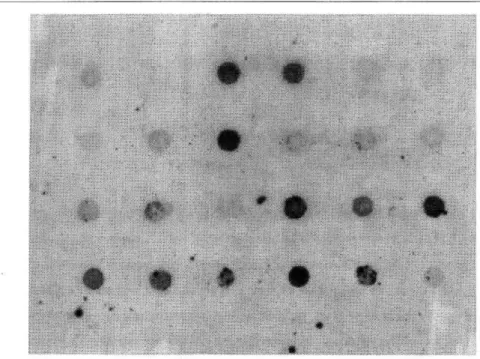
The detection leveI of viral nucleic acid by NASH was at nano gram / micro litter in sample solution aliquotes (Fig. 1). While sensitivity was lower than RT-PCR, with the pica gram of viral nucleic acid / micro litter sensitivity, sampling was far easier and many samples can be handled at ease with several hundred samples by one worker / day, in contrast to that RT-PCR requires many processes and rather high costs with a few number of samples. NASH can be practically used for initial screening for germplasm health in field collection at genebanks or when handling a large number of sample individuals at production areas for pathogen survey.
Institute of Biology-oriented Science and Technology, Kinki University, Wakayama, Japan
Fig. 1. A representative image of the result of NASH on sweet potato samples. Field collected leaves were used in the SPFMV infection diagnosis. Hybridization was made at 55 °C
overnight, using 70 ng of the labeled probe of cDNA from SPFMV. Primary wash was made at 55 °C with 10 min twice, and secondary wash at room temperature for 5 min
twice. The film exposure was conducted overnight. It was estimated that the presence
of 0. 1 ng level of the viral nucleic acid was detected.
References
1. Colinet, D., M. Nguyen, J. Kummert, P. Lepoivre and F. Z. Xia (1998) Differentiation among potyviruses infecting sweet potato based on genus and virus-specific reverse transcription polymerase chain reaction. Plant Disease 82: 223-229.
2. Karyeija, R. F. , R. W. Gibson and J. P. T. Valkonen (1998) The significance of sweet potato feathery mottle virus in subsistence sweet potato production in Africa. Plant Disease 82:4-15.
3. Nishiguchi, M., M. Mori, F. Suzuki, R. Nagata, T. Morishita, J-I. Sakai and K. Hanada (1995) Specific detection of a severe strain of sweet potato feathery mottle virus (SPFMV-S) by reverse trasncription and polymerase chain reaction (RT-PCR). Ann. Phytopathol. Soc. Jpn. 61: 119-122.
4. Oonuki, M. and K. Hanada (1996) Highly sensitive and simple diagnosis of virus diseases of sweet potato by RT-PCR. Shokubutuboueki 50(3) : 22-25.
Fig. 1. A representative image of the result of NASH on sweet potato samples. Field collected leaves were used in the SPFMV infection diagnosis. Hybridization was made at 55 °C
overnight, using 70 ng of the labeled probe of cDNA from SPFMV. Primary wash was made at 55 °C with 10 min twice, and secondary wash at room temperature for 5 min
twice. The film exposure was conducted overnight. It was estimated that the presence
of 0. 1 ng level of the viral nucleic acid was detected.
References
1. Colinet, D., M. Nguyen, J. Kummert, P. Lepoivre and F. Z. Xia (1998) Differentiation among potyviruses infecting sweet potato based on genus and virus-specific reverse transcription polymerase chain reaction. Plant Disease 82: 223-229.
2. Karyeija, R. F. , R. W. Gibson and J. P. T. Valkonen (1998) The significance of sweet potato feathery mottle virus in subsistence sweet potato production in Africa. Plant Disease 82:4-15.
3. Nishiguchi, M., M. Mori, F. Suzuki, R. Nagata, T. Morishita, J-I. Sakai and K. Hanada (1995) Specific detection of a severe strain of sweet potato feathery mottle virus (SPFMV-S) by reverse trasncription and polymerase chain reaction (RT-PCR). Ann. Phytopathol. Soc. Jpn. 61: 119-122.
4. Oonuki, M. and K. Hanada (1996) Highly sensitive and simple diagnosis of virus diseases of sweet potato by RT-PCR. Shokubutuboueki 50(3) : 22-25.
要 約
サ ツ マ イ モ 遺 伝 資 源 にお け るSPFMV感 染 診 断 の た め のNASH法 に よ る 簡 易 検 定 渡 邉 和 男 ・ 渡 邉 純 子
サ ツ マ イ モ の 主 要 ウ イ ル ス 病 原 で あ るSPFMV(sweetpotatofeatherymottlevirus)の サ ツ マ イ モ 遺 伝 資 源 へ の 感 染 診 断 を 行 うた め、 簡 易 検 定 法 と し てNASH(NucleicAcidSpotHybridization)法 の 適 用 を 行 っ た 。 異 な るSPFMV 株 の 被 膜 タ ンパ ク質 領 域 に 関 し て 共 通 した 配 列 か ら設 計 さ れ たPCRプ ラ イ マ ー を 用 い てcDNAプ ロ ー ブ を 作 成 し、
診 断 検 定 を 行 っ た。 感 度 はRT‑PCRに 劣 る も の の 多 数 の 遺 伝 資 源 で の ウイ ル ス 感 染 検 定 を 行 うた め の 簡 易 性 や 十 分 な検 出 精 度 が あ る も の と認 め られ た 。