RIMS-1734
Dual Consistent Systems of Linear Inequalities and Cardinality Constrained Polytopes
By
Satoru FUJISHIGE and Jens MASSBERG
December 2011
Dual Consistent Systems of Linear Inequalities and Cardinality Constrained Polytopes
Satoru Fujishige
∗Jens Maßberg
†December 6, 2011
Abstract
We introduce a concept of dual consistency of systems of linear inequalities with full generality. We show that a cardinality constrained polytope is represented by a certain system of linear inequalities if and only if the systems of linear inequalities associated with the cardinalities are dual consistent. Typical dual consistent systems of inequalities are those which describe polymatroids, generalized polymatroids, and dual greedy polyhedra with certain choice functions. We show that the systems of inequalities for cardinality-constrained ordinary bipartite matching polytopes are not dual consistent in general, and give additional inequalities to make them dual con- sistent. Moreover, we show that ordinary systems of inequalities for the cardinality- constrained (poly)matroid intersection are not dual consistent, which disproves a conjecture of Maurras, Spiegelberg, and Stephan about a linear representation of the cardinality-constrained polymatroid intersection.
1. Introduction
Cardinality constrained polyhedra and their linear representations were first investigated by Maurras [7] and Camion and Maurras [1], and later rediscovered by Gr¨otschel [5]
for what is called a cardinality homogeneous set system (also see related recent work by
∗Research Institute for Mathematical Sciences, Kyoto University, Kyoto 606-8502, Japan E-mail:
[email protected] Research partly supported by a Grant-in-Aid from the Ministry of Educa- tion, Culture, Sports and Technology of Japan.
†Research Institute for Discrete Mathematics, University of Bonn, Lenn´estraße 2, 53111 Bonn, Ger- many E-mail: [email protected] Research partly supported due to the “General Agreement for Cooperation between Hausdorff Center for Mathematics, University of Bonn and Research Institute for Mathematical Sciences, Kyoto University”.
Kaibel and Stephan [6], Stephan [10], Maurras and Stephan [9], and Maurras, Spiegel- berg, and Stephan [8]).
Given a finite nonempty set S, a combinatorial optimization problem Π on S, and an increasing sequencec = (c1, . . . , cm)of nonnegative integers ci (i = 1, . . . , m), the cardinality constrained versionΠc ofΠhas the set of feasible solutions consisting of all feasible solutions of the original problem with the property that the cardinality (i.e. the number of elements) of every solution is equal toci for somei∈ {1, . . . , m}. In [7, 1, 5]
they introducedforbidden cardinality inequalitiesof the form
(cp+1−cp)x(U)−(|U| −cp)x(S)≤cp(cp+1− |U|)
for allU ⊆Swithcp <|U|< cp+1 for somep∈ {1, . . . , m}, (1) where x(U) = ∑
u∈Ux(u) for U ⊆ S, and showed that the inequalities hold for Πc. Usually these inequalities are not facet-defining for the polyhedron associated withΠc.
Recently Maurras and Stephan [9] derived strong valid inequalities that give a com- plete linear description for cardinality constrained matroids. This result has been general- ized by Maurras, Spiegelberg, and Stephan [8, 11] to cardinality constrained polymatroids as follows. Given a polymatroid rank functionf : 2S → Rand an increasing sequence (c1, . . . , cm)of nonnegative integersci (i= 1, . . . , m), they aim for the convex hull of all vectorsxof the polymatroid associated withf of cardinalityci for somei∈ {1, . . . , m}, i.e.x(S) =ci. The cardinality constrained polymatroid is shown to be determined by the following system of inequalities:
x(U)≤f(U) (U ⊆S),
(cp+1−cp)x(U)−(f(U)−cp)x(S)≤cp(cp+1−f(U))
(U ⊆S with cp < f(U)< cp+1 for some p∈ {1, . . . , m−1}), (2) c1 ≤x(S)≤cm, x≥0.
In the present paper we introduce the concept of dual consistent systems of linear in- equalities and formulate the cardinality constrained problem in a more general setting. In Section 2 we give a characterization of certain complete systems of linear inequalities ex- pressing cardinality constrained polytopes with two cardinalities, where an essential role is played by the concept ofdual consistencyof systems of linear inequalities that we intro- duce in the present paper. Section 3 is concerned with multiple cardinality constraints. In Section 4 we show how the inequalities given in [9, 8, 11] are derived from our result. We also show that the systems of inequalities for the cardinality-constrained ordinary bipartite matching polytopes and for the cardinality-constrained (poly)matroid intersection are not dual consistent in general. The latter implies that a conjecture of Maurras, Spiegelberg, and Stephan [8, 11] about a linear representation of the cardinality-constrained intersec- tion of polymatroids does not hold in general.
2. Cardinality Constrained Polytopes
In this section we consider the case where we have two cardinalitiesc1 < c2(i.e.,m = 2).
The multiple cardinality case (i.e.m >2) will be discussed in Section 3.
2.1. Dual Consistent Systems of Inequalities
LetS be a finite nonempty set andZ be a finite nonempty set of non-zero vectors inRS. Choose and fix a vectorz0 ∈ Z. Then, consider two functions fi : Z → R (i = 1,2) withc1 :=f1(z0) < f2(z0) =: c2. Note that for the cardinality constrained polymatroid, Z is the set of characteristic vectorsχX of all nonempty subsets X ofS andz0 is given byχS, the all-one vector inRS. (For eachU ⊆ S the characteristic vectorχU ∈ RS is defined byχU(u) = 1foru∈U andχU(u) = 0foru∈S\U.)
For eachi= 1,2 define the polyhedron Pfci
i ={x∈RS | ∀z ∈ Z :hz, xi ≤fi(z), hz0, xi=ci}, (3) whereh·,·idenotes the canonical inner product defined byhz, xi=∑
u∈Sz(u)x(u). We assume that the Pfci
i (i = 1,2) are nonempty and bounded. Pfci
i can be regarded as a polyhedron restricted to vectors of cardinality ci where the cardinality of a vector x is given byhz0, xi(we may havez0 =χS(the all-one vector) in the ordinary case).
We are interested in obtaining a complete system of linear inequalities for the convex hull of Pfc1
1 ∪ Pfc2
2. To this end we introduce a concept of dual consistent systems of inequalities. We will show that if, and only if, the systems of linear inequalities appearing in (3) fori= 1,2are dual consistent, the convex hull is represented by the inequalities
(c2−c1)hz, xi −(f2(z)−f1(z))hz0, xi ≤c2f1(z)−c1f2(z) (z ∈ Z), (4)
c1 ≤ hz0, xi ≤c2 (5)
(see Theorem 1 to be shown below).
Remark 1: It should be noted that for eachi= 1,2, if we add the constrainthz0, xi=ci to (4), the system of inequalities (4) together with the added constraint is equivalent to
hz, xi ≤fi(z) (z∈ Z), hz0, xi=ci. (6) This is exactly the system of inequalities definingPfci
i in (3). 2
Now, for anyw∈RSandi= 1,2 consider the following problem
(Pwi ) Maximize hw, xi subject to x∈Pfci
i. (7)
Letxˆi be an optimal solution of Problem(Pwi )fori= 1,2and define
Zi(ˆxi) ={z ∈ Z | hz,xˆii=fi(z)} (i= 1,2), (8) which represents the set of active (or tight) constraints of (6) atxˆi fori = 1,2. For each i = 1,2 a set B ⊆ Z is called a dual optimal basefor Problem (Pwi )if there exists an optimal solutionxˆi of Problem(Pwi )such that
B ⊆ Zi(ˆxi), (9)
rankB=|S|, (10)
whererankBis the rank of the matrix formed by the vectors inB. By definition xˆi is an extreme point of Pfci
i. It follows from (9) and (10) thatxˆi is a unique solution of the system of equations
hz, xi=fi(z) (z ∈ B). (11) We assume that for every dual optimal baseBappearing in the following arguments we havez0 ∈ B. The systems of linear inequalities (6) fori= 1,2are calleddual consistent if for everyw ∈ RS there exists a common dual optimal baseB for(Pw1)and(Pw2). If there is no possibility of confusion, we also simply call the pair(f1, f2)dual consistentin the sequel. Recall that the dual consistency depends on the choice ofci (i = 1,2)andz0 besidesfi(i= 1,2).
Examples: Iff1 andf2 are submodular functions on2S withf1(S) = c1 < c2 = f2(S) andf1(∅) = f2(∅) = 0, the pair(f1, f2)is dual consistent due to the greedy algorithm ([2] and also see, e.g., [4]). More generally, dual greedy polyhedra with a common choice function give us a dual consistent pair. This follows directly by their definitions (see [3]).
2 Remark 2: We have assumed that Pfci
i (i = 1,2) are nonempty and bounded. We can extend the concept of dual consistency to systems of linear inequalities such that Pfci
i
(i= 1,2)are pointed and have a common characteristic cone, by considering only weight vectorsw that give finite optimal values for Problem (Pwi ). (We may also call (f1, f2) totally dual consistent with respect to z0 if (f1, f2) is dual consistent for z0 and every choice ofci (i = 1,2)such thatPfci
i 6= ∅(i = 1,2). Polymatroids give typical examples of totally dual consistent systems with respect to the all-one vector asz0.) 2
2.2. The Convex-hull Polyhedron
Define the polyhedron (polytope)Pˆby
(c2−c1)hz, xi −(f2(z)−f1(z))hz0, xi ≤c2f1(z)−c1f2(z) (z ∈ Z), (12)
c1 ≤ hz0, xi ≤c2. (13)
(Recall Remark 1 given in Section 2.1.) LetPfc1,c2
1,f2 denote the convex hull ofPfc1
1 ∪Pfc2
2. We will show thatPfc1,c2
1,f2 = ˆP (defined by (12) and (13)) if and only if the pair(f1, f2)is dual consistent. Before we show this, we analyze another (infinite) system of linear inequalities.
Denoting the optimal objective function value of (7) byζiw, we introduce the condition that everyx∈Pˆsatisfies
(c2−c1)hw, xi −(ζ2w −ζ1w)hz0, xi ≤c2ζ1w−c1ζ2w (∀w∈RS). (14) Lemma 1: If for allw∈RS and allx∈Pˆinequality(14)holds, then the pair(f1, f2)is dual consistent.
(Proof) If we considerζiw for eachi = 1,2as a function inw ∈ RS, it is what is called thesupport functionof polytopePfci
i. Hence, the inequalities of (14) together withc1 ≤ hz0, xi ≤c2 determine the convex hullPfc1,c2
1,f2 ofPfc1
1 ∪Pfc2
2. (Note that inequalities of (14) are exactly those which support bothPfci
i (i= 1,2).) It follows from the assumption that Pˆ ⊆Pfc1,c2
1,f2. We can easily see that the converse inclusion relation also holds true, due to Remark 1. Consequently,
Pˆ =Pfc1,c2
1,f2. (15)
Since it suffices to consider an arbitrary genericw ∈RS to show the dual consistency, it follows from (15) that for a genericw∈ RS the unique optimal solutionsxˆi for problem Pwi (i = 1,2)are adjacent vertices ofPˆ(= Pfc1,c2
1,f2), which implies that there exists a dual
optimal base for problemPwi (i= 1,2)for allw. 2
Remark 3: Here we do not need thatf1 andf2 have a common domainZ. For different domains off1 andf2the above proof is valid to show that constraint (14) implies the dual
consistency of(f1, f2). 2
Remark 4: As noted in the above proof, the inequalities of (14) together with inequalities c1 ≤ hz0, xi ≤ c2 determine the convex hull Pfc1,c2
1,f2 of Pfc1
1 ∪ Pfc2
2. Since Pfc1,c2
1,f2 is a polytope, we need only a finite number of inequalities from (14) besides (13) to obtain a representation ofPfc1,c2
1,f2 by linear inequalities, but the number of required inequalities could be much larger than|Z|. Note that every inequality of (14) gives a hyperplane that supports bothPfc1
1 andPfc2
2, andvice versa. 2
Next we show the following lemma.
Lemma 2: For any dual consistent pair (f1, f2) with f1(z0) = c1 < c2 = f2(z0) the convex hullPfc11,f,c22 ofPfc11 ∪Pfc22 is expressed by(12)and(13).
(Proof) Recall that Pˆ is the polytope defined by (12) and (13) and that Pfc1,c2
1,f2 ⊆ Pˆ. Suppose thatPfc1,c2
1,f2 6= ˆP. Then there exists an edgeLof Pˆ connecting a vertexx1 and
a vertexx2 ofPˆ such that one of the two is a vertex of Pfc11 or ofPfc22 and that the other belongs toPˆ\Pfc1,c2
1,f2. We assume without loss of generality thatx1is a vertex ofPfc1
1 and x2 ∈Pˆ\Pfc1,c2
1,f2.
Lethw, xi=bbe a supporting hyperplane ofPˆthat defines the edgeL. Thenx1is the unique optimal solution of Problem(Pw1). Lety2be an optimal solution of Problem(Pw2).
We can assume thatw is (generically) chosen so thaty2 is a unique optimal solution as well. Because of the dual consistency there exists a baseBsuch thatBis a dual optimal base for both problems(Pwi ) (i = 1,2). It follows from Remark 1 thatx1 and y2 lie on the lineL0 determined by the system of equations given by (12) for allz ∈ B \ {z0}, each of (12) for suchz holding with equality. It follows that x2 must coincide withy2, which
contradicts the assumption onx2. 2
Lemma 3: IfPfc1,c2
1,f2 = ˆP, then inequalities(14)hold for allx∈Pˆ. (Proof) SincePfc1,c2
1,f2 is determined by (14) and inequalitiesc1 ≤ hz0, xi ≤c2, the present
theorem follows. 2
Now it follows from Lemmas 1, 2, and 3 that
Theorem 1: The following three statements are equivalent:
(a) We havePfc1,c2
1,f2 = ˆP.
(b) Inequalities(14)hold for allx∈Pˆ.
(c) The pair(f1, f2)is dual consistent. 2
Remark 5: When the domains off1andf2are different and given byZ1 andZ2, we can always obtain a common domainZ1∪ Z2 by adding redundant constraints. 2 Remark 6: For any two polytopesP1 andP2 lying on two distinct parallel hyperplanes, letz0 be a common normal vector of the hyperplanes, and letZ be a finite set of normal vectors of hyperplanes (linear inequalities) that define the convex hull P of P1 ∪ P2, connecting the two polytopes. Then we get two functionsfi :V →R(i= 1,2)such that Pi =Pfci
i withfi(z0) = ci (i= 1,2)and the pair(f1, f2)is dual consistent.
This means that the systems of inequalities for any such two polytopes can be made dual consistent by adding some redundant inequalities. (Also see Remark 4.) 2
3. Multiple Cardinality Constrained Polytopes
In Section 2 we have considered cardinality constrained polytopes with only two cardi- nalitiesc1andc2. In the multiple cardinality case wherem >2there are a finite sequence of cardinalities(c1, . . . , cm)withc1 < c2 <· · · < cm and functionsf1, . . . , fm :Z → R withfi(z0) =ci (i = 1, . . . , m), whereS, Z, andz0 are the same as those in Section 2.
We assume that each pair offi andfi+1is dual consistent fori = 1, . . . , m−1. It should be noted that the relation of dual consistency on such pairs is not an equivalence relation, and it is not transitive, in particular.
Again we consider nonempty polytopesPfci
i (i= 1, . . . , m)defined as in (3) and aim for a linear inequality representation of the convex hullPfc1,...,cm
1,...,fm ofPfc1
1 ∪Pfc2
2 ∪ · · · ∪Pfcm
m. In the most general case it will be hard to derive inequalities for the convex hull if the inequalitieshz, xi ≤ fi(z) of (3) (1 ≤ i ≤ m and z ∈ Z) are not valid for all points x∈Pfc1,...,cm
1,...,fm withhz0, xi=cifor everyi= 1, . . . , m. Hence we assume Pfc1,...,cm
1,...,fm ∩ {x∈RS| hz0, xi=ci}=Pfci
i (i= 1, . . . , m). (16) We also assume
(T) each inequality in (3)(i = 1, . . . , m)defines a face (or supports the polytope with equality).
Here (T) is the tightness condition for eachfiandci. It should be noted that the tightness condition (T) is not required whenm= 2.
Remark 7: LetP∗ ⊂ RS be a polyhedron, z0 ∈ RS \ {0}, c1 < · · · < cm a sequence of cardinalities, andP∗ci = P∗∩ {x∈ RS| hz0, xi = ci}(nonempty and bounded). Then there is a finite set Z ⊂ RS \ {0} and functions fi : Z → R (1 ≤ i ≤ m) such that P∗ci =Pfci
i for alli= 1, . . . , m. Due to the convexity of the polyhedronP∗ equations (16)
hold true. 2
Under assumption (16) we immediately get Pfc1,...,cm
1,...,fm = ∪
1≤i≤m−1
Conv (
Pfci
i ∪Pfci+1
i+1
)
, (17)
whereConv(·)is the convex hull operator inRS.
We can easily generalize Theorem 1 to the multiple cardinality case as follows. Define a polyhedron (polytope)Pˆfc1,...,cm
1,...,fm by
(ci+1−ci)hz, xi −(fi+1(z)−fi(z))hz0, xi ≤ci+1fi(z)−cifi+1(z)
(z ∈ Z, i= 1, . . . , m−1), (18)
c1 ≤ hz0, xi ≤cm. (19)
For eachi= 1, . . . , m−1andz ∈ Z \ {z0}denote the inequality in (18) byHiz. We see from the tightness condition (T) and Theorem 1 that inequalityHizsupports the following three polytopes:
Pfci
i, Pfci+1
i+1, Conv (
Pfci
i ∪Pfci+1
i+1
) .
It follows from assumption (16) and the convexity ofPfc1,...,cm
1,...,fm that inequalityHiz is also valid for other polytopesPfcj
j (j ∈ {1, . . . , m}\{i, i+1}). It should be noted that (convex) polytopesConv(Pfci
i ∪Pfci+1
i+1) (i= 1, . . . , m−1)andPfc1,...,cm
1,...,fm have the same dimension.
Because of this argument and Theorem 1 we then get
Theorem 2: Under assumption(16)and the tightness condition(T)the following state- ments are equivalent:
(i) We havePfc1,...,cm
1,...,fm = ˆPfc1,...,cm
1,...,fm. That is, the system of inequalities in (18)and (19) represents the cardinality constrained polytopePfc1,...,cm
1,...,fm.
(ii) Functionsfiandfi+1 are dual consistent for all i= 1, . . . , m−1. 2
4. Examples and Counterexamples
4.1. Polymatroids
For eachU ⊆Swe identifyU with the characteristic vectorχU ∈RS.
We now show how the forbidden cardinality inequalities of [9] and [11] can be derived from (12). To this end let f : 2S → R≥0 be a polymatroid rank function and let Z = 2S \ {∅} and z0 = S. Also let 0 ≤ c1 < · · · < cm ≤ f(S). Now define functions fi :Z ∪ {∅} →R(i= 1, . . . , m)byfi(U) = min{ci, f(U)}forU ∈ Z ∪ {∅}. Consider polytopesPfci
i defined by (3) for alli= 1, . . . , m.
Note that for each i = 1, . . . , m fi is the rank function of the truncation, by ci, of the underlying polymatroid with rank function f. Due to the submodularity of fi (i = 1, . . . , m), the functions fi and fi+1 are dual consistent for all i = 1, . . . , m−1.
Moreover, the tightness condition (T) holds for allfi andciand (16) also holds.
Hence by Theorem 2 the system of inequalities in (18) and (19) defines the convex hull ofPfc11 ∪ · · · ∪Pfcmm. Note that Remark 7 applies to the current polymatroid case.
Inequalities (18) can be written as
(ci+1−ci)x(U)−(fi+1(U)−fi(U))x(S)≤ci+1fi(U)−cifi+1(U)
(U ⊆S, i= 1, . . . , m−1). (20) For anyi∈ {1, . . . , m−1}consider any subsetU ⊆Ssuch thatci ≤f(U)≤ci+1. Then by definition offi andfi+1 we get fi(U) = ci and fi+1(U) = f(U). Hence inequality
(20) reduces to
(ci+1−ci)x(U)−(f(U)−ci)x(S)≤ci(ci+1−f(U)) (21) for suchU. These are exactly thef-induced forbidden cardinality inequalities shown in [8, 9, 11] (see (2)). It should be noted that ifci+1 < f(U), (20) becomesx(U) ≤ f(U) and if f(U) < ci, then 0 ≤ x(S \ U), both being valid inequalities for the original polymatroid polytope. More precisely, (20) together withc1 ≤x(S)≤cm implies (2).
4.2. Bipartite Matchings
LetG= (V+, V−;E)be a bipartite graph with a vertex bipartition(V+, V−)and a setE of edges betweenV+andV−. For any vertexv ∈V+∪V−denote byδvthe set of edges incident tov.
Let w be a weight vector generically chosen from RE and ci (i = 1,2) be positive integers withc1 < c2such that there exists at least one matchingMinGof size|M|=c2. Then for eachi= 1,2consider a maximum-weight matching problem with a cardinality constraint, relaxed inRE as follows.
(Pwi ) Maximize ∑
e∈E
w(e)x(e)
subject to ∑
e∈δv+
x(e)≤1 (v+∈V+),
∑
e∈δv−
x(e)≤1 (v− ∈V−), 0≤x(e)≤1 (e∈E),
∑
e∈E
x(e) = ci. (22)
Here, we havez0 =χE ∈RE, andZis the set of the coefficient vectors of the inequalities and the equation appearing in (22), where0 ≤ x(e)should be regarded as an inequality
−x(e)≤0for alle∈E. Also, for eachi= 1,2 functionfi :Z → Ris defined so as to take the values specified by the right-hand sides of (22).
For each i = 1,2let xˆi be the unique optimal solution of Problem (Pwi ), where the uniqueness is due to the choice of genericw. Then, due to the integrality of (22), for each i= 1,2there is a matchingMi ⊆EinGsuch thatxˆi =χMi.
Consider the symmetric differenceM1∆M2 ≡(M1\M2)∪(M2\M1). ThenM1∆M2 can be decomposed into vertex-disjoint paths and possible cycles. Note that such paths and cycles are formed by alternating edges ofM1andM2. Because of the uniqueness of the optimal solutions there does not exist any such alternating cycle or path of even length (even number of edges). Suppose that the vertex-disjoint paths are then given by Q(k)
(k = 1, . . . , `), each of which satisfies one of the following two. We denote byE(Q(k)) the edge set ofQ(k).
|M2 ∩E(Q(k))|=|M1∩E(Q(k))|+ 1, (23)
|M2 ∩E(Q(k))|=|M1∩E(Q(k))| −1. (24) Let n+ and n−, respectively, be the number of paths Q(k) of type (23) and that of type (24). Then we see that` =n++n−andn+−n− =c2−c1 ≥1. Suppose thatn− ≥1, and then consider a pair of a path of type (23) and a path of type (24). The pair contains the same number of arcs fromM1and fromM2in total, which contradicts the uniqueness of the optimal solutions. It follows that we have n− = 0, i.e., n+ =c2−c1 =`.
For each pathQ(k) denote byV˜(Q(k))the set of intermediate (inner) vertices of Q(k), its initial and terminal vertices being discarded.
The tight inequalities (equations) in (22) common fori= 1,2are given as follows.
(i) For alle∈M1∩M2 we havex(e) = 1.
(ii) For alle∈E\(M1∪M2)we havex(e) = 0.
(iii) For eachk = 1, . . . , c2−c1, associated with (23), we have
∑
e∈δv+
x(e) = 1 (v+∈V˜(Q(k))∩V+), (25)
∑
e∈δv−
x(e) = 1 (v−∈V˜(Q(k))∩V−). (26)
For eachk = 1, . . . , c2 −c1 the total number of equations appearing in (25) and (26) is equal to|V˜(Q(k))|=|E(Q(k))| −1.
Since equations of type (i)x(e) = 0and type (ii)x(e) = 1can always be taken into a dual base, we delete the arcs of(M1∩M2)∪(E\(M1 ∪M2))fromG, and assume that M1∩M2 =∅andE =M1∪M2 in the sequel.
Ifc2−c1 = 1, then the symmetric difference M1∆M2 must form a single path. We can see that the system of exactly|E| equations of (i), (ii), and (iii) (withc2 −c1 = 1) together with the cardinality constraint uniquely determines the optimal solution xˆi for eachi = 1,2. Hence(Pwi ) (i = 1,2)have a common optimal dual base. It follows that the systems of inequalities for (Pwi ) (i = 1,2) is dual consistent. In the present case the cardinality constrained polytope is represented by (22) with the last equation being replaced by
c1 ≤ ∑
e∈E
x(e) ≤ c2 (=c1+ 1). (27) The present fact is closely related to the primal-dual, augmenting path algorithm for the maximum-weight matching problem, and is well known.
On the other hand, ifc2−c1 ≥2, there arec2−c1(at least two) paths of (23), so that the number of tight equations common fori= 1,2is at most|E| −2. Hence(Pwi ) (i= 1,2) cannot have any common dual optimal base even if we take the cardinality constraint into account. That is, the systems of inequalities for(Pwi ) (i = 1,2)are not dual consistent.
This implies that we need some additional redundant inequalities for(Pwi ) (i = 1,2)to express the cardinality constrained polytopePfc1,c2
1,f2 = Conv(Pfc1
1 ∪Pfc2
2). Such additional inequalities can be given in a form of (14). A set of additional inequalities is, for example, given as follows.
For eachk = 1, . . . , c2−c1 lete(k) be an edge ofM2 in pathQ(k). For anyF ⊆ E letσ(F)be the maximum size of a matching inGcontained inF. PutM :=M1 ∪M2. By construction we haveσ(M) = |M2| = c2. For each k = 1, . . . , c2−c1 consider set M \ {e(k)}. We see thatM2 \ {e(k)} is a matching inM \ {e(k)} and there cannot be a larger one withinM \ {e(k)}. Hence we haveσ(M \ {e(k)}) = c2−1.
It follows that each inequality
∑
e∈M\{e(k)}
x(e) ≤ c1 (28)
is valid for(Pw1)and is tight forx=χM1, while each inequality
∑
e∈M\{e(k)}
x(e) ≤ c2−1 (29)
is valid for(Pw2)and is tight for x = χM2. Note that inequalities (28) (or (29)) together with the other tight inequalities (25) and (26) are linearly independent sincec2−c1 ≥2.
(One of these inequalities can be deleted, if we take into account the cardinality constraint x(E) =ci fori= 1or2.) Adding inequalities (28) to(Pw1)and (29) to(Pw2), we have a common dual optimal base formed by these inequalities.
Any generic weight wdetermines a pair of optimal matchingsM1 for(Pw1)andM2 for(Pw2). Let us call such a pair(M1, M2)anadmissible pair. Then, adding inequalities (28) to (Pw1) and (29) to (P2w)for all admissible pairs (M1, M2)makes the systems of inequalities for(Pwi ) (i = 1,2)dual consistent, i.e., it makes them have a common dual base for anyw. It should be noted that for a non-genericw, even if optimal matchingsM1 andM2are not unique, we can always find optimal matchingsM10 andM20 with|M10|=c1 and|M20|=c2 such that(M10, M20)is admissible.
4.3. Matroid intersection
Suppose we are given two matroidsM(1)andM(2) on a ground setSwith rank functions r1andr2, respectively. Define the functionf : 2S →Rby
f(U) = min{r1(T) +r2(U \T)|T ⊆U} (∀U ⊆S). (30)
Note thatf(U)is equal to the maximum size of a common independent set ofM(1) and M(2)restricted onU ⊆S. Consider the matroid intersection polytope represented by
x(U)≤f(U) (U ⊆S), (31)
x≥0. (32)
Taking into account the nonnegativity constraint, define
Z =Za∪ Zb, (33)
Za={χU |U ⊆S, U 6=∅}, Zb ={−χe |e ∈S}. (34) Letc1 andc2 withc1 < c2 ≤ f(S)be two given positive integers (the cardinalities) and definefi :Z →Rfor eachi= 1,2by
fi(z) =
{ min{f(U), ci} (z =χU, ∅ 6=U ⊆S)
0 (z =−χe, e ∈S) (∀z∈ Z). (35) The cardinality-constrained polytopesPfc11 andPfc22 are given by (3).
Let us examine whether the pair(f1, f2)is dual consistent in general, i.e. whether the convex hull ofPfc1
1 ∪Pfc2
2 is described by (4) and (5):
(c2−c1)hz, xi −(f2(z)−f1(z))hz0, xi ≤c2f1(z)−c1f2(z) (z ∈ Z), c1 ≤ hz0, xi ≤c2,
wherez0 is given byχS, the all-one vector in RS. Actually we will show that the pair (f1, f2)for matroid intersection is not dual consistent in general.
Remark 8: In Section 4.2 we have seen that ordinary systems of linear inequalities for cardinality-constrained bipartite matchings are not dual consistent. However, this does not imply that the linear representations of the cardinality-constrained matroid intersection are not dual consistent in general, though the bipartite matching problem is a special case of the matroid intersection problem. Note thatZ ⊇2S\ {∅}for matroid intersection and that this is not the case for ordinary bipartite matching polytopes. (We identify a subset
ofS with its characteristic vector as before.) 2
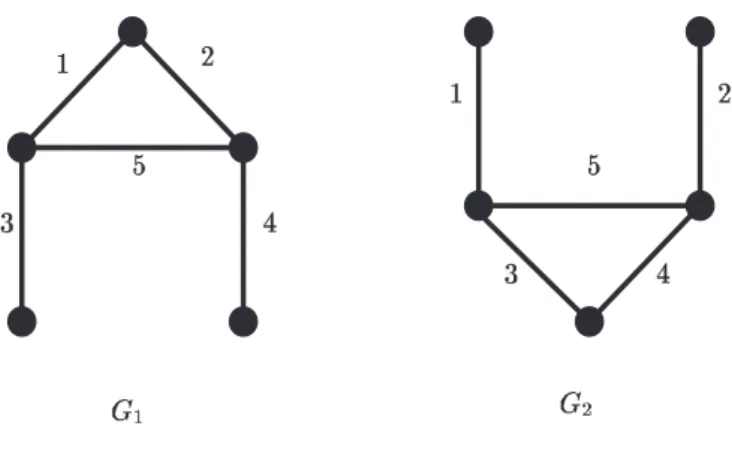
Now letM(1)andM(2) be the graphic matroids on the ground setS ={1,2,3,4,5} represented by the graphsG1andG2given in Figure 1.
Supposec1 = 1andc2 = 4. For an appropriately given weight vectorwwe have Ic1 ={5}, Ic2 ={1,2,3,4} (36) as the unique maximum-weight common independent sets of sizec1(= 1)andc2(= 4), re- spectively, which give the unique optimal solutionsxˆ1 =χIc
1 andxˆ2 =χIc
2 of Problems
Figure 1: The graphsG1 andG2 representing the graphic matroidsM(1)andM(2).
(Pw1)and (Pw2), respectively, due to the integrality of the matroid intersection polytope with a single cardinality constraint. For such a weight vectorwwe can easily see that a common dual optimal base is given by the following five:
S(={1,2,3,4,5}), S\ {e} (e∈ {1,2,3,4}). (37) Next, copy each of M(1) and M(2) on the ground set S0 = {10,20,30,40,50}. For i= 1,2consider the direct sum ofM(i)and its copy and denote it byM(i)again, so that M(1) andM(2) are defined on the ground setS ∪S0 = {1,2,3,4,5,10,20,30,40,50}. Put S ← S ∪ S0 and let c1 = 2 and c2 = 8. For an appropriate weight vector w we get Ic1 = {5,50} as the unique maximum-weight common independent set of size c1(= 2) andIc2 = {1,2,3,4,10,20,30,40}as the unique maximum-weight common independent set of sizec2(= 8).
We can see that a maximum rank of common tight sets ofxˆ1 =χIc
1 andxˆ2 =χIc
2 for the inequalities and equation in (6) fori= 1,2is attained by the following nine sets:
S(= {1,2,3,4,5,10,20,30,40,50}), (38) S\ {e} e∈ {1,2,3,4,10,20,30,40}. (39) Since there are ten variables, we do not have a common dual optimal base, i.e. the pair (f1, f2)is not dual consistent. An additional valid inequality that yields a common dual base with respect to the presentwis given, for example, by
6x({5}) +x({1,2,3,4,5,10,20,30,40,50})≤8. (40)
It is left open to give a finite set of additional inequalities in a systematic way that makes the systems for cardinality-constrained (poly)matroid intersection dual consistent.
It is conjectured in [8, 11] that the convex hull ofPfc1
1 ∪Pfc2
2 is determined by x(U)≤f(U) (U ⊆S),
(c2−c1)x(U)−(f(U)−c1)x(S)≤c1(c2−f(U)) (41) (U ⊆S with c1 < f(U)< c2),
c1 ≤x(S)≤c2, x≥0.
Similarly as discussed in Section 4.1 we can see that inequalities (41) are implied by inequalities (4) and (5), so that the polytopePˆ determined by (4) and (5) is included in the polytope P0 determined by (41). Since in our example the pair (f1, f2) is not dual consistent, it follows from Theorem 1 that the convex hullPfc1,c2
1,f2 ofPfc1
1 ∪Pfc2
2 is strictly included inPˆ. HencePfc1,c2
1,f2 6= P0 and our example given above disproves a conjecture of Maurras, Spiegelberg, and Stephan [8, 11] for the cardinality-constrained polymatroid intersection.
5. Concluding Remarks
We have introduced a new concept of dual consistency of systems of inequalities and have revealed that the concept of dual consistency plays a crucial role in the linear representa- tion of cardinality constrained polytopes. We have also shown that the ordinary systems of inequalities for the cardinality-constrained bipartite matching polytopes are not dual consistent in general and have given a set of additional inequalities to make the system of inequalities dual consistent.
Moreover, we have shown that ordinary systems of inequalities for the cardinality- constrained (poly)matroid intersection are not dual consistent in general, which disproves a conjecture of Maurras, Spiegelberg, and Stephan [8, 11] about a linear representation of the cardinality-constrained polymatroid intersection.
References
[1] P. Camion and J. Maurras: Polytopes `a sommets dans l’ensemble{0,1}n. Cahiers du Centre d’ ´Etudes de Recherche Op´erationnelle24(1982) 107–120.
[2] J. Edmonds: Submodular functions, matroids, and certain polyhedra.Proceedings of the Calgary International Conference on Combinatorial Structures and Their Appli- cations(R. Guy, H. Hanani, N. Sauer and J. Sch¨onheim, eds., Gordon and Breach, New York, 1970), pp. 69–87; also in: Combinatorial Optimization—Eureka, You
Shrink! (M. J¨unger, G. Reinelt and G. Rinaldi, eds., Lecture Notes in Computer Science2570, Springer, Berlin, 2003), pp. 11–26.
[3] S. Fujishige: Dual greedy polyhedra, choice functions, and abstract convex geome- tries.Discrete Optimization1(2004) 41–49.
[4] S. Fujishige: Submodular Functions and Optimization(Second Edition), (Annals of Discrete Mathematics58) (Elsevier, 2005).
[5] M. Gr¨otschel: Cardinality homogeneous set systems, cycles in matroids, and asso- ciated polytopes. In: The sharpest cut. The impact of Manfred Padberg and his work (M. Gr¨otschel, Ed., MPS-SIAM Series on Optimization4, 2004), pp. 199–216.
[6] V. Kaibel and R. Stephan: On cardinality constrained cycle and path polytopes.
Mathematical Programming, Ser. A,123(2010) 371–394.
[7] J. F. Maurras: An example of dual polytopes in the unit hypercube. Annals of Dis- crete Mathematics1(1977) 391–392.
[8] J. F. Maurras, I. Spiegelberg and R. Stephan: On cardinality constrained polyma- troids.Discrete Applied Mathematics(2011), doi:10.1016/j.dam.2011.10.007 . [9] J. F. Maurras and R. Stephan: On the cardinality constrained matroid polytope.Net-
works57(2011) 240–246.
[10] R. Stephan: Cardinality constrained combinatorial optimization: Complexity and polyhedra.Discrete Optimization7(2010) 99–113.
[11] R. Stephan and I. Spiegelberg: On cardinality constrained polymatroids. Electronic Notes in Discrete Mathematics36(2010) 1017–1024.