PAPER
Rule-Based Automatic Question Generation Using Semantic Role Labeling
Onur KEKLIK†,Nonmember, Tugkan TUGLULAR†a),Member,andSelma TEKIR†,Nonmember
SUMMARY This paper proposes a new rule-based approach to auto- matic question generation. The proposed approach focuses on analysis of both syntactic and semantic structure of a sentence. Although the primary objective of the designed system is question generation from sentences, au- tomatic evaluation results shows that, it also achieves great performance on reading comprehension datasets, which focus on question generation from paragraphs. Especially, with respect to METEOR metric, the designed sys- tem significantly outperforms all other systems in automatic evaluation. As for human evaluation, the designed system exhibits similar performance by generating the most natural (human-like) questions.
key words: question generation, rule-based, semantic role labeling, ME- TEOR
1. Introduction
Humans have curios nature. They ask questions to gain more knowledge and try to link them with other things they know. Our daily lives include asking questions in conver- sations. For instance, student questions play an important role in their learning process and help them to learn more from their teachers and teacher questions help students to assess their performance. In a nutshell, questions are one of the primary sources of learning from daily conversations to verbal tutorings and assessments.
Most of learners are not good at asking questions.
Hacker et al. (1998) state that learners have a problem with identifying their own knowledge deficits. Therefore, they ask very few questions. Automation of question generation systems can help learners to find out their own knowledge gaps by helping them to reach their valuable inquiries.
Automation of question generation systems helps auto- mated question answering systems such as IBM Watson to perform self training (IBM Watson Ecosystem, 2014). Au- tomatic question generation systems automatize the process of defining ground truth answers from the questions. Intelli- gent tutoring systems can also get benefit from that. Rather than relying on human experts to manually extract questions from study materials, each end user can define its own tutor- ing system automatically from the study material.
Question generation is a fundamental activity in ed- ucational learning. Questions serve to different levels of complexity in the educational learning process. In terms
Manuscript received June 6, 2018.
Manuscript revised January 3, 2019.
Manuscript publicized April 1, 2019.
†The authors are with the Department of Computer Engineer- ing, Izmir Institute of Technology, Izmir, 35430 Turkey.
a) E-mail: [email protected] DOI: 10.1587/transinf.2018EDP7199
of complexity, Rus and Graesser (2009) divide questions into deep and shallow categories. If a learner wants to ac- quire difficult scientific and technical material, deep ques- tions (such as why, why not, how, what-if, what-if-not) can be asked. These questions involve more logical thinking than shallow questions. Conversely, shallow questions fo- cus more on facts (such as who, what, when, where, which, how many/much and yes/no questions).
Question generation for reading comprehension uses a paragraph as an information source and creates questions that test its understanding. Question generation from a sen- tence, on the other hand, poses factual questions related to the given input sentence.
Recently, Question Generation (QG) and Question Answering (QA) in the field of computational linguistics has got enormous attention from the researchers (Rus and Graesser, 2009). Twenty years ago, receiving answers to the same questions would take hours or weeks through docu- ments and books. After the computers and internet, wealth of information becomes available and this field holds great promise for making sophisticated question asking and an- swering facilities mainstream in the future.
Most of the question generation systems tackles the problem with a rule-based approach. In the proposed ap- proach, sentence-to-question transformation is performed by applying external rules or internal templates to the syn- tactic representation of the given input sentence. However, syntactic representations are not sufficient to reach high- level abstractions in question generation. There is a strong need to consider the semantic roles of words to increase the comprehension level of generated questions. Thus, question generation should be enriched by the process of understand- ing meaning behind a sentence. Mazidi and Tarau (2016) highlights this fact by stating that natural language under- standing (NLU) is a missing piece of the puzzle in question generation.
This work proposes a rule-based approach to ques- tion generation from sentence. To be specific; dependency- based, named entity recognition-based, and semantic role labeling-based templates/rules are used. In terms of rules, our contribution can be outlined as follows:
1. For dependency-based rules, the following patterns are newly added:
• S-V-oprd is an object predicate that defines the subject.
• S-V-xcomp is an open clausal complement with- Copyright c2019 The Institute of Electronics, Information and Communication Engineers
out an internal subject.
• S-V-ccomp (clausal complement) is a clause with an internal subject.
2. NER-based rules, which are S-V-number, S-V-location, S-V-date, S-V-person, are added.
3. More importantly, new semantic role labeling-based templates/rules are constructed:
• S-V-ARGM-CAU: cause clause.
• S-V-ARGM-MNR: manner marker.
• S-V-ARGM-PNC: purpose clause.
• S-V-ARGM-LOC: locative.
• S-V-ARGM-TMP: temporal marker.
4. Any rule can be enabled or disabled. That means deep and shallow questions can be generated individually, selectively, or all together.
Automatic question generation can be enriched by ex- ploiting semantic roles of words in a diverse set of rules to generate both shallow and deep questions. Semantic role la- beling promises deep question generation as semantic roles are not simple functions of a sentence’s syntactic structure, but are proved (Lapata and Brew, 1999) useful as cues to reveal the meaning of a word in a particular context.
The proposed approach uses dependency-based, NER- based, and SRL-based semantic rules. Semantic roles of words contribute to comprehensive question generation in two ways:
• Using different parsers in combination (namely Depen- dency parser-SRL and NER-SRL).
• Using SRL-based templates (exclusively examining SRL parser to look for more sentence patterns).
To test the effectiveness of our approach, we com- pare against two state-of-the-art systems: Du et al.’s (2017) learning-based system for question generation for reading comprehension and the best rule-based system by Heilman and Smith (2010). Our automatic evaluation through ob- jective neural translation metrics show that our system has superior performance and outperforms the others in BLEU- 2, METEOR, and ROUGE-L metrics. Our superior perfor- mance especially in METEOR metric can be attributed to its recall-based nature. By diversifying and extending the rule sets, our approach generates an expanded set of questions out of those that can possibly be asked.
We performed human evaluation as well. In our ex- perimental setup, 25 sentences are randomly sampled from SQuAD. From this set, 126 questions are generated and rated by four different professional English speakers on a 1-5 scale (5 for the best). We compare our results with those of Du et al. (2017) and Heilman & Smith (2010) system. In both difficulty and correctness metrics, our system produces closest scores to the real human-generated questions, indi- cating that our proposed system outperforms the others and is the most natural (human-like) system.
In the remaining part of the paper, first in Sect. 2, back- ground is provided along with the related work. In Sect. 3,
the proposed approach is explained in detail. After that, au- tomatic evaluation and human evaluation are presented in separate sections. Finally, in Sect. 6, the paper is concluded with some remarks and possible future directions.
2. Background
2.1 Related Work
There are various types of questions and researchers pro- posed different taxonomies for organizing them. In terms of complexity, as Rus and Graesser (2009) state, questions can be divided into two categories, namely deep questions and shallow questions. If a learner wants to acquire diffi- cult scientific and technical material, deep questions (such as why, why not, how, what-if, what-if-not) can be asked.
These questions involve more logical thinking than shal- low questions. On the other hand, shallow questions focus more on facts (such as who, what, when, where, which, how many/much and yes/no questions).
Most of the question generation systems tackle the problem with a rule-based approach. Majority of the steps are: first get the syntactic representation of the given input sentence, then use external templates or internal rules to ap- ply sentence-to-question transformation. However, relying only on syntactic representations, which don’t tell anything about the semantic role of words, force us to use only low- level abstractions in question generation. Du et al. (2017) state that the rule-based approaches make use of the syntac- tic roles of words, but not their semantic roles.
Heilman and Smith (2011) use a multi-step process to generate factual questions from text. The process be- gins with NLP transformations for the input sentence.
Then, manually encoded transformation rules are applied for sentence-to-question conversion, and finally a linear regression-based ranker assigns acceptability scores to ques- tions to eliminate the unacceptable ones.
Most of the prior works mentioned here arrange sen- tence constituents with respect to grammar rules to generate as many possible questions as they can. In contrast, Mazidi and Tarau (2016) introduced NLU-approach that focuses on constituent patterns in a sentence. These patterns are key to detect the type of question that should be asked. They also used multiple parsers (both syntactic and semantic parsers) instead of depending on only one because each parser tells its own particular viewpoint about the sentence. In their evaluation of the top 20 questions, their system generated 71% more acceptable questions than other state of the art question generation systems by augmenting the generation process with NLU techniques.
Labutov et al. (2015) used a completely different ap- proach. They used crowd sourcing method to generate deep comprehension question templates. First, they obtain the high-level question templates from the crowd. Then, they retrieve the subset of collected templates. For example, category-section pairs for an article about Albert Einstein contains (Person, Early life), (Person, Awards), and (Per-
son, Political views). Articles about persons have similar subsections, so that templates formed for one person should transfer reasonably well to others. Their relevance classi- fier decides on whether category-section pairs match or not.
However, in some cases, it transfers irrelevant content and raises the false positive errors.
Du et al. (2017) used another innovative approach to generate questions for reading comprehension. They used a neural language model with a global attention mechanism to generate questions. They study several variations of this model, from sentence focused models to paragrahs, reading passages and other variations to determine the importance of pre-trained vs. learned word embeddings. Moreover, they don’t rely on hand-crafted rules in their approach.
The first Question Generation Shared Task Evaluation Challenge (QGSTEC, 2010) is one of the campaigns that follows the same tradition of STECs (such as Text REtrieval Conference, TREC) in Natural Language Processing. The campaign consists of two tasks. The first task focuses on question generation from paragraphs, whereas the second task focuses on question generation from sentences. Data sets, evaluation criteria and guidelines are prepared with re- spect to these tasks. For the second task, input sentences were selected from Wikipedia, OpenLearn and Yahoo! an- swers (30 inputs from each source). Participants were also provided with the list of target question types (who, where, when, which, what, why, how many/long, yes/no) that they need to generate. Finally, human evaluators evaluate the submitted questions according to evaluation criteria, which are relevance, question type (who/what/why), syntactic cor- rectness, fluency, ambiguity, and variety.
Using human evaluators to evaluate machine generated questions is a time and resource consuming process. How- ever, automatic evaluation metrics are key to manage this process much efficiently. Since the release of IBM’s BLEU metric (Papineni et al, 2002) and the closely related NIST metric (Doddington, 2002), automatic evaluation metrics have been widely recognized and extensively used by ma- chine translation (MT) community. Compared to the human evaluations, evaluating an MT system using such automatic metrics is cheaper, faster and time-saving. This is why Du et al. (2017) used BLEU, METEOR and ROUGE-L metrics to evaluate their neural question generation system. They also perform human evaluations to complement their results.
BLEU metric is first proposed by IBM (Papineni et al, 2002). It is the exact matches of words and matches against a set of reference translations for greater variety of expres- sions. It calculates geometric average of the n-gram scores (size 1 to 4) for precisions. It has no recall, but uses expo- nential brevity penalty to reduce the score of overly short sentences in order to compensate for recall.
METEOR metric is first proposed by Denkowski and Lavie (2009). It is a recall oriented metric, which combines recall and precision as weighted score components. ME- TEOR calculates the similarity score between generations, references and semantic equivalents such as inflections, syn- onyms and paraphrases. Instead of relying on higher order
n-grams, METEOR uses a direct word-ordering penalty.
ROUGE (Recall-Oriented Understudy for Gisting Evaluation) metric, which is first proposed by Lin (2004), is designed to compare n-grams recall of machine produced translations against human-produced translations. ROUGE- L is measured according to the longest common subse- quence.
Our implementation uses the evaluation package re- leased by Chen et al. (2015) that includes the implemen- tation of BLEU-1, BLEU-2, BLEU-3, BLEU-4, METEOR and ROUGE-L metrics.
Constructing a question answering or reading compre- hension dataset is also a challenging problem. Richardson et al. (2013) curated MCTest, where each question is paired with 4 answer choices. Despite the dataset contains chal- lenging human generated questions, its size is too small to support data-demanding question answering models. After that, many datasets are released and most of them generate the questions in a synthetic way. bAbI (Weston et al, 2015) is a fully synthetic reading comprehension dataset which features 20 distinct tasks. In order to solve these tasks dif- ferent types of reasoning is required. Hermann et al. (2015) constructed a corpus of cloze style questions by predicting entities in abstractive summaries of Daily News/CNN arti- cles. With this approach they collected a million new stories.
However, Chen et al. (2016) concluded that the dataset is quite easy and current neural networks almost reached ceil- ing performance.
Finally in 2016, Rajpurkar et al. (2016) released the Stanford Question Answering Dataset (SQuAD). SQuAD is a reading comprehension dataset that consists of 100,000+ questions on 500+articles. Questions are posed by crowd- workers on a set of Wikipedia articles. It overcomes the semi-synthetic and small size data issues that mentioned above.
2.2 Parsers
In this section parsers, which are the main building blocks of question generation, are explained one by one, with their own particular viewpoint examples.
2.2.1 Part-of-Speech Tagging
Part-of-speech tagging (POS tagging) is a task that intends to identify the syntactic role of each word in the given sen- tence such as singular noun, adjective. Part-of-speech tag- ging uses different tagsets based on language and corpus that was collected from different sources. The designed system relies on SENNA’s (Collobert et al., 2011) part-of-speech tagging algorithm which uses Penn Treebank tagset (Mar- cus, Marcinkiewicz and Santorini, 1993). An example part- of-speech of the sample sentence “The Bill of Rights gave the law federal government greater legitimacy” can be seen in Table 1.
Table 1 An example of POS and chunk tags of sample sentence.
Token POS Tag Chunk Tag
The DT B-NP
Bill NNP E-NP
of IN S-PP
Rights NNPS S-NP
gave VBD S-VP
the DT B-NP
new JJ I-NP
federal JJ I-NP
government NN E-NP
greater JJR B-NP
legitimacy NN E-NP
Fig. 1 An example dependency tree of sample sentence.
2.2.2 Chunking
Chunking (also called shallow parsing) is a process that first detects constituents in a sentence, then segments them to chunks of syntactically related word groups. Each word is labeled with its own unique tags in the groups. The designed system uses SENNA’s chunking implementation. For this implementation, chunk tags have two parts. The first part indicates the beginning, continuation or end of a chunk. The second part indicates the type of the current word group.
For example, beginning of a chunk noun phrase is labeled with B-NP, continuation of a chunk verb phrase is labeled with I-VP. Example chunking tags of the sample sentence
“The Bill of Rights gave the law federal government greater legitimacy” can be seen in Table 1.
2.2.3 Dependency Parsing
The main idea of dependency parsing is that each word is connected to each other by directed links. These links are called dependencies in linguistics. The main goal is to reveal the syntactic structure of the sentence by looking at these de- pendencies. Structure is determined by the relation between a head word and its dependents (childs). The most widely used syntactic structure is a parse tree. It allows to navigate through generated parse tree using head and child tokens.
An example dependency tree of the sentence “REM sleep is characterized by darting movement of closed eyes” can be seen in Fig. 1.
2.2.4 Named Entity Recognition
Named Entity Recognition (NER) is an information extrac- tion task that labels words into various semantic categories such as person, date, location, facility. There are various NER approaches based on rule-based techniques and statis- tical models, i.e. machine learning. Rule-based approaches
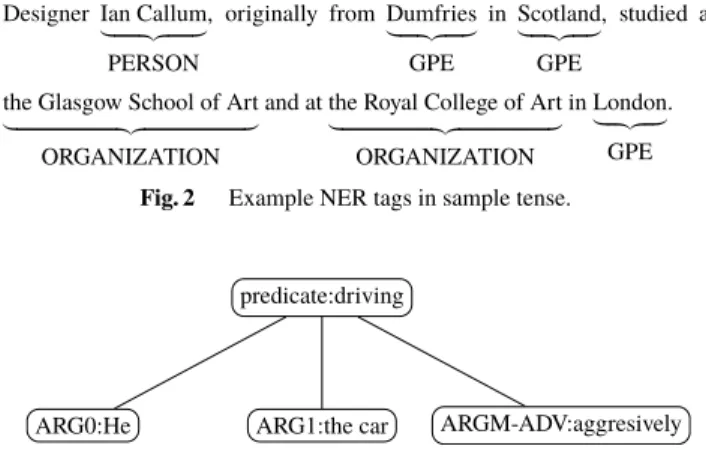
Fig. 2 Example NER tags in sample tense.
Fig. 3 An example SRL representation of a sample sentence.
rely on hand-crafted rules which is done by experienced lin- guists, whereas statistical approaches need large set of train- ing data. Statistical models also allow to train custom mod- els and define new categories according to problem domain.
Found named entity tags of the sentence “Designer Ian Cal- lum, originally from Dumfries in Scotland, studied at the Glasgow School of Art and at the Royal College of Art in London” can be seen in Fig. 2.
2.2.5 Semantic Role Labeling
Semantic Role Labeling (SRL) is a process that aims to re- veal the semantic structure of a sentence by labeling word groups and phrases. It is an essential part of NLU and ex- tracts the semantic word groups in a sentence. In SRL rep- resentation, predicate is the root and word groups accom- panying the predicate is considered as arguments. Depend- ing on their role in the sentence, predicates are assigned to different semantic categories. These categories are decided by the Proposition Bank (Palmer, Kingsbury, Gildea, 2005) which adds predicate-argument layer to syntactic structures of the Penn Treebank. The Proposition Bank provides num- bered argument tags (such as ARG0, ARG1) and assigns functional tags to all verb modifiers, such as cause (CAU), temporal (TMP), purpose (PNC) and others (Malaya, 2005).
The designed system relies on AllenNLP’s (Gardner et al., 2017) semantic role labeler which includes high quality trained models. An example SRL representation of the sen- tence “He is driving the car aggressively.” can be seen in Fig. 3.
3. Proposed Approach
3.1 Predefined Rules (Templates)
In this section, templates and their generation are explained in detail. In order to consider a sentence pattern as a tem- plate, it should satisfy the criteria which are previously stated by Mazidi and Tarau (2016). These are: (1) The sen- tence pattern should be working on different domains. (2) It should extract important points in the source sentence and
Table 2 Dependency-based template examples.
Template and Example
1.S-V-acomp is an adjective phrase that describes the subject.
S:It has been argued that the term “civil disobedience” has always suffered from ambiguity and in modern times, become utterly debased.
Q:Indicate characteristics of the term “civil disobedience”.
2.S-V-oprd is an object predicate that defines the subject.
S:Brain waves during REM sleep appear similar to brain waves during wakefulness.
Q:How would you describe brain waves during REM sleep?
3.S-V-attr is a noun phrase, usually following copula and defines the subject.
S:The fourth Yuan emperor, Buyantu Khan (Ayurbarwada), was a competent emperor.
Q:How would you describe the fourth Yuan emperor, Buyantu Khan (Ayurbarwada)?
3.S-V-xcomp is an open clausal complement without an internal subject.
S:Some of Britain’s most dramatic scenery is to be found in the Scottish Highlands.
Q:What is some of Britain ’s most dramatic scenery?
4.S-V-dobj (direct object) is a noun phrase that is the accusative object of a verb.
S:In 1996, the trust employed over 7,000 staffand managed another six sites in Leeds and the surrounding area.
Q:What did the trust manage in Leeds and the surrounding area in 1996?
5.S-V-ccomp (clausal complement) is a clause with an internal subject.
S:He says that you like to swim.
Q:What does he say?
6.S-V-dative indicates an indirect object.
S:The Bill of Rights gave the new federal government greater legitimacy.
Q:What did give the new federal government greater legitimacy?
7.S-V-pcomp is a complement of a preposition that modifies the meaning of a prepositional phrase.
S:REM sleep is characterized by darting movement of closed eyes Q:What is REM sleep characterized by?
create an unambiguous question. (3) Semantic information that is transferred by sentence pattern should be consistent across different instances.
Templates are categorized below with respect to the parsing method(s) they used. Each sentence pattern is de- tected by using different parsers.
3.1.1 Dependency-Based Templates
Using semantic role labeling, first the semantic structure of a sentence is revealed, then using dependency parsing, se- mantic arguments are matched with the found dependency tags to check if the sentence template corresponds to any template. In Table 2, templates can be seen with example sentences. S-V-acomp, S-V-attr, S-V-dobj, S-V-pcomp and S-V-dative are previously mentioned by Mazidi and Tarau (2016). S-V-xcomp and S-V-ccomp are changed and S-V- oprd is added according to the criteria that we have men- tioned in Sect. 3.1.
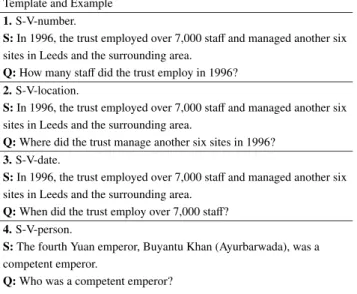
Table 3 NER-based template examples.
Template and Example 1.S-V-number.
S:In 1996, the trust employed over 7,000 staffand managed another six sites in Leeds and the surrounding area.
Q:How many staffdid the trust employ in 1996?
2.S-V-location.
S:In 1996, the trust employed over 7,000 staffand managed another six sites in Leeds and the surrounding area.
Q:Where did the trust manage another six sites in 1996?
3.S-V-date.
S:In 1996, the trust employed over 7,000 staffand managed another six sites in Leeds and the surrounding area.
Q:When did the trust employ over 7,000 staff? 4.S-V-person.
S:The fourth Yuan emperor, Buyantu Khan (Ayurbarwada), was a competent emperor.
Q:Who was a competent emperor?
3.1.2 NER-Based Templates
Using semantic role labeling, first the semantic structure of a sentence is revealed, then using named entity recognition, the designed system detect words that are labeled as per- son, location, date or number. So, the designed system can ask who, where, when or how many questions accordingly.
Then, the tagged word is removed from the corresponding semantic argument. Finally, using the rest of the semantic arguments, the designed system checks if the constructed sentence has reasonable components (subject, direct object, verb,etc.).
However, “who” question is problematic. Let’s con- sider an example sentence: “Atop the Main Building’s gold dome is a golden statue of the Virgin Mary.” In this sce- nario, NER detects “Virgin Mary” as a person. However, if we look at the full noun phrase: “statue of the Virgin Mary”
is an object, not a person. So, “who” question is not an appropriate choice in this situation. The designed system tackles this problem through the use of chunking. So, the full noun phrase can be detected and this problematic case can be eliminated. With the use of chunking, the designed system also detects relative clauses to ensure a sentence re- ally mentions a person, not an object. NER-based templates and examples can be seen in Table 3.
3.1.3 SRL-Based Templates
Using semantic role labeling, the designed system reveals the semantic structure of the sentence under consideration.
Using only numbered argument labels and modifiers, the de- signed system generates questions. Templates and examples can be seen in Table 4.
3.2 The Designed System
The designed system focuses both on deep and shallow
Table 4 SRL-based template examples.
Template and Example
1.S-V-ARGM-CAU: cause clause.
S:On 24 March 1879, Tesla was returned to Gospic under police guard for not having a residence permit.
Q:Why was Tesla returned to Gospic on 24 March 1879?
2.S-V-ARGM-MNR: manner marker.
S:Tesla’s work for Edison began with simple electrical engineering and quickly progressed to solving more difficult problems.
Q:How did Tesla’s work for Edison progress quickly to solving more difficult problems?
3.S-V-ARGM-PNC: purpose clause.
S:To secure further loans, Westinghouse was forced to revisit Tesla’s AC patent, which bankers considered a financial strain on the company (at that point Westinghouse had paid out an estimated $200,000 in licenses and royalties to Tesla, Brown, and Peck)..
Q:For what purpose was Westinghouse forced to revisit Tesla’s AC patent, which bankers considered a financial strain on the company?
4.S-V: don’t have any modifier, using only numbered argument labels to generate yes/no questions.
S:The Bill of Rights gave the new federal government greater legitimacy.
Q:Did the Bill of Rights give greater legitimacy?
5.S-V-ARGM-LOC: locative.
S:Mr. Bush met him privately, in the White House, on Thursday.
Q:Where did mr. Bush meet him on Thursday?
6.S-V-ARGM-TMP: temporal marker.
S:Mr. Bush met him privately, in the White House, on Thursday.
Q:When did mr. Bush meet him in the White House?
questions which have mentioned in Sect. 2.1. As shallow questions, the designed system can generate the following question sentences:
• What. . . ?
• Who. . . ?
• Where. . . ?
• How many. . . ?
• When. . . ?
As deep questions, the designed system can generate:
• Why. . . ?
• How. . . ?
• How would you describe. . . ?
• Indicate characteristics of. . . ?
• For what purpose. . . ?
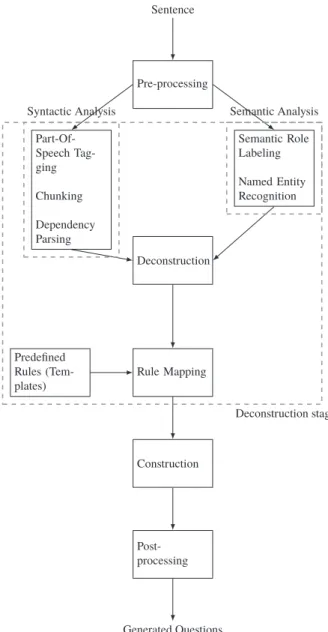
As seen in Fig. 4, the designed system takes an input sentence, which is preprocessed. In the preprocessing stage, contractions are expanded first. For instance, “would’ve” is expanded into “would have”. Contractions can be problem- atic for parsers, as most of them get parsed wrong and gen- erate unexpected results. So, in order to detect verb groups perfectly and reduce errors, the designed system uses our predefined dictionary to handle contractions.
In the second step of preprocessing, idiomatic language is eliminated. Idiomatic language is another problematic case for question generation systems. For instance, the sen- tence “Mary has to learn to bite the bullet and face her fears
Fig. 4 Flowchart of the designed system.
of flying” results in the generated question: “What does Mary have to learn to bite?”. However, the generated ques- tion is vague and out of context. In this case, “the bullet”
grammatically is the direct object, which is why this ques- tion was generated, but “bite the bullet” is an idiom. In the preprocessing stage, the designed system detects idioms by using our predefined dictionary and eliminates these prob- lematic cases.
The designed system uses multiple semantic and syn- tactic parsers because each parser tells its own particular viewpoint about the sentence and adds to its understanding.
In Algorithm 1, dependency and SRL parsers (lines 9-10), NER and SRL parsers (lines 13-14), exclusively SRL parser (line 19) are used. By exploiting synergies between these parsers, the designed system searches for various templates.
As a result, the designed system generates different types of questions for the templates found. Question generation ex- amples can be seen in Sect. 3.3. Following the preprocess-
ing, in the deconstruction stage, dependencies between the words, the named entity information and also semantic word groups are extracted. For extracting dependencies between the words and gathering the named entity information, the designed system relies on Spacy’s†algorithms. Finally, the designed system uses AllenNLP’s (Gardner et al., 2017) se- mantic role labeler for extracting semantic word groups in a sentence.
The main objective of deconstruction stage is to get an intermediate representation in order to determine the sen- tence pattern. Sentence pattern is crucial to detect the type of question to be generated. Systematic arrangement of words (such as Subject+Verb+Object+Complement) in a sen- tence is called the sentence pattern.
Intermediate representation consists of sentence ele- ments. In English, a part of the sentence is classified as a certain sentence element such as subject, direct object, verb, subject complement, etc. Full verb detection is also needed in this stage. The designed system relies on chunking al- gorithm to extract verb groups and phrases. For chunking algorithm, the designed system uses SENNA’s (Collobert et al., 2011) implementation.
Algorithm 1 shows the pseudo code of the deconstruc- tion stage. The deconstruction stage exploits synergies be- tween SRL and dependency parser, SRL and NER parser.
Also, it exclusively examines SRL parser to look for more sentence patterns. First, dependency list, NER list and SRL list are defined with constant string names. These are the templates mentioned in Sect. 3.1.
First loop starting in line 9 to 12 focuses on search- ing dependency-based templates. Dependency tags found are checked one by one. If any tag matches with our prede- fined list of dependencies, the designed system checks the validity of the sentence by examining the corresponding se- mantic representation. This process is performed by exam- ining numbered argument tags (such as ARG0, ARG1) in the semantic representation (please see Sect. 2.2.5 for de- tails). The least numbered argument becomes the subject of the sentence and the other one becomes the object. If the semantic representation has no problem (has a subject, ob- ject, verb) and head node of the dependency found matches with verb of a semantic representation, then deconstruction stage begins. Using semantic representation and chunk tags, sentence is separated into its parts, then added to the decon- structed list. If extra fields exist in the semantic representa- tion (such as ARGM-TMP and ARGM-LOC), they are also added.
Next loop starting in line 13 to 18 focuses on search- ing NER-based templates mentioned in Sect. 3.1.2. It has a similar process with the previous loop. Instead, this time, found NER phrase is removed from the corresponding se- mantic representation and remaining parts of it becomes the object of the question.
In SRL-based templates starting in line 19 to 24, each key in SRL set is searched in the predefined semantic role
†https://github.com/explosion/spaCy/
labeling list. If the semantic representation conforms to the subject, verb, object pattern, it is valid. Then deconstruc- tion stage takes place for SRL-based templates. Once the semantic representation is valid, there is an extra option for generating a yes/no question. If this option is active, the sys- tem is ready to generate questions using the corresponding SRL object.
Algorithm 1Deconstruction
1:functionDeconstruct(sentence)
2: depList←[“dobj”, “acomp”, “attr”, “pcomp”, “ccomp”, “oprd”, “dative”]
3: nerList←[“location”, “date”, “person”, “number”]
4: srlList←[“argm-cau”, “argm-pnc”, “argm-mnr”, “argm-loc”, “argm-tmp”]
5: srlT ags←set of found srl lists in the sentence.
6: depT ags←dependency representation of the sentence.
7: nerT ags←detected ner tags in the sentence.
8: chunkT ags←shallow chunking representation of the sentence.
9: foreach d∈ depTagsdo 10: foreach s∈ srlTagsdo
11: ifdepList.match(d.dep )ands[’V’]==d.head.textand isValid(s)then
12: handleDeconstruction(s,chunkT ags,null,d.dep) 13: foreach d∈ nerTagsdo
14: foreach s∈ srlTagsdo 15: foreach value ∈ sdo
16: ifnerList.match(n.label )andvalue.match(n.text)and isValid(s)then
17: value←remove(n.text,value) remove found ner 18: handleDeconstruction(s,chunkT ags,value,
n.label) 19: foreach s∈ srlTagsdo 20: foreach key∈ sdo
21: ifsrlList.match(key)and andisValid(s)then 22: handleDeconstruction(s,chunkT ags)
23: else ifisValid(s)thenoption for creating yes/no question 24: handleDeconstruction(s,chunkT ags,null,key) 25:
26:
27:functionhandleDeconstruction(srlOb ject,chunkT ags,modi f iedValue, type)
28: f ullVerb←getFullVerb(srlObject[’V’],chunkTags)
29: get sentence parts
30: ifmodifiedValue !=nullthen 31: ob ject←modifiedValue 32: else
33: ob ject←getObject(srlObject) 34: sub ject←getSubject(srlObject) 35: extaField←getExtraField(srlObject)
36: addDeconstructedParts(f ullVerb,sub ject,ob ject,extaField,type)
Algorithm 2Construction
1:functionConstruct
2: fori in 0...types.lengthdo
3: verbParts←convertVerbTense(fullVerb[i])
4: question←buildQuestion(types[i], verbParts, objects[i], subjects[i], 5: extraFields[i])
6: f ormattedQuestion←postProcess(question) 7: f oundQuestions.push(formattedQuestion)
returnf ormattedQuestion 8:
In construction stage, as shown in Algorithm 2 the de- signed system matches the sentence pattern with predefined rules, i.e.templates. If a rule matches with the sentence pat- tern, a question can be generated. By examining extracted verb groups with part-of-speech tagging, grammatical tense is detected. The designed system relies on SENNA’s (Col- lobert et al., 2011) part-of-speech tagging algorithm, which uses English Penn Treebank tagset (Marcus, Marcinkiewicz and Santorini, 1993). Then, using Python package named
as Pattern, which is developed by Smedt and Daelemans (2012), the designed system gets the base form of the verb.
Finally, sentence elements are put together to form a ques- tion with respect to the detected template type. After check- ing all templates one by one, the system returns the gener- ated questions as an output.
Our implementation is written in Python 3.6. The de- signed system relies on
• SENNA’s part-of-speech tagging and chunking algo- rithm,
• AllenNLP’s semantic role labeling algorithm,
• SpaCy’s dependency parsing and NER algorithm, and
• Python package named as Pattern to get the base form of verbs.
Moreover, two dictionaries are constructed to handle con- tractions and detect idioms. The source code is available at github†.
3.3 Trace of Question Generations
In the first place, dependency parser-SRL synergy will be exemplified. Assume that we want to trace an example of question generation for the sentence: “Inflammation is one of the first responses of the immune system to infection”.
The sentence does not have any contractions to expand, nei- ther idioms to detect. So, we skip the pre-processing stage.
Before we begin with the deconstruction stage, sentence is parsed with using parsers explained above. The obtained se- mantic representation and dependency tags are given below:
Semantic representation: [Inflammation]ARG1 [is]V
[one of the first responses of the immune system to infection]ARG2
Dependency tags:
Then, we deconstruct the sentence. First, we look for dependency based templates in Algorithm 1 in lines 9-12.
There is an attr (attribute) dependency between “is” and
“one”. So, we will search for S-V-attr pattern mentioned in Sect. 3.1.1. S-V-attr pattern is one of the deep question gen- eration templates. In order for a generated sentence to be valid, corresponding semantic representation should consist of a verb and two numbered arguments (such as ARG0 and ARG1). In addition, in dependency based templates (line 11), head of the detected dependency tag should be the same as the verb of the corresponding semantic representation and the tail of the detected dependency tag should belong to one of the numbered arguments in the corresponding semantic representation. Then we can conclude that the template is valid and can be used for question generation.
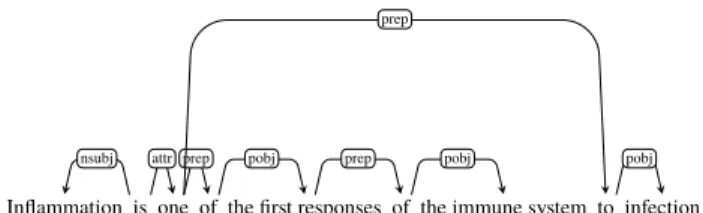
In dependency tree of the example sentence (Fig. 5), the verb “is” belongs to the head of the detected dependency tag and it is also the verb of the corresponding semantic rep- resentation. A similar case also applies to the tail of the detected dependency tag “one”. It is a part of one of the numbered arguments in the corresponding semantic repre- sentation. We conclude that S-V-attr template is valid.
†https://github.com/OnurKeklik/Qg-Iztech
Fig. 5 Dependency tree of example sentence.
Next, we deconstruct the sentence (line 12). In S-V- attr template, the least numbered argument in semantic rep- resentation, which is “inflammation”, should be the object of the generated question, because we are going to ask the description of “inflammation”. For this template, we only need “inflammation” as a deconstructed part. Other parts of the to be generated question are static and selected with respect to detected template type in the construction stage (Algorithm 2, line 4). Object of the to be generated ques- tion “inflammation” and template type “attr” are added to the queue for the construction stage (Algorithm 1, line 36).
Since there are no detected NER tags, algorithm passes NER based template generation and jumps to line 19. In SRL based templates, yes/no question is generated for the sample sentence (generation of other predefined SRL based templates in Sect. 3.1.3, can be seen in the next example).
In yes/no questions, the least numbered argument in the se- mantic representation, which is “inflammation” in our ex- ample, becomes subject of the question to be generated and the other numbered argument “one of the first responses of the immune system to infection” becomes the object. The verb “is” of the semantic representation becomes the verb of the question to be generated. Then, these question sen- tence parts are added to the queue for the construction stage.
As mentioned, in order to detect the tense of the sentence, the algorithm looks for verb phrases in chunking represen- tation. So, we conclude that there is only one verb and the sentence is in present simple tense form.
In construction stage (Algoritm 2), each deconstructed sentence is iterated. First, if the base form of the verb is needed, it is converted into its base form (line 3). Then, question word is determined and the question is built with respect to detected template type, which is S-V-attr template in our example (line 4). After arranging punctuation and capital letters (with respect to proper nouns), question sen- tence is ready. So, for the sample sentence given above, two questions, one deep and one shallow, are generated.
• How would you describe inflammation? (S-V-attr) (deep question)
• Is inflammation one of the first responses of the im- mune system to infection? (S-V) (shallow question) For the next example, we will only examine SRL based templates. SRL representation of the sample sentence
“Phrasal verbs tend to be more common in speech than in writing as they are less formal” can be seen below.
Semantic representation: [Phrasal verbs]ARG1 [be]V
[more common]ARG2 [in speech]ARGM-LOC [than in
writing]C-ARG2[as they are less formal]ARGM-CAU
We look for SRL based templates in Algorithm 1 in lines 19-24. There are ARGM-CAU (cause clause) and ARGM-LOC (locative) tags in the SRL representation. Our semantic representation is also valid (it has two numbered arguments and verb). In SRL based templates, the least numbered argument in the semantic representation, which is “Phrasal verbs” in our example, becomes subject of the question to be generated and the other numbered argument
“more common” becomes the object. The verb “tend to be”
of the semantic representation becomes the verb of the ques- tion to be generated. The designed system successfully de- tects verb phrases using chunking representation of the sam- ple sentence. Then, these question sentence parts are added to the queue for the construction stage (both for ARGM- CAU and ARGM-LOC).
In construction stage (Algoritm 2), question word is determined and the question is built with respect to de- tected template types, which are S-V-ARGM-CAU and S- V-ARGM-LOC templates in our example (line 4). After arranging punctuation and capital letters (with respect to proper nouns), question sentences are ready. So, for the sample sentence given above, two SRL based questions, one deep and one shallow, are generated.
• Why do phrasal verbs tend to be more common in speech? (S-V-ARGM-CAU) (deep question)
• Where do phrasal verbs tend to be more common? (S- V-ARGM-LOC) (shallow question)
In this study, first, the designed system reveals the se- mantic structure of the sentence under consideration by us- ing AllenNLP’s semantic role labeling. Then, the designed system exploits the synergies between different parsers. If a semantic representation has valid sentence parts, the sen- tence is deconstructed. Another advantage of using prede- fined rules with semantic representations is that shallow and deep question generations can be generated distinctively and selectively. Since it is a rule based system, we exactly know which templates generate shallow and deep questions. So, we can select the type of questions we want to generate. For instance, if the question generation is used on tutoring sys- tem, only deep question generation can be enabled. In this way, the learner can acquire difficult scientific and technical material in a precise way.
4. Automatic Evaluation
In the automatic evaluation stage, the proposed system’s performance is measured using automatic evaluation met- rics. Despite the proposed system focuses on question gen- eration from sentences, its performance is compared with Du’s reading comprehension system (Du et al. 2017) that focuses on question generation from paragraphs. In order to compare two systems, the proposed system sets up the same evaluation environment as the other system. Both systems use Stanford Question Answering Dataset (SQuAD), which is released by Rajpurkar et al. (2016). Also, both systems
Table 5 BLEU 1-4, METEOR and ROUGE-L scores of different sys- tems.
Model BLEU-1 BLEU-2 BLEU-3 BLEU-4
IRBM25 5.18 0.91 0.28 0.12
IREdit Distance 18.28 5.48 2.26 1.06
MOSES+ 15.61 3.64 1.00 0.30
DirectIn 31.71 21.18 15.11 11.20
H&S 38.50 22.80 15.52 11.18
Vanilla seq2seq 31.34 13.79 7.36 4.26
Du’s Model (no pre-trained) 41.00 23.78 15.71 10.80 Du’s Model (w/pre-trained) 43.09 25.96 17.50 12.28 Proposed Approach 41.90 26.90 16.90 10.61
Model METEOR ROUGE-L
IRBM25 4.57 9.16
IREdit Distance 7.73 20.77
MOSES+ 10.47 17.82
DirectIn 14.95 22.47
H&S 15.95 30.98
Vanilla seq2seq 9.88 29.75
Du’s Model (no pre-trained) 15.17 37.95 Du’s Model (w/pre-trained) 16.62 39.75 Proposed Approach 25.01 40.38
use the same evaluation package released by Chen et al.
(2015) that includes the implementation of BLEU-1, BLEU- 2, BLEU-3, BLEU-4, METEOR and ROUGE-L metrics.
Table 5 shows BLEU 1-4, METEOR and ROUGE-L scores of different systems. Our automatic evaluation through these objective neural translation metrics show that our system has superior performance and outperforms the others in BLEU- 2, METEOR, and ROUGE-L metrics. Especially for ME- TEOR metric, the proposed system gets highly significant difference. Banerjee et al. (2005) demonstrated that ME- TEOR has significantly enhanced correlation with human evaluators. They also demonstrated that when obtaining high level correlation with human evaluators, recall plays more significant role than precision. Because of the diver- sity of the templates that the proposed system using, recall thus METEOR score is significantly higher than the other competitive systems.
5. Human Evaluation
Human evaluation studies were also performed to measure the quality of generated questions. Human evaluators evalu- ate the submitted questions according to evaluation criteria, which are difficulty, relevance, syntactic correctness, and ambiguity.
Difficulty is rated to ensure that there is a syntactic divergence between the input sentence and the generated question. That is, some reasoning is necessary to answer the question. The difficult question should assess the reader’s knowledge about the input sentence. Relevance is rated to ensure that the question can be answered based on the input sentence. Syntactic correctness is rated to ensure that the question generated is grammatically correct. Finally, ambi- guity is rated to ensure that the question makes sense when asked with no context. Typically, an unambiguous question will have one very clear answer.
Table 6 Human evaluation results for generated questions.
Total Questions Difficulty Ambiguity Correctness Relevance
126 2.85 3.10 3.60 3.65
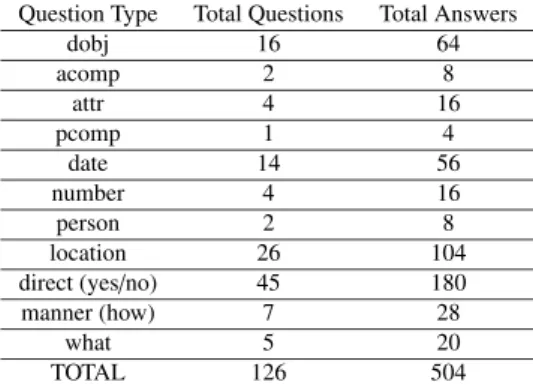
Table 7 The total number of questions, their types, and the total number of answers.
Question Type Total Questions Total Answers
dobj 16 64
acomp 2 8
attr 4 16
pcomp 1 4
date 14 56
number 4 16
person 2 8
location 26 104
direct (yes/no) 45 180
manner (how) 7 28
what 5 20
TOTAL 126 504
Table 8 ANOVA p-values: Question types against the evaluation crite- ria.
Difficulty Ambiguity Correctness Relevance 9.1e-10 0.0485 1.14e-09 4.22e-10
Relevance, syntactic correctness and ambiguity were previously stated on QGSTEC (2010). 25 sentences are ran- domly sampled from SQuAD (2016) and QGSTEC (2010).
From this set, 126 questions are generated and rated by four different professional english speakers on a 1-5 scale (5 for the best). Table 6 shows the average scores for each evalua- tion criterion in human evaluation.
Within the generated question set; the total number of questions, their types, and the total number of answers are given in Table 7.
In order to evaluate the suitability of the evaluation cri- teria in measuring the performance of questions of different types, we applied analysis of variance (ANOVA). ANOVA is used to test the null hypothesis that question types are in- dependent from the evaluation criteria, which are difficulty, ambiguity, correctness, and relevance. As a result, all but one of these criteria got so smallp-values that we can safely reject the null hypothesis meaning that there is dependency between these criteria and the generated question types. In other words, these three criteria are proved useful in distin- guishing the performance among different question types.
Only the criterion of ambiguity does not give a statistically significantp-value (Table 8).
In a study on evaluating evaluation methods in text gen- eration (Stent et al. 2005), although the mean scores for adequacy (a variant of ambiguity) distinguishes one system from the other, the analysis of adequacy scores of a judge on the same set of questions (paired-sample t test) states that his rating for each generated text does not make a difference between the two given systems. However, scores for other human evaluation measures make a statistically significant difference at the individual question level.
Answerability is another ambiguity-related metric that
Table 9 Human evaluation results.
Difficulty Ambiguity Correctness Relevance
H&S 1.94 - 2.95 -
Du’s Model 3.03 - 3.36 -
The Proposed Approach 2.85 3.10 3.60 3.65
Human 2.63 - 3.91 -
depends on the presence of relevant information such as question type, entities, relations, etc. In a recent study, Nema and Khapra (2018) test based on the human evalu- ations whether answerability depends on question types or not. Their experimental results show that dependence on question types behaves differently across different datasets, namely WikiMovies, SQuAD, and VQA.
Our results and similar evidences from the current lit- erature show that ambiguity scores do not manage to distin- guish different types of questions. Statistical independence of ambiguity scores from question types can be explained by the fact that this measure is hard for humans to rate con- sistently across different (types of) questions.
To rate ambiguity, human evaluator is presented with an input sentence, and then a question generated from it, and expected to evaluate the generated question with respect to its independence from the given context as if she was not provided with the input sentence. For humans, it is hard to consistently rate this measure correctly for all along the generated questions considering the context variations due to different input sentences. Seeing both the input sentence and the generated question may cause human evaluators to make slight errors in rating ambiguity thus explaining the neutralization effect among different question types.
Du et al. (2017) also performed human evaluation stud- ies. They both evaluated the performance of the H&S sys- tem and their own system. They used two criteria: difficulty and naturalness. Naturalness indicates the grammatical cor- rectness and fluency. It corresponds to correctness criterion that we have mentioned above. They randomly sampled 100 sentence-question pairs in SQuAD and asked four profes- sional English speakers to rate the sentence-question pairs in terms of difficulty and naturalness on a 1-5 scale (5 for the best). They also rated real human-generated sentence- question pairs (ground truth questions) in SQuAD.
As noted above, in our experimental setup, 25 sen- tences are randomly sampled from SQuAD. From this set, 126 questions are generated and rated by four different pro- fessional English speakers on a 1-5 scale (5 for the best).
Since our experimentation setup is very similar to Du et al.’s setup, we can compare their results with our own re- sults. Table 9 shows human evaluation results for Du et al.’s system, H&S system and the proposed system. For diffi- culty metric, the designed system gets score of 2.85 and real human-generated questions gets score of 2,63. Also, for correctness metric, the proposed system gets score of 3,60 and real human-generated questions gets score of 3,91. Al- though Du et al.’s system generated more difficult questions than the designed system, our difficulty score is much closer to real human-generated questions. Since human-generated
Table 10 Sample questions generated by H&S, Du et al. and the de- signed system.
Sentence 1:Inflammation is one of the first responses of the immune system to infection.
Human:What is one of the first responses the immune system has to infection? (shallow question)
H&S:What is inflammation one of? (shallow question) Du:What is one of the first objections of the immune system to infection? (shallow question)
The Designed System:• How would you describe inflammation?
(deep question)
• Is inflammation one of the first responses of the immune system to infection? (shallow question)
Sentence 2:However, the rainforest still managed to thrive during these glacial periods, allowing for the survival and evolution of a broad diversity of species.
Human:Did the rainforest managed to thrive during the glacial periods? (shallow question)
H&S:What allowed for the survival and evolution of a broad diversity of species? (shallow question)
Du:Why do the birds still grow during glacial periods? (deep question) The Designed System:• Did the rainforest manage to thrive during these glacial periods still? (shallow question)
• When did the rainforest manage to thrive? (shallow question)
• What did the rainforest manage still? (shallow question)
questions are taken as ground truth questions, we can say that the question generation system, which has more simi- lar scores to human-generated questions, is better. As can be seen from the results, the designed system significantly outperforms all other systems and turns out to be the most natural (human-like) system.
For further evidence, sample questions generated by H&S system, Du’s system, and the designed system can be seen in Table 10. For H&S system, top ranked question is taken from their list. When we look at the sample sentence 1, H&S system failed to detect the object of the sentence.
H&S system’s pure syntactic approach on question genera- tion sometimes causes failures to detect parts of a sentence.
However, the proposed system combines the knowledge of syntactic parsers with semantic roles. This increases the correctness of the generated questions. Moreover, through the use of SRL-based templates like S-V-ARGM-CAU, S- V-ARGM-MNR, and S-V-ARGM-PNC; correct, relevant, and unambiguous deep questions can be generated. From the sentence, H&S and Du’s systems generate shallow ques- tions. On the other hand, the designed system generates one shallow and one deep question. The deep question is gener- ated through S-V-attr dependency-based template. The tem- plate uses SRL’s knowledge to complement the knowledge coming from the dependency parser.
When we look at the sample sentence 2, Du’s system generates an over difficult and ambiguous question. This can be attributed to its learning-based algorithm from para- graphs. The designed system does not require any ranking algorithm like H&S system, because it does not overgener- ate questions in order to eliminate unacceptable ones. All generated questions with respect to detected templates are accurate, unambiguous and relevant. In addition, using se- mantic representations the designed system can conclude
that if the question has valid parts or not. Again, human evaluation results given in Table 9 confirm this.
6. Conclusion and Future Work
This paper presents a rule-based automatic question gener- ation system. Especially, with respect to METEOR metric, the proposed approach significantly outperforms all others in automatic evaluation stage. Banerjee et al. (2005) demon- strated that METEOR has significantly enhanced correlation with human evaluators. So, our results confirm that state- ment by performing human evaluation study as well. In con- clusion, the proposed approach significantly outperforms all other systems in human evaluation study by generating the most natural (human-like) questions.
Currently, our templates are designed to generate ques- tions from sentences. To improve the performance of paragraph-based questions, we need to investigate how to better use the paragraph-level information. Also, some tem- plates might fit better with some topics than others. This will be explored in future work.
References
[1] D.J. Hacker, J. Dunlosky, and A.C. Graesser, “Metacognition in ed- ucational theory and practice,” Routledge, 1998.
[2] IBM, IBM Watson Ecosystem - Getting Started Guide, 2014.
[3] V. Rus and C.G. Arthur, The question generation shared task and evaluation challenge workshop report, The University of Memphis, National Science Foundation, Citeseer, 2009.
[4] K. Mazidi and P. Tarau, “Infusing nlu into automatic question gener- ation,” Proceedings of the 9th International Natural Language Gen- eration conference, pp.51–60, 2016.
[5] M. Lapata and C. Brew, “Using subcategorization to resolve verb class ambiguity,” Proceedings of the Joint SIGDAT Conference on Empirical Methods in Natural Language Processing and Very Large Corpora, 1999.
[6] X. Du, J. Shao, and C. Cardie, “Learning to ask: Neural ques- tion generation for reading comprehension,” Proceedings of the 55th Annual Meeting of the Association for Computational Linguistics, pp.1342–1352, 2017.
[7] M. Heilman and N.A. Smith, “Rating computer-generated ques- tions with mechanical turk,” Proceedings of the NAACL HLT 2010 workshop on creating speech and language data with Amazon’s me- chanical turk, pp.35–40, Association for Computational Linguistics, 2010.
[8] M. Heilman, Automatic Factual Question Generation from Text, PhD Thesis, Carnegie Mellon University, 2011.
[9] I. Labutov, S. Basu, and L. Vanderwende, “Deep questions without deep understanding,” Proceedings of the 53rd Annual Meeting of the Association for Computational Linguistics and the 7th International Joint Conference on Natural Language Processing (Volume 1: Long Papers), vol.1, pp.889–898, 2015.
[10] V. Rus, B. Wyse, P. Piwek, M. Lintean, S. Stoyanchev, and C.
Moldovan, “The first question generation shared task evaluation challenge,” Proceedings of the 6th International Natural Language Generation Conference, pp.251–257, Association for Computational Linguistics, 2010.
[11] V. Rus, B. Wyse, P. Piwek, M. Lintean, S. Stoyanchev, and C.
Moldovan, “A detailed account of the first question generation shared task evaluation challenge,” Dialogue & Discourse, vol.3, no.2, pp.177–204, 2012.
[12] K. Papineni, S. Roukos, T. Ward, and W.-J. Zhu, “Bleu: a method