INVITED PAPER
Special Section on Microwave and Millimeter-Wave TechnologyRectenna Design and Signal Optimization for Electromagnetic Energy Harvesting and Wireless Power Transfer
Apostolos GEORGIADIS†a), Ana COLLADO†,andKyriaki NIOTAKI†,Nonmembers
SUMMARY This work addresses two key topics in the field of energy harvesting and wireless power transfer. The first is the optimum signal design for improved RF-DC conversion efficiency in rectifier circuits by using time varying envelope signals. The second is the design of rectifiers that present reduced sensitivity to input power and output load variations by introducing resistance compression network (RCN) structures.
key words: rectenna, energy harvesting, wireless power transfer, resis- tance compression network, rectifier
1. Introduction
The massive development of concepts such as the smart cities and the Internet of Things (IoT) require a large amount of sensors to be spread in the surrounding environment in or- der to provide us with useful information. In order to make these concepts a reality this large quantity of sensors and de- vices need to be autonomous and self-sustained in order to avoid the costly maintenance of battery replacement[1],[2].
In order to achieve the required sensor energy auton- omy the use of energy harvesting and wireless power trans- fer solutions have been proposed. When considering energy harvesting the main drawback is that the amount of available energy from the available energy sources (solar, electromag- netic, thermal or mechanic) is variable and sometimes un- predictable. As the harvesting systems are designed for spe- cific operating conditions deviation from them may cause a dramatic drop in the harvester efficiency. Several advances aiming at improving the efficiency of energy harvesters have been proposed in the literature[3]–[9]focusing both on the antenna and the rectifier circuits.
Energy harvesters are designed to operate at certain in- put power levels and certain output load values, however real scenarios may not match the optimum operation con- ditions at all times. Structures that aim at maintaining the RF-DC conversion efficiency independently of variations in the input power level and output load time variations have been proposed[10],[11] based on resistance compression networks (RCN). Originally they have been used in DC-DC converter circuits to compensate for variations in the rec- tifier loads[10]. In[11]the use of a dual band RCN was proposed to be used in dual band rectifier circuits for energy harvesting and wireless power transfer.
Another field that is attracting attention is the use of Manuscript received April 3, 2015.
†The authors are with the Centre Tecnologic de Telecomunica- cions de Catalunya (CTTC), 08860 Castelldefels, Spain.
a) E-mail: [email protected] DOI: 10.1587/transele.E98.C.608
time-varying envelope signals to improve the RF-DC con- version efficiency in wireless power transfer systems. Sev- eral works have shown that under certain operating condi- tions it is possible to obtain improvement in the efficiency if using multi-sine, chaotic or modulated signals[12]–[19].
In this paper several aspects and advances in these two topics will be presented.
2. Signal Selection for Optimum Rectifier Performance It has been shown in the literature that signals with time- varying envelope and high peak-to-average power ratio (PAPR) may under certain conditions operate rectifier cir- cuits in a more efficient manner, which leads to improved performance in terms of RF-DC conversion efficiency[12]–
[19]. The underlying motive for this is that high PAPR sig- nals take advantage of the nonlinear dynamics of rectify- ing devices and make them operate in a region of their (i-v) curve that lead to larger mixing products at the desired DC output.
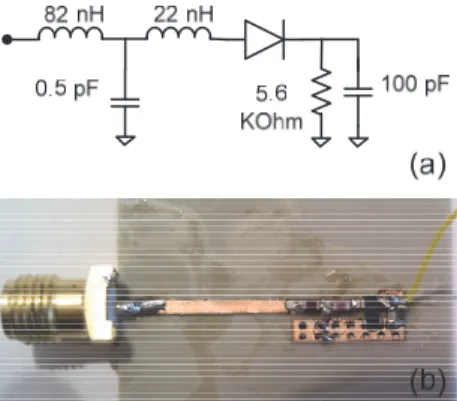
Several experiments have been performed using a 433 MHz rectifier (Fig. 1). The selected topology is an enve- lope detector with a Schottky diode as the rectifying ele- ment (Skyworks SMS7630-02LF). The rectifier operates at 433 MHz using a suitable LC matching network, and has an output RC filter with C=100 pF and Rload=5.6 KOhm.
The selected time-varying envelope signals used in the experiments are a chaotic signal, a white noise signal and an OFDM signal, all of them presenting a high PAPR (Table 1).
A single carrier signal is also used in the experiments for comparison.
Fig. 1 Rectifier circuit at 433 MHz. (a) Schematic of the envelope de- tector rectifier, (b) photo of the prototype.
Copyright c2015 The Institute of Electronics, Information and Communication Engineers
The performance of the rectifier circuit under different input signals is evaluated in terms of RF-DC conversion effi- ciency (see Eq. (1)). In order to make a fair comparison both the single carrier and all the time varying signals used (Ta- ble 1) have the same average power in a 6 MHz bandwidth around 433 MHz. A commercial band-pass surface acoustic wave (SAW) filter was used to limit the signal bandwidth to 6 MHz.
The used measurement set-up is depicted in Fig. 2, where a power splitter is used to divide the signal between the rectifier circuit and an oscilloscope that is used to accu- rately measure the amount of power that reaches the rectifier circuit. The measured power is used to calculate the RF-DC conversion efficiency in Eq. (1).
η= PDC
PRF in =V2DC/RL
PRF in (1)
The obtained measured results are shown in Fig. 3, where it can be seen that for this specific experiment the signals with higher PAPR lead to larger improvement in the RF-DC conversion efficiency. Specifically, in the case of a chaotic signal with a PAPR of 14.8 dB the efficiency is ap- proximately 20% larger compared to a single carrier signal.
The precise theoretical conditions corresponding to circuit design parameters and signal parameters which result in an
Table 1 Measured PAPR of selected signals.
Fig. 2 Measurement set-up.
Fig. 3 Comparison of RF-DC of the rectifier in Fig. 1 under different input signals.
efficiency improvement at a given average input power rep- resent the object of future work.
3. Resistance Compression Networks for Improved Rectifier Performance
One of the major issues to address when designing rectifier circuits is the fact that they are usually designed to oper- ate for a certain level of input power and for certain load conditions. However, real scenario conditions suffer from variations in the received power levels and also in the load which due to the nonlinearity of the rectifying device may also cause load variations. Deviation from the design con- ditions causes the performance of the rectifier to degrade causing un-matching of the circuit and consequently reduc- tion in RF-DC conversion efficiency. A circuit topology that has been proposed to overcome this problem is the use of resistance compression networks (RCN)[10],[11].
Resistance compression networks are circuits that are capable to minimize their input resistance variation under large output load variations. RCN are formed by two paral- lel braches, each of them loaded with the same load. Each of the branches is formed by reactive elements that produce resistance compression and transformation. The main char- acteristic that the two branches have to fulfill to achieve the resistance compression is that their input impedance has to be of equal magnitude and opposite phase at the design fre- quency.
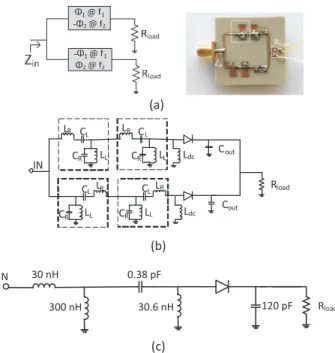
When designing RCN based rectifiers the output load of the two branches of the RCN is the rectifying element together with the output DC load (Fig. 4), which is a com-
Fig. 4 Dual band rectifier with resistance compression network, a) cir- cuit block diagram and fabricated prototype, b) circuit topology (LR=8.7 nH, LL =100 nH, CR =0.8 pF, CL =2.7 pF), c) dual band envelope detector rectifier used in the comparisons.
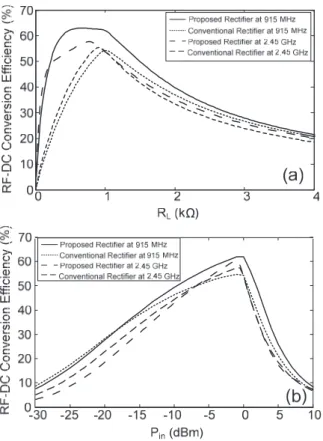
Fig. 5 RF-DC conversion efficiency versus (a) output load, (b) input power.
plex load. Here a dual band RCN-based rectifier is pre- sented that operates at 915 MHz and 2.45 GHz. The two branches of the RCN are designed to present compression properties at both operation frequencies by using reactive circuits formed by series and shunt LC networks. In order to achieve equal magnitude and opposite phase response the reactive circuitry in the lower branch is the same network as in the upper branch but mirrored. The proposed structure for the RCN is shown in Fig. 4. Instead of considering only one reactive cell per branch, two cells have been used in order to have more flexibility in the design. The fabricated prototype is shown in Fig. 4 (a).
In order to evaluate the performance of the RCN-based rectifier, it has been compared to the performance of a con- ventional envelope detector rectifier also operating in the 915 MHz and 2.45 GHz frequency bands. Figure 5 shows the RF-DC conversion efficiency for both circuits. The proposed RCN-based rectifier presents less variation in the RF-DC conversion efficiency versus variations in the input power level (Fig. 5 (b)) and in the output load (Fig. 5 (a)).
Using the designed RCN-based rectifier, a rectenna el- ement has been designed and its performance evaluated for different incoming power densities (Fig. 6). The used an- tenna in a series fed printed dipole pair antenna[20] de- signed to have dual-band operation at 915 MHz and 2.45 GHz. The antenna is fabricated in the same Arlon A25N substrate used for the RCN-based rectifier and presents 4 dB gain at 915 MHZ and 4.8 dB gain at 2.45 GHz.
Fig. 6 Prototype of the RCN-based rectenna element.
Fig. 7 Obtained DC voltage using the RCN-based rectifier versus power density.
Fig. 8 Comparison of RF-DC conversion efficiency in multi-band recti- fiers.
The obtained DC voltage by using this RCN-based rectenna is measured for different power densities (Fig. 7) showing that the harvested DC voltage can reach 300 mV at 915 MHz and 75 mV at 2.45 GHz for power densities of 1 μW/cm2.
A comparison of different multiband rectifiers in the literature has been made in order to evaluate the perfor- mance of the presented RCN-based rectifier with respect to the state-of-the-art. Figure 8 shows the RF-DC conversion efficiency of different multi-band rectifier designs versus in-
put power levels. The presented RCN-based rectifier perfor- mance is highlighted in a dashed square.
4. Conclusion
There has been significant progress recently in the design of wireless power transfer systems. Nonetheless, further devel- opments are foreseen addressing issues such as the optimum signal and device characteristics which result in higher RF- DC conversion efficiency, multiband operation, and reduc- ing the sensitivity of the rectifying circuits to input power and output load variations. This paper highlights recent results in the above topics. It is shown that signals with high PAPR can lead, under certain input power and out- put load conditions, to higher RF-DC conversion efficiency compared to continuous wave signals. Resistance compres- sion networks can be employed to reduce the sensitivity of a rectifier to output load. In this paper, dual band operation of a resistance compression network is demonstrated.
Acknowledgments
This work was supported by the Spanish Ministry of Econ- omy and Competitiveness and FEDER funds through the project TEC2012-39143, the Generalitat de Catalunya un- der grant 2014 SGR 1551 and the EU COST Action IC1301 Wireless Power Transmission for Sustainable Electronics.
References
[1] W.C. Brown, R.H. George, and N.I. Heeman, “Microwave to DC converter,” US. Patent 3434678, 1969.
[2] S. Kim, C. Mariotti, F. Alimenti, P. Mezzanotte, A. Georgiadis, A.
Collado, L. Roselli, and M.M. Tentzeris, “No Battery Required: Per- petual RFID-Enabled Wireless Sensors for Cognitive Intelligence Applications,” IEEE Microw. Mag., vol.14, no.5, pp.66–77, Ju- ly-Aug. 2013
[3] T. Paing, J. Morroni, A. Dolgov, J. Shin, J. Brannan, R. Zane, and Z.
Popovic, “Wirelessly-Powered Wireless Sensor Platform,” in Proc.
2007 European Conference on Wireless Technologies, pp.241–244, 8-10 Oct. 2007.
[4] K. Niotaki, S. Kim, S. Jeong, A. Collado, A. Georgiadis, and M.M.
Tentzeris, “A Compact Dual-Band Rectenna Using Slot-Loaded Dual Band Folded Dipole Antenna,” IEEE Antennas Wireless Propag. Lett., vol.12, pp.1634–1637, 2013.
[5] A. Collado and A. Georgiadis, “24 GHz substrate integrated wave- guide (SIW) rectenna for energy harvesting and wireless power transmission,” in Proc. 2013 IEEE MTT-S International Microwave Symposium Digest (IMS), pp.1–3, 2-7 June 2013.
[6] C. Walsh, S. Rondineau, M. Jankovic, G. Zhao, and Z. Popovic, “A conformal 10 GHz rectenna for wireless powering of piezoelectric sensor electronics,” in Proc. 2005 IEEE MTT-S International Mi- crowave Symposium Digest, pp.1–4, 12-17 June 2005.
[7] K. Hatano, N. Shinohara, T. Mitani, K. Nishikawa, T. Seki, and K. Hiraga, “Development of class-F load rectennas,” in Proc. 2011 IEEE MTT-S International Microwave Workshop Series on Inno- vative Wireless Power Transmission: Technologies, Systems, and Applications (IMWS), pp.251–254, 12-13 May 2011.
[8] S. Yoshida, G. Fukuda, T. Noji, S. Tashiro, Y. Kobayashi, and S.
Kawasaki, “Wide power range operable 3-stage S-band microwave rectifier with automatic selector based on input power level,” in
Proc. 2013 IEEE MTT-S International Microwave Symposium Di- gest (IMS), pp.1–4, 2-7 June 2013.
[9] S. Korhummel, D.G. Kuester, and Z. Popovic, “A harmonically-ter- minated two-gram low-power rectenna on a flexible substrate,” in Proc. 2013 IEEE Wireless Power Transfer (WPT), pp.119–122, 15-16 May 2013.
[10] Y. Han, O. Leitermann, D.A. Jackson, J.M. Rivas, and D.J. Perreault,
“Resistance Compression Networks for Radio-Frequency Power Conversion,” IEEE Trans. Power Electron., vol.22, no.1, pp.41–53, Jan. 2007.
[11] K. Niotaki, A. Georgiadis, and A. Collado, “Dual-Band Rectifier Based on Resistance Compression Networks,” in Proc. IEEE MTT-S IMS 2014, pp.1–3, Tampa, 1-6 June, 2014.
[12] M.S. Trotter, J.D. Griffin, and G.D. Durgin, “Power-optimized wave- forms for improving the range and reliability of RFID Systems,” in Proc. IEEE Int. Conf. RFID, pp.80–87, 2009.
[13] A.S. Boaventura and N.B. Carvalho, “Maximizing dc power in en- ergy harvesting circuits using multisine excitation,” in Proc. 2011 IEEE MTT-S Int. Microwave Symp., pp.1–4, 2011.
[14] A.J.S. Boaventura, A. Collado, A. Georgiadis, and N.B. Car- valho, “Spatial Power Combining of Multi-sine Signals for Wire- less Power Transmission Applications,” IEEE Trans. Microw. The- ory Techn., Special Issue on Wireless Power Transfer, vol.62, no.4, pp.1022–1030, April 2014.
[15] A. Collado and A. Georgiadis, “Improving Wireless Power Trans- mission Efficiency Using Chaotic Waveforms,” in Proc. IEEE MT- T-S IMS 2012, pp.1–3, Montreal, 17-22 June 2012.
[16] A. Collado and A. Georgiadis, “Optimal Waveforms for Effi- cient Wireless Power Transmission,” IEEE Microw. Compon. Lett., vol.24, no.5, pp.354–356, May 2014.
[17] G. Fukuda, S. Yoshida, Y. Kai, N. Hasegawa, and S. Kawasaki,
“Evaluation on use of modulated signal for Microwave Power Trans- mission,” 2014 44th Eur. Mirco. conf., Rome, Italy, Oct. 2014, pp.425–428.
[18] J.A. Hagerty, F.B. Helmbrecht, W.H. McCalpin, R. Zane, and Z.B.
Popovic, “Recycling ambient microwave energy with broad-band rectenna arrays,” IEEE Trans. Microwave Theory & Tech., vol.52, no.3, pp.1014–1024, March 2004.
[19] A. Georgiadis, A. Collado, and K. Niotaki, “Optimal signal selection and rectenna design challenges for electromagnetic energy harvest- ing and wireless power transfer,” Proc. 2014 Asia Pacific Microwave Conference (APMC), pp.597–599, Sendai, Japan, Nov. 2014.
[20] F. Tefiku and C.A. Grimes, “Design of Broad-Band and Dual-Band Antennas Comprised of Series-Fed Printed-Strip Dipole Pairs,”
IEEE Trans. Antennas Propag., vol.48, no.6, pp.895–900, June 2000.
[21] R. Scheeler, S. Korhummel, and Z. Popovic, “A Dual-Frequency Ultralow-Power Efficient 0.5-g Rectenna,” IEEE Microw. Mag., vol.15, no.1, pp.109–114, Jan.-Feb. 2014.
[22] A. Collado and A. Georgiadis, “Conformal hybrid solar and Elec- tromagnetic (EM) energy harvesting rectenna,” IEEE Trans. Circuits Syst. I, Reg. Papers, vol.60, no.8, pp.2225–2234, Aug. 2013.
[23] V. Rizzoli, G. Bichicchi, A. Costanzo, F. Donzelli, and D. Masotti,
“CAD of multi-resonator rectenna for micro-power generation,”
Proc. EuMIC 2009, pp.331–334, Sept. 2009.
[24] B.L. Pham and A.-V. Pham, “Triple bands antenna and high effi- ciency rectifier design for RF energy harvesting at 900, 1900 and 2400 MHz,” in Proc. IEEE MTT-S Int. Microw. Symp., pp.1–3, Seattle, WA, USA, Jun. 2–7, 2013.
Apostolos Georgiadis was born in Thes- saloniki, Greece. He received the B.S. degree in physics and M.S. degree in telecommuni- cations from the Aristotle and 1996, respec- tively. He received the University of Thessa- loniki, Greece, in 1993 Ph.D. degree in elec- trical engineering from the University of Mas- sachusetts at Amherst, in 2002. He is currently a Senior Researcher and Group Leader of the Microwave Systems and Nanotechnology De- partment at Centre Tecnologic de Telecomuni- cacions de Catalunya (CTTC), Barcelona, Spain, in the area of communi- cations subsystems where he is involved in active antennas and antenna arrays and more recently with RFID technology and energy harvesting.
Dr. Georgiadis was the recipient of a 1996 Fulbright Scholarship for grad- uate studies with the University of Massachusetts at Amherst, the 1997 and 1998 Outstanding Teaching Assistant Award presented by the Uni- versity of Massachusetts at Amherst, 1999 and 2000 Eugene M. Isenberg Award presented by the Isenberg School of Management, University of Massachusetts at Amherst, and the 2004 Juan de la Cierva Fellowship pre- sented by the Spanish Ministry of Education and Science. He is Member of the IEEE MTT-S TC-24 RFID Technologies (Chair 2012-2014) and Mem- ber of IEEE MTT-S TC-26 Wireless Energy Transfer and Conversion. He serves as an Associate Editor of the IEEE Microwave and Wireless Com- ponents Letters and IET Microwaves Antennas and Propagation Journals.
He is Editor-in-Chief of the Wireless Power Transfer journal by Cambridge University Press.
Ana Collado received the M.Sc. and Ph.D. degrees in Telecommunications Engineer- ing from the University of Cantabria, Spain, in 2002 and 2007 respectively. She is cur- rently a Senior Research Associate and the Project Management Coordinator at the Techno- logical Telecommunications Center of Catalonia (CTTC), Barcelona, Spain where she performs her professional activities. Her professional in- terests include active antennas, substrate inte- grated waveguide structures, nonlinear circuit design, and energy harvesting and wireless power transmission (WPT) so- lutions for self-sustainable and energy efficient systems. She has partic- ipated in several national and international research projects and has co- authored over 70 papers in journals and conferences. Among her activities she has collaborated in the organization of several international workshops in different countries of the European Union and also a Training School for PhD students. She was a Marie Curie Fellow of the FP7 project Symbiotic Wireless Autonomous Powered system (SWAP). She serves in the Editorial Board of the Radioengineering Journal and she is currently an Associate Editor of the IEEE Microwave Magazine and a member of the IEEE MTT- 26 Wireless Energy Transfer and Conversion and MTT-24 RFID Technolo- gies.
Kyriaki Niotaki was born in Crete, Greece.
She received the B.S. in Informatics and the M.S. in Electronic Physics with specialization at Electronic Telecommunication Technology, both from Aristotle University of Thessaloniki (Greece), in 2009 and 2011, respectively. Since December 2011, she has been with the Centre Tecnologic de Telecomunicacions de Catalunya (CTTC), Barcelona, Spain, as a Research As- sistant. Currently, she is working towards her Ph.D. in the Signal Theory and Communications Department of the Technical University of Catalonia (UPC), Barcelona, Spain. Her main research interests include energy harvesting solutions and the design of power amplifiers. In 2014, she was the recipient of an IEEE Microwave Theory and Techniques Society (IEEE MTT-S) Graduate Fel- lowship Award.