INVITED PAPER
Special Section on Josephson Junctions — Past 50 years and Future —Terahertz Radiation Emitted from Intrinsic Josephson Junctions in High-T c Superconductor Bi 2 Sr 2 CaCu 2 O 8 +δ
Hidetoshi MINAMI†a), Manabu TSUJIMOTO†, Takanari KASHIWAGI†, Takashi YAMAMOTO†∗, andKazuo KADOWAKI†,Nonmembers
SUMMARY The present status of superconducting terahertz emit- ter using the intrinsic Josephson junctions in high-Tc superconductor Bi2Sr2CaCu2O8+δ is reviewed. Fabrication methods of the emitting de- vice, electrical and optical characteristics of them, synchronizing operation of two emitters and an example of applications to the terahertz imaging will be discussed. After the description of fabrication techniques by an Ar- gon ion milling with photolithography or metal masks and by a focused ion beam, optical properties of radiation spectra, the line width, polarization and the spatial distribution of emission are presented with some discussion on the operation mechanism. For electrical properties, reversible and ir- reversible operations at high and low electrical currents, respectively, and electrical modulation of the radiation intensity for terahertz imaging are presented.
key words: intrinsic Josephson junction, terahertz, high-Tc, superconduc- tor
1. Introduction
The frequency range approximately from 100 GHz up to several THz has attracted much attention because of a va- riety of useful potential applications such as spectroscopic analyses, various kinds of nondestructive sensing and imag- ing, medical diagnoses, security controls and high speed communication, etc. [1], [2]. Although they are highly de- manded, a lack of compact, convenient and inexpensive solid-state emitters as well as the sensitive detectors at this frequency range hinders development, known as the THz gap.
A Josephson junction as a quantum device enables us to make ultrahigh frequency devices due to their extremely fast response, for examples, high precision voltage stan- dards, multiplexers, mixers and excellently high sensitive electromagnetic-wave detectors, etc. at the frequency range from 10 GHz up to several THz. It is a well-known fact that in a Josephson junction theac-Josephson effect works as a natural voltage-frequency transducer which transforms adc-voltage to a high-frequency ac-current, described by the formula f=(2e/h)V=483.597891 GHz/mV, where f is
Manuscript received July 22, 2011.
Manuscript revised October 20, 2011.
†The authors are with the Institute of Materials Science, and Graduate School of Pure and Applied Sciences, University of Tsukuba, Tsukuba-shi, 305-8573 Japan, and Japan Science and Technology Agency, CREST, Kawaguchi-shi, 332-0012 Japan, and WPI-MANA.
∗Presently, with the Quantum Beam Science Directorate, Japan Atomic Energy Agency.
a) E-mail: [email protected] DOI: 10.1587/transele.E95.C.347
the frequency of theac-Josephson current,Vthedc-voltage appearing two superconducting electrodes,ethe elementary charge, andhPlanck constant. Thus, the Josephson junction can be an excellent source of continuous and monochro- matic high-frequency electromagnetic radiation. However, the output power detected from a single Josephson junction is ranging from 10−12W to 10−10W so that it was too low for fundamental as well as applied researches [3]–[5].
Considerable power of electromagnetic waves has been demonstrated by the integrated Josephson junction arrays [6]–[17]. The power of about 400μW at 410 GHz gener- ated from an array of 498 Nb/AlOx/Nb discrete Josephson junctions was detected by the on-chip detector [12]. This in- dicates a possible generation of the milliwatt power at sub- mm wavelengths. However, it was only 2μW at 76 GHz in the off-chip detection for a low-Tcjunction array [17], show- ing the difficulty of coupling to free space for radiation. It is obvious that high power can be obtained when the mutual phase locking of the Josephson currents produced in each junction is achieved in the whole array. Indeed, the coherent emission due to the synchronized Josephson junctions has been confirmed in many cases since the emission power is proportional to the quadratic number of junctions,N2 [6], [7], [14], [17]. The arrays are also expected to reduce the linewidth by 1/N. Arrays of discrete Josephson junctions of high-Tcsuperconductors have been also studied intensively because of possible emissions at higher frequencies up to several THz. The phase-locked operation has been demon- strated [13], however, there have been hurdles to fabricate the larger-scale arrays necessary for more thanμW level of radiation, because of the extremely short coherence lengths (the order of Å∼10 Å) and the difficulty to fabricate identi- cal junctions from multi-element compounds.
A solution to overcome such difficulties is to make use of a natural stack of the intrinsic Josephson junctions (IJJ’s) in a high-Tc superconducting Bi2Sr2CaCu2O8+δ (BSCCO) single crystal [18], which comprises the alternating dou- ble layers of thin superconducting CuO2 and the insulat- ing double layers of Bi2O2in a unit cell, including atomic- scaleN=670 junctions in a crystal of 1μm thick. It works as a large-scale one-dimensional natural array of identical Josephson junctions, so that it is expected to be an ideal system of intense and coherent THz sources because of the large superconducting gap energy (30∼60 meV) [19]–[21].
Recently, Batov et al. and Bae et al. succeeded in the de- tection of sub-THz radiation, but the power was unexpect- Copyright c2012 The Institute of Electronics, Information and Communication Engineers
Fig. 1 (a) Schematic view of the BSCCO-based superconducting THz emitter. (b) Spectra measured by an FT-IR spectrometer. The inset shows a relation that the frequency is inversely proportional to the mesa width [24].
edly small [22], [23]. Many efforts have been made in the Josephson-vortex-flow oscillator, but it was unsuccessful to make synchronization of a large number of IJJ’s.
In 2007, Ozyuzer et al. have demonstrated a contin- uous and monochromatic THz radiation with power up to
∼0.5μW by exciting the coherentac-Josephson current in the system having about 700 IJJ’s in a BSCCO crystal in zero magnetic field [24]. This device was fabricated into a rectangular mesa structure on top of the single crystal of about 1 mm×1 mm×10μm dimensions, as schematically shown in Fig. 1(a). The THz radiation was detected outside the cryostat after traveling in air. It was observed from early stage of experiments that the emission frequencies ranges from 0.36 to 0.85 THz, inversely proportional to the mesa width, w, which can be varied from 100μm to 40μm, as shown in Fig. 1(b). The emission intensity was observed to be proportional to the quadratic number of IJJ’s, strongly suggesting that the emission occurs due to the coherent syn- chronization of theac-Josephson current inside the mesa.
At present, the total emission power of the BSCCO-base superconducting THz emitter have reached a few tens of μW at 0.43∼0.65 THz [25], [26], and the radiation frequency ranges from 0.32 THz to 0.92 THz [27].
We review the recent experimental progress on this emitter performed at the University of Tsukuba, including the fabrication techniques, electrical and optical character- istics, synchronizing operation of two emitters, and an ap- plication to the THz imaging.
2. Fabrication Methods and Device Structures
The superconducting THz emitters are fabricated by either an Ar-ion milling or a focused ion beam (FIB) method from a piece of mm-size thin single crystal of BSCCO. High qual- ity single crystals of BSCCO used in the present studies were prepared by a traveling solvent floating zone technique [28]. Prior to the device fabrication, the as-grown single crystals were annealed and quenched at 550∼650◦C in a re- duced oxygen condition of 0.05∼0.1% mixed with argon gas, in order to obtain slightly underdoped crystals. Tera- hertz emission has so far been observed with the crystals of Tc=67∼89 K. The quality and the doping level of the sin- gle crystal are both crucially important for the generation of THz waves [29].
Fig. 2 (a) Photograph of a mesa fabricated by photolithography and Ar- ion milling technique, and the cross-section of the mesa observed by AFM [30]. (b) Photographs of a metal sheet of shadow masks which determine the width and length of mesas, and mesas fabricated by Ar-ion milling with the masks. The cross-sections of the mesas observed by AFM show that the edges have similar slopes as ones by photolithography.
A piece of single crystal of approximately 1.0 × 1.0 mm2with the thickness of a few tens ofμm was glued onto a sapphire substrate using a synthetic resin or silver paste. Just after cleaving the crystal using Scotch tape to ob- tain an atomically flat fresh surface, Ag and Au were evapo- rated one after another for electrodes. Then, mesa devices as shown in Fig. 2 were fabricated by an Ar-ion milling tech- nique with photolithographic or metal masks.
Photolithography is superior to metal masks in adjust- ing the position of subsequent masks, but the mesa height is limited by etching of resist cover. Rectangular-shaped mesas with dimensions of the width of 40∼100μm, the length of 400μm and the height of 1.0∼2.0μm were fab- ricated [24], [25], [30], [31]. It is the fabrication technique by metal masks that provides us with an easy way to obtain the reliable emitting mesas, especially when many mesas are simultaneously fabricated on a chip of BSCCO crys- tal to make arrayed emitters [32]. This method also en- ables us to make thicker mesas than the photolithographic method. Rectangular-shaped mesas with dimensions of the width of 40∼120μm, length of 200∼400μm and height of 1.0∼4.0μm were fabricated by etching step by step with the metal masks. The fabrication by the FIB technique provides us with better flexibility on the shape of mesa. Rectangular, square and disk shape mesas, etc. were fabricated by FIB technique [33]. As is easily understood, this technique is not suited for milling of wide areas, so that usually the width and the depth of the groove of about 10μm and 1∼2μm, respec- tively, is cut out, finally making an island-like terrace. This technique was also used to cut out a part from rectangular mesas made by the metal-mask method so as to make them shorter or narrower [27]. By an atomic force microscope (AFM) (Keyence, VN8000/8010) observation, it turned out that the actual mesa has a trapezoidal shape with consider- able slopes at their edges as seen in Fig. 2. It is interesting to note that this trapezoidal slope happens to occur in any fabrication methods so far used in our experiment. At the end of the fabrication processes, a CaF2 film for electrical isolation and an Au film for current lead were deposited and
patterned as in Fig. 2(a), or an Au wire of 10μm in diameter was glued by Ag paste as shown in Fig. 2(b).
3. Experiments
The THz radiation was measured by a conventional modula- tion technique using an optical chopper with a Si-composite bolometer filtered internally above 3 THz (IR laboratories, fc≈100 Hz), while the current-voltage (I-V) characteristic was simultaneously measured [30]. The sample mesas were biased with a load resistor of 10∼300Ω connected in se- ries in the current supply circuit. Because the detected sig- nal has a large offset due to the ambient thermal radiation which is strongly absorbed by the water vapor in the atmo- sphere, it is important to keep dry and keep the tempera- ture of all components constant in order to avoid a drift in the signal. The radiation spectra and the polarization were analyzed by a Fourier transformation infrared (FT-IR) spec- trometer (JASCO Co., Japan, FARIS-1) incorporated with the Martin-Puplett interferometer, a modified type of the Michelson interferometer using wire-grid polarizers at the entrance, the exit and for the beam splitter, with the reso- lution of 7.5 GHz. A Si-composite bolometer filtered inter- nally above 10 THz or a DLATGS pyroelectric sensor was used to detect the radiation. Spectral linewidth was esti- mated by using a semiconducting sub-harmonic mixer (VDI Co., USA, WR1.2SHM).
Before going into the detailed study, the temperature dependence of the mesa’sc-axis resistanceR(T) was always measured. This gives very useful information to check the condition of the mesa such as the contact resistance, the sample quality, the doping level, andTc, etc. This also al- lows us to estimate the temperature of the mesa while emit- ting [29], [34].
4. Optical and Electrical Characteristics: Long Rect- angular Mesas
With accumulating data experimentally obtained from many IJJ mesa samples (∼100), it is evident that theac-Josephson effect, f=(2e/h)V, is the essential mechanism for the gen- eration of coherent THz radiation. In order to take out the electromagnetic waves generated inside the mesa, another necessary condition is required. It is the geometrical cav- ity resonance necessary for the THz radiation. In almost all cases of long rectangular mesas, except for a case described later [35], the excitation of radiation has been observed in such a condition that the fundamental mode corresponding to one-half wavelength is equal to the shorter width of the mesa,w. It is expressed as f=c0/nλ=c0/2nw, wherec0is the speed of light in vacuum,nthe refractive index of BSCCO, andλthe wavelength of the emission in vacuum. The in- tense and monochromatic emission occurs, when these two conditions are simultaneously satisfied and the synchroniza- tion of all junctions in the mesa is realized. Because of the trapezoidal shape of the mesas, the central frequency of ra- diation changes about 10% within a variety of widths by the
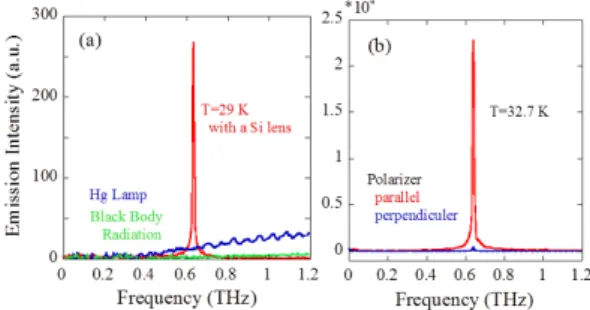
Fig. 3 Spectral characteristics of the radiation from a rectangular mesa emitter with designed dimensions of the width of 60μm, length of 400μm, and height of 1.9μm. The actual mesa has a trapezoidal shape with widths of 54.6μm at the top and 70.7μm at the bottom. (a) The radiation is com- pared with those from a mercury lamp and a black body at 1200 K. A sil- icon hemispherical lens is inserted just in front of the sample in order to efficiently focus and collect the emitted radiation. All are measured by a DLATGS pyroelectric sensor. (b) The emission is linearly polarized with the observed polarization ratio of∼50 [31].
conditions of measurement, and is somewhat tunable by the applied voltage [36].
In Fig. 3(a), an example of the radiation from the mesa of the designed width of ∼60μm is displayed, compared with the radiations from a mercury lamp and from a black body at 1200 K [31]. A Silicon hemispherical lens is in- serted just in front of the sample in order to efficiently fo- cus and collect the emitted radiation, which increases the signal intensity by a factor of five. All radiations are ana- lyzed by the FT-IR spectrometer and detected by a DLATGS pyroelectric sensor. The observed linewidth (full width at half maximum) of∼11 GHz is limited by the experimental resolution. Recently, the linewidth detected by the semi- conducting sub-harmonic mixer has been resulted in about 0.5 GHz for a mesa emitter. The emission frequency satis- fies the relation, f=c0/2nw, very well, using the refractive index n ∼4.2 obtained from this empirical relation which appears to work very well in many samples with different widths [37] in this sub-THz frequency region, although this value ofn corresponding to the dielectric constant=17.6 is about 50% larger than that (=12) obtained previously by infrared spectroscopy [38].
The intensity is much higher than that of the mercury lamp which is widely used for a far infrared light source, so that the radiation is detectable by such a sensor which works at room temperature without using any sophisticated detection system. The total radiation power emitted was es- timated to be ∼5μW [30], [31]. For typical values of ra- diation power, 1∼10μW is commonly obtained at the fre- quencies up to 0.65 THz, which is also checked by an InSb hot-electron detector whose system sensitivity is provided by the supplier (QMC). Since the total power fed into mesas is approximately 3∼30 mW, this results in the total efficiency of radiation to be∼10−3.
Observed resonance condition for the rectangular mesas appears to be rather peculiar, because it is in gen- eral easily found that the excitation energy of the cavity resonance for the longer dimension is lower than that for the shorter one, although the Josephson plasma frequency,
f=c0/2πnλcwhereλcis thec-axis superconducting penetra- tion depth, may be the lower cutofffrequency. Actually, the radiation according to different resonance conditions from above has been recently observed. Wang et al. have reported the THz radiation at high bias current whose radiation fre- quency varies in a wide range strongly depending on tem- perature, suggesting a different resonance mechanism for locking into a certain frequency associated with local and modulated self-heating phenomena [35]. Another excep- tional case is seen when the external structure out of a mesa works as a resonator [27]. Further, the radiation tunable in wide frequency range has been observed in the inner branch states, whose resonance condition for locking into a certain frequency is not yet understood well [39]. In short rectan- gular, square and disk mesas, various resonant cavity modes determined by the geometry have been observed so far [33].
Figure 3(b) shows the experimentally observed spec- tra measured at perpendicular and parallel settings of a pair of the wire-grid polarizers at the entrance and exit of the Martin-Puplett interferometer with respect to theab-plane of the BSCCO crystal. The THz radiation emitted from the mesa emitter is linearly polarized with the polarization di- rection of the electric field being perpendicular to theab- plane of the BSCCO crystal.
When all junctions are active, the emission voltage is given byVem=(c0h/2e)(1/nlc)(d/w), wherelc=30.7 Å is the c-axis length of BSCCO anddthe height of the mesa. This can simply be expressed asVem=48.2(d/w) (V) after numer- ical manipulation. This means that the voltage required for the emission depends only on the dimensions of the mesa;
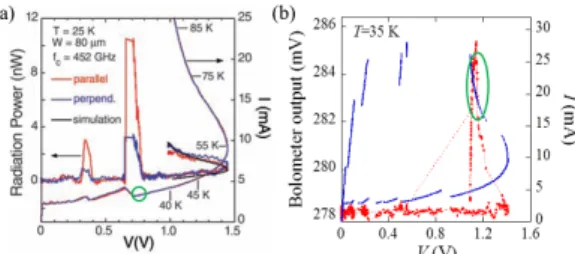
the heightdand the widthw. When only a part of the IJJ’s is active,d should be replaced by the effective thickness. On the other hand, theI-V characteristic of the mesa strongly depends on the doping level of the crystal and the tempera- ture of the mesa, in addition to the dimensions. For most of the mesa emitters, the local heating of the mesa due to self- heating produces the negative differential resistance (NDR) in the high electric current region. Therefore, there are two regions in theI-V curve where strong THz radiation can be generated: one is located in the return branch in the hys- teretic I-V curve as seen in Fig. 4(a) [24] and another ap- pears in the region of NDR at high electric currents as seen in Fig. 4(b) [29]. The former has more often been observed for underdoped crystals ofTc=67∼85 K, whereas the latter has been observed for more lightly underdoped crystals of Tc=80∼89 K [29]. It is just because theI-V curve crosses Vem at high electric currents only for lightly underdoped crystals as seen in Fig. 4. For lightly underdoped crystals, the emission often appears in both regions in theI-Vcurve.
The emission appearing in the return branches occurs in many cases in the vicinity of a jump to the other stable branches, and stops radiating when theI-V curve is exerted to the jump, as seen around 0.71 V in Fig. 4(a). This process is irreversible, and in order to get the emission again, it is necessary to go around the outermost branch and come back to the same bias point. We call this type of emission the irreversible (IR-) type of radiation. As the highest emission
Fig. 4 (a) TheI-Vcharacteristic and radiation power of an IR-type 80μm mesa emitter. The radiation frequency is 0.48 THz. The voltage depen- dences of the current and of the radiation power for parallel and perpendic- ular settings of the filter with 0.452 THz cut-offfrequency are shown for decreasing bias. Polarized emission occurs near 0.71 and 0.37 V, and un- polarized thermal radiation occurs at higher bias [24]. (b) TheI-Vand ra- diation characteristics of an R-type 60μm mesa [29]. The emission spectra measured by the FT-IR spectrometer show a sharp peak of the fundamental radiation at 0.64 THz which satisfies the relationf=c0/2nw. The bolometer signal has a big offset due to the ambient thermal radiation modulated by an optical chopper.
usually occurs in the vicinity of the unexpected jump, it is rather difficult to stabilize the emission.
Figure 4(b) shows theI-Vcurve and the radiation char- acteristic of a 60μm mesa emitter (actual dimensions mea- sured by AFM are 53μm at the top and 61μm at the bottom of the width, 350μm in length and 1.3μm in height.) [29].
The emission in this particular mesa occurs in the region of NDR at high currents. The emission at 0.64 THz obeys two necessary conditions similar to the IR-type emission: the ac-Josephson effect and the cavity resonance for the nar- rower width, f=c0/2nw. Wang et al. also has confirmed the emission at high bias currents, however, they suggested a different resonance mechanism from the mentioned above [35]. The emitting voltageVem ∼1.15 V implies that almost all junctions are active and participate in the synchronized emission. The resistance of the mesa at the maximum inten- sity of radiation can be estimated to be 57Ωfrom the I-V curve. Comparing it with theR(T) curve, it turns out that the emission occurs when the mesa temperature is just below Tc. In this region, both electric current and radiation power are continuous and reversible functions of voltage around the maximum intensity of radiation. We therefore call this type of emission as the reversible (R-) type of radiation. The discontinuity aroundV=1.25∼1.35 V is because the slope of theI-V curve is smaller than that of the load line. From de- vice application point of view, the R-type is superior to the IR-type in stability, reproducibility, simplicity of bias opera- tion and easy to use in power modulation technique, but the power consumption is much larger.
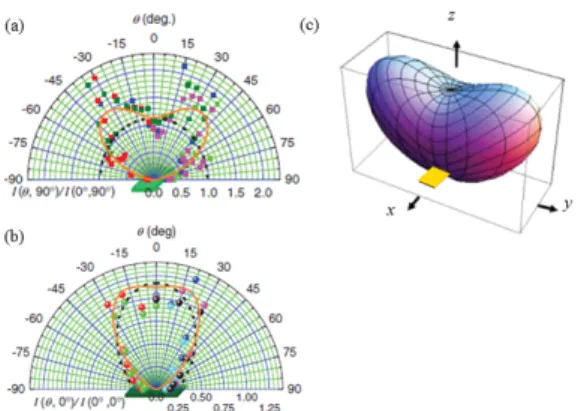
Figures 5(a) and 5(b) present the angleθdependences of the radiation intensity, I(θ), in theyz-plane and thexz- plane, respectively, for a long rectangular mesa with the length∼400μm and width∼60μm [37]. Here, the xyz- coordinate system is defined as in Fig. 5(c): the x-axis is parallel to the long side of the mesa and thez-axis is per- pendicular to the surface, andθis the angle from thez-axis.
The observed radiation is very anisotropic: it is the strongest in theyz-plane and mostly several times weaker inxz-plane for long rectangular mesas. The maximum intensityImaxoc-
Fig. 5 Polar plots of the radiation intensitiesI(θ) normalized atI(0) mea- sured in theyz-plane (a) and thexz-plane (b) for a long rectangular mesa emitter. Thexyz-coordinate system is defined as sketched in (c) andθis the angle from thez-axis. The 3D plot of the spatial distribution of radiation predicted by a dual-source mechanism is sketched in (c) with adjusting the relative amplitude and phase of the two source currents and accounting for the substrate effect. The solid curves in (a) and (b) are cross-sectional cuts of the 3D plot by theyz-plane and thexz-plane, respectively. The dashed curves are the corresponding cavity model fits (see text) [37].
curs atθ∼ ±30◦from the mesa top (θ=0◦) in theyz-plane.
At the top of the mesa, the radiation intensity has a local minimum withI(0)/Imax ≈0.4∼0.7. On the other hand, the observedI(θ) diminishes strongly asθ→90◦(parallel to the xy-plane; theab-plane of BSCCO crystal). Although there is some sample-to-sample variation, the similar behaviors are obtained for long rectangular mesa emitters [31].
If the radiation were simply induced by the funda- mental cavity resonance mode, as expected from capacitor patch antenna theory [40] and widely predicted for rectan- gular BSCCO mesas [41]–[46],I(θ) would be maximal at θ=0◦ as shown by the dashed curves in Figs. 5(a) and 5(b).
If a uniform ac-Josephson current were the primary radi- ation source, I(θ) would vanish at θ=0◦ and be maximal near toθ=90◦, as for simple dipole radiation [40]. Appar- ently, the experimental results contradict both simple ex- planations. In order to explain the experimental results, a dual-source mechanism has been proposed by Klemm and Kadowaki [47], [48], in which the uniform and inhomoge- neous parts of theac-Josephson current respectively act as an electric surface current source and set up a displacement current that excites a mesa cavity resonance mode which locks the radiation frequency, and acts as a magnetic sur- face current source. By adjusting the relative amplitude and phase of the two source currents and accounting for the sub- strate effect, excellent agreement with experimental results is obtained as depicted by the solid curves in Figs. 5(a) and 5(b) and sketched in Fig. 5(c) [37].
5. Synchronization of Two Emitters Fabricated on a BSCCO Crystal
The BSCCO-base mesa emitter can be viewed as a large scale array of strongly coupled Josephson junctions stacked in the direction of the height. It is expected that the radia- tion power is proportional toN2, if theNjunctions work co-
Fig. 6 (a) A photograph of the sample in which three mesas were fab- ricated on the surface of a BSCCO single crystal. A gold wire of 10μm in diameter was attached to each mesa by silver paste [32]. (b) TheI-V curve and radiation power characteristic as a function of voltage when the O3-2 and O3-3 mesas are biased in series. (c) The radiation frequency and radiation power as a function of current when the O3-2 and O3-3 mesas are biased in series. The bolometer signal includes little increased offset at higher bias current due to the thermal radiation from the sample.
herently [6], [7], [14], [17], [24]. However, there would be a limitation in mesa height, because this device is highly dissi- pative with poor thermal conductivity of BSCCO so that the mesa gets heated easily aboveTc. A solution to overcome this problem and to enhance the radiation power greatly may be to construct 1D or 2D planer array of mesas like the arrays of Nb-base discrete Josephson junctions. Simi- lar to the previous observation [8], Orita et al. demonstrated synchronized operation between two rectangular emitting mesas separately located side by side at a distance of 200μm on a BSCCO single crystal [32].
Figure 6(a) shows a photograph of the sample mesas which were made on the surface of a BSCCO crystal and located side by side at a distance of 200μm. By the AFM measurement, the widths were 47, 53 and 52μm at the top and 55, 61 and 60μm at the bottom for O3-1, O3-2 and O3-3 mesas, respectively. The length was 400μm and the height was 1.3μm for three mesas. When the mesas are individ- ually biased, the radiation frequencies are 0.73, 0.63 and 0.68 THz for O3-1, O3-2 and O3-3 mesas, respectively.
Figure 6(b) shows theI-V curve and the radiation in- tensity as a function of voltage when the O3-2 and O3-3 mesas are biased in series. TheI-Vcurve exhibits a charac- teristic hysteresis of the IJJ system, and a negative differen- tial resistance due to Joule heating in the high bias current region. Around V ≈1.6 V, only the O3-3 mesa emits be- cause the superconducting critical current is lower than O3- 2. Then, both mesas start to emit radiation aroundV ≈2.4 V.
The R-type radiation occurs in the high current region of the outermost reversible branch at the frequency around 0.7 THz.
Figure 6(c) shows the radiation frequency and radia- tion power as a function of current at 30 K when the O3-2 and O3-3 mesas are biased in series. The radiation occurs in the wide range of bias current of 15∼33 mA. The spec- tra have two peaks in the bias current below 25 mA, while they merge into one line in the range of bias current above 26 mA and stay together until the emission stops by Joule heating. The radiation intensity integrated for two separated lines increases with increasing current and takes a constant
intensity between 22 and 26 mA. With further increase of the current, the radiation intensity increases again to a max- imum value of 1.5 times of the constant intensity between 22 and 26 mA. This means that two separated mesas coher- ently work as a strongly connected THz emitter, probably by the synchronized terahertz current propagating through the superconducting substrate. The power observed here is not quite 4(=22) times as expected, but it was about 3 times.
6. Electrical Modulation of the Radiation Intensity and the Application to THz Imaging
The R-type emitter allows us to operate it as a power mod- ulation mode by simply applying a voltage to switch bias point from one to the other. Electrical modulation is a very efficient technique to reduce noise and it is crucially impor- tant for applications of this device. Here, we present the demonstration of the modulated radiation intensity at low- frequency and the application to the raster-scan imaging.
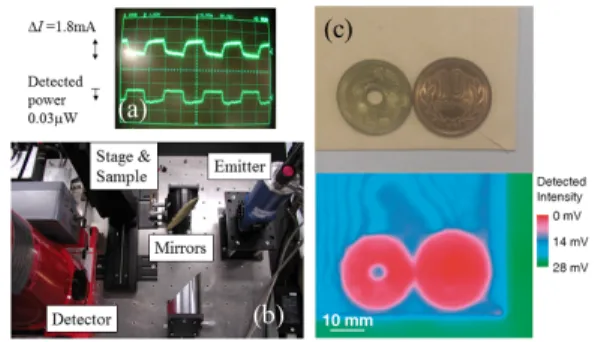
For the amplitude modulation (or switching) of the ra- diation, the bias current was directly modulated with a rect- angular pulse together with an appropriatedccurrent. The THz radiation was detected by an InSb hot-electron detec- tor (QMC, fc ≈500 kHz). Figure 7(a) shows the THz out- put signal (bottom) from a mesa emitter (width: 60μm, length: 350μm, height: 1.3μm) on the oscilloscope screen.
The radiation frequency is 0.58 THz. The bias current is modulated with a small-amplitude (top) of 1.8 mA around the emitting condition around I=16∼30 mA. The modula- tion frequency is 20 kHz. For small current modulation, the modulation up to 500 kHz is observed.
Using the amplitude modulation of radiation, we demonstrate that it is possible to use the BSCCO-base THz emitter for an application to the raster-scan imaging. The optical set-up is displayed in Fig. 7(b). The THz radiation emitted from a cooled emitter comes out from the cryostat through a quartz-glass window and is focused at a sample mounted on a controllable stage by two off-axial parabolic
Fig. 7 (a) An oscillograph of the THz output signal from a 60μm mesa emitter detected by an InSb hot-electron detector (bottom) for a small- amplitude current modulation (top) around the emitting condition. The modulation frequency is 20 kHz. (b) Optical set-up used for the raster- scan imaging. (c) A transmitted THz image of two Japanese coins put in a brownish envelope, with the photograph by visible light where the coins are put out of the envelope. Interference pattern produced by paper sheets of the envelope is clearly visible.
mirrors. The transmitted THz beam is detected by the InSb hot-electron detector placed behind the sample. The posi- tions of optical elements were adjusted by using a visible light beam of a LED mounted on the other side of the cold finger on which the THz emitter is mounted.
Since the InSb hot-electron detector has the lowest noise of 3 nV/Hz1/2around 20 kHz (30 nV/Hz1/2at 100 Hz,
≥100 nV/Hz1/2atdc), the R-type THz emitter is modulated at 20 kHz. The modulation frequency also matches our tar- gets of the scan speed and spatial resolution. The signal is pre-amplified with the gain of 1000 and is detected by a lock-in amplifier with the time constant of 1∼5 ms, so that the noise voltage ofVrms ≈0.1 mV is estimated. All the con- trol of the movable stage and the measuring instruments and the acquisition and processing of the data are automatically performed by a personal computer.
A transmitted THz image of two Japanese coins put in a brownish envelope is displayed in Fig. 7(c), with the photograph by visible light where the coins are put out of the envelope. The frequency of THz radiation is 0.56 THz.
The interference pattern produced by two paper sheets of the brownish envelope and the coins with thickness of 1.5 mm is clearly visible, demonstrating that the radiation is stable and monochromatic. A coin has a hole of 5 mm exactly. We estimate the spatial resolution at∼1.3 mm. Signal voltage of 28 mVrms without sample is obtained at the input of the lock-in amplifier, corresponding to 24 nW of detected radi- ation power. The total power emitted is estimated at∼1μW, taking into account the solid angle to the first mirror and the transmittance of the quartz-glass window of cryostat. Short- time noise voltage was∼0.2 mVrms, corresponding to the de- tector noise. It takes 45 minutes to get this image at present, however, it may be possible to improve much with the same S/N ratio and the spatial resolution in the near future.
7. Summary and Future Perspectives
The intrinsic Josephson junction system in a high-Tcsuper- conductor Bi2Sr2CaCu2O8+δworks as an array of strongly coupled Josephson junctions made of a high-Tc supercon- ductor, which gives us a solution to resolve the difficulty in fabrication of an artificial array from discrete high-Tc
Josephson junctions due to the extremely short coherence length. As a result, a remarkable phenomenon, monochro- matic and continuous radiation with high power at sub- THz frequency region, has been achieved by fabricating it into mesa structure. This emission has been understood by the coherently synchronized oscillation of Josephson cur- rent excited across large numbers of the intrinsic Josephson junctions. By tuning at a variety of cavity resonance modes, the emission has been observed at the frequency range of 0.32∼0.92 THz, and the total emission power has reached a few tens ofμW at 0.43∼0.65 THz with the frequency purity of 0.5 GHz. There are two regions in the I-V curve where strong THz radiation can be generated: one is located in the return branch in the hystereticI-Vcurve (IR-type), while an- other radiation occurs in the negative differential resistance
region at high bias currents (R-type).
The application to the raster-scan imaging has directly demonstrated the intensity, monochromatic nature and sta- bility of the radiation under electrical switching operation.
However, the radiation power is still insufficient for real- time imaging, and the frequency purity is too low to use it for local oscillator of receiver. We believe that the de- velopment of planer array formation of mesas and the im- provement in the performance of individual mesa device are necessary. As a beginning, we have demonstrated the syn- chronization of two emitters located on a chip of crystal.
Aiming at practical uses, the research of high-speed modu- lation and electrical tuning of radiation frequency may also be important. This all-high-Tcsuperconductor device, with a miniature size of∼1 mm dimensions, has the advantage of operating at higher temperature more than 30 K. This may allow us to use the compact Stirling coolers and make a portable THz-light source and a compact imaging system, etc. We expect that this THz emitter can widely be used in research fields and also for practical purposes.
Acknowledgments
The authors would like to express our special thanks to Profs. M. Tachiki, R.A. Klemm, I. Kakeya, L. Ozyuzer, U. Welp, W.-K. Kwok, Drs. K. Yamaki, H. Asai, Mrs. H. Yamaguchi, K. Delfanazari, T. Koike, N. Orita, and M. Sawamura for close collaborations.
References
[1] M. Tonouchi, “Cutting-edge terahertz technology,” Nature Photon- ics, vol.1, pp.97–105, 2007.
[2] D.L. Woolard, W.R. Loerop, and M.S. Shur, eds., Terahertz sensing Technology, World Scientific, Singapore, 2002.
[3] D.N. Langenberg, D.J. Scalapino, B.N. Taylor, and R.E. Eck, “In- vestigation of microwave radiation emitted by Josephson junctions,”
Phys. Rev. Lett., vol.15, pp.294–297, 1965.
[4] A.H. Dayem and C.C. Grimes, “Microwave emission from su- perconducting point-contacts,” Appl. Phys. Lett., vol.9, pp.47–49, 1966.
[5] J.E. Zimmerman, J.A. Cowen, and A.H. Silver, “Coherent radia- tion from voltage-biased weakly connected superconductors,” Appl.
Phys. Lett., vol.9, pp.353–355, 1966.
[6] T.F. Finnegan and S. Waflsten, “Observation of coherent microwave radiation emitted by coupled Josephson junctions,” Appl. Phys.
Lett., vol.21, pp.541–544, 1972.
[7] C. Varmazis, R.D. Sandell, A.K. Jain, and J.E. Lukens, “Generation of coherent tunable Josephson radiation at microwave frequencies with narrowed linewidth,” Appl. Phys. Lett., vol.33, pp.357–359, 1978.
[8] R.D. Sandell, C. Varmazis, A.K. Jain, and J.E. Lukens, “Study of the properties of coherent microbridges coupled by external shunts,”
AIP Conf. Proc. no.44, Future Trends in Superconductive Electron- ics (AIP, 1978), pp.327–334.
[9] A.K. Jain, K.K. Likharev, J.E. Lukens, and J.E. Sauvageau, “Mutual phase-locking in Josephson junction arrays,” Phys. Rep., vol.109, pp.309–426, 1984.
[10] S. Han, B. Bi, W. Zhang, and J.E. Lukens, “Demonstration of Josephson effect submillimeter wave sources with increased power,”
Appl. Phys. Lett., vol.64, pp.1424–1426, 1994.
[11] P.A.A. Booi and S.P. Benz, “High power generation with distributed
Josephson-junction arrays,” Appl. Phys. Lett., vol.68, pp.3799–
3801, 1996.
[12] S. Kiryu, W. Zhang, S. Han, S. Deus, and J.E. Lukens, “Off-chip detection of radiation from a linear array oscillator with a spiral an- tenna,” IEEE Trans. Appl. Supercond., vol.7, pp.3107–3110, 1997.
[13] M. Darula, T. Doderer, and S. Beuven, “Millimetre and sub-mm wavelength radiation sources based on discrete Josephson junction arrays,” Supercond. Sci. Technol., vol.12, pp.R1–R25, 1999.
[14] P. Barbara, A.B. Cawthorne, S.V. Shitov, and C.J. Lobb, “Stimulated emission and amplification in Josephson junction arrays,” Phys. Rev.
Lett., vol.82, pp.1963–1966, 1999.
[15] V.P. Koshelets and S.V. Shitov, “Integrated superconducting re- ceivers,” Supercond. Sci. Technol., vol.13, pp.R53–R69, 2000.
[16] B. Vasili´c, S.V. Shitov, C.J. Lobb, and P. Barbara, “Josephson- junction arrays as high-efficiency sources of coherent millimeter- wave radiation,” Appl. Phys. Lett., vol.78, pp.1137–1139, 2001.
[17] F. Song, F. M¨uller, R. Behr, and A.M. Klushin, “Coherent emission from large arrays of discrete Josephson junctions,” Appl. Phys. Lett., vol.95, 172501, 2009.
[18] R. Kleiner, F. Steinmeyer, G. Kunkel, and P. M¨uller, “Intrinsic Josephson effects in Bi2Sr2CaCu2O8 single crystals,” Phys. Rev.
Lett., vol.68, pp.2394–2397, 1992.
[19] T. Koyama and M. Tachiki, “Plasma excitation by vortex flow,” Solid State Commun., vol.96, pp.367–371, 1995.
[20] M. Tachiki, M. Iizuka, K. Minami, S. Tejima, and H. Nakamura,
“Emission of continuous coherent terahertz waves with tunable fre- quency by intrinsic Josephson junctions,” Phys. Rev. B, vol.71, 134515, 2005.
[21] S. Savel’ev, A.L. Rakhmanov, and F. Nori, “Using Josephson vor- tex lattices to control terahertz radiation: Tunable transparency and terahertz photonic crystals,” Phys. Rev. Lett., vol.94, 157004, 2005.
[22] I.E. Batov, X.Y. Jin, S.V. Shitov, Y. Koval, P. M¨uller, and A.V. Ustinov, “Detection of 0.5 THz radiation from intrinsic Bi2Sr2CaCu2O8 Josephson junctions,” Appl. Phys. Lett., vol.88, 262504, 2006.
[23] M.H. Bae, H.J. Lee, and J.H. Choi, “Josephson-vortex-flow terahertz emission in layered high-Tc superconducting single crystals,” Phys.
Rev. Lett., vol.98, 027002, 2007.
[24] L. Ozyuzer, A.E. Koshelev, C. Kurter, N. Gopalsami, Q. Li, M.
Tachiki, K. Kadowaki, T. Yamamoto, H. Minami, H. Yamaguchi, T. Tachiki, K.E. Gray, W.-K. Kwok, and U. Welp, “Emission of coherent THz radiation from superconductors,” Science, vol.318, pp.1291–1293, 2007.
[25] K. Yamaki, M. Tsujimoto, T. Yamamoto, A. Furukawa, T.
Kashiwagi, H. Minami, and K. Kadowaki, “High-power tera- hertz electromagnetic wave emission from high-Tcsuperconducting Bi2Sr2CaCu2O8+δmesa structures,” Opt. Express, vol.19, pp.3193–
3201, 2011.
[26] T. Yamamoto, private communication.
[27] T. Kashiwagi, K. Yamaki, M. Tsujimoto, K. Deguchi, N. Orita, T. Koike, R. Nakayama, H. Minami, T. Yamamoto, R.A. Klemm, M. Tachiki, and K. Kadowaki, “Geometrical full-wavelength res- onance mode generating terahertz waves from a single crystalline Bi2Sr2CaCu2O8+δ rectangular mesa,” J. Phys. Soc. Jpn., vol.80, 094709, 2011.
[28] T. Mochiku and K. Kadowaki, “Growth and properties of Bi2Sr2(Ca,Y)Cu2O8+δ single crystals,” Physica C, vol.235-240, pp.523–524, 1994.
[29] H. Minami, N. Orita, T. Koike, T. Yamamoto, and K. Kadowaki,
“Continuous and reversible operation of Bi2212 based THz emitters just belowTc,” Physica C, vol.470, pp.S822–S823, 2010.
[30] K. Kadowaki, H. Yamaguchi, K. Kawamata, T. Yamamoto, H.
Minami, I. Kakeya, U. Welp, L. Ozyuzer, A.E. Koshelev, C. Kurter, K.E. Gray, and W.-K. Kwok, “Direct observation of terahertz elec- tromagnetic waves emitted from intrinsic Josephson junctions in sin- gle crystalline Bi2Sr2CaCu2O8+δ,” Physica C, vol.468, pp.634–639, 2008.
[31] H. Minami, I. Kakeya, H. Yamaguchi, T. Yamamoto, and K. Kadowaki, “Characteristics of terahertz radiation emitted from the intrinsic Josephson junctions in high-Tc superconductor Bi2Sr2CaCu2O8+δ,” Appl. Phys. Lett., vol.95, 232511, 2009.
[32] N. Orita, H. Minami, T. Koike, T. Yamamoto, and K. Kadowaki,
“Synchronized operation of two serially connected Bi2212 THz emitters,” Physica C, vol.470, pp.S786–S787, 2010.
[33] M. Tsujimoto, K. Yamaki, K. Deguchi, T. Yamamoto, T. Kashiwagi, H. Minami, M. Tachiki, K. Kadowaki, and R.A. Klemm, “Geo- metrical resonance conditions for THz radiation from the intrin- sic Josephson junctions in Bi2Sr2CaCu2O8+δ,” Phys. Rev. Lett., vol.105, 037005, 2010.
[34] C. Kurter, K.E. Gray, J.F. Zasadzinski, L. Ozyuzer, A.E. Koshelev, Q. Li, T. Yamamoto, K. Kadowaki, W.-K. Kwok, M. Tachiki, and U.
Welp, “Thermal management in large Bi2212 mesas used for tera- hertz sources,” IEEE Trans. Appl. Supercond., vol.19, pp.428–431, 2009.
[35] H.B. Wang, S. Guenon, B. Gross, J. Yuan, Z.G. Jiang, Y.Y. Zhong, M. Grunzweig, A. Iishi, P.H. Wu, T. Hatano, D. Koelle, and R.
Kleiner, “Coherent terahertz emission of intrinsic Josephson junc- tion stacks in the hot spot regime,” Phys. Rev. Lett., vol.105, 057002, 2010.
[36] K.E. Gray, A.E. Koshelev, C. Kurter, K. Kadowaki, T. Yamamoto, H. Minami, H. Yamaguchi, M. Tachiki, W.-K. Kwok, and U. Welp,
“Emission of terahertz waves from stacks of intrinsic Josephson junctions,” IEEE Trans. Appl. Supercond., vol.19, pp.886–890, 2009.
[37] K. Kadowaki, M. Tsujimoto, K. Yamaki, T. Yamamoto, T.
Kashiwagi, H. Minami, M. Tachiki, and R.A. Klemm, “Evidence for dual-source mechanism of THz radiation from rectangular mesa of single crystalline Bi2Sr2CaCu2O8+δintrinsic Josephson junctions,”
J. Phys. Soc. Jpn., vol.79, 023703, 2010.
[38] S. Tajima, G.D. Gu, S. Miyamoto, A. Odagawa, and N. Koshizuka,
“Optical evidence for strong anisotropy in the normal and su- perconducting states in Bi2Sr2CaCu2O8+z,” Phys. Rev. B, vol.48, pp.16164–16167, 1993.
[39] M. Tsujimoto, T. Yamamoto, K. Delfanazari, R. Nakayama, T.
Kitamura, M. Sawamura, T. Kashiwagi, H. Minami, M. Tachiki, K.
Kadowaki, and R.A. Klemm, “Broadly tunable sub-terahertz emis- sion from internal branches of the current-voltage characteristics of superconducting Bi2Sr2CaCu08+δsingle crystals,” to be published in Phys. Rev. Lett., 2012.
[40] C.A. Balanis, Antenna Theory, Analysis and Design, 3rd ed., Wiley, Hoboken, NJ, 2005.
[41] L.N. Bulaevskii and A.E. Koshelev, “Radiation due to Josephson oscillations in layered superconductors,” Phys. Rev. Lett., vol.99, 057002, 2007.
[42] A.E. Koshelev and L.N. Bulaevskii, “Resonant electromagnetic emission from intrinsic Josephson-junction stacks with laterally modulated Josephson critical current,” Phys. Rev. B, vol.77, 014530, 2008.
[43] S. Lin, X. Hu, and M. Tachiki, “Computer simulation on terahertz emission from intrinsic Josephson junctions of high-Tcsupercon- ductors,” Phys. Rev. B, vol.77, 014507, 2008.
[44] S. Lin and X. Hu, “Possible dynamic state in inductively coupled intrinsic Josephson junctions of layered high-Tcsuperconductors,”
Phys. Rev. Lett., vol.100, 247006, 2008.
[45] X. Hu and S. Lin, “Three-dimensional phase-kink state in a thick stack of Josephson junctions and terahertz radiation,” Phys. Rev. B, vol.78, 134510, 2008.
[46] A.E. Koshelev, “Alternating dynamic state self-generated by internal resonance in stacks of intrinsic Josephson junctions,” Phys. Rev. B, vol.78, 174509, 2008.
[47] R.A. Klemm and K. Kadowaki, “Angular dependence of the ra- diation power of a Josephson STAR-emitter,” J. Supercond. Nov.
Magn., vol.23, pp.613–616, 2010.
[48] R.A. Klemm and K. Kadowaki, “Output from a Josephson stimu-
lated terahertz amplified radiation emitter,” J. Phys.: Condens. Mat- ter, vol.22, 375701, 2010.
Hidetoshi Minami received the Ph.D. de- gree in Physics from University of Tokyo in 1992. After Assistant Professor of Department of Pure and Applied Sciences, University of Tokyo (1986–1992), then Lecturer of Institute of Materials Science, University of Tsukuba (1992–).
Manabu Tsujimoto received the Mas- ter’s degree in Engineering from University of Tsukuba in 2010, then entered Graduate School of Pure and Applied Sciences, Doc- toral Program in Material Science, University of Tsukuba in 2010. During 2010–2011, he was Research Assistant in University of Tsukuba.
He is now Research Fellow of the Japan Soci- ety for the Promotion of Science (2011–).
Takanari Kashiwagi received the Ph.D. de- gree in Physics from Osaka University in 2008.
After Post. Doc. in Center for Quantum Science and Technology under Extreme Conditions in Osaka University (2008–2009), then Assistant Professor of Institute of Materials Science, Uni- versity of Tsukuba (2009–).
Takashi Yamamoto received the Ph.D. de- gree in Engineering from University of Tsukuba in 2007. Postdoctoral Fellow in Institute of Ma- terials Science, University of Tsukuba (2007–
2011). Currently, Postdoctoral Fellow in Quan- tum Beam Science Directorate, Japan Atomic Energy Agency (2011–).
Kazuo Kadowaki received the Ph.D. degree in Physics from Osaka University in 1980. Af- ter Post. Doc. in Department of Physics, Alberta University, Canada (1982–1986), and lecturer in Natuurkundig Laboratorium der Universiteit van Amsterdam, the Netherlands (1986–1990), group leader in National Research Institute for Metals (1990–1995), Assistant Professor, then Professor of Institute of Materials Science, Uni- versity of Tsukuba (1995–).
![Fig. 2 (a) Photograph of a mesa fabricated by photolithography and Ar- Ar-ion milling technique, and the cross-sectAr-ion of the mesa observed by AFM [30]](https://thumb-ap.123doks.com/thumbv2/123deta/5626812.1500345/2.892.123.378.120.269/photograph-fabricated-photolithography-milling-technique-cross-sectar-observed.webp)