Input Frequency and the Learning of L2 Morphology
Theoretical models of inflectional morphology
There are various theoretical accounts of inflectional morphology. In the lexical access literature, dual-route access models are common (e.g., Baayen, 1991; Caramazza, Laudanna, & Romani, 1988; Chialant & Caramazza, 1995; Laudanna, Badecker, & Caramazza, 1992; Shreuder & Baayen, 1995). These models share the assumption that irregularly inflected word forms are mainly accessed through whole-word representations while regularly inflected word forms are accessed through both whole-word and decomposed morpheme representations. Connectionist and usage-based network models (e.g., Bybee 1985, 1988, 1995; Daugherty & Seidenberg, 1992; McClelland & Rumelhart, 1985; Plaut, McClelland, & Seidenberg 1996; Plunkett & Marchman, 1991; Rumelhart & McClelland, 1986; Stemberger, 1995), fundamentally assume that morphological processing is managed by lexical storage, through which rule-like behavior emerges from generalization among stored items by the associative function of memory. Generative linguistic accounts, on the other hand, distinguish between regularly and irregularly inflected word forms (e.g., Clahsen, 1999; Pinker, 1991, 1997; Pinker & Prince, 1991; Prasada & Pinker, 1993; Ullman, 2001), and propose that there is a dual-processing mechanism, dissociating rule-based regular inflections from storage-based irregular inflections. Currently, researchers in cognitive approaches, connectionism, generative grammar, and lexical access studies ask whether there are two modes of processing for inflectional morphology, by rule or by rote, and which mode is possible for regularly and irregularly inflected word forms. A central question in the debate in this literature has become whether regular forms exhibit the effects of input frequency in the process of lexical access and morphological production. Empirical studies of frequency effects
experiments. Burani, Salmaso, & Caramazza, (1984), Gordon and Alegre, (1999), Hare, Ford, and Marsen-Wilson (2001), and Taft (1979) investigated frequency effects for inflected word forms in a lexical decision task. Prasada, Pinker, & Snyder, (1990) and Seidenberg and Bruck (1990) investigated stem-priming effects for regularly and irregularly inflected word forms in a naming task. Beck (1997), Brovetto and Ullman (2001), and Lalleman, Santen, and Heuven (1997) replicated the study design by Prasada, et al. and investigated frequency effects for inflected word forms in a second language. Ellis and Schmidt (1997) investigated frequency effects for both regularly and irregularly inflected word forms in an artificial language. The current experimental findings to date, however, are conflicting, with some studies reporting effects of frequency only for irregular forms, and others finding frequency effects for regular forms as well.
In a lexical access study, Taft (1979) tested pairs of regularly inflected word forms: one word in each pair was high in whole-word frequency and the other was very low, but both were matched in base frequency (stem frequency plus all inflections). In Taft’s experiments, the items were visually presented for 500 milliseconds, and the subjects were asked to classify whether items were words or nonce words. Access latencies were measured by the length of response time between the onset of the stimulus presentation and the onset of vocal response by saying yes or no. In the results, Taft found significant word frequency effects, suggesting that regular inflections may have whole-word representations. However, in another experiment, Taft also found significant base frequency effects when pairs of regularly inflected forms were matched in word frequency but with different base frequencies.
out by other researchers. For example, the findings in the Burani, et al. study might be confounded with the type frequency of other inflected word forms that share the same endings (e.g., –ing, ed, –s in English) if one assumes that independent decomposed representations of morphemes are available in the lexicon (e.g., Baayen & Schreuder, 1999; Schreuder & Baayen, 1995). As for the Taft (1979) study, Gordon and Alegre (1999) point out that the experimental items in the study involved stem forms that are derived from nouns (e.g., numbered, timed; Taft 1979, p. 272). Nine out of twenty items in the low word frequency group had derived stems, while the high word frequency group had none. If one assumes that denominal verbs have independent representational status in the lexicon, then Taft’s computation for base frequency might be inaccurate, since he included both noun and verb base frequency to control for the matched pairs in the experimental items. Alternatively, if derived verbs are generated by rule, this includes complex processing steps (e.g., access to noun base form, zero derivation from noun base, and the application of the inflectional rule). In either case, denominal verbs in low frequency items might have contributed longer reaction times in the experiments.
approximate base frequency of 100 per million. Although the results did not fully meet their predictions based on the aforementioned dual-route access models, Gordon and Alegre found the evidence that frequently occurring regularly inflected word forms seem to have independent mental representations in the lexicon.
A study by Hare, et al. (2001) also reports a statistically significant whole-word frequency effect on regular forms, investigating the same question with a slightly different focus. In their study, regularly and irregularly inflected forms were compared with their homophones (e.g., made, maid, allowed, aloud). The homophones were used for primes in a lexical decision task, and the results showed that if the inflected word form was more frequent than the homophone pair, reaction times were faster, but if the homophone word form was more frequent, reaction times were slower.
no differences in reaction times for the regularly inflected word forms. However, when irregular forms were tested in the same fashion, past tense forms that are higher in frequency were produced statistically significantly faster than lower frequency past tense forms. These results suggested that regular inflections are generated by rule, while irregular inflections are stored as whole words.
The research design developed by Prasada, et al. (1990) has been adopted in second language research as well. The second language studies that replicated Prasada, et al.’s study (Beck, 1997; Brovetto & Ullman, 2001; Lalleman et al, 1997) report statistically significant word frequency effects on irregulars but no effect on regulars in native speaker controls, but the findings in L2 learners are inconsistent. Beck (1997) reports the results of a number of experiments showing that second language learners of English behave much like L1 speakers on regulars, arguing against the notion that regularly inflected word forms have full-form representations in the lexicon. What Beck actually found for the regular items in the experiments, however, were shorter reaction times for low word frequency items than for high word frequency items. This phenomenon has often been referred to as an “anti-frequency effect” (Beck, 1997; Pinker, 1991) and taken as key evidence to support the existence of a rule-governed mechanism for L2 morphological processing (e.g., Eubank & Gregg, 1995). Moreover, Beck found no significant word frequency effect on irregulars, suggesting that the natural input frequency of irregulars may not be very relevant since it is very common practice in L2 classrooms to provide lists of irregular verbs to be memorized by the students. In contrast to Beck’s findings, on the other hand, Lalleman, et al. (1997) found an advantage for both high-frequency irregular and high-frequency regular items in their initial experiment. Similarly, Brovetto and Ullman (2001) observed a statistically significant word frequency effect on irregulars and also found longer reaction times for low frequent regulars by L2 learners.
for the past form. Pinker and Prince (1991) note:
Prasada, Pinker, & Snyder (1990) selected pairs of verbs that had identical nonpast frequencies (e.g., each pair consisted of a regular verb and an irregular verb that were equated on the sum of the frequency of stem form, the frequency of -ing form, and the frequency of -s form), but that differed in their past tense frequency. (p. 235)
Following the same computing method by Prasada, et al., Beck (1997, p. 115) provides the experimental items used in her experiments, and selected pairs of verbs that shared similar non-past frequencies. For example, laugh and hunt had a shared similar non-past base frequency of 38 and 37 per million in Kucera and Francis (1967) but differing past-form word frequency of 51 and 8 (laughed and hunted). In the item lists, laugh was categorized as a high word frequency item because laughed had higher past-form word frequency than hunted. In turn, hunted was categorized as low word frequency item.
There are several potential problems introduced through this approach. Based on the computation method used by Prasada, et al., Beck controlled the non-past base frequency for each pair of verbs and set the baseline condition for comparison between high and low frequency category relatively. This categorization is appropriate if it applies to one pair of verbs or a set of verbs that share a matched value of non-past base frequency. However, the item lists in Beck study had multiple non-past base frequency values, varying from 10 to 225 with differing word frequencies. It is inappropriate to compare word frequencies in this way since the method had only one category (high vs. low word frequency) with multiple baseline conditions (differing non-past base frequencies for each pair) for comparison.
the computation of base frequency. However, this manipulation of base frequency becomes a problem if one assumes that the base frequency should contribute to the activation levels associated with the word frequency of high word frequency regular forms (as dual-route access models assume), or if the base frequency should contribute to the activation levels with the word frequency of all inflected forms (as connectionist and usage-based network models assume).
A third potential problem is that the word frequency distribution in naturally occurring corpora is usually highly correlated with associated base frequency distribution. In the computation method used by Prasada et al, the non-past base frequency for each pair of verbs was matched, but the base frequencies among the regular items were not controlled. As a result, the regular items in the Beck study exhibit very high correlations between their non-past base frequencies and word frequencies (r = .93 in the high frequency word list and r = .95 in the low frequency word list). They also show extremely high correlations between their base frequencies and word frequencies (r = .99, and r = .99, respectively). If word frequency and base frequency should both contribute to activation levels, as the other models hypothesize, then the effect of base frequency must be separated out if one is to analyze the effect of word frequency; however, without controlling for collinearity, the word frequency and non-past frequency variables operationalized by the Prasada, et al. method may turn out to be the same factor under different labels.
Nevertheless, based on the Prasada, et al. design, there is one experimental study that obtained word frequency effects for both regularly and irregularly inflected forms in which input frequency was completely controlled in a laboratory setting. Ellis and Schmidt (1997) investigated frequency effects for both regularly and irregularly inflected word forms in an artificial language using both human data and connectionist simulations. In the experiments, participants learned 20 new stem forms in an artificial language and then learned the corresponding inflected forms. Half of the items were regularly inflected forms in that they shared the same affix, but the remaining 10 items were irregulars in that they had non-identical affixes. In the learning trials, half of the regular and irregular inflected forms were presented on the computer screen five times more frequently than the other items. On each trial, the latencies of the participants’ verbal responses were measured using a voice key, as in the Prasada, et al. (1990) study. The participants took between 13 and 15 trials to complete the learning phase. In the early stages of learning, Ellis and Schmidt found that the performance on both regular and irregular items exhibited significant word frequency effects, but in the later stages, the size of the word frequency effect for regular items diminished with the increasing base frequency. The size of the word frequency effect on irregular items also similarly diminished with the increasing base frequency but did so more slowly than the regular items. These frequency effects for both regular and irregular items exhibited non-linear learning curves, showing that the latency data adhered to the power law of practice. The connectionist simulations also exhibited very similar learning curves with the human data when the system was presented with the same exemplars in the same order used with human participants. Combining the results from both human data and simulations, the results suggested that a frequency and regularity interaction was consistent with the power law that operates in associative processes in memory, showing that the results did not necessarily imply rule-governed processes for regular inflections.
Most studies that investigated the representational status of regularly inflected word forms (e.g., Burani, et al., 1984; Gordon & Alegre, 1999; Taft 1979) defined base frequency as the frequencies of the stem plus all of the inflectional forms. These studies have shown that word frequency effects are evident when base frequencies are kept constant, suggesting input frequency has a key role in the processes of inflectional morphology. The experimental studies that investigated a processing dissociation between regular and irregular morphology (e.g., Beck, 1997; Brovetto & Ullman, 2001; Lalleman, et al., 1997; Prasada, et al. 1990; Seidenberg & Bruck, 1990) equated non-past base form frequency between pairs of verbs to categorize high and low word frequency items, but they did not control for the base frequencies among the word items in the high and low word frequency category. These studies generally provide the evidence that regularly inflected word forms do not exhibit word frequency effects. Connectionist simulations (e.g., Daugherty & Seidenberg, 1992; Ellis & Schmidt 1997; Plaut, et al., 1996; Plunkett & Marchman, 1991; Rumelhart and McClelland, 1986), on the other hand, have shown that base frequency, word frequency, and regularity interactions indicate the relationship that involves the power law in which word frequency effects are larger in the early stages of acquisition, but word frequency effects become smaller with increasing base frequency.
L1 and L2 processing for regularly inflected word forms: is it governed by rule or rote? If there are parallel effects for L1 and L2 morphological priming, this findings would argue strongly for an account that L2 learners behave much like native speakers, but if there is a contrast effect for L1 and L2 processing, it would argue strongly for an account that L2 morphological processing is essentially different from L1 processing. The goal of the study is to contribute more informative experimental evidence to the debate. The research questions and the hypotheses for the current study are as follows:
Research questions
RQ 1: For native speakers of English, do regularly inflected words show word frequency effects on the access latency?
RQ 2: For native speakers, is there a difference between any observed word frequency effect for words with high base frequency and words with low base frequency?
RQ 3: For non-native speakers of English, do regularly inflected words show word frequency effects on the access latency?
RQ 4: For non-native speakers, is there a difference between any observed word frequency effect for words with have high base frequency and words with low base frequency?
Method
Participants
the NNS participants had scored more than 550 on the TOEFL test to enter the graduate programs within the previous 3 years. The 25 NNS participants comprised 4 Chinese, 2 Hindi, 11 Japanese, and 8 Korean speakers. It can be summarized that they were advanced learners of English who had extensive exposure to American English in everyday life for several years but with a considerable variability.
Materials
Token frequencies of regularly inflected word forms were calculated from Kucera and Francis (1967) with TextStat concordance software. Base frequency was defined as the summed frequency of the stem form, -s form, -ing form and -ed form.
Word frequency was defined as the frequency tokens of inflected word forms
between the base and word frequency (r = .09) was not statistically significant (p = .61). These word items were then categorized as 15 lower and 15 higher word frequency items within a base frequency range of approximately 110, using the median split as a cut point. For the distractor items, pseudo-words were used. 60 neologisms were sampled from an electronic resource (Huth & Huth, 2006). All of the samples were verb stem forms. For the purpose of this study, the sampled stem forms were inflected by the researcher, either as a present third-person-singular form or a past-tense form.
Procedures
All of the experimental and distractor items were digitally recorded by a native English-speaking adult male who spoke each item at a normal rate. The recording was done in a sound-attenuated booth in a dedicated linguistic laboratory. The volume and background noises of each recorded item were standardized, and then the duration of each auditory stimulus was controlled for length (110 milliseconds) without modifying the pitch with the sound processing functions. Each participant was tested individually and privately by the researcher in a quiet room. At the beginning of the testing procedure, each participant was instructed to say “yes” if they hear a genuine word or “no” if they hear a pseudo-word, as quickly as possible. All of the experimental word items (90 items) plus distractor items (60 items) were played in one session and in random order for each participant. There was an 8-second pause before each item was presented. The total lexical decision task required approximately 16 minutes to complete. Each Reaction Time (RT) was measured by the duration between the onset of the auditory stimulus and the onset of vocal response by participant’s lexical decisions.
Analysis
with lower and higher word frequencies within the base frequency of 30, b) the summed RT scores for word items with lower and higher word frequencies within the base frequency of 60, and c) the summed RT scores for word items with lower and higher word frequencies within the base frequency of 110. For the statistical analyses, the alpha level was set to .05.
Results
For the NS participants, the reliability of the experimental items (n = 25, k = 90) was .89 (Cronbach’s alpha). For the NNS participants, the reliability of the experimental items (n = 25, k = 90) was .87 (Cronbach’s alpha). The estimated marginal means and accuracy rates by NS and NNS participants are summarized in Table 1.
Table 1
Estimated Marginal Mean RT Scores and Accuracy Rates
BFREQ WFREQ M SD Accuracy SE
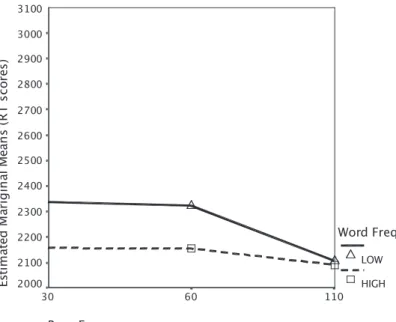
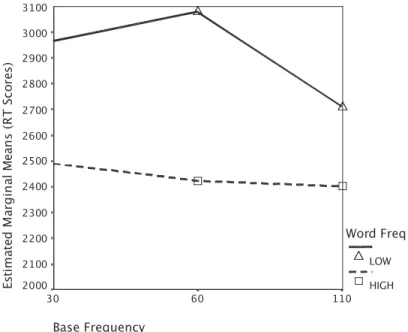
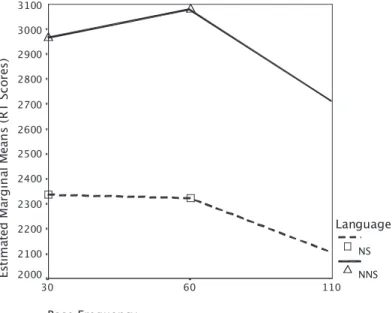
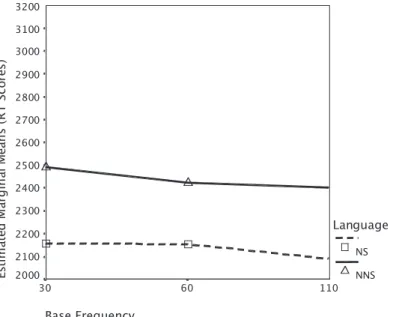
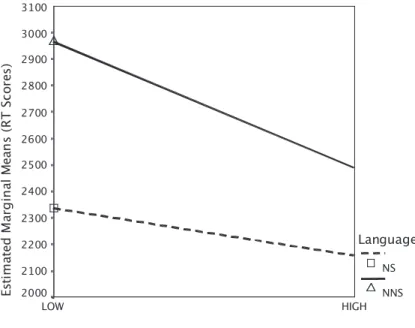
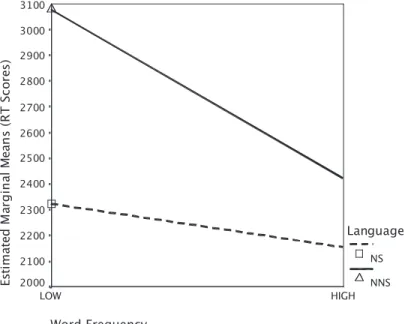
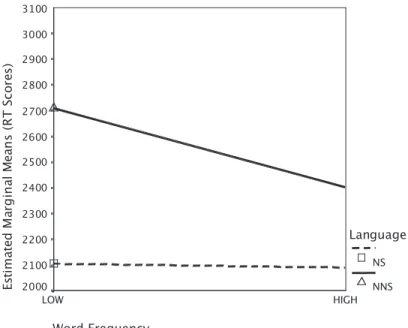
NS (n = 25) 30 LOW 2335.80 160.19 .99 106.17 HIGH 2157.48 131.09 1 73.39 60 LOW 2322.76 138.19 1 110.42 HIGH 2154.96 122.46 .99 71.43 110 LOW 2106.40 138.72 1 78.09 HIGH 2091.32 144.64 1 77.34 NNS (n = 25) 30 LOW 2968.04 733.47 .73 106.17 HIGH 2489.72 502.16 .88 73.39 60 LOW 3078.88 768.46 .79 110.42 HIGH 2421.60 482.69 .92 71.37 110 LOW 2711.00 534.48 .95 78.09 HIGH 2400.44 527.43 1 77.34
The participants’ mean RTs indicated that both NS and NNS participants produced longer latencies for the lower word frequency items than the higher word frequency item overall. The RTs by the NNS participants were slower than the NS participants. The accuracy rates showed that the NS participants made almost no errors at all levels of word and base frequency. On the other hand, the NNS participants tended to err more on the lower word frequency items at the lower levels of base frequency (.73 and .79 at the base frequency of 30 and 60). The overall ANOVA effects indicated that there were several statistically significant within-subject effects that interacted with the language between-subjects effect. The word frequency within-subjects factor had the largest main effect, F (1, 48) = 72.95, p < .0005, ηp2 = .60, and it was followed by the language between-subjects main effect, F (1, 48) = 20.89, p < .0005, ηp2 = .30, and the base frequency within-subjects main effect, F (1.553, 74.539) = 10.51, p < .0005, ηp2 = .18. Two-way interaction effects were evident. The largest two-way interaction effect was the word frequency by language interaction, F (1, 48) = 26.29, p < .0005, ηp2 = .35, and it was followed by the word frequency by base frequency interaction, F (1, 48) = 18.26, p < .0005, ηp2 = .28. Although the size of the base frequency by word frequency by language interaction was very small, F (1, 48) = 6.27, p = .035, ηp2 = .07, the three-way interaction was also evident, which suggested that the interaction of word frequency by base frequency was not the same under the NS vs. NNS between-subject language factor. In order to analyze the interaction effects at each level, the three-way interaction will be discussed in the following order:
1. Base frequency by word frequency interaction between NS and NNS. 2. Base frequency by language interaction within each level of word
frequency.
3. Word frequency by language interaction within each level of base frequency.
Figure 1. Base frequency by word frequency interaction by NS participants
effects of word frequency were evident at all levels (See figure 2 for profile plots).
Figure 2. Base frequency by word frequency interaction by NNS participants
frequency of 110 was smaller than both the base frequency ranges of 30 and 60. At the level of low word frequency, the simple main effects of base frequency were evident within the base frequency ranges from 30 to 110 and 60 to 110, and RT scores slowed equally on average for both NS and NNS participants. (See figure 3 for profile plots). The main effects became larger toward the higher end of base frequency.
Figure 3. Base frequency by language interaction at low word frequency
difference within the base frequency from 30 to 110 was 257.04 (p = .017) with the lower bound of 95% C. I. of 36.56, and upper bound of 95% C.I. of 477.52. The mean difference within the base frequency from 60 to 110 was 367.88 (p < .0005) with the lower bound of 95% C. I. of 176.63, and upper bound of 95% C.I. of 559.13. The multivariate tests indicated that the simple main effects of base frequency at the level of low word frequency were both statistically significant for the NS participants (p = .025, ηp2 = .15) and NNS participants (p < .0005, ηp2 = .34). On the other hand, at the level of high word frequency (See figure 4 for profile plots), the simple main effects of base frequency were not statistically significant for the NS and NNS participants across all three base frequency levels (See Appendixes D and E). Nevertheless, slight decrease in the mean RTs seems apparent for both NS and NNS participants.
The comparisons between NS and NNS participants’ marginal means showed that there were statistically significant mean differences at all levels; the NNS participants’ mean RT scores for the target regularly inflected word forms were much longer than the NS participants’ responses (See figures 5, 6, and 7). However, the effect diminishes persisted at the level of high word frequency for all ranges of the base frequency.
Figure 5. Word frequency by language interaction at the base frequency of 30
the upper bound of 95% C.I. of 934.14. At the level of high word frequency, the mean difference was 332.24 (p = .002, ηp2 = .18) with the lower bound of 95% C. I. of 123.54 and the upper bound of 95% C.I. of 540.94. At the level of low word frequency within the base frequency of 60 (See figure 6), the mean difference was 756.12 milliseconds (p < .0005, ηp2 = .33) with the lower bound of 95% C. I. of 442.15 and upper bound of 95% C.I. of 1070.01. At the level of high word frequency, the mean difference was 266.64 (p = .01, ηp2 = .13) with the lower bound of 95% C. I. of 66.39 and the upper bound of 95% C.I. of 466.89.
Figure 6. Word frequency by language interaction at the base frequency of 60
= .14) with the lower bound of 95% C. I. of 89.195 and the upper bound of 95% C.I. of 529.05.
Figure 7. Word frequency by language interaction at the base frequency of 110
The mean differences between NS and NNS results were evident especially for the low word frequency items across all three base frequency levels. Nevertheless, the profile plots also showed general characteristics shared by both NS and NNS participants; low word frequency items produced longer latencies than high word frequency items at the most levels of base frequency. The only exception to this tendency was the NS participants’ minimum mean difference at the base frequency of 110.
participants overall. However, the analyses on the within-subject effects revealed similar patterns among NS and NNS participants; the simple main effects of base frequency were evident for the items associated with low word frequency level and the main effects became evident as the base frequency increased, while the main effects at the high word frequency level were not evident. The analysis of the simple main effects of word frequency indicated that they were evident except for those at the high base frequency level of 110 by NS participants, which seemed to be the sole cause of the three-way interaction (p = .035, ηp2 = .07). The main effects of the between-subjects language factor tended to affect the size of the main effects of word frequency. For NS participants, the main word frequency effects were significant at the low base frequency range of 30 (p = .005, ηp2 = .15) and the middle base frequency of 60 (p = .036, ηp2 = .09), but the effects of word frequency diminished at the high base frequency range of approximately 110 (p = .676, ηp2 = .004). For NNS participants, the main effects of word frequency affected all ranges of the base frequency, and the size of the main effects was constant (p < .0005, ηp2 = .57 at the base frequency of 30; p < .0005, ηp 2 = .60 at the base frequency of 60;
p < .0005, ηp2 = .61 at the base frequency of 110).
Discussion
Findings indicated that the effects of word frequency were evident for the regularly inflected word forms associated with low base frequencies. On the other hand, the effects of base frequency became evident as the base frequency became high for the low word frequency forms. These findings are compatible with the predictions made by connectionist models (Daugherty & Seidenberg, 1992; Plaut, et al., 1996; Plunkett & Marchman, 1991; Rumelhart & McClelland, 1986), and with the findings of Ellis and Schmidt (1997), suggesting the following answers to the four research questions asked in this study.
RQ 1: For native speakers of English, do regularly inflected words show word frequency effects?
RQ 2: For native speakers, is there a difference between the word frequency effect for words with high base frequency and words with low base frequency? The effects of word frequency interacted with the effects of base frequency. The word frequency had an effect on NS participants’ access latencies for regularly inflected word forms associated with low base frequency, but the effect of word frequency diminished and eventually disappeared as the base frequency increased. RQ 3: For non-native speakers of English, do regularly inflected words show word
frequency effects?
The effects of word frequency were found for regularly inflected word forms. RQ 4: For non-native speakers, is there a difference between the word frequency
effect for words with high base frequency and words with low base frequency?
The word frequency constantly had an effect on NNS participants’ access latencies for regularly inflected word forms. Unlike the NS participants, the effect of word frequency did not disappear as the base frequency increased. However, the base frequency had an effect on NNS participants’ access latencies for words associated with low word frequency at the higher base frequency ranges.
frequencies were kept constant at three levels for regularly inflected word forms, the current results exhibited statistically significant word frequency main effects, base frequency main effects, and word by base frequency interaction effects for the NS participants, which do not support the predictions made by the dual-processing mechanism models.
The current findings are compatible with the predictions posited by the dual-route access models (Chialant & Caramazza, 1995; Shreuder & Baayen 1995). The dual-route access models allow storage of regularly inflected word forms and suggest that the regularly inflected word forms associated with high word frequency should exhibit the effects of word frequency. The current results for NS participants seem to fit this prediction at some levels; however, the results also suggest that the effects of word frequency tended to diminish at the high base frequency range, showing that there was virtually no difference in the mean access latencies within high and low frequency word items at the high base frequency level. The dual- route access models tend to posit the relationship between word frequency and access latency as being linear; high word frequency regular forms should exhibit shorter latencies than low word frequency word forms; however, the NS participants’ results did not show such a relationship between access latencies and word frequency. Conclusion
The results showed that word frequency effects tended to be apparent in lower base frequency range, and the effects of base frequency tended to become evident at the higher base frequency range. It is likely that word frequency strongly affects the access latency for a low word frequency regular form with low base frequency, since low base frequency does not provide enough exemplars for generalization, and the input frequency of the word form becomes the sole basis for access. In turn, it is likely that word frequency weakly affects the access latency for a low word frequency regular form with high base frequency, since high base frequency provides enough exemplars to make use of online exemplar-based generalization of the common pattern shared with the other inflected word forms in the same inflectional paradigm.
functions of memory are at work for morphological processing, providing a more plausible explanation for the lexical access of regular forms, which do not necessarily imply a hybrid processing mechanism where regular forms are accessed thorough rule-based online generation.
References
Baayen, H. (1991). Discussion: On frequency, transparency and productivity. In G. E. Booij & J. van Marle (Eds.), Yearbook of morphology (pp. 181-208). Dordrecht: Foris.
Baayen, R. H., Schreuder, R. (1999). War and peace: Morphemes and full forms in a noninteractive parallel dual-route model. Brain and Language, 68, 27-32. Beck, M. L. (1997). Regular verbs, past tense and frequency: Tracking down a
potential source of NS/NNS competence differences. Second Language
Research, 13, 93-115.
Bley-Vroman, R. (1990). The logical problem of foreign language learning.
Linguistic Analysis, 2, 3-49.
Bley-Vroman, R. (1997). Feature and patterns in second language acquisition. Paper
presented at the second language research forum. Michigan State
University.
Brovetto, C. & Ullman, M. (2001). First vs. second language: A differential reliance on grammatical computations and lexical memory. Poster presented at the
14th Annual CUNY Conference on Human Sentence Processing. University of Pennsylvania.
Burani, C., Salmaso, D., & Caramazza, A. (1984). Morphological structure and lexical access. Visible Language, 4, 348-358.
Bybee, J. L. (1985). Morphology. Philadelphia: John Benjamins.
Bybee, J. L. (1988). Morphology as a lexical organization. In M. Hammond & M. Noonan (Eds.), Theoretical Morphology. San Diego: Academic Press. Bybee, J. (1995). Regular Morphology and the Lexicon. Language and Cognitive
Bybee, J., & Hopper, R. (Eds.). (2001). Frequency and the emergence of linguistic
structure. Amsterdam: John Benjamins.
Caramazza, A., Laudanna, A., & Romani, C. (1988). Lexical access and inflectional morphology. Cognition, 28, 297-332.
Chialant, D., & Caramazza, A. (1995). Where is morphology and how is it processed? The case of written word recognition. In L. B. Feldman (Ed.),
Morphological aspects of language processing (pp. 55-78). Hillsdale, NJ:
Erlbaum.
Chomsky, N. (1980). Rules and Representations. New York: Columbia University Press.
Clahsen, H. (1999). Lexical entries and rules of language: A multi-disciplinary study of German inflection. Behavioral and Brain Sciences, 22, 991-1060. Daugherty, K., & Seidenberg, M. (1992). Rules or connections? The past tense
revisited. Proceedings of the 14th Annual Meeting of the Cognitive Science
Society. Hillsdale, NJ: Erlbaum.
Ellis, N. C. (1996). Sequencing in SLA: Phonological memory, chunking, and points of order. Studies in Second Language Acquisition, 18, 91-126.
Ellis, N. C. (1998). Emergentism, connectionism, and language learning. Language
Learning, 48, 631-664.
Ellis, N. C. (2002). Frequency effects in language processing: A review with implications for theories of implicit and explicit language acquisition.
Studies in Second Language Acquisition, 24, 143-188.
Ellis, N. C., & Schmidt, R. (1997). Morphology and longer distance dependencies: laboratory research illuminating the A in SLA. Studies in Second
Language Acquisition, 19, 145-171.
Elman, J., Bates, E., Johnson, M., Karmiloff-Smith, A., Parisi, D., & Plunkett, K. (1996). Rethinking innateness: A connectionist perspective on
development. Cambridge, MA: MIT Press.
Gordon, P., & Alegre, M. (1999). Frequency effects and the representational status of regular inflections. Journal of Memory and Language, 40, 41-61. Hare, M. L., Ford, M., & Marsen-Wilson, W. D. (2001). Ambiguity and frequency
effects in regular verb inflection. In J. Bybee & P. Hopper (Eds.),
Frequency and the emergence of linguistic structure (pp. 181-200).
Amsterdam: John Benjamins.
Hunston, S., & Francis, G. (2000). Pattern grammar: A corpus driven approach to
the lexical grammar of English. Amsterdam: John Benjamins.
Huth, M., & Huth, G. (2006). Internalational Dictionary of Neologism. Retrieved 1 21, 2006, from http:// www.neologism.us/.
Kucera, H. & Francis, W. N. (1967) Computational analysis of present-day
American English. Providence, R. I: Brown University Press.
Lalleman, J. A., van Santen, A. J. & van Heuven, V. J. (1997). L2 processing of Dutch regular and irregular verbs. International Review of Applied
Linguistics, 115/116, 1-26.
Langacker, R. W. (1987) Foundations of cognitive grammar: Theoretical Prerequisites. Stanford, CA: Stanford University Press.
Laudanna, A., Badecker, W., & Caramazza, A. (1992). Processing inflectional and derivational morphology. Journal of Memory and Language, 31, 333–348. MacWhinney, B. (Ed.). (1999). The emergence of language. Hillsdale, NJ: Lawrence
Earlbaum Associates.
McClelland, J. L. and Rumelhart, D. E. (1985). Distributed memory and the representation of general and specific information. Journal of
Experimental Psychology: General, 114, 159-197.
Pinker, S. (1991). Rules of language. Science, 253, 530-535.
Pinker, S. (1997). Words and rules in the human brain. Nature, 387, 547-548. Pinker, S., & Prince, A. (1991). Regular and irregular morphology and the psychological
Plaut, D. C., McClelland, J. L., & Seidenberg, M. S. (1996). Understanding normal and impaired word reading: Computational principles in quasi-regular domains. Psychological Review, 103, 56-115.
Plunkett, K., & Marchman, V. (1993). From rote learning to system building: Acquiring verb morphology in children and connectionist nets. Cognition,
48, 21-69.
Prasada, S., Pinker, S. & Snyder, W. (1990). Some evidence that irregular forms are retrieved from memory but regular forms are rule-generated. Paper
presented at the 31st Annual Meeting of the Psychonomic Society. New
Orleans, LA.
Prasada, S., & Pinker, S. (1993). Generalization of regular and irregular morphological patterns. Language and Cognitive Processes, 8, 1-56.
Rumelhart, D. E., & McClelland, J. L. (1986). On learning the past tenses of English verbs. In J. L. McClelland & D. E. Rumelhart (Eds.), Parallel distributed
processing (Vol. 2, pp. 216-271). Cambridge, MA: MIT Press.
Schmidt, R. (1992). Psychological mechanism underlying second language fluency.
Studies in Second Language Acquisition, 14, 357-385
Schreuder, R., & Baayen, R. H. (1995). Modeling morphological processing. In L. B. Feldman (Ed.), Morphological aspects of language processing (pp. 131-156). Hillsdale, NJ: Erlbaum.
Seidenberg, M. S., & Bruck, M. (1990). Consistency effects in the generation of past tense morphology. Paper presented at the 31st Annual Meeting of the
Psychonomic Society. New Orleans, LA.
Stemberger, J. (1995). Phonological and lexical constraints on morphological processing. In L. B. Feldman (Ed.), Morphological aspects of language
processing (pp. 247-270). Hillsdale, NJ: Erlbaum.
Stemberger, J. P., & MacWhinney, B. (1988). Are inflected forms stored in the lexicon? In M. Hammond & M. Noonan (Eds.), Theoretical morphology:
Approaches in modern linguistics (pp. 101-116). San Diego, CA:
Taft, M. (1979). Recognition of affixed words and the word frequency effect.
Memory and Cognition, 7, 263-272.