A Study of the Structure of Pyridine Extracts from Submerged Wood and Artificial Coals by High Resolu
tion Nuclear Magnetic Resonance Spectroscopy
by Hiroshi TSUKASHIMA, Susumu YOKOYAMA,*
Mit suomi ITOH* and Gen T AKEY A*
39
Recently, the high resolution nuclear magnetic resonance (NMR) method has been adopted in
la,lb, I c)
the studies on the constitution of natural coal. H. Tsukashima carried out the investigation on an artificial coalification process, with Submerged Wood as the starting raw material. 2) The Submerged Wood is found at Uozu, Toyama Prefecture. In his previous papers the composition 2) of Submerged Wood was examined and the cellulose, lignin and humic acid etc. in the artificial coals that were prepared from the Submerged Wood, were measured by various analytical methods, and several reactions in the initial stage of the coalification process were explained.
The present report deals with the examination of the structural features of the pyridine extracts of the Submerged Wood and artificial coals therefrom; a study based upon their hydrogen distribution. The NMR spectra of the pyridine extracts of the Submerged Wood and of the artificial coals were compared with NMR spectra of the pyridine extracts of natural coal, reported by G. Takeya et al. 3)
Preparation of artificial coals
One series of samples of the artifida1 coal was prepared as follows. Fifty g. of the powdered sample (40-100 mesh) of the Submerged Wood was placc:l in a stainless steel autoclave of shaking type (capacity 1 l.) with 500 ml. of water. This was heated at 150, 170, 200, 250, 260, 270, 280, 300, 325, 350°C for 8, 24, 40, 72 hr. under gas-steam pressures at corresponding atm of 4, 13, 25, 50, 58, 65, 80, 105, 145, 210 atm (gauge pressure). The artificial coal thus formed was separated by filtration, washed with water and air-dried.
Another series of samples of the artificial coal was prepared as follows. After 50 g. of the powdered sample of the Submerged Wood was placed in a stainles:s steel autoclave of rotating type (capacity 5 l.) with 700 mi. of water, the air in the autoclave was replaced with nitrogen.
Then the powdered sample in the autoclave was heated at 375, 400°C for 8 , 40 hr. under gas-steam pressures at 210, 270 atm (gauge pressure). The artificial coal formed was separated by filtration, washed with water and air-dried. Among 44 artificial coal samples thus prepared,
7 artificial coals were selected as samples for NMR spectral analysis.
NMR spectra of Submerged Wood and artificial coals
The powdered sample of the Submerged Wood and the seven artificial coals were extracte d with pyridine of superior quality, in a Soxhlet apparatus. These extracts (AC extracts) were
*Hokkaido University.
hr. The ultimate analysis of the powdered sample of the Submerged Wood and of the seven artificial coals, together with the ultimate analysis and the yield of AC extracts are shown in Table 1. These dried extracts were redissolved into deutero-pyridine (Merck Sharp & Dohme of
Sample No.
I
1
: 2
3 4 5 6 7
8
Table 1. Analysis of Submerged Wood, Artificial Coal and their pyridine extracts (in weight percentage, dry ash free)
Temp. CCC) & Submerged WOOd artificial coal & Pyridine extracts Time(hr.) in artificial
coalification of Sub- Ultimate analysis Ultimate analysis merged Wood c
I
H I I O,N cI
HI
·---O,NSubmerged Wood 52.7 6.3 I 41.0 73.1 7.2 19.7
150°C (72hr.) 55.6 5.9 38.5 70.8 6.5 22.7
200 ( 8) 59.8 6.2 34.0 72.2 6.5 21.3
200 (40) 66.9 6.0 27.1 73.5 6.6 19.9
260 (72) 77.5 5.6 16.9 76.9 6.5 16.6
300 ( 8 ) 79.9 5.4 14.7 78.1 6.4 15.5
325 (72) 82.7 4.8 12.5 80.8 6.2 13.0
400 (40) 89.6 4.3 6.1 80.8 5.3 13.9
1
yield
7.0 7.4 18.3 I
19.8 37.9 31.0 20. 1 9.0
Canada Limited, guaranteed purity 98 %) making a 10 percent deutero-pyridine solution of the respective extracts. These deutero-pyridine solutions to which tetramethyl silane ( 0. 4 %) was added as an ijntemal standard, were examined by NMR spectroscopy at 60Mc. with a JNM-3H-60 NMR spectrometer. NMR spectra thus measured on the AC extracts are shown in Fig. 1. The NMR spectra of the pyridine extracts of the natural coals ( Yubari coal and Tokachi lignite) are also 3) shown in Fig. l, to compare the above AC extract spectra with the natural coal extracts.
The distribution of hydrogen in the AC extracts was estimated from the intensities of the four different NMR bands. Ha represents the aromatic hydrogen atom which was located at ca. -7 .4 p.p.m. from the tetramethyl silane peak in the NMR spectra of AC extracts; Ha, the hydrogen atom at a-positions to the aromatic rings ( ca. o -2 .5 p.p.m.), and Ho, the hydrogen on the other saturated carbon atoms ( ca. o -1.3 p.p.m.). The peaks of Ha, Ha and Ho in the NMR spectra of AC extracts appeared at identical positions of respective peaks in the NMR srectra of the natural coal extracts. But the intensities of these peaks in the NMR spectra of AC extracts were different from the intensities of respective peaks in the NMR spectra of the natural coal extracts.
Ha2 specific peak
While a slight appearance of the peak Ha2 ( o-3.7p.p.m.) was seen in the NMR spectra Of Tokachi lignite extract, this peak failed to appear in the NMR spectra of natural coal extractsl 3 However, this peak apreared very clearly in the NMR srectra of pyridine extracts of Submerged Wood and artificial coals made from Sul:n:erged Wood. These are shown in Fig. 1. The peak
Ha2 may be assigned to the hydrogen on the ether linkage, possibly the methoxyl group.
/tl 9 8
Submerged Wood 5 260°C, 72hr.
9 Yubari coal Fig. 1.
10
7 j" 4 3 2
2 150°C, 72hr. 3 200°C, Shr. 4
6 300°C, 8 hr. 7 325°C, 72hr. 8 10 Tokachi lignite
NMR spectra of the pyridine extracts of coal and artificial coal in deu tero· pyridine
I 0
f.I!M.
200°C, 40hr.
400°C, 40hr.
fractions. They reported that the peak Ha:2 (8 -3.7 p.p.m.) could be assigned to the hydrogen on the diphenyl methane structure. Halleux and Greef reported that the methylated derivatives of 4)
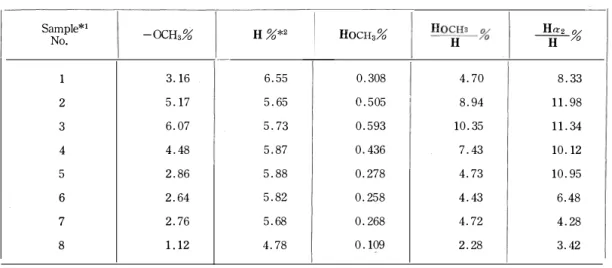
coal had a peak (ca. o -3.4 p.p.m.) which could be assigned to the methoxyl hydrogen. It was also reported that the NMR spectrum of lignin in its deutero-chloroform solution showed a dominant peak at 8 -3.8 p.p.m. which was assigned to the methoxyl hydrogen in lignin structure. 6) Thus to determine the peak of Ha:z in the NMR spectra of AC extracts, the methoxyl group in AC extracts was measured by the Zeisel method in this paper. The results are shown in Table 5) 2. Both values of the ratio HocH / H of methoxyl hydrogen to total hydrogen and Ha:2/H, obtained
Table 2. Analysis of methoxyl group in pyridine extracts
Sample*1 No. 1
-OCHa%
3.16I H%*2 6.55 I HOCH3% 0.308
I
2 5.17 5.65 0.505 I
3 6.07 5.73 0.593
4 4.48 5.87 0.436
5 2.86 5.88 0.278
6 2.64 5.82 0.258
7 2.76 5.68 0.268
8 1. 12 4.78 0.109
*1 Numbers of samples correspond to the respective numbers in Table I.
*2 'Revised total hydrogen.
HOC!i'__% H _!!_a:_g_% H
4.70
I
8.338.94 11.98
10.35 11.34
7.43 10.12
4.73 10.95
4.43 6.48
4.72 4.28
2.28 3.42
by the Zeisel method and from the NMR spectral analysis, showed a considerably good agreement, as shown in the last two columns of Table 2. Furthermore, the demethylated extract, after
determining methoxyl group in the AC extract No. 4 (200°C, 40 hr.) by the Zeisel method, was redissolved into pyridine and examined by the NMR spectrometer. Whereupon the peak Ha:z
disappeared from the NMR spectrum of the demethylated extract (10%)-pyridine solution. This NMR spectrum is shown in Fig. 2.
From the experimental results above described, the peak at o=-3. 7 p.p.m. appearing in the NMR spectra of Submerged Wood extract and AC extracts could be assigned to the methoxyl
hydrogen in their structure.
Mean structure of pyridine extracts of Submerged Wood and artificial wals In the studies of coal structure Brown & Ladner introduced three structural parameters based upon lb) the contents of the different types of hydrogen atoms obtained from the NMR spectrum, and
data on the ultimate analysis.
.2. D
f./"At.
.Fi_�.2 NMR �pectra of demethylated sample (200°C, 40hr.)
43 These three structurai parameters are fa (carbon aromaticity) ,o- (the measure of the substitution of the aromatic system) and Hau/ Ca(the atomic hydrogen-to-carbon ratio of the hypothetica 1 unsubstituted aromatic material). Takeya et al. proposed another structural parameter Ro/H.r (length of aliphatic C-chain attached to the aromatic system) for the analysis of the structure of
0 0 �
pyndme extracts from Japanese coals.
In this paper the four structural paramenters above described were adopted for the analysis of the structure of pyridine extracts from Submerged Wood and artificial coals.
To obtain the hydrogen distribution of the AC extracts, the chemical shift of their phenolic qhydrogen in the NMR spectra should be examined firstly. In the NMR spectra shown in Fig. 1 te peak to be assigned to the ph·�n:Jlic hydrogen did mt appear in th� entire range from the tetramethyl silan� p�::�k to 8 = -8.5 p.p.m. It h::ts b:oen confirmed that the resonance peak fo' phenolic hydrogen of phenol and a-naphthol in pyridine solution appeared at a far lower position of the applied magnetic field than D=-8. 7 p.p.m. 3)
It was als:J reported that the content of hydroxyl oxygen in pyridine extracts from natural coals was about 60 percent of the total oxygen. Accordingly, to determine the hydrogen distribution 3) from the peak intensities in NMR spectra of AC extracts, the total hydrogen must be revised by the deduction of the hydroxyl hydrogen calculated with the hydroxyl oxygen. Assuming that the hydroxyl oxygen of AC extract is 60 percent of its total oxygen, the quantitative hydrogen distri
bution of the AC extract may be calculated from the respective NMR peak area by using the revised total hydrogen. The results and the atomic ratio are shown in Table 3.
Table 3. Atomic ratio and hydrogen distribution of pyridine extracts
Sample*'
No.
1:-c;'"] mt�/11_1-H.-;-H --�
--11-:;H�_) l�;a:�i'ib_r�o
n Ho/H-r H a
iHa
l *-;-I
�
1.
: :
0�
63711
,,.!: :::
-: :::
�::: : --:::n- : :: - : ��
2 3 4 5 6 7
o. 236 o. 323 o.185 o.113 I o. 3 7 8 o. 478
1.060 0.215
1.106 1.133 1.201
0.178 0.17 0 0.146
0.321 0.340 0.328 0.1;25
0.229 0.294 0.330 0.304
0.101 I
0.110 0.065 0.043
__
_ s _____
_
l.
�
2�
----o��
l-�
· 3,12 _,_ __ o_. 35�
----o �034*1 Numbers of samples corresp::md to the respective numbers in Table 1.
*2 Hal ; Aliphatic hydrogen atom.
0.349 0.256 0.2T7 0.:2:28 I 0.271
0.4 7 2 0.515 0.488 0.740 0.520
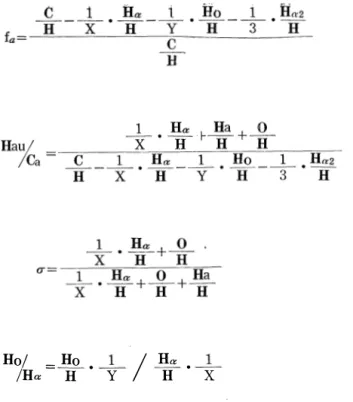
The existence of methoxyl groups in the AC extracts is evident in Table 2 and Ha2 in the NMR spectre could be assigned to the methoxyl hydrogen. Accordingly, the structural parameter of fa and Hau/Ca according to Brown and Ladner were modified by adding the new term Ha2/H (for the methoxyl hydrogen) to the Brown's relation. The four structural parameters thus derived for the AC extracts: fa, Hau/Ca, and Ho jH., are as follows :
Hauj /Ca
Ho// Ha H = Ho • _Y 1_
/
Ha H • _X 1_In the derivation of the above four parameters, nitrogen and sulfur in artificial coal constituents have been disregarded. Furthermore, two assumptions were made regarding the constitution of AC extracts: (1) all oxygen elements are attached directly to the aromatic systems; i.e., practically all oxygen occurs in the form of phenolic hydroxyl, methoxyl and quinone groups, and (2) the aromatic rings are not directly linked by a C-C bond. !b) A realistic value for x and y in Brown's
!b)
relations appears to be close to 2, as Brown and Ladner have stated. The values of structural parameters are given in Table 4. The aromatic hydrogen to aliphatic hydrogen ratios of AC extracts are also given in Table 3.
Table 4. Structural parameters of pyridine extracts
Sa mp e 1 * fa 0" Hau/Ca Ho/Ha
No.
1 0.602
I
0.566 0.90 2.52 0.676 0.557 0.86 2.4
3 0.701 0.504 0.87 2.0
4 0.695 0.507 0.88 1.5
5 0.718 0.488 0.84 0.9
6 0.713 0.506 0.82 0.8
7 0.767 0.412 0.79 0.8
8 0.774 0.513 0.64 0.8
-
* Numbers of samples correspond to the respective numbers in Table 1.
As the value of Hau/Ca was about 0. 9 in the pyridine extracts (No. 1 -No. 4), 0. 8 in the pyridine extracts (No. 5 -No. 7 ) and 0. 6 in the pyridine extract No. 8, the number of arorratic condensed rings might be estimated 1-2 rings in the extracts (No. 1-No. 4), 2 rings in the extracts (No. 5-No. 7 ) and 5 rings in the extract No. 8, based upon the comparison with the calculated values of Hau/Ca of various pure aromatic substances. Number of carbon atoms (N) in the aliphatic C-chains directly attached to the aromatic system can be calculated on the basis of the following relation : 3)
N = (Ho/Hrr) + 1
Accordingly, the number N is estimated at 4-3 in the extracts (No. 1-No. 2), 3-2 in the extracts (No. 3-No. 4) and about 2 in the extracts (No. 5-No.8).
1)
References a) D.W. van Krevelen, "Coal", Elsevier, and N. Sheppard, Fuel, 39, 79-R7 (1960) (1961) ; 43, 177 (1962)
Amsterdam (1961) pp. 387-393 b) J.K. Brown, W.R. Ladner c) J.F.M. Oth and H. Tschamler, Brennstoff.Chemie., 42, 378
2) H. Tsukashima, J. Chern. Soc. Japan, Ind. Chern. Sec. 57, 69(1954); This Bulletin 5, 54 (1954) ; 7, 39 (1956) 8, 22 (1957) ; 9, 34 (1958) ; 11, 41 (1960) ; 13,41 (1962). The 7th, 9th, lOth, 11 th, 12th, 13th, 15th, and 17th Annual Meeting of the Chemical Society of Japan, Tokyo or Kyoto, April, 1954, 1956, 1957, 1958, 1959, 1960, 1962, 1964; Coal Utilization Technical Congress of Japan, Tokyo, November, 1959
3) Gen Takeya et al., Bulletin Chem. Soc. Japan, 36, 1222 (1963) ;Bulletin Facul. Eng. Hokkaido Univ. 35 , 129 (1964) ; The 1st Coal Science Congress, Tokyo, Nov. (1964)
4) A. Halleux and H. de. Greef, Fuel, 42, 185 (1963)
5) S. Zeisel, Monatsh., 6, 989, (1885) ; M.J. Stritar, Z. Analyt. Chern., 4
,
579 (1903); N. Migita, Experimental Method of Pulp and paper Manufacture Industry, pp. 148-153 (1950, Kyoritsu-shuppan)6) D.E. Bland, Nature, 196, 985 (1962) (Received, 30,0ct,, 1964)
1)
iト
2)一一一一一一一一一一一一一一一一一一ー一一一
A Study of the Strucモ'lr今 ηゃ pyr・ldj_円@ 可文セra. crt
s
from一一一一一一 一一一一一一
Submerεed Vlood and Ar七L�tc'181
coa
1s
':y High Resolutlon Nuo1ear Magηetlc Resona�ce Sp符otrosaopy.(39-45 P.)一一一一一一←
魚体埋没特による石ì6t ff:行什民間ずる治;: �l�
富山県魚悼埋没林の,!��因につWて(ι6 -- 5f/.. P. )
頁 位 事4 正
40 . 5
一一一一
40 閣 内
ト一一一一一一ー←
40 圃1坦
43
+
2ト一一一一一一一
43 + ろ
一 一一←ー←ー
43 + 9
43 +11
」一一一
44 Tab1s
4
45 - 1
ト一一一一一一一 一←一一一一
46 ・・ r, γ 46 -1 8
46 四18
46 -20
46 -20
46 -23
46 輔24
46 -26
4ワ 図 -3
Of
一一一一一一一一一一一
were
一一ー『一一一一
ijn切r'n9.1 hypothetioa 1
一一一一一一一一一
8na1ysiS
一一一一一 一一一一一一一一一 一一一一 一一一
yhァd明ogen fo'
ftl.
トーー
30,Oc七, ,
1"1"11 守r_:r1ooding of"' 七he rlver.
e9'ヲ令ms recen
aco七ivlty B. P.
七be七ween hemlca1 recn七
縄文後期来土器
('11'"
一一一一一一一一 一
Y今1"e
in十合r'n-3.1
一-__.‘ 』
ーー・ 『 ー一一一一,一司ー
hマつothet1oel
一一一
全戸.戸1Y91翁
ー一一一 『一一一一
hでdrogen f'o1"
ずι
一、 ー,一.
一一一一一 一一一一
一一守Fー守 守一・ 副『
一一
一 一 一 一一一一一一
一一一一一ー一一一
30,00七. ,
ト一 一一一
一一一一一一一一
一一r1ver flood.
8eems
一一一←一一
reeent
←一一一一一一一一一一一
ac七ivity B.P.
betw弓en ohemloa1
ト一一
r・90ent
一一一一
一一一 一一
一一一一一一一一一一一一
縄文後嗣末土器 位置欄の+は上から、 ーは下からの行をあらわす。
.
NO 3;' I コピー岡韓