マイクロクレジット利用者の変容:
バングラデシュ現地調査による考察
The Transfiguration of Micro–credit Users as Observed from Field Research in Bangladesh *
倉沢 宰
KURASAWA Sai (SYED M. Murtuza)
Abstract:
This paper presents some salient points from the field–research and case studies and done in Bangladesh villages through several visits between August 2012 and September 2013. The cases for study were identified and selected in reference to a previous study done under the initiative of JBIC (Japan Bank for International Cooperation) in 2001.
Besides a broad–based survey, a major objective of the present study was to find and explore changes occurring among the micro–credit users during the passage of time between the earlier study and the present study. Thus, approximately a period of about a quarter of century could be scrutinized by referring to the records of the earlier study.
Special efforts were made to interview the same case studies recorded in the earlier survey mentioned above, and examine the state of alleviation from poverty of the individual cases over the period of time. In all, twelve case studies from two villages lying in two different regions, one in Bogra District and another in Comilla District, were selected for detailed examination.
Poverty has many causes and is a multifaceted phenomenon. The cases studied were all uniquely different, each family trying in its own way to wriggle out of poverty. There are cases of success and cases of failure.
The causes are also multifarious. With only a few cases studied during the survey, obviously it is beyond the scope of this paper to reach definite conclusions. However, some analytical observations about individual cases, and concurrent general observations are highlighted in this paper as some significant findings of the case studies.
Key–words: Micro–credit or micro–finance, weekly repayment install- ments, micro–savings, income–generating activities, default, overlapping loans.
Note: The terms micro–credit and micro–finance are often used equiva- lently although there is some debate on nuance of the two terms.
This paper, avoiding the debate, conforms by and large to using
“micro–credit” from the standpoint of the clientele using the loans.
* This paper is a partial report from the Research Project on "Microfinance and Poverty Alleviation in Bangladesh" which was funded by Monkasho Kakenhi (Grants–in–Aid for Scientific Research) Kiban B Overseas, No.23402050
1. Introduction
Micro–credit was introduced in Bangladesh in the late–1970s and Bangladesh is often considered as “one of the most advanced countries in the field of microfinance”.
Today, the Grameen Bank is the largest micro–credit provider in rural Bangladesh with a total membership of 8.4 million borrowers (1). However, there are several other large institutes, like the BRAC (2), ASA (3), PKSF (4), that also provide micro–credit. Besides these, there are other NGOs, domestic and foreign, that also provide non–collateral micro–loans in Bangladesh. The total number reaches more than 26 million borrowers and a huge amount of money (see Table 4 at the appendix).
The poor people in Bangladesh were beyond the reach of the conventional banking system and were usually excluded from formal sector financial services. The collateral requirement to receive a loan was often the main reasons for the exclusion. So the poor people had to depend on informal sources, especially private moneylenders who in most cases charged exorbitant interest rates for providing loans. Being poor they were exploited, and did not have access to capital at reasonable interest rates to invest into income generating activities and improve their own conditions through their own efforts.
New mechanisms (Grameen Bank being the pioneer) were devised to provide non– collateral micro–credit services to poor households, especially in rural areas. Instead of collateral, emphasis was placed on group membership, providing loans at the doorstep of the recipients, strict discipline in providing credit and collecting repayments, weekly or biweekly installments of tiny amounts for loan repayment, mandatory savings, regular group meetings and marginal supervision of the borrower’s activities in the micro–credit system. Women were particularly targeted since they were least eligible to get loans from formal sectors.
With the progress of micro–credit services available formally for more than three decades, and covering a large section of rural populace, reactions from various circles about the impact of micro–credit on alleviation of poverty are multifarious and multipo- lar. Some empirical studies emphasize the positive impacts of micro–credit on poverty
reduction and other relevant outcome variables at the household level [see for example, Hossain Mahabub (1988), Hossain Muazzam (1998), Khandker (1998; 2003)].
Some critics, however, question the ability of micro–credit in reaching the poorest section of the people. They argue that micro–credit is effective for the poor in general, but it is not effective for the poorest of the poor [for example, Datta (2004), Montgomery and Weiss (2005), Scully (2000), Fujita (2005)]. Others argue that “the bulk of micro– credit is borrowed for non–productive purposes, for consumption and debt repayment”.
They also mention that the “average return on investment is not enough even to cover the most minimum or tolerance level of wages for family labors, let alone paying any interest and making any profit after keeping aside the principal” (Molla, and et.al., 2008). Further, with the increase of multiple providers of loan, there are concerns about overlapping loans and increase of burden for repayment [Abdullah and Jalal Uddin (2013), Yuge (2011)]. Professor Abul Barkat, a renowned economist in Bangladesh is also a strong critic of micro–credit (direct interview with the researcher in August 2010).
(1) Research Plan:
It was, therefore, considered important to conduct a large scale survey and a small scale specific case studies in the same villages examined about a decade ago under the initiative of Japan Bank for International Cooperation (JBIC) in 2001. (5) Besides evaluating the general conditions and comparing micro–credit users with the non–user but micro–credit eligible group, an important objective of the present study is to explore and identify changes occurring among the recipients of micro–credit, and their efforts toward alleviating poverty between the time of previous survey conducted in 2001 and the current one conducted in 2013–14.
A two–stage sampling technique was applied. In the first stage, a census of the whole village was conducted. Using the data, households that were participating in a micro– credit program and the households that were eligible but not participating in micro– credit program were identified. In the second stage, a detailed survey of the households in both groups was conducted to examine and compare the socio–economic and welfare level of the two groups. In addition to the survey, a number of detailed and comprehen- sive case studies were conducted separately to observe the struggling pattern of each household and their efforts toward alleviation from poverty.
The quantitative survey assesses statistically the impacts of micro–credit program participation on different households through selected welfare indictors, namely, yearly household income, education expenditure, medical expenditure, types of medical advice received, total household living space, quality of roof (6), quality of side walls, ownership of consumer durables, food security, having a bank account, and subjective poverty (as perceived by the respective respondent). The results were then compared with the non– participatory but micro–credit eligible group, and the significance or the influence of religious bias if any.
It is beyond the scope of the present paper to record details of the statistical survey.
However, it may suffice to mention here that the micro–credit participatory group in general showed a better condition or state of existence in numerical terms when com- pared to the non–participatory group. The women of micro–credit program households were more aware of their household incomes and had a stronger decision–making ability when compared to the non–participatory group. The results also indicate that micro– credit program participation reduces the subjective poverty of participating households significantly after controlling for other factors that also influence the subjective poverty status of households. The religious affinity per se did not show a significant influence on the decision whether or not to participate in micro–credit program, although it is often argued that people with strong religious affinity may avoid using institutional micro– credit, because the transactions are interest based. Islam, for example, prohibits interest.
The result of the statistical survey has been compiled in a separate report.
As stated above, this paper presents some results from the case studies conducted in two different villages in Bangladesh to explore and identify changes occurring among the users of micro–credit, and their efforts toward alleviating poverty during the decade between the earlier survey of 2001 and the present survey. Approximately a period of about a quarter of century could be examined by referring to the records of the earlier study.
2. Case study samples (1)Location of Villages:
The survey villages (see the maps below) were selected from two different regions, Maps of Bogra and Comilla Districts and location ( ★ ) of selected villages
(Source: https://www.google.co.jp/search?q=district+map+bangladesh&rlz=1C2FLDB_enJP556JP556&biw=
1171&bih=836&tbm=isch&tbo=u&source=univ&sa=X&sqi=2&ved=0CB4QsARqFQoTCPaC6tjl0sgCFYMTlAo dakUBrw)
one from Bogra District in the north, and the other from Comilla District in the south– east. Bogra is situated about 205km from Dhaka in the northwest, and the village is located at about 11km south of the Bogra town, the district headquarters. A paved trunk road runs nearby the village. The village has a primary school and a madrasa (Islamic religious school) for children.
Comilla is situated at about 100km from Dhaka in the southeast, and the village is located at about 22km to the northwest of Comilla town. A paved major road runs nearby the village. However, the gravel and mud road leading into the village was in poor condition with large potholes here and there, usually forming during the rainy season.
The village has electricity, a primary school and a madrasa for children. It also has access to the market in Companiganj (a regional business hub) at a distance of about two kilometers and a hospital at about one kilometer from the village.
As stated above, the target villages were identified and selected following an earlier study conducted by JBIC in 2001. These villages were situated near the trunk roads and had easy access to the regional business hubs. As acknowledged in the earlier study as well, because of their proximity to the major roads and business hub, the villages perhaps were not a cross section of more isolated villages in Bangladesh. However, since the present study intended to explore the changes occurring after a time lapse of more than a decade by comparing the findings of the present study with those of the previous study, it was considered useful to conduct survey in the same villages.
Due to political turmoil and frequent general strikes (hartals) in 2013, the plans for study of a third village in Barisal District (situated in the southern riverine area of Bangladesh) had to be cancelled, further limiting the scope of incorporating more varieties of villages for study.
(2) The Samples:
While selecting samples for the case studies, special efforts were made to locate and interview the same samples and respondents from the previous JBIC study of 2001; a few new cases were also interviewed.
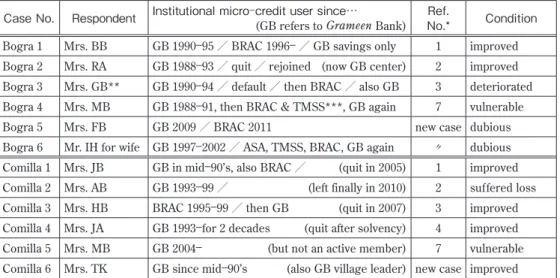
The case studies were conducted during several visits between August 2012 and September 2013 with the researcher visiting each household and talking directly with the respondent. As the table below shows, all the respondents were female except in one case where the husband replied to the questions due to his wife’s absence. Table 1 shows the list of samples.
(3) Some Salient Characteristics:
Most of the respondents in the case studies (as Table 1 indicates) had been using institutional micro–credit for almost three decades, since the 1990s, with only two exceptions. One joined in 2004 (but was inactive now due to her inability to repay the weekly or biweekly installments) and the other (a new case) joined in 2009. Most cases
joined multiple micro–credit institutions, the Grameen Bank and the BRAC being the most common, and often borrow alternatively or sometimes simultaneously from several sources.
Regarding their overall economic condition as compared to the previous study, six cases showed remarkable improvement; two cases were economically highly vulnerable due to particular circumstances, for example, husband’s death and living alone at advanced age (Bogra case 3), or husband’s chronic illness for the last 18 years (Comilla case 5), two cases (e.g., Bogra case 4, and Comilla case 2) showed an economically deteriorated situation or loss of property, and two other cases (e.g., Bogra cases 5 and 6) showed somewhat dubious and risky status because of a diversion of large amounts of loan (ref., Table 3) for non–economic purposes (marriage expenses, or house repair) without feasible plans for repayment.
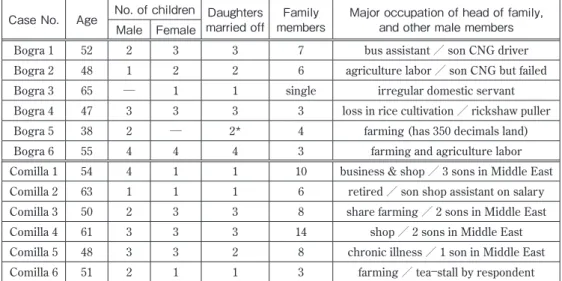
Most of the respondents were late middle aged. They on average had four to six children and most of them had married off their daughters (see Table 2). Many cases lived with their sons, who were married, as extended or joint family. All respondents, except one (Bogra case 3), were living on their own homestead. Some had expanded their homestead and rebuilt their houses. One respondent (Comilla case 4) planned and by purchasing additional land built separate houses on the same compound for all three of her sons who after their marriages were living together as a large joint family.
With two exceptions (namely, Bogra case 4, whose situation had actually deteriorated;
and Comilla case 2 who had suffered loss), all other cases emphasized that by joining the micro–credit program they could achieve a better living condition. They all had start- ed with initially receiving only a small loan of, say, 2,000 Takas. But now some of them are able to borrow much larger amounts of, say, ten times or even more (see Table 3).
Table 1: Respondent, starting year of micro–credit membership, present condition Case No. Respondent Institutional micro–credit user since…
(GB refers to Grameen Bank) Ref.
No.* Condition Bogra 1 Mrs. BB GB 1990–95/BRAC 1996–/GB savings only 1 improved Bogra 2 Mrs. RA GB 1988–93/quit/rejoined (now GB center) 2 improved Bogra 3 Mrs. GB** GB 1990–94/default/then BRAC/also GB 3 deteriorated Bogra 4 Mrs. MB GB 1988–91, then BRAC & TMSS***, GB again 7 vulnerable
Bogra 5 Mrs. FB GB 2009/BRAC 2011 new case dubious
Bogra 6 Mr. IH for wife GB 1997–2002/ASA, TMSS, BRAC, GB again 〃 dubious Comilla 1 Mrs. JB GB in mid–90’s, also BRAC/ (quit in 2005) 1 improved Comilla 2 Mrs. AB GB 1993–99/ (left finally in 2010) 2 suffered loss Comilla 3 Mrs. HB BRAC 1995–99/then GB (quit in 2007) 3 improved Comilla 4 Mrs. JA GB 1993–for 2 decades (quit after solvency) 4 improved Comilla 5 Mrs. MB GB 2004– (but not an active member) 7 vulnerable Comilla 6 Mrs. TK GB since mid–90’s (also GB village leader) new case improved Note: To protect the privacy of the respondents only initials are used here. *Ref. No. refers to the case studies of the earlier study completed in 2001. ** widow, *** TMSS (Thengamara Mohila Sabuj Sangha) is an NGO engaged in socio–economic development effort at the grassroots level for women.
In addition to agriculture (farming and agriculture labor or both), rickshaw (a tricycle passenger carrier) puller, CNG (three wheeled motorized vehicle, also called “baby– taxi”) driver, bus assistant, shop assistant, running grocery store, etc., were the main occupations of the head of the family or other male members in the family (see Table 2). The women mostly remained and worked at home.
Loans were often used to support economic activities of the male members or cover other sporadic expenditures, including medical costs and marriage expenses (see Table 3). Raising cows, goats and poultry were adopted by some female members to supplement family income. Some families, especially in the Comilla area, used money Table 2: Age of respondent, number of children, present family members, major
occupation of head of family and other adult male member in the family Case No. Age No. of children Daughters
married off Family
members Major occupation of head of family, and other male members Male Female
Bogra 1 52 2 3 3 7 bus assistant/son CNG driver
Bogra 2 48 1 2 2 6 agriculture labor/son CNG but failed
Bogra 3 65 ─ 1 1 single irregular domestic servant
Bogra 4 47 3 3 3 3 loss in rice cultivation/rickshaw puller
Bogra 5 38 2 ─ 2* 4 farming (has 350 decimals land)
Bogra 6 55 4 4 4 3 farming and agriculture labor
Comilla 1 54 4 1 1 10 business & shop/3 sons in Middle East
Comilla 2 63 1 1 1 6 retired/son shop assistant on salary
Comilla 3 50 2 3 3 8 share farming/2 sons in Middle East
Comilla 4 61 3 3 3 14 shop/2 sons in Middle East
Comilla 5 48 3 3 2 8 chronic illness/1 son in Middle East
Comilla 6 51 2 1 1 3 farming/tea–stall by respondent
Note: All respondents except one (Bogra case 5) are grand–mothers now. *marriage of step–daughters (The age of respondents are mostly approximates. The family members account present size)
Table 3: Recent Loan amount, source and utilization Case No. Loan amount, source, and used for➸…
Bogra 1 50,000 from MCI➸bought CNG; 20,000 from BRAC & 20,000 from mohajon➸for marriage Bogra 2 8,000 from GB➸to rent rice field and to prepare for rice plantation/ …almost a restart Bogra 3 Loan of about 1,000 Taka/sold homestead at 20,000 Taka to pay for husband’s treatment Bogra 4 21,000 from GB & 45,000 from informal source➸built house for daughter/loss in farming Bogra 5 10,000 from GB & 12,000 from BRAC➸to pay marriage expense loans/priority for housing Bogra 6 39,000 from several sources➸for marriage expenses//would take loan when necessary Comilla 1 Now uses commercial bank. Deposit 188,000 Taka, bank loan 180,000 Taka➸for business Comilla 2 Repeated loss from investments in cow rearing. Had to sell land. Finally withdrew from MC Comilla 3 Good income from agriculture, 3 milking cows, overseas remittance. Left MC 8 years ago.
Comilla 4 Started with raising cows and agriculture. Now owns land, shop, etc. Left MC after solvency.
Comilla 5 Husband chronically ill. Spent 250,000 Taka for son’s travel. Sold land to raise money.
Comilla 6 No specific loan at present. She is running a tea–stall in the village. GB center leader.
Note: Mohajon refers to merchant and also private and informal money lender.
raised from various sources to send family members to work overseas. Sending male members to the Middle East for employment is more common in the Comilla area.
Overseas remittances have allowed families to improve their living conditions. But in the absence of concrete plans after return, many of them go overseas again.
A research report by Matsui and Ikemoto (2013) divides the rural poor in Bangladesh into three categories: moving out of poverty, demoted into poverty, and chronically poor.
Their research finds the average debt of each category as follows: Taka 32,000 for the non–poor group, Taka 16,000 for the poor but moving out of poverty group, as well as those who are entrapped into poverty, and Taka 7,000 for the chronically poor group (see Table 5 in the appendix).
Our case studies though not categorically defining poverty and sub–categories of the poor strata as devised by Matsui and Ikemoto, broadly conforms to the pattern that those who are well–off utilize higher amounts of loan than those who are not.
Uncertainty over kisti (weekly repayment of loan) creates an inconvenience when taking out loan. Details are discussed below.
3. A Glimpse of Individual Cases:
(1) Bogra Case Studies
Case No. 1: BB was very poor before joining the micro–credit program. She had to work as a domestic servant. She first joined Grameen Bank (GB) in 1990 and took out several loans, spending the money mostly on the four decimals of land she bought to build a house. Kisti were paid from her husband’s income who was working as a bus assistant. She had a quarrel with some members and left GB. She then joined BRAC in 1996 where she now serves as a long–standing leader. BB continuously improved her condition. She felt hesitant to give the details although some said that she lend out smaller loans to others. She now owns eight decimal of homestead and has built a new house fitted with electricity. She was using electric fans, still a rarity in her village.
Being better–off, BB has become more conscious of her social standing. She observes the common social practice of “receiving and giving” (len–den, as she called it) common in rural Bangladesh. She has also spent large amount of money on the marriages of her daughters and considers it befitting to her status. During important festivals or visits to or by her daughters or in–laws, she now prepares gifts for them, even if she may have to borrow money for to do this.
From being a domestic servant, about which she feels hesitant to discuss in front of others, she now owns a CNG (bought with a micro–credit entrepreneur loan), which is run by her son. This brings a healthy income to the family. Her present outstanding loans are, 50,000 Taka taken from MCI (to buy the CNG); 20,000 from BRAC & 20,000 from a private money lender (to disburse marriage expenses). She is a very vocal and intelligent lady. Her strong complaint concerning micro–credit was the high interest
rate and the penalty of 11 Taka per week for each 100 Taka levied in the case of payment default of the Kisti.
Case No. 2: Mrs. RA joined Grameen Bank in 1988. She had some experience in cow rearing as a domestic help for wealthy villagers, so she bought a cow using micro– credit and over the years raised 17 cows born from this one. She also took out loans for her husband’s rice–cultivation and rice husking trade. She left GB after a quarrel with the official, but returned. Now the GB village meetings are held at her house. She has expanded the homestead and rebuilt the house. She was landless before and possessed no valuable assets. Now she has a two Bigha (equivalent to 0.66 acres) leased–in rice field, a 14 decimal homestead land, one cow, two calves, ten chickens and five ducks.
Eggs are used for both family consumption and as a source of income procurement.
Recently she had invested a large amount of money from her savings and borrowings to buy a CNG and run by her married son with whom she lives. But the venture failed because the son was not diligent enough and she had to sell the CNG incurring a loss of 30,000 Taka. She now makes handicraft works along with her daughter–in–law and earns about 2,000 Taka each month from this domestic venture. Presently she has an outstanding loan of 8,000 Taka and a small savings of 600 Taka with the Grameen Bank.
Recently she has joined the DPS (Deposit Premium Scheme of BRAC Bank, a special savings plan that allows saving on a monthly basis which gains a handsome amount at maturity) and started one year ago making monthly deposits of 100 Taka. After losing her savings in the CNG venture, this has been almost a restart for her.
Case No. 3: She is about 65 years old and lost her husband recently who was about 75 years old and had been sick for about a year. She had become a member of Grameen Bank in 1990, taking loans consecutively to raise a cow, buy tin–sheets to repair the roof, and the proxy loans for her sister–in–law and daughter. But then after taking a seasonal loan she defaulted for several weeks in paying the kisti and had to leave GB after adjusting the outstanding loans from her savings with GB.
Later she joined BRAC and gradually improved her financial situation by raising chickens. From her profits she had bought one decimal of land as homestead from her sister–in–law. But then, her husband became weak due to advanced age, and she had to take care of him and pay his medical expenses. She sold her homestead to her sister–in– law to cover the medical costs. She also paid the costs for his burial declining financial help by her neighbors. Her sister–in–law, who lives nearby, has allowed her to continue living in the house.
She wants to live by herself, instead of living with her daughter (her only child, married off and living in another village), although her income is rather limited and irregular. Once she tried raising goats and had eight goats; but failed when they all died. She works as a domestic help for wall repairs (laying mud coating on wall). With
advancing age she is uncertain about the future.
She gets some rice from her brother, living in the neighboring village, who cultivates land inherited from their father. She also has some loans as well as saving with TMSS (see notes in Table 2). Because of the death of her husband, TMSS most likely will write off her loans and she may receive about 1,700 Taka of her savings. She says joining micro–credit has improved her life. At least she can now wear cloths easily and has several sari. She hopes not to have to beg from any one and live by herself. She yearns for an independent life.
Case No. 4: Mrs. MB has been in and out of three different micro–credit institutions, joining first Grameen Bank (possibly in 1988 for three years), then BRAC, and then TMSS. She had invested in rice cultivation. However, she has not been able to improve her economic condition.
She had suffered from several unfortunate events beyond her control, namely, the illness of her husband, losses incurred in rice cultivation due to heavy rainfall, and then unexpected price fall for post–harvested rice in the following year. These created hard- ships leading to her failure as a micro–credit user and a decline in her living conditions.
She frequently changed micro–credit institutions and incurred losses, including her savings. Her husband is a rickshaw–puller and also works as a farm laborer. She works as a domestic help in the village whenever she can find employment. Her youngest son (who is 12 years old) is sent out to live as a domestic servant in Bogra town.
Absence of infrastructure, including storage facilities for crops for later sale and better marketing access, makes micro–credit users vulnerable for selling their produce.
Lack of experience in rice cultivation and absence of alternative advice for safer income generating investment also creates hardships.
Mrs. MB has taken out another loan, which is quite high at 20,000 Taka from GB and 45,000 Taka from informal sources. This she invested in a bigger homestead where she built a house. She calls it “unnoti” or improvement. In the absence of necessary financial services, micro–credit provides the poor some leverage to improve their immediate environs. Without concrete plans for repayment, she claims, being poor they have no alternative but to work hard and repay kisti from their meagre income. Her situation is obviously highly vulnerable.
Case No. 5: This is a new case added for this study. The respondent is a relatively younger participant of the MC program, joining the Grameen Bank in 2009 and the BRAC from the last two years. Her husband is a “ghor–jamai” (married into her family as an adopted son–in–law). She owns 350 decimals (about 1.4 hectare) of land that is in her name, and cultivated by her husband. Under the Grameen Bank’s initial criteria of land- less poor to be eligible for micro–credit, she may not have qualified for receiving loans form GB. But now she is a member of both the Grameen Bank and the BRAC. Micro–
credit institutions evidently have started providing loans to a wider range of clientele.
She took out loans of 10,000 Taka from GB and 12,000 Taka from BRAC to pay for the marriages of her two step–daughters. With non–productive use of the loans she is burdened now to pay weekly kisti from the meagre earnings of the family. But she acknowledged that the availability of micro–credit was beneficial for her. She could arrange good marriages for the daughters and also rebuild her house. She sometimes gets rice aid from the Union office. She has no particular idea for income generating activities.
Her preference for a future loan is to improve her housing, erecting walls for more privacy, installing a latrine and a tube–well. She said BRAC provided concrete slabs for toilet free of charge. And a five year loan at flexible kisti is available from the Grameen Bank to install the tube well. Merely providing micro–credit does not necessarily, as evident in this case also, leads to income generating activities.
Case No. 6: This is also a new case added for this study. The respondent, Mr. IH, was the head of the family. He answered the interview because his wife was away visiting their daughter in another village. He informed that his wife had been a Grameen Bank member since 1997, but had dropped out for about ten years because they were unable to pay the weekly kisti. She rejoined MC to get loans for their daughters’marriages. She borrowed a total of 39,000 Taka (10,000 Taka from GB, 15,000 Taka from ASA, 8,000 Taka from TMSS, and 6,000 Taka from BRAC) that requires her to pay 1,025 Taka kisti weekly as repayment of these loans.
All loans were used to pay for the marriages of his daughters, one last year and the other daughter this year. Until two years ago he was without debt. He commented that they depended on micro–credit at times of need only. During prosperous times he would not take loans.
He owns 350 decimals of farm–land which he bought two years ago by selling the property of his deceased first wife located in another village. He is illiterate and works as a farmer for six months and as a day laborer for the other six months. His son from the second marriage, who is living together, is also illiterate and works as a farmer and a rickshaw–cart (a tricycle carrier for goods) driver.
The daily income of Mr. IH is between 150 and 250 Takas when he works as a day laborer. So the weekly payment of kisti is not easy for him. He said he would live on whatever he could earn. He is looking forward to his son’s income as well for repaying the loans. Besides cultivation, he has no other idea for increasing income through other feasible investments. According to him, villagers need institutional loans on flexible repayment scheme to rent–in and invest in agricultural land for cultivation. As he is getting old, he does not intend to take fresh loans in future.
(2) Comilla Case Studies
Case No. 1: Mrs. JB was a Grameen Bank member in mid–1990’s and joined BRAC in 2001. With BRAC she had two accounts, one under her own name and another under her daughter’s name. She borrowed loans (often multiple loans) and invested in her husband’s fruit shop. The business expanded improving her overall economic condition.
Her eldest son, working as a tailor in Chittagong, also earned well and brought money home. She spent 17,000 Taka for her son’s medical treatment, then bought land, and sent her sons to work in the Middle East.
She and her husband both were literate. They sent all their children to schools up to the secondary level. The education eventually gave them an advantage in their struggle toward economic development. Her eldest son, who has returned from Chittagong, now manages the business expanding it further to yarn business, mobile phone shop, fruit shop in the town and a grocery store in the village. Three of her sons are working in the Middle East sending a fair amount of money home. Instead of loans they could finance the costs for overseas travel by themselves.
She has left both GB and BRAC several years ago. She said it was not necessary to go every week to the BRAC meetings anymore. They now use the commercial bank. They live in a spacious “brick–and–cement” house which is considered a sign of economic prosperity in rural Bangladesh. The house is connected with electricity. Mahogany trees are planted around the homestead. She had planted them in 1990’s at the advice of GB official.
Case No. 2: Mrs. AB was a Grameen Bank member in 1993 and took out several loans.
The GB officials had told her that she could prosper if she reared cows. So, with her first loan from GB and adding her savings she bought a cow. After rearing it for several months the cow died. The GB official advised her to buy a cow again. But this cow too, died. She bought a total of five cows in her seven years of GB membership and all five cows died. She said, in those days, cow–rearing was more common. She had to repay the loans with her husband’s daily labor income, and her own income from knitting fishing nets, working as domestic help and ferrying clothes from door to door in the village.
The irresponsible advice from the Grameen Bank official to raise cows obviously had increased her debt and miseries. She finally left GB in 2010.
Mrs. AB and her husband have a daughter and a son. The daughter is married off.
The daughter’s husband was working in Saudi Arabia for eight years and came back home two years ago. For going to Saudi Arabia he had to spend a large amount of money taking out loan mostly from informal sources which were paid by his income. He could not save much. He is unemployed now and is trying to go overseas again either to Malaysia or Dubai. The daughter and her family are momentarily living at Mrs. AB’s house.
Mrs. AB said she was better off now compared to about ten years ago. The house
has been rebuilt at a cost of 20,000 Taka. She had an accumulated debt of 100,000 Taka which she repaid by selling two decimals of land. She does not have any savings now.
She had to spend about 100,000 Taka as medical expenses for her husband’s illness who was suffering from chronic heart disease and high blood pressure. He is about 75 years old.
Mrs. AB had sold 15 decimals of land to repay the debts and to cover expences for her daughter’s marriage. Mrs. AB and her family lives in a tin house built some years ago on the four decimals homestead they own. They also own 90 decimals of lease–in agricultural land on share cropping and grow rice by hiring labor. Her son is working as a shop assistant in the town and receives a salary of about 5,000 Taka monthly. Mrs. AB gets some eggs from the hens she is breeding and often sells them to supplement the family income. She is economically somewhat solvent now, but she had to sell her land to clear the debts.
Case No. 3: Mrs. HB was a BRAC member during 1995–99. She became a Grameen Bank member also, but left GB in 2007 because of a change of the group leader. She had invested the first loan she took in her husband’s jackfruit trade, but incurred loss because a boatload of the fruits was spoiled due to a continuous hartal (wide–scale general strike) and stoppage of the transport. Her second loan was used to finance her husband’s travel to Saudi Arabia for work. Besides BRAC, she had borrowed from informal sectors also to cover the expenses.
With her third loan she bought a cross–breed Jersey cow. But the cow died. Her fourth loan was used to pay interest for debts from the informal sectors. She could, however, repay the entire principal amount within a year from the remittance by her husband. To send her husband to Saudi Arabia a second time after the initial four years he worked there (because he could not find a stable income source after repatriation) she sold 15 decimals of land to cover the expenses. Her husband has returned home after working in Saudi Arabia for ten years and now is looking after agriculture. Her two sons are presently working in the Middle East.
The family owns 90 decimal of land on share cropping and an additional 60 decimal rent–in land for agriculture earning a fairly good income from farming. Presently they have a debt of 10,000 Taka as loans taken from the relatives and investing it for culti- vation (payment of wages, purchase of seed, irrigation, fertilizer, pesticide, etc.). They also own three milking cows producing 60kgs of milk a day, and eight ducks producing 50 eggs a month. The milk is sold to the middleman. The eggs are used for both family consumption and as a source of income procurement
She said she was much better now than she was before. The significant change came after her husband and later her sons started working in the Middle East. She could bor- row money from her brothers who were economically solvent. Now they live in a well– built tin house on a 10 decimal homestead. Both she and her husband have separate
savings of 12,000 Taka each at the private savings funds.
Case No. 4: Mrs. JA joined the Grameen Bank in 1993 and was its member for two decades. She continually improved her condition. She had invested the loans in several projects, first, cow rearing, and then buying land from the profits, building separate houses for her sons, starting homestead garden by planting mahogany trees and fruit trees around her house, agriculture by leasing the farm land, and running a stationary shop near the major road.
Mrs. JA had some education and calculated well. She brought up her sons with formal education and occupational training (tailoring, masonry, etc.) which allowed them to have better jobs. They are much better now. She has left micro–credit program after becoming economically solvent.
Now they have their own grocery store taken care by her husband. Two sons are working in the Middle East and send money regularly. The eldest son is a tailor working in Saudi Arabia and may establish his tailoring shop after coming back to Bangladesh.
The daughter–in–law is working as a dress maker. The second son is working in Oman.
They own 10 decimals of homestead and 36 decimals of agricultural land and 16 decimals of rented–out non–agricultural land providing fixed income from the rent. The youngest son is a masonry and earns well from his job. They have reconstructed their tin house replacing it with brick and cement house. The family lives as a joint family with all the sons living together as she had wished and planned accordingly by building separate dwellings for them on the common homestead.
Case No. 5: Mrs. MB joined Grameen Bank in 2004 but is not an active member because of her inability to pay kisti every week. Her husband is suffering from chronic illness from last 18 years. Because of his week condition, she has to remain in home and look after him. He cannot work anymore and his medical costs are 500 Taka per month.
They have six children. Two children were born after her husband became perma- nently weak to do any hard work. She and her husband, both being illiterate, did not give priority to send their children to school. When they were better–off, the children attended elementary schools. But after her husband’s illness, the younger children went to school for a shorter period or did not go to school at all. Two daughters are married off.
Mrs. MB lives in a tin house built 10 years ago by financial help from her brother who runs a grocery store in Chittagong. The homestead is inherited and belongs to her husband. Her eldest son is working in Dubai for the last two years, but still was not able to get a good job. She had to spend 250,000 Taka to send him overseas. She sold 15 dec- imals of land to raise the money. The second son is at home working as an agriculture labor. The third daughter is also at home helping household chores. The parents are worried about her marriage since she has reached marriageable age. The youngest son
is living at his uncle’s home.
Over the recent years her situation has deteriorated further. With her husband’s ill- ness and no stable income, she feels perplexed and helpless. She has high expectations towards her son in Dubai as a major source of rescue from the present situation.
Case No. 6: This is a new case added for this study. Mrs.TK joined Grameen Bank in mid–1990s and is serving as its village leader from last 15 years. With the loans taking from GB she opened a tea–stall in the village about 10 years ago. She runs it by herself serving tea to the customers and earns a stable income from the venture. She said she did not face any strong opposition from conservative religious circle in the village while opening the tea–stall and operating it herself. Islam, for example, puts emphasis on seclusion of women or purdah as it is called in Bangladesh.
Besides the Grameen Bank, BRAC, and ASA offering micro–credit in the village, an NGO called “Nijera Kori” which means “we do it ourselves” is also operating in the village. Nijera Kori is a unique advocacy and awareness building movement working in rural areas in Bangladesh through organizational and collective mobilization towards claiming rights and achieving changes.
Her husband and her son farm together on a three Kani (equivalent to about five acres) agriculture land which they have rented–in by using micro–credit available from ASA. Her son had taken out loan from Grameen Bank through her for his self–use, which she has already repaid. She said she is much better–off now compared to 10 or 15 years ago. Now they can finance the cost for agriculture by themselves.
4. General Observation:
We may summarize findings of the case studies as having revealed the following trends:
Causes of failure
Illiteracy, lack of idea for income generating investment Irresponsible advice from MC providers
Uncontrollable factors, like illness, crop failure, etc.
Risk cases
Diversion of loans for marriage expenses, housing, etc.
Micro–credit borrowers: Laundering loans from multiple sources to repay debt Huge loan from informal sources to go overseas for job
Causes of success
Assertive and strong personality, leadership
Priority on feasible income generating activities/investment Regular income to pay kisti (weekly repayment installment)
The following are some general observations made by the researcher while interview- ing and compiling the case studies.
1. Micro–credit is offered mostly to females. Since early inception, MC was regarded as a tool to generate supplementary income in the family to alleviate poverty. Thus the institutional micro–credit usually provided a tiny loan (say, about 2,000 to 3,000 Takas). However today, the loans under micro–credit program vary remarkably from smaller to much larger amounts. Larger loans, provided to women, are often handled by the male members of the family. The role of the male becomes vital for investing in profitable ventures, while the role of women remains minor.
2. The long–standing non–defaulter members have the advantage of qualifying for larger loans. A favorable record of the user (usually in terms of timely repayment of kisti or the weekly installments, and mandatory savings) allows the amount of each subse- quent loan to gradually increase to reach more than 20,000 and even 40,000 Takas.
3. MC users often draw loans from multiple sources. To avoid becoming defaulters, they sometimes employ a fresh loan from a different source to repay the former loan.
Cross–institutional check mechanisms are almost nonexistent. In worst cases this leads to an inflation of the overall loan burden.
4. From the institutional side, providing fresh loans to recover outstanding loans is also not uncommon. For example, officials provide fresh loans to its members and deduct their outstanding liabilities from this fresh loan amount. Thus, 100% recovery is entered into the accounting books regarding the records of a particular member.
A member who defaults in repaying Easy Loan is given the option of converting the outstanding liabilities into a Contract loan (detour, in case of Grameen Bank). Thus the loan amount is regularized instead of being classified as a defaulted or bad loan.
5. Although micro–credit institutional loans are available in the villages, the traditional private money lenders (mohajon) are also doing business. They charge higher rates of interest but not extra–ordinarily high as they used to do in the past. In times of need, even MC members use them and often repay the principal by taking out loans from micro–credit institutions.
6. With easy money available from micro–credit institutions, instead of investing for income generating activities, many MC borrowers use the cash for improving their dwelling, to pay for their children’s marriages, etc. Such expenditure requires larger loan amounts, requiring them to occasionally borrow from multiple sources.
7. Dowry giving (be it a large or small amount, cash or gift, forced or non–forced) is still common in the villages, although the villagers often avoid acknowledging it as “dowry”
because of negative connotation attached to this term in recent years. Large expendi- ture for marriage places heavy burdens on the parents. Economically it is a negative legacy, but socially, the parents feel satisfied when they can arrange “good marriage”
for their daughter and develop social bondage with their new in–laws. This, in other
words, can be considered as an accumulation of “social capital” with a daughter well married and the new social networks created at the personal level.
8. Merely conveying the message to spend less on marriages (for example, as stipulated in 16 Decisions of Grameen Bank) is not very useful, since it is the norm of the society to use lavish sums of money for marriages. The trend is evident among the burgeoning middle class in the cities who also prepare expensive weddings. There is a dire need to develop mechanisms to offer special and occasional loans to the poor to cover such sporadic medical and social expenses, the two major areas of high concern even for the poor.
9. Economic deprivation often robs the “social existence” and inter–connectedness of the poor with the society. For developing inter–connectedness, the social norm of “len– den” (receiving and giving) is considered meaningful. So, the poor also, if they have the means or can take out a loan, try to conform to this social norm.
10. Housing is a priority and is considered as a dire necessity for privacy, especially for the women, and welfare of the family. Low income MC users who still may not qualify for housing loan sometimes divert project–based loan (Easy Loans) to finance their housing, creating further hardships in their ability to repay the loans.
11. With multiple microfinance institutions competing in the field, cream skimming of the clientele by micro–credit providing agents has reduced in recent years. However, MC programs put emphasis on weekly repayment and savings. Thus, having a source of regular income is considered important by some borrowers, leading to self– screening–out by those who do not have secure means to pay the weekly repayment installments.
12. Advanced aged MC members are reluctant to borrow fresh loans because of their increased uncertainty over secure income.
13. The mandatory savings program by the micro–credit institutes has had positive effect that has made the poor, who usually live “hand–to–mouth”,aware of the importance of savings as a safety valve for “rainy days”. Some members, although a small minority, have started voluntarily joining the savings programs offered by the Grameen Bank or the BRAC Bank Deposit Premium Scheme.
14. Some micro–credit users have become economically solvent by sending family mem- bers to work in the Middle East and receiving overseas remittances from them. But in the absence of concrete plans following repatriation, many are forced to go overseas again, creating a cycle of overseas departures for work. The government, in general, is reluctant to take any initiative in this matter because it is highly dependent on the foreign currency remittances from the expatriate workers make. It, rather, encourages the labor export from Bangladesh.
15. Opportunity to travel overseas for employment is not equal for all regions and to all people. Poverty alleviation by investing micro–credit into income generating activities becomes blurred in such cases, making it difficult to assess the effects of micro–credit
itself in generating economic activities.
16. The respondents of the case studies, who were mostly females, could talk freely with male strangers (including the interviewer) and offered informative answers with confidence to the questions asked. Considering the milieu in rural Bangladesh, this is a remarkable achievement. Traditionally, village women would seldom talk to a male stranger. Pretending not to know anything, they would prefer to leave the matter to their husband or another male member in the family to answer questions regarding financial aspects. Perhaps, by attending meetings conducted by the Grameen Bank or BRAC the women have become more aware and more vocal.
5. Concluding Remarks:
Poverty has many causes and is a multifaceted phenomenon. The above case studies are all uniquely different, each family trying in its own way to wriggle out of poverty.
There are cases of success and cases of failure. The causes are also multifarious. It would be rash and irresponsible to draw any definite conclusions basing solely on the few case studies cited here.
Experiments on providing non–collateral micro–credit (or micro–financing) to the poor started in the mid–1970s. The Grameen Bank is by far the most widely acknowl- edged. The bank as a special micro–credit providing bank for the poor was formally established in Bangladesh in 1983 (under the Grameen Bank Ordinance of 1983).
Concurrently however, BRAC, ASA and several other organizations were also providing institutional micro–loans. Institutional micro–credit has evolved today into a versatile and multilateral program, serving a wide range of clientele.
A recent research report mentions:
"…Bangladesh is one of the most advanced countries in the field of microfinance today. MFIs in Bangladesh have created innovative financial products and services to deal with various challenges and attract clients. Nowadays, overlapping loan problems have started to present new challenges to the microfinance industry in Bangladesh.
Although overlapping loan problems have not yet posed an imminent threat to microfinance industry, some scholars warn that it would cause a serious damage to microfinance borrowers and MFIs in the future unless countermeasures are taken immediately." (7)
Bangladesh, in the not so distant past, was suffering from acute poverty. Nearly half of its population had been classified as poor and Bangladesh as a country was regarded as one of the poorest in the world. However, poverty or the characteristics of poverty and the poor class per se are never a fixed phenomenon. With time passing, people move or their behavioral patterns change.