Language
著者
J ACTAT Br uno
j our nal or
publ i c at i on t i t l e
STU
D
I ES I N
FO
REI G
N
LAN
G
U
AG
E ED
U
CATI O
N
vol um
e
40
page r ange
3- 21
year
2018- 03- 31
JACTAT Bruno
Interactive Listening Strategy Instruction
for
Japanese Beginner Level Learners of a
Foreign Language
ABSTRACT
This pedagogical essay on foreign language classroom pragmatics argues for jumpstarting the exploration of a foreign language by embedding Oral Communication Strategies (OCS) into the curriculum from the very irst class. The focus here is on explicit instruction of Interactive Listening Strategies (ILS) to boost Communicative Competence (CC). Japanese learners often resort to avoidance behaviors in Foreign Language (FL) interaction if they are not otherwise instructed to consciously and appropriately respond with adequate strategies. After deining what ILS are, a set of task-based activities which stage these speciic strategies will be described for FL classroom use.
KEYWORDS
communication strategies, interactive listening, foreign language, task-based language learning
1 Context
A disenchantment with the grammar-lexis focus on language instruction lead to a search in the 1970s for a more effective oral approach to language learning and the development of the Communicative Language Teaching (CLT) theory and methodology. However it has not gained wide-spread approval in Japan’s Foreign Language (FL) teaching landscape. Sociocultural, political, institutional and interpersonal reasons (Kavanagh, 2012; Smith, 2012) account for the failure of providing adequate instruction to effectively foster Communicative Competence (CC) in Japan. FL teachers keep using the same methods that have consistently produced poor results despite numerous studies questioning the effectiveness of the current linguistically-based schooling provided in Japan (Gan, 2012, p.43). As Sun (2014) puts it, there is an “overdue bias on linguistic competence rather than strategic competence” (p.1064) and an “overdue bias on discrete skills rather than interactional skills” (p. 1065).
This pedagogical essay propounds that inserting strategic competence into the curriculum from the outset of foreign language teaching would help overcome the aforementioned problem. Jactat (2017) professes that one of the exemplary pedagogical stratagems to enhance CC resides in the explicit instruction and training of Oral Communication Strategies (OCS) through interactional pair-based activities.
toward production strategies (e.g. Bialystok, 1990; Dornyei, 1995; Faerch & Kasper, 1983; Kozawa, 2017; Nakatani, 2005, 2010; Nakatani & Goh, 2007; Naughton, 2006; Paribakht, 1985; Saito, 2016; Talandis & Stout, 2015; Tarone, 1981; Willems, 1987). This essay, however, looks at the lip side of production, namely reception strategies. And more precisely it focuses on the usefulness of instructing Interactive Listening Strategies (ILS), an under-examined component of interaction.
The idea of using ILS to boost CC will be discussed in the irst part (chapters 2-5). The last chapter will present an array of pedagogical exercises for Oral Communication Strategy (OCS) training, and more precisely for developing ILS skills.
The scope of this article does not allow to cover all possible ILS that can be taught to improve communicative competence. The primary intention is to discuss its value in changing FL learning practices and behaviors, foremost among Japanese learners who have a tendency to avoid responding and remain silent when faced with a communication problem. ILS are thought to be useful in curtailing these behaviors in formal conversational settings.
2 Communicative strategies versus avoidance
behaviors
Communication strategies have been broadly categorized into two general groups: achievement strategies and avoidance strategies (Bialystok, 1990; Dörnyei & Scott, 1997; Faerch & Kasper, 1983; Nakatani, 2005, 2006; Tarone, 1981). Achievement strategies are used by learners when they need and want to ind alternate ways to express their communication objective. On the other hand, avoidance strategies are ways to escape a communication breakdown by opting out of any backup plan to remedy the situation. The former are regarded as “good learner” behaviors and the latter as “anti-learning” behaviors (Purpura, 2014). The most common avoidance strategy observed in Japanese learners of a foreign language is lack of uptake i.e. silence (Brachet, 2000). Some other noted behaviors are inappropriate code switching, feigning understanding, message abandonment, under elaboration, linguistic avoidance, (Jactat, 2001, 2017). Other reactions include laughing inappropriately, overriding (ignoring the sender’s utterances and carrying on with the topic) and minimal feedback (e.g. uh-huh) (Tokeshi, 2003, p.56).
5
taking. These students are obviously not enacting achievement strategies to overcome these dificulties but instead avoiding them through silence, a socio-cultural imprint on their classroom behavior. We had already made the point that avoidance strategies referred to in CS literature should be renamed avoidance behaviors (Jactat, 2017, p.3). In formal classroom settings, avoidance is not considered a strategy by some researchers as these so called “strategies circumvent target language use and, therefore, do not demonstrate strategic competence” (Houston, 2006, p.65). Since such conduct is detrimental to learning and does not meet the agenda of OCS as “language devices relied on during oral interaction for sustaining conversation and handling communication breakdowns” (Jactat, 2017, p.3), it is advisable to give students tools to embrace the numerous challenges they face when using a language, and especially from the beginner level.
Studies have shown that explicitly teaching CS has a positive side-effect in that it diminishes the use of avoidance behaviors (e.g. Inuzuka, 2001; Rohani, 2013; Watanabe, 2004). Classroom teaching practices help students reduce avoidance behaviors by resorting to more achievement strategies through augmented interaction that therefore improves their overall communicative competence (Kozawa, 2017; Nakatani, 2005, 2010; Nakatani & Goh, 2007; Naughton, 2006; Saito, 2016; Talandis & Stout, 2015).
3 Deining Interactive Listening
Receptive strategies in this context point to verbal and non-verbal acts taken during communicative interaction between speaker and listener, not to situations in which the listener experiences one-way input such as in media input (TV, music, etc.), conference and eavesdropping for example.
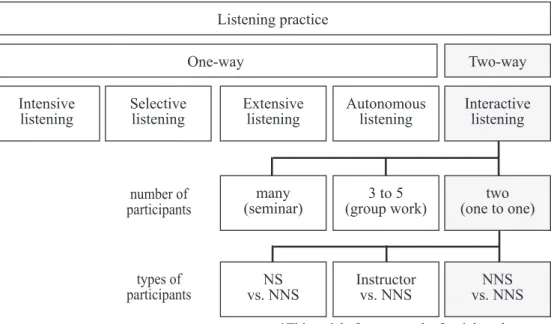
There are indeed a variety of listening practices. Rost’s most recent classiication of types of listening practice for the foreign language classroom divides them into the ive following groups:
• “Intensive listening: listening to a text closely, with the intention to decode the input for purposes of analysis.”
• “Selective listening: listening with a planned purpose in mind, often to gather speciic information to perform a task.”
• “Extensive listening: listening for several minutes at a time, staying in the target language, usually with a long-term goal of appreciating and learning the content.”
• “Autonomous listening: independent listening, without the direct guidance of an instructor.”
• “Interactive listening: type of conversational interaction in which the listener takes a leading role in understanding, through providing feedback, asking questions and supporting the speaker.”
(Rost, 2013, p. 184-200. For a detailed description of each category see Rost, 2016, p. 169-190.).
• Two-way listening: typically associated with conversation.
One-way listening comprises the irst four types in which the listener is alone faced with incoming audio information (intensive, selective, extensive and autonomous listening). Most classroom listening instruction uses this type of non-participatory activities. But many L2 learners actually hope to develop their listening competence through interactions, to be able one day to communicate and exchange in social conversations with the native speaker. The ifth listening practice aims just at that: interactive listening is a two-way process by which the listener alternates as speaker and listener in a conversation (see Figure 1).
Figure 1. Listening practice
In order to deine interactive listening in this context, Xiaoxian & Yan’s (2010) report on the 20 or so existing quasi-definitions of interactive listening and examined their most salient features which are mainly: listener behavior, active role of listener, communicative purpose, and collaborative nature. Listener responses to an interlocutor were found to be the single most striking feature of interactive listening as these responses spotlighted the listener’s negotiation of aural input.
Xiaoxian & Yan (2010) rendered a rather long construct for interactive listening. It nevertheless has the advantage of deining in detail what it actually entails to listen interactively:
*This article focuses on the far right column.
Listening practice
Selective listening
Extensive listening
Autonomous listening
Interactive listening
3 to 5 (group work)
two (one to one)
Instructor vs. NNS
NNS vs. NNS Intensive
listening
many (seminar)
One-way Two-way
NS vs. NNS number of
participants
7
Interactive listening takes place in a communicative situation, in which the listener, taking an active role (as a participant or an addressee), listens and gives responses such as signaling comprehension, requesting clariications, negotiating meanings, etc. In so doing, the listener, in collaboration with the speaker, solves communication problems, shapes the discourse, and accomplishes certain goals of interaction (p. 22).
Interactive listening can furthermore be characterized by the number and type of participants engaged in the interaction. There can be a very large group, as in an entire class being responsive to a lecturer (e.g. the teacher), a small group of 3 to 5 students (as in group work in a class), or it can be on a one-to-one basis (as in pair work activities).
This paper is foremost interested in looking at the latter situation, in a bilateral non-native speaker (NNS-NNS) context for totally beginner level students. Before the student can actively engage with a native speaker (NS) in a natural setting, the formal classroom environment allows for training in a safe NNS vs NNS situation. Interactive listening in this particular context “refers to a type of conversational interaction in which the listener takes a leading role in understanding, through providing feedback, asking questions and supporting the speaker” (Rost, 2013, p. 190).
Taking on such a role implies that the listener needs a set of strategic tools that will lead him to successfully achieve those communicative goals (i.e. providing feedback, asking questions and supporting the speaker). By naturally switching roles as speaker and listener, L2 learners can ask their interlocutor for clarification or confirmation, ask them to repeat or slow down, hence experiencing the use of reception strategies firsthand. This is of great benefit to the learner who through the use of listening strategies will become a better listener who can intervene more appropriately.
4 Deining Interactive Listening Strategies
As previously mentionned, several authors have attempted to deine interactive listening, but as yet there is still to be found a clear deinition for ILS. Drawing on the aforementioned authors’ deinitions of interactive listening (Rost, 2013; Xiaoxian & Yan, 2010) and OCS (Jactat, 2017), we can identify interactive listening strategies as:
“responses the listener resorts to during oral interaction to handle comprehension breakdowns and sustain conversation.”
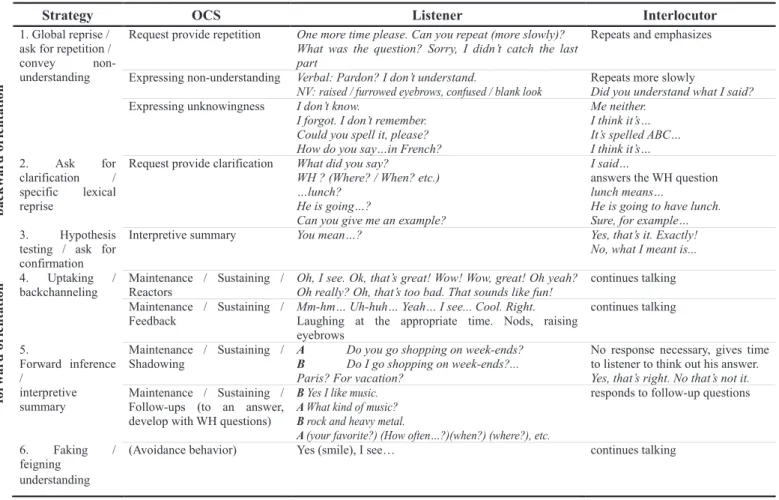
In the literature there seems to be a consensus among investigators of ILS that these strategies have either a backward orientation or forward orientation (Vandergrift, 2012, p.31). Backward oriented strategies aim at signaling non-understanding of previously given information thus serve to
handle comprehension breakdowns (see strategies 1-3 in Table 1, p.7). As for
(strategies 4-6 in Table 1).
The inventory of Interactive Listening Strategies by Vandergrift (2012 p. 30) is a well-established model based on previous research with L2 listeners engaged in interactive tasks (Dörnyei & Kormos, 1998; Farrell & Mallard, 2006; Rost & Ross, 1991; Vandergrift, 1997, 2006). Table 1 reproduces those results and juxtaposes a number of examples considered suitable to teach for beginner level foreign language learners (for a caption deinition of each strategy type, refer to Vandergrift, 2012, p. 30).
Interactive implies a collaborative communication set up in the FL classroom. Therefore, it is not enough to give the listener a set of response strategies but it is equally important to provide the interlocutor with some possible reactions to those strategies, in order to respond in turn appropriately to the listener’s feedback. This is especially true for beginner level students who might be at a loss as to how to follow up the conversation. This guarantees a virtuous loop in the conversation where both interlocutors can bounce off one another even with little linguistic knowledge or experience and ensure that the two-way communication does not break down.
Table 1 offers a sample of formulaic language containing pragmatic devices that the listener and interlocutor can use exchangeably to sustain the conversation flow. The next section will showcase pragmatic activities as to how strategy instruction can be embedded into task-based activities for the FL class.
5 Interactive Listening Strategies
Verbal strategies presented in Table 1 are composed of utterances (Oh yeah!)
and formulaic chunks (Can you repeat that?) which, combined to possible responses from the interlocutor, make up for what Kozawa (2017) calls “prefabricated patterns of communication strategies” (PPCS). These devices are believed to enhance student awareness of available strategies, enhance their communicative skills and thus bend their learning curve upwards. Teachers can explicitly instruct students on how to use these language devices to respond consciously and appropriately to their interlocutor through a series of two-way collaborative tasks which effectively stage these interactive listening skills. These communicative activities support listener control of conversations, such as “regulating turn-taking and seeking feedback through clarification and conirmation checks” (Lynch, 1996).
9
Strategy OCS Listener Interlocutor
1. Global reprise / ask for repetition / convey non- understanding
Request provide repetition One more time please. Can you repeat (more slowly)? What was the question? Sorry, I didn’t catch the last part
Repeats and emphasizes
Expressing non-understanding Verbal: Pardon? I don’t understand.
NV: raised / furrowed eyebrows, confused / blank look
Repeats more slowly
Did you understand what I said?
Expressing unknowingness I don’t know.
I forgot. I don’t remember. Could you spell it, please? How do you say…in French?
Me neither. I think it’s… It’s spelled ABC… I think it’s…
2. Ask for clarification / specific lexical reprise
Request provide clarification What did you say?
WH ? (Where? / When? etc.) …lunch?
He is going…?
Can you give me an example?
I said…
answers the WH question
lunch means…
He is going to have lunch. Sure, for example…
3. Hypothesis testing / ask for confirmation
Interpretive summary You mean…? Yes, that’s it. Exactly!
No, what I meant is...
4. Uptaking / backchanneling
Maintenance / Sustaining / Reactors
Oh, I see. Ok, that’s great! Wow! Wow, great! Oh yeah? Oh really? Oh, that’s too bad. That sounds like fun!
continues talking
Maintenance / Sustaining / Feedback
Mm-hm… Uh-huh… Yeah… I see... Cool. Right.
Laughing at the appropriate time. Nods, raising eyebrows
continues talking
5.
Forward inference /
interpretive summary
Maintenance / Sustaining / Shadowing
A Do you go shopping on week-ends? B Do I go shopping on week-ends?... Paris? For vacation?
No response necessary, gives time to listener to think out his answer.
Yes, that’s right. No that’s not it.
Maintenance / Sustaining / Follow-ups (to an answer, develop with WH questions)
B Yes I like music. A What kind of music? B rock and heavy metal.
A (your favorite?) (How often…?)(when?) (where?), etc.
responds to follow-up questions
6. Faking / feigning
(Avoidance behavior) Yes (smile), I see… continues talking
b ac k w ar d o ri en tat ion for w ar d or ie n tat ion understanding
Adapted from Vandergrift & Goh, 2012
Note: all examples of strategies presented here are appropriate for beginner level learners except Interpretive summary (from intermediate)
Table 1. Interactive Listening Strategies – Vandergrift model Inter
thought, Kozawa (2017) conirms that it “would be practical for language learners to learn strategic prefabricated patterns for communication. In particular, novice learners, who experience difficulty in constructing sentences, can appreciate prefabricated meaningful expressions they can say as a whole unit” (p.10).
The tasks listed in the next pages can be implemented at the first stages of learning any foreign language, be it English (elementary school in Japan), or when taking on a second foreign language whether it be at school or college. As we have seen, communicative strategies are known to help keep the communication channel open. And as one of the ingredients of CS, the use of ILS equally aims for that outcome. When appropriately handled, they ensure that the listener gives feedback to the interlocutor who can in turn provide clariication or help in different ways. This instills a virtuous circle of learning “that makes learners responsible for the outcome of their interactions with other learners [and goes] a long way towards promoting meaningful communication in the classroom, thereby increasing the opportunities for strategy use” (Houston, 2006, p.81).
6 ILS instruction through task-based activities
Tasks indexed hereafter are mostly pair-based activities to entice maximum exchange time between learners. Tarone purported that “exercises designed to give the student practice in using communication strategies to solve communication problems should require that the speaker alone have information that the listener or listeners require in order to complete some task” (Tarone, 1984, p.7). The subsequent conversational tasks do just that. Thus some of the best tasks for fostering the use of ILS will be information gap tasks.
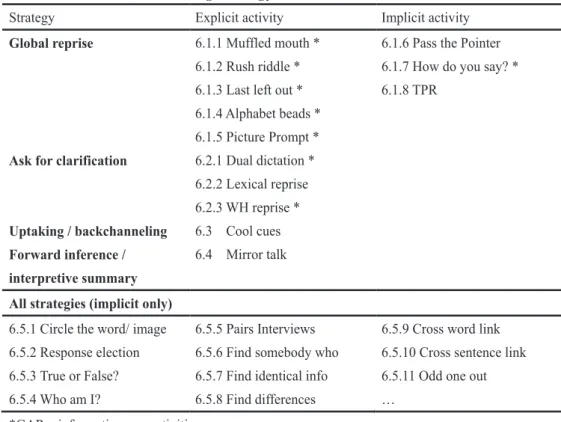
Classroom activities geared toward helping students enact ILS are hereafter distinguished into two broad types : activities that explicitly focus on the use of a particular ILS, and activities that create a situation that implicitly requires students to resort to ILS. Empiric classroom practice shows that explicit ILS tasks should directly precede implicit ILS tasks for maximized learning outcome. The guiding principle in the use of the following activities is that of “learn a little, use a lot”. To secure long term memory of prefabricated patterns of communication strategies (PPCSs), students need practice in a variety of ways, henceforth the diversity of activities.
Following is a listing of ILS task-based activities the teacher can implement in their FL classroom. Most of these activities are adapted from the FL teaching literature while some are originally created tasks by the author. The reference to the original source is provided when available.
6.1 Strategy : Global reprise
6.1.1 Mufled mouth
ILS use: ask to repeat (Ichikawa, 2003, p.5)
11
GAP: student A and student B have complete and incomplete sentences. Student A turns their face away and mufles a complete sentence. If student B cannot ill in the missing words on their sheet, they ask student A to repeat. Student A then repeats without mufling.
6.1.2 Rush riddle
ILS use: ask to slow down (Ichikawa, 2003, p.5) Can you repeat that more slowly, please?
GAP: student A silently reads the irst sentence two times in their head. Then student A turns to student B and reads the sentence out loud as quickly as possible. If student B cannot ill in the missing words on their sheet, they ask student A to repeat and slow down.
6.1.3 Last left out
ILS use: ask to repeat last word (Ichikawa, 2003, p.5) Sorry, I didn’t catch the last part/word.
GAP: student A reads the irst sentence clearly but mufles the very last word. If student B cannot ill in the missing word on their sheet, they ask student A to repeat more clearly. Other prompts are:
Table 2. Interactive listening strategy task-based activities
Strategy Explicit activity Implicit activity
Global reprise 6.1.1 Muffled mouth * 6.1.6 Pass the Pointer 6.1.2 Rush riddle * 6.1.7 How do you say? * 6.1.3 Last left out * 6.1.8 TPR
6.1.4 Alphabet beads * 6.1.5 Picture Prompt * Ask for clarification 6.2.1 Dual dictation *
6.2.2 Lexical reprise 6.2.3 WH reprise * Uptaking / backchanneling 6.3 Cool cues Forward inference /
interpretive summary
6.4 Mirror talk
All strategies (implicit only)
6.5.1 Circle the word/ image 6.5.5 Pairs Interviews 6.5.9 Cross word link 6.5.2 Response election 6.5.6 Find somebody who 6.5.10 Cross sentence link 6.5.3 True or False? 6.5.7 Find identical info 6.5.11Odd one out 6.5.4 Who am I? 6.5.8 Find differences …
*GAP = information gap activities.
Sorry, can you repeat this last word again? Sorry, I couldn’t hear the word after ‘la’. Sorry, what does ‘voiture’ mean?
6.1.4 Alphabet beads
ILS use: expressing non-understanding Sorry, I didn’t catch that!
GAP: students A and B reconstruct the name of a celebrity by saying the letters one letter at a time in turn. When they don’t get it they ask for repetition. Once they are done, they check orally that they got the same info using the model. This can be done with names of places, brands, things, etc.
Student A Student B S_p_i_ M_r_e_u _ o_h_e _a_c_a_
Answer : Sophie Marceau
Model conversation:
B. I think it’s Sophie Marceau! A. Yes, that’s right. Who is she?
B. I think she’s a French actress. Do you know which photograph is hers?
A. I think it’s this one (and points) B. Yes I think that’s right.
6.1.5 Picture Prompt
ILS use: expressing unknowingness
GAP: A and B sheets have a printed page full of pictures, some of them with captions and some without, some of them they know already (80%) and some are new (20%). Student A shows student B an image on his sheet and asks B “Do you know/remember how to say this in French?”
Options for reaction are:
I think it's… it's …, thanks.
How do you spell it?
Sorry, what did you say that was?
No, I don't know. Me neither, I don't know.
I forgot. I don't remember. I think it's…
6.1.6 Pass the Pointer
ILS use: expressing unknowingness (Yee, undated, Interactive Techniques)
What is this in French? Which one of these is a …?
13
or detailed images but without any captions. Students already know some of these words (80%) and some are new (20%). They use a pencil as a pointer, point to one of the images and use one of the two prompts above.
6.1.7 How do you say?
ILS use: expressing unknowingness
GAP: student A asks student B how to say such and such word they don’t have on their sheet in the target language.
Model interaction:
A. Comment dit-on dog en français? (How do you say dog in French?) B. On dit chien. (It’s chien)
A. Chien, merci. Ça s’écrit comment ? (Chien, thanks. How do you spell it?) B. C.H.I.E.N.
A. Merci. (thanks)
B. De rien. (you’re welcome)
6.1.8 Total Physical Response (TPR)
ILS use: expressing non-understanding Do you understand what I just said?
Student A reads a list of sentences. Student B either stands or sits to indicate their answers, such as Yes/No, to student A’s questions. Other options are to use other non-verbal cues to respond such as frowned eye-brows, smile, eyes wide-open, shoulder shrug, etc. This activity focuses both on the listener’s use of non-verbal listening strategies, but most importantly on the interlocutor’s perception of them and the speaker’s reaction toward body signals of non-understanding.
The speaker The listener
Reads a sentence from list and asks:
Do you understand what I just said? nonverbal reaction
Ok, you got it! nonverbal reaction
Ok, let me rephrase this. nonverbal reaction
6.2 Strategy: Ask for clariication
6.2.1 Dual dictation
ILS use: ask for clariication
What did you say? How do you spell…? What does …mean?
GAP: this is like Alphabet beads (see above), except that instead of just letters, students reconstruct full sentences. They read one word after another to each other and must ask questions for clarification without showing each other’s papers.
Student A Student B
Il _______ Tom _______. _______ s’appelle _______
Mayers.
Il _______ Britannique. _______ est _______.
Il s’appelle Tom Mayers. Il est Britannique. (His name is Tom Mayers. He is
British)
6.2.2 Lexical reprise
ILS use: ask for clariication
What did you say? How do you spell…? What does …mean?
Student A reads a sentence and student B automatically repeats either: - the sentence without the last word and with rising intonation.
(Tom Mayers is going …?)
- the last word of the sentence with rising intonation : … shopping?
Student A repeats the whole sentence. Student B can ask for further clariication if necessary.
6.2.3 WH reprise
ILS use: ask for clariication
GAP: student A reads a sentence and student B automatically responds with a WH question for clariication on the basis of this model:
A. Tom va à l’école. Tom goes to school
B. Où ça? Where?
A. à l’école. to school.
B. ah d’accord, à l’école ok, to school
A. Il y va avec Sophie. He’s going there with Sophie.
B. Avec qui? With who?
A. Avec Sophie…etc with Sophie…
6.3 Strategy: Uptaking / backchanneling Cool cues
ILS use: uptaking
Cards with the following gambits written on them (one per card): Oh, I see. Ok, that’s great! Wow! Wow, great! Oh yeah? Oh really? Oh, that’s too bad. That sounds like fun!
15
6.4 Strategy: Forward inference / interpretive summary Mirror talk
ILS use: shadowing
Student A asks student B questions from a list and student B automatically repeats the questions but puts “I” instead of “you” when appropriate.
A. Tu viens ici comment ? How do you come here?
B. Je viens ici comment? How do I come here?
En vélo. By bicycle.
Et toi, tu viens ici comment? and you, how do you come here ?
A. Moi? Me?
Je viens ici à pied. I walk here.
6.5 Strategy: implicit activities calling on all interactive listening strategies
6.5.1 Circle the word/ image
ILS use: all (Yee, undated, Interactive Techniques)
How do you say...in French? How do you spell it?
Distribute a handout that has a list of likely words or images students know and don’t know yet. Ask students to circle the ones they don’t know the answers to and ask their neighbor for help.
6.5.2 Response election
ILS use: all (Yee, undated, Interactive Techniques)
Distribute a list of gambits and have pairs decide together which listening responses are best in the list with it. Then have them play out the lines and responses.
6.5.3 True or False
ILS use: all (Yee, undated, Interactive Techniques)
Pre-make some cards on which is written a statement. Each student gets a card. Half of the cards contain true statements, the other half false ones. Participants decide if their partner’s statement is true or not, using the listening stratagems they need.
6.5.4 Who am I?
ILS use: all (Yee, undated, Interactive Techniques)
to guess the word hidden behind their own back.
6.5.5 Pair interviews
ILS use: all (Vannieuwenhuyse, 2017)
Each student has a chart to ill. They seek out an interlocutor to ask the same questions repeatedly. Interactive listening prompts are also listed so that the listener can check understanding. Example:
6.5.6 Find somebody who
ILS use: all
A popular worksheet in Second Language Acquisition (SLA) textbooks. Worksheets can be grammar-based (e.g. present perfect and food) or vocabulary-based (likes and dislikes foods). Each student goes about the classroom with their checklist and try to ind a student who has certain characteristics. When they find “someone who has natto for breakfast” or “someone who doesn’t like chocolate” they write that person’s name on their checklist and move on to the next person and see if s/he will meet one of the other characteristics on the checklist. The goal is to find the name of at least one student for each characteristic on the list.
6.5.7 Find identical info
ILS use: all
This activity requires students to form questions about pictures, words or sentences they have on their worksheet. Worksheets A and B have some similar pictures and some different ones. If the topic is “jobs” for example, they might have these sheets:
■ Survey form Formulaire
name
nom
lives in
lieu d’habitation
comes from
lieu d’origine
example Suzuki Taro Fukuoka Iwate
1st
person
2nd
person
3rd
17
Student A (words) Student B (pictures)
baker, lawyer, teacher, policeman, engineer, scientist, mechanic, etc..
Conversation model:
A. Do you have the picture of a baker? B. A what?
A. A baker. B. What’s a baker?
A. I think he makes bread. B. Oh, ok, yes I have a picture of bread.
A. Ok let’s circle baker and bread. B. Ok, do you have “Sherlock Holmes”?
A. You mean a “detective”? B. Yes a detective.
A. No I don’t. B. Ok I’ll cross him out.
6.5.8 Find differences
ILS use: all
This classic FL classroom activity requires students to ind differences in texts, or pictures. Lemeunier et al. (2010) have designed ingenious activities based on this setting. For example, students each have a different image of a fridge with various groceries inside the refrigerators. They must ask what the other does not have in their fridge and make a grocery list from it (p.114-115).
6.5.9 Cross word link
ILS use: all (Nation, 2008, p.25)
Each student has a sheet with different words and deinitions. They have to talk and decide which deinition goes with which word. There is always a word and a definition which don’t match in the end. Students try to come up with their own definition to the last word, and own word to the remaining definition. At complete beginner levels it is easier to have students match statements as in the following example:
Student A Student B
1. She likes sweets. 1. An apartment.
2. A dog 2. I don’t go to school on foot.
3. I live in Tokyo. 3. A book.
4. A bicycle. 4. Mika likes pets.
6.5.10 Cross sentence link (Nation, 2008, p.25)
Each student has a sheet with different sentences and they must agree on which ones correspond to each other, which have close meanings. For example:
Student A Student B
1. She likes sweets. 1. An apartment.
2. A dog 2. I don’t go to school on foot.
3. I live in Tokyo. 3. A book.
4. A bicycle. 4. Mika likes pets.
6.5.11 Odd one out (Burton, 1987 in Nation, 2008, p.25)
Students receive a list of four items and must decide which one doesn’t belong. For example, a set can be:
-a grammar based list: sang, sung, song, sing (the noun doesn’t belong)
-a vocabulary based list: dog, cat, lion, horse (the wild animal doesn’t belong)
-a content based list: English, Japanese, Thai, Korean (the non-Asian language doesn’t belong)
Final thoughts
To sum up, this pedagogical essay suggests that implementing OCS and more particularly ILS into the curriculum at the outset of a FL teaching program can help learners improve their oral communicative competence, notably by curtailing observable avoidance behaviors, such as silence, which are characteristic of Japanese students.
Since many avoidance behaviors appear on the receptive side of an interaction (no follow-up on a statement, message abandonment, feigning understanding, etc.), we can assume that the instruction of ILS has the potential to help students rely more on conscious achievement strategies rather than unconsciously fall back on avoidance behaviors.
The display of materials here is succinct and should only serve as an inspirational source for teachers to develop their own material.
Furthermore, these activities are not to be thought of exclusively as listening tasks although they are presented as such. ILS involve the presence of an interlocutor in contrast to pure listening activities which are stand-alone tasks (listening to a radio program or a recorded story). Thus the two executants of these interactive tasks take turns playing out the listening strategies. This does not exclude the general use of productive skills.
This paper brings an underexposed area of SLA to light. The spotlight has usually been shone on productive skills in interaction. These ILS tasks should help raise some awareness about the importance of developing listening skills in an interaction, as a natural companion to speaking skills.
19
a delayed post-test to evaluate long term improvement would shed light on the matter.
References
Bialystok, E. (1990). Communication strategies: A psychological analysis of second language use. Oxford: Basil Blackwell.
Brachet, M. (2000). Les silences dans les cours de pratique orale en milieu
universitaire japonais. Mémoire de DEA. Université de Franche Comté.
Burton, D. (1986). The odd man out. Modern English Teacher 13, 4: 43–44. Dornyei, Z. (1995). On the teachability of communication strategies. TESOL
Quarterly, 21, 55-85.
Dörnyei, Z., & Kormos, J. (1998). Problem-solving mechanisms in L2 communication. Studies in second language acquisition, 20(3), 349-385. Dörnyei, Z., & Scott, M. L. (1997). Communication strategies in a second
language: Deinitions and taxonomies. Language learning, 47(1), 173-210.
Dörnyei, Z., & Thurrell, S. (1994). Teaching conversational skills intensively: Course content and rationale. ELT journal, 48, 40-49.
Faerch, C., & Kasper, G. (1983). Plans and strategies in foreign language communication. In C. Faerch & G. Kasper (Eds.), Strategies in interlanguage communication (pp. 210-238). London: Longman.
Farrell, T. S. C. & Mallard, C. 2006. The use of reception strategies by learners of French as a foreign language. The Modern Language Journal, 90(3), 338-352.
Faucette, P. (2001). A pedagogical perspective on communication strategies: Beneits of training and an analysis of English language teaching materials. University of Hawaii Second Language Studies Paper 19 (2).
Gan, Z. (2012). Understanding L2 Speaking Problems: Implications for ESL Curriculum Development in a Teacher Training Institution in Hong Kong. Australian Journal of Teacher Education, 37(1), 43-59.
Harumi, S. (2010). Classroom silence: Voices from Japanese EFL learners. ELT journal, 65(3), 260-269.
Houston, T. (2006). Communication Strategies in the Foreign Language Classroom. Applied Language Learning, 16(2), 65-82.
Ichikawa, A. (2003). Communication Strategies and How to Teach them to
Japanese High School Students. Consulted online August 4th 2017 at URL:
https://www.scribd.com/document/307256927/ 030329-Ichikawa.
Inuzuka, A. (2001). How Students Acquire Communication Strategies: Analysing Conversations between Japanese Junior High School Students and an ALT. Consulted online July 22nd 2016 http://www.tcp-ip.or.jp/~ainuzuka/2001pap erEnglish.htm.
Jactat, B. (2001). Quelles stratégies de communication les apprenants japonais utilisent-ils lors d’interactions ? Mémoire de D.E.A. en Sciences du Langage, de l’Homme et de la Société, Université de Franche-Comté, Besançon.
Jactat, B. (2017). Oral Communication Strategies from the Start in the Foreign Language Classroom. Studies in Foreign Language Education, N.39. Center for Education of Global Communication, Foreign Language Education Division, University of Tsukuba. pp. 1-17.
Kavanagh, B. (2012). The theory and practice of communicative language teaching in Japan. Academic Research International, 2(2), 730.
Kozawa, Y. (2017). The Effect of Communication Strategies on Learners’ Speaking Ability in Task-Based Language Teaching The Language Teacher 41.2, March / April 2017, JALT.
Lemeunier, V., Gracia, M., Cardon, J. (2010). En jeux : activités orales pour favoriser l'apprentissage du français - FLE : livre de l'apprenant (A1) Cayenne : CRDP Académie de Guyane.
Locastro, V. (1996). English language education in Japan. In H. Coleman (Ed.), Society and the language classroom (pp. 40-58). Cambridge: Cambridge University Press.
Lynch, T. (1996). Communication in the language classroom. Oxford: Oxford University Press.
Maleki, A. (2010). Techniques to Teach Communication Strategies. Journal of Language Teaching & Research, 1(5).
Nakatani, Y. (2010). Identifying strategies that facilitate EFL learners' oral communication: A classroom study using multiple data collection procedures.
The Modern Language Journal, 94(1), 116-136.
Nakatani, Y. (2006). Developing an oral communication strategy inventory. The Modern Language Journal, 90(2), 151-168.
Nakatani, Y. (2005). The effects of awareness-raising training on oral communication strategy use. The Modern Language Journal, 89, 76-91. Nakatani, Y., & Goh. C. (2007). A review of oral communi¬cation strategies:
focus on interactionist and psycho¬linguistic perspectives. In A. D. Cohen & M. Ernesto, (Eds.), Language learner strategies (pp. 207–227). New York: Oxford University Press.
Nation, I. S., & Newton, J. (2008). Teaching ESL/EFL listening and speaking. Routledge.
Naughton, D. (2006). Cooperative strategy training and oral interaction: Enhancing small group communication in the language classroom. The
Modern Language Learner, 90, 169-184.
Ogane, M. 1998. Teaching communication strategies. Chiba (Japan): Todoroki - cho Junior High School consulted online July 2nd 2016 at URL: http://iles. eric.ed.gov/fulltext/ED419384.pdf.
Paribahkt, T. (1985). Strategic competence and language proficiency. Applied Linguistics, 6, 132-146.
Purpura, J. (2014) Language learner styles and strategies. In M. Celce-Murcia, D. M. Brinton & M. A. Snow (Eds.),). Teaching English as a second or foreign language (4th ed., pp. 532-549). Boston, MA: National Geographic Learning/ Cengage Learning.
Roger, A. (2008) Teaching the Speaking Skill to Japanese Students Part1, The Kanda Journal, Vol.20.
Rohani, S. (2013). Positive versus negative communication strategies in task-based learning. TEFLIN Journal, 24(2), 158-179.
21
and teachability. Language learning, 41(2), 235-268.
Saito, A. (2016). Communication Strategies and their Role in English Language Learning. The Bulletin of Hachinohe Institute of Technology, 35, 141-145. Smith, B. (2012). Coping with institutional regimes: Towards a Japanese
CLT. Consulted online 12 December 2017 http://r-cube.ritsumei.ac.jp/ bitstream/10367/3957/1/15-Coping%20With%20 Institutional%20Regimes. pdf.
Sun, D. (2014). From Communicative Competence to Interactional Competence: A New Outlook to the Teaching of Spoken English. Journal of Language Teaching & Research, 5(5).
Takanashi, Y. (2004). TEFL and Communication Styles in Japanese Culture. Language, Culture and Curriculum 17 (1), 1-14.
Talandis, G. & Stout, M. (2015). Getting EFL students to speak: an action research approach. ELT J, 69 (1), 11-25.
Tarone, E. (1984). Teaching strategic competence in the foreign-language classroom. In S. J. Savignon & M. S. Berns (Eds.), Initiatives in communicative language teaching (pp. 127-136). Reading, MA: Addison-Wesl.
Tarone, E. (1981). Some thoughts on the notion of communication strategy. TESOL quarterly, 15(3), 285-295.
Tokeshi, M. (2003). Listening comprehension processes and strategies of Japanese junior high school students in interactive settings (Doctoral dissertation). University of Wollongong, Australia.
Vandergrift, L. (2006). Second language listening: listening ability or language proiciency? The Modern Language Journal, 90(1), 6-18.
Vandergrift, L. (1997). The Cinderella of communication strategies: Reception strategies in interactive listening. The Modern Language Journal, 81(4),
494-505.
Vandergrift, L., & Goh, C. C. (2012). Teaching and learning second language listening: Metacognition in action. Routledge.
Vannieuwenhuyse et al. (2017). Moi-Je communication, ALMA éditeurs.
Watanabe, K. & Gappa, A. (2005). Types of Communication Strategies Used by Japanese learners of English, 教育実践総合センター 研究紀 要 Vol.13 2004/3, 33-39. 奈良教育大学. Consulted online July 12th 2016 at URL: http://www.nara-edu.ac.jp/CERT/ bulletin2004/b2004-05.pdf.
Weatherall, A., Watson, B., & Gallois, C. (Eds.). (2007). Language, discourse and social psychology. Springer.
Willems, G. M. (1987). Communication strategies and their significance in foreign language teaching. System, 15(3), 351-364.
Xiaoxian, G., & Yan, J. (2010). Interactive Listening: Construct Deinition and Operationalization in Tests of English as a Foreign Language. Chinese Journal of Applied Linguistics (Foreign Language Teaching & Research Press), 33(6).
Yee, K. (undated). Interactive Techniques. Consulted online August 4th 2017 at URL: http://www.usf.edu/atle/documents/handout-interactive-techniques. pdf.