WASEDA BUSINESS & ECONOMIC STUDIES 2009 NO.45
The Succession of Technology and Production of the Technology Management Brand "Chanel"
by
Shin'ya Nagasawa* and Kana Sugimoto**
Abstract: This study offers recommendations for the corporate management of most Japanese manufacturing companies. While it is true that no company can avoid relyingg on unstable business resources, such as its company "brand," consistent efforts over an extensive period are required to develop a powerful brand with long term prospects. However, any well-established brand can easily lose its positive image.
Companies must respond appropriately to rapid changes in the market, including consumption patterns, consumer trends, and technological developments. This study focuses on a top luxury brand, Chanel, as a model company for both its sustained efforts and appropriate responses to market changes. The findings show that Chanel's approach of achieving its targets through the application of basic business resources, such as through its corporate philosophy, human resources, organization, and the succession of technology and skills, has enabled it to maintain its position as a top luxury brand since the company was established. The conclusions of this study have implications for the management of traditional Japanese manufacturing companies.
* Shin'ya Nagasawa is a professor of MOT (Management of Technology) at Waseda Business School, Graduate School of Commerce, Waseda University, Tokyo, Japan, and also a visiting professor of ESSEC Business School, Cergy, France (2008-2009). He holds a Doctor of Engineering from Waseda University.
** Kana Sugimoto is a graduate at Waseda Business School , Graduate School of Commerce, Waseda University, Tokyo, Japan. She is now Chief Instructor and Marketing Manager of Sugi's Method of Teaching General American English Sound System. She holds a Master of Business Administration from Waseda University.
This paper is revised from the paper presented on the International Conference on Ifrnsei Engineering and Emotion Research 2009, Osaka, March 2009.
41
1. Introduction
Firstly, this paper explains why the study described here deals with Chanel. Chanel is a significant and renowned brand name throughout the world. It has received high praise around the world. Its popularity in Japan is so stable that it did not suffer from the aftereffects of the bursting of the economic bubble in the early 1990s. Chanel is a star brand that has maintained an established position and achieved good business results over an extensive period. Bernard Arnault, who is the Chairman and CEO of the biggest and most profitable brand conglomerate, LVMH Moet Hennessey. Louis Vuitton, stated that
"ti
meless," "modern," "fast-growing" and "highly profitable" were the four characteristics required for the success of a brand (Arnault 2002). If a product can be created that is both simultaneously timeless and modern, such a product will become a Star Brand and provide continuous benefits to the company. He points out that heritage is not only an important aspect of establishing a Star Brand, but it also takes a long time to foster such a quality of timelessness. Only a limited number of companies can achieve this, and this validates his point. In addition, he insists that it is absolutely critical to have long term dedicated employees to maintain the quality of the brand that the company has built up, since they are the ones who truly understand the long history of the brand and its meaning. Similarities can be seen between the characteristics of such Star Brands and the management approach of traditional Japanese manufacturing companies: organizations whose foundation is their emphasis on human resources development, the accumulation of technologies, and the life-time employment system.
The popularity and value of such brands has been so well established chat they cannot easily lose their market position. Their position is also bolstered by the support and admiration of the consumers. However, it is also true that any well-established brand can easily lose its positive image if it depends on prestige alone. In addition, external changes in the market, including the economic conditions and trends, must also have a considerable influence on brands. The lack of a strategy or any appropriate response to the external environment can also lead to the loss of brand prestige. Since brands depend to a great extent on designs and images whose impact cannot be measured quantitatively, there are great uncertainties involved. It is true that running a business based on unstable business resources, such as by presenting a "brand," might be risky under conditions of very rapid change and keen competition. What are the conditions that traditional Japanese manufacturing companies should refer to for the development of their management philosophy under these circumstances? We found some tentative answers to this question through this analysis of the "Chanel" brand, which has continued to hold
the position of a high-end luxury brand since the Chanel company was established.
Under this study, research was conducted on the key factors that ensure the success of a brand. Our findings indicate that it is not only the quality of the products and services that have an effect on the success of the brand, but also the level of marketing or sales skills. Western brands can be taken as an example of this.
In the 1970s, the established brands of Western countries came to be distributed on the open market in Japan. At that time, people bought these Western brands, which had been considered top brands such as Louis Vuitton, Hermes, and Gucci, only because
"
they had brand name value." Japanese consumers placed product quality and service, which should have been valued more than anything else, after the brand and competed to buy such products simply because, as people said, "this was the brand to buy." While the brand market and consumers in Japan had not yet become mature, the most important aspect of a brand was to indicate that "Everyone can recognize at a glance that it is a top brand."
Over the decades since the 1970s, the number and sales channels of imported brands has expanded up to today. Now the brand market has matured and consumers
have broadened their experience. There are a few exceptions, however, since most consumers do not support a brand simply "because it is a brand." Both the accumulated experience of product quality based on assured technology over a long product history and value generated through the corporate philosophy or policy are becoming important for consumers today. Moreover, the time has come in which the companies need to continue to rapidly innovate in order to win new clients in a constantly changing market.
In addition to its products and services, any company must add value that helps them appeal to the consumer's Kansei (Sensibility) through various methods and situations provided at the point of contact with the clients, such as through sales, advertisements, shops, events and websites. In short, the "Traditional system no longer works."
It is essential for companies to correctly interpret the situation so that they can identify their strengths and weaknesses, develop a realistic strategy, and carry it out. This seems like a fairly classical approach, but there still might not be very many companies applying it appropriately. Chanel is a well-established luxury brand that has maintained its top position since the company was established. They have been able to achieve this by steadily applying this classical approach. Flourishing well-established brands or makers thrive not only by maintaining their corporate philosophy and the traditions, but also by changing drastically what they think they need to do in order to innovate. This study focuses on Chanel, as an example of the best practice as a technology management
43
company. In addition, their technology, manufacturing, and approach in terms of the succession of technology and skills are analyzed. The conclusions of this study have implications for the management of traditional Japanese manufacturing companies. This paper refers to the literature on luxury brand industries, the history of Chanel, and other related manufacturing industries.
2. Tradition and Innovation in the Field of Technology and Manufacturing Adopted by Chanel: the Example of the Perfume Chanel "N°5"
Chanel "N"5" has been the product with the longest history and highest sales in the Chanel fragrance business. This chapter takes this product as an example in order to illustrate how the corporate philosophy and succession of technology and skills of this company are reflected in the manufacturing and marketing of Chanel itself.
2.1. History of the birth of the perfume Chanel "N°5"
Chanel "N°5" is the first perfume developed by Chanel and has made a substantial contribution to the brand as a source of high profits and considerable brand awareness.
The history of this perfume was launched in 1921 and started with Coco Chanel's visit to the perfumer Ernest Beaux. Coco, who had been innovative through her clothing since the brand started, came to think about creating innovation in the field of perfumery. She first asked Beaux to create an abstract and unique scent that expressed her personality.
Before Chanel "N"5" came on the market, the scent of such perfumes tended to imitate the actual scents of flowers. There was no such thing as the "abstract scent" that Coco asked him to create. The existing scents of violet, rose, and orange were all floral based and were quite boring for Coco. One problem with the existing fragrances of the perfumes at that time was that flower scents had actually also become boring to most people. Another issue was that the aroma evaporated very quickly. Coco's innovation solved both these problems since the scent itself and the persistence of the scent were created at the same time.
Beaux tried to create a unique fragrance at the request of Coco. He gathered exotic ingredients such as Grasse jasmine, Rose de Mai, ylang-ylang, Bourbon vanilla, Haitian vetiver and so on. However the scents created were so rich that it needed something to harmonize them. Beaux added three different types of synthetic aldehydes, in contrast to the precedents in the field of perfumery at the time. These aldehydes gave the scents richness, depth, and stability. This was exactly what Coco requested Beaux to create as a
"feminine hint that abstracts the scent of flowers." According to how Beaux expressed it,
Figure 1 Chanel "N'S"
The perfume Chanel "N°5" in the Exhibition of Chanel at the Metropolitan Museum (May 2, 2005, New York, U.S.A.) Source. Nagasawa, Shin'ya ed. (2010) , with Kana Sugimoto: CHANEL Strategy Management of the Ultimate
Luxury Brand, Toyo Keizei Shinposha, p.129, Photo (AFP=Jilt),
adding aldehydes to the perfume was like "putting lemon on strawberries."
The origin of the name Chanel "N'5" is another innovation. Beaux picked some samples from many prototypes, divided them into two groups, and assigned a number to each group: the numbers I to 5 were given to the first group and the numbers 20 to 24 to the second group in order to present them to Coco. She picked up the bottle with "N"5"
then this came to be the name of the fragrance. Most of the fragrances numbered below
"N°5"
were romantic and too decorative. Since Coco Chanel hated such established conventions, she chose a simple name that included the number. In terms of the definitive difference between the existing fragrances before "N'5", this was a groundbreaking approach in the field of determining fragrances for perfumes.
As shown in Figure 1, Coco uses a simple square bottle for Chanel "N'5".
According to the record, she got the inspiration for the bottle design from some cosmetic product for men she happened to have. This case demonstrates the technique Chanel used of remaking materials and styles that were originally for men to something totally new for women. Besides the name, the simplicity of the design of the bottle was a revolutionary idea. In the process of creation as well, it was found that the accumulation of absolutely innovative and unconventional approaches created Chanel "N°5", as already mentioned.
2.2 Succession of tradition and innovation in the technology and design of the fragrance of Chanel "N°5"
The following is a summary of the characteristics in the history of the creation of the
45
fragrance of Chanel "N'5" as recounted in the preceding paragraph.
• Scent: Monotonous floral base to an abstract and mixed one
• Ingredients: Addition of synthetic aldehydes to flower ingredients to avoid evaporation of the aroma
• Name : Decorative to simple
• Bottle : Decorative to simple
This indicates that the technological capability and innovative philosophy of Coco Chanel developed the perfume Chanel "N°5". Even if a product was originally innovative, there are many cases in which it becomes obsolete over a period of time.
Nevertheless this is not the case with Chanel "N°5", which is still enormously popular and statistics have shown that a bottle of Chanel "N°5" is sold every 30 seconds.
As shown in Table 1, a combination of succession and innovation enables "N°5" to avoid obsolescence since its birth more than 80 years ago. The changes in its "appearance"
is likely to be one of the reasons. The recipe has never been changed at all since it was launched. On the other hand, Chanel has made changes to the bottle little by little in response to social and cultural changes. In 1924, an emerald cut was applied to the bottle and at the edge of cap in order to make it much more strong and dense, for example. The bottle cap has evolved through fine tuning of the thickness of die cap while the overall shape was continued. In this case, Chanel's particular persistence can be interpreted in terms of their succession of technology and product quality being a key factor in establishing their long-term customer loyalty.
Table 1 Classification of the Fragrance Chanel "N°5" Elements of Succession and Innovation
I Succession Innovation
Contents i Ingredients (Recipe) Appearance
_ _ Naming Bottle
2.3 Corporate Philosophy in the Marketing of "N°$"
"N°5"
once tumbled from its position as "the world's best selling perfume" that Chanel climbed to within a few years after its debut. It was fortunate for Chanel that the way to "maintain the steady, innovate, and evolving spirit and philosophy of the founder Cow Chanel" extended through to the organization. It is conjectured that this is the factor that enabled Chanel to restore the consumer trust that amazingly had been lost. An examination of the process and approaches taken regarding their recovery in fragrance
business is given below.
In 1974, "N"5" was still the world leader of the fragrance business. Although it accounted for about 4% of the $875 million US fragrance market, this share started to turn downward little by little. Mismanagement over a few years gave consumers the image that "`N"5" is an outdated and second class fragrance.' This is a clear example of where the mismanagement of the distribution and image-building strategy can easily
make a brand lose its value even after establishing the top position.
However, "N'5" regained its top position. Firstly, Chanel tried to create exclusiveness and uniqueness by removing "N"5" from discount drugstores. Thanks to the Washington law firm that Chanel hired, they could remove "N"5" from the shelves of US discount drugstores without violating the Robinson-Patman Act. As a result, the number of the stores dealing in Chanel "N"5" dropped from 18,000 to 12,000. Chanel tried hard to keep its products from entering any gray market distribution channels. In addition to the disposition of the distribution channels, Chanel invested multimillion dollar advertising expenditures in order to recover the brand image of its fragrance and cosmetics business.
Jean Hoehn Zimmerman is a leading advocate of maintaining tradition and innovation. Zimmerman started her career at Chanel in 1978. The annual sales of its cosmetics business at that time was under a million dollars, according to Zimmerman.
Thanks to her great contribution, she was promoted to the position of senior vice president for marketing and sales based in Manhattan, New York in the 1990s. The US magazine "Marketing News" highly praised Zimmerman as a person who succeeded in transforming its strategy without destroying a legend.
It is very important to point out that she applied innovation to a legend - valuable corporate assets such as its philosophy, products, and image that Coco Chanel had established - without doing any damage. Coherence can be seen in founder Coco Chanel's strong commitment to her philosophy to "Keep the traditional culture and technology with innovation" and its corporate activities. In business terminology, it can safely be said that "there was consistency between the strategy and the activities." At Chanel as a company, every experiment with new approaches and changes to existing things is carried out based thoroughly on Coco's philosophy, which is shared both inside and outside the company. This is reflected in Chanel's products, services, and marketing approach, and then extends to the customers, It can be considered that the strong coherence that Chanel has been committed to is one of the factors determining its long- term competitiveness.
47
Let us look at the marketing approach that Zimmerman used. As an example, part of the approach is to be thoroughly particular with its conservative and established image.
Any designer and the marketing staff working for Chanel must work with close attention to avoiding deviation from Chanel's traditional conduct. Even if competitors launch fragrances one after another over a short period in response to market trends, Chanel did not follow them according to its policy. Zimmerman mentioned that Chanel understood very well what their customers want from Chanel. 'Therefore they do not confuse their customers by releasing products unnecessarily frequently. She also emphasized that customers will always cone back to Chanel as long as it keeps on the right track as a company.
She has argued that what Chanel provides to the customers is not only a product, but a spirit. She also said that the image of Chanel's advertisements allows the audience to recognize its attitude of the pursuit of high-level achievement with consistency, and to then make a decision as to whether they choose Chanel or not. The sales or marketing division has the kind of function of connecting the technology and the products created from the technology and to bring them to the market through the company. Such a policy allows Chanel to be consistent in its beliefs.
The approach of Chanel's competitors is to launch many fragrances over a short period and then quickly disappear from the market and is quite different from that of Chanel. The philosophy of continuing to be traditional but new, timeless, and innovative at the same time is the ongoing challenge that supports Chanel in its efforts to repeatedly challenge the market and make improvements even for a small product line in order to establish a distinction between Chanel and its competitors. Utilizing this policy and approach, Chanel has achieved the top position not only in the field of fragrances, but also in cosmetics.
Zimmerman mentions that through the successful experience of developing its cosmetics and other business fields in the 1980s, her colleagues were able to cultivate a sense of dedication and brand loyalty. In addition, she emphasizes that this was not achieved at the individual level but as a team, for good or ill. There is thus common ground between the attitude of Chanel - the team working together in order to ensure that the corporate philosophy is reflected in the products and services as a means of maintaining adherence to tradition and innovation - and that of traditional Japanese manufacturing companies.
3. Tradition and Innovation in the Field of Technology and Manufacturing Adopted by Chanel: the Example of the "chain belt bag"
3.1 History of the Birth of the "chain belt bag"
Its debut in the history of Chanel was 1929, and the actual entry into production was February 1955. This shoulder bag, was thus named "2.55" in honor of its birth date and is an iconic and major item for Chanel.
In 1929 the bag was originally launched in the shape of a quilted (matelass€) pouch and adjustments and improvements have been added right up to the present time. A variety of materials, colors, and shapes of the "chain belt bag" form the basis for of Chanel's popularity and financial resources. Coco Chanel added the first improvements to
~e
~ -"
,:
~~'~~
a y.
e
-40
gym.
,~:~
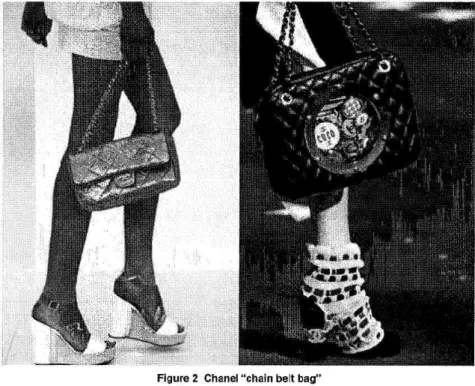
Figure 2 Chanel "chain belt bag"
left: This is the most standard version of the 'chain belt bag' with the combination of chain belt and matelass€
(quilting) plus "CC mark." (October 6, 2006, Paris)
right This is the 'chain belt bag' that appeared in the 2008 Spring/Summer Collection This type was scatterec by Chanel's iconic motifs on the most standard version with the combination of chain belt and matelass6 (October 5, 2007, Paris)
Source Nagasawa, Shm'ya ad (2010), with Kana Sugimoto CHANEL Strategy Management of the Ultimate Luxury Brand, Into Kaizal Shmposha, p 137, Photos (AFP=Jiy)
49
the pouch by including a length-adjustable chain in order to convert it into a shoulder bag. According to the record, the origin of the shoulder bag is a kind of haversack that soldiers used in the battlefield. A bag without a shoulder chain restrains one arm and it is therefore impossible to use both arms. Chanel relieved women from having the use of only one arm when using the bag by putting a chain on the inconvenient bag shown in Figure 2 (left). It should be added here that a chain entwined with a leather strap is technology born from Chanel's concept of keeping the strap from breaking when carrying heavy items.
Moreover, while the "chain belt bag" is designed with both elegance and functionality, it includes other technologies and ingenuous elements such as a turnover to prevent the bag from opening unexpectedly, a wide gusset to allow for sufficient capacity, an inside pocket for lipstick, the application of a quilting (matelass€) processing technology that maintains the shape better, and so on.
3.2 Succession of Tradition in the Technology and Design of the "Chain Belt Bag" Series
A summary of the innovation involved in the history of the birth of the "chain belt bag" is given below.
versi "chain belt
com the Cha
as g easily g a Chanel bag.
It should also be mentioned that, regarding the "chain belt bag," it is also easily recognized as a Chanel bag even without the brand logo just by looking at the combination of the leather strap with the chain and the quilting (matelass€). In another words, this means that a "Chanel style" has spread among people as a universal image.
In viewing this example of a Chanel product, it can be interpreted that Chanel's A shoulder chain that relieved one arm from holding the bag
A turnover to prevent the bag from opening unexpectedly A wide gusset to provide sufficient capacity
An inside pocket for convenience
Quilting processing that helps the bag to keep its shape
A leather strap with a chain that is durable and can cope with heavy items
Currently, Chanel offers several sizes and designs of its bags derived from the classic bag" mentioned above. The brand logo of the "CC marl' - a on of the
nickname of the brand founder Gabrielle Bonheur bination of the "C" initial, nel - is attached to each version. In most cases, a "CC mark" made of materials such
so that it can
be reco nized as metal or leather is attached to the front of the ba
manufacturing does not rely solely on design. The bag arose from its technological capabilities and the philosophy of Coco Chanel. From this, it can be said that Chanel has established an underlying philosophy and technology that enables it to keep what is required to succeed, add new aspects, and provide novelty and convenience at the same time as shown in Table 2.
Table 2 Classification of the Chanel"Chain Belt Bag" Elements of Succession and Innovation
Succession Innovation
Concept A shoulder bag that relieved _ one arm from holding the bag
Appearance Chain Design (color, shape,
Q
uilting (matelasse) size, material)
3.3 Example of the Corporate Philosophy in the Marketing of the "Chain Belt Bag"
Chanel is about manufacturing ultimate luxury and high-quality products, thus the brand is ranked as "luxury." Despite this, the general understanding is that the concept of a luxury brand conflicts with the concept of mass market products.
Yamada (2008) explains the strategy of Coco Chanel whereby she admits the concept of the mass market in luxury fashion and stands it on its head. In the case of the 2.55, Yamadas point can be seen in the marketing described below through which Chanel succeeded in increasing the brand value as a small-volume manufacturer by admitting the existence of the mass market as opposed to other haute couture designers, which should be considered reasonable.
French journalist Dana Thomas (2007) notes that most luxury brands of bags have an astoundingly high profit margin for a bag - between ten and twelve times the cost - and emphasizes that not only fragrances, but also handbags and leather items became more and more important as an entry item for luxury brands in the latter half of the 1990s. Unlike clothes, customers buying a bag need neither a particular size nor a fitting.
She indicates that bags are easier to make than fragrances, and are the easiest luxury fashion item to sell that accurately makes the marketing point.
In terms of evaluation, it can be said that an outsider such as Thomas, and insiders connected with the brand have a sort of accordance. In fact Karl Lagerfeld, Chanel's chief designer since 1983, admitted that everyone can afford a luxury brand bag. Aside from the question that if everyone can afford a Chanel bag, which cost over 200,000 JPY on average as of 2009 in a retail store in Japan, it must be absolutely critical for a brand to
51
have bags as a product line in terms of their business. Although it is not public information, it is said that for Louis Vuitton, one of the most distinguished major luxury brands of France besides Chanel, 40 percent of all sales at their store in Tokyo are made on the first floor, which sells its icon bags and leather goods.
A predictor of such a predominent movement in the bag business could already be seen in the US in the 1980s. As women have become more active throughout society, they have needed a bag, a form of briefcase for women. Furthermore, women needed a classic bag that is neither like the ones that men use nor should it be too flashy. Women would like to avoid having a bag that will go out of fashion too quickly since they regard a good leather bag as an investment. Consequently, the executives of Chanel thought about pushing out the thirty-year-old bag. Arie Kopelman, the CEO at that tine, decided to conduct a major campaign for its bags and made an advertising plan - Chanel did not advertise items other than fragrances and cosmetics up to that time - and improved the product line. As a result, Karl Lagerfeld added his new interpretation and arrangement to the original version of the "chain belt bag" and attracted a sufficiently large number of people that sales exploded. Not content with being limited to bags, Karl Lagerfeld launched a haute couture evening gown inspired by the "chain belt bag" in 1986.
At any rate, the major items produced by Chanel on the basis of its technology and innovation, such as fragrances and bags, have produced high profit margins. This has become a source of investment for long-term projects and has enabled investment in technological development and image creation, which is one of the core competences of Chanel. This consecutive cycle has created Chanel's unchallenged competitive superiority in manufacturing. According to a source, Chanel devotes sufficient time for the development of cosmetics, unlike other brands, which launch cosmetics over a short-term cycle. Even if employees tried to launch products over a short period of time without ensuring the quality in order to improve the company's performance, it can be assumed that Chanel would not accept this. The point is that Chanel would reject this since it is against Chanel's vision. To be more precise, the management approach that Chanel adheres to is completely different from the acquisitive attitude of the pursuit of short- term profits. This requires a long-term view, however, in order to ensure technologies and human resources that are worth developing; sufficient financial resource are also necessary for success.
4. Conclusion
In conclusion, we would like to make suggestions for Japanese manufacturing companies based on the results of this study by summarizing the advantages of Chanel as a technology management brand.
The following is a summary of the two advantages of Chanel based on the results of the observations mentioned above.
• Maintain the consistency of the philosophy of management and manufacturing.
• Innovate continuously based on close consistency with the philosophy.
In the words of Richard Collasse, the president of Chanel KK in Japan, this approach of Chanel as a company can be put very concisely.
The founder Coco Chanel established one style. That became a brand and its value and name are known throughout the world. All the creations that have Chanel's name on
them maintain a consistent value. We cannot talk about the brand of Chanel's present and future without the spirit and the history of the various innovations of Coco Chanel, which are the proper roots of the brand.
(Collasse, Richard. `Fashion: Business and Creativity,' open lecture at Aoyama Gakuin University. Aoyama, November 7, 2007)
Thus, Chanel facilitates its business based on an established philosophy and strategy.
In addition, it continuously innovates its strategy based on this philosophy. We assume that this is the factor in the success of Chanel. It seems quite an orthodox method, and nothing particular or extraordinary. It might be easy for other companies to imitate.
However, it should be remembered that in order to use this method, time and patience are essential, and the technology, human resources, and philosophy are corporate values that require a long time to establish. The most important thing is to thoroughly recognize what the core of the business - the source of one's strength - is and to ensure that all actions reflect this in a consistent manner.
In conclusion, examples of Chanel's capability in manufacturing, its succession of technology, and its appeal to the consumers have been examined, which are all basic to a brand and offer some suggestions from these findings.
Note for reference that the author analyzes and LVMH, Louis Vuitton, and Hermes in another books (Nagasawa 2002, Nagasawa 2006, Nagasawa 2007, Nagasawa 2009c).
53
References
Arnault, Bernard (2002), LVMH The Perfect Paradox of Star Brands, Harvard Business School Review, March, pp.80-89.
Bert, Daniele, ed., MarikoTakahashi Trans.(2007), CHANEL, Kodansha. (in Japanese)
Collasse, Richard (2007), Business and creativity, open lecture at Aoyama Gakuin University. Aoyama, 7 November 2007.
Kyojiro Hata (2006), My Brand Theory - Meets Louis Vuitton -, Nihon Keizai Shimbunsha. (in Japanese)
High Fashion (2008),'Ihe modern sign of Chanel, High Fashion, Bunka press, February, 2008, pp. 18-44.
Nagasawa, Shin'ya (2002), An Unpainted Face of the Empire ofLuxury Brands: LVMH Moet Hennessy Louis Vuitton, Nihon Keizai Shimbunsha. (in Japanese) and
Taiwan Business Weekly (Taipei). (translated in Chinese, 2004)
Nagasawa, Shinya ed. (2006), with Nagasawa's Laboratory in the Waseda Business School,Creating Customer Experience in Long Standing Companies: Design Management of Encounters with Customers, Doyukan. (in Japanese) and
Corporate Synergy Development Center (Taipei). (translated in Chinese, 2008)
Nagasawa, Shin'ya ed. (2007), with Kenji Ohizumi, and Kazuaki Maeda, The Prinuples of Louis Vuitton: The Strongest Brand Strategy, Toyo Keizai Shinposha. (in Japanese) and Between Lines Publishers (Seoul). (translated in Hangul, 2009) and Technology Promotion Association (Bangkok). (translated in Thailand Language,
2009)
Nagasawa, Shin'ya (2009a), Creating Customer Experience in Luxury Brands - Comparison of Hermes, Louis Vuitton and Coach-, Waseda Business &Economic
Studies, No.44, pp.25-39, Graduate School of Commerce, Waseda University.
Nagasawa, Shin'ya (2009b), Marketing Principles of Louis Vuitton -The Strongest Brand Strategy -, Waseda Business R: Economic Studies, No.44, pp.41-54, Graduate School of Commerce, Waseda University.
Nagasawa, Shin'ya ed. (2009c), The Secrets ofLouis Vutton: Why Louis Vuitton is tough in hard times? Kodansha. (in Japanese)
Nagasawa, Shin'ya ed. (2010), with Kana Sugimoto, CHANEL Strategy: Management of the Ultimate Luxury, Toyo Keizai Shinposha. (in Japanese)
Oliver, Joyce Ann (1990), She Innovates Without Destroying a Legend, Marketing News, December, p.10.
Sugimoto, Kana, and Shin'ya Nagasawa (2009): The Succession of Technology and Production of the Technology Management Brand of "Chanel," Proceedings of International Conference on Kansci Engineering and Emotion Research 2009,
14G-01, pp.l-7, Japan Society of Pansei Engineering.
Thomas, Dana (2007), DELUXE: How Luxury Lost Its Luster, The Penguin Press.
Yamada, Toyoko (2008), Chanel - Secrets of the most powerful brand -, Asahi Shimbunsha. (in Japanese)
Yamaguchi, Masako (2002), The Truth of Chanel, Jinbun Shoin. (in Japanese)
55