The Japanese Association of Indian and Buddhist Studies The JapaneseAssociation of Indian and Buddhist Studies
(122)
Journal
oflndian
and BuddhistStudiesVol.64,No.3,March 2016On
the
derivation
ofsamadapana-/k;amadapana-
in
the
Saddharmapurpdarika-sUtra
KAsAMATSu
Sunao
1.
Should
sama-dapana-in
KP
Be
Emended
to
Read
sama'da'pana-?There are six occurrences of samaddipana-
in
the editions KN[ed.
Kern and Nanjio] orWT
[ed.
Wogihara
andTsuchida]
ofSaddhp
(-
table
I).
All
ofthese
arefound
in
as a member of compounds asfbllows:
KN
II:
40,3-4
(=
WT
37,6-8)
yad
idarp
tatha'gatojn-a-nadars'anasama-da-panahetunimittam
sattvdnarptathagato
'rhansanryaksa-rTibuddho
loka
utpaclyate, "Thatis,
indeed,
the TUthagata,Arhant,
Sanryaksar;ibuddha
is
born
in
the worldin
orderto
incite
people
for
the
TZithagata'sinsight
andknowledge."
Asthe
final
member ofBahuvr/This,
it
is
inflected
usingthe
gender
that
agrees withthe
nounwhich
it
qualifies
asfollows:
KN
II:
43,8-10
(=
WT
40,4-8)
tatmS'a-riputra
ye
s'ravakah . . .imarp
kriya'm,
tathagatasyabuddhaya'na-samadapanarTi
na s'rn.vanti... na teS'a-riputra
tathagatasyas'ravaka-veditavya-h., "Now}
O
S'a-riputra,
suchdisciples
...whodo
nothear
the
fothagata'sactivityinciting
thepeople
to[realize]
theBuddha-vehicle
.,.O
Sariputm,
they
should notbe
acknowledged asTathagata's
disciples."
Here
the
reading Table I:Occurrences ofsamii[laYpana- and samadipaka- inthe Kashgar ms. and KNIWTKashgarms, KN(WT)
(o)samadapaka-47a4;177a3;19ob6i)
esamadapana-46b2,48a5,49a3,50a2;50b6;83b5 esamadapanimslb4-5.(e)samddapaka-
40,11(37,18);200,4(176,23);466,8(380,27) osamadapana- 40,3(37,7);41,5(38,5);41,16(38,20);42,7(39,7)2);42,17(39,21);77,12(73,16)
esamadapana'm 43,8-9(40,6) -1164
on the
derivation
ofsarnadapana-!Sama'dapana- intheSaddharrnapurpdarika-sUtra(KAsAMATsu)
(123)
OsamadapanarTt
is
doubtful.
WT
has
emendedit
as esamadttpanarli. Thisinterpretation
is
tenable
because
onlythe
form
samadapana-is
attestedfor
the
mostpart
in
BHS
literature.3)
The
sameis
true
for
the
agentive noun samadapaka- asfbllows:
KN
II:
40,11(=
WT
37,18-19) tathagatojn-anadans'ana-samadapakaevaharnSariputru,
"I am,indeed,
the
person
whoinstructs
[these
people]
in
the
Tlathagata'sinsight
andknowledge,
O
Sariputru."
Edgerton's
BHSD
5671
suggeststhat
KP
14,4
Osamonapakofbund
in
the
prose
portion
is
to
be
emendedto
odapako:KP
14,4-s
prctvrty'ydsamadapako
bodhisatvasya
bhatakalya"amitru
sarvakurwfalama)-lopastambhdya, `tA
person
whoincites
people
to
pravrtgya
is
agood
friend
ofthe
Bodhisattva
andthe
onefbr
supporting allgood
deeds."
His
emendation maybe
appropriatebecause
there
is
the
form
samdidapOin
the
prose
portion
of KP: KP4,7--8
yas'
casatvan, , ,tan
sarvan uttarasya(iti)sanryaksarpbodhldu] samadapa[EJ(tV4}.., ,
"If
they
incite
these
people
to
the
highest
sarrtyalcsarpbodhi ...."Assuming
these
fbrms
arederived
from
sam-a-da, we would expectthe
form
odape.Instead,
the
fbrm
odapein
the
verses: KP 14 2abpravrqiya
ye
capi samadapenti temitizimalarT! sugatasya vuktah, `tAndif
there
are those whoincite
people
aftertheir
becoming
a monk, they are saidto
be
friends
or a source[ofmerit],"
which
forms
we should adopt?2.
Samadapana-,
sama-dapaka-in
the
Kashgar
Manuscript
All
the examplesfound
in
the
Kashgar ms. show thepeculiar
readings asfo11ows:
Kashgar
ms.II:
46b2 tathagatojn-anadars'ana-samadapana-hetunimittam,"In orderto
incite
[the
people]
to
the
Tkithagata's
insight
andknowledge";
Kashgar
ms.II:
47a4
bodhtsatva-samadapaka ' evahai!iSaradvatiputra,
L'I am,indeed,
theinstructor
ofBodhisattvas,
O
Saradvatiputra";
Kashgar
ms.II:
51b3-5
ye
. , .ima(in)
krrtyam
tathagatctsyanirdis'atobuddhayana-samadapanim.
na s'rn,vamti...,"Ifthere
arepeople
whodo
nothear
the
[dharrna-]proclaiming
the
TUthagata's
activityinciting
[the
people
to]
Buddha-vehicle..."(cE
KN
43,s-lo).It
is
noteworthythat
the
forms
found
in
the Kashgar ms., sama-dapana- and samadapaka-, are same asthe
onesfbund
in
Pali
literature.
2.1.
Samddape-ti
in
Verses
Only
the
stem samadape-`'is
fbund
in
the
verses ofthe
Kashgar ms, andKNIWT
asfbllows:
Saddhp
I
2sab(-
KN
12,11,WT
10,15-16)
pramodyav'a-tah
pravadanti
dharmarTt
samadapento
bahu-bodhisattvan,
`loyfu11y;they
[the
Bodhisattvas]
proclaim
the
law)
-The Japanese Association of Indian and Buddhist Studies The JapaneseAssociation of Indian and Buddhist Studies
(124)
Onthederivationofsamadapana-1lsamaddpana-intheSaddharrnapmpdarika-satra(KAsAMATsu)inciting
many Bodhisattvas";Kashgar ms. I:19a6-7pra-modycy'a-tah
pravadanti
dharmaip
sama-dapentibahusatva
bodhaya,
"Joyfu11y,they
proclaim
the
law;
they
incite
manypeople
to
enlightenment."2.2.
Sama-dapaya-"
in
theProse
Potion
ofthe
Kashgar
Ms.
againstSama-da-paya-ti
in
KN/WTThough the Kashgar ms. shows
the
form
sama-dapaya-ti,the
regular samadapaya-ti i4susedthroughout
KNIWT
asfo11ows;
Kashgar
ms.V:
136b6
tadbhagavdin
bodhau
sama-dapayati;KN
137,9
(=
WT
127,6) tarpbhagavan
bodhau
samadapayati, "Bhagavantincites
him
to enlightenment"There
is
adistinction
between
sarnadapita- oftheKashgar
ms. andKNI
WT's
samadapita-.The
only exceptionthat
I
canfind
is
asfollows:
Kashgar
ms.XXVIII:
457a4 as'raddhds' ca satvaihdigradharmesu
sarnada-payitazyani, "Here, thepeopie
whohave
no
faith
areto
be
incited
tothisfbremost
law";
KN XXVII: 485,4-5(=
WT 392,20-21)ye
caS'raddhah sattvds te'smin
dharmaparydye
samadapayitavyah, `tAs tothe
people
whohave
no
faith,
they
areto
be
incited
to
this
law."
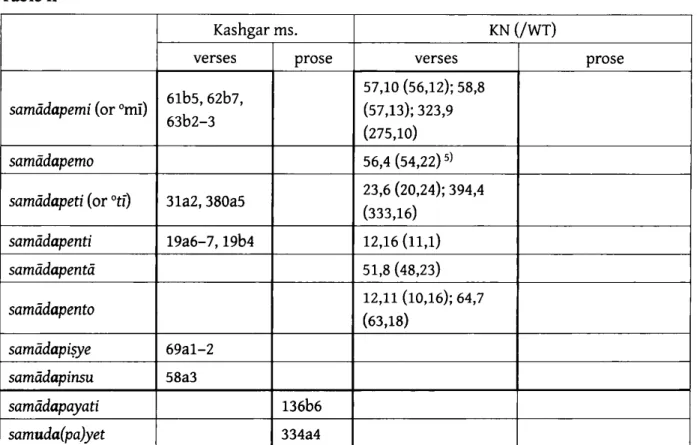
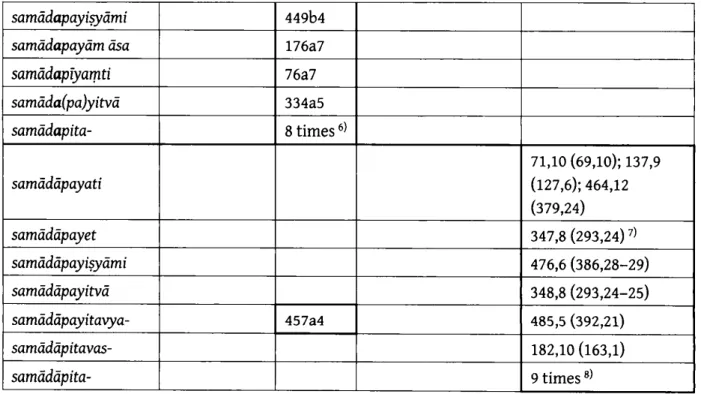
All
occurrences ofsamada-Upe-`" or samada-"paya-'i inthe
Kashgar ms. orKNIWT
that
I
canfind
are shownin
thefbllowing
table
II.
Table II
Kashgarms. KN(IWT)
verses
prose
versesprose
samadapemi(oremi)61b5,62b7, 63b2-3 57,10(56,12);58,8
(57,13);323,9
(275,10)
samadapemo 56,4(54,22)5) samdnapeti(oroti)31a2,380a5 23,6(20,24);394,4(333,16)
sama-dapenti 19a6-7,19b4 12,16(11,1) sama-dapenta- 51,8(48,23) samadtrpento 12,11(10,16);64,7(63,18)
samadtrpisye 69al-2 samadapirtsu 58a3 samadapayati 136b6 samuda(pa)yet 334a4 -1166
-On
thederivation
ofsamadapana-!lsamada-pana-in
theSaddharmapurpdarika-sUtra(KAsAMATsu)(125)
sama-dapayisyami 449b4 samadapayamasa 176a7 sama-daptyarriti 76a7 samada(pa)yitvdi 334a5 samadapita- 8times6> samadapcryati 71,10(69,10);137,9(127,6);464,12
(379,24)
samadapayet 347,8(293,24)7) samadapayisyami 476,6(386,28-29) sama'dapayitva348,8(293,24-25)
samada-payitarya- 457a4 485,5(392,21) samadapitavas- 182,10(163,1) samadapita- 9timesS)3.
Conclusion
What
has
been
discussed
above maybe
summarized asfo11ows
in
table
III.
Table III
Kashgarms. KNIWT
pali
verses prose verses
prose
samadape-ti
o
o
o
(e)sama-dapana-
o
0
osamddapaka-o
o
sama'dapaya-tio
sama'dapita-o
o
samadapaya-tio
(o)samadapana-
o
osamadapaka-o
samada'pita-o
samada-pita;lya-(lx)
Usage seen
in
the Kashgar ms,refer to one more example of a
is
the
same asthat
ofPaliliterature.Iwould
like
to
dative
infinitive
fbund
in
the
Agokan
inscriptions:
-1167-The Japanese Association of Indian and Buddhist Studies The JapaneseAssociation of Indian and Buddhist Studies
(
126)
Onthederivation
ofsamtuapana-!lsamaddipana-intheSaddharmapurpdarika-satra(KAsAMATsu)
samadapayitave alarri capalam sama-dapayitave, "tobe
ableto
incite
unsteadypeople"
(Delhi-TopraIs,
Allahabad
KausarnbiI4,
RadhiaI5,
RampurvaI4).
Itemergesfrom
this
survey that the stems samadape-t`found
in
the verseportion
ofBHSliterature
and sama-dapaya-tTjn
the
prose
portion
ofthe
Kashgar
ms. are the same asthe
onefbund
in
Pali
literature
and ASokaninscriptions,
i.e.,
Middle
Indo-Aryan
languages.
Causative
sama-dape-"i or samadapaya-t' areformed
from
the
present
stemlike
as Paliadapeti,
thapeti
etc.(cf.
A
Pali
Grammar
g180;
Pischel
[1981]
g551).
Passive
samadaptyatriti isconstructedwith -tya-
from
present
stem(cf.
A
Pali
Grammar
g176.2;
Pischel
[1981]
5535;
Edgerton
BHSG
g37,6).
Future
form
samadapisyefbund
in
Kashgar
ms,69al-2
would suggestedthat
sama-dapis
treated
as set-root. Thusit
seems reasonableto
assume that the nouns samadapana-/lsamadapaka- arefbrmed
from
this
pseudo-root
samddap with -ana- or-aka-suffixes.
It
shouldbe
concluded,from
whathas
been
discussed
above,that
there
mustbe
samdidapana-13iamadapaka- as well as samadapana-![samadakapa-in
the
BHS
literature,
especially
in
the
Saddhp's
Kashgar
manuscript.Notes
1) Toda's
[1981]
IndexTI
(p.
361)
admits samadapaka- atthe end of 44ob3, But there isonly samadapa, ekalp couldpresurnably
be
added inthe missing partof theleaf
440. Cfits
parallel
KN
466,8tathdgatadars'ana-sarnaJda-pakab.2) Khadaliq'sFragrnent6
(verso)
reads .,,madapanam eva satvd[n](a)[rri].3) Based on my personalexperience, itissame as
in
themss. of Saddhp. Cf Watanabe[1975],
Kotsuki[2014]
andJiang[1988].
According toTsukamoto[1988],
the only exceptionis
sama'dapanamof T,ms.
(MS.
no, 412).Although BHSD 5671gives
an entryfbr
sarnadapana- inSikij.
XVIII:337,1-2but
in
fact
the textreads sama-dayanena(cf.
Bendalt's[1897-19o2]
Index IIs.v.samadetyi and samadapanatd).4) +samadapayati. Fillingup some missing syllables according to
Siks.
53,2-3.s) LUshunms.readssa(m)a(dape)m(o).
6) Kashgarms. 114a2,177b5, 179bl, 296b2, 298bl,299a2,
300a3,
366a7. 7) Khadaliq'sFragment 77(verso)
reads samadapa at theend ofline6.
8)
KN
(wr)
110,7(102,27);
183,14(164,2);
185,7(165,6);
309,5(262,9);
310,15-311,1(264,2);
311,7(264,11-12.);
312,4(265,1);
380,4(321,23);
464,13(379,26).
Abbreviations
BHS: Buddhist Hybrid Sanskrit.
BHSD:
BuddhistHYbrid
SansiatitDictiona,y.KN: Saddhp editedby
Kern
and Narljio.KP: Kdyapa-Parivartaeditedby
VOrobyova-Desyatovskaya. ms.: manuscript.Saddhp:
Sanskrittextof 5addharmapundanTkct-Satru.Siks.:
Siks,
dsamuccaya
editedby
Bendall.
WT:-11os-Onthe
derivation
ofsama'dapana-13;ama'da-pana- intheSaddharmapundarika-satra(KAsAMATsu)
(127)
Saddhp
editedby
wogihara and Tsuchida.TextsBendall,
Cecil.Isg7-1902.
Ciks,asamuccaya:
A Compendiumof
BuddhisticTleaching;Compiledby
Ca-ntideva,
BibliothecaBuddhica 1.St,Petersburg:Commissionariesde
1'Acad6mie
inp6rialedes
sclences.
Chandra,Lokesh.Ig77.Saddharma-Pu"darika-5Utrti:KashgarManuscript.Tokyo:Reiyukai.
Hultzsch,E.1925.Inscriptions
qfAs'oka,
Oxfbrd:
Clarendon
Press.Reprint,New Delhi:ArchaeologicalSurveyoflndia, 1991.
Jiang
Zhongxin, 198s. A SanskritManuscriptofSaddharmapu4darika,
KeptintheLibraryofthe
CulturulPalace
ofthe
Nationalities,Beijing.
Beljing:
China
Social
SciencesPublishingHouse.Kern,
H.,
andBunyiu
Narljio.1908-1912. Saddharmapundarika BibliothecaBuddhica
lo.St.
petersburg: Inpr
de
1'Acad6mie
imp6rialedes
sciences,Kotsuki,Haruaki.2014. SanskritLotus Sutm Manuscript
from
the AsiaticSociedycKolkata(No,
4079):RomanizedTlext.Tokyo:Soka
Gakkai.
Stael-Holstein,Baron A.von, 1926.
The
Kdyapaparivarta:
A
MahdyanasUtraofthe
RatnakuFaClassintheOriginalSanskrit,inTibetanand inChinese.Shanghai:Commercial Press.
Toda, Hirofumi. 1981. SaddharmapupdarikastitTu:CentrulAsian Manttscripts Romanized Tlaxt.
Tokushima:Kyoiku Shuppan Center.
Vorobyova-Desyatovskaya, M. I.2002. The Kdyapaparivarta:Romanized Tlextand FUcsimiles,In
collaboration with Seishi Karashirna and Noriyuki Kudo. Bibliotheca Philologicaet
PhilosophicaBuddhica s.Tokyo:Intemational Research Institute
fbr
Advanced BuddhologyWatanabe, Shoko. 1975, Saddharmapundan-kaManttscripts found inGitgit.Part 2,Romanized Text,
Tokyo:Reiyukai.
Wille,Klaus. 200o, Fragments qfa Manuscript
of
theSaddharrnapu"darikasatrafiom
Kha-daliq,Tokyo: Soka Gakkai.Wogihara,U.,and C.Tsuchida.1934,Saddharmapupdarfka-Satram:Rornanizedand RevisedZext
oj'
theBibliothecaBuddhicaPublication
by
Consulting
a Skt.MS.&
Tibetanand ChineseTnctnslations.Tokyo: SankiboBuddhist
Book
Store.
References
Edgerton,Franklin,1953.BuddhistltybridSanskritGrammar and Dictionary.2 vols, New Haven: Yale UnjversityPress,
Geiger,wilhelm. 1994.A PaliGrammar, Translated
by
BatakrishnaGosh,
Revised
and editedby
K.R.Norman. Oxfbrd: The PaliText Society
It6Zuiei
crmeeebl
et aL 1993.Bonbun
Hohekyo'Ogihara,Tlsuchida-bonsjsakuinKIS[UiaggeXth
' ±M7IstwtptB1,Tokyo:Benseisha,
Pischel,R.1981.A
Grammar
ofthePrdkrit
Languages.
Translatedby
SubhadraJha.
Delhi:MotilalBanarsidass.
The Japanese Association of Indian and Buddhist Studies The Japanese Assoclatlon of 工ndlan and Buddhlst 二 St二udles
(128)
On the
derivation
ofsama −dapana
−/5αm百d
δPαηα一inthe Saddharmapu4dari1(a−sUtra (KAsAMATsu)Tsukamoto
Keish
δ塚本 啓 祥et al.1988. Bonbun Hokekyδ shahon shdSeiRo
“maji−
bon
, sakuin 梵 文 法華経 写 本集成ロ ーマ 字本 ・索引 .Vol.2,Tokyo:Bonbun Hokeky6 Kenkyakai . woolner, Alfred C.(1924)1gg3 .Asoka Text and Glossary. Delhi:Low
Price Publications.
Key w ・rds3 硼 面 @α η α一,sam δ
dOPaka
−, Kashgar manuscript(Associate Professor, National lnstitute ofTechnology ,
Sendai
College
)New
Publication
BDK
Tripi
aka
Translation
Series
Esoteric
Texts
The
Sutra
ofthe
Vow
ofFulfilling
the
Great
Perpetual
Enjoyment
and
Benefiting
All
Sentient
Beings
without
Exception
(
大樂
金
剛
不 空
眞
實
三麼
耶
經
)
Translated
by
Taisen
Miyata
The
Matahga
Sutra
(
摩 登 伽 經
)
Translated
by
RolfW
.Giebel
ノ
The
Bodhicitta
Sastra
(
金 剛 頂 瑜 伽 中發 阿 耨
多
羅
三藐
三菩提
心
論 )
Translated
by
Minoru
Kiyota
15 .6x
23 .1 cm
,161
pp
.,¥4
,320
($50
)Bukkyo
Dendo
Kyokai
,2015(