62
Article
Rice
Cultivation
and
Land
Tenancy
System
under
Shallow
Tubewell
Irri-gation
in Barind
Tract,
Bangladesh
A Case Study in Tetulia Village, Bogra District.*
Kazuo Ando, Md. Abdur Rashid and Yoshihiro Kaida
Introduction
The percentage of irrigated land in the total cultivated area in Bang-ladesh increased from 7 percent (1,433 thousand acres) in 1960/61 to 26 percent (5,483 thousand acres) in 1984/85 [Hossain 1989: 27]. This was attained mainly by application of irrigation to Boro rice 1) and wheat.2) The growth of irrigated farming has been a notable major change in Bang-ladesh agriculture.
Modern irrigation methods including low-lift pumps (LLP) and tube-wells (TW) have contributed much to the expansion of irrigated area,
* This paper is based primarily on our earlier study entitled " Economic and Social Aspects of Rice Cultivation: STW Irrigation and Land Tenure System ", in Kaida, Y. ed. Agricultural and Rural Development in Bangladesh: Tetulia Village in Bogra, JSARD Publication No. 16, June 1990, JICA Bangladesh.
安藤和雄 Kazuo Ando. Faculty of Agriculture, Kyoto University. Tropical
Agriculture. Other publications include:
" Rice Cultivation in the Low -lying Areas of the Bengal Delta-A Note on Mixed Aus and Broadcast Aman Cultivation and Parboiled Rice in the Eastern Region of Bangladesh " (in Japanese), Tonan Ajia Kenkyu (Southeast Asian Studies), Vol. 25, No. 1, Kyoto, CSEAS, pp. 125-139, 1987.
" Traditional Irrigation Technology and Rice Cultivation of the Dry Season in the Periphery Area of the Haor Region in Bangladesh "(in Japanese), Ajia Keizai, Vol. 32, No. 2, Tokyo, IDE, pp. 18-33, 1991. (with Haruo Uchi-da).
accounting for 4,579 thousand acres (84 percent of the total irrigated area) in 1984/85. The share of TW irrigation in the modern irrigation in-creased rapidly from 16 to 50 percent during the First and Second Five Year Plan periods (from 1977/78 to 1984/85). The shares of the three major forms of tubewell irrigation, i.e., deep-tubewell (DTW), shallow-tubewell (STW) and hand-shallow-tubewell (HTW)3) changed from 73, 22 and 5 percent respectively in 1977/78, to 34, 63 and 3 percent respectively in 1984/85. The annual growth rate of DTW, STW and HTW irrigation by acreage during the Second Five Year Plan period was 12, 54 and 22 percent respectively [Ahmed 1988: 83].
The above statistics indicate that STWs were adopted at an unusually high rate in the 1980s. The shift from DTWs to STWs was accelerated by the Government's policy of privatizing irrigation equipment , which was effected by reducing the subsidy to cooperatives and groups operating DTWs and encouraging individual farmers and groups to purchase ir-rigation equipment. STWs were more attractive to individual owners than DTWs as they involved much lower capital costs and much less administrative work arrangement for organization of farmers [Sadeque and Hakim 1989: 1-4]. Most STWs are owned either by individuals or jointly by small groups.
It is likely that " individual motivation on an individual scale " with Md. Abdur Rashid. Rural Development Academy, Bogra. Agronomy. Other publications include :
" Cropping Patterns and Their Changes in Tetulia Village ",The Bangla-desh Rural Development Studies, Vol. II, No. 1, Bogra, Rural Development Academy, pp. 48-60, 1990. (with Kazuo Ando).
" Characteristics of Hydrology and Irrigation Technologies : A Comparison. of Haor, Floodplain and Barind Areas ", Proceedings of the Second JSARD Work-shop August 20-21, 1989. Agricultural and Rural Development in Bangladesh, JSARD Publication No. 18. Dhaka, JICA Bangladesh, pp. 40-53, 1990. (with
Kazuo Ando and Haruo Uchida).
海 田能宏 Yoshihiro Kaida. The Center for Southeast Asian Studies , Kyoto
University. Rural Development. Other publications include:
" Rural -Urban Interaction and Its Implication for Rural Development in Bangladesh " (in Japanese), Tonan Ajia Kenkyu (Southeast Asian Studies) Vol.. 28, No. 3, Kyoto, CSEAS, pp. 403-416, 1990. (with Keshav L .Mahar-jan)
" Irrigation Landscapes and Waterscapes in the Rice Land of Tropical Asia ", Tonan Ajia Kenkyu (Southeast Asian Studies) Vol . 28, No. 4, CSEAS, pp. 574-585, 1991.
64 Journal of the Japanese Association for South Asian Studies, No. 3
the use of individual STWs is the major force behind the rapid expansion of Boro rice production in Bangladesh. We have studied, therefore, the effects of STW irrigation on the rice-based traditional cropping systems, household economy and socio-economic relations among villagers.
Our study village,4) namely, the village of Tetulia in Sherpur upazila, Bogra district, lies in the Barind Tract, a slightly elevated Pleistocene terrace covering the northwestern part of Bangladesh including Bogra, Rajshahi, Dinajpur and Rangpur districts. The unique agro-ecological character of the Barind Tract is traditionally involved a single rainfed rice crop of transplanted Aman with constraints of low rainfall and clayey Barind soil [Rasiuddin and Elahi 1984]. In the study village and its neighboring villages in the tract, vast areas of fallow land lay unused in the dry season, and agriculture depended on the single rice crop of the rainy season. More than 30 STWs now in operation in the village, how-ever, have transformed the gray, dry bare land of the dry season into a large green belt of modern variety Boro rice. In 1987/88, double crop-ping of Aman and Boro rice was practiced on 94 percent of the cultivated land of the village [Ando and Rashid 1990b].
A peculiar land tenancy system called chaunia has appeared in the vil-lage with the introduction of the STW irrigation. The STW owners rent lands in areas adjacent to their own pumps at a fixed rent and them-selves carry out irrigated rice farming in the dry season. This is unlike the common practice of TW owners to sell water and rarely seen else-where.5) This paper deals mainly with this peculiar chaunia system and is based on our intensive field studies from November 1988 to March 1989. We stayed in the village during the first two months and conducted an all-household survey of general socio-economic conditions and other investigations of specific aspects of the village, including interviews with 29 STW owners, to obtain detailed information on changes in the crop-ping system over time, practices of cropcrop-ping and irrigation, costs of ir-rigation and other inputs, landholding and its changes over time, etc. Major information on the chaunia was obtained by the interview.
1. Economics of Rice Cultivation
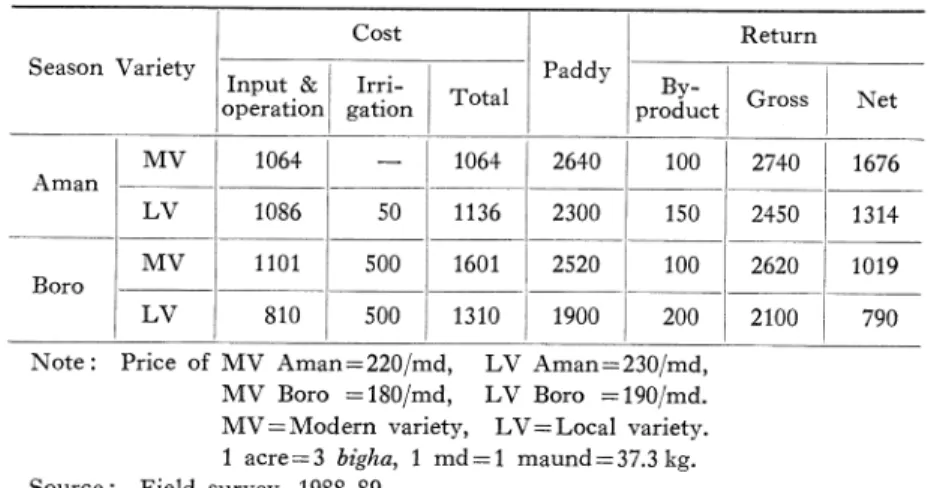
It is seen from Table 1 that the net returns as well as the gross returns from Aman rice are higher than from Boro rice, although the yield per bigha (1 bigha = 1/3 acre) of Aman rice is lower than Boro rice. This is
mainly because the price of Aman rice is higher than Boro rice.
The total input cost of Boro rice, excluding irrigation, is much less than that of Aman rice. This is mainly because of the lower ploughing re-quirement for Boro rice. The first ploughing of land for Boro rice cul-tivation is carried out under the optimal soil moisture conditions locally called /ow. It usually starts immediately after the Aman rice harvest. The land is then kept dry for 10 to 15 days without ploughing and lad-dering until the first irrigation. The land is puddled with the first ir-rigation, and the land preparation for transplanting Boro rice is thus completed with fewer ploughing. On the other hand, farmers start ploughing and preparing land for Aman rice cultivation after the rainfalls in July. The number of ploughing depends upon the timely rainfalls and usually the soil is rarely prepared well by single rainfall, thus requir-ing a number of ploughrequir-ing.
It may be said that Boro rice cultivation is theoretically less attractive to farmers in terms of the net returns due to the high cost of irrigation and cheaper price of rice. But, Boro rice cultivation has agronomic advan-tages of less requirement of ploughing and higher and more stable yield than Aman rice owing to fine weather of the dry season, provided that irrigation is available.
Table 1. Cost and Return on Existing Cropping Patterns (Middle land.), 1987/88
66 Journal of the Japanese Association for South Asian Studies, No. 3
Table 2, and Figure 1 as well, illustrate the average percentage of Boro rice production against total rice production and average sale of Boro rice against total sale of rice per one household. The table suggests that Boro rice is mostly cultivated for marketing while Aman rice is for home con-sumption. Figure 1 shows clearly that the farmer, who grows more
Table 2. Percentage of Boro Rice Production and Sale in Total Boro Rice Production, 1987/88
Note : The "rice production " includes all rice obtained as water fee paid in kind in korani, as rent paid in kind in chaunia and sharecropping. Source : Field survey, 1988-89
Fig. 1 Relationship between Sales Value and Production of Boro Rice, Tetulia Village, 1987/88.
Boro rice, sells it more. Briefly, Boro rice is the cash-crop in this village. 2. Land Tenancy System under STW Irrigation
(1) Land Tenancy System
Five types of land tenancy were found associated with irrigated Boro rice cultivation in the village. They are briefly accounted as follows.
Chaunia: Chaunia has developed in association with Boro rice
cultiva-tion. A land owner rents out a piece of land to a STW owner who op-erates the land for a fixed amount of rent, normally 3-4 maunds (1 maund
= 37.3 kg) of paddy for a Boro season. The cost incurred for producing the crop is borne by the STW owner. The rent for Aman crop is a little higher, 5-6 maunds of paddy because no irrigation is required.
Korani: Korani is an arrangement in which a land owner who does
not have his own STW buys water from a STW owner paying in advance Tk. 500 per bigha as a water fee for the Boro season. Those who can't afford to pay the cash advance are also allowed to pay in kind after the season, at a higher rate, usually 5 maunds of paddy.
Bad Badli literally means exchange. This exchange arrangement is
made between two STW owners, one of whom owns a part of his land in the other's STW command area and rents out that piece of land to the STW owner, and vice versa. In this case, rents are not paid, but the concerned land is exchanged over an agreed condition.
Sompotton (Lease): Sompotton or lease contract is normally made for
a year or a crop season, at a rate of Tk. 1,000 to 1,500, varying according to the land type involved. The land owner is not liable for any loss of production in the land concerned. Upon completion of the contract, the land reverts to the owner.
Khaikhalashi: Khaikhalashi is a type of land lease. It is normally practiced on a 7 year term, with the lease rate varying between Tk. 2,500 and 4,500 for the term, according to the types and quality of the land involved. Normally a person who needs a certain amount of cash, leases
out part of his land as khaikhalashi. Upon completion of the term, the land is returned to the owner.
According to Table 3 showing the historical development of land tenancy system in terms of the irrigated acreage, the first stage (1969 to 1976) is characterized by the own-use, and the second stage (1977 to 1981) is by the chaunia. During the second stage, both the own-use and chaunia
68 Journal of the Japanese Association for South Asian Studies, No. 3
dominated. The korani was comparatively insignificant. In the third stage from 1982 to 1987, the chaunia covered a large acreage (240 acre) and the korani also increased sharply. In 1987, the chaunia occupies 53% of the total irrigated acreage, the korani 25%, and own-use 17%.
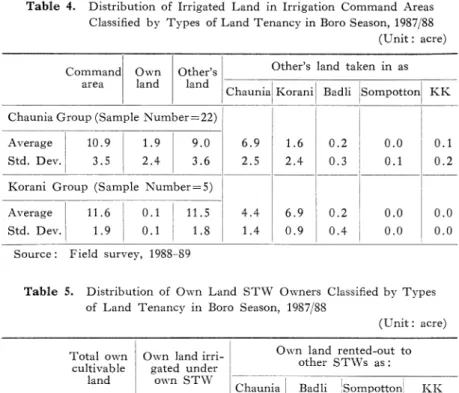
Two basic statistics on the STW irrigation in Tetulia village are pre-sented in Tables 4 and 5. Table 4 shows the distribution of irrigated land classified by the types of land tenancy in a STW command area, and Table 5 gives the distribution of own land of the STW owners by
Table 3. Development of Land Tenancy System in Tetulia Village after the Introduction of STWs
types of land tenancy. In order to classify the character of the STW owners, they are divided into three groups, namely chaunia, korani and sompotton group on the basis of the respective major arrangement they take. These information may support the following observations.
1) Not all the STW owners are large land owners. The average land holding of the chaunia group STW owners is 5.2 acres and that of the korani group is 1.2 acres. Twenty-two out of 27 STWs owned by the
Table 4. Distribution of Irrigated Land in Irrigation Command Areas Classified by Types of Land Tenancy in Boro Season, 1987/88 (Unit : acre)
Source : Field survey, 1988-89
Table 5. Distribution of Own Land STW Owners Classified by Types of Land Tenancy in Boro Season, 1987/88
(Unit : acre)
70 Journal of the Japanese Association for South Asian Studies, No. 3
chaunia group are installed in their own land, while only one out of five STWs of the korani group is in his own land. This is reflected in the fact that the chaunia group STW owners hold 50% of their own lands in their command area, while the corresponding percentage of the korani group is only 5%.
2) The average command area of a STW operated by the chaunia, korani and sompotton groups was 10.9, 11.6 and 12.7 acres respectively, with no significant difference.
3) The acreage under the chaunia arrangement of the chaunia group is 6.9 acre, and the one of the korani arrangement under the same group is only 1.6 acres. Whereas, the acreage under chaunia and korani arrange-ment in the korani group is 4.4 and 6.9 acres respectively. In case of the sompotton group, though only one case was identified in this category, the acreage of chaunia, korani and sompotton arrangement was 1.4, 4.8 and 5.3 acres respectively.
(2) Comparative Preferences of the Chaunia and Korani
The chaunia covers 53% of all the irrigated area, which is twice that of korani and 3 times that of owner cultivator. Why does the chaunia attract the STW owners so much? According to Table 6, the chaunia is more profitable, giving a STW owner 3.3 times more profit than the korani, or simply selling water.
As indicated in Table 7, a land owner who rents out his land through the chaunia gets Tk. 540 per bigha with no extra investment. This amount is higher than Tk. 461 received by a sharecropper under the
Table 6. Estimated Profit of STW Owners by Types of Land Tenancy in Boro Season, 1987/88 (MVs, Middle Land)
(Taka/bigha)
Note : Gross return=Paddy (14 mds @Tk. 180)+Straw (Tk. 100)=Tk. 2620 Source : Field suevey, 1988-89
korani arrangement, though this case is very limited here. The profit from the chaunia is comparable to that from the sharecropping. How-ever, if a owner-cultivator takes the korani, profit is Tk. 1,019, nearly twice that from the chaunia. The fee of sonpotton or lease arrangement is Tk. 800 which is less than the profit for an owner-cultivator under the korani.
The korani is the favourable system for a small own-cultivator cum STW owner because he is relieved of the large capital investment for running the STW, as he can receive cash water-charge in advance. A chaunia group owner needs larger capital both for running the STW and cultivating Boro rice by himself, but he can expect much larger profit than the korani. The chaunia is preferable system for large land owners.
Water users can obtain more profit under the korani rather than under the chaunia arrangement. It is thus in the interests of both the STW owners and water users operating under the korani to work together to expand the command area. The irrigation efficiency of an STW under the korani is therefore tends to be a little higher than under the chaunia.
Ten STWs out of 29 STWs are installed on land which does not belong to STW owners. This arrangement is made in order to avoid the compe-tition for the command area and to share the profit among STW owners.
In this situation, the STW irrigation is a profit-sharing business for STW owners.
The decision as to any STW owner adopting either the chaunia or the korani is related not only to the issues discussed above but also to the
Table 7. Estimated Profit of Land Owners by Types of Land Tenancy in Boro Season, 1987/88 (MVs, Middle Land)
(Taka/bigha)
Note: Return of Chaunia=3 mds @Tk. 180 = 540 Tk.
Gross return=Paddy (13 mds @Tk. 180)+Straw (Tk. 100)=Tk. 2620 Source: Field survey, 1988-89
72 Journal of the Japanese Association for South Asian Studies, No. 3 Table 8. Years and Methods of Obtaining STWs in Tetulia Village
73
difficulty in collecting money or paddy as water-charges from the water users under the korani. Often, farmers try to delay or escape from pay-ing water charges. Thus STW owners with large land holdings who can
afford to mobilize capital investments, naturally prefer the chaunia.
3. Mode of Purchase of STWs: Differences between Large and Small Land Owners
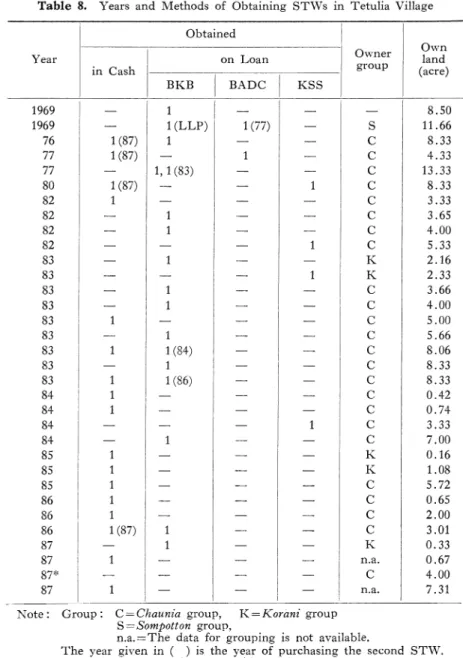
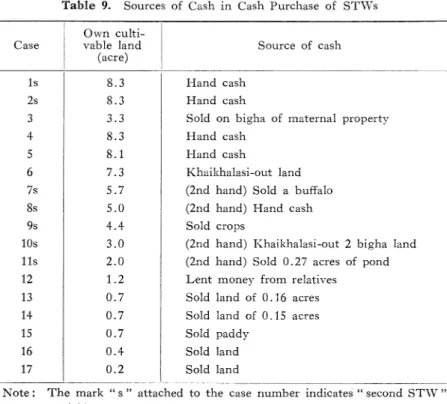
Table 8 shows the year and mode of purchase of STWs, and Table 9 indicates the source of cash in the cash purchases of STWs.
Prior to 1984 the medium and large land holders with land acreages varying from 2.16 to 13.33 acres used to purchase STWs mainly through loans from the Bangladesh Krishi Bank. On the other hand, from 1984 onward, the small land holders with land acreage below 1 acre began to purchase them mainly in cash from open market.
74 Journal of the Japanese Association for South Asian Studies, No. 3
The source of money for purchasing STWs also varies between the large and small land holders. The small land holders purchased STWs mainly by selling or renting out their property, namely land and cattle, while large land holders with a STW could purchase another STW using cash from his saving. Most large land holders of this village possess two STWs. These STW owners reported that they purchased the second STW from profits accrued through use of the first STW. They pur-chased the first STW by taking loan from the bank, but they had not yet repaid the loan fully. The price of land mortgaged in the bank against the loan has already been made up by the profit earned from the STWs. Nevertheless the government has been unable to have their land attached because the number of those not-yet-paid was so large. Had govern-ment enforced repaygovern-ment this would have become a large social and political problem.
The above discussion suggests that institutional credit encouraged large and medium land holders to purchase STWs, but did not attract the small land holders. But hard evidence of this is limited.
4. Social Relations between STW Owners and Land Holders (1) A Brief Historical Account of the Chaunia
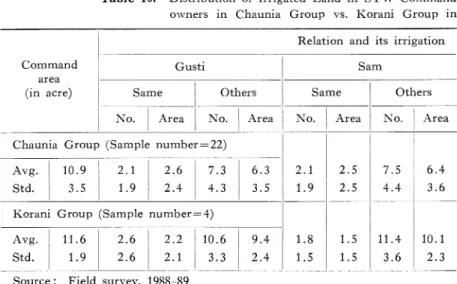
Table 10. Distribution of Irrigated Land in STW Command owners in Chaunia Group vs. Korani Group in
Today, the chaunia is commonly practiced not only in Boro but also in Aman rice cultivation, but it was not in practice before Boro rice was introduced with LLP irrigation. During the Pakistan period, the chaunia was applied only to Boro rice, and borga (sharecropping) was common for both Aus and Aman rice cultivation. After the Independence, the chaunia was introduced for Aman and Aus rice cultivation, and the borga disap-peared gradually. The chaunia has rapidly taken the place of borga in all seasons.
In 1968, a wealthy villager installed a LLP on the bank of a small river in the village, taking loan from the Krishi Bank (presently the Rajshahi Krishi Unnayan Bank), to try grow kaliboro, a local Boro rice variety. As his own land at the pump site was very small, he requested land owners in the vicinity to rent their land to him for Boro rice cultivation. The land owners willingly responded to his request without any rental charge,
because, one land owner reported to us, they had no idea about irrigated Boro rice cultivation by lifting water from the river.
At the harvest of his Boro rice in the following year, yield was found to be 6-7 maunds per bigha, with only light application of chemical fer-tilizer at the rate of 2-3 seers (1 seer =1/40 maunds) per bigha. The villagers were surprised to see the high return of irrigated kaliboro rice,
Area Classified by the Social Relationship with the STW
76 Journal of the Japanese Association for South Asian Studies, No. 3
and the next year, the land owners demanded to him one maund of paddy per bigha as a rental charge. In this way, the chaunia came into existence in this village.
The rate of rental charge in the chaunia gradually increased after 1976 in accordance with change of Boro rice variety and the rapid increase in STW irrigation. The chinese, a high yielding variety, grown firstly dur-ing Boro season in 1976 produced 13-15 maunds per bigha, which was twice the yield of kaliboro. The increase of STWs caused competition among the STW owners for getting land in command area of the STWs. In 1979, the rental charge was increased to 3 maunds per bigha for all kinds of land. Since 1987, the rate for the kandor land (most fertile land [Ando and Rashid 1990b] increased upto 4-5 maunds. In 1988, the rate of the chaunia in Aman rice was 6 maunds per bigha because of lower cost of irrigation.
(2) Social Relations between STW Owners and Land Holders
To investigate the social relations of STWs owners with their water users/land holders in the command area, the following set of information were analyzed.
(a) The social relationship of STW owners with the water users/land
holders in the command area in terms of their affiliation to gusti, sam, bari and para.6) (Table 10)
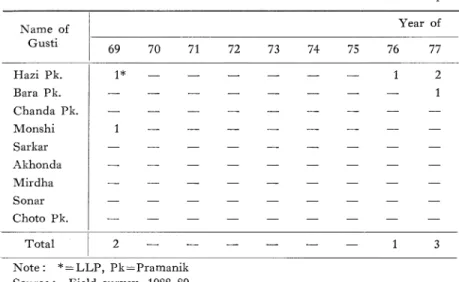
(b) Number of STWs in each gusti according to the year of purchase (Table 11).
(c) Gusti-wise land ownership map of 1911 prepared on the basis of the khatian (register made in the cadastral survey)
(d) Gusti-wise land ownership map of 1987, based on the new registra-tion number by the revisional survey of settlement of Bogra district. (e) The command area of the present STWs.
The following observation was made on the basis of the above set of data: 1) The number of the land owners in a command area of the korani group is larger than that of the chaunia group, as the land owned by the former is much smaller.
2) The member of ' others ' (Table 10) in all social units are larger in the korani group than in the chaunia group. It suggests that chaunia requires somewhat closer social relationship between the STW owner and land owners from whom he rents lands.
3) The member of ' same ' in para is much larger than ' others.' On the contrary, in other social units, the member of ' others ' is much larger than the ' same.' The social relationships except in the para may not
78 Journal of the Japanese Association for South Asian Studies, No. 3
be significant.
4) In such a case that the command area is distributed only in one para and the STW is installed in the STW owner's land, the acreage of land of the same gusti members is 5.7 acres against 3.6 acres of the land of other gusti members. It implies that if STW is installed in the STW owner's land and the command area is located within the para to which he belongs, their social relationship is based on the gusti relation.
5) The relative comparability in the shape of the command area of STWs with that of the gusti-wise land distribution supports the above observation.
6) The land of gusti scatter over the para where the members of gusti are residing. The paddy plots of individual gusti are likely to be concen-trated.
The above observations suggest that the gusti relationship is not pre-valent between STW owners and land holders, except the case in which the STW is installed in the para where the owner resides. One of the factors maintaining this relationship is the distribution pattern of the land of the gusti. This mechanism works to some extent for the land holders to provide their land to the STW owner under the chaunia arrangement. Villagers also reported that they would preferably rent their lands to those who were blood relatives more than to others at the time when the chaunia was introduced.
Conclusion
For the villagers of Tetulia, modern-variety Aman rice is cultivated for home consumption, and high-yielding Boro rice is produced for sale. In the Boro rice production, a new land tenancy system of chaunia is prevalent. The chaunia affords the STW owners much greater gains than simply selling water to the adjoining land holders. The STWs in the village are installed not only in the owners' own land but also in land owned by others in order to secure a larger irrigation area and to reduce business competition. These major findings suggest that STW irriga-tion is providing a good economic chance for the STW owners to invest their surplus income in their own village. These STW owners are village-based entrepreneurs who invest their surplus in developing potential agricultural production.
on the agrarian society of Bangladesh has centered around "access to water " in the framework of large vs. small farmers or rich vs. poor farmers. Arguments have been focused on economic " polarization " in the village on the basis of the size of landholding [Jansen 1979; Howes 1985; and Lein 1990]. The recent government policy of privatizing irrigation equipment has created a class of " water lords " in rural Bangladesh, who sell water to farmers at an exorbitant rate [Jaim 1990; Fujita 1990]. The term " water lord " implies unfair " access to water."
In the case of STW irrigation, " access to water " may be better expres-sed as " possession of water." Our case study of Tetulia village suggests that the problem of " water lords " should be discussed in the context of the emergence of rural entrepreneurs who " possess water " in order to exploit potential rice production in rural Bangladesh. More empirical studies are required to evaluate the positive role of the " water entre-preneurs." We need to know how they make the decision to investing in STWs, how they mobilize their capital for the STW installation, how they do their "irrigation business," how they accumulate capital, and where they invest the capital gained from irrigation. The authors wish to explore this area further in future.
Acknowledgment
We conducted this study as a part of the " Joint Study on Agricultural and Rural Development in Bangladesh," sponsored by the Ministry of Agriculture of the Government of Bangladesh and Japan International Cooperation Agency (JICA). Dr. Bruce Currey, Program Leader of Human Resources Development Division, Windrock International, read our draft report very carefully and gave us warm encouragement and sharp academic comments. Dr. Haruo Uchida, National Research In-stitute of Agricultural Engineering (NRIAE) has also given us valuable comments during the preparation of this report. We thank our field assistants and villagers of Tetulia for helping us in various ways in the village.
Notes
1) Rice varieties are classified into three ecotypes, Aus, Aman and Boro, on the basis of their physiological and agronomic characteristics. Local varieties of Aman rice are strongly photo-sensitive and are mostly harvested in
November-80 Journal of the Japanese Association for South Asian Studies, No. 3
December. Local varieties of Aus and Boro rice are weakly photo-sensitive and are harvested in July-August and April-May respectively. The names Aus, Aman and Boro are also used for the rice-growing seasons derived from the ecotypes of local varieties.
2) The share of Aus, Aman, and Boro rices, wheat and other crops in total ir-rigated area are 7.5, 8.3, 62.4, 11.2 and 10.6 percent respectively in 1983/84 [Fujita 1990] .
3) Tubewells are classified into deep tubewells (DTW), shallow tubewells (STW) and hand tubewlls (HTW). The DTWs and the STWs are driven either by diesel engines or electric motors, and the HTWs are operated manually. The STWs are normally from 30 to 40 feet deep, and the DTWs can be as deep as 100 feet [Ahmed 1988 : 77].
4) The village is located in the westernmost corner of the upazila bordering Nandigram upazila, about 9 kilometers west of upazila headquarters of Sherpur paurashava, on a winding dirt cart-track. It is typical of villages on the level Barind Tract. The total population of 766 is clustered into 160 households (1988). The village is split into two paras or gatherings of households, the Muslim para with 130 Muslim households, and the Hindu para with 30 Hindu Households. The average landholding is 3.1 acres per Muslim household and 3.5 acres per Hindu household.
5) Glaser, M. [1989] reports on the chaunia observed in her study villages in Rajshahi district. She uses the term " reverse tenancy of fixed in-kind rent " for the chaunia we found in Tetulia village. She explains with respect to the rental system that poorer landowners without access to irrigation water and without feasible alternative cropping patterns are forced to rent their land to STW owners.
6) Bari and para are the basic social units. A bari is a cluster of several house-holds of patrilineal relatives. There are 17 of them in the village. A para is
an aggregation of bari. This unit is almost identical to gram, or ga in the local dialect, and people call each other gramiyo bhai or chacha as if they were kin.
Gusti and sam are two informal but also very basic social units inthe village. Gusti is a group of villagers who have a common male ancestor in their pat-rilinial genealogy. The Muslim para has 12 gusti, of which the largest one
contains 27 households and the smallest one two households. There are four gusti in the Hindu para, the largest of which contains 19 households. The sam is a more functional unit which handles disciplinary and behavioural matters of the members who are household heads. It is headed by a leader,
Reference:
Ahmed, Mushtaq. 1988. Bangladesh Agriculture-Towards Self Sufficiency, Dhaka, External Publicity Wing, Ministry of Information, Government of Bangladesh . Ando, K. and Rashid, M. A. 1990a. " Economic and Social Aspects of Rice
Cultivation: STW Irrigation and Land Tenure System," in Kaida , Y. (ed.), Tetulia Village in Bogra, Agricultural and Rural Development in Bangladesh, JSARD Publication No. 16. Dhaka, JICA Bangladesh, pp. 23-44.
Ando, K. and Rashid, M. A. 1990b. "Cropping Patterns and Their Evolution ", in Kaida, Y. (ed.), Tetulia Village in Bogra, Agricultural and Rural Development in Bangladesh, JSARD Publication No. 16, Dhaka, JICA Bangladesh, pp. 15-22. Fujita, Koichi. 1990. "Development of Irrigation and Institutional Issues ", (in
Japanese), in Sato, H. (ed.), Bangladesh: Teikaihatsu no Seijikouzou [Bangla-desh: Political Dimensions of Underdevelopment], IDE Kenkyu Sosho [IDE Re-search Series] No. 393, Tokyo, IDE, pp. 209-257.
Glaser, Marion. 1989. " Land Tenancy and Shallow Tubewell Irrigation: Alter-native Trajectories of Agrarian Change in Bangladesh ", The Journal of Social Studies, No. 45, Dhaka, CSS (Centre for Social Studies), pp. 51-67.
Hossain, Mahabub. 1989. Green Revolution in Bangladesh. Dhaka , University Press Limited.
Howes, M. 1985. Who's Water? Dhaka, BIDS (Bangladesh Institute of De-velopment Studies).
Jaim, W.M.H. 1990. " Strategies for Agricultural and Rural Development in Bangladesh ", in Kaida, Y. (ed.), A Review of Related Studies. Agricultural and Rural Development in Bangladesh, JSARD Publication No. 19, Dhaka, JICA Bangladesh, pp. 115-127.
Jansen, E. G. 1979. " Choice of Irrigation Technology in Bangladesh: Impli-cations for Dependency Relationships between Rich and Poor Farmers ", The Journal of Social Studies, No. 5, Dhaka, CSS (Centre for Social Studies),
pp. 61-84.
Lein, Haakon. 1990. " Persistence and Polarization: The Case of the " Green Revolution " in Bangladesh," The Journal of Social Studies, No. 48, Dhaka, CSS
(Centre for Social Studies), pp. 112-126.
Rasiuddin, M. and Elahi, N. E. 1984. " Technologies for the Low Rainfall, Barind Tract ", in Proceedings of the First BRRI-Extension Multilocation Work-ing Group MeetWork-ing on Rice-based CroppWork-ing Systems, 14-15 March 1984 , BRRI (Bangladesh Rice Research Institute), pp. 107-132.
Sadeque, Syed. and Hakim, M. A. 1989. Review of Studies on Shallow Tubewell Irrigation Management in Bangladesh, Dhaka , BARC (Bangladesh Agricultural Research Council).