■ Article ■
Decentralisation
or Retreat
of the State?:
Comparison
of House
Tax Collection
in Village
Panchayats
in Madhya
Pradesh
and Tamil Nadu
●
Yu Sasaki
1. Introduction
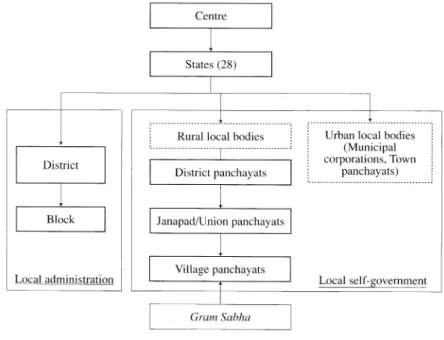
The 73rd constitutional amendment in India marked a significant watershed in terms of advancing the goal for decentralisation and development of rural local self-gov-ernment, namely Panchayati Raj Institutions (PRIs). The amendment provided for the uniform structure of three-tier PRIs [Figure 1], guaranteed regular elections for its representatives and further sought to empower them by guaranteeing financial pow-ers. These financial powers included a) tax imposing power, b) assignment of certain funds of Staten government to PRIs and c) grants in aid to PRIs (Article 243-H). The 73rd amendment, arguably therefore, was intended to provide an incentive to the cen-tral as well as the State governments to devolve a part of their financial powers to PRIs.2) Devolution, according to Cheema and Rondinelli, is the most comprehensive form of decentralisation, involving the transfer of functions and authority from the central government to autonomous units of local governments [1983: 22-23]. Al-though the reality on the ground is often perceived otherwise, the principle of de-volving financial power to the PRIs, provided in the 73rd amendment, is widely considered to be a significant part of the devolution process. This can also be seen as a sign of guaranteeing PRIs as 'self-government' in a true sense as originally con-ceived in the Constitution.3)
Although PRIs have attracted much attention, most studies are limited to anecdotal insights or suffer from lack of empirical data [Robinson 2005]. Moreover, the sheer
佐 々木 結 Yu Sasaki, Ph.D candidate, Graduate School of International Cooperation Studies, Kobe University
76 Journal of the Japanese Association for South Asian Studies, 17, 2005
diversity amongst various States in terms of issues of governance has made it difficult to compare and contrast administrative functioning amongst them, especially on the basis of a set of measurable indicators.4) Perhaps, the only comprehensive analysis of PRIs so far has been the study recently published by the World Bank that sought to examine the performance of decentralised institutions in seven States [200045) From the empirical claims of this report, the World Bank went on to argue in another re-port that there was 'steady progress' in 'the devolution of powers' in States such as
`
Karnataka, Gujarat, Maharashtra, West Bengal, Kerala, and Madhya Pradesh' [2000b: 45]. Nonetheless, this report still failed to provide clear criteria for measur-ing the complex issue of performance amongst PRIs in India. If increased devolution is linked to enhanced administrative performance, as most contemporary discourses on public administration claim, then clearly much of the assessment of PRIs still lacks empirical and conceptual analysis, despite the voluminous literature on the subject. Studies are yet to firmly establish methods for comparing and ascertaining adminis-trative performances by decentralised institutions across States in India.
This paper is a modest attempt at engaging with this conceptual gap in the decentralisation debate in India. In order to assess the performance of the PRIs, I will compare and contrast village panchayats in Madhya Pradesh and Tamil Nadu respec-tively, in terms of their capacities for mobilising financial resources. The idea will be
to offer some sort of acceptable template for judging and evaluating the manner in which decentralisation strategies have been put into operation in these two States. In effect, therefore, I will also assume that the increased resource mobilisation power of the PRIs is a good indicator of their enhanced administrative performance as decen-tralised institutions. With this objective in mind, this paper will compare tax collec-tion in village panchayats in Madhya Pradesh and Tamil Nadu. The data regarding tax collection was gathered at village panchayat offices during my first visit to the two States from December 2003 to March 2004.6) Information on the 'local adminis-tration'7 [Figure 1] and its relations with PRIs was also gathered through interviews with the block, district and State level officials in charge of PRIs as well as with vil-lage panchayat presidents and secretaries. These data and information were supple-mented with those gathered during a second field research conducted from January to March 2005 in the two States.
As a result of the enquiry, it was found that village panchayats in Madhya Pradesh hardly collect tax while their counterparts in Tamil Nadu show very high level of col-lection. It was also revealed that village panchayats in Tamil Nadu, unlike their coun-terparts in Madhya Pradesh, were inspected and supervised regularly by the local administration. Ironically, therefore, it appears in the Tamil Nadu case in particular that the members of the centralised State administration play a constructive and sup-portive role in securing accountability of village panchayats as well as improving the performance of PRIs. This leads to a conclusion which contradicts the assumption of international financial institutions, such as the World Bank, that decentralisation is more or less a linear process in which the state retreats. The conclusion in this paper shares some similarities with the findings of Judith Tendler [1997] that the process of decentralisation is more complex and multi-dimensional, involving both centralisation and decentralisation of authority, and that the State government plays an active role. Thus, it can be said that a carefully calibrated degree of centralisation was effective in making decentralisation more successful in Tamil Nadu, while in the case of Madhya Pradesh, a complete retreat of the state resulted in a dismal status of the panchayats' capacity for financial viability.
2. Background
2.1 Discourse of decentralisation
The last two decades has seen the enthusiasm or 'fever' for decentralisation in many Third World countries [Harriss 2002: 71]. Despite its earlier failure in the 1950s and 1960s in South Asia as well as in Africa, the 'second wave' [Crook and Manor 1998: 3] of decentralisation has attracted the attention and support from a much wider range of discourses, such as from `Gandhians' or `anarcho-communitarians' to even free market economists [Bardhan 2002]. This 'second wave' of decentralisation has
78 Journal of the Japanese Association for South Asian Studies, 17, 2005
coincided with the collapse of Communist regimes and has increased emphasis on the notion of 'good governance' as a development agenda, which might have contrib-uted to the over-expectation on decentralisation [Crook and Manor 1998: 2].
The World Bank, one of the major advocates of decentralisation, argues that de-centralisation is a process of rethinking the role of the state and transferring the state's authority to institutions 'closer to the people' with participation of civil society [World Bank 1994: 75-79; 1997: 110-123]. Decentralisation was increasingly incorporated into the structural adjustment programme together with liberalisation and privatisation, or promoted through direct loans to subnational governments in the 1990s [World Bank 1994; Litvack, Ahmad and Bird 1998]. The view of the World Bank is strongly influenced by fiscal federalism which argues that decentralisation increases efficiency in public service provision and local resource mobilisation [Inman and Rubinfeld 1997; Musgrave 19971.8) According to such discourse, the state is minimised as just one of the many agents providing public services together with other subnational governments, private service providers and NG0s.98
On the other hand, more sceptical observers warn us about the 'danger' of decen-tralisation, claiming that decentralisation does not necessarily increase efficiency in service provision and often leads to control of resources by local elites [Prud'homme 1995; Tanzi 2002]. Tendler also argues that decentralisation is not a simple process of transformation from a centralised state to a more decentralised one, but involves certain degree of administrative centralisation while decentralising the provision of services [Tendler 1997]. With regards to the role of the state, Bardhan concludes that
`
the state, far from retreating into the minimalist role of classical liberalism. may
sometimes have to play certain activist roles' in order to avoid exploitation by local elites and to ensure building up of local capacity [Bardhan 2002: 202]. So what is the role of the state in decentralised India? Is decentralisation about the retreat of the Indian state?
2.2 Decentralisation in Indian context
According to the categorisation by Crook and Manor [1998], the first wave of de-centralisation in India came in the 1950s. However, as Tendler argues, it was not a linear process of decentralising the former centralised regime. Mukarji argues that although the colonial state was unitary, it was far from centralised. It was more de-centralised than the state in post independent India, leaving local problems to be man-aged by elite bureaucrats in the provincial governments and 'ruler model' districts [Mukarji 1996: 261-262]. The challenge faced by the post independent state was a complex one: maintaining national unity and achieving rapid economic development, while minimising the control of bureaucracy which the independent state inherited from the colonial state.10) The political leadership at the State level was not willing to accept the discretionary powers left with bureaucrats, and made sure that official posts
were arranged in a way that power remained concentrated at the top [Webster 1996: 227].11) At the national level, the solution to the complex challenge was sought in a centralised planning system with the Planning Commission playing a decisive role in resource allocation and decision making of other major policies [Chatterjee 1998]. In this way, the initial stage after independence saw a process in which 'a bureaucrati-cally decentralised system ... gave way to a politibureaucrati-cally centralised one' [Mukarji 1996: 262].
The first wave of decentralisation was witnessed in the context of centralisation of resource allocation. Although PRIs were not given much attention in the original con-stitution, they were revived by Nehru's government in order to successfully imple-ment the Community Developimple-ment programme (CD). CD started in 1952 as a part of the First Five Year Plan with financial aid from the United States.12) The programme was aimed at increasing food production and providing various social welfare schemes at the village level. After the initial period of stagnation, Balwantrai Mehta Committee was appointed to review the programme and recommended to the gov-ernment in 1957 to vigorously empower democratic participation through PRIs [GOI
1957]. Following the recommendation, all States made their respective panchayat acts by 1959 and the first experiment of PRIs after independence was initiated at the all India level. However, this enthusiasm did not last long and by the end of the 1960s, PRIs stopped functioning in many States even as implementing agencies.
Several reasons have been given for the decline of first wave decentralisation: in-creasing government schemes implemented outside PRIs; shortage of resources avail-able for PRIs [Maheshwari 2000]; reluctance and resistance by bureaucracy in alliance with local, State and national level politicians [Mathew 1994]. However, more careful observers agree that the root of the problem was the failure of land form. The experiments of CD and PRIs were coincided with the stress on land re-form during the Second Five-Year Plan. Nehru combined these policies hoping that CD based on PRIs would alter the traditional power structure in villages and 'form the basis of a progressive agrarian structure' [Chakravarty 1987: 21]. However, con-trary to Nehru's intention, the failure of land reform resulted in the failure of CD and PRIs [Kaviraj 1996; Manor 1999]. PRIs were taken over by local landed elites and
`
(i)nstead of undermining their power, it [PRIs] gave their economic control over the lives of common villagers an additional stamp of electoral legitimacy' [Kaviraj 1995: 105].
While PRIs declined, however, the local administration remained the sole agent of the state in rural India. Besides, the implementation of CD changed the structure of local administration drastically by introducing the new post of Block Development Officer (BDO). District, which had been the basic unit of administration since the British rule, was divided into several blocks, each covering an average population of 300,000. BDO became the head of about 30 officials from various departments
sta-80 Journal of the Japanese Association for South Asian Studies, 17, 2005
tioned at the block office and responsible for implementing and coordinating various rural development schemes. Although the District Collector13) remained at the top of district administration with its integrated power, BDO became 'the second kingpin in district administration' [Maheshwari 2000: 1001. In other words, due to the dysfunc-tion of PRIs, BDOs did not have to be accountable to elected officials, and unlike officials at the State or national level, he or she could exercise relatively free-hand control on various development schemes.
It was not until the 73rd and 74th constitutional amendment in the early 1990s that the decentralisation policy was taken up at the all India level again.14) This 'second wave' of decentralisation in India, unlike the first one, is debated in a much wider context of governance and deepening of democracy. The 73rd amendment, passed one year after the initiation of economic liberalisation, is increasingly regarded as a mea-sure to enhance 'participation' of 'civil society'. Possibly due to the progressive seat reservation for women, scheduled castes and scheduled tribes, PRIs are often re-garded as a part of 'people's sector' [cited in Vyasulu 2003: 47] or as being in the
`
private' as opposed to the 'public' sphere.15) It is true that PRIs, especially village
panchayats, have a dual aspect of being part of both the local administration and the village community. However, at the same time, PRIs are 'self-government' as stated in the constitution. They are a part of the government, with all the legitimacy em-bodied by the elected representatives and a clear area of jurisdiction. This paper tries to examine the second aspect of PRIs, that is, PRIs as local self-government, in order to evaluate their performance.
2.3 Ground level reality
Following the 73rd amendment, every State made their conformity act (CA) accord-ingly. There are two major changes in panchayat finance since the CA. The first change is the multiple increases in development funds directed to PRIs from both cen-tral and State governments. The second is the transfer of management of village panchayat accounts from BD016) to village panchayat. In the 1990s, the revenue of PRIs tripled and more than 95% of that revenue was the transfer from both central and State governments [Figure 2]. Most of these transferred funds were 'tied' funds which cannot be used other than for the designated purposes. The critics of panchayat finance argue that these tied funds should be reduced and there should be more un-tied funds so that PRIs have discretion on how to use them.17) However, more significant is the fact that the management of these tied funds has been transferred to village panchayats and is no longer the task of BDO. Although the funds are tied and can only be used according to the guidance of the government, it is the president and the secretary18) of the village panchayat who actually disburse the development funds from their bank account. The account books are maintained by the panchayat secre-tary at the panchayat office, and not by BDO at the block office as it used to be the
case. Although there are still frequent interventions by local officials regarding the disbursement of developmental funds to the panchayat's bank account itself, theo-retically, village panchayat representatives no longer have to go over to the block office to plead for disbursement. On the other hand, as sceptical observers warn about the control of resources by local elites [Prud'homme 1995; Tanzi 2002], one has to observe carefully how such increased funds are managed at the village panchayat level. Therefore, it is not only the amount of discretionary funds of the village panchayat but also the management of such funds that requires to be examined.
3. Finance of PRIs
3.1 Rationale for analysing house tax collection
There are three categories in the revenue of PRIs: own tax revenue, own non-tax revenue and other revenue [Figure 3]. 'Own tax revenue' includes the revenue from taxes levied and collected by the PRIs. 'Own non-tax revenue' refers to the revenue
Source: Report of the Eleventh Finance Commission for 2000-2005 [GOI 2000] Figure 2 Total Revenue of PRIs (Rs.)
82 Journal of the Japanese Association for South Asian Studies, 17, 2005
from fees, user charges and cesses levied and collected by the PRIs. The remainder
of the revenue is referred to as 'other revenue', which includes shared taxes from the
State government, various government scheme funds and so called 'block funds' or
`
untied funds' that can be used at the discretion of PRIs.
Regarding the necessity of grants from the upper level of governments, Rajaraman [2003] argues that the additional own tax revenue is necessary for panchayats for two reasons. First, it gives incentives to panchayats to seek low cost options in their ex-penditure. Second, it improves accountability 'downward' because of 'the enhanced visibility resulting from the reduced distance between the taxpayer and the govern-ment' [ibid.: 23]. In order to avoid the vicious practice of 'financial irresponsibility' and to ensure accountability, own tax revenue is important for a local self-govern-ment.
The tax examined in this study is House Tax19) which comes under the category of village panchayat's own tax revenue for the following reasons. First, unlike 'own non-tax revenue' which includes user charges for water, light or drainage, house non-tax is imposed on almost all the households as long as they own houses, regardless of the amount or kind of services they receive in return. Therefore, the condition for collec-tion is supposed to be similar in all panchayats. Second, in many States, house tax is provided as an obligatory tax in CA and one of the major own tax sources20) of vil-lage panchayat with the broadest tax base. House tax is to be levied by the vilvil-lage panchayat21) upon all the houses within its jurisdiction. As long as house tax is an obligatory tax, the ability of the village panchayat to levy and collect house tax may reflect its ability as a local self-government unit, which is, in turn, supported by both the trust of villagers and the given institutional conditions.
3.2 State Wise Comparison of PRI Finance
Following the provision of the 73rd Constitutional Amendment (1992), most States established State Finance Commissions (SFC) in 1994. SFC, the equivalent of Fi-nance Commission constituted at the Centre, is to recommend to the State govern-ment with regards to the distribution of funds from the State governgovern-ment to PRIs. With the recommendation of SFC, the revenue of PRIs increased considerably [Ap-pendix 1].
The rate of increase in the revenue of PRIs varies for each State. Kerala and Madhya Pradesh are among the highest, and Punjab and Tamil Nadu the lowest.22) Kerala is well known for its high social indicators and vibrant civic culture, which contribute to make its PRIs active in participatory planning, based on its tradition of grass-roots movement [Tornquist and Tharakan 1996; Issac and Franke 2000]. Madhya Pradesh, on the other hand, is less studied compared with Kerala, but is known for its initiative in the decentralisation reform taken by the Congress govern-ment since 1994. Digvijay Singh, the then Chief Minister, recognised decentralisa-tion as a 'pre-requisite' for accelerating economic growth and empowering the poor
and the weak [GOMP 2001: Madhya Pradesh was the first State to hold three-tier
panchayat elections after the 73rd amendment in 1994. Hence, it seems reasonable that these two States lead the other States in terms of increasing the level of financial devolution to the PRIs.
However, when we look at the classification of the revenue, own revenue ratio (taxes, fees and other charges) of the total revenue of PRIs in each State shows dif-ferent trends from those of total revenue. Kerala remains the top among all States, while the own revenue ratio of Madhya Pradesh appears very low, contrary to its over-all increase. On the other hand, it is interesting to note that States like Tamil Nadu score very high on own tax revenue ratio despite its minimal level of total revenue [Figure 4]. Moreover, Tamil Nadu increased its own tax revenue ratio from 1991 to 1998, which is not the case for many other States. Madhya Pradesh, regarded as a good performer in the 'devolution of power' by the World Bank, is not necessarily performing well in terms of resource mobilisation, whereas Tamil Nadu, which is not even considered as a decentralised State, is performing well.
It was expected by the fiscal federalists that decentralisation would increase efficiency in local resource mobilisation, but this does not seem to be the case in re-ality. If we suppose that increase in the own tax ratio of a village panchayat indicates its capacity as local self-government to mobilise local resources and hence leads to its fiscal as well as overall empowerment, examining why village panchayats in Tamil Nadu succeeded in increasing their own tax revenue, while their counterparts in Madhya Pradesh failed to do so, regardless of the amount of their overall revenue, may give us some insight into understanding the problems of local self-government.
84 Journal of the Japanese Association for South Asian Studies , 17, 2005
4. Case study: Comparison between Tamil Nadu and Madhya Pradesh Both in Tamil Nadu and Madhya Pradesh, the panchayat secretary conducts the evaluation of houses on the basis of rough criteria such as the kind of roof and size , and decides the level of tax at the beginning of the fiscal year.23) Villagers come to pay the tax at the panchayat office, often on the occasion of Gram Sabha or when they apply for some official documents. House tax is the largest 'own tax' source for village panchayats in both Tamil Nadu and Madhya Pradesh . House tax revenue is mainly used for operation and maintenance activities , such as the electricity bill for power pumps and streetlights, since most of the construction works can be done with the grants from the State or central government. It is these operation and maintenance costs that often become a huge financial burden in panchayats where there is no own revenue.
The actual house tax collected in both States is compared in Table 1.24) It is clear from the table, in terms of both per panchayat income and per capita income , that house tax collection is considerably higher in village panchayats in Tamil Nadu than that in Madhya Pradesh. What makes this significant difference appear between the two States?
4.1 Possible explanatory factors
There are three possible factors to explain the difference in house tax collection between the two States. First of all, the low level of own revenue ratio in Madhya
Source: Report of the Eleventh Finance Commission for 2000-2005 [GOI 2000] Figure 4 State-Wise Own Tax Revenue Ratio of PRIs
Pradesh is a relative phenomenon since it is simply a result of the hugely increased transfer of developmental funds from the central plan expenditure, whereas the trans-fer from the central plan expenditure did not increase as much in Tamil Nadu. As it can be seen in Appendix 1, the rate of increase in 'other expenditure' during 1990-91 and 1997-98 is 761% in Madhya Pradesh and only 151% in Tamil Nadu. The case of Tamil Nadu, in particular, can be explained by the fact that the severe fiscal con-straints at the State level forced village panchayats to increase their own revenue so that they can cover the developmental expenditure on their own:25) Punjab and Haryana show a similar tendency to Tamil Nadu: a low level of increase in 'other revenue' with a high level of non-tax revenue. However, the actual house tax collec-tion in Tamil Nadu and Madhya Pradesh still shows considerable disparity between the two States [Table 1]. In addition, fiscal constraints are a common problem shared by many other States. Moreover, the case of Kerala shows that it is possible to in-crease own tax revenue, in addition to the inin-creased transfer from central plan schemes. Fiscal constraints could be a part of the explanatory factor, but is certainly not sufficient. The question remains as to why the high level of own tax collection was possible in Tamil Nadu but not in other States.
The second possible explanatory factor is the income disparity among States. In terms of per capita Net State Domestic Product (NSDP), however, even the high-in-come States such as Punjab, Maharashtra and Haryana are performing poorly in own tax ratio, though Punjab and Haryana are performing well in own non-tax ratio. Therefore, although per capita NSDP of Tamil Nadu scores 1.75 times higher than that of Madhya Pradesh, it may not be a reasonable indicator for considering the ef-fect of income disparity between the two States. Although it is difficult to compare the actual income disparity in rural areas between the two States, it is possible to speculate from the villagers' attitude towards paying tax by comparing it with other resource mobilisation schemes in rural areas. Swam Jayanti Swarojgar Yojna (SGSY) is a central government scheme mainly targeting families below the poverty line (BPL) to ensure a sustainable level of income through micro-finance. BPL families are encouraged to form Self Help Groups consisting of about ten families per group. Each family saves a monthly amount, so as to be eligible for an extra grant from the government after a year.26) With their own savings as well as added government grants, they can rotate loans within the group and/or buy dairy animals to generate income. During the financial year 2002-2003, 51,907 BPL families27) benefited from the scheme in Madhya Pradesh, and each family saved about Rs. 30 monthly under this scheme [GOMP 2004]. In an interview conducted at a village panchayat in the district of Damoh, villagers from poor families complained that there was no money left to pay tax after feeding their children and criticised the government for doing nothing for them. However, even such families were participating in Self Help Groups to save monthly, which suggests that they would pay as long as they expect an actual
86 Journal of the Japanese Association for South Asian Studies , 17, 2005
return. Given the fact that the lowest level of house tax is Rs.10-20 a year, the reason why people do not pay tax does not seem to be simply because they cannot afford it, but because they do not feel obliged to do so and/or because they cannot expect any return from the village panchayat. Therefore, there may also be reasons other than economic constraints.
The third explanatory factor is the 'matching grant' in Tamil Nadu. The matching grant is a kind of incentive grant given to local bodies levying taxes, which are cur-rently seen only in Maharashtra and Tamil Nadu. 'House tax matching grants' exist only in Tamil Nadu Maya 1998]. They are given to village panchayats at the rate of Rs. 2 for every one rupee of house tax collected, and are allocated as a grant-in-aid which belongs to 'other revenue' of the panchayat [GOTN 2001?].28) Tamil Nadu State Finance Commission recognises the contribution of matching grants to the in-creased level of tax collection, but projects that the present rate of grant might not be sustainable in the long run [GOTN 2001a: 195]. Moreover, it is questionable as far as equity is concerned, because the amount of house tax collection reflects not only the panchayat's tax effort but also the income disparity among panchayats. Despite
Table 1 House Tax Collection in Tamil Nadu and Madhya Pradesh Tamil Nadu
Source: Report & Recommendations of Second State Finance Commission Tamil Nadu ,
2002-2007, Volume 1 [GOTN 2001a].
Madhya Pradesh
Source: Memorandum on the Effective Implementation of Panchayat Raj in Madhya Pradesh [GOMP 1998].
these problems, it cannot be denied that the house tax matching grant gives village panchayats a clear incentive to levy and collect house tax. On the other hand, how-ever, this in itself is not sufficient to ensure that all the panchayat representatives be-come interested in revenue generation, since it could risk their popularity in their constituencies.29) Thus there may be another reason to motivate them to collect house tax.
4.2 Alternative explanation: Audit and inspection system 4.2.1 Tamil Nadu
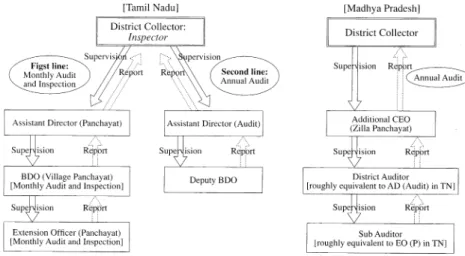
One of the significant characteristics in the actual process of tax collection in Tamil Nadu is the strong controlling power over PRIs by the State administration. Firstly, unlike in other States such as Karnataka, Orissa and Madhya Pradesh, the District Rural Development Agency (DRDA)30) remains independent from PRIs, and is con-trolled directly by the District Collector. Secondly, Tamil Nadu CA provides a Dis-trict Collector to assume the role of 'Inspector' for all three levels of PRIs. The Inspector can enter the office of any village panchayat and inspect any records, regis-ters and activities.31) On the basis of this position as the Inspector, the District Collec-tor, or a person authorised by him, can check the collection status of house tax. Several officers admitted that there are cases where the District Collector, as the 'In-spector', can guide village panchayats to collect more house tax, before they expect disbursement of developmental funds from the district administration.
Thirdly, and more significantly, the audit system in Tamil Nadu functions more strictly than in Madhya Pradesh. There are two lines of supervisory activities over village panchayats. The first line conducts regular monthly inspections and the sec-ond line focuses on account auditing. The first line starts with the Extension Officer (Panchayat) inspecting accounts and activities of village panchayats twice a month [Figure 5]. There is another monthly inspection by the BDO (Village Panchayat). Both are based at the block office.32) They then report the results to the Assistant Di-rector (Panchayat) at the district headquarters. In terms of the annual account audit, after the closure of the fiscal year, the accounts of village panchayats will be first audited by the Deputy BDO, who is supervised by the Assistant Director (Audit). The Assistant Director (Audit) also conducts spot inspections of 10% of village panchayats in the district once every two months. The District Collector, as the In-spector, heads the audit and inspection system and checks the reports of his/her sub-ordinates.
This dual structure of inspection and auditing is stricter than in Madhya Pradesh. Furthermore, the inspection system in Tamil Nadu is unique in the way that it is op-erated to increase panchayat revenues. Panchayat secretaries, who are in many cases the employees of village panchayats, have weekly meetings at the block office, in which they have to give the BDO (VP) detailed reports on tax collection as well as
88 Journal of the Japanese Association for South Asian Studies, 17, 2005
progress reports of various government schemes. The BDO (VP) will then make monthly reports33) which are accumulated and ultimately submitted to the Director of Rural Development Department in Chennai, where monthly meetings of Assistant Di-rector (Panchayat) from all districts are held. Officers at all levels are responsible for raising the tax collection ratio of village panchayats under their jurisdiction . If any serious irregularities or significant failures in tax collection are found in the monthly reports or regular spot examination by the higher officials, there is a chance that the BDO (VP), Extension Officer (Panchayat) or Deputy BDO will be subjected to disci-plinary action for negligence of his/her duties, including suspension in the worst case. They therefore have to make sure that the village panchayats are collecting tax prop-erly. It is important to note that such activities of frequent inspections and regular reports were introduced after the devolution of power to the PRIs. The high own tax ratio in Tamil Nadu can be considered as an outcome of this strong control by the district administration.
This tight control by local officials as well as house tax matching grant as incen-tives provided by the State administration contribute to the high level of house tax
collection in Tamil Nadu village panchayats. For example, in village
Deevarappanpatti34) in district Dindigul, the house tax collected in the fiscal year 2002-2003 was Rs. 61,710 which amounted to 81.7% of the total estimation. This, together with the matching grant (of triple)35) composed 24% of the discretionary amount, from which they could pay operation and maintenance costs for power pumps, village roads etc.36) For the year 2003-2004, the estimation was raised to Rs.
Figure 5 Audit and Inspection System under District Administration in Tamil Nadu and in Madhya Pradesh
82,863 and as of the end of December 2004, the collection ratio was 69.9%.
The consequence is not limited only to high levels of tax collection. The frequent contact with officials through audit and inspection activities enables the transfer of expertise from the government officials to the village panchayat representatives, and contributes to the high level of awareness among the latter. As a result of the strict audit and inspection provisions, BDO (VP) and other block level officials visit the village panchayats frequently, and have more chance to interact with the representa-tives of village panchayats. Officials guide the representarepresenta-tives on how to manage the accounts, which requires them to share the overall knowledge of various government schemes. The account books in every village panchayat I visited were maintained properly in a uniform manner.37) Presidents of village panchayats in Tamil Nadu are well aware of the four different kinds of accounts,38) as well as the various govern-ment schemes. They are also aware that they can decide how to use the funds from the general account, in which own tax revenue such as house tax is included, and which can be utilised at their discretion. How to utilize the funds in the general ac-count is a subject of panchayat meetings, as well as Gram Sabhas, so the panchayat representatives pay more attention to this account.
The relatively high level of awareness among village panchayat representatives may, of course, not only be the consequence of the proactive role played by State administration, but also the result of high literacy rates in the State.39) However, this is not to deny the fact that the more time the village panchayat representatives and government officials spend together to manage the accounts, the more knowledge and expertise they are likely to share.
Some may argue that this tight control by the State administration undermines the autonomy of village panchayats. This problem is often pointed out and, in fact, is considered as evidence of the delayed administrative devolution from the State ad-ministration to PRIs. However, in reality, the house tax collected is a discretionary fund of village panchayats, which can be used according to their decision. Paradoxi-cal as it may be, it can be said that village panchayats in Tamil Nadu enjoy a high level of fiscal autonomy due to the tight control by local officials.
4.2.2 Madhya Pradesh
In contrast to the tight control and incentives provided by government officials in Tamil Nadu, Madhya Pradesh has focused more on devolution of administrative as well as financial power from the State government to PRIs. Madhya Pradesh was once known as a part of BIMARU,40) the four 'sick' States in northern India, with its low level of economic and social indicators. However, the Congress government of Madhya Pradesh (1993-2003) conducted administrative reforms as part of a decen-tralisation programme that included abolishing the formal structure of DRDA and bringing DRDA under the control of Zilla Panchayat, the elected representative body
90 Journal of the Japanese Association for South Asian Studies, 17, 2005
at the district level.41) Since most of the funds directed to PRIs come through DRDA, the District Collector in Madhya Pradesh lost a considerable part of his/her control-ling power over PRIs compared with his/her counterpart in Tamil Nadu.42) An attempt was also made towards integrating various schemes of different government depart-ments. Many of these schemes were programmed to be channelled through PRIs so that PRIs could actually have funds and power to function.
As far as the audit and inspection system is concerned, there is no position equiva-lent to the Inspector of Tamil Nadu [Figure 5]. The audit system in Madhya Pradesh shares the basic structure with that of Tamil Nadu. The Deputy Chief Executive Officer, Janapad Panchayat (Deputy CEO (JP)) has the position equivalent to that of the BDO (Village Panchayat) in Tamil Nadu, and is also in charge of inspecting the activities of village panchayats monthly, just as the BDO (VP) does in Tamil Nadu. In contrast to Tamil Nadu, however, the audit and inspection system in Madhya Pradesh has only one line of annual auditing, and regular inspection activities are not conducted. Audit and inspection activities are not linked to tax collection and, what is more, the audit activity itself is less strict than in Tamil Nadu. A monthly inspec-tion by Deputy CEO (JP) is opinspec-tional and since, as several officials admitted, they are discouraged from visiting village panchayats too often, the optional monthly inspec-tion is practically not in operainspec-tion.43) Accounts of village panchayats are audited an-nually by the Sub Auditor at the block office, but even this annual audit can often be postponed or relocated to the district headquarter, in which case the village panchayat secretary has to travel there. Since there is no such institution as 'Inspector' as in Tamil Nadu, there is virtually no chance for district administration to intervene in the tax collection of village panchayats.
In terms of house tax collection, there seems to be hardly any incentive for any stakeholder to levy tax in village panchayat in Madhya Pradesh. First, village panchayat president does not want to risk his popularity before the next election, and hence no motivation exists for levying tax. Second, local officials do not recognise the low level of tax collection as problematic. This apathy can also be seen among the State level officials who consider that taxation at the village level is almost im-possible. They, therefore, do not encourage village panchayats to levy taxes and even refrain from regularly inspecting village panchayat accounts and other activities. I have already mentioned the tax-payer's attitude in the earlier part of this section.
As a consequence, house tax is not even levied in many of the village panchayats in Madhya Pradesh. Out of the nine village panchayats I visited in 2004, four panchayats levied house tax and one considered levying. Collection is another mat-ter. Out of the four panchayats that levied house tax, two had not collected at all and the other two had difficulties in collection. The collection ratio was estimated to be minimal, as speculated from the fact that even the president of the panchayat had not paid house tax for the current year, which he said he would do before the election.44)
Officials claim that it may be more customary to pay house tax in municipalities or adjacent village panchayats but not in most village panchayats.
When we consider the fact that in Madhya Pradesh village panchayats have a rela-tively high level of grants devolved from the State government, the low level of own tax collection itself may not be so important. However, as in Tamil Nadu, the conse-quence is not only limited to the level of tax collection. As a direct conseconse-quence of this loose audit system, the account books are not properly maintained. When I vis-ited nine village panchayats in Madhya Pradesh, it often happened that the panchayat secretaries refused to show their accounts45) and even when they did, the accounts were not maintained properly. Different accounts were mixed in one book or did not correspond to the receipt of expenditure. It is, therefore, quite natural that panchayat presidents do not know much about accounts. It was also observed that there was a disparity in the knowledge and expertise of panchayat presidents regarding develop-ment schemes.
The relatively limited contact of officials with village panchayats, however, was an outcome of a set of policies introduced by the Congress government (1993-2003). Digvijay Singh, the then Chief Minister of Madhya Pradesh, argues that local officials tend to exploit villagers when they interfere in the matters of village panchayats.46) This is perceived to be true not only for Madhya Pradesh, but also for many other parts of India.47) Rajiv Gandhi is often quoted as having said that Tor every 1 rupee leaving Delhi only 15 paisa ever reaches the final destination', suggesting that devel-opment funds do not reach village panchayats as planned by the central government. Only a reduced amount of funds reaches the final recipient, because intermediaries, including officials, take a portion of each disbursement of development funds. Digvijay Singh also anticipated securing the 'autonomy' of PRIs without any inter-ference from outside, and admits he had ordered the district administration not to in-tervene in the matters of PRIs too much. District administration interpreted this as meaning less audits and inspections of PRIs, and hence has not conducted the op-tional monthly inspections. Singh argues that in order to assure the autonomy of vil-lage panchayats, accountability should be secured not with the help of local officials who could at the same time exploit the development funds, but with the vigilance of civil society, such as NGOs as a group or individually. Therefore, he would rather empower Gram Sabhas than give strong control to officials. In 2001, the Madhya Pradesh government announced the beginning of Gram Swaraj (village self-rule),48) devolving many tasks of the village panchayat to Gram Sabha. This change was made after a complaint that since a village panchayat normally consists of two or more vil-lages due to the population criteria, the village panchayat president tends to direct most of the development funds to his own village while paying no attention to other villages within the same village panchayat. The new Gram Swaraj policy empowers Gram Sabhas and gives them their own bank accounts so that they can receive
gov-92 Journal of the Japanese Association for South Asian Studies, 17, 2005
emment funds directly.49) The emphasis is put on the 'autonomy' of the Gram Sabha, so the audit of Gram Sabha accounts is to be conducted by an 'Auditor' who is ap-pointed at a Gram Sabha meeting, and not by government officials. The Auditor is supposed to be accountable to the Gram Sabha, according to a system called 'Social Audit'.
However, it is difficult in reality to maintain all the activities of Gram Sabha as envisaged in the reformed Act for two reasons. First, the panchayat secretary is over-burdened with responsibility and workload. The account books of Gram Sabha are supposed to be maintained by a village panchayat secretary, who has to keep all the Gram Sabha accounts within the village panchayat, in addition to the village panchayat accounts. Second, and more importantly, the attendance of Gram Sabha meetings tends to be very low and the participants are often limited to people be-longing to the dominant caste. In the interviews conducted during my second field visit, I often heard that people belonging to the scheduled castes (SC) or the sched-uled tribes had very limited access to the Gram Sabha meetings. Some of them had never heard of the Gram Sabha, and many of those who knew about it thought it was only for upper caste people and not for them. One panchayat secretary, who belongs to SC said:
`
I understand the idea of Social Audit. I too think it's a good thing. But the
real-ity in this village is that Dhakar people [the dominant caste in the village] use the occasion of Gram Sabha to criticise each and everything and laugh at the president, who is an illiterate Chamar [SC] woman. In such circumstances, how can you expect it to work?'50)
In such an environment, it is not possible to conduct Social Audit as it is projected in the Act. Since 'civil society' is not as active as anticipated, the limited audit by local officials results in village panchayat and Gram Sabha not having to disclose their accounts information more than once a year. It cannot be denied that this rela-tively loose management of panchayat accounts might have contributed to the mount-ing criticism against 'corruption' by the opposition.50 The PRIs in Madhya Pradesh may have been designed to be more 'participatory' and 'autonomous', but the results are not necessarily encouraging. At the root of the difference in this audit and inspec-tion system is the different percepinspec-tion about local officials. While local officials are perceived by the ex-Chief Minister to 'exploit villagers' in Madhya Pradesh, they play a major role in controlling and empowering PRIs in Tamil Nadu. Where does this difference derive from? Is it that local officials in Madhya Pradesh are less compe-tent than their counterparts in Tamil Nadu? Or are their differences historical in ori-gin?
5. Historical background
Differences in the audit and inspection system in Tamil Nadu and Madhya Pradesh have not suddenly appeared at the 'second wave' of decentralisation. They are a con-sequence of the historical development of local administration in the two States re-spectively before independence. Madras, the capital of Tamil Nadu, was one of the earliest settlements of the East India Company, established in the 17th century. The Madras Presidency has been exposed to British colonial rule for a much longer pe-riod than many other areas, and is considered to have established a well-disciplined modern public administration system. In terms of land revenue administration, two-thirds of Madras Presidency were under the ryotwari system, which required a de-tailed land survey and frequent visits to the villages by local officials.52) The districts selected in this study in Tamil Nadu were also brought under the ryotwari system in the early 19th century, and are therefore considered to have a tradition of close con-tact with local officials.
A Bengal ICS53) officer who visited Madras Presidency reported in 1910 that the ryotwari system requires the administration to deal directly with the villages where the primary records are kept. He wrote:
Under this system, in which the State deals directly with the raiyat [sic., farmer], the revenue administration naturally and necessarily starts from the revenue vil-lage. The registered occupant of each field deals directly with Government,... In these circumstances it is obvious that the records must be kept locally. It is the duty of the village accountant to keep the records of each village as settled from time to time by the Settlement Department... This maintenance of records on the spot as well as the collection of the revenue and cess involves the upkeep of an establishment for each village.54)
Considering the fact that many districts had come under the ryotwari system by the early 19th century, this observation may reflect the tradition of nearly a century in the area. Many villages in Madras Presidency had maintained the custom of keeping records on land and revenue collection, and meeting officials directly in the village.
In terms of institutional development of decentralisation, Lord Mayo's Resolution on Provincial Finance in 1870 and the subsequent Resolution by Lord Ripon in 1882 marked a watershed in the decentralised system of finance, which also reflected the enthusiasm on the development of local self-government in British society [Bates 2005 (forthcoming)]. Madras Presidency introduced the recommendation of 1870 Resolution as early as 1871. Local taxation was introduced accordingly and various developmental works were transferred to the local bodies. Local fund boards were constituted to mobilise resources locally to supplement grants from the central gov-ernment [Misra 1983]. Local bodies were further empowered by the Madras Local
94 Journal of the Japanese Association for South Asian Studies, 17, 2005
Bodies Act, 1884, which provided for elections in the three tier local bodies, namely, district boards, taluka boards and union boards. Union boards were constituted for a village or a group of villages and levied house tax. The taxation power of local bod-ies was further enhanced by the Madras Village Panchayats Act, 1920.
As the financial status of local bodies was strengthened by various legislations, the provincial government's control also increased. The Madras Panchayat Act XI, 1930 introduced the office of 'Inspector' of Local Boards and Municipal Councils, and a district panchayat officer was appointed for each district [Institute of Social Sciences
1995]. With the development of the independence movement in the late 1930s, the local bodies supported the movement, which resulted in diverging from the interests of the provincial government. Threatened by this emerging power of local bodies, the Madras Village Panchayat Act, 1941 gave the government power to take over panchayats, and panchayats were required to obtain the approval of the Inspector in making decisions on certain cases. Thus, the government's control over panchayats gradually increased towards the end of colonial rule, but at the same time, panchayats had established considerable power as a local self-government in terms both of rev-enue and expenditure.
On the other hand, Madhya Pradesh did not have a uniform legislation for local bodies at the time of independence. Present Madhya Pradesh consists of Madhya Bharat, Bhopal, Vindhya Pradesh and Madhya Pradesh, and is more diverse in terms of colonial experience than the present Tamil Nadu. It was only in 1956, nine years after independence, that the present Madhya Pradesh (then including Chhattisgarh) was created. Being a mixture of different regimes for several decades, the newborn State created a new uniform panchayat act only in 1962.
In terms of land revenue settlement, Central Provinces and Berar, which was part of British India, had a variety of tenurial arrangements when it annexed many territo-ries under its rule in the early 19th century. By the 1860s, however, proprietary rights had converged in the hands of malguzars, equivalent to zamindars, who paid land revenue while receiving 15-25% on the gross collection of crops on their property and often engaged in money lending.55) There were spots of ryotwari villages in the Narmada valley as it was sparsely populated and there were no true landlord tenures. In such areas, assessment was conducted in the ryotwari manner, but they remained different from the formal ryotwari villages in Madras Presidency, which required a detailed land survey and record maintenance [Jha 2002]. The villages under malguzaris were basically left untouched by the government except at the time of land revenue settlement.56) District Gazetteers record several attempts by the British administration since the beginning of 1860s to have as accurate a land survey as pos-sible for new settlements. However, due to the absence of 'professional' survey tech-nology and reliable records, the administration had to wait until 1892-93 to complete the survey.57 This contrasts with the ryotwari villages in Madras Presidency where
detailed land record was required from the beginning of the land system itself and kept in each village.
As far as formal institutions were concerned, many former princely states in Madhya Bharat, Vindhya Pradesh and Bhopal did not have local bodies, and even if they did, most of them had remained nominal institutions. Even in the regions con-sisting of old Madhya Pradesh, most of which were former Central Provinces and Berar, the development of local bodies was not remarkable. The Central Provinces and Berar Local Self Government Act, the first legislation on local self-government, was passed in 1883. District Councils and Local Boards, the latter acting as an agent of the former, were established but the Local Boards had neither independent income nor practical duties until at least 1910.58) Following the Government of India Act, 1919, which sought more popular representation and less control by the local bureau-cracy in local self-governments, the Central Provinces and Berar Local Self-Govern-ment Act of 1920 was enacted. The Act widely enhanced the financial powers of local bodies, created an electorate on a liberalised franchise, increased the proportion of elected members, practically eliminated official members and relaxed overall official contro1.59) The functions of District Councils and Local Boards included construction and maintenance of roads and the establishment and management of schools. How-ever, without previous experience in financial management, the elected representa-tives in Berar could not manage to collect taxes, and were reported to have made complaints that 'the odium of (tax) collection should fall on government' .6°) Frus-trated with the poor political awareness among the elected representatives, the Chief Secretary in Central Provinces reported in a letter to the Secretary to the Government of India:
In the Central Provinces and Berar there are nearly fourteen million people of whom ...less than 5 per cent., are literate...In this matter of removing the igno-rance of the electorate it is significant that the local bodies, which are for the most part dominated by the higher castes with leanings towards the Swaraj creed, have so far shown no inclination to take advantage of the compulsory Pri-mary Education Act....The position of the Government is a difficult one..., the case for the Government is never placed before the electorate and cannot be placed before it during an election so long as the Government Servants' Con-duct rules remain in force....[T]ime is necessary for the development of respon-sibility in the electorate and for the growth of proper relations between the constituencies and their representatives.61)
Elected representatives of local bodies were so concerned with matters outside the jurisdiction of local bodies62) that it discouraged further devolution of power. Con-trary to the spirit of the Act, devolution to local bodies in Central Provinces and Berar
96 Journal of the Japanese Association for South Asian Studies, 17, 2005
was very limited and so was the development of any other relations between local officials and local bodies.
To summarise, before uniform panchayat institutions were established after inde-pendence, the historical paths that Tamil Nadu and Madhya Pradesh took were far from similar. Madras Presidency was very advanced in terms of the development of local bodies. Local bodies had been trained as local self-government since the late 19th century, and had accumulated expertise and wealth. By the 1930s, they became mature and wealthy enough to attract the provincial bureaucracy who could not ig-nore them due to their financial power and significant presence in development ac-tivities in the districts. The provincial bureaucracy went so far as to create a position of Inspector to monitor the activities of local bodies, which continues till today. On the other hand, local bodies in present Madhya Pradesh practically did not exist in many parts of the State before independence, and the few that did were not as active as those in Madras Presidency. They, therefore, had no experience of practical man-agement of local administration or actual interaction with local bureaucracy.
The experiences following the reformed Acts after 1919 remind us of the argument raised by Digvijay Singh, the ex-Chief Minister of Madhya Pradesh, concerning whether local administration should interfere in the matters of local bodies. The case of Bengal Presidency is illustrative in this regard [Misra 19831.63) Bengal Presidency was relatively advanced in terms of the development of local bodies, but the legisla-tion enacted after 1919 totally changed the previous customs especially in terms of expenditure and audit. Aiming at liberalising the local bodies, the new Act removed the supervision and control of local government officers from the District Boards, and was designed so that the local government officers were not to interfere in the pro-ceedings of local bodies. The new Act also empowered local bodies to levy new taxes. However, no representatives were willing to risk their popularity especially in the ab-sence of bureaucratic control. The previous condition was resumed after the failure of the non-cooperation movement in the late 1920s. However, by then, the District Collector in Bengal had practically lost control over the affairs of local self-govern-ments and this could not be reversed. Although this happened more than eight dec-ades ago when there was a different political environment with the tension between the British and the 'Indians', it is worth considering the relevance of the words of P. H. Waddell, the District Magistrate of Bakarganj, Bengal for the present argument.
The time is near at hand when local bodies will have much the same freedom as they have in England but, although I am no opponent of this policy, I trust that all the control existing in England will be exercised. Especially as regards audit, England has reached its present stage of development in local self-government after many years and India is only beginning. If control is still necessary in En-gland, it is much more necessary in India for the public benefit.64)
Whether the local government should be 'controlled' by the higher level govern-ment or 'autonomous' seems to be a question shared over generations.
6. Conclusion
The experiences of decentralisation in the two States bring us back to the question we had framed at the outset: is decentralisation about the retreat of the state? This may be too big a question to answer in such a short paper. Nevertheless, it would be possible to argue that the case study we have presented here goes some way towards substantiating the claim that decentralisation must be viewed as a staggered process in which, as Judith Tendler has pointed out, the state does not retreat but remains partly centralised while other functions are decentralised [1997]. The case of Madhya Pradesh is an example in which the state withdraws its responsibility to monitor and regulate the PRIs and devolves such responsibility to the 'community', namely the Gram Sabha. In Tamil Nadu, by contrast, the state has devolved certain financial pow-ers to the lower level of government, namely the village panchayat, but maintains the authority to monitor and regulate the latter. The difference is reflected in the financial
status of the village panchayat in the respective States. The village panchayat in Tamil Nadu has been able to collect more of its own revenues than its counterpart in Madhya Pradesh, which remains almost totally dependent on the 'tied' government funds. In other words, the centralised control by the Tamil Nadu State government helps village panchayats in the State to be relatively more financially viable than the
ones in Madhya Pradesh.
However, despite this obvious advantage of the Tamil Nadu village panchayats in terms of their relative financial viability, I would still argue, in agreement with Tendler, that Tamil Nadu's success owes much to being a staggered type of central-ised decentralisation. I disagree with James Manor that Tendler has carried the point too far, 'into an unnecessarily negative judgment on the promise of decentralisation' [Manor 1999: 64, italics added]. Manor argues that the active role played by the cen-tral government in Tendler's case study can be replaced by 'nonofficial associations'65) which can engage 'more actively with decentralised institutions and persuade citi-zens that local governance is not the sole territory of the elected local council' [op. cit.]. He does not deny that the central government plays some role, but argues that it is a supplementary one limited to primarily ensuring grass roots participation.
In the official rhetoric, decentralisation reforms in Madhya Pradesh were suggested to promote the 'participation' of 'civil society'. Gram Sabha was, therefore, exten-sively empowered so that every village can make decisions independently on the al-location of development funds. It was designed so that the villagers themselves can
`
participate' in the process of planning, implementation and monitoring without any
98 Journal of the Japanese Association for South Asian Studies, 17, 2005
Gram Sabha often becomes an arena for local elites to dominate. 'Empowerment' and
`
participation' become a useful tool for powerful landed elites to exclude the poor
and the marginalised. The panchayati raj system in Tamil Nadu is not designed to
`
empower' Gram Sabha or local community as in Madhya Pradesh. Gram Sabha
simi-larly tends to be dominated by the local elites. However, in Tamil Nadu, there is a strong presence of the State government to ensure the functioning of village panchayats. This strong controlling power in Tamil Nadu has evolved through a long history of interaction between public administration and local governments. It directly or indirectly helps village panchayats to become financially viable. Decentralisation, in this sense, seems to work efficiently with some intervention by the centralised
state, namely the State government in this case.
It is true that there still remains the problem of official control undermining the autonomy of PRIs, as anticipated by the ex-Chief Minister of Madhya Pradesh. How-ever, merely passing the burden of responsibility from the State government to the PRIs, does not seem to be helpful for building autonomous PRIs either. In this sense, the work of Peter Evans on the complementary relationship between the government and community might lead our enquiry to the next stage [1996]. He argues for a 'pub-lic-private synergy' in which active government and mobilised communities can en-hance each other's capacity in developmental efforts. Whether such positive outcome is feasible in the case of development of PRIs is a question to be pursued further.66) So far, as it appears from the findings in this present paper, we can endorse Bardhan's view that the state, 'far from retreating into the minimalist role..., may sometimes have to play certain activist roles' [Bardhan 2002: 202] in decentralised India. Acknowledgements
I would like to thank Takako Hirose, Kyoko Inoue, Sudha Pai, Indira Rajaraman, Digvijay Singh, R.S. Srivastava, and Wolfgang-Peter Zingel for their useful com-ments on the earlier version of this paper. Many thanks also to Rohan D'Souza. Notes
1) In this paper, the word 'state' with small 's' denotes the government in general, and 'State' with capital 'S ' denotes the province comprising the federation of India.
2) Issues regarding 'local government' are stated in the constitution as part of the jurisdiction of the State government. The State governments, therefore, are required to make respec-tive conformity acts (CA) accordingly, in which they make provisions with regards to the kinds of taxes to be imposed by PRIs, and also establish State Finance Commissions to recommend the amount of assigned revenue and grants to be transferred to PRIs from the State government.
3) For arguments regarding Article 40 which defines village panchayat as 'self-government', see Vyasulu [2003: 50-53].
survey with history and current situation on panchayati raj for each State [2000], but even that has not been able to provide any uniform perspective to make comparative studies possible. The World Bank has published thorough investigation on the fiscal devolution in two States, Kerala and Karnataka [2004]. However, like its earlier publication [2000a], the focus seems to be put more on extracting lessons for the future out of the findings rather than evaluating or analysing the performance of the two States comparatively.
5) The study by the World Bank [2000a] was conducted in the following States: Andhra Pradesh, Karnataka, Kerala, Madhya Pradesh, Maharashtra, Rajasthan and Uttar Pradesh. 6) The first field research was conducted from December 2003 to March 2004 in three
dis-tricts in Tamil Nadu (Cuddalore, Dindigul and Madurai) and three disdis-tricts in Madhya Pradesh (Damoh, Betul and Vidisha). Second field research was conducted from January 2005 to March 2005 in another three districts in Tamil Nadu (Dharmapuri, Coimbatore and Ramnathapuram) and also in Madhya Pradesh (Betul, Guna and Ujjain).
7) 'Local administration' in this paper refers to the public administration below the State level and will be distinguished from local self-government or local government, that is, three-tier PRIs. The local district administration plays the major role in rural development. See section 2.2 for details.
8) Many advocates of fiscal federalism, such as Richard Bird and Vito Tanzi, write for the World Bank publications [Litvack, Ahmad and Bird 1998; Tanzi 2000].
9) Chandhoke [2003] describes this process as `pluralisation of the state' and argues that it is a 'move from centralised state to governance', rather than to a decentralised state. The shift to governance occurred, Chandhoke argues, following the similar shift in industrial firms, that is, replacement of contestation or 'the political' by notions of administration and management.
10) Ludden [1992] describes how carefully the bureaucratic legacy of British India was pre-served and inherited by the newly independent national state.
11) For more detailed arguments on the interdependent relationship between politicians and officials in a southern State government over the latter's posting, see Wade [1985]. 12) See Maheshwari [2000: 49-50] for details.
13) Also called District Magistrate, he/she is the top IAS (Indian Administrative Services) officer of the district administration. IAS is one of the so-called All India Services. IAS officers are recruited by the central government and posted in the respective State govern-ment, where they serve until they retire. They consist of the upper echelon of the State government as well as district administration. Apart from the District Collector, there are roughly less than five IAS officers stationed in the district. The rest of the public servants (most of the officers in the local administration) working under the State government are State administrative services officers who are recruited by and posted within the State gov-ernment.
14) There were, of course, significant attempts in West Bengal and Karnataka after 1977. How-ever, such attempts were restricted to specific States and never spread all over the country. 15) Even some official documents discuss the empowerment of PRIs within a context of em-powering 'civil society'. For example, in the conference of District Collectors held in May 2005, 'partnership' with PRIs was encouraged in the context of 'public-private partner-ship' [GOI 2005: 17-18].