Japan’s first steps as a donor of the‘official development assistance’ (later - ODA) can be traced back to the 1950s when it supplemented the post-war reparations to the victim nations of the Japanese war aggression. In the 1960s, the amount of aid increased steadily every year and from the 1970s low-interest loans and grants from Tokyo have served as a critically important source of international economic dynamism, at least in the Asia-Pacific. Gradually, the whole world got accustomed to the thought that the terms‘Japan’and‘development assistance’were closely interrelated, in fact almost inseparable. Economic cooperation (as aid is often referred to in Japan) began to seem like the nation’s hallmark.
In the 1990s, while Western democracies were enveloped in the so-called ‘aid fatigue’, Japan resisted this negative trend longer than any other
donor. However, gradually, disappointment over concessional transfers to the developing nations, notably loans allotted to China, ultimately spread to Japan. In 1997 the Cabinet decided that from then on aid programs should focus not on the quantitative growth but on the increase in ODA efficiency.1
A need for huge financial help aimed at preventing victim countries of the Asian Crises from a possible meltdown (1998 -1999) tem-porarily suspended the tendency to reduce ODA volumes but could not prevail over it. From year 2000, the volume of financial assistance
三 五 八
Thirty Years of Japan
’
s Official Aid to
China (the 1980s-2000s)
decreased yearly and, ultimately, according to the official statistics, by 2009 Japan rolled back to the non-prestigious fifth place as an aid donor to the developing world2
.
During 56 years from 1954 to 2010 as many as 189 independent coun-tries and dependent territories received the benefits of the Japanese funds.3
It is no exaggeration to say that Japan’s ODA has been one of the most important phenomena of contemporary history.
Among other recipient countries, the Peoples’Republic of China enjoyed a unique position. It is remarkable that, contrary to Japan’s own Official Development Assistance Charter (ODA Taiko), the country where a rigid communist regime reigned and, moreover, a country that possessed and actively tested nuclear weapons remained the biggest recipient of official funds from the non-nuclear and democratic Japan for several decades.
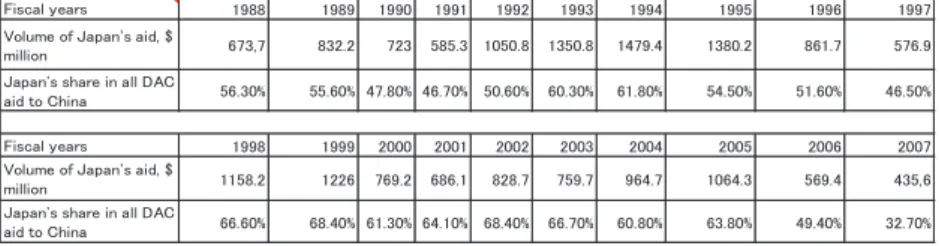
Table 1. Japan's Annual Development Aid to China in the 1980s - 2000s
Sources: Japan's International Cooperation, Ministry of Foreign Affairs, Tokyo, various years; Katada, Saori, Old visions and new actors in foreign aid politics: Explaining changes in Japanese ODA policy to China, p.61.
During 30 years from 1979 to 2008 Tokyo transferred to its rapidly developing partner about US$45 billion (including US$40.5 billion in low-interest loans and more than US$4 billion in grants). The dynamics of aid flow are evident from the data in Table 1. The total sum of ODA flow to 三
五 七
China equalled to roughly one fifth of all Japanese government’s assistance to the developing world since the 1950s. On average, in terms of volume Japan accounted for about sixty percent of all aid inflow from the DAC member states to China.(Germany’s share, which ranked second, was roughly about 15 to 20 percent.)More than 60 percent of foreign students and trainees studying in Japan at the expense of its government, as part of the framework of technical assistance, were young Chinese citizens.
This article aims to retrace interrelationship between the zigzagging bilateral Sino-Japanese political relations and the dynamics of Japanese assistance to China. The analysis is based on long-term monitoring of the Japanese mass media; papers published by Japanese, European, American and other researchers and a number of talks with analysts and experts of Japan’s foreign aid. The period covered in this paper can be divided into three phases:
1. Enthusiasm and euphoria among business community and population, 2. Relatively inertial development phase, and
3. Disappointment in political results of aid-giving and dismantling of the financial aid programs.
Economic cooperation between the two Far Eastern great nations has never been a conflict-free process. Aid-related conflicts have usually occurred because of to the difference in ODA’s perception by the both sides. From Japan’s perspective, this aid to China was at various times motivated by a variety of economic, political and other factors which will be discussed below. China, in its turn, perceived official funds from Japan first and foremost as a substitute for post-war reparations. Therefore, from the Chinese leadership’s viewpoint, when Japan began lending funds to the PRC, it lost the right to terminate loans, and to exert political pressure on China.4The author argues that Japan met with great, hardly surmountable
三 五 六
difficulties in its attempts‘to buy influence’and raise its image in the eyes of the neighbouring power by means of economic assistance. On the other hand, Japan has obviously contributed to international stability through its ‘engagement’of China by its huge and long-term transfers of official funds.
The Problem of War Indemnity to the Chinese Nation
Japanese aid descended from the post-war reparations payments which had started in the 1950s and which Japan was obliged to pay to the nations which suffered from its aggression. Nearly all of these countries by that time had been recently freed from the colonial rule. Nearly all of these countries in the future would become ASEAN member states. Indonesia, the most heavily populated Southeast Asian nation, at the time ruled by the Suharto brutal regime, happened to be Japan’s‘ super-favourite’ nation in terms of aid in the 1960s - 1970s. However, the PRC - the main victim of the Pacific War - could not be a legal recipient of Japanese funds, unless the diplomatic relations between Tokyo and Beijing were normal-ized.
In fairness, there existed another Chinese nation, the Republic of China (ROC, or Taiwan) that could claim for compensation for the damages, suf-fered through Japanese colonialism. Until the early 1970s, Taiwan had offi-cially represented the interests of the Chinese people both in Japan and in the United Nations. Morally, Taipei could claim Japanese reparations for a more profound reason than other Pacific Asian countries, as Taiwan had suffered under Japanese occupation for the longest period of time - for half a century, from 1895 to 1945. The peace treaty between Japan and the ROC was ratified in April 1952. However, at that time Taiwan’s supreme leader Chiang Kai-shek publicly renounced financial claims to the former 三
五 五
occupant. An American scholar Kenneth Pyle points out that this decision could possibly be a result of the pressure from the US.5 Chiang Kai-shek himself recalled in his memoirs that Japan had been in such a deplorable state that, considering the external‘red imperialist forces’which were going to grasp this nation, any Taiwanese actions aimed at weakening Japan would be counter-productive.6Caught in the rapidly escalating Cold War, the USA was indeed disinterested in weakening Japan. Because of this Taiwan, as its client state, was obliged to conform to the American will -even if the Taiwanese government may have yearned for material compen-sation from Japan. In the future, Taiwan’s renouncing reparations on behalf of the whole Chinese people would have a negative impact on the process of normalization between Beijing and Tokyo.
During normalization negotiations in 1972, the Chinese Communist lead-ership declared its desire to begin the relationship from a clean slate. In order to buttress the new approach, Mao Zedong waived financial claims to Japan in a grand gesture, saying that only the military elite and not the Japanese people were responsible for China's disasters in the 1930s and 1940s. Chinese leadership’s decision was, to some extent, motivated by Taiwan’s previous waiver of rights to reparations. They did not wish to look less generous that the Chiang Kai-shek regime. At the time, Mao’s benevo-lence was a blessing for Japan as China could, in principle, present a tremendous bill for the reparations for the massive destruction and death of more than 10 million Chinese people at the hands of Japanese armed forces. (Tanaka Kakuei, the Japanese head of government, himself in the joint statement officially acknowledged Japan’s responsibility for its past wrong-doings). China’s possible financial demands could have been so large that they could have seriously weakened Japan’s economy.
三 五 四
It’s quite possible that Chinese leadership’s decision was a wise political step - it helped to severe formal ties between Japan and Chinese ‘rene-gade’province of Taiwan and contributed to Japan’s recognition of China as a legitimate member of international community.7 Certainly for the supreme authorities in Beijing Taiwan’s unification with the PRC was a top priority. However, in its heart of hearts, Chinese society never came to terms with Mao’s controversial decision to waive indemnity payments. Deng Xiaoping, the next supreme leader of China later openly called his predecessor’s decision“ a rash mistake”.
The issue of Japan’s compensation for war damages to China remained and the ODA could serve as the only suitable form of indemnity. However, until Deng’s ascension to power, the ODA was out of question, because loans or grants from capitalist states were officially banned as a form of humiliation for a socialist nation. Changes were allowed to happen only in 1978, when the China-Japan Peace and Friendship Treaty was signed and when the Chinese new leader, the great reformer Deng Xiaoping turned down the notorious policy of self-isolation. During his visit to Tokyo in October 1978, Mr. Deng almost openly demanded indemnity from the wartime enemy. The Japanese leadership itself obviously understood the need for providing substantial support to pragmatists who came to power in the neighbouring nation.
In December 1979, Prime Minister Ohira Masayoshi offered a package of low-interest loans amounting to 330 billion yen (about US$1.4 billion) to contribute to the implementation of China’s Five Year Plan (1979 - 1984), in the framework of the so called‘gift diplomacy’(omiyagi gaiko).8 Significantly, the relationship between reparations and aid was never men-tioned in any official documents either in China or Japan. However, it was 三
五 三
tacitly understood by everyone involved that this and the following pro-grams were a substitute for the post-war reparations. Some of the analysts, for instance Gregory Clark from Akita International University, went so far as to declare that Japan’s assistance was just a cheap way to evade paying reparations.9
The opponents to this aid used to criticize the government of Japan for the careless waste of the Japanese taxpayers' money on questionable goals in China. This stereotypical explanation is mainly populist and true only to certain extent. In fact, the bulk of ODA to China has been allocated not from the State budget (i.e. not from taxes) but from a special Fiscal Investment and Loans Program which is a part of postal saving banks (yuu-bin chokkin) where people’s savings are deposited.11
Early Stage of Japan s Aid to China: Shaping the Pattern
At the early stages, the number of proponents of aid to China consider-ably exceeded the number of its opponents. Researchers, such as S. Katada and D. Trinidad, rightly claim that disbursement of Japanese assistance in general has long diverged into two independent tracks, one following the geo-economic orientation; the other more humanitarian goals. Basically agreeing with this viewpoint I would like to add that in the case of China not two but three discourses for embracing assistance existed.
Among broad segments of society, support for ODA to China was based on humanitarian approach, as a form of moral obligation to the former vic-tim of Japanese aggression. The feeling of guilt over the former atrocities in China throughout the 1930s and 1940s was even stronger, as the Middle Kingdom from time immemorial was perceived as the main source of art,
三 五 二
culture and religion for the Japanese. Military intervention in the country that, in fact, had given birth to Japanese civilization, was really perceived by many people as the greatest injustice and required indemnity.
At the same time, financial and technical aid to China has never been a charity. On the contrary, in the words of a US political scientist, it was an investment of special importance.12
From economic viewpoint, it was meant to play the role of‘grease’, geared to protect Japan’s own diverse economic interests. Huge new business opportunities lay open across the East China Sea. The main task for Japanese business community was to ‘re-open’China. Giving assistance to China seemed essential for restora-tion of this narestora-tion as a major foreign economic base, as it was until the end of the Pacific War. In addition to direct access to China’s trade and invest-ment markets, Japanese corporations anticipated double benefits from these official transfers. First, it was expected that monetary“injections” from Tokyo would help upgrade China’s antiquated infrastructure to the level acceptable for large-scale investment by Japans multinationals.13 Second, Japanese companies hoped to get sizable profits from their role as contractors during construction of multiple infrastructure projects in China.
These two paths are usually associated with the Ministry of Foreign Affairs (humanitarian approach) and Ministry of Economy, Trade and Industry (formerly MITI, which has promoted neo-mercantilist use of aid), respectively. Importantly, in reality, the‘humanitarian’reasons for Chinese assistance emerged much later than a‘developmentalist’(or neo-mercan-tilist) approach, although it was humanitarian sympathy for affected China and feeling of guilt that stimulated Chinese euphoria in Japan’s public opinion.
三 五 一
There was another direction in reasoning in favour of helping China. Politically, both in Japan and in the West there was an expectation that, with strong Japanese support, the reform-oriented new China would devel-op into a normal member-nation of the global economic system with a pre-dictable and peaceful foreign policy. In this connection, Japanese policy-makers must have realized that in the near future China would emerge as Japan’s main competitor in Asia Pacific and, therefore, maintenance of smooth bilateral relations (the so-called engagement of China) was a major priority.
Thus, the three groups of motives for providing aid to China - humanitar-ian, geo-economic and politico-strategic - entwined at the end of the 1970s and beginning of the 1980s. Japan, an addition to ASEAN member-states, chose the Peoples ’Republic of China as its new‘favourite’. Strictly speaking, there was no other major country on which Beijing could rely upon in terms of massive assistance. The US could not be an ODA donor for legal reasons as aid-giving to communist nations had been forbidden by a special act of Congress.14Needless to say, any financial or technical coop-eration with the then hostile Soviet Union was out of question. So, at that time Japan did not expect any international competition for China’s future favour, while economic dividends deriving from its aid activities could be potentially huge.
Meanwhile, transformation of China into a major recipient of funds from Tokyo was painfully received by ASEAN member-nations, who feared that China would swallow a sizable slice of ODA‘pie’intended for them. In this anxious atmosphere, Prime Minister Ohira, attempting to avoid frictions with Southeast Asian states, emphasized the importance of existing rela-tions with ASEAN.15 In particular, he promised that the volume of
China-三 五 〇
bound assistance would never surpass that for the biggest recipient nation among ASEAN members, i.e. Indonesia. However, Ohira died soon there-after, and his pledge was quietly forgotten. Within a couple of years the PRC pushed Indonesia to the second place and for decades ahead became number one recipient of Japan’s assistance annually consuming more than 10 percent of Tokyo’s official funds.
At the start of Sino-Japanese rapprochement, the Japanese business community was obviously lured by the huge investment opportunities in the neighbouring but nearly forgotten China. Attracted by radical econom-ic reforms, Japanese firms signed dozens of investment contracts with rel-evant authorities. Both parties had high expectations from the investment deals. China, in particular, primarily hoped that private capital inflow from the technologically advanced Japan would help to upgrade and modernize their antiquated economy. However, when it came projects implementa-tion, the PRC proved to be unfit for large-scale investments for a number of reasons - such as out-dated infrastructure, blatant corruption, red tape and others. In addition, as R. Drifte wrote, China's government realized that in the given period of time it had‘overreached itself’by signing too many contracts and was unable to‘digest’them.16Due to the combination of all these factors, previously signed contracts between Japanese firms and Chinese authorities began to dissolve thick and fast, including the con-tract to build the giant Baoshan steelmaking plant in Shanghai area.
So, at that time, private Japanese companies failed to bring sufficient funds and technology that China had been craving for. Anticipated profits of Japanese investors and the future of Japanese presence in China were threatened. In order to secure its nation’s economic presence in China, Japan’s government could not help taking the role of a supplier of the needed funds, most of which thereafter flowed into profits of Japanese 三
四 九
contractors. Japan’s yen loans, the size of which was ten times larger than the sum of financial grants and technical cooperation, became the princi-pal form of Japan’s ODA to China.
In general, Japan - unlike most Western donor states - has traditionally considered‘soft’loans to be a more appropriate form of aid than financial grants. This approach came from their own post-war experience, when loans from the US and international monetary organizations helped Japan recover its economy from war-time devastation. As the Swedish researcher B. Edström put it,“Japan prefers to provide loans rather than grants since it promotes discipline of the aid recipient; it was good for Japan, so it is
seen to be good for other countries”17
. From the Japanese viewpoint, the commitment to repay credits increases the sense of ownership and respon-sibility on the part of a recipient state and contributes to a more effective and prudent use of aid. A. Nishigaki, who served as president of the Overseas Economic Cooperation Fund (OECF) in the 1990s, wrote, “Yen loans are an especially effective means of supporting self-help efforts and promoting self-reliance. This is because recipients of yen loans select pro-jects of high development priority and make efficient use of funds in the knowledge that the loans require repayment”.18
This loan-oriented philosophy was seen differently by other countries. In the 1970s and 1980s, due to overwhelming predominance of loans and low ‘grant-element’in these loans, Japan acquired a reputation of a‘profiteer on aid’, the image of a nation who makes money even on transfers to the ‘third’world. However, in the case of China Japan’s perceived greed was seemingly not to blame. The pattern of bilateral cooperation was agreed upon with the Chinese authorities who would later regularly repay loans back to Tokyo. Apparently, Beijing’s complaisance was motivated by its
三 四 八
wish to give bilateral relations a more equitable image, to show them as a relationship between a creditor and a responsible debtor. China did not insist on prevailing grants which could be perceived as a kind of charity. An absolute predominance of loans, which were supposed to be repaid, in Japan’s ODA to China is not the same as post-war reparations. It may be better to describe the Japanese aid to China as quasi or, or better said, sur-rogate reparations.
The lion’s share of these funds was officially allotted to the‘sustained development’, in other words. for the creation of economic and social infrastructure, mainly in the field of transportation and communications. Without governmental involvement in Chinese infrastructure projects, China would simply not develop as Japan’s major partner in trade or investment. An additional factor in favor of ODA was the opportunity to study local business environment and culture in the recipient nation. In other words, ODA could become a tool of legal reconnaissance.
In practice, the‘humanitarian’motivation of Japanese ODA manifested itself much later than the‘mercantile’one. Japan expanded its range of programs in the PRC by adding sectors related to its population’s pressing needs, such as access to fresh water, sanitation and other social infrastruc-ture objects, as late as in the beginning of the 1990s. Also, in the 1990s Japan began cooperation in environmental protection where it could use its extensive experience.
Observers have frequently stressed the unique character of Sino-Japanese relations with regard to financial aid. In particular, China became the only developing country to receive grants and loans based on five (six)-year plans, not ordinary yearly agreements. Moreover, these pro-三
四 七
grams were mainly tailored to fit China’s own Five-Year Plans of national economic development. In other words, paradoxically, the free-market Japan conducted its relations with China in accordance with the socialist planning principles. Overall, as many as four 5-year (or 6-year) ODA pro-grams were implemented from 1979 to the end of 20th century, each being larger in volume than the previous ones.
As was mentioned above, the first loan package (1979 - 1983) was con-cluded by Prime Minister Ohira and amounted to 1.4 billion dollars. The next program, prepared by the Nakasone cabinet, was designed for the years 1984 - 1989 while total sum made 2.1 billion dollars. The third aid package (1990 - 1995) provided for the payment of loans and grants totalling 5.4 billion dollars. Lastly, the fourth package (1996 - 2000) was divided into two parts (three and two years, respectively) and payments for the first three years were supposed to reach the amount of 5.8 billion dollars.
The importance of all these programs was emphasized by the fact that they were personally presented by Japan’s Prime Ministers directly to China’s supreme leaders, bypassing the ordinary bureaucratic proce-dures.19
The five (six)-year format of loans turned beneficial for China, as it seriously hindered any sanctions against this nation, such as loans sus-pension, for the violation of Japanese principles of aid-giving.
One issue that needs to be mentioned here is the strategic dimension of China - Japan aid relations. In the late 1970s, amidst the renewed Cold War, the US focused on strategic cooperation with the PRC in order to withstand the Soviet military power in East Asia. Japan, being a staunch ally of the US, went the other way for the‘engagement’of China - the way
三 四 六
of a major ODA donor. It was assumed that, being Japan’s major debtor, China would adhere to a more predictable and peaceful foreign policy. Indeed, for China, Japan proved by far the biggest single supplier of con-cessionary financial funds providing much more aid than all other donor-states combined.
The reaction to these developments from the West was mixed. Japan’s role of a nearly monopolistic donor to the PRC was both positive and nega-tive from the Western viewpoint. The pros of the situation was that this pattern played into the hands of the US and its allies, as it helped to shift the financial burden on Japan amidst the lingering Cold War with the Soviet Union. The cons were that European and American private compa-nies rightly suspected that the implementation of infrastructure and other projects on the Chinese soil by Japanese contactors would deprive them of sizable potential profits. To avoid suspicions of Japan’s attempts to monop-olize Chinese markets, Prime Minister Ohira emphasized in his Three Principles (1979) that the policy of assistance to the PRC would be coordi-nated with the US and other developed nations and. (In fact, the five-year format of loans to China would hinder Japanese policy coordination and cooperation with the Western democracies).
China as a Maverick Aid Recipient
As mentioned before, from the economic viewpoint Japanese aid to China was a necessary prerequisite for boosting trade and investment rela-tions. Judging on the growth of economic exchange in the 1980 - 2000s, these costs fully paid off. Even there some (obviously exaggerated) com-plaints could be heard that Japan, through its assistance, achieved such economic advantages that it had not been able to achieve by means of mili-三
四 五
tary intervention in the 1930s - 1940s.20
In terms of bilateral political relations, the results proved to be more controversial, with China in most cases getting an upper hand and mainly outplaying Japan. Chinese authorities let Japan see that they would not tolerate any attempts at control from the outsiders. In their opinion, the foreign aid was an auxiliary tool for building Chinese socialism, while for-eign values and interests were not be imposed on the Chinese people.21 Among other measures, they established a rule, according to which the share of foreign aid in the costs of any project would not exceed 50 per cent. It meant that all projects would be ultimately controlled by the host authorities, while Japan’s contribution would be intangible. As Marie Soderberg wrote,“no project is their own although they participate in the various projects.”22
When it comes to ODA, the two last decades of the 20th century appeared as series of political tampering on the part of China and conces-sions on the part of Japan, although, naturally, Japanese cabinets would hardly yield to Chinese demands if they did not feel it necessary for Japan’s long-term economic security. Concessions began in 1982, when a scandal over a presumably biased (from the Chinese viewpoint) explanation of Japan’s aggression in Japanese school textbooks flared up. Beijing explicit-ly accused Japan of the revival of militarism. The relationship between countries became so strained, that in order to cool the situation down, Premier Suzuki Zenko paid a special visit to Beijing where he promised to alter the contents of textbooks as well as allocate new loans (!) for China’s infrastructure development.23
Tragic events in the Tiananmen Square in 1989 - the bloody crackdown 三 四 四
on pro-democracy students - were the next major trial for Japan’s Chinese policy. Of course, as an ally of the Western democracies, Japan had to demonstrate solidarity with them and could not escape joining sanctions against China’s Communist authorities. However, these sanctions proved to be short-lived, as at that stage Japan was not interested in breaking off its support of the PRC. Maintenance of ostensibly friendly relations with China and improvement of Chinese infrastructure to the level acceptable for Japanese investors remained top priorities. (A decade later, Japan’s government would similarly shut eyes on severe persecution of Falun Gong spiritual movement by Chinese authorities).
As the American researcher Gilbert Rozman noted, Japan’s government must have concluded that brutally oppressed pro-democracy movement in China did not have a sufficient political base and could be ignored in the formulation of policy towards China.24 At the G7 Summit in Houston, in response to Japan’s request, George Bush’s administration waived its pre-vious opposition to the‘special relations’between the two East Asian nations. As a result, Japanese sanctions did not last long and loans in the framework of the third aid package were resumed as early as in July 1990.25 Obviously, Japan’s leadership expected a kind of gratitude on the part of China for the break of its international isolation but failed. State-controlled Chinese media kept silent about the positive contribution of Japan’s aid or stressed Japan’s selfish interests in China.
For fairness sake it should be mentioned that the Tiananmen massacre has had a positive impact on the formation of an institutional basis of aid-giving by Japan. Until the beginning of the 1990s, Japan did not have any established guidelines which would determine‘do’s’and‘don’ts’in car-rying out ODA policy. Meanwhile, a sizable part of Japanese society 三
四 三
demanded that the government would react by all available means to the violations of human rights. The massacre in Beijing (and the US Gulf War in Iraq) prompted Japan in 1992 to issue the so-called‘ODA Charter’that specifically prescribed suspending or freezing loans and grants to the countries which allow massive human rights abuse. The Charter would not be observed too strictly but, at least, it appeared as important guidelines for further assistance-planning. (In 2003 it was revised to protect Japan’s own national interests in the implementation of ODA more clearly).
Practically, Japan nearly avoided imposing sanctions against China as a penalty for the Tiananmen tragedy. Certainly Japanese people are more sensitive to military build-up, especially to nuclear testing, than to the abuse of human rights in foreign countries. When China carried out two nuclear tests on the Lop Nur Lake in Xinjiang Uyghur Autonomous District in 1995, Japan could not help reacting to such an extraordinary event. The Hashimoto cabinet, in order to show its concern, suspended grants -though not loans - which were designed for China, to the amount of US$92 million. In the background of huge bilateral economic ties, this grant sus-pension was merely a token measure. However, even this pinprick serious-ly irritated the Chinese authorities. At the meeting with Japanese politi-cians, Chairman Jiang Zemin addressed them with the words,“people with full stomachs can never understand the feeling of the people with empty stomachs”.26
One can imagine China’s reaction if the main part of Japan’s aid, i.e. the long-term loans, were frozen. (Interestingly, when India and Pakistan tested their nuclear weapons three years later, Japan’s reaction appeared to be much more rigid - both grants and loans were suspended for several years).
Japan’s supreme leaders, former Prime Minister Murayama and the then 三 四 二
Prime Minister Hashimoto Ryutaro, argued that freezing loans would leave deep scars in bilateral relations and would hinder China’s transition to a market economy.27
Foreign Minister Kono Yohei explained that scrupulous observance of Japan’s ODA Charter would deprive the nation’s government of flexibility.28
China’s new nuclear tests in the following year (1996) did not lead to sanctions at all, as Chinese government promised to abstain from testing in the future.
Besides political considerations, an unusually soft reaction of Japan’s administration to nuclear tests at the Lop Nur Lake was also prompted by economic prospects. As Lim Hua Sing writes, Japan was keen to partic-ipate in the construction of a hydro-electric power station at the Three Gorges Dam on the Yangtze River, the largest dam in the world. With sup-port from the Ministry of International Trade and Industry, a group of Japanese companies decided to tender for the project that would cost about 60 billion yen. However, Japanese contractors could hope for suc-cess only if China were given government’s aid to pay for their services. Despite criticism from various peace organizations, Japan’s government gave its support to industries to go ahead.29
Growing Disappointment with Aid to Beijing and the End of Story
In 1998 and 1999, in accordance with previous agreements (4th
aid pack-age) as much as US$1,158 million and US$1,226 million respectively were transferred to the Chinese government from Tokyo. On the surface, the impression was that this aid was not in principle subject to reduction, being a sacrosanct resource of Japanese diplomacy. Meanwhile as early as in 1995, the British researcher Reinhard Drifte had astutely foreseen the coming decline of euphoria over China.30Indeed, the discontent was brew-三
四 一
ing in Japanese society over Chinese annual double-digit percentage increase in military expenditures which could be indirectly fuelled by Japanese funds. Besides, the Japanese people disliked what they consid-ered China’s interference with their domestic affairs. The new generation of Japanese men and women increasingly refused to understand why they, who had nothing to do with the Japanese previous violence to China, were to pay for the sins of the wartime politicians.
In particular public opinion was appalled with rigid statements by Chairman Jiang Zemin in the course of his official visit to Japan in 1998. Jiang insistently demanded from Japan new formal apologies for the past war but failed to utter a single good word about the two previous decades of Japan’s ODA. His straightforward wording made the Japanese think that China did not appreciate Japan’s help and simply took it for granted.31 Those who were in the upper echelons of power in Japan came to realize that, in the long-term perspective, it would be futile to expect special grat-itude from the debtor nations.
In May 2000 Foreign Minister Kono Yohei first warned his Chinese col-league that Japan might cut its aid programs. Perhaps Beijing authorities failed to adequately perceive the current irritation in Japanese society. As if taunting Japan, they let Chinese‘research’vessels trespass into the Japanese exclusive economic zone several times in year 2000. Japanese mass media denounced the Chinese behavior as a provocation and increased its demands to end the annual perceived waste of taxpayers’ money on infrastructure projects in China.32Sea border incidents resulted in a temporary freezing of Japan’s plans to allocate China a next purpose loan (17.2 billion yen) designed for the modernization of railway network around Beijing and upgrading of the Xian International Airport. Such were
三 四 〇
circumstances on the eve of the Chinese Prime Minister Zhu Rongji’s offi-cial visit to Tokyo in October 2000.
Unusually for the Chinese decision-makers, during his trip Zhu repeated-ly praised Japanese assistance to his nation. He even acknowledged it as “a major help in the development of the Chinese economy and the con-struction of the Chinese state”.33However, his visit could not be called suc-cessful as he was unable to prevent the anticipated reduction of subsidies to China. By coincidence, in 2000 Beijing happened to be a competitor to Japan’s Osaka in its bid to become the capital of Olympic Games-2008 and won vote. Beijing’s modern urban infrastructure (new or radically renewed airport, subway, power stations, hospitals that were supported mainly by Japanese money) appeared to be a decisive argument for the International Olympic Committee to choose Beijing, and not Osaka. This fact definitely added fuel to the fire in Japan’s public opinion.
China was ultimately given the previously suspended loans of 17 billion yen total for Beijing and Xian urban transport networks. However, Zhu Rongji’s main aim was obviously more ambitious - he tried to obtain multi-billion funds from the Japanese government for financing the new grand development project for the Western poor inland provinces. The intentions underlying this plan were not necessary good. Its realization could lead to a forced relocation of ethnic minorities who had traditionally lived in that area, or to their assimilation with the Han Chinese. With this in mind, the World Bank rejected China’s bid, whereupon the Chinese authorities thought it natural to ask for help from Japan, its major donor.
In anticipation of future Japanese loans, the Chinese official critical eval-uation of its ODA had suddenly and quite artificially changed to the aptly 三
三 九
named‘diplomacy of thanks’. However, Prime Minister Mori Yoshio addressed Mr. Zhu bluntly, effectively telling him to inform the Chinese people about Japan’s huge contributions into China’s development, or he would not be able to convince the Japanese people that continuing the aid program were a good goal. The Chinese visitor admitted that he had failed to fully inform his compatriots about the real scale of Japanese ODA and promised to make efforts for improving the situation.
It was not an easy task for Japan to entirely reject China’s request for levelling its Western poor provinces, because the focus of the previous promises was only on the development of impoverished areas. Two teams of experts were set up to solve the problem - one team composed of experts from the Foreign Ministry and the other consisting of officials from the ruling Liberal-Democratic Party. As a result of these commissions’ work, Beijing was deprived of its cherished privilege to receive ODA from Tokyo on the basis of the Five Year Plans. Therefore, the relations between China and Japan lost their‘special’character. In late 2000, the Japanese government also decided that, from then on, all China-oriented projects would be approved only if they aligned with Japanese priorities. Projects which were considered‘uninteresting’for Japan would not be supported with Japanese funds.34
Above all, Japan demanded that its infrastructure and other projects in China would be stripped of their anonymity and should become visible to the public. In the wake of Zhu Rongji’s visit, the pendulum of Japan’s favoritism firmly swung away from China.
The Chinese leaders, who have become accustomed to take the financial influx from Japan for granted, declared the new Japanese model unaccept-able. They made it clear that they did not intend to lose their control over foreign loans. Thus, a curious situation emerged when the Beijing
authori-三 三 八
ties started to select from the list of Japanese proposals only those pro-jects which aligned with Chinese goal and interests. Because of this ‘dou-ble selection’, the range of possible infrastructure and other projects natu-rally grew smaller, which negatively reflected on the overall volume of aid.
Meanwhile, starting in the mid-1990s, important rethinking was under-way among the Japanese elite with regard to Japanese philosophy of aid to developing part of the world. ODA-financed countless infrastructure pro-jects in China and elsewhere (hakomono shien) were increasingly provok-ing criticism in the Diet, mass media and within Japanese electorate. Above all, the Japanese government needed a new, fresh and impressive international initiative in order to maintain somewhat fading national pres-tige in the world. As early as in 1995 Prime Minister Murayama used the new term‘human security’to designate one of the goals of Japanese for-eign assistance and forfor-eign policy in general. In 1999, this term was widely used in the text of Foreign Ministry's Blue Book, and in 2003 the‘human security policy’was codified in the revised version of ODA Charter.35These changes manifested partial departure from developmentalism as a basic pillar of Japan’s economic assistance.
The‘human security’approach in its mature and holistic form incorpo-rated the concepts of‘freedom from want’and‘freedom from fear’. While ‘freedom from want’meant the use of foreign help for fighting poverty, ‘freedom from fear’included a variety of urgent issues for individuals such as environmental destruction, demographic problems, infectious diseases such as AIDS, drug trafficking, organized crime, problem of refugees, humiliation of women in developing nations and liquidation of landmines, etc.36In the developing world, a sizable part of Japanese aid addressing these problems was supposed to be transferred through local grassroots 三
三 七
organizations. As D. Trinidad wrote,“grassroots applicants receive funds directly, without the intersession of the national government. Applicants submit their application forms directly to the embassy of Japan and funds are released directly to them.”37
China's specificity was that, with the possible exception of ecological problems, the decision-makers did not welcome the admission of foreign-ers to resolution of their internal social problems, including the Japanese. Chinese government was even less prepared to allow direct ties between local communities and foreign embassies. The PRC was still preoccupied with major infrastructure projects while Japanese assistance in the field of ‘human security’was hindered, especially on the grassroots level. This
sit-uation was not consistent with the Japanese new mainstream.
Soon after Zhu Rongji’s talks in Tokyo, one of influential leaders of the ruling party Kamei Shizuka made a sensational proposal to sharply slash the volumes of Japanese aid in general and especially to China. He explained his position by the fact that financial payments to China were contrary to the objectives of Japanese ODA.38
Perhaps Kamei’s initiative mirrored the growing irritation of Japanese business community, which was unhappy with decreasing opportunities to contract to Chinese infras-tructure programs. The ensuing conflicts about the Japanese history text-books and the invitation of the Taiwanese ex-president Lee Teng-hui to Japan, and the reciprocal introduction of import restrictions heated up anti-ODA sentiments in Japanese society even further.
In January 2002, the Koizumi cabinet which was now freed from the five-year agreements announced its plans to reduce yen loans allocated for China by 25 percent. In the list of recipients of ODA from Tokyo, China
三 三 六
found itself on the 3rdplace next to Indonesia and Vietnam, which was unprecedented.39
At this stage, most Japanese abandoned their former benevolence towards China and were prepared to support only environ-mental and humanitarian programs. The bad prospect of further pollution in the nearby rapidly developing nation prompted MITI to initiate the so-called‘green aid plan’. Actually, this initiative reinforced the trend that has begun in the 1990s.40Already in the framework of the fourth aid pack-age (1996 - 2000) as much as 16 percent of loans volume was allocated for environment conservation, including transforming selected Chinese cities (Dalian, Chongqing and Guiyang) to‘ecologically model cities’. From the national security’s standpoint, focusing on ecological cooperation with China has been a well-grounded and prudent approach, especially when considering yellow rains coming to Japan from mainland China.
For some time China’s authorities continued to cling to Japanese prefer-ential loans for infrastructure projects. However, from year to year, on the background of economic stagnation in Japan, the situation was getting increasingly absurd both economically and politically. Economically, China seemed wealthy enough to be able to afford preparations for the costly Olympic Games in 2008 and their carry out its space exploration program. Politically, it was hard to combine an extremely harsh criticism of Koizumi’s ritual visits to Yasukuni Shrine (where souls of war criminals are said to rest) with demands for continuation of economic cooperation. (During his stay in power Koizumi was never invited to visit Beijing)..
In the fall of 2004, Japanese Foreign Minister made public government’s plans to terminate aid to China for good, although he did not specify pre-cise timing. Under these circumstances Chinese policy-makers decided to take initiative into their own hands. China’s Foreign Minister declared at 三
三 五
the ASEAN summit in Vientiane that his country would do without Japan’s aid and would rely on its own financing sources.41In March 2005, Prime Minister Wen Jiabao approached his Japanese counterpart with an appeal to end well that had started well, in other words, to end long-term econom-ic cooperation seamlessly and avoiding a confleconom-ict. 42
Japan seemingly understood the Chinese request as in 2005 fiscal year China received the last major“injection”of funds (US$1,064 million) after which the aid flow has gone into a sharp decline. By 2008, only environ-ment-oriented grants and those for energy-saving remained on the agenda. In 2010, for example, US$56 million was transferred by Japan Bank for International Cooperation (JBIC) for these aims, a paltry sum when com-pared to previous billions of dollars of funding support. Moreover, Maehara Seiji, who briefly occupied the post of Foreign Minister, ordered to reduce these insignificant payments even further, although Japan went on fulfill-ing its commitments in the framework of existfulfill-ing projects.43
In any case, this was the time when the 30-year story of Sino-Japanese economic coop-eration came to an end.
The reasons for Japanese government's abrupt ending of cooperation with China in the early 21 century should be discussed. In respect to the ‘humanitarian’angle, it should be said that the standard of living in China is not higher than in Southeast Asia to whose nations Japan still readily provides‘soft’loans and even grants. So far, Tokyo authorities have failed to explain why they ceased to see PRC a developing nation. There are obviously different reasons for this end of a long funding relationship.
In his recent paper, a Japanese-American author S. Katada argues that each of the two existing interpretations of the termination of the Japanese
三 三 四
aid to China, namely‘realist’and‘neo-mercantilist’ones, are valid only partly. The realist discourse means that Japan was aware of a dangerous competition for a place under the sun with China and, moreover, of a dan-ger to the Japanese economic security. According to Katada, the opinion that Japan previously, by means of its assistance had contributed to its competitor’s might and by the termination of aid could weaken China’s movement forward is not convincing. Even in the nearest future, a cessa-tion of economic cooperacessa-tion will not make a self-sufficient China weaker and will not prevent it from strengthening its international influence. On the contrary, it would deprive Japan of potential ability to adjust political behavior of its partner in a desired direction.
The‘neo-mercantilist’explanation of the termination of Sino-Japanese aid-related ties is based on the assumption that loans to China have lost their attractiveness for Japan’s private business sector. This discourse is also only partially correct. Those Japanese firms who invest in China’s economy could further continue obtaining additional profits as contractors or advisers if ODA were not terminated.
Katada comes to a conclusion that the shift in the so-called‘foreign aid modality’has been the most important factor of ending assistance to the PRC. This term means that in the course of development of policy towards China (roughly beginning in the mid-1990s) Japan’s authorities had to increasingly consider their country’s public opinion, which increasingly turned negative in respect to helping China.44
If in 1979 as many as 78.6 percent of the Japanese felt affinity toward China (compared to the 14.7 percent who did not), by 2005 the favorable proportion dropped to 32.4 percent while the unfavorable proportion grew to 63.4 percent.45
Which of these three factors was most crucial is arguable, but, obviously, all of them 三
三 三
blended into a whole and led to the end of aid programs to China in 2008.
The economic cooperation could have ended a year later or a year earli-er, but Japan seemed to have purposely chosen the year 2008. Forty-four years earlier, in 1964, Tokyo hosted Olympic Games, which was immedi-ately followed by the announcement from the Western creditors that Japan had matured and did not need foreign aid any more. In all probability, according to Japanese logic, the organization of Olympic Games in 2008 in Beijing signified the economic maturing of China and led to it losing the candidacy as a recipient of concessional loans.46
The Results of Japanese-Chinese Economic Cooperation
It would be fair to ask whether Japan achieved tangible benefits by transferring to China US$45 billion for nearly 30 years. From economic viewpoint, the answer is surely positive. Being a modest trade partner at the beginning of ODA programs, by 2010 China became significantly more important exporter of goods and services to Japan and an importer of Japanese produce than the USA (in terms of value). However, as Michael Yahuda wrote, paradoxically both countries‘growing economic interdepen-dency has not led to a corresponding improvement of relations in other spheres.’47
From political point of view, if Japan’s goal was‘to buy influence’in China,48the answer is mostly negative. Beijing has not actually supported any of Japan’s major international initiatives. It opposed Japan’s proposal to establish Asian Monetary Fund (AMF) in the wake of Asian financial cri-sis in the late 1990s. Trying to hinder the rise of Japan’s influence the Chinese authorities persisted in opposing its permanent membership in the UN Security Council. In 2002, five years earlier than Japan and behind
三 三 二
Japan’s back, the PRC concluded a free trade agreement with ASEAN. By doing so, China positioned itself as Japan’s direct and dangerous competi-tor in Southeast Asia, which for decades used to be Japan’s most cherished region. The full list of unfriendly actions on the part of China is much longer than this. Japan was taught a lesson that lavish subsidies do no guarantee friendly or even simply loyal relations with recipient states.
Aid flow to Beijing could not help Japan win love or respect on the grass-roots level either. Public opinion surveys have repeatedly portrayed that respondents evaluated the USA more favorably than Japan, although the USA has never supplied assistance to China. This perceived“unfairness” has naturally caused frustration for the Japanese decision-makers and ordinary citizens.
The political failure of Japanese ODA program can be partially explained by its perception as a substitute for post-war reparation payments to the Chinese. However, a more important reason for Japan’s inability to make political capital out of China’s help was withholding of the information about Japan’s aid efforts by China’s mass media. A former Japanese ambas-sador to Beijing remembered that not only China’s people but the nation’s leaders themselves did not have a slightest idea about the spheres where Japan’s assistance was applied as these funds were automatically included in the budget and were distributed by working level bureaucrats.49
In 2011, when Japanese government (like the governments of other developed nations) announced an actual termination of nearly all assistance to China, complaints could be heard in the Chinese official mass media. However, these complaints fell on deaf ears of the bulk of China’s people because they were never aware of the influx of free or low-interest funds from Japan. The Internet bloggers asked why nobody had told them earlier that 三
三 一
China was‘begging for alms’from the outside world - until this aid was ter-minated.50
Thus the combination of such factors as retaining control over Japanese aid by the Chinese authorities, taking ODA for granted as indemnity for the wartime damage, and suppression of information on this matter by China’s official propaganda has prevented yen loans and grants to China from becoming a tool of political influence. For Japan, its results were politically insignificant. There is a opinion that due to its recent withdrawal from China, Japan has lost an important channel of influence on that nation. Perhaps this is true, but in reality even in the past Japan was hardly able to take political advantage of its ODA to China.
Nevertheless, in the international dimension Japan’s ODA was seen as a favorable development. Professor Iokibe Makoto came to an interesting conclusion when comparing political behavior of Japan towards China with the American behavior in the countries of the Middle and Near East. This Japanese scholar wrote that the US disregard for the real needs of the region’s nations and its emphasis on the military components of aid led to a streak of failures, starting with the Islamic Revolution in Iran in 1979 to the tragedy of September 11(2001) and so on. He argues that, unlike the USA, Japan’s forward-looking policy of engagement of China by means of economic and technical assistance proved to be of a key benefit for the East Asian region and, in a way, protected it from major conflicts.51Indeed, since the Sino-Vietnam War (1979), China has not been involved in any armed conflict. In any case, Japanese positive contribution to the regional peace and stability, pursuing its own interests, cannot be disregarded. Objectively speaking, Japan has done valuable international work.
三 三 〇
The nation that has come to replace China as a single major recipient of Japanese aid is India, which is comparable to China in the size of its popu-lation but it is three times poorer than China in terms of per capita income. In the first decade of the 21st century, over half a billion dollars were annually transferred to New Delhi. There are good economic, humanitarian and political reasons for this geographical shift. The researchers, such as the practical expert on Japan’s ODA M. Araki, see India as a counterweight to China’s power. All kinds of unexpected surprises may happen in the future and aid to India, the world's biggest democracy, fits into the con-cept of Japan’s comprehensive national security.52
An important chapter in the history of Sino-Japanese relations has become a thing of the past. New tasks and new solutions to problems con-front both Japan and China. A free trade agreement with China within a framework of a bilateral pact or East Asian tripartite partnership or a Trans-Pacific Partnership is on the agenda, and this task looks more diffi-cult than the problems, associated with the past ODA to China.
In Place of a Conclusion
A long time ago, in the 1950s and 1960s, Japan found itself in a peculiar situation where it was simultaneously a recipient and a donor of interna-tional aid. In the early 21stcentury, the Peoples’Republic of China repeat-ed Japan’s experience. While still clinging to assistance from Japan and other developed nations, it was rapidly transforming into a major aid donor. By increasing financial and technical assistance to developing world, China positioned itself as a real competitor to Japan in terms of “soft power”. At the G8 Summit in Hokkaido in 2008 Chairman Hu Jintao 三
二 九
informed other leaders that his country was providing assistance to as many as 160 developing nations in the forms of grants, technical aid, inter-est-free or low-interest loans, thus helping them to implement Millennium Development Goals.53If this information is correct, the number of recipi-ents of Chinese ODA is close to the number of those who received aid from Japan at the peak of the program. In terms of volume of assistance China still lags considerably behind Japan. There is no reliable Chinese statistical data for this but the estimates from the Centre of Global Development in Washington suggest that the annual flow of aid from China varies between two and three billion dollars, and may grow much greater.54
As it happened at the early stage of Japan’s ODA funding to the develop-ing world, Chinese funddevelop-ing is pavdevelop-ing a way to direct foreign investment, primarily investment aimed at the access to natural resources. However, in this regard China has its specificity and substantial advantages. Japanese cabinets have normally had to coordinate, one way or another, their actions with the US and other major aid donors, especially when relations with odious regimes were involved. The Japanese decision-makers tried, not always successfully, to avoid lowering their country's reputation by supporting antipopular governments.
China’s specificity is that its government, unlike Japan, does not need to look to international public opinion or coordinate its actions with other donor-states while giving aid to rogue states, as it does not belong to the Organization for Economic Co-operation and Development (OECD) or its major arm Development Assistance Committee (DAC). It does not actually need to look back to its own parliament either. China is ready to cooperate with any odious dictatorships if they are in control of desirable resources. As a Belarusian researcher wrote, authoritarian leaders are impressed by
三 二 八
the‘neutral’stance of the Chinese benefactors who do not disseminate their ideology, do not moralize about human rights and do not divide politi-cal groups and movements in the respective countries into good (demo-cratic) and bad (totalitarian) ones.55
China has one more trump card up its sleeve in pursuing its interests in the developing world - the readiness to dispatch not only financial resources but huge numbers of experts and construction workers to other countries. It is true that Japan has also emphasized technical cooperation with recipient countries but, in terms of number of dispatched manpower, China is far superior to Japan. By working side by side and in constant con-tact with the local labourers, the Chinese employees help enhance China’s soft power at the grass-roots level.
Due to its political‘neutrality’and massive presence of Chinese individu-als abroad, China is rapidly gaining control over foreign natural resources. Japan simply cannot successfully compete with China in this political field, especially in Africa. For instance, in 2009 Chinese Prime Minister pledged to transfer to African states as much as US$10 billion of free or low-inter-est funds within three years. The international mass media has even coined a new term for this -‘AfroChina’.56
Besides, in certain poorer nations of Southeast and South Asia China is also strongly competing with Tokyo when it comes to infrastructure projects or training local manpower.
Against this background, any sanctions aimed at dictatorial regimes or rogue states are likely to lead to weakening of Japan’s diplomatic positions. Perhaps the problem of Chinese aid expansion confronts not only Japan but other OECD member-states as well. As The Japan Times put it, it seems likely that they will have to either lower the bar of moral require-三
二 七
ments to recipient nations or accept the increasing engagement of devel-oping nations by China.57 However, as Japan’s experience has demonstrat-ed, checkbook policy has relatively short-term results and recipients’ “gratitude”does not last long. Thus, in the future China might find out
that billions of dollars it spends in the developing world do not guarantee sustaining effects.
1 Fifty years of Japan’s ODA (Tokyo: Ministry of Foreign Affairs, 2005), p.10
2 Official Japanese statistics show annual outflow of aid minus repayments of loans from debtor nations which are rising in the 21 century. Thus, the volume of real new allocations for ODA is obviously larger than national and DAC’s official figures.
3 Only North Korea and seven small island states and territories such as Turks and Caicos Islands, St. Pierre and Miquelon, etc. have never been given financial aid by Japan.“Japan’s ODA White Paper 2010”(Tokyo: Ministry of Foreign Affairs, 2011, p. 160.
4 Rozman, Gilbert,“China’s changing images of Japan, 1989-2001: The struggle to balance partnership and rivalry”, International Relations of the Asia-Pacific, 2002, No.1, p. 108. 5 Pyle, Kenneth,“Japan Rising: The emergence of Japanese power and purpose”(New York:
Public Affairs, 2007), p.324. 6 Ibid.
7 http://www.easttime.ru. 17 May, 2009.
8 Hook, Glenn et. al. (eds.) Japan’s international relations: Politics, economics and security (London and New York: Routledge, 2005), p.194.
9 The Japan Times, 30 May, 2005.
10 Katada, Saori,“Old visions and new actors in foreign aid politics: Explaining changes in
Japanese aid to China”in Leheny, David and Warren, Key (eds.) “Japanese aid and
con-struction of of global development: Inescapable solutions”. London, Routledge, 2012, p.71 11 See Katada, Saori, “Japan’s two-track approach: The forces behind competing trends”,
Asian Survey, vol.42, no.2, 2002; Trinidad, Dennis,“ Japan’s ODA at the crossroads:
Disbursement patterns of Japan’s development assistance to Southeast Asia”, Asian
Perspective, vol.31, No.2, 2007.
12 Naisbitt, John, Megatrends Asia: The eight Asian megatrends that are changing the world (London: Nicholas Brealy Publishing, 1995, p.7.
13 Streltsov, Dmitrii“Official development assistance as a major instrument of Japan’s foreign policy”in: Molodiakova, Elgena (ed.), Japan’s foreign policy: History and the present (Moscow: Vostochnaia Literatura, 2008), p.260.
三 二 六
14 The U.S. Foreign Assistance Act (1961).
15 Iokibe, Makoto (ed.), The diplomatic history of postwar Japan (London and New York: Routledge, 2009), p.132.
16 Drifte, Reinhard,“The ending of Japan's ODA loan programs to China : all is well that ends
well?”, Asia-Pacific Review, 2006, vol.13, No.1, p. 96.
17 Edström, Bert,“Japan’s ODA still going strong”, Institute for Security & Development
Policy. Policy Brief, No.95, May 23, 2012, p.2.
18 Nishigaki, Akira,“A new phase in Japanese economic cooperation”, Asia-Pacific Review, 2000, Vol.7, No.1, p.59.
19 Soderberg, Marie (ed.), Chinese-Japanese relations in the 21st century (London and New York: Routledge, 2002), p.120.
20 Tong, Xianguo,“Japan’s ODA and the Peoples’Republic of China: Strategic aid?”,
pre-sented at the international conference on Japan’s ODA to East Asian nations, Bangkok, 21-22 March, 1991, p.3.
21 Katada, 2012, p.57. 22 Soderberg, p. 119. 23 Hook, p.194.
24 Rozman, Gilbert, Northeast Asian stunted regionalism: Bilateral distrust in the shadow of globalization (Cambridge University Press, 2004), p. 82.
25 Yahuda, Michael, The international politics of the Asia-Pacific (London and New York: Routledge, 2011), p.324.
26 Lim Hua Sing, Japan’s role in Asia: Mutual development or ruthless competition?
(Singapore: Times Academic Press, 2003), p.220. 27 Nihon Keizai Shinbun, 11 June, 1996.
28 Drifte, Reinhard, Japan’s foreign policy in the 1990s: From economic superpower to what power? (Basingstoke: Macmillan Press, 1996), p.125].
29 Lim Hua Sing, p.222. 30 Drifte, p. 112.
31 Asahi Evening News, 25 October, 2000.
31 Researchers often refer to the fact that the brand-new Beijing airport was built mainly at the expense of Japan’s ODA, while Narita airport in Tokyo remained much smaller and overcrowded.
32 Yahuda, p. 326. 33 Soderberg, p.125.
34 Kurusu, Kaoru,“Japan as an active agent for global norms; The political dynamism behind
the acceptance and promotion of human security”, Asia-Pacific Review, vol.18, No.2, 2011, p.118-122
35 Ibid., p.119. 36 Trinidad, p.119.
37 Asahi Shinbun, 15 November, 2000. 38 The Japan Times, 19 January, 2002.
三 二 五
39 See Hirono, Ryokichi,“Japan environmental cooperation with China during the last two
decades”, Asia-Pacific Review, vol.14, No.2, November 2007. 40 The Japan Times, 29 November, 2004.
41 Drifte (2006), p.110.
42 The Epoch Times, 3 March, 2011. 43 Katada, 2012, p.55.
44 Arase, David and Akaha, Tsuneo, The US-Japan alliance: Balancing soft and hard power in East Asia (London and New York: Routledge, 2011), p. 65-66.
45 Drifte, 2006, p.111. 46 Yahuda, p.328.
47 See Arase, David, Buying power: The political economy of Japan’s foreign aid (Boulder: Lynne Rienner Publishers), 1995.
48 Asahi Evening News, 8 February, 1999. 49 The Epoch Times, 3 March, 2011.
50 Iokibe, Makoto,“ODA as a foreign policy tool”, Japan Review of International Affairs, No.2, 2003. Page
51 Araki, Mitsuya,“The Japan ODA model that began life in Southeast Asia”, Asia-Pacific
Review, 2007, vol.14, No.2, p. 24. 52 www.chinaembassy.ru, 9 July, 2008.
53 www.cgdev.org/ content/publications/detail/13953.
54 Vitkovsky, S.M, Japanese-Chinese competition in the“third world”nations at the present stage, Zhurnal mezgdunarodnogo prava i mezhdunarodnykh otnoshenii (Minsk), 2008, No.4, p.1.
55 Kommersant-Vlast (Moscow), 16 November, 2009, p.45. 56 The Japan Times, 25 December. 2008.
三 二 四