Effects of pre-surgical administration of prostaglandin analogs on the outcome of trabeculectomy
Takako Miki1*, Tomoko Naito1, Miyuki Fujiwara1, Ryoichi Araki1, Rieko Kiyoi2, Yusuke Shiode1, Atsushi Fujiwara1, Yuki Morizane1, Fumio Shiraga1
1 Department of Ophthalmology, Okayama University Graduate School of Medicine, Okayama, Japan, 2 Japanese Red Cross Okayama Hospital, Okayama, Japan
Abstract
For primary open angle glaucoma (POAG), laser treatment or surgery is used when the tar- get intraocular pressure (IOP) cannot be achieved by pharmacological agents, such as prostaglandin (PG) analogs; these drugs also have varied effects. We retrospectively reviewed the medical records of 74 POAG patients (74 eyes) whose IOP was inadequately controlled by PG analogs (bimatoprost [13 eyes], latanoprost [34 eyes], tafluprost [11 eyes], and travoprost [16 eyes]) and underwent primary trabeculectomy. The proportion of patients with no recurrent IOP elevation within 24 months post-trabeculectomy was significantly (P<
0.001) lower in the bimatoprost group (31.3%) than in the latanoprost (83.2%), tafluprost (45.5%), or travoprost groups (65.6%). Deepening of the upper eyelid sulcus (DUES) was observed before trabeculectomy in 18 of 74 eyes (24.3%) treated with bimatoprost (9 eyes;
50.0%), latanoprost (3 eyes; 16.7%), tafluprost (1 eye; 5.5%) and travoprost (5 eyes;
27.8%). The proportion of patients with no recurrent IOP elevation up to 24 months post-tra- beculectomy was significantly (P<0.0001) lower in the DUES(+) group (34.7%) than in the DUES(-) group (74.3%). Multivariate stepwise logistic regression analysis, with no recurrent IOP elevation used as dependent variable, and bimatoprost, latanoprost, travoprost, taflu- prost,β-blocker, carbonic anhydrase inhibitor, brimonidine, gender, age, preoperative IOP, mean deviation, duration of PG analog use before surgery, and the number of ophthalmic solutions used as independent variables, identified only bimatoprost as a significant inde- pendent factor (P = 0.0368). Thus, the outcome of trabeculectomy varied depending on the PG analog used preoperatively, and bimatoprost use was associated with a high risk of recurrent IOP elevation up to 2 years post-trabeculectomy. This may indicate that the inci- dence of DUES differed with the PG analog used. Patients with glaucoma who are treated with bimatoprost should be monitored for DUES, and when these patients undergo trabecu- lectomy, the postoperative course of IOP should be followed carefully.
a1111111111 a1111111111 a1111111111 a1111111111 a1111111111
OPEN ACCESS
Citation: Miki T, Naito T, Fujiwara M, Araki R, Kiyoi R, Shiode Y, et al. (2017) Effects of pre-surgical administration of prostaglandin analogs on the outcome of trabeculectomy. PLoS ONE 12(7):
e0181550.https://doi.org/10.1371/journal.
pone.0181550
Editor: Sanjoy Bhattacharya, Bascom Palmer Eye Institute, UNITED STATES
Received: November 29, 2016 Accepted: July 3, 2017 Published: July 20, 2017
Copyright:©2017 Miki et al. This is an open access article distributed under the terms of the Creative Commons Attribution License, which permits unrestricted use, distribution, and reproduction in any medium, provided the original author and source are credited.
Data Availability Statement: All relevant data are within the paper.
Funding: The authors received no specific funding for this work.
Competing interests: The authors have declared that no competing interests exist.
Introduction
Currently, lowering intraocular pressure (IOP) is the only evidence-based, reliable treatment for glaucoma [1]. Various options are available as IOP-lowering therapy, including pharmaco- logical agents, laser treatment, and surgery [2]. In the case of primary open angle glaucoma (POAG), laser treatment or surgery is generally considered when the target IOP is not
achieved by pharmacological agents, or when pharmacological treatment cannot be conducted optimally due to adverse effects or poor compliance [3].
Prostaglandin (PG) analogs are used as first-line medications because of their excellent IOP-lowering effect, absence of systemic adverse effects, and requirement of few instillations [4]. In Japan, 4 PG analogs, i.e., bimatoprost, latanoprost, tafluprost and travoprost, are cur- rently used clinically [5,6]. The known adverse effects specific to PG analogs include deepening of the upper eyelid sulcus (DUES), pigmentation of the eyelid and iris, and lengthening of the eye lashes [7–15].
Trabeculectomy is the surgery most commonly conducted for POAG. Trabeculectomy is a filtering surgery that involves removing a piece of limbal tissue beneath the scleral flap to cre- ate a new outflow for the aqueous humor. Combined use of anti-metabolites to inhibit scarring has greatly improved the surgical results of trabeculectomy. While IOP control is maintained long-term after trabeculectomy in most patients, there are cases in which IOP increases again, requiring repeat surgery.
In the present study, we focused on PG analogs that are the most frequently used treatment for POAG, and retrospectively analyzed the effects of various PG analogs used before trabecu- lectomy on the postoperative outcome. Upon finding a PG analog-dependent difference in postoperative outcome, we then focused on the development of DUES as a possible cause, and explored the relationship between the DUES status before trabeculectomy and the postopera- tive outcome.
Methods
Patients and subgroups
We retrospectively reviewed the medical records of POAG patients who underwent primary trabeculectomy at Okayama University Hospital between April 2012 and March 2015. This study was approved by the Ethical Committee of Okayama University (approval number:
1606–507). Informed consent was obtained from the subjects after a thorough explanation of the study objective and information collection was given in accordance with ethical principles based on the Helsinki Declaration. The study is registered with the UMIN Clinical Trial Regis- try (Trial Registration: UMIN000022926).
The diagnostic criteria for POAG were: (1) presence of open anterior chamber angle; (2) presence of glaucomatous optic disc change and associated glaucomatous visual field change; and (3) absence of ocular diseases except glaucoma or systemic diseases that may cause visual field disturbance. One eye of each patient was studied. When trabeculectomy was conducted in both eyes, the first eye that underwent trabeculectomy was included in the analysis. Patients who had a history of superior sclerocorneal incision cataract surgery or vitrectomy, and patients who had superior conjunctival scarring, were excluded from analysis.
All the trabeculectomies in this series were performed by one experienced surgeon (T.N.) using standardized procedures. Conventional trabeculectomy was performed with a fornix- based flap of the conjunctiva and Tenon’s capsule. A half- thickness 4 mm×4 mm scleral flap was dissected to the clear cornea. A fluid-retaining sponge soaked with mitomycin (0.4 mg/
mL) was applied to the superior sclera for 5 minutes, followed by washing with 100 ml of saline. After excision of the trabeculum, a peripheral iridectomy was performed. The scleral flap and conjunctiva were sutured firmly with 10–0 nylon. The conjunctiva was closed, and Seidel testing was performed at the conclusion of the procedure. Laser suturelysis was per- formed after surgery.
The PG analogs used immediately prior to trabeculectomy were bimatoprost 0.03% (Lumi- gan1Ophthalmic Solution; Senju Pharmaceutical Co., Ltd., Osaka, Japan), latanoprost 0.005% (Xalatan1Ophthalmic Solution; Pfizer Inc., Tokyo, Japan), tafluprost 0.0015% (Tap- ros1Ophthalmic Solution; Santen Pharmaceutical Co. Ltd., Osaka, Japan), and travoprost 0.004% (Travatan Z1Ophthalmic Solution; Alcon Japan, Ltd., Tokyo, Japan). Prostaglandin analogs prescribed by the referring doctors were not changed until surgery in all patients. The subjects were divided based on the PG analog used into the bimatoprost, latanoprost, taflu- prost, and travoprost groups, and the post-trabeculectomy outcomes in the 4 groups were ana- lyzed. Presence or absence of DUES was based on attending physicians’ evaluations and patients’ subjective symptoms. Three ophthalmologists who evaluated the upper eyelid photo- graphs attained consensus on whether DUES was present in all patients. When all three observers agreed on the presence of obvious DUES and the patient also noticed signs of DUES, the patient was judged as DUES positive.
Patients with a description of DUES in the medical record prior to trabeculectomy were considered to be DUES-positive [DUES(+)]. The subjects were divided into a DUES(+) group and a DUES(-) group, and the postoperative outcome was compared between the 2 groups.
Outcome measures
The primary outcome measure was the proportion of patients who demonstrated no recur- rent IOP elevation up to 24 months after trabeculectomy in each PG analog group. Intraocu- lar pressure was measured using a Goldmann applanation tonometer. Recurrent IOP elevation was diagnosed when 1 of the following criteria was fulfilled: (1) 2 or more consecu- tive episodes of IOP15 mmHg were noted; (2) additional glaucoma ophthalmic solution was prescribed; (3) glaucoma surgery (excluding needling) was performed. Secondary out- come measures were the incidence of DUES in the PG analog groups, the relationship between the status of DUES and post-trabeculectomy outcome, and the factors associated with recurrent IOP elevation.
Statistical analysis
Statistical analyses were conducted using JMP ver. 12.2 (SAS Institute Inc., Cary, NC, USA).
The significance level was set at 5% for 2-tailed tests. Chi-squared tests and analysis of variance (ANOVA) were used to compare the patient background among the 4 groups. Cumulative proportions of patients with no recurrent IOP elevation in the various groups were calculated using the Kaplan–Meier method, and compared using the log-rank test. The incidence of DUES was compared among groups using univariate logistic regression analysis, and the odds ratio (OR), 95% confidence interval (CI), and P-value were calculated. In a multivariate logistic regression analysis, using stepwise selection, candidate independent variables (age, gender, preoperative IOP, preoperative mean deviation [MD], duration of PG analog use before sur- gery, frequency of preoperative ophthalmic solution instillation, preoperative bimatoprost use, preoperative latanoprost use, preoperative travoprost use, preoperative tafluprost use, preoper- ativeβblocker use, preoperative carbonic anhydrase inhibitor use, and preoperative brimoni- dine use) were entered into the model.
Results
Patient background
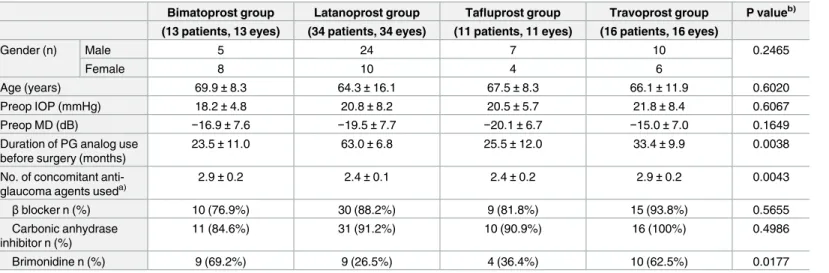
A total of 74 patients (74 eyes) were analyzed (Table 1). They were categorized by the preoper- ative PG analog used into a bimatoprost group (13 patients, 13 eyes), latanoprost group (34 patients, 34 eyes), tafluprost group (11 patients, 11 eyes), and travoprost group (16 patients, 16 eyes). No significant differences in age and gender distribution were observed among the 4 groups (P = 0.2465 and 0.6020, respectively; chi-squared test and ANOVA, respectively). Pre- operative IOPs were 18.2±4.8 mmHg in the bimatoprost group, 20.8±8.2 mmHg in the lata- noprost group, 20.5±5.7 mmHg in the tafluprost group, and 21.8±8.4 mmHg in the travoprost group. Preoperative mean deviations (MD) were−16.9±7.6 dB in the bimatoprost group,−19.5±7.7 dB in the latanoprost group,−20.1±6.7 dB in the tafluprost group, and
−15.0±7.0 dB in the travoprost group. No significant differences were observed in the preop- erative IOP and preoperative MD among the 4 groups (P = 0.6067 and 0.1649, respectively;
ANOVA). The duration of PG analog use before trabeculectomy differed among the 4 groups (P = 0.0038, ANOVA), because the various PG analogs were launched at different times. On the other hand, the number of concomitant glaucoma ophthalmic solutions used and the rate of concomitant use of brimonidine were significantly different among the 4 groups
(P = 0.0043 and 0.0177, respectively; ANOVA and chi-squared test).
Intraocular pressure after trabeculectomy
The IOP at 1 month after trabeculectomy was 8.3±4.2 mmHg in the bimatoprost group, 8.2±3.7 mmHg in the latanoprost group, 8.6±4.1 mmHg in the tafluprost group, and 8.7±3.9 mmHg in the travoprost group; there were no significant differences among the 4 groups (P = 0.9739, ANOVA).
Among the three criteria of recurrent IOP elevation, most patients (9 of 18) met the crite- rion of two or more consecutive IOPs15 mmHg. No patients were started on additional glaucoma medications despite an IOP<15 mmHg. Needling was performed in 1 patient in the latanoprost group and 1 patient in the bimatoprost group. Statistical analysis for inter- group difference was not possible due to the small number of cases.
As the primary outcome measure, the proportions of patients with no recurrent IOP eleva- tion, up to 24 months post-trabeculectomy were calculated by Kaplan-Meier method; these were 31.3% in the bimatoprost group, 83.2% in the latanoprost group, 45.5% in the tafluprost group, and 65.6% in the travoprost group (Fig 1). A significant difference was observed in the recurrence rate of elevated IOP among the 4 groups (P<0.001; log-rank test), and was the highest for bimatoprost among the PG analogs.
Relationship with DUES
The incidence of DUES in the various PG analog groups was 69.2% (9/13 eyes) in the bimato- prost group, 8.8% (3/34 eyes) in the latanoprost group, 9.1% (1/11 eyes) in the tafluprost group, and 31.3% (5/16 eyes) in the travoprost group, with the highest incidence in the bimato- prost group as compared to the other 3 groups (Fig 2). When the tafluprost group was used as reference, the OR for the development of DUES was not significantly different in the latano- prost group (OR: 0.97, 95% CI: 0.11 to 20.77; P = 0.9784) and the travoprost group (OR: 4.55, 95% CI: 0.59 to 95.16; P = 0.1545), but was significantly higher in the bimatoprost group (OR:
22.5, 95% CI: 2.89 to 492.85; P = 0.0017) (Table 2).
The 74 patients (74 eyes) analyzed were divided based on the presence of absence of DUES into a DUES(+) group (18 patients, 18 eyes) and a DUES(-) group (56 patients, 56 eyes). The 2
Table 1. Patient background of various prostaglandin (PG) analog groups.
Bimatoprost group Latanoprost group Tafluprost group Travoprost group P valueb) (13 patients, 13 eyes) (34 patients, 34 eyes) (11 patients, 11 eyes) (16 patients, 16 eyes)
Gender (n) Male 5 24 7 10 0.2465
Female 8 10 4 6
Age (years) 69.9±8.3 64.3±16.1 67.5±8.3 66.1±11.9 0.6020
Preop IOP (mmHg) 18.2±4.8 20.8±8.2 20.5±5.7 21.8±8.4 0.6067
Preop MD (dB) −16.9±7.6 −19.5±7.7 −20.1±6.7 −15.0±7.0 0.1649
Duration of PG analog use before surgery (months)
23.5±11.0 63.0±6.8 25.5±12.0 33.4±9.9 0.0038
No. of concomitant anti- glaucoma agents useda)
2.9±0.2 2.4±0.1 2.4±0.2 2.9±0.2 0.0043
βblocker n (%) 10 (76.9%) 30 (88.2%) 9 (81.8%) 15 (93.8%) 0.5655
Carbonic anhydrase inhibitor n (%)
11 (84.6%) 31 (91.2%) 10 (90.9%) 16 (100%) 0.4986
Brimonidine n (%) 9 (69.2%) 9 (26.5%) 4 (36.4%) 10 (62.5%) 0.0177
Data are expressed as mean±standard deviation or number of patients (%).
a)Combination formulation is counted as a single agent.
b)Analyzed by chi-squared test and ANOVA. Preop = preoperative; IOP = intraocular pressure; MD = mean deviation https://doi.org/10.1371/journal.pone.0181550.t001
Fig 1. Cumulative proportions of patients with no recurrent intraocular pressure (IOP) elevation in various prostaglandin analog groups. The proportions of patients with no IOP elevation recurring up to 24 months post- trabeculectomy were 31.3% in the bimatoprost group, 83.2% in the latanoprost group, 45.5 in the tafluprost group, and 65.6% in the travoprost group.
https://doi.org/10.1371/journal.pone.0181550.g001
groups did not differ in terms of gender distribution and age (P = 0.9158 and 0.1491, respec- tively; chi-squared test and ANOVA). Preoperative IOPs were 18.4±4.6 mmHg in the DUES (+) group and 21.1±8.0 mmHg in the DUES(-) group, while preoperative MDs were
−19.4±7.3 dB in the DUES(+) group and−17.8±7.6 dB in the DUES(-) group, with no signif- icant differences in either parameter between the 2 groups (P = 0.1640 and 0.4355, respectively;
ANOVA). On the other hand, the number of concomitant glaucoma ophthalmic solutions used and the rates of concomitant use ofβblocker and carbonic anhydrase inhibitor were not significantly different between the 2 groups (P = 0.2694, 0.6528 and 0.6483, respectively;
ANOVA and chi-squared test). However, the rate of concomitant use of brimonidine was sig- nificantly higher in the DUES(+) group (P = 0.0211; chi-squared test) (Table 3).
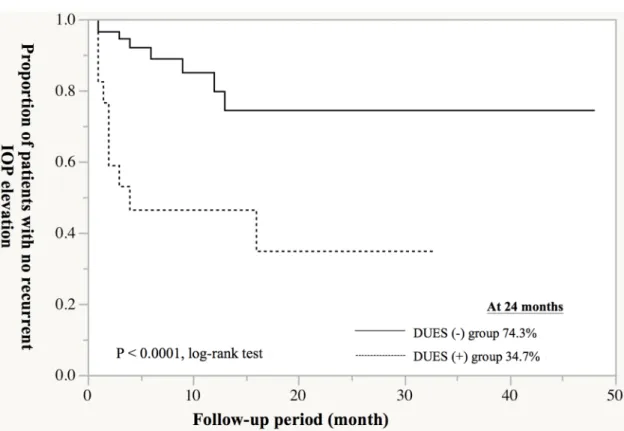
The proportion of patients with no recurrence of IOP elevation by up to 24 months after trabeculectomy was significantly lower in DUES(+) group than in DUES(-) group (34.7% vs.
74.3%; P<0.0001, log-rank test) (Fig 3). When the PG analogs used prior to trabeculectomy were examined, the analog most frequently used in the DUES(+) group was bimatoprost (50.0%, 9/18 eyes), followed by travoprost (27.8%, 5/18 eyes), latanoprost (16.7%, 3/18 eyes), and tafluprost (5.6%, 1/18 eye) (Fig 4A). On the other hand, the most frequently used analog
Fig 2. Incidence of deepening of the upper sulcus (DUES) in various prostaglandin (PG) analog groups. The incidence of DUES in various PG analog groups was 69.2% (9/13 eyes) in the bimatoprost group, 8.8% (3/34 eyes) in the latanoprost group, 9.1% (1/11 eyes) in the tafluprost group, and 31.3% (5/16 eyes) in the travoprost group, showing a high incidence in bimatoprost group compared to the other 3 groups.
https://doi.org/10.1371/journal.pone.0181550.g002
Table 2. Odds ratios for onset of deepening of the upper sulcus (DUES) in various prostaglandin (PG) analog groups.
Odds ratio 95% Confidence interval P value
Tafluprost group 1 - -
Latanoprost group 0.97 0.11–20.77 0.9784
Travoprost group 4.55 0.59–95.16 0.1545
Bimatoprost group 22.5 2.89–492.85 0.0017
https://doi.org/10.1371/journal.pone.0181550.t002
Table 3. Characteristics of patients in the DUES(+) and DUES(-) groups.
DUES(+) group DUES(-) group P valueb)
(18 patients, 18 eyes) (56 patients, 56 eyes)
Gender (n) Male 11 35 0.9158
Female 7 21
Age (years) 70.0±13.1 64.9±12.9 0.1491
Preop IOP (mmHg) 18.4±4.6 21.1±8.0 0.1640
Preop MD (dB) −19.4±7.3 −17.8±7.6 0.4355
No. of anti-glaucoma agents used concomitantlya) 2.7±0.6 2.5±0.6 0.2694
βblocker n (%) 15(83.3%) 49(87.5%) 0.6528
Carbonic anhydrase inhibitor n (%) 17(94.4%) 51(91.1%) 0.6483
Brimonidine n (%) 12(66.7%) 20(35.7%) 0.0211
Data are expressed as mean±standard deviation or number of patients (%).
a)Combination formulation is counted as one agent.
b)analyzed by unpaired t-test. Preop = preoperative; IOP = intraocular pressure; MD = mean deviation https://doi.org/10.1371/journal.pone.0181550.t003
Fig 3. Cumulative proportion of patients with no recurrent intraocular pressure (IOP) elevation according to deepening of the upper sulcus (DUES). The proportion of patients with no recurrence of IOP elevation by up to 24 months after trabeculectomy was significantly lower in DUES(+) group than in DUES(-) group (34.7% vs. 74.3%;
P<0.0001, log-rank test).
https://doi.org/10.1371/journal.pone.0181550.g003
in the DUES(-) group was latanoprost (55.4%, 31/56 eyes), followed by travoprost (19.6%, 11/
56 eyes), tafluprost (17.9%, 10/56 eyes) and bimatoprost (7.1%, 4/56 eyes) (Fig 4B).
Factors associated with recurrent IOP elevation
Based on the above results, we conducted a multivariate analysis to identify the factors associ- ated with recurrent IOP elevation up to 24 months after trabeculectomy. In a stepwise logistic regression analysis using no recurrent IOP elevation as the dependent variable and bimato- prost, latanoprost, travoprost, tafluprost,βblocker, carbonic anhydrase inhibitor, brimoni- dine, gender, age, preoperative IOP, preoperative MD, duration of PG analog use before surgery, and number of ophthalmic solutions used before surgery as independent variables, only bimatoprost was identified as the significant independent factor (P = 0.0368).
Discussion
In the present series of POAG patients in whom IOP was inadequately controlled by PG ana- logs and who underwent trabeculectomy, the proportions of patients who experienced no recurrent IOP elevation constituted 83.2% in the latanoprost group, 65.6% in the travoprost group, 45.5% in the tafluprost group, and 31.3% in the bimatoprost group. These results dem- onstrated that postoperative outcome, as indicated by recurrent IOP elevation, differs depend- ing on the PG analog used before trabeculectomy. In particular, the proportion of patients with recurrent IOP elevation was significantly higher among patients who used bimatoprost than in those who used the other 3 PG analogs. Furthermore, the results of multivariate analy- sis identified pre-trabeculectomy bimatoprost use as a significant risk factor for recurrent IOP elevation up to 24 months after trabeculectomy.
In terms of possible factors contributing to the difference in postoperative outcome depending on the PG analog used, we focused on DUES, which has been the focus of
Fig 4. Ratios of prostaglandin (PG) analogs used before trabeculectomy in deepening of the upper sulcus DUES (+) and DUES (-) groups. When the PG analogs used prior to trabeculectomy were examined, the analog most frequently used in the DUES(+) group was bimatoprost (50.0%, 9/18 eyes), followed by travoprost (27.8%, 5/18 eyes), latanoprost (16.7%, 3/18 eyes), and tafluprost (5.5%, 1/18 eyes). The most frequently used analog in the DUES(-) group was latanoprost (55.4%, 31/56 eyes), followed by travoprost (19.6%, 11/56 eyes), tafluprost (17.9%, 10/56 eyes) and bimatoprost (7.1%, 4/56 eyes).
https://doi.org/10.1371/journal.pone.0181550.g004
numerous reports in recent years. DUES is a specific adverse effect of PG analogs. In 2004, Peplinski et al. reported the first cases of DUES caused by bimatoprost therapy [7]. The mecha- nism of PG-induced DUES has been proposed to be as follows. Via activation of the prostanoid FP receptor, PG analogs decrease fat production in the orbital fat tissue; consequently, the orbital volume is reduced, deepening the eyelid sulcus [11,16–21]. However, the incidence of DUES has been shown to differ depending on the type of PG analog. Inoue et al. reported that the incidence of DUES was 60.0% in patients using bimatoprost, 50.0% in those using travo- prost, 24.0% in those using latanoprost, and 18.0% in those using tafluprost [22].
In the present study, the proportion of patients with IOP elevation recurring up to 24 months after trabeculectomy was significantly higher in patients who were positive for DUES than in those who were negative. Moreover, the DUES-positive rate was higher in patients who used bimatoprost (69%) than in those who used travoprost (31%), latanoprost (9%), or tafluprost (9%), suggesting that the high incidence of DUES in patients using bimatoprost may be associated with the unfavorable post-trabeculectomy outcome in these patients.
The present study has several limitations. First, Aihara et al. rated DUES by evaluating the photographs of the eyes and forehead. Before the initiation of treatment, PG was instilled in one eye [16]. Photographs were taken before treatment and every 2 months after starting treat- ment. The photographs were evaluated for the presence of DUES by 3 examiners, and a unani- mous agreement was required for rating the eyes as DUES (+). Due to the retrospective design of our study, DUES was rated based on the attending physicians’ evaluations and patients’ sub- jective symptoms. However, the incidence in the present study was similar to that in a prospec- tive evaluation study reported by Sakata et al. [23], indicating that the rating in our study was generally valid.
Next, besides DUES, several other factors may be responsible for the PG-related poor out- come after trabeculectomy, including conjunctival inflammation [24,25]. Broadway et al.
reported that long-term treatment with anti-glaucoma ophthalmic solutions induced conjunc- tival inflammation before surgery, causing fibroblast proliferation, as well as increases in mac- rophages, mast cells, and lymphocytes, in and beneath the conjunctival epithelium, which are risk factors for failure of trabeculectomy [26,27]. However, conjunctival hyperemia is not a specific adverse effect of PG analogs. In addition, patients who undergo trabeculectomy gener- ally have not achieved the target IOP despite the use of multiple anti-glaucoma medications.
Since nearly all the subjects in the present study were also receiving multiple concomitant medications (100% in bimatoprost group, 97% in latanoprost group, 100% in tafluprost group, and 100% in travoprost group), it would seem invalid to simply compare conjunctival hyper- emia in various PG analog groups, and concluding that conjunctival hyperemia is a PG-related poor prognostic factor of trabeculectomy. However, in a meta-analysis of 32 randomized con- trolled trials in patients with POAG and ocular hypertension, the risk of conjunctival hyper- emia was higher for PG analogs compared to timolol, with relative risks (95% CI) of 4.66 (3.49–6.23) for bimatoprost, 2.30 (1.76–3.00) for latanoprost, 4.34 (2.34–8.04) for tafluprost, and 3.92 (3.04–5.05) for travoprost [28]. Therefore, the frequency of conjunctival hyperemia is generally high when PG analogs are used, and the possibility that conjunctival hyperemia is a risk factor for a poor outcome cannot be excluded.
Furthermore, eyelid hardening associated with prostaglandin-associated periorbitopathy (PAP) may also be a factor in poor prognosis. PAP is an adverse effect specific to PG analogs, and the term PAP describes a constellation of symptoms, including DUES, upper lid ptosis, involution of dermatochalasis, periorbital fat atrophy, mild enophthalmos, inferior scleral show, increased prominence of lid vessels, and tight eyelids [29,30]. When eyelid hardening occurs due to PAP, the upper eyelid acts as a pressure eye patch and compresses the filtration
bleb, affecting the formation and maintenance of the bleb. Further study is required to exam- ine the effect of preoperative PAP caused by PG analogs on the outcome of trabeculectomy.
Baudouin et al. pointed out the possibility that benzalkonium chloride (BAK) may have del- eterious effect on postoperative bleb function [31,32]. However, in the present study, the rate of no recurrent IOP elevation was the highest in the group using latanoprost that has the high- est BAK concentration. Therefore, the principal component is probably involved in maintain- ing bleb function. The preservatives used in the four prostaglandin analogs are as follows:
0.005% BAK in Lumigan1, 0.02% BAK in Xalatan1, 0.001% BAK in Tapros1, and SofZia1in Travatan Z1.
Previous reports suggested that topical prostaglandin analogs did not affect the outcome of laser trabeculoplasty treatment [33,34]. On the other hand, we found that the outcome of tra- beculectomy varied depending on the PG analog used before surgery. The difference in the effect of PG analogs on the two procedures may be due to the difference in level of PG expo- sure. Drug exposure at the conjunctiva with a bleb formed by trabeculectomy is vastly higher than that at the angle (inside the anterior chamber) that is irradiated by laser trabeculoplasty (approximately 0.01% of ophthalmic solution reaches the anterior chamber) [35–37].
Conclusion
In the present study, we retrospectively analyzed the effect of PG analogs used prior to trabecu- lectomy on postoperative outcome in POAG patients with inadequate IOP control by PG ana- logs. In the present series, the outcome of trabeculectomy differed depending on the PG analog used before surgery, and the results suggested a high risk of recurrent IOP elevation up to 24 months after trabeculectomy in patients who used bimatoprost before surgery. The dif- ference in incidence of DUES depending on the type of PG analog may be a factor. The sample size for individual PG groups was relatively small, especially for the bimatoprost group. Fur- ther large-scale study is required to confirm the findings.
The findings of the present study indicate that when performing trabeculectomy for patients with glaucoma, the status of DUES should be confirmed and the postoperative course of IOP should be followed carefully. In patients using bimatoprost but with poor IOP control, who are considering the option of surgical therapy in the future, medical treatment should be monitored to prevent the onset of DUES as far as possible. When trabeculectomy is performed in eyes that have already developed DUES, the postoperative course should be followed very carefully for recurrence of IOP.
Author Contributions
Conceptualization: Tomoko Naito, Rieko Kiyoi.
Data curation: Takako Miki, Miyuki Fujiwara, Ryoichi Araki, Rieko Kiyoi.
Formal analysis: Takako Miki, Miyuki Fujiwara, Rieko Kiyoi, Atsushi Fujiwara.
Investigation: Takako Miki.
Methodology: Tomoko Naito, Yusuke Shiode, Yuki Morizane.
Project administration: Takako Miki.
Supervision: Tomoko Naito, Fumio Shiraga.
Validation: Takako Miki, Miyuki Fujiwara.
Visualization: Takako Miki, Yusuke Shiode, Atsushi Fujiwara.
Writing – original draft: Takako Miki, Tomoko Naito.
Writing – review & editing: Takako Miki, Tomoko Naito.
References
1. Heijl A, Leske C, Bengtsson B. Reduction of intraocular pressure and glaucoma progression. Arch Ophthalmol. 2002; 120: 1268–1279. PMID:12365904
2. Crawley L, Zamir S, Cordeiro M. Clinical options for the reduction of elevated intraocular pressure.
Ophthalmol Eye Dis. 2012; 4: 43–46.https://doi.org/10.4137/OED.S4909PMID:23650457 3. Kulkarni S, Damji K, Buys Y. Medical management of primary open-angle glaucoma: Best practices
associated with enhanced patient compliance and persistency. Patient Preference and Adherence.
2008; 2: 303–313. PMID:19920977
4. Sethi HS, Dhawan M, Naik MP, Gupta VS. Prostaglandin analogs in glaucoma. Astrocyte. 2015; 2:
126–32.
5. Ishida N, Kawabata N, Shimazaki A, Hara H. Prostanoids in the therapy of glaucoma. Cardiovascular drug reviews. 2006; 24: 1–10.https://doi.org/10.1111/j.1527-3466.2006.00001.xPMID:16939629 6. Aihara M. Clinical appraisal of tafluprost in the reduction of elevated intraocular pressure (IOP) in open-
angle glaucoma and ocular hypertension. Clinical Ophthalmology. 2010; 4: 163–170. PMID:20390038 7. Peplinski LS, Albiani SK. Deepening of lid sulcus from topical bimatoprost therapy. Optom Vis Sci.
2004; 81: 574–577. PMID:15300114
8. Filippopoulos T, Paula JS, Torun N, Hatton MP, Pasuquale LR, Grosskreutz CL. Periobital changes associated with topical bimatoprost. Ophthalmol Plast Reconstr Surg. 2008; 24: 302–307.
9. Yam JC, Yuen NS, Chan CW. Bilateral deepening of upper lid sulcus from topical bimatoprost therapy.
J Ocul Pharmacol. 2009; 53: 176–179.
10. Yang HK, Park KH, Kim TW, Kim DM. Deepening of eyelid superior sulcus during topical travoprost treatment. Jpn J Opthalmol. 2009; 53: 176–179.
11. Tappeiner C, Perren B, Iliev ME, Frueh BE, Goldblum D. Orbital fat atrophy in glaucoma patients treated with topical bimatoprost—can bimatoprost cause enophthalmos? Klin Monbl Augenheilkd. 2008; 225:
443–445.https://doi.org/10.1055/s-2008-1027362PMID:18454393
12. Lee JW, Kim DY, Lee YK. Two cases of deepening of upper lid sulcus from topical bimatoprost therapy.
J Korean Ophthalmol Soc. 2007; 48: 332–336.
13. Aydin S, Isikligil I, Teksen YA, Kir E. Recovery of orbital fat pad prolapsus and deepening of the lid sul- cus from topical bimatoprost therapy: 2 case reports and review of the literature. Cutan Ocul Toxicol.
2010; 29: 212–216.https://doi.org/10.3109/15569521003796860PMID:20670089
14. Kucukevcilioglu M, Bayer A, Uysal Y, Altinsoy HI. Prostaglandin associated periorbitopathy in patients using bimatoprost, latanoprost and travoprost. Clin Experiment Ophthalmol. 2014; 42: 126–131.
https://doi.org/10.1111/ceo.12163PMID:23844550
15. Park J, Cho HK, Moon J. Changes to upper eyelid orbital fat from use of topical bimatoprost, travoprost, and latanoprost. Jpn J Ophthalmol. 2011; 55: 22–27.https://doi.org/10.1007/s10384-010-0904-z PMID:21331688
16. Aihara M, Shirato S, Sakata R. Incidence of deepening of the upper eyelid sulcus after switching from latanoprost to bimatoprost. Jpn J Opthalmol. 2011; 55: 600–604.
17. Choi HY, Lee JE, Lee JW, Park HJ, Lee JE, Jung JH. In vitro study of antiadipogenic profile of latano- prost, travoprost, bimatoprost, and tafluprost in human orbital preadiopocytes. J Ocul Pharmacol Ther.
2012; 28:146–152.https://doi.org/10.1089/jop.2011.0160PMID:22107041
18. Liu L, Clipstone NA. Prostaglandin F2alpha inhibits adipocyte differentiation via a G alpha q-calcium- calcineurin-dependent signaling pathway. J Cell Biochem. 2007; 100: 161–173.https://doi.org/10.
1002/jcb.21044PMID:16888802
19. Miller CW, Casimir DA, Ntambi JM. The mechanism of inhibition of 3T3-L1 preadipocyte differentiation by prostaglandin F2alpha. Endocrinology. 1996; 137: 5641–5650.https://doi.org/10.1210/endo.137.
12.8940395PMID:8940395
20. Serreo G, Lepak NM. Prostaglandin F2alpha receptor (FP receptor) agonists are potent adipose differ- entiation inhibitors for primary culture of adipocyte precursors in defined medium. Biochem Biophys Res Commun. 1997; 233: 200–202.https://doi.org/10.1006/bbrc.1997.6433PMID:9144422 21. Taketani Y, Yamagishi R, Fujishiro T, Igarashi M, Sakata R, Aihara M. Activation of the prostanoid FP
receptor inhibits adipogenesis leading to deepening of the upper eyelid sulcus in prostaglandin-
associated periorbitopathy. Invest Ophthalmol Vis Sci. 2014; 55: 1269–1276.https://doi.org/10.1167/
iovs.13-12589PMID:24508785
22. Inoue K, Shiokawa M, Wakakura M, Tomita G. Deepening of the upper eyelid sulcus caused by 5 types of prostaglandin analogs. J Glaucoma. 2013; 22: 626–631.https://doi.org/10.1097/IJG.
0b013e31824d8d7cPMID:22936280
23. Sakata R, Shirato S, Miyata K, Aihara M. Incidence of deepening of the upper eyelid sulcus in prosta- glandin-associated periorbitopathy with a latanoprost ophthalmic solution. Eye. 2014; 28: 1446–1451.
https://doi.org/10.1038/eye.2014.224PMID:25233818
24. Alm A, Grierson I, Shields MB. Side effects associated with prostaglandin analog therapy. Surv Ophthalmol. 2008; 53 Suppl1: S93–105.
25. Shah M, Lee G, Lefebvre DR, Kronberg B, Loomis S, Brauner SC, et al. A cross-sectional survey of the association between bilateral topical prostaglandin analogue use and ocular adnexal features. PLoS ONE. 2013; 8: e61638.https://doi.org/10.1371/journal.pone.0061638PMID:23650502
26. Broadway DC, Grierson I, O’Brien C, Hitchings RA. Adverse effects of topical antiglaucoma medication.
I. The conjunctival cell profile. Arch Ophthalmol. 1994; 112: 1437–1445. PMID:7980133
27. Broadway DC, Grierson I, O’Brien C, Hitchings RA. Adverse effects of topical antiglaucoma medication.
II. The outcome of filtration surgery. Arch Ophthalmol. 1994; 112: 1446–1454. PMID:7980134 28. Lin L, Zhao YJ, Chew PT, Sng CC, Wong HT, Yip LW, et al. Comparative efficacy and tolerability of topi-
cal prostaglandin analogues for primary open-angle glaucoma and ocular hypertension. Ann Pharmac- other. 2014; 48: 1585–1593.https://doi.org/10.1177/1060028014548569PMID:25184309
29. Berke SJ. PAP: New concerns for prostaglandin use. Rev Ophthalmol 2012; 19:70.
30. Sakata R, Shirato S, Miyata K, Aihara M. Recovery from deepening of the upper eyelid sulcus after switching from bimatoprost to latanoprost. Jpn J Ophthalmol. 2013; 57: 179–184.https://doi.org/10.
1007/s10384-012-0219-3PMID:23233196
31. Baudouin C, Labbe A, Liang H, Pauly A, Brignole-Baudouin F. Preservatives in eyedrops: tha good, the bad and the ugly. Prog Retin Eye Res. 2010; 29: 312–334.https://doi.org/10.1016/j.preteyeres.2010.
03.001PMID:20302969
32. Baudouin C, Garcher C, Haouat N, Bron A, Gastaud P. Expression of inflammatory membrane markers by conjunctival cells in chronically treated patients with glaucoma. Ophthalmology. 1994; 101: 454–
460. PMID:7907416
33. Singh D, Coote MA, Hare F. Topical prostaglandin analogues do not affect selective laser trabeculo- plasty outcomes. Eye. 2009; 23: 2194–2199.https://doi.org/10.1038/eye.2009.1PMID:19182767 34. Ayala M, Chen E. The influence of topical prostaglandin analogues in inflammation after selective laser
trabeculoplasty treatment. Journal of ocular pharmacology and therapeutics. 2012; 28: 118–122.
https://doi.org/10.1089/jop.2011.0084PMID:22087857
35. Ogundele A, Jasek M. Aqueous humor penetration of topical bimatoprost 0.01% and bimatoprost 0.03% in rabbits. Clinical Ophthalmology. 2010; 4: 1447–1450.https://doi.org/10.2147/OPTH.S15521 PMID:21188157
36. Ichhpujani P, Kats L, Hollo G. Comparison of human ocular distribution of bimatoprost and latanoprost.
Journal of ocular pharmacology and therapeutics. 2012; 28: 134–144.https://doi.org/10.1089/jop.
2011.0097PMID:22136089
37. Sjoquist B, Stjernschantz J. Ocular and systemic pharmacokinetics of latanoprost in humans. Survey of ophthalmology. 2002; 47: 6–11.