資料HDR作3-3
HDR-TVに関する
ITU-R SG6会合(2016年1-2月)の結果
概要
勧告案:
HDRテレビの番組制作及び国際番組交換用の映像パラメータ
空間解像度:
2K, 4K, 8K、時間解像度:24~120Hz、BT.2020広色域
背景輝度:
5cd/m
2、ピーク輝度
1000cd/m
2以上、黒:
0.005cd/m
2以下
伝達関数:
HLGとPQの2方式のOETF、EOTF、OOTFを規定
•
HLGのOETFはARIB STD-B67と同等
•
PQのEOTFはSMPTE ST 2084と同等
輝度・色差信号:
YʹCʹ
BCʹ と
RIC
TC の2通り
P• 非低輝度
YʹCʹ
BCʹ
Rは
BT.2020と同等
• 定輝度
IC
TC
Pは新規定
デジタル表現:
narrow rangeとfull rangeの整数表現及び浮動小数点表現
• 採択・承認手続きに
5ヶ月程度を要する見込み
レポート:番組制作及び国際番組交換用の
HDRテレビ
HDRテレビの技術的な説明
今後の主要な検討課題
IC
TC の妥当性
P
PQ方式のOOTFの妥当性
OETF(光-電気) EOTF(電気-光), OOTF(光-光)
OETF, EOTF, OOTF
HLG
HLGとPQの相互変換
PQHLG
ディスプレイのピーク輝度
HLGPQ
ディスプレイのピーク輝度(
Scene Lightを介した変換も可能)
TABLE 1
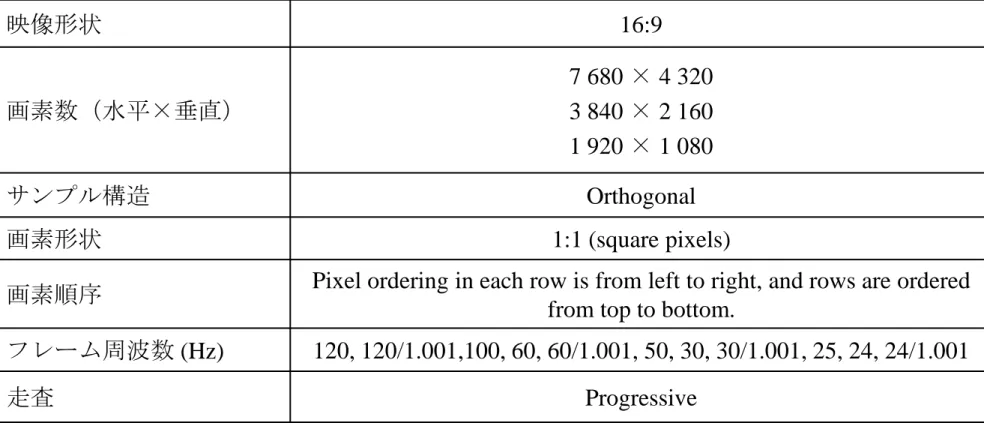
映像の空間・時間特性
映像形状 16:9 画素数(水平×垂直) 7 680 × 4 320 3 840 × 2 160 1 920 × 1 080 サンプル構造 Orthogonal 画素形状 1:1 (square pixels)画素順序 Pixel ordering in each row is from left to right, and rows are ordered from top to bottom.
フレーム周波数 (Hz) 120, 120/1.001,100, 60, 60/1.001, 50, 30, 30/1.001, 25, 24, 24/1.001
TABLE 2
カラリメトリ
Optical spectrum (informative) Chromaticity coordinates (CIE, 1931)x
y
三原色 赤 (R) monochromatic 630 nm 0.708 0.292 緑 (G) monochromatic 532 nm 0.170 0.797 青 (B) monochromatic 467 nm 0.131 0.046 基準白色 D65 per ISO 11664-2:2007 0.3127 0.3290 等色関数 CIE 1931TABLE 3
厳密な観視の場合の基準観視条件
背景、周囲 Neutral grey at D65 背景輝度 5 cd/m2
周囲輝度 ≤ 5 cd/m2
照明 Avoid light falling on the screen
視距離
For 1920x1080 format: 3.2 picture heights For 3840x2160 format: 1.6 to 3.2 picture heights For 7680x4320 format: 0.8 to 3.2 picture heights ディスプレイピーク輝度 ≥ 1 000 cd/m2
TABLE 4
PQ方式の基準非線形伝達関数
PQ EOTFの入力信号 Non-linear PQ encoded value.
The EOTF maps the non-linear PQ signal into display light.
PQ EOTF FD = EOTF E
[
′ = 10000 Y]
1 m 1 m 1 2 max[
(
E′ − c1)
,0]
Y = 1 m 2 − ′ where c2 c E3 Eʹ denotes a nonlinear colour value {R’, G’, B’} or { L’, M’, S’} in PQ
space [0,1]
FD is the luminance of a displayed linear component {RD, GD, BD} or YD or ID, in cd/m2.
So that when R’=G’=B’, the displayed pixel is achromatic.
Y denotes the normalised linear colour value, in the range [0:1] m1 =
m2 =
c1 =
c2 =
TABLE 4(続き)
PQ OOTFの入力信号 Scene linear light.
The OOTF maps relative scene linear light to display linear light.
PQ OOTF
FD = OOTF[E] = G1886 [G709[E]] where
E = {Rs, Gs, Bs; Ys; or Is} is the signal determined by scene light and
scaled by camera exposure
E’ is a non-linear representation of E
FD is the luminance of a displayed linear component (RD, GD, BD; YD; or
ID)
The values E, Rs, Gs, Bs, Ys, Is are in the range [0:1]
FD = G1886 [ G709[E]] = G1886 E’ E’ = G [E] = 1.099 (59.5208 E)0.45 709 – 0.099 for 1 > E > 0.0003024 = 267.84 E for 0.0003024 ≥ E ≥ 0 F E’2.4 D = G1886[E’] = 100
TABLE 4(続き)
PQ OETFの入力信号
Scene linear light.
The OETF maps relative scene linear light into the non-linear PQ signal value.
PQ OETF
1
− −1
E′
=
OETF E
[ ]
= EOTF
[
OOTF E
[ ]
]
= EOTF
[
F
D]
where m2 m1
c + c Y
1 − 1 2EOTF
[
F
D]
=
m
1
1
+ c Y
3
Y
= F 10000
DE
´
is the resulting non-linear signal (R’,G’,B’) in the range [0:1]FD, E, are as specified in the opto-optical transfer function
TABLE 5
HLG方式の基準非線形伝達関数
HLG OETFの入力信号
Scene linear light.
The OETF maps relative scene linear light into the non-linear signal value. HLG OETF
E 2
0
≤ E ≤1
E′
= OETF
[ ]
E
=
a
⋅ln
(
E
− b
)
+ c
1
< E
where:E is the signal for each colour component {Rs, Gs, Bs} proportional to
scene linear light and scaled by camera exposure, normalised to the range [0:12]5b.
E
´
is the resulting non-linear signal {R’, G’, B’} in the range [0:1] .a = 0.17883277, b = 0.28466892, c = 0.55991073
Note 5b: If E is normalised to the range [0:1] then the equivalent equation for the OETF is:
[ ]
(
)
<
+
−
⋅
≤
≤
=
=
′
E
c
b
E
a
E
E
E
E
12 1 12 1ln
0
3
OETF
TABLE 5(続き)
HLG EOTFの入力信号 Non-linear HLG encoded value.
The EOTF maps the non-linear HLG signal into display light.
HLG EOTF
−1
= OOTF = OOTF OETF ′
FD
[ ]
E[
[ ]
E]
γ−1 Thus, R =α
Y R +β
D S S γ−1 GD =α
YS GS +β
γ−1 BD =α
YS BS +β
where:Rs, Gs, Bs are the scene linear light signals, E, for each colour component normalised in the range [0:12]5c.
2 1
4E′ 0≤ E′ ≤
−1 2
E = OETF
[ ]
E′ = 1
exp
((
E′− c)
/ a)
+ b < E′ 2
YS = 0.2627R +S 0.6780GS + 0.0593BS
α
=(
LW − LB)
/12γβ
= LBFD is the luminance of a displayed linear component {RD, GD, or BD}, in cd/m2.
Note 5c: If E is normalised to the range [0:1] then the equivalent equation for the E is:
[ ] (( ) ) ′ < + − ′ ≤ ′ ≤ ′ = ′ = − E E E E 2 1 2 1 3 0 OETF
TABLE 5(続き)
HLG EOTF(続き)
Eʹ is the non-linear signal {R’,G’,B’} as defined for the OETF. RD, GD, BD are the displayed light for each colour component5d, in
cd/m2.
The values of parameters a, b, and c are as defined for the OETF. The OOTF is defined below.
5e, 5f
γ
= 1.2 at the nominal display peak luminance of 1000 cd/m2.LW is nominal peak luminance of the display in cd/m2.
LB is the display luminance for black in cd/m2.
5g
The nominal signal range of E, Rs, Gs, Bs, and YS is [0:12].
The reference display shall not display values greater than E' = 1.0. Such values should be clipped to 1.0 prior to display5h.
Note 5d: This EOTF applies gamma to the luminance component of the signal, whereas some legacy displays may
apply gamma separately to colour components. Such legacy displays approximate this reference OOTF. Note 5e: For displays with nominal peak luminance (L gr a r than 1000 cd/m2
W) e te , or where the effective nominal
peak luminance is reduced through the use of a contrast control, the system gamma value should be adjusted according to the formula below, and may be rounded to three significant digits: γ = 1.2 + 0.42Log10(LW 1000)
Note 5f: The system gamma value may be decreased for brighter background and surround conditions.
Note 5g: When E is normalised to the range [0:1] then the equation for α is:α =(LW − LB)
TABLE 5(続き)
HLG OOTFの入力信号
Scene linear light.
The OOTF maps relative scene linear light to display linear light.
HLG OOTF γ−1 FD =OOTF E
[ ]
=αYS E+ β γ−1 RD =αYS RS +β γ−1 GD =αYS GS + β γ−1 BD =αYS BS +β Ys = 0.2627R +S 0.6780GS + 0.0593BS where:FD is the luminance of a displayed linear component {RD, GD, or BD}, in cd/m2.
E is the signal for each colour component {Rs, Gs, Bs} proportional to
scene linear light and scaled by camera exposure, normalised to the range [0:12].
YS is the normalised linear scene luminance.
TABLE 6
非定輝度
YʹCʹ
B
Cʹ 信号形式
R
PQ HLG R′
, G′
, B′
{R′
, G′
, B′
}=EOTF-1(F D) where FD = {RD, GD, BD} {R′
, G′
, B′
}=OETF(E) where E = {RS, GS, BS} 輝度信号 Y' = 0.2627R' + 0.6780G' + 0.0593B' 色差信号 C ′B = B' − Y' 8814 1. C ′R = R' − Y' 4746 1.TABLE 7
定輝度
IC
T
C 信号形式
P
PQ HLG L, M, S色空間 L =(
1688R+ 2146G + 262B)
4096 M =(
683R+ 2951G + 462B)
4096 S =(
99R+ 309G + 3688B)
4096 L’, M’, S {L′
, M′
, S′
}=EOTF -1(F D) where FD = {LD, MD, SD} {L′
, M′
, S′
}=OETF(E) where E = {LS, MS, SS} I’I
= 0.5L'
+ .5M '
0
色差信号 CT =(
6610L'−13613M '+7003S')
4096 CP =(
17933L'−17390M '−543S')
4096YʹCʹ
BCʹ 信号の使用が
Rdefault。IC
TC 信号の使用は関係者の合意が条件。
PTABLE 8
信号サンプリング
信号 R', G', B' or Y', C'B, C'R, , or I, CT, CP
サンプリング構造
R', G', B', Y', I Orthogonal, line and picture repetitive co-sited
サンプリング構造 C'B, C'R, CT, CP
Orthogonal, line and picture repetitive co-sited with each other. The first (top-left) sample is co-sited with the first Y’ or I samples.
4:4:4 system 4:2:2 system 4:2:0 system
Each has the same number of horizontal samples as the Y' or I
component.
Horizontally subsampled by a factor of two with
respect to
the Y' or I component.
Horizontally and vertically subsampled by a factor of two with respect to the Y' or
component.
TABLE 9
10-bit、12-bit整数表現
信号 R', G', B' or Y', C'B, C'R, , or I, CT,CP
ビット数 n = 10, 12 per component
Narrow range Full range
R‘, G’, B‘, Y’, I の量子化 C'B, C'R, CT, CP の量子化
量子化レベル 10-bit coding 12-bit coding 10-bit coding 12-bit coding 黒(R’ = G’ = B’ = Y’ = I = 0) 64 256 0 0 DR', DG', DB', DY', DI 無彩色(C’B = C’R = 0) 512 2048 512 2048 DC'B, DC'R, DCT, DCP Nominalピーク (R’ = G’ = B’ = Y’ = I = 1) 940 3760 1023 4092 DR', DG', DB', DY', DI Nominalピーク (C’B = C’R = ±0.5) 960 3840 1023 4092 DC'B, DC'R, DCT, DCP
4 through 16 through 0 through 0 through 映像データ
TABLE 10
浮動小数点表現
信号 Linear R, G, B.
信号表現 16-bit floating point per IEEE standard 754-2008. PQの正規化 A value of 1.0 for each of R, G, B yields 1.0 cd/m
2 on the reference
display.