(日本救命医療学会雑誌Vol. 17より再掲載)
日本救命医療学会多臓器障害(MOF)診断基準と
改訂について
この診断基準は,本学会の前身である救命救急医療研究会で制定したものであり,すでに 15年を経ております. 本基準制定に関して,当時は救急施設ごとに考え方の違いが比較的大きいものでしたが, それでもどの施設でも利用でき,医学研究の際に共通のメジャーになることを重視し,緩い 基準と厳しい基準の2段階とすることになりました. すなわち,臓器障害と確実に診断できる所見を重視して制定したものが厳しい基準ですが, 救急領域で扱う重症患者では,この基準を満たしてから治療を開始したのでは,手遅れにな る患者が少なくありません.したがって,それより早期にMOFを念頭にして治療を開始すべ き所見を緩い基準としました.緩い基準は治療開始基準,厳しい基準はMOF診断基準ともい えます. この基準も現在では文献などに引用される場合が多くなってきました.しかし一方で,こ の15年間にMOF治療もかなり進歩しました.この診断基準が現在の医療レベルに適合してい るか再検討する必要があります.そこで今回の総会を機に検討委員会を設け,このまま今後 も使用できるか,また使用上問題があるとすればどのように改訂をする必要があるか,検討 することになりました(第16回日本救命医療学会理事会).今後,会員の先生方には,MOF診 断基準検討委員会から節目節目にご意見を求められることになると思いますが,よろしくご 協力の程お願い申し上げます. 平成15年9月吉日日本救命医療学会理事長
鈴 木 忠
(日本救命医療学会雑誌Vol. 17より再掲載)
多臓器障害(MOF)の診断基準
(第4回救命救急医療研究会,1990年)
1)多臓器障害の定義: ⑴ 心,腎,肺,肝,中枢神経系,凝固系,消化管(出血)の臓器やシステムのうち, ⑵ 二つ以上の臓器,システムが, ⑶ 同時に,あるいは短時間のうちに連続して, ⑷ 機能不全に陥った重篤な病態である. 救命救急医療研究会誌 3, 99(1989)より引用 2)広義のMOFと狭義のMOF 対象としては,腎・呼吸器・肝・心血管系・DIC・消化器・中枢神経の7臓器ないし臓器システムとする. 緩い基準に示す臓器障害を2以上みたす際をMOF(広義)とする. 更に,厳しい基準(臓器障害をより確実に示すと考えられる基準)に基づき,2臓器以上をみたしたものを 狭義のMOFとする. 注1) 以上の各項目の1つ以上を満たせば,臓器障害が存する とする. 注2)MOFと診断した際には,広義・狭義を併記する. 注3)広義のMOFには,以下の項目も含める. ただし,その際は,厳しい基準に基づく. ア)原疾患の悪化 イ)外傷による臓器障害 (*Goldbergerに基づく) 注4)以下の項目は除外する. ア)癌末期と考えられる異常,悪液質による変化 (急性の合併症は含める) イ)慢性化した例における死亡直前にみられた異常値 ウ)脳死確定後 注5)将来の目標として,以下を念頭におく. ⑴ 各臓器障害を確実に反映する指標を求める. ⑵ MOFの原因・背景病態,臓器障害の有機的関連を 追及し,究明する. (1)緩い基準 (2)厳しい基準 機能障害関連項目 治療関連項目 腎 1)尿量<600ml/day 2)BUN>50mg/dl 3)血清クレアチニン>3mg/dl 1)血清クレアチニン>5mg/dl 2)CH2O>0.0ml/hr 3)FENa>3.0% 呼吸器 1)PaO2<60mmHg(Room air)2)PaO2/FiO2<350mmHg 3)AaDO(FiO2 2=1.0)>300mmHg 4)Q˙s/Q˙t>20% 1) 人工呼吸を要した(5 日間以上:PEEP, CPAP, IMVを含む) 1)PaO2/FiO2<250mmHg 2)AaDO(FiO2 2)>400mmHg 3)Q˙s/Q˙t>30% 肝 1)血清ビリルビン>3.0mg/dl 2)s-GPT>100U/l 3)AKBR<0.7 1)血清ビリルビン>5.0mg/dl 2)AKBR<0.4 DIC 1) 厚生省DIC基準で2点以上の項目が1つ 以上(FDP≧20µg/ml, 血小板数≦8万, 血漿フィブリノーゲン≦100mg/dl) 2) 1~2日以内でのFDP,血小板,血漿 フィブリノーゲンの急激な悪化(正常 値の3倍ないし1/3) 3)厚生省DIC基準で,DICの疑い(6点) 1)ヘパリン投与 >50単位/kg/day 1)厚生省DIC基準に基づくDIC 心血管系 1)CVP>10mmHg 2)Major arrhythmia*の出現 3)Forrester分類Ⅳ 4)末梢血管抵抗<1000dyne・sec・cm-5 1) 血圧低下に対して昇 圧剤を要する (2時間以上) 1)Forrester分類Ⅳ+Shock 2)Life threatening arrhythmia* 3)急性心筋梗塞 4)心停止 5)Major arrhythmia*の出現+血圧低下 消化器 1)吐下血 2)潰瘍の確認 1)輸血2パック/day以上 1)血圧低下を伴う消化管出血2)消化管穿孔,壊死 [3)膵炎,胆嚢炎:他に原因を認めない] 中枢神経 1)JCS>10 2)GCS<12 1)JCS>1002)GCS<8 3)意識消失を伴う痙攣発作 4)ABRに対する無反応,脳死
Table : Diagnostic Criteria of MOF and MOD (draft)
Journal of the Japanese Association for Critical Care Medicine Vol. 4 1990
(4th Research Meeting of the Japanese Association for Critical Care Medicine)
1. Definition of multiple organ failure (MOF)/dysfunction (MOD) : A serious condition in which
(1) Among the following 7 organ(s) or organ systems: heart, kidney, lung, liver, central nervous system, coagluation system (bleeding or DIC), gasterointestinal (GI) system
(2) Two or more organs or systems
(3) Simultaneously or consecutively within a short time frame (4) become dysfunctional
(Journal of Japan Society for Critical Care Medicine, 1989 ; 3 : 99)
2. MOF in the broad sense and MOF in the narrow sense (MOD)
This relates to following 7 organs or organ systems: kidney, respiratory organs, liver, cardiovascular system, DIC, digestive organs, and central nerves.
When there are two or more organ disorders indicated in the loose criteria, it will be considered MOF or MOD in the broad sense.
Furthermore, when there are two or more organ disorders indicated in the strict criteria (criteria that are considered to indicate organ disorder more reliably), it will be considered MOF in the narrow sense.
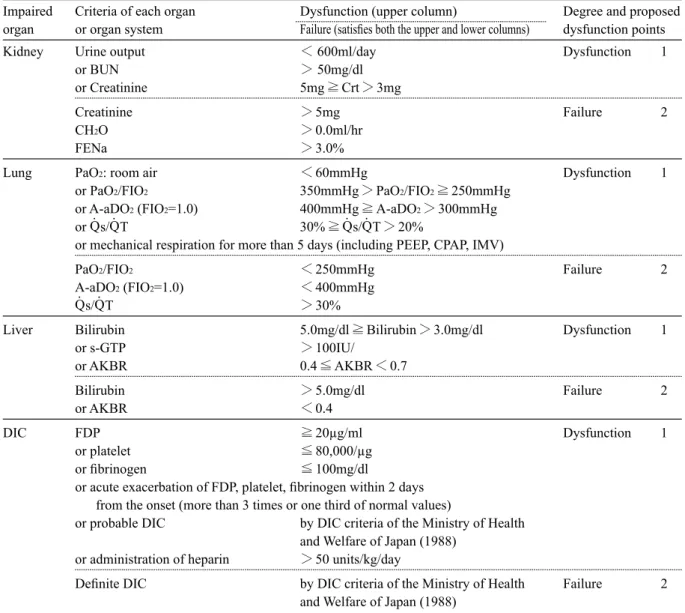
Impaired Criteria of each organ Dysfunction (upper column) Degree and proposed organ or organ system Failure (satisfies both the upper and lower columns) dysfunction points Kidney Urine output < 600ml/day Dysfunction 1
or BUN > 50mg/dl or Creatinine 5mg≧Crt>3mg
Creatinine >5mg Failure 2 CH2O >0.0ml/hr
FENa >3.0%
Lung PaO2: room air <60mmHg Dysfunction 1 or PaO2/FIO2 350mmHg>PaO2/FIO2≧250mmHg
or A-aDO2 (FIO2=1.0) 400mmHg≧A-aDO2>300mmHg or Q˙s/Q˙T 30%≧Q˙s/Q˙T>20%
or mechanical respiration for more than 5 days (including PEEP, CPAP, IMV)
PaO2/FIO2 <250mmHg Failure 2 A-aDO2 (FIO2=1.0) <400mmHg
Q˙s/Q˙T >30%
Liver Bilirubin 5.0mg/dl≧Bilirubin>3.0mg/dl Dysfunction 1 or s-GTP >100IU/ or AKBR 0.4≦AKBR<0.7 Bilirubin >5.0mg/dl Failure 2 or AKBR <0.4 DIC FDP ≧20µg/ml Dysfunction 1 or platelet ≦80,000/µg or fibrinogen ≦100mg/dl
or acute exacerbation of FDP, platelet, fibrinogen within 2 days from the onset (more than 3 times or one third of normal values)
or probable DIC by DIC criteria of the Ministry of Health and Welfare of Japan (1988)
or administration of heparin >50 units/kg/day
Definite DIC by DIC criteria of the Ministry of Health Failure 2 and Welfare of Japan (1988)
Impaired Criteria of each organ Dysfunction (upper column) Degree and proposed organ or organ system Failure (satisfies both the upper and lower columns) dysfunction points Cardio- CVP >10mmHg Dysfunction 1 vascular or major arrhythmia* by Goldberger*
or Forrester classification: IV
or peripheral vascular resistance <1000dyne·sec·cm-5 or inotropic agents care for more than two hours
Forrester classification: IV with shock Failure 2 or life threatening arrythmia* by Goldberger*
or acute myocardial infarction or cardiac arrest
or major arrythmia* with hypotension by Goldberger*
Digestive Hematemesis, melena Dysfunction 1 tract or ulcer
or blood transfusion more than 2 units/day
GI bleeding with hypotension Failure 2 or perforation, necrosis
Central JCS: Japan Coma Scale 100≧JCS>10 Dysfunction 1 nerves or GCS:Glasgow Coma Scale 8≦GCS<12
JCS >100 Failure 2
or GCS <8 or convulsion with unconsciousness
or no auditory brain stem response or brain death
Note
When describing the condition, discriminate MOF or MOD (MOF in a broad sense)
In the criteria of MOD, the following condition are included (the criteria is based upon the severe one) (1) Function disturbance influenced by the primary disease(s)
(2) Organ disorder caused by acute trauma The following condtion(s) are excluded.
(1) Endstadium of cancer and the metabolic abnormality/cachexia (acute exacerbation are not excluded) (2) Abnormal values of chronic disease patient just before death
(3) After diagnosis of brain death In the future
(1) Search for indexes that reflect accurately the degree of organ failure (2) Research and clarify the mechanism of mutual relationships of organ failure
Translated with modification from the original Japanese version, proposed 1989 and 1990
注) 前掲の多臓器障害(MOF)の診断基準(第4回救命医療研究会)の英訳文です。 研究会で討論がなされたスコア(ポイント)に関しても呈示しました(試案)。 不備な点も多いと思いますので、ご指摘をお待ちしております。
(日本救命医療学会雑誌Vol. 16 : P87より再掲載)
日本救命医療学会が提言する臓器障害度指数
本学会(第12~14回)パネルディスカッションで,救命領域での臓器障害の評価として SOFAが適切か,新たな評価法が必要でないのか,各臓器障害の程度を誰もが頭に描ける簡素 化された評価法はないか,などに関して討議され,以下の指数が本学会臓器障害度指数として 承認された. 総点数が同じでも,N1, R3, K1(total 5)とC1, R1, H1, K1, D1(total 5)とでは1臓器(肺)の障害 の程度,点数の重みが異なるため,前者の方が生命予後にとってより危険であるのは容易に察 しがつきます.本指数は多臓器の障害を表現する場合,総点数のみでなく,個々の障害程度を 記載し,誰もがその障害の程度と予後に関して,より理解できることを目的に作成されていま す.本指数決定に至った経緯に関しては本会雑誌12~14巻を参照していただきたい. なお,日本救命医療学会誌 15 : 127, 2001に記載不備がありましたことをお詫び申し上げま す. (文責 関西医科大学 田中孝也)日本救命医療研究会臓器障害度指数
中枢神経(N)*Glasgow Coma Scale
循環動態(C) Dopamine+ Dobutamine投与量 (µg/kg/min) 呼吸機能(R) P/F ratio Compliance** 肝機能(H) Total Bilirubin(mg/dl) HPT(%), PT(%), AKBR 腎機能(K) Serum Creatinine(mg/dl) 尿量 凝固能(D) 血小板数(×103mm3) ≧12 0 P/F≧300 または Comp≧45 t-Bil<1.2 ≦1.1 ≧150