X線天文衛星 ASTRO-H
による精密分光
江副 祐一郎
首都大学東京 理工・物理
•
X線天文と ASTRO-H
•
ASTRO-H による精密分光
•
Beyond ASTRO-H
•
まとめ
X
X
•
宇宙物理の大目標:宇宙の物質・構造の起源と進化を知る
•
さまざま手段(電磁波, 宇宙線, 重力波)での観測が必要
宇宙物理とX線天文学
•
宇宙の
高エネルギー現象
を探る
•
粒子加速 (keV-TeV), プラズマ加熱
•
輝線・吸収線を使った
プラズマ診断
•
化学組成, 密度, 温度, 運動
•
そもそも宇宙の
物質(バリオン)
の
約80%はX線でしか観測できない
「X線の利点」
典型的に 0.3-600 keV
髪の毛座銀河団
可視光 (銀河 ~1000 個)
X
線 (高温プラズマ)
暗黒物質の重力に束縛
•
宇宙からのX線は地球大気で吸収,
飛翔体
が不可欠
•
日本は
継続した衛星計画
で世界を牽引, 活動的宇宙を明らかに
日本のX線天文衛星
EXOSAT
XMM-Newton
ROSAT
Chandra
Einstein
Beppo-SAX
RXTE
Swift
NuSTAR
Granat
1980
1990
2000
2010
2020
(Year)
Ginga
ASCA
Suzaku
Hakucho
Tenma
Japan
ASTRO-H
2015
X
1970
1960
Ufuru
96 kg
216 kg
420 kg
417 kg
1680 kg
2700 kg
•
1. High Resolution Spectroscopy
by a micro-calorimeter array
•
Extended objects, Fe K lines
•
2. Wide-Band/High Sensitivity
Observation
•
0.3-600 keV, thermal +
non-thermal emissions
ASTRO-H 概要
CCD
Si/CdTe Compton
Camera
X-ray Telescopes
Si/CdTe Imager
Micro Calorimeter
14 m, 2700 kg
Low earth orbit
ASTRO-H collaboration
国内34機関, 海外27機関, メーカー
arXiv:1210.4378v1 [astro-ph.IM] 16 Oct 2012
The ASTRO-H X-ray Observatory
Tadayuki Takahashia, Kazuhisa Mitsudaa, Richard Kelleyb, Henri Aartsc,
Felix Aharoniand, Hiroki Akamatsuc, Fumie Akimotoe, Steve Allenf, Naohisa Anabukig,
Lorella Angelinib, Keith Arnaudh, Makoto Asaif, Marc Audardi, Hisamitsu Awakij,
Philipp Azzarelloi, Chris Balutaa, Aya Bambak, Nobutaka Bandoa, Mark Bautzl,
Roger Blandfordf, Kevin Boyceb, Greg Brownm, Ed Cackettn, Maria Chernyakovad,
Paolo Coppio, Elisa Costantinic, Jelle de Plaac, Jan-Willem den Herderc, Michael DiPirrob,
Chris Donep, Tadayasu Dotania, John Dotyq, Ken Ebisawaa, Megan Eckartb,
Teruaki Enotor, Yuichiro Ezoes, Andrew Fabiann, Carlo Ferrignoi, Adam Fostert,
Ryuichi Fujimotou, Yasushi Fukazawav, Stefan Funkf, Akihiro Furuzawae,
Massimiliano Galeazziw, Luigi Gallox, Poshak Gandhia, Keith Gendreaub, Kirk Gilmoref,
Daniel Haasc, Yoshito Habae, Kenji Hamaguchih, Isamu Hatsukadey, Takayuki Hayashia,
Kiyoshi Hayashidag, Junko Hiragaz, Kazuyuki Hirosea, Ann Hornschemeierb,
Akio Hoshinou, John Hughesaa, Una Hwangab, Ryo Iizukaac, Yoshiyuki Inouef,
Kazunori Ishibashie, Manabu Ishidaa, Kosei Ishimuraa, Yoshitaka Ishisakis, Masayuki Itoad,
Naoko Iwataa, Naoko Iyomotoae, Jelle Kaastrac, Timothy Kallmanb, Tuneyoshi Kamaef,
Jun Kataokaaf, Satoru Katsudar, Hajime Kawaharas, Madoka Kawaharadaa,
Nobuyuki Kawaiag, Shigeo Kawasakia, Dmitry Khangaluyana, Caroline Kilbourneb,
Masashi Kimurag, Kenzo Kinugasaah, Shunji Kitamotoai, Tetsu Kitayamaaj,
Takayoshi Kohmuraak, Motohide Kokubuna, Tatsuro Kosakaal, Alex Koujelevam,
Katsuji Koyamaan, Hans Krimmb, Aya Kubotaao, Hideyo Kuniedae, Stephanie LaMassao,
Philippe Laurentap, Fran¸cois Lebrunap, Maurice Leuteneggerb, Olivier Limousinap,
Michael Loewensteinb, Knox Longaq, David Lumbar, Grzegorz Madejskif,
Yoshitomo Maedaa, Kazuo Makishimaz, Genevi`eve Marchandam, Maxim Markevitchb,
Hironori Matsumotoe, Kyoko Matsushitaas, Dan McCammonat, Brian McNamaraau,
Jon Millerav, Eric Millerl, Shin Mineshigean, Kenji Minesugia, Ikuyuki Mitsuishis,
Takuya Miyazawae, Tsunefumi Mizunov, Hideyuki Moria, Koji Moriy, Koji Mukaib,
Toshio Murakamiu, Hiroshi Murakamiai, Richard Mushotzkyh, Housei Naganoe,
Ryo Naginog, Takao Nakagawaa, Hiroshi Nakajimag, Takeshi Nakamoriaf,
Kazuhiro Nakazawaz, Yoshiharu Nambaaw, Chikara Natsukaria, Yusuke Nishiokay,
Masayoshi Nobukawaan, Masaharu Nomachig, Steve O’ Dellax, Hirokazu Odakaa,
Hiroyuki Ogawaa, Mina Ogawaa, Keiji Ogij, Takaya Ohashis, Masanori Ohnov,
Masayuki Ohtaa, Takashi Okajimab, Atsushi Okamotoay, Tsuyoshi Okazakia, Naomi Otaaz,
Masanobu Ozakia, Frits Paerelsba, St´ephane Paltanii, Arvind Parmarbb, Robert Petreb,
Martin Pohli, F.Scott Porterb, Brian Ramseyax, Rubens Reisav, Christopher Reynoldsh,
Helen Russellau, Samar Safi-Harbbc, Shin-ichiro Sakaia, Hiroaki Sameshimaa,
Jeremy Sandersn, Goro Satoa, Rie Satoa, Yoichi Satoay, Kosuke Satoas, Makoto Sawadak,
Peter Serlemitsosb, Hiromi Setaai, Yasuko Shibanoa, Maki Shidaa, Takanobu Shimadaa,
Keisuke Shinozakiay, Peter Shirronb, Aurora Simionescuf, Cynthia Simmonsb,
Randall Smitht, Gary Sneidermanb, Yang Soongb, Lukasz Stawarza, Yasuharu Sugawaraac,
Hiroyuki Sugitaay, Satoshi Sugitae, Andrew Szymkowiako, Hiroyasu Tajimae,
Hiromitsu Takahashiv, Shin-ichiro Takedaa, Yoh Takeia, Toru Tamagawar,
Takayuki Tamuraa, Keisuke Tamurae, Takaaki Tanakaan, Yasuo Tanakaa,
Makoto Tashirobd, Yuzuru Tawarae, Yukikatsu Teradabd, Yuichi Terashimaj,
Francesco Tombesib, Hiroshi Tomidaa, Yoko Tsuboiac, Masahiro Tsujimotoa,
Hiroshi Tsunemig, Takeshi Tsuruan, Hiroyuki Uchidaan, Yasunobu Uchiyamaf,
Hideki Uchiyamaz, Yoshihiro Uedaan, Shiro Uenoay, Shinichiro Unobe, Meg Urryo,
Eugenio Ursinow, Cor de Vriesc, Atsushi Wadaay, Shin Watanabea, Norbert Wernerf,
Nicholas Whiteb, Takahiro Yamadaa, Shinya Yamadar, Hiroya Yamaguchit,
Noriko Yamasakia, Shigeo Yamauchiaz, Makoto Yamauchiy, Yoichi Yatsuag,
Daisuke Yonetokuu, Atsumasa YoshidakTakayuki Yuasaa
aInstitute of Space and Astronautical Science (ISAS), JAXA, Kanagawa 252-5210, Japan; bNASA/Goddard Space Flight Center, Greenbert, MD 20771, USA;
cSRON Netherlands Institute for Space Research, Utrecht, the Netherlands; dDublin Institute for Advanced Studies, Dublin, Ireland;eDepartment of Physics, Nagoya
University, Nagoya 338-8570, Japan;fKavli Institute for Particle Astrophysics and
Cosmology, Stanford University, Stanford, CA 94305, USA;gDepartment of Earth and
Space Science, Osaka University, Osaka 560-0043, Japan;hDepartment of Physics,
University of Maryland, College Park, MD 21250, USA;iUniversit´e de Geneve24, Geneve,
Switzerland;jDepartment of Physics, Ehime University, Ehime 790-8577, Japan; kDepartment of Physics and Mathematics, Aoyama Gakuin University, Kanagawa
229-8558, Japan;lKavli Institute for Astrophysics and Space Research, Massachusetts
Institute of Technology, Cambridge, MA 02139, USA;mLawrence Livermore National
Laboratory, Livermore CA, 94550, USA;nInstitute of Astronomy, Cambridge University,
Cambridge,CB3 0HA, UK;oDepartment of Physics, Yale University, New Haven, CT
06520, USA;pDepartment of Physics, University of Durham, Durham City, DH1 3LE, UK; qNoqsi Aerospace, Pine, CO 80470, USA;rRIKEN, Saitama 351-0198, Japan;sDepartment
of Physics, Tokyo Metropolitan University, Tokyo 192-0397, Japan;tHarvard-Smithsonian
Center for Astrophysics, Cambridge MA 02138, USA;uFaculty of Mathematics and
Physics, Kanazawa University, Ishikawa 920-1192, Japan;vDepartment of Physical Science,
Hiroshima University, Hiroshima 739-8526, Japan;wPhysics Department, University of
Miami, Coral Gables. FL 33124, USA;xDepartment of Astronomy and Physics, Saint
Mary’s University, Halifax, Nova Scotia, B3H 3C3, Canada;yDepartment of Applied
Physics, University of Miyazaki, Miyazaki 889-2192, Japan;zDepartment of Physics,
University of Tokyo, Tokyo 113-0033, Japan;aaDepartment of Physics and Astronomy,
Rutgers University, Piscataway, NJ 08854, USA;abDepartment of Physics and Astronomy,
Johns Hopkins University, Baltimore, MD 21218, USA;acDepartment of Physics, Chuo
University, Tokyo 112-8551, Japan;adFaculty of Human Development, Kobe University,
Hyogo 657-8501, Japan;aeDepartment of Applied Quantum Physics and Nuclear
Engnieering, Fukuoka 819-0395 Japan;afResearch Institute for Science and Engineering,
Waseda University, Tokyo 169-8555, Japan;agDepartment of Physics, Tokyo Institute of
Technology, Tokyo 152-8551, Japan;ahGunma Astronomical Observatory, Gunma
377-0702, Japan;aiDepartment of Physics, Rikkyo University,Tokyo 171-8501, Japan; ajDepartment of Physics, Toho University, Chiba 274-8510, Japan;akDepartment of
Physics, Kougakuin University, Tokyo 192-0015, Japan;alSchool of Systems Engineering,
Kochi University of Technology, Kochi 782-8502, Japan;amSpace Exploration Development
Space Exploration, Canadian Space Agency, Saint-Hubert QC J3Y 8Y9, Canada;
anDepartment of Physics and Department of Astronomy, Kyoto University, Kyoto 606-8502,
Japan;aoDepartment of Electronic Information Systems, Shibaura Institute of Technology,
Takahashi+12 SPIE
•
衛星は
種子島
に到着, 発射台へ移動
•
2月12日(金) 17:45 (JST) H-IIA ロケットで打ち上げ予定
ASTRO-H の状況
2016
年1月13日 種子島 報道公開
•
X線熱量計 : 極低温 = 高エネルギー分解能, 非分散 = 大面積 @
0.3-10 keV
•
Δ
E (FWHM)
<7 eV @ 5.9 keV
(CCD
の20倍)
•
>2 keV
で世界最高の分光計
•
広がった天体でもΔE 劣化なし
SXS : Soft X-ray Spectrometer
6x6
アレイ (5 mm 角 = 3分角)
- 820 µm
角 HgTe 吸収体
- Si
半導体温度計
熱浴温度 50 mK
温度変化 ΔT = E/C ~ 1 mK
X
線光子 E~1 fJ
熱容量 C ~ 1pJ/K
X
線
-
重量 390 kg
-
電力 570 W
- X
線天文衛星で
最重量・最大電力
の検出器
0.95 m
•
X線CCD
•
X
線を electron hole pair に変換
•
Δ
E (FWHM)
~150 eV @ 5.9 keV
•
Mega pixel
= imager
として使用
代表的な宇宙X線分光計
ASTRO-H SXI
- 4 CCD chips
- 62 mm
角 = 38分角
X
線望遠鏡
回折格子
直接光
回折光
検出器
•
回折格子
•
X線の波長の違いを位置の違いに変換
•
Δ
E (FWHM)
~1 eV @ 1 keV,
~30 eV @ 5.9 keV
•
広がった天体では ΔE が劣化
X線エネルギー vs Resolving Power
X
線エネルギー (keV)
Resolving P
ower (E/
Δ
E)
回折格子(点源)
X
線CCD
H-He like ion K
輝線分離
He-like triplet 分離
ASTRO-H SXS
4 eV (
目標)
7 eV (
要求)
doppler shift (100 km/s, 100 photon)
good
HEG
MEG
LETG
RGS
プラズマ温度
プラズマ温度
,
密度
プラズマ運動
X線エネルギー vs 有効面積
0.1
1.0
10.0
Energy [keV]
10
-6
10
-4
10
-2
10
0
10
2
10
4
SXS Effective Area [cm
2
]
0.1
1.0
10.0
Energy [keV]
10
-6
10
-4
10
-2
10
0
10
2
10
4
SXS Effective Area [cm
2
]
1
10
Energy [keV]
0
100
200
300
400
SXS Effective Area [cm
2
]
10
1
2
5
0.5
10
100
1000
Effective Area (cm )
2
Energy (keV)
SXS
HEG
MEG
LETG
RGS
回折格子
ASTRO-H SXS
good
有効面積
(cm
2
)
X
線エネルギー (keV)
衛星試験で得られたエネルギー分解能
55Fe
線源スペクトル (Mn Kα)
Kα1
Kα2
55Fe
線源スペクトル (Mn Kα)
pixel
別 エネルギー分解能
*
機械式冷凍機ノミナル運転時
全ピクセル積算
*
Baseline =
電気・熱雑音で決まる分解能
signal
が来ていない baseline から計算
FWHM 4.53 eV !
X線カロリメータによる超精密分光
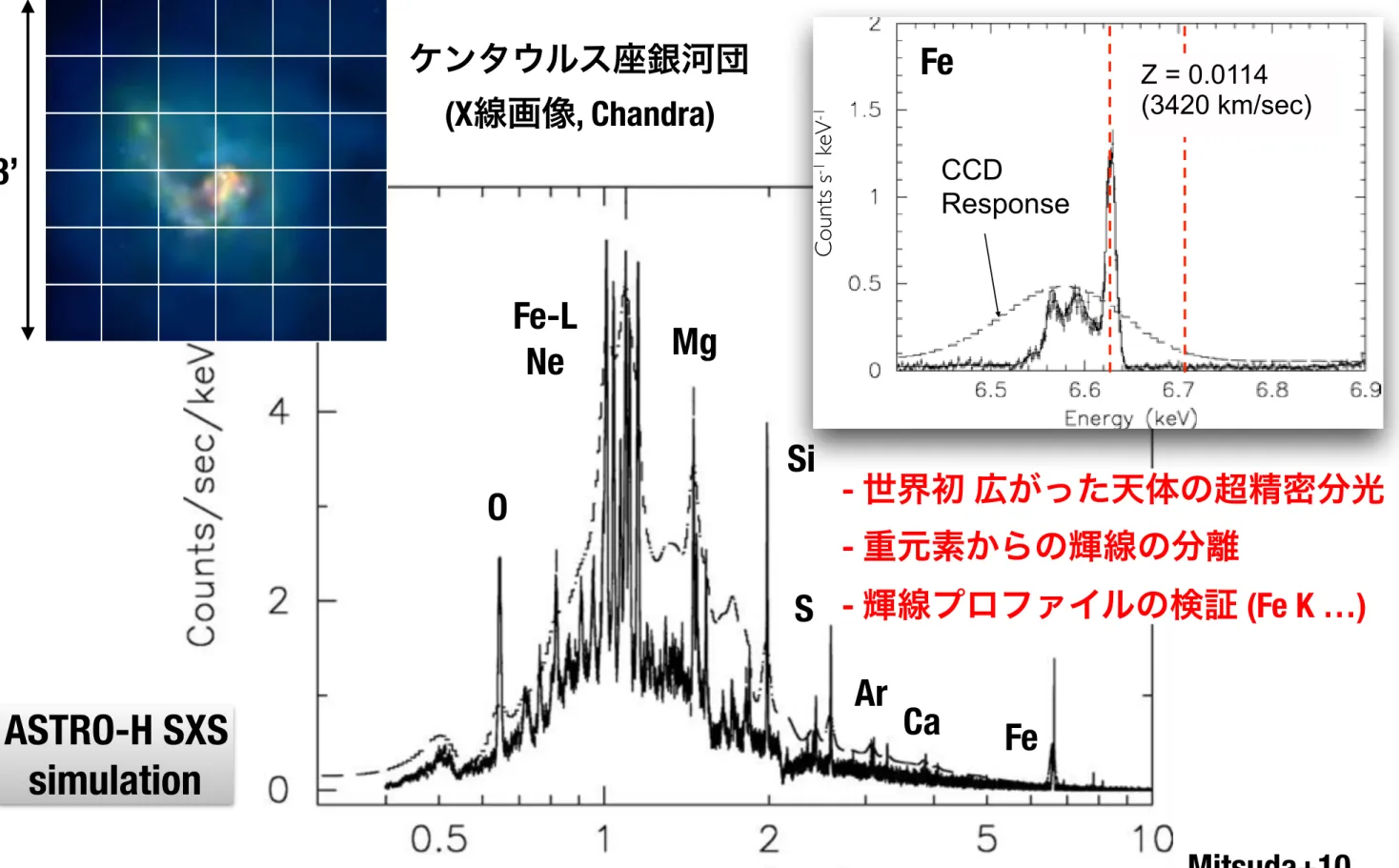
O
Fe-L
Ne
Mg
Si
S
Ar
Ca
Ar
S
Ca
Si
Mg
O
Fe-L
Ne
Ni
Counts s
-1
k
eV
-1
Centaurus cluster
30
HPD
6x6 SXS pixels
Chandra image
Z = 0.0114
(3420 km/sec)
CCD
Response
He-like Fe K
Counts s
-1
k
eV
-1
Figure 3. SXS pixel format and half power circle of the SXS X-ray telescope point spread function overlaid on the X-ray
image of Centaurus cluster central region observed with Chandra
5
(top left) and simulated SXS energy spectra of the
cluster. The spectrum plotted with a broken line is for a typical X-ray CCD resolution and is multiplied by a factor of 3
for display purpose. (Color on-line)
liquid Helium. The
4
He Joule-Thomson (JT) cooler which is pre-cooled by two sets of double stage Stirling-Cycle
coolers (2ST-PCa and 2ST-PCb), and two shield cooler (2ST-SCa and 2ST-SCb) provide thermal shields for the
liquid He. The ADR and the cryo-cooelrs are controlled by four cooler driver electronics.
Analog signal from the DA is amplified and digitized by the X-ray processing box (Xbox). The digitized data
stream is sent to the Pulse Shape Processor (PSP), where X-ray events are detected and their pulse heights are
determined by applying the optimum digital filtering algorithm. The PSP will also format the science and house
keeping data into telemetry packets and send them to the spacecraft data-handling system. The PSP consists
of the Mission Input/output (MIO) boards and Space Card boards, both of which are commonly used in other
science instruments of ASTRO-H . Hardware logic constructed in a FPGA (Field Programmable Gate Array)
on the MIO board will detect X-ray events from the digitized data stream, and the software running on a CPU
on the Space Card board will perform optimum digital filtering and telemetry formatting.
The Power Supply Unit (PSU) provides extremely low-noise regulated power to the Xbox. It will also provide
a sync signal to the ADR control (ADRC) so that the switching pulses of all the DC-DC converters in the PSU
and in the ADRC are synchronized with one another, which will reduce any beat frequency noises.
The filter wheel Mechanism (FWM) is mounted at a distance of 90 cm from the detector on the lower panel of
the fixed optical bench of the spacecraft. The FWM has six filter positions including open. The choice of filters
are not determined yet, but at least we will have a Be filter to cut low-energy X-rays, a neutral density filter to
reduce X-ray flux without modifying energy spectrum, and an optical blocking filter to observe optically bright
objects. The Be filter will also be employed to protect the detector and optical blocking filters inside the Dewar
3’
ケンタウルス座銀河団
(X
線画像, Chandra)
-
世界初 広がった天体の超精密分光
-
重元素からの輝線の分離
-
輝線プロファイルの検証 (Fe K …)
Mitsuda+10
ASTRO-H SXS
simulation
Fe
Fe
銀河団のガスダイナミクス
bulk motion (line shift) ?
乱流運動 (line broadening) ?
•
銀河団 : 10
7-8
K 高温ガス, 宇宙のバリオンの 20%
•
ガスの total energy =
非熱的運動
:
銀河団の質量推定に影響 → 宇宙論パラメータ (ダー
クマター, ダークエネルギー等) 推定
1' = 22 kpc
Perseus
銀河団
(Chandra)
•
巨大ブラックホール:10
5-10
M
sun
, 銀河中心, 降着物質からX線
•
存在頻度は低光度のものほど近傍
•
「 ダウンサイジング」, 理論的に未解明
•
ガスに
埋もれたブラックホール
? : Fe K
輝線で探査
ガスに埋もれたブラックホールの探査
Ueda+07
z (
赤方偏位)
存在頻度
(Mpc
-3
)
遠方
•
太陽風・磁気圏イオンと惑星・彗星の希薄で広がった大気
•
輝線分布で区別:禁制線が強い, large n からの輝線が強い, n の target 依存性
•
粒子加速 (輝線幅, シフト), 大気組成 (輝線比)
の新たな探査
手段
太陽系天体からの電荷交換X線 (CX)
地球外圏CX
simulation
Ezoe+13
地球磁気圏
the range 0.4–0.5 keV and solar abundances, after
includ-ing additional Mg10+ and Si12+emission (at 1.35 and
1.86 keV, respectively): the presence of these lines in the spectrum is a likely consequence of solar activity, which we know was enhanced over the October–November 2003 period. The XMM-Newton spectral data, then, appear to give support to the view that Jupiter’s low-latitude disk
X-rays are scattered solar radiation (Branduardi-Raymont
et al., 2006b,c). Similar results showing the disk emission to be harder than the auroral emission, were reached from the
February 2003 Chandra ACIS-S observation of the planet (Bhardwaj et al., 2004; Bhardwaj et al., 2006). These Chandra observations also appear to confirm a correlation (originally found by ROSAT) between regions of low magnetic field strength and somewhat higher soft X-ray count rate, suggesting the possible existence of a secondary component in addition to the scattered solar X-ray flux. Unlike the auroral X-ray emission, X-ray emission from Jupiter’s disk does not show any variability on timescales from 10 to 100 min.
The conclusions derived from spectral studies of Jupiter are strengthened by the observation, again in November 2003 by XMM-Newton, of similar day-to-day variability in the solar and Jovian equatorial X-ray fluxes. A large solar X-ray flare occurring on the Jupiter-facing side of the Sun is found to have a corresponding feature in Jupiter’s disk
X-ray lightcurve (seeFig. 30, taken fromBhardwaj et al.,
2005a). This finding lends support to the view that indeed Jupiter’s low latitude X-rays are largely scattered radiation of solar origin. Recent calculations of the effects of albedo (Cravens et al., 2006) are consistent with the observed fluxes, under the hypothesis that scattering, elastic and fluorescent, is at the origin of the observed emission. These results, however, do not rule out the presence of other source(s) of low-latitude X-ray emission, e.g., precipitation of energetic S and O ions from Jupiter’s radiation belts,
especially into regions of low magnetic field (Bhardwaj
et al., 2006). 9. Saturn
By analogy with Jupiter, X-ray emission from Saturn might be expected since it possesses a magnetosphere with
ARTICLE IN PRESS
Fig. 28. Jovian X-ray morphology first obtained with Chandra HRC-I on 18 December 2000, showing bright X-ray emission from the polar ‘auroral’ spots, indicating the high-latitude position of the emissions, and a uniform distribution from the low-latitude ‘disk’ regions (from
Gladstone et al., 2002).
Fig. 29. Combined XMM-Newton EPIC spectra from the November 2003 observation of Jupiter. Data points for the North and South aurorae are in black and red, respectively. In green is the spectrum of the low-latitude disk emission. Differences in spectral shape between the aurorae and the disk emission are very clear (see text for details) (fromBranduardi-Raymont et al., 2007).
A. Bhardwaj et al. / Planetary and Space Science 55 (2007) 1135–1189 1160
木星オーロラ
Gladstone+02
718 K. Dennerl et al.: High resolution X-ray spectroscopy of Mars
Fig. 8. a) Superposition of the RGS images in Fig. 7, each centered on the wavelength/energy of an individual emission line, with ionized
oxygen coded in blue, ionized carbon coded in green, and fluorescence coded in yellow and red. The circle indicates the position and size of Mars; the projected direction of the Sun is towards the left. As the roll angle of the satellite was adjusted for each of the 12 individual pointings in order to minimize the motion of Mars along cross dispersion direction, the position of the Sun with respect to dispersion direction was changing monotonically. Solar directions are labeled for the first and last pointing (cf. Table 1). b) Same as a), but after applying an additional transformation individually to all photons (rotation around the circle at center) so that the projected direction to the Sun is in all cases exactly at left (horizontal arrow). The direction of increasing right ascension (“E”) and declination (“N”) are given at upper left. The sphere at lower left provides details about the observing geometry: the grid shows areographic coordinates, with blue lines for the southern hemisphere (top) and red lines for the northern hemisphere (bottom). The bright part of the sphere is the sunlit side of Mars. A green arrow indicates its direction of motion, as seen from a stationary point at the position of the Earth. The yellow arrow illustrates the velocity of solar wind particles, emitted radially from the Sun with 400 km s−1with respect to Mars.
– In the morphological interpretation (cf. Fig. 8b), we see an emission region which is most prominent above the poles, but somewhat tilted away from the Sun. This general ap-pearance may be a consequence of the phase angle at which Mars was observed: if the X-ray emission originates pref-erentially at the sunward side of the Martian halo, then we should see a crescent-like structure when observing it at a phase angle of 41.◦2. This was the result of numerical
sim-ulations (Holmström et al. 2001, Plate 1), which predicted a crescent-like structure that resembles (on a smaller scale) the observed emission in ionized carbon (Fig. 7f). The fact that (i) the emission of ionized carbon extends far above the poles and that (ii) the emission of ionized oxygen emis-sion is observed to occur almost exclusively above the poles could be understood as evidence for an asymmetric density structure in the Martian exosphere, which would be much denser above the poles and towards the night side than to-wards the Sun.
A straightforward distinction between these two cases would be possible by comparing the negative and positive spectral or-ders: if the tilt was a spectral effect, then the images at negative and positive spectral orders would be mirrored, while in the case of a morphological effect, the tilt would be oriented in the same way in both orders. Unfortunately, this method cannot be
applied here, because RGS works only at negative orders and because both RGS 1 and RGS 2 are oriented in the same way.
The only possibility to distinguish, on a purely observa-tional basis, between these two cases is to utilize the variable direction to the Sun caused by changes of the satellite roll an-gle (Table 1). The lines left of Mars in Fig. 8a illustrate this direction for the 12 pointings. In Fig. 9, we show the O6f im-age accumulated during the first three pointings, where the so-lar direction exhibited the so-largest deviation from the cross dis-persion direction. Despite the low number of photons, there is evidence for a tilt against the cross dispersion direction, ap-proximately the amount expected for an emission morphology directed along the Sun-Mars vector. This could be considered as evidence in favor of the morphological interpretation.
Under the assumption that the cause of the tilt of the emis-sion region is mainly morphological, an improved, sharper im-age can be obtained by applying to each photon an additional rotation around the center of Mars according to the instan-taneous orientation of the detector with respect to the Sun. Figure 8b takes this additional rotation into account. A com-parison between Figs. 8a and 8b shows that the differences be-tween both images are subtle. This demonstrates that there is little dependence on the assumptions made. It is well possible that we see a superposition of both effects.