Introduction
In the densely populated north central region of Namibia, seasonal wetlands are usually formed during the rainy season due to flooding from Angolan highland (Zegada-Lizarazu et al. 2007). Even though the climate of this region is semi-arid, e.g. annual rainfall is around only 400 mm, rice can be introduced to the seasonal wetlands by using the flood water (Awala et al. 2009). However, several environmental factors may affect the productivity of rice in this region. Because of the low rainfall (200−400 mm), rice will be exposed to drought stress during a growing period. Salt accumulation within surface soil layers due to less precipitation should also be the major factor affecting crop growth. Because water level in such area cannot be controlled due to the irregular rainfall, a short or prolonged flooding occurs. Therefore, abiotic stress such as drought, salinity and flooding affects growth and productivity of rice in semi-arid regions of Africa (Manneh et al. 2007). To solve these environmental problems, rice cultivars which are tolerant to drought, salinity and flooding stresses must be introduced. Moreover, shoot elongation ability is required for prolonged flooding tolerance which is regarded as the crucial ability to survive under turbid flooding conditions.
Several studies have been conducted on drought (Ndjiondjop
et al. 2012), salinity (Awala et al. 2010) and flooding (Sakagami et al. 2009) stresses separately in cultivated rice. However,
currently little information is available on these three multiple stress tolerance. The objectives of this study were to compare the drought, salinity and flooding tolerance among Oryza sativa, O.
glaberrima and their interspecific cultivars including NERICA
(New Rice for Africa), and to find out the candidate cultivars for rice introduction to semi-arid regions of Africa, such as north central Namibia, which could have multiple stress environments.
Materials and methods
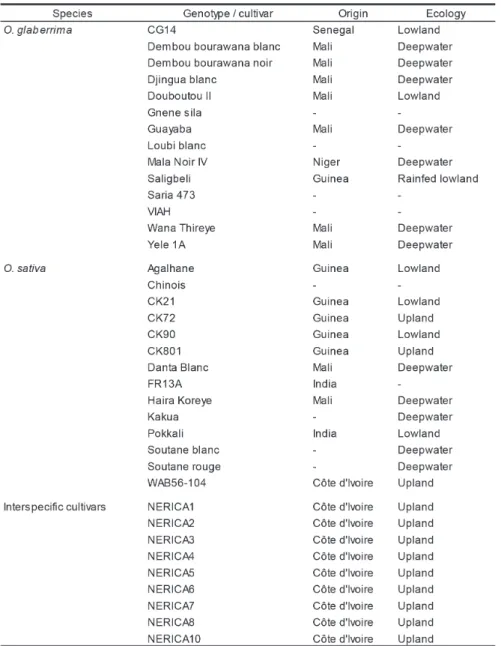
A pot experiment was conducted to evaluate drought, salinity and flooding tolerance of the rice genotypes during the vegetative growth stage at Kinki University, Japan. Based on the previous experiments for flooding tolerance (Cisse et al. 2009, Cisse et al. 2010), 37 genotypes {Oryza glaberrima Steud. (14),
Oryza sativa L. (14) and interspecific cultivars (9)} were used
(Table 1).
Rice plants were grown in a greenhouse condition using plastic pots with 14.0 cm height and 11.3 cm diameter, each of which filled with 1.5 kg of soil (Table 2) mixed with synthetic fertilizer (N : P2O5 : K2O = 0.2 : 0.2 : 0.2 g kg−1 soil). The pots
were arranged in a complete randomized block design with three
Drought, Salinity and Flooding Tolerance of Oryza sativa, Oryza glaberrima
and their Interspecific Cultivars
Yuki Okazaki1), Koji Yamane2), Yasuhiro Izumi1) and Morio Iijima2) 1)Graduate School of Environmental Science, The University of Shiga Prefecture
(2500 Hassaka, Hikone, Shiga 522−8533, Japan)
2)Graduate school of Agricultural Science, Kinki University
(3327−204 Nakamachi, Nara 631−8505, Japan)
Summary: In the densely populated northern Namibia, seasonal wetlands are formed due to flooding from Angola. Even though the climate of this region is semi-arid, rice can be introduced to the seasonal wetlands. However, several environmental stresses, such as drought, salt accumulation and flooding, often occur in this region. The objective of the present study was to evaluate the drought, salinity and flooding tolerance of Oryza
sativa, Oryza glaberrima and their interspecific cultivars. O. sativa showed the highest salinity tolerance among
the three species, and O. glaberrima did the highest flooding tolerance. As for drought tolerance, there was no statistical difference among species probably because the experiment was conducted under greenhouse conditions using pots. Among the 37 cultivars tested, Guayaba showed relatively better tolerance of all the three stress environments. This indicated that Guayaba can be one of the candidate cultivar for rice introduction to semi-arid regions of Africa, such as north central Namibia, which could have multiple stress environments. O. glaberrima showed high xylem sap flow rates at recovery period from drought stress compared with O. sativa and interspecific cultivars. It is considered that many genotypes of O. glaberrima have a mechanism of rapid recovery from drought stress and can use newly irrigated water in drought condition.
Key words: Drought, Flooding, NERICA, Oryza glaberrima Steud., Rice, Salinity
Acccepted : January 17, 2014
Corresponding author:Morio Iijima([email protected])
Research Article
replications. The seeds of O. glaberrima genotypes were kept in a convection oven at 49ºC for 7 d to break seed dormancy. Seeds were surface-sterilized with a Benomyl hydrate solution for 24 hr. After washing several times with water, seeds were soaked in water and incubated at 30ºC for 48 hr in darkness to promote germination. Five pre-germinated seeds of each genotype were sown at the center of pot in June 20, 2012. Seedlings were thinned into one plant per pot at 12 d after sowing (DAS). Each stress of drought, salinity and flooding was given from 22 DAS in the following ways. In drought treatment, the soil water content (gravimetric basis) was adjusted every day at 5.8% for 28 d until harvesting. Salinity stress was imposed by adding 80 mM NaCl solution to pots for 15 d. Thereafter, as plants might be died owing to severe stress, NaCl solution in pots was replaced with water and plants were grown for 4 d. At 41 DAS, salinity stress was again imposed by adding 80 mM NaCl for 2 d
Table 1 List of 37 genotypes used in the experiment
and 120 mM NaCl for 7 d. In flooding treatment, pots were placed in the container (1.0 m depth) which filled with turbid water (30 cm depth). The water level was raised every 10 cm per day. Rice seedlings were submerged completely in turbid water (1.0 m depth) from 29 to 50 DAS. The turbidity was kept at 53.8 ppm during flooding stress period. In control treatment, water level in the pots was maintained at approximately 3 cm above the soil surface until the plants were harvested.
The biomass samples were separated into shoots and roots. Each part was oven-dried at 80ºC for 72 hr and the dry weight was measured. In control, drought and salinity treatment, xylem sap was collected by cutting the stems, placing cotton puffs on the top of the stumps, and wrapping them with thin polyethylene film, according to the method described by Morita and Abe (1999). The xylem sap flow rate per plant was determined as the increase in the weight of the cotton puff. To evaluate recovery from each stress, drought and salinity stress was finished at 3 d before collecting xylem sap, and the plants were grown under water logging conditions until harvested.
Results and discussion
Shoot and root growthTable 3 shows the shoot dry weight and the relative shoot dry weight of 37 rice genotypes as affected by drought, salinity and flooding stress. In drought stress, CK801 showed the highest relative shoot dry weight followed by NERICA1, CG14 and CK90. In salinity stress, Agalhane showed the highest relative shoot dry weight followed by CK21, CK72 and CK801. In flooding stress, Dembou B. noir showed the highest relative shoot dry weight followed by Loubi blanc, Soutane rouge and Soutane blanc. Among the 37 cultivars tested, Guayaba (O.
glaberrima) showed relatively better tolerance of all the three
stress environments; it recorded the relative shoot dry weight of 0.225 in drought, 0.344 in salinity and 0.664 in flooding. This indicated that Guayaba can be one of the candidate cultivar for rice introduction to Namibia as the multiple stress tolerance cultivars. The range of the relative shoot dry weight was 0.14− 0.26 in drought stress, 0.21−0.49 in salinity stress, and 0.01− 0.93 in flooding stress. These results for shoot growth indicate that genotype variation caused by abiotic stresses was various among the three stresses. We found that the tolerance and susceptivity to drought showed very small genotypic differences within O. glaberrima, O. sativa and interspecific cultivars. In addition, there was no significant difference in the relative shoot dry weight in drought stress among species (Table 4) whereas previous studies showed that drought tolerance differed in cultivated rice (Morishima et al. 1962, Furuya et al. 1994, Jones
et al. 1997). The reason for very small genotypic differences in
this study is probably because the experiment was conducted
under greenhouse conditions using pots. The relative shoot dry weight in salinity stress of O. sativa was significantly higher than that of O. glaberrima and interspecific cultivars (Table 4). The salinity tolerance of interspecific cultivars is reported to be better than that of O. sativa (Awala et al. 2010) or in between those of O. sativa and O. glaberrima (Sone et al. 2010). In the both studies, O. glaberrima showed much susceptivity to salinity compared with O. sativa. O. glaberrima showed the highest relative shoot dry weight among the three species in flooding stress (Table 4). In all the O. glaberrima genotypes except for CG14 and VIAH, the top leaf reached to water surface at the end of flooding stress. In O. sativa genotypes, all plants of Agalhane, CK21, Danta Blanc, Haira Koreye, Kakua and Soutane Rouge survived under flooding stress by resurfacing, but CK801, FR13A and WAB56-104 died completely during 21 d flooding stress. All of the interspecific cultivars died in flooding stress. The survival rates of O. glaberrima (90.5%) were higher than those of O. sativa (40.5%) and interspecific cultivars (0%). O.
glaberrima genotypes have submergence escape strategy, that is,
rapid leaf and stem elongation, therefore it can survive under short or prolonged flooding conditions (Sakagami et al. 2012). Our results suggest that O. glaberrima have submergence escape strategy under turbid flooding condition as well. On the other hand, indica cultivar FR13A, which is reported to be highly tolerant to submergence by restricting leaf and internode elongation during submergence and resuming the leaf development when flood water subside (Singh et al. 2001, Das
et al. 2005), died completely under submerged conditions for 21
d (Table. 3). This is because the submergence period for 21 d in this experiment may be too long for FR13A to survive under flooding condition. Interspecific cultivars were severely affected by flooding stress on account of the slow shoot elongation. The range of the relative root dry weight was 0.07−0.21 in drought stress, 0.06−0.35 in salinity stress, and 0.02−0.39 in flooding stress (Table 5). In drought stress, interspecific cultivars showed the highest value followed by O. sativa and O.
glaberrima (Table 4). The relative root dry weight in salinity
stress of O. sativa (0.240) was significantly higher than that of O.
glaberrima (0.138) and interspecific cultivars (0.139). Although
in this experiment rice plants were cultivated in pots where root growth was restricted, there was much genotypic differences in root dry weight compared with shoot dry weight. These results suggest that root growth should be appreciated in the evaluation of drought and salinity tolerance.
Xylem sap flow rate at recovery period
Xylem sap flow rates were evaluated as an indicator of recovery from drought and salinity stress (Table 6). Drought and salinity stress treatment was finished at 3 d before collecting xylem sap. In many genotypes of O. glaberrima and O. sativa, xylem sap flow rates of drought treatment were higher than that
Table 3 Shoot dry weight and relative shoot dry weight of O. glaberrima, O. sativa and their interspecific cultivars grown in different stress environments, i.e., drought, salinity and flooding
Table 4 Comparison among O. glaberrima, O. sativa and interspecific cultivars for shoot and root growth and xylem sap flow rate as affected by drought, salinity and flooding stress
of control, and in particular O. glaberrima showed high xylem sap flow rates at recovery period from drought stress (Table 4). On the other hand, interspecific cultivars did not show any recovery from drought stress. These results indicate that many genotypes of O. glaberrima have a mechanism of rapid recovery from drought stress and can use newly irrigated water in drought condition. As the genotypic differences in drought tolerance for shoot growth were not observed, xylem sap flow rates might be
an indicator of drought tolerance and recovery from drought. Judging from xylem sap flow rates, there was not much recovery from salinity stress in all O. glaberrima, O. sativa and interspecific cultivars because the recovery period was short in this study.
Table 5 Root dry weight and relative root dry weight of O. glaberrima, O. sativa and their interspecific cultivars grown in different stress environments, i.e., drought, salinity and flooding
Acknowledgements
We are grateful to Mr. A. Cisse, Mr. G. Kigoshi, Mr. H. Fujii and Mr. K. Imaki at Kinki University, and Dr. J. Sakagami at Japan International Research Center for Agricultural Sciences, for their contribution to the experiment.
References
Awala, S., P. Nanhapo, L. Kanyomeka, J. Sakagami, O. Mwandemele, S. Ipinge, Y. Izumi, T. Suzuki and M. Iijima (2009) Potential for rice cultivation in seasonal wetlands and Zambezi river flood plains in Namibia. Jpn. J. Crop Sci. 78
Table 6 Xylem sap flow rate of O. glaberrima, O. sativa and their interspecific cultivars at recovery period from drought and salinity stress
(Extra Issue 1) : 10−11.
Awala, S. K., P. I. Nanhapo, J. Sakagami, L. Kanyomeka and M. Iijima (2010) Differential salinity tolerance among Oryza
glaberrima, Oryza sativa and their interspecies including
NERICA. Plant Prod. Sci. 13 : 1−10.
Cisse, A., Y. Izumi, J. Sakagami and M. Iijima (2009) Survival of prolonged flooding stress during seedlings stage of rice in
Oryza sativa, O. glaberrima and NERICA. Jpn. J. Crop Sci.
78 (Extra Issue 2) : 252−253.
Cisse, A., Y. Izumi, K. Yamane, J. Sakagami and M. Iijima (2010) Turbidity tolerance of Oryza glaberrima Steud., O. sativa L. and their interspecific progenies including NERICA during submergence. Jpn. J. Crop Sci. 79 (Extra Issue 2) : 6−7. Das, K. K., R. K. Sarkar and A. M. Ismail (2005) Elongation
ability and non-structural carbohydrate levels in relation to submergence tolerance in rice. Plant Sci. 168 : 131−136. Furuya, A., R. Itoh and R. Ishii (1994) Mechanisms of different
responses of leaf photosynthesis in African rice (Oryza
glaberrima Steud.) and rice (Oryza sativa L.) to low leaf water
potential. Jpn. J. Crop Sci. 63 : 625−631.
Jones, M. P., M. Dingkuhn, G. K. Aluko and M. Semon (1997) Interspecific Oryza sativa L.X O. glaberrima Steud. progenies in upland rice improvement. Euphytica 92 : 237−246.
Manneh, B., P. Kiepe, M. Sie, M. Ndjiondjop, N. K. Drame, K. Traore, J. Rodenburg, E. A. Somado, L. Narteh, O. Youm, A. Diagne and K. Futakuchi (2007) Exploiting partnerships in research and development to help African rice farmers cope with climate variability. Paper presented at ICRISAT and CGIAR 35th Anniversary Symposium "Climate-Proofing Innovation for Poverty Reduction and Food Security" 22−24
November.
Morishima, H., K. Hinata and H. Oka (1962) Comparison between two cultivated rice species, Oryza sativa L. and O.
glaberrima Steud. Jpn. J. Breeding 12 : 17−29.
Morita, S. and J. Abe (1999) How to measure and how to evaluate bleeding sap rate. Root Res. 8 : 117−119. (In Japanese) Ndjiondjop, M. N., P. A. Seck, M. Lorieux, K. Futakuchi, K. N.
Yao, G. Djedatin, M. E. Sow, R. Bocco, F. Cisse and M. Fatondji (2012) Effect of drought on Oryza glaberrima rice accessions and Oryza glaberrima derived-lines. Asian J. Agr. Res. 6 : 144−157.
Sakagami, J., Y. Joho and O. Ito (2009) Contrasting physiological responses by cultivars of Oryza sativa and O. glaberrima to prolonged submergence. Ann. Bot. 103 : 171−180.
Sakagami, J., C. Sone and M. Nakazono (2012) Injury to rice plants by floods and resistance to submergence. Jpn. J. Crop Sci. 81 : 1−9. (in Japanese with English abstract)
Singh, H. P., B. B. Singh and P. C. Ram (2001) Submergence tolerance of rainfed lowland rice: search for physiological marker traits. J. Plant Physiol. 158 : 883−889.
Sone, C., M. Tsuda and Y. Hirai (2010) The salinity tolerance in an interspecific progeny NERICA 1 derived from the cross between O. sativa L. and O. glaberrima Steud. Jpn. J. Crop Sci. 79 : 184−191. (In Japanese with English abstract)
Zegada-Lizarazu, W., L. Kanyomeka, Y. Izumi and M. Iijima (2007) Water acquisition from the seasonal wetland and root development of pearl millet intercropped with cowpea in a flooding ecosystem of northern Namibia. Plant Prod. Sci. 10 : 20−27.