Vol. 55, No. 2, June 2012, pp. 125–145
TOPOLOGY OPTIMIZATION OF TENSEGRITY STRUCTURES UNDER SELF-WEIGHT LOADS
Yoshihiro Kanno
University of Tokyo
(Received November 11, 2011)
Abstract A tensegrity structure is a prestressed pin-jointed structure consisting of continuously connected tensile members (cables) and disjoint compressive members (struts). This paper addresses topology opti-mization of tensegrity structures subjected to self-weight loads, where the compliance, i.e., the strain energy at the equilibrium state, is to be minimized. It is shown that the optimization problem can be formulated as a mixed integer linear programming (MILP) problem. The proposed method does not require connectiv-ity relation of cables and struts of a tensegrconnectiv-ity structure to be known in advance. Numerical experiments illustrate that various tensegrity structures can be found by solving the presented MILP problem.
Keywords: Optimization, mixed integer programming, structural optimization,
tenseg-rity, tension structure, design-dependent constraint
1. Introduction
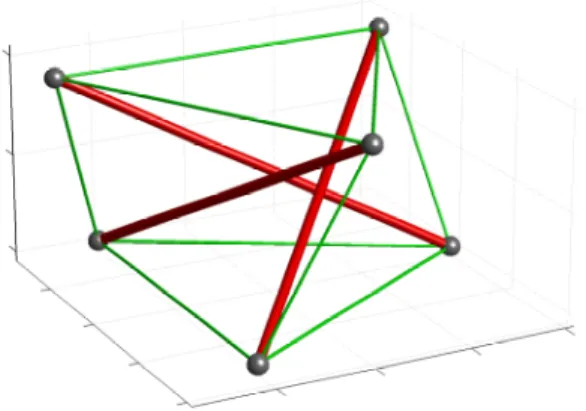
The terminology tensegrity, coined by Fuller [13] from tension integrity, represents a partic-ular class of tension structures invented by Richard Buckminster Fuller [12], David Georges Emmerich [11], and Kenneth Snelson [30]. A tensegrity structure is a prestressed pin-jointed structure consisting of continuous tensile members (cables) and discontinuous compressive members (struts). An example of a tensegrity structure is shown in Figure 1. This tenseg-rity structure consists of three struts and nine cables connected by six nodes, where struts and cables are depicted by thick and thin lines, respectively. Here, struts do not touch each other, while cables are connected continuously. The nodes are aligned in the shape of a twisted triangular prism. By introducing an axial tensile force to each cable, this tensegrity structure attains a stable equilibrium state. The forces introduced at this initial equilibrium state are called the prestress forces.
Since cables of a tensegrity structure are very thin compared with struts, tensegrity structures often give the impression of a cluster of struts floating in the air. Snelson has been creating many tensegrity structures as fascinating sculptures [31] with his intuition as an artist and sophisticated techniques developed over the years. Fuller and Emmerich, in contrast, explored possibility of application of tensegrity structures to architecture. This at-tempt, afterward, has been realized as, e.g., tensegrity domes [25]. Following these pioneers, various methods for finding forms of tensegrity structures have been proposed by many re-searchers; see surveys due to Juan and Mirats Tur [20] and Tibert and Pellegrino [35]. Note that an arbitrarily given geometrical configuration is not necessarily realized as a tenseg-rity structure because the configuration of a tensegtenseg-rity structure depends on the prestress forces. Most of the proposed numerical methods require to specify topology of a tenseg-rity structure as input data, where by topology we mean the connectivity of struts and cables of a tensegrity structure. Finding new topologies of tensegrity structures has been
Figure 1: An example of a tensegrity structure
fully addressed only by few authors and remains as a challenging problem. For example, based on the group representation theory [8], Back and Connelly [3] attempted to enumerate tensegrity structures with the specified symmetry property. There exist only few numerical methods that can find asymmetric topology of tensegrity structures [10, 21, 26].
Today the original definition of tensegrity has been extended in various ways; see Motro [24] and the references therein. It has been recognized, or at least expected, that potential applications of tensegrity structures include architectural and civil engineering structures [1, 4, 25], deployable structures [33, 34], and cell cytoskeleton models in biomechanics [36, 37]. They are also studied in the graph theory [5, 19, 32].
On the basis of this overview, it is desired to develop numerical methods that can find various topologies of tensegrity structures without experience and intuition. The author proposed a mixed integer linear programming (MILP) approach to topology optimization of compliance of a tensegrity structure subjected to a fixed external load [21]. In continu-ation of that previous work, this paper addresses self-weight loading. The self-weight load depends on design of a structure and design is certainly unknown in the course of optimiza-tion. Therefore, topology optimization of structures with the self-weight loads possesses particular difficulties. This problem was discussed by Rozvany [27] for the plastic design, and subsequently studied for arches [28], beams and columns [2, 22, 29], composite struc-tures [23], shell strucstruc-tures [18], and continua [6]. Nevertheless, the self-weight load is still often neglected in optimization of structures. However, tensegrity structures are unusual structures in the sense that stiff structural elements, i.e., struts, are not connected to each other, and hence they are relatively flexible in general. Therefore, it is important to con-sider the self-weight load, which might significantly affect the equilibrium configuration of a tensegrity structure. It is often that the compliance, i.e., the external work done by an applied load, is used as a measure of global flexibility of a structure. Hence, by minimizing the compliance under the self-weight load we can find a tensegrity structure which is stiff against the self-weight load.
The paper is organized as follows. Section 2 introduces the definition and fundamental equations of tensegrity structures. The terminology of the graph theory is used in this exposition, especially for readers who are familiar with operations research but not with applied mechanics. Section 3 presents the constraints and the objective function considered in the topology optimization of tensegrity structures. In Section 4, the optimization problem is reduced to an MILP problem. Three numerical examples are demonstrated in Section 5. We conclude in Section 6.
2. Fundamentals of Tensegrity Structures
As an initial solution for optimization, consider a structure constructed with some straight structural components called members. The ends of the members are connected at joints called nodes. Each node is a pin joint, which means that members connected to a node can rotate around the node without friction. External forces are considered to be applied only at the nodes. Therefore, an internal force transmitted by a member is only an axial force, which is either tensile or compressive. Such a structure is referred to as a truss. The locations of nodes of a truss are specified in the three-dimensional space, when no external force is applied. This configuration is called the initial configuration. Throughout the paper, we assume that deformation of a structure is small and that members consist of a linear elastic material.
Let V and E denote the set of nodes and the set of members of a truss, respectively,
where |V | = n and |E| = m. For simplicity, we assume E = {1, . . . , m}. If we adopt the
terminology of the graph theory, V and E correspond to the set of vertices and the set of edges of a graph G = (V, E), respectively. Unlike the graph theory, however, the location is assigned to each node of the truss.
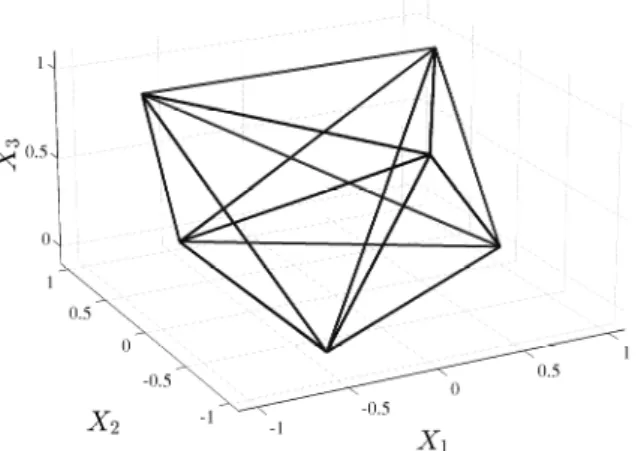
Figure 2 shows an initial configuration of a truss consisting of |E| = 15 members
con-nected by |V | = 6 nodes. The nodes of this truss form two horizontal equilateral triangles.
This paper proposes an optimization-based method for finding a tensegrity structure, re-garded as a special truss, from a given initial truss. Figure 1 is a tensegrity structure obtained from the initial structure in Figure 2. Note that three members are removed from Figure 2 to obtain the tensegrity structure in Figure 1.
Let qi denote the axial force of member i (i∈ E) introduced in the initial configuration.
Here, qi > 0 means that the axial force is tensile, while qi < 0 means that it is compressive.
In a tensegrity structure, a member transmitting a compressive force is called a strut , while
that transmitting a tensile force is called a cable. Let{S, C, N} be a partition of E defined
by
S = {i ∈ E | qi < 0}, (2.1a) C = {i ∈ E | qi > 0}, (2.1b)
N ={i ∈ E | qi = 0}, (2.1c)
where S, C, and N are the sets of struts, cables, and removed members from the initial structure, respectively. Finding a tensegrity structure from an initial structure is to deter-mine S, C, and N satisfying some particular conditions introduced below; see Definition 2.1.
For example, a tensegrity structure in Figure 1 consists of|S| = 3 struts and |C| = 9 cables,
while|N| = 3 members are removed from the initial structure in Figure 2. Note that struts
are represented by thick lines and cables are represented by thin lines. This is because, in a real-world tensegrity structure, bars with large cross-sections (e.g., stainless-steel tubes) are often used for struts, while cables (e.g., stranded wires) usually have smaller cross-sections than struts.
Let f ∈ R3n denote the vector of external forces. The static equilibrium condition, or
the force-balance equation, is written as
Hq = f , (2.2)
where H ∈ R3n×m is a constant matrix called the equilibrium matrix. This matrix is
Figure 2: An initial structure to obtain the tensegrity structure in Figure 1
graph G = (V, E), where V and E are regarded as the sets of vertices and edges of G,
respectively. Let D ∈ Rn×m denote the incidence matrix of G. Define B
i ∈ R3×3n by Bi =−dTi ⊗ I3, where di ∈ Rn is the ith column vector of D, I3 is the 3× 3 identity matrix,
and the Kronecker product is designated by ⊗. Let x ∈ R3n denote the vector consisting of
the location vectors of all nodes in the three-dimensional space. Then the ith column vector of H, denoted by hi, is given by hi = (1/li)BiTBix, where liis the length of member i. Thus, H is a matrix determined by the connectivity of members and the locations of nodes of the
initial structure. Note that (2.2) is similar to the flow conservation condition of the network
flow; the vertex vp at which fj ̸= 0 corresponds to a source or a sink and q corresponds to a
flow. Unlike the network flow, however, qi’s in (2.2) possibly take negative values and each
node has three balance equations corresponding to the coordinates of the three-dimensional space.
We say that the structure is at the state of self equilibrium if it sustains q ̸= 0 satisfying (2.2) with f = 0. It should be clear that self-weight loads are regarded as external loads
and hence are not considered at the self-equilibrium state. The axial force qi at the
self-equilibrium state is introduced as a prestress force. Once the self-self-equilibrium configuration is found, we usually apply the specified external load to the structure to investigate the deformation from the self-equilibrium state.
Let E(vp) ⊂ E denote the set of indices of the members that are connected to the
node vp ∈ V . A tensegrity structure is defined in terms of prestress forces q as follows.
Definition 2.1. A truss is said to be a tensegrity structure if there exists q ̸= 0 satisfying
Hq = 0, (2.3)
|S ∩ E(vp)| ≤ 1, ∀vp ∈ V, (2.4)
where S is defined by (2.1a). ■
Condition (2.3) together with q ̸= 0 requires that a tensegrity structure has a
self-equilibrium state. This means that m− rank H ≥ 1. Here, ds = m− rank H is called the
degree of static indeterminacy. We say that a structure is statically determinate if ds = 0
and that it is statically indeterminate if ds≥ 1. On the other hand, the degree of kinematic
indeterminacy is defined by dk = 3n− rank HT− 6. The member elongations, denoted c,
can be written in terms of the nodal displacements, denoted u, as c = HTu. Therefore, a
nontrivial solution to HTu = 0 corresponds to nodal displacements without member
the number of degrees of freedom of infinitesimal deformations that cause no member
elon-gation. In other words, a structure with dk> 1 can deform infinitesimally without applying
any external forces. Such a structure is said to be kinematically indeterminate (or
unsta-ble). In contrast, if dk= 0, then we say that the structure is kinematically determinate (or
stable). Since rank H = rank HT, we obtain
m− ds= 3n− dk− 6, (2.5)
which is called the extended Maxwell rule [7, 14]. It is known that the tensegrity structure
in Figure 1 satisfies ds = dk = 1, i.e., both statically and kinematically indeterminate,
and hence it is unstable. By introducing prestress forces, however, this tensegrity structure can be stabilized [9]. As such this is an “usual” structure and attracts interests of many researchers and artists. A kinematically indeterminate structure stabilized by introducing prestress forces is said to be prestress stable. Finding a new tensegrity structure that is prestress stable is an extremely challenging problem. Issues of stability are not taken into account in this paper; particularly, Definition 2.1 does not require prestress stability.
Condition (2.4), called the discontinuity condition of struts, requires that any two struts of a tensegrity structure do not share a common node. In other words, S is a matching of the graph G = (V, E). The discontinuity condition of struts is an intrinsically difficult condition when we attempt to design a new tensegrity structure. Note that Definition 2.1 is one of the most classical definitions of a tensegrity structure; the concept of tensegrity structures has been extended in various ways [24].
3. Compliance Optimization under Self-Weight Load
An optimization problem of tensegrity structures considering the self-weight load is formu-lated.
3.1. Practical constraints on prestress forces
By definition, the prestress force, qi, of a tensegrity structure is required to satisfy (2.1).
From a practical point of view, however, it is not accepted to apply a very large force to a member. On the other hand, a very small tensile force, which often causes cable sag, should also be avoided from view points of maintainability and visual clarity. Therefore, instead of (2.1), we impose the lower and upper bound constraints for the prestress force as
qi ∈ [−qs,−qs] if i ∈ S, [qc, qc] if i∈ C, {0} if i∈ N, (3.1)
where qs, qs, qc, and qc are positive constants satisfying qs< qs and qc< qc.
Besides (3.1), q should satisfy the self-equilibrium condition introduced in (2.3).
3.2. Member cross-sectional areas
It is often that a real-world tensegrity structure is constructed by using thick bars for struts and thin wires for cables. We denote by ξsand ξc(ξs > ξc) the specified cross-sectional areas
of such bars and wires, respectively. Then the cross-sectional area of member i, denoted ai,
is given by ai = ξs if i∈ S, ξc if i∈ C, 0 if i∈ N. (3.2)
The elongation stiffness of member i, which represents the axial force caused by a unit elongation, is written as ki = Y ai li , (3.3)
where Y is the Young modulus. Precisely, the elongation stiffness should be defined by using the initial (i.e., undeformed) member length, li0, as Y ai/li0. Due to the presence of
prestress forces, the member length of the initial structure, li, is not equal to li0. However,
the difference between li and l0i is negligibly small. Hence, in this paper we define the
member elongation stiffness by (3.3).
3.3. Equilibrium state under self-weight load
Usually a tensegrity structure transfers the applied external load (including its self-weight load) to the ground (or a foundation). The connections which join a structure to its founda-tion are called supports. In Secfounda-tion 3.1 we have assumed that the tensegrity structure does not have supports to study the self-equilibrium state at which no external load is applied. In contrast, we here suppose that some of degrees of freedom of the displacements are fixed by supports to investigate its equilibrium state in the presence of the external load.
Let u ∈ R3n denote the vector of nodal displacements. Consider a partition J
D∪ JN =
{1, . . . , 3n} of the set of indices of the degrees of freedom of displacements. Suppose that
the displacement for each j ∈ JDis fixed by a support as uj = 0 and that the external force
for each j ∈ JN is specified as fj. Since the self-weight load is a function of the member
cross-sectional areas, a, we write fj(a) in what follows. We use si to denote the axial force
equilibrated with the external load. The force balance between si (i = 1, . . . , m) and fj(a)
(j ∈ JN) can be written by using the equilibrium matrix H introduced in (2.2). Summing
up the support conditions and the force-balance conditions, u and s should satisfy
uj = 0, ∀j ∈ JD, (3.4)
(Hs)j = fj(a), ∀j ∈ JN, (3.5)
where (Hs)j is the jth component of the vector Hs. Note that the prestress force qipresents
before applying the external load. In other words, the total axial force at the equilibrium state, denoted ˜si, is given by
˜
si = qi+ si. (3.6)
The equilibrium state is characterized by three conditions: the force-balance equation (i.e., (3.5)), the compatibility relation, and the constitutive law. Let cidenote the elongation
of member i. The compatibility relation that associates ci with u can be written by using
the column vector of H as
ci = hTi u, i = 1, . . . , m. (3.7)
The constitutive law gives the relation between ci and si. By using the elongation stiffness
defined by (3.3), it can be written as
si = kici, i = 1, . . . , m. (3.8)
The upshot is that, for the given external load fj(a) (j ∈ JN), the equilibrium state is found as the solution of (3.4), (3.5), (3.7), and (3.8).
We also consider the upper and lower bound constraints for the axial forces at the equilibrium state under the self-weight load. Specifically, the total axial force, i.e., ˜si in
(3.6), should satisfy
qi+ si ∈
{
[−ss,−ss] if i∈ S,
[sc, sc] if i∈ C. (3.9)
Here, ss, ss, sc, and sc are positive constants satisfying ss < ss and sc < sc. Note that for
i∈ N no constraint is considered on the axial force.
3.4. Constraints on existing members
By definition, the struts should satisfy the discontinuity condition introduced in (2.4). Be-sides this condition, we consider other constraints on number of members to restrict the feasible solutions to attractive tensegrity structures.
To find complex tensegrity structures, it is natural to attempt to use many struts. This motivates us to consider the constraint
|S| ≥ ns
, (3.10)
where ns is the specified lower bound for the number of struts.
Roughly speaking, a tensegrity structure with less cables is more interesting when the number of struts is fixed. Some of existing tensegrity structures, especially that are created as arts, are prestress stable. Recall that stability is related to dk, the degree of kinematic indeterminacy: dk = 0 if the tensegrity structure is stable, while dk > 0 if it is unstable.
On the other hand, a tensegrity structure satisfies ds ≥ 1, because it satisfies (2.3) by
definition. Therefore, every stable tensegrity structure satisfies dk− ds ≤ −1. An unstable
tensegrity structure illustrated in Figure 1 satisfies dk − ds = 0. Hence, we attempt to
explore tensegrity structures with large values of dk−ds, e.g., dk−ds=−1, 0, 1. Since many tensegrity structures do not have a node that are connected to cables only, we substitute
m =|S| + |C|, n = 2|S|
into (2.5) to obtain dk− ds = 5|S| − |C| − 6. Accordingly, we consider the constraint
5|S| − |C| − 6 = nd (3.11)
where nd is the specified value of d
k− ds. In other words, the larger the value of nd, the less the number of cables when the number of struts is fixed.
A more practical constraint was introduced in [21]. It is often that an initial structure includes many intersecting members; see, e.g., Figure 3 in Section 5.1. In a tensegrity structure obtained from the initial structure, presence of mutually intersecting members is not accepted. Practically, two members that are too close cannot exist simultaneously. The set of such pairs of members is denoted by Pcross. Precisely, we write (i, i′) ∈ Pcross if the
distance of member i and member i′ is less than a specified threshold δ (δ > 0). Then the
constraint excluding too close members is formally written as
{i, i′} ̸⊆ S ∪ C, ∀(i, i′)∈ P
3.5. Optimization problem of tensegrity structures
Since tensegrity structures are relatively flexible in general, the self-weight load may possibly affect a tensegrity structure significantly compared with other stiff structures such as trusses and frames. For example, if only prestress forces are taken into consideration in the design process, then the configuration of the actually constructed tensegrity structure under the force of gravity may become much different from the expected one. Moreover, due to such difference of configurations, some cables may become slack and/or tensile forces may be introduced to some struts unanticipatedly. Thus it is inevitable to consider the self-weight load in designing a tensegrity structure. This is actually the motivation of the present work. To prevent unanticipated deformation due to the self-weight, it might be natural to explore a structure which is stiff against the self-weight load. Finding a stiff structure is usually performed by minimizing the compliance, which is the work done by the applied external load. If the Dirichlet boundary conditions are homogeneous (that is the case with our problem as seen in (3.4)), then the compliance is equal to the elastic energy stored in the structure. Therefore, the compliance can be regarded as a measure of flexibility of a structure. Let u be the displacement vector at the equilibrium state, i.e., be a solution of (3.4), (3.5), (3.7) and (3.8). Then the compliance, denoted w, is defined by
w = ∑ j∈JN
fj(a)uj. (3.13)
Note that in this paper we define the compliance as the external work done only by the self-weight load. In other words, the internal work due to the prestress forces q is not considered in (3.13).
We are now in position to formulate an optimization problem for designing a tensegrity structure. The constraints of the problem consist of the following four conditions: (i) the prestress forces should satisfy (2.3) and (3.1); (ii) the equilibrium condition under the self-weight load is described by (3.4), (3.5), (3.7), and (3.8), where the member cross-sectional areas and the elongation stiffness are defined by (3.2) and (3.3); (iii) at that equilibrium state the axial forces should satisfy (3.9); (iv) regarding existing members we consider the constraints (2.4), (3.10), (3.11), and (3.12). Under these constraints, we find the structure that minimizes the compliance defined by (3.13).
Thus the optimization problem of tensegrity structures is a nonconvex optimization
problem. Particularly, the constraints depend on the partition {S, C, N} of E. Therefore,
nonlinear programming approaches are likely to be inefficient. This motivates us to refor-mulate the optimization problem as an MILP problem, which is the subject of the next section.
4. Mixed Integer Linear Programming Formulation
The optimization problem presented in Section 3 is reduced to an MILP problem.
4.1. Constraints on member forces
A difficulty of optimization of structures considering the self-weight load stems from the fact that the self-weight load depends on the design variables. In contrast, an optimization problem of tensegrity structures subjected to a fixed external load was reduced to an MILP problem in [21]. We briefly recall, here, the formulations in [21] concerning the labels of members and the stress constraints under a fixed external load. The constraints involving the self-weight load will be addressed in Section 4.3.
An essential idea presented in [21] is introducing two 0–1 variables, xi and yi, to represent
the classification of member i as
(xi, yi) = (1, 0) ⇔ i ∈ S, (4.1a)
(xi, yi) = (0, 1) ⇔ i ∈ C, (4.1b)
(xi, yi) = (0, 0) ⇔ i ∈ N. (4.1c)
The case (xi, yi) = (1, 1) is excluded, i.e.,
xi+ yi ≤ 1. (4.2)
Moreover, we rewrite the compatibility relation, (3.7), as
csi = { hTi u if i ∈ S, 0 otherwise, (4.3) cci = { hTi u if i∈ C, 0 otherwise. (4.4)
That is, csi represents the elongation of a strut and cci represents that of a cable. The
constitutive law, (3.8), is then reduced to
si = ksic s i+ k c ic c i, (4.5) where kis= Eξ s li , kic= Eξ c li .
Thus, (3.2), (3.3), (3.7), and (3.8) are equivalently rewritten as (4.3), (4.4), and (4.5). Note that (4.3), (4.4), and (4.5) imply si = 0 for i∈ N as expected.
The upper and lower bound constraints on axial forces are introduced in (3.1) and (3.9). We rewrite these constraints in terms of qi, csi, and cci together with the member label (xi, yi).
Suppose that (4.1) and (4.3), (4.4), (4.5) are satisfied. Then we can see that qi and si satisfy
(3.1) and (3.9) if and only if the linear inequalities
qcyi− qs(1− yi)≤ qi ≤ −qsxi+ qc(1− xi), (4.6a) −ssx i ≤ qi+ kisc s i ≤ −s sx i + qcyi, (4.6b) −qsx i+ scyi ≤ qi+ kicc c i ≤ s cy i (4.6c) are satisfied.
Remark 4.1. If (xi, yi) = (1, 1), then (4.6a) is reduced to qc ≤ qi ≤ −qs. Therefore, (4.6a)
implies (4.2). In the MILP problem presented in Section 4.4, we use (4.2) as a valid inequality
constraint. ■
Finally we rewrite (4.3) and (4.4) as linear inequalities with binary variables. We again use xi and yi defined by (4.1). For i∈ S, it follows from (4.6a) and (4.6b) that qi and csi are
subjected to the following constraints:
−qs ≤ q i ≤ −qs, −ss ≤ q i+ kisc s i ≤ −s s.
These inequalities imply
qs− ss ≤ kiscsi ≤ qs− ss.
Therefore, (4.3) can be rewritten as
(qs− ss)xi ≤ kisc s i ≤ (q s− ss)x i, (4.8a) M (1− xi)≥ |csi − h T i u|, (4.8b)
where M ≫ 0 is a sufficiently large constant. Similarly, (4.4) can be rewritten as
(sc− qc)yi ≤ kicc c i ≤ (s c− qc)y i, (4.9a) M (1− yi)≥ |cci − h T i u|. (4.9b)
4.2. Constraints on member labels
In Section 4.1 we have introduced variables (xi, yi) ∈ {0, 1}2 by (4.1) to formulate the
constraints concerning the equilibrium state under the specified external load. As the other
constraints in terms of xi and yi, we here investigate the constraints on the numbers of
struts and cables.
We first consider the discontinuity condition of struts, (2.4). This constraint can be written in terms of xi (i∈ E) as
∑
i∈E(vp)
xi ≤ 1, ∀vp ∈ V. (4.10)
The lower bound constraint on the total number of struts was given by (3.10), which is reduced to
∑
i∈E
xi ≥ ns. (4.11)
The relation between the number of struts and that of cables was given by (3.11). This constraint can be written as
∑
i∈E
(5xi− yi) = nd+ 6. (4.12)
Constraint (3.12) was introduced to prevent two close members from existing together. This constraint can be written in terms of xi and yi as
xi+ xi′+ yi+ yi′ ≤ 1, ∀(i, i′)∈ Pcross. (4.13)
4.3. Compliance under self-weight load
We here discuss the compliance constraint under the self-weight load in the framework of MILP. In the force-balance equation, (3.5), the self-weight load is denoted by f (a). For simplicity, the gravity forces acting on cables are neglected, because in many real-life tensegrity structures struts are much heavier than cables. Hence, f (a) is the sum of gravity
forces acting on struts. Since the member cross-sectional area, ai, is given by (3.2), f (a)
can be written as
f (a) =∑
i∈E
Figure 3: An initial structure with three layers
where f(i) is the gravity force vector of a unit cross-sectional area of member i.
The compliance, w, is then given by (3.13) with fj(a) in (4.14). Define extra variables
wi (i∈ E) by wi = ∑ j∈JN fj(i)uj if i∈ S, 0 otherwise. (4.15) Then (3.13) is rewritten as w =∑ i∈E wi. (4.16)
On the other hand, by using xi, (4.15) is rewritten as
M xi ≥ |wi|, (4.17a)
M (1− xi)≥ wi−
∑
j∈JN
fj(i)uj , (4.17b)
where M is a sufficiently large constant. Thus, minimizing the compliance of a tensegrity structure is realized by minimizing w in (4.16) under constraint (4.17).
4.4. MILP formulation
We are now in position to formulate an MILP problem for topology optimization of tensegrity
structures. The optimization problem was defined in Section 3.5. To reformulate this
problem, the constraints on member forces were reduced to linear inequalities in Section 4.1 by introducing 0–1 variables, xi and yi. Section 4.2 dealt with the constraints regarding the
numbers of struts and cables. In Section 4.3, the compliance constraint under the self-weight load was expressed by using linear inequalities including xi.
The upshot is that the optimization problem of tensegrity structures can be written as min x,y,q,s,cs,cc,u,w ∑ i∈E wi s. t. Hq = 0, qcyi− qs(1− yi)≤ qi ≤ −qsxi+ qc(1− xi), ∀i, (Hs)j = ∑ i∈E xiξsf (i) j , ∀j ∈ JN, uj = 0, ∀j ∈ JD, si = kiscsi + kiccci, ∀i, −(ss− qs)x i ≤ ksic s i ≤ −(s s− qs)x i, ∀i, (sc− qc)yi ≤ kcic c i ≤ (s c− qc )yi, ∀i, M (1− xi)≥ |csi− h T i u|, ∀i, M (1− yi)≥ |cci − h T iu|, ∀i, −ss xi ≤ qi+ ksic s i ≤ −s s xi+ qcyi, ∀i, −qsx i+ scyi ≤ qi+ kcic c i ≤ s cy i, ∀i, M xi ≥ |wi|, M(1 − xi)≥ wi − ∑ j∈JN fj(i)uj , ∀i, ∑ i∈E(vp) xi ≤ 1, ∀vp ∈ V, ∑ i∈E xi ≥ ns, 5 ∑ i∈E xi− ∑ i∈E yi− 6 = nd, xi+ xi′ + yi+ yi′ ≤ 1, ∀(i, i′)∈ Pcross, xi ∈ {0, 1}, yi ∈ {0, 1}, xi+ yi ≤ 1, ∀i. (4.18)
This is an MILP problem. In Section 5 we solve this MILP problem by using commercial solvers, CPLEX [17] and Gurobi Optimizer [15]. Note that this problem includes a large constant M . It is well known that such a “big-M” should not be chosen larger than necessary, because constraints including unnecessarily large M often slow down the solution process. Unfortunately, it is not easy to guess the smallest value of M for this problem in advance.
5. Numerical Experiments
The optimal topologies of various tensegrity structures are found by solving problem (4.18). Computation was carried out on two 2.66 GHz 6-Core Intel Xeon Westmere processors with 64 GB RAM. The data of MILP problem (4.18) were prepared with MATLAB Ver. 7.9 in the CPLEX LP file format. Then, for comparison, the MILP problem was solved by using CPLEX Ver. 12.2 [17] and Gurobi Optimizer Ver. 4.5 [15] with the default options.
In the examples of this section, the material of struts and cables is aluminium, where
the Young modulus is Y = 70 GPa and the mass density is ρ = 3× 10³kg/m3. The member
cross-sectional areas of struts and cables are ξs = 2000 mm2 and ξc = 100 mm2, respectively.
The bounds for prestress forces in (3.1) are qs = 3.5 kN, qs = 140 kN, qc = 1.75 kN, and
qc = 35 kN. For the axial forces under the self-weight load, the bounds in (3.9) are ss = 7 kN,
ss = 70 kN, sc= 3.5kN, and sc= 17.5 kN.
5.1. Three-layer tensegrity structure
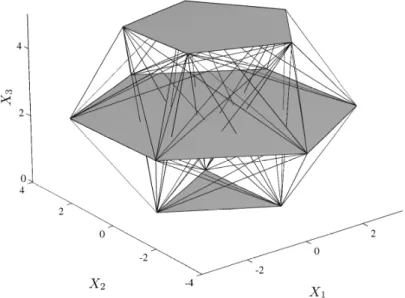
Consider an initial structure illustrated in Figure 3, where X1 and X2 are taken to be two
horizontal axes and the vertical axis is denoted by X3. The structure consists of |V | = 14
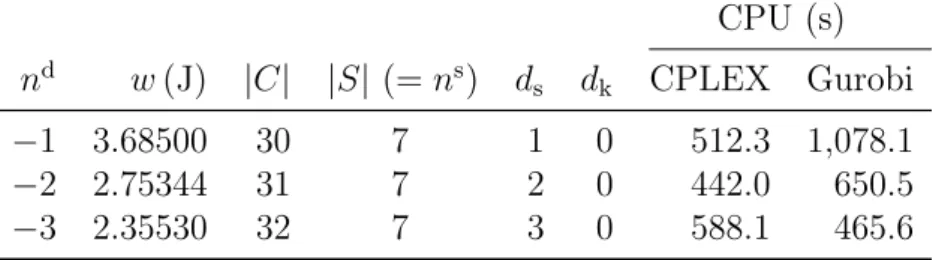
Table 1: Computational results of the three layer example CPU (s) nd w (J) |C| |S| (= ns) d s dk CPLEX Gurobi −1 3.68500 30 7 1 0 512.3 1,078.1 −2 2.75344 31 7 2 0 442.0 650.5 −3 2.35530 32 7 3 0 588.1 465.6
The locations of the nodes of this initial structure are defined as follows. The nodes form three horizontal layers as depicted by shaded polygons in Figure 3, where the centers of these polygons are on the X3-axis. The bottom layer is in an equilateral triangular shape, the middle one is a regular hexagon, and the top one is a regular pentagon. The lengths of
edges of these polygons are 2√3 m, 4 m, and 5 sinπ5 m, respectively. Each polygon has an
edge which is parallel to the X2-axis. The distance between the adjacent layers is 2.5 m. Any two nodes are connected by a member, but members corresponding to the diagonals of hexagonal and pentagonal layers are removed. As stated in Section 3.4, we do not allow two close members to exist simultaneously. The lower bound for the distance of two existing
members is δ = 0.05 m, which results in |Pcross| = 17 pairs of intersecting members for this
initial structure. To consider the equilibrium state under the self-weight load, six degrees
of freedom of displacements of the bottom nodes are fixed, i.e., |JD| = 6. Specifically, we
fix the displacements in all directions of the node at (1,√3, 0), the displacements in the
X1- and X3-directions of the node at (1,−√3, 0), and the displacement in the X3-direction
of the node at (−2, 0, 0). Then MILP problem (4.18) has 2|E| = 154 binary variables,
5|E| + 3|V | = 427 continuous variables, 1495 linear inequality constraints, and 162 linear quality constraints.
As for nd introduced in (3.11), we consider three cases: nd = −1, −2, and −3. The
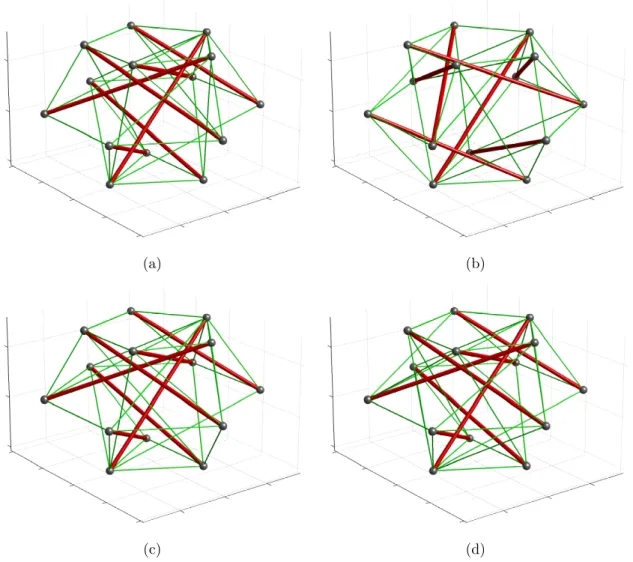
lower bound for the number of struts is ns = 7. The optimal tensegrity structures obtained
by solving problem (4.18) are shown in Figure 4, where the thick lines and the thin lines represent struts and cables, respectively. The computational results are listed in Table 1. Here, w means the compliance of the optimal solution, “CPU” is the computational time
spent by an MILP solver, |C| is the number of cables, |S| is the number of struts, and ds
and dkdenote the degrees of static indeterminacy and kinematic indeterminacy, respectively.
All the obtained structures are kinematically determinate (i.e., stable). It is observed in Table 1 that as the number of cables increases, the degree of static indeterminacy increases and the compliance decreases. Thus the stiffness against the self-weight load is improved by increasing the number of cables.
In the case of nd = −1, different optimal solutions are found by CPLEX and Gurobi
Optimizer; Figures 4(a) and (b) illustrate the solutions obtained by CPLEX and Gurobi Optimizer, respectively. The objective value of the solution by CPLEX is w = 3.6850015, while that by Gurobi Optimizer is w = 3.6850044. Therefore, the solution provided by Gurobi Optimizer is not a global optimal solution, although the difference of these objective values is subtle.
The optimal solutions shown in Figures 4(a), (c), and (d) share the same set of struts. However, the locations of cables are different. More precisely, for example, the set of cables in Figure 4(a) is not a subset of that in Figure 4(c).
(a) (b)
(c) (d)
Figure 4: Optimal solutions obtained from the three-layer initial structure in Figure 3.
(a) nd =−1 by CPLEX; (b) nd =−1 by Gurobi Optimizer; (c) nd =−2; (d) nd=−3
5.2. Cantilevered tensegrity structure
We next consider an initial structure illustrated in Figure 5. The structure consists of
|V | = 14 nodes and |E| = 82 members. The number of pairs of intersecting members (with
threshold δ = 0.05 m) is|Pcross| = 23.
The locations of the nodes of this initial structure are defined as follows. The nodes form four vertical layers, which are two equilateral triangles and two squares as shown in Figure 5. We call these layers L1, L2, L3, and L4, where the leftmost one is L1 and the rightmost one is L4. The lengths of edges of L1 and L4 are
√
3 m, while those of L2 and L3 are 1.25
√
2 m. All the layers are parallel to the X2X3-plane and their centers are on the X1-axis. Moreover, each of L1, L3, and L4 has an edge which is parallel to the X2-axis. Then L2 is rotated from
L3 counter-clockwise around the X1-axis with the angle π/12. The X1-coordinates of the
nodes of L1, L2, L3, and L4 are 0 m, 4.25 m, 4.75 m, and 9 m, respectively.
Any two nodes of the initial structure are connected by a member, but members
con-necting the pair L1 and L4 are removed to avoid presence of too long members. To consider
the equilibrium state under the self-weight load, all the nodes of L1 are fixed. Therefore,
|JD| = 9 and |JN| = 33. Such a structure anchored at only one end on a wall is called a
Figure 5: A cantilevered initial structure
(a) (b)
(c) (d)
(e) (f)
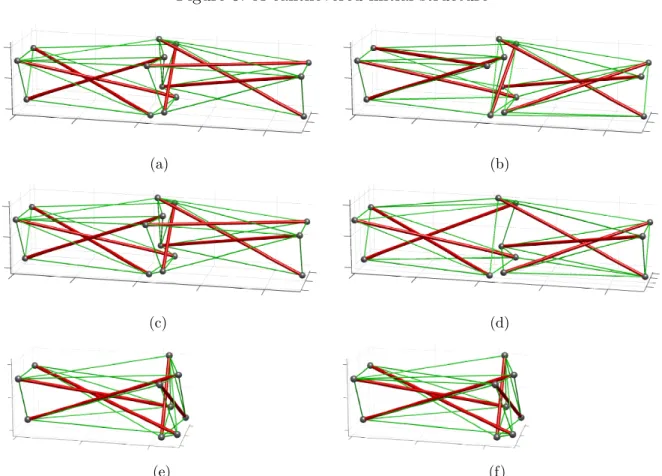
Figure 6: Optimal solutions obtained from the cantilevered initial structure in Figure 5. (a) (ns, nd) = (7,−1); (b) (ns, nd) = (7,−2); (c) (ns, nd) = (6,−1); (d) (ns, nd) = (6,−2); (e) (ns, nd) = (5,−1); (f) (ns, nd) = (5,−2)
continuous variables, 1596 linear inequality constraints, and 167 linear equality constraints. As for ns and nd, we consider nine cases: ns = 5, 6, 7 and nd= 0,−1, −2. The solutions obtained by CPLEX are illustrated in Figure 6. The computational results are listed in Table 2. In each case, the computational time required by Gurobi Optimizer is larger than
that required by CPLEX. The three cases with nd= 0 are infeasible problems. The solution
obtained for (ns, nd) = (6,−1) is same as that for (ns, nd) = (7,−1).
In Table 2, the symbol “∗” means that the solution obtained by Gurobi Optimizer is not
a global optimal solution. Indeed, both for (ns, nd) = (6,−2) and (ns, nd) = (5,−2), Gurobi
Table 2: Computational results of the cantilevered example CPU (s) ns nd w (J) |C| |S| d s dk CPLEX Gurobi 7 0 infeasible — — — — 89.1 417.3 7 −1 30.8941 30 7 1 0 93.5 1,096.9 7 −2 19.5696 31 7 2 0 107.9 12,521.6 6 0 infeasible — — — — 124.3 385.9 6 −1 30.8941 30 7 1 0 139.4 303.4 6 −2 14.6165 26 6 2 0 100.6 ∗ 5 0 infeasible — — — — 206.5 629.8 5 −1 1.0729 20 5 1 0 163.0 595.5 5 −2 1.0243 21 5 2 0 145.5 ∗
Figure 7: An L-shaped initial structure
solutions. It is evident from Table 2 that the solutions obtained by CPLEX in these two cases have smaller objective values than the solution for (ns, nd) = (7,−2).
5.3. L-shaped tensegrity structure
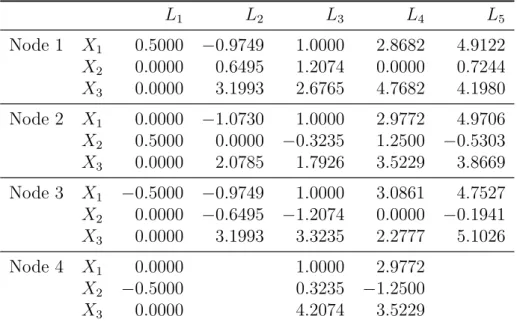
In this section we consider an initial structure illustrated in Figure 7. This structure consists of |V | = 18 nodes and |E| = 116 members. The locations of the nodes are listed in Table 3. The nodes form five regular polygons, i.e., two equilateral triangles and three squares, as shown in Figure 7. We call the bottom square L1. The remaining polygons are called
L2, . . . , L5, where the leftmost triangle is L2 and the rightmost triangle is L5. Squares L1 and L3 are parallel to the X1X2-plane and the X2X3-plane, respectively. The lengths of
edges of L1 are √2/2 m, those of L2 and L5 are 3√3/4 m, and those of L3 and L4 are
5√2/4 m.
The members connecting the pairs {L1, L4}, {L1, L5}, and {L2, L5} are not considered.
Table 3: Locations of the nodes of the L-shaped initial structure in Figure 7 L1 L2 L3 L4 L5 Node 1 X1 0.5000 −0.9749 1.0000 2.8682 4.9122 X2 0.0000 0.6495 1.2074 0.0000 0.7244 X3 0.0000 3.1993 2.6765 4.7682 4.1980 Node 2 X1 0.0000 −1.0730 1.0000 2.9772 4.9706 X2 0.5000 0.0000 −0.3235 1.2500 −0.5303 X3 0.0000 2.0785 1.7926 3.5229 3.8669 Node 3 X1 −0.5000 −0.9749 1.0000 3.0861 4.7527 X2 0.0000 −0.6495 −1.2074 0.0000 −0.1941 X3 0.0000 3.1993 3.3235 2.2777 5.1026 Node 4 X1 0.0000 1.0000 2.9772 X2 −0.5000 0.3235 −1.2500 X3 0.0000 4.2074 3.5229
Table 4: Computational results of the L-shaped example CPU (s)
nd w (J) |C| |S| (= ns) ds dk CPLEX Gurobi
−1 infeasible — — — — 18,286.1 ∗∗
−2 6.3504 41 9 2 0 14,459.3 ∗∗
−3 9.6019 42 9 3 0 35,559.7 ∗∗
The equilibrium state under the self-weight load is considered by fixing all four nodes of L1.
Hence, |JD| = 12 and |JN| = 42. The lower bound for the number of struts is ns= 9. Then
problem (4.18) has 2|E| = 232 binary variables, 5|E| + 3|V | = 634 continuous variables,
2276 linear inequality constraints, and 225 linear equality constraints.
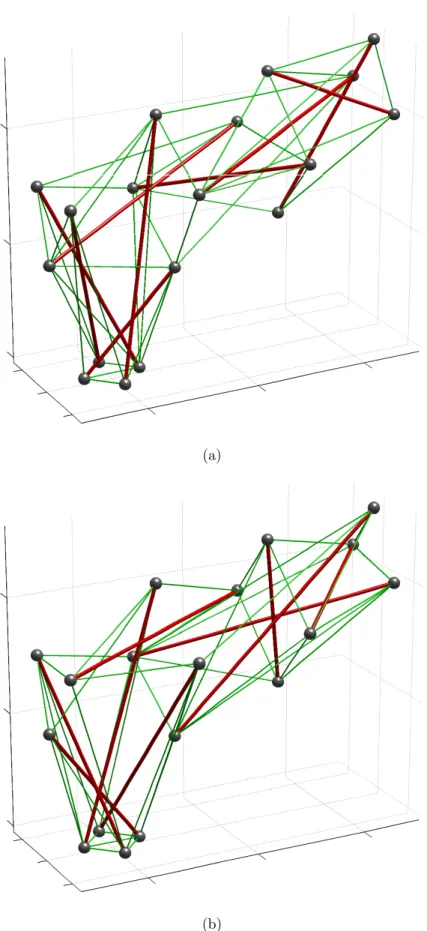
The computational results are listed in Table 4. Here, the symbol “∗∗” means that
Gurobi Optimizer does not terminate within 100,000 s. The solutions obtained by CPLEX are shown in Figure 8. It is observed that sets of struts are different between Figures 8(a) and (b).
6. Conclusions
For developing real-world innovative tensegrity structures, form-finding methods that can explore diverse topologies are desired. In this paper we have explored a topology optimiza-tion problem of tensegrity structures subjected to self-weight loads. The presented approach prepares an initial structure with sufficiently large number of candidate members and does not require a topology of tensegrity structures to be known in advance. The optimization problem has been reduced to an MILP problem. It has been shown in numerical examples that various configurations of tensegrity structures can be obtained by solving this MILP problem. The numerical experiments illustrate that, for this MILP problem, Gurobi Opti-mizer is not superior to CPLEX from viewpoints of computational efficiency and accuracy. This paper has not addressed issues of stability of tensegrity structures. The tensegrity
(a)
(b)
Figure 8: Optimal solutions obtained from the L-shaped initial structure in Figure 7.
structures obtained in Section 5 are kinematically determinate (i.e., stable), whereas many well-known tensegrity structures are kinematically indeterminate (i.e., unstable) and stabi-lized by introducing prestress forces; see, e.g., Calladine [7], Guest [14], Hanaor and Liao [16], and Pellegrino [25]. Therefore, it remains as an important future subject to develop a numerical method that can find unstable (but prestress stable) tensegrity structures. Also, the geometrical nonlinearity has not been considered. Furthermore, the proposed formula-tion results in a large MILP problem, which might be a potential disadvantage for finding tensegrity structures consisting of a large number of members.
Acknowledgments
This work is partially supported by Grant-in-Aid for Scientific Research (C) 23560663, by the Global COE Program “The Research and Training Center for New Development in Mathematics,” and by the Aihara Project, the FIRST program from JSPS, initiated by CSTP.
References
[1] B. Adam and I.F.C. Smith: Active tensegrity: a control framework for an adaptive civil-engineering structure. Computers and Structures, 86 (2008), 2215–2223.
[2] T.M. Atanackovic: Optimal shape of column with own weight: bi and single modal optimization. Meccanica, 41 (2006), 173–196.
[3] A. Back and R. Connelly: Catalogue of Symmetric Tensegrities (web page).
http://mathlab.cit.cornell.edu/visualization/tenseg/tenseg.html (Accessed October 2011).
[4] N. Bel Hadj Ali, L. Rhode-Barbarigos, A.A. Pascual Albi, and I.F.C. Smith: Design optimization and dynamic analysis of a tensegrity-based footbridge. Engineering
Struc-tures, 32 (2010), 3650–3659.
[5] S. Bereg: On characterizations of rigid graphs in the plane using spanning trees. Graphs
and Combinatorics, 25 (2009), 139–144.
[6] M. Bruyneel and P. Duysinx: Note on topology optimization of continuum structures including self-weight. Structural and Multidisciplinary Optimization, 29 (2005), 245– 256.
[7] C.R. Calladine: Buckminster Fuller’s “tensegrity” structures and Clerk Maxwell’s rules for the construction of stiff frames. International Journal of Solids and Structures, 14 (1978), 161–172.
[8] R. Connelly and A. Back: Mathematics and tensegrity. American Scientist, 86 (1998), 142–151.
[9] R. Connelly and W. Whiteley: Second-order rigidity and prestress stability for tenseg-rity frameworks. SIAM Journal on Discrete Mathematics, 6 (1996), 453–491.
[10] S. Ehara and Y. Kanno: Topology design of tensegrity structures via mixed integer programming. International Journal of Solids and Structures, 47 (2010), 571–579.
[11] D.G. Emmerich: Construction de r´eseaux autotendants. French Patent No. 1,377,290,
September 28, 1964.
[12] R.B. Fuller: Tensile-integrity structures. U.S. Patent No. 3,063,521, November 13, 1962. [13] R.B. Fuller: Synergetics: Explorations in the Geometry of Thinking (Collier McMillian,
[14] S.D. Guest: The stiffness of tensegrity structures. IMA Journal of Applied Mathematics,
76 (2011), 57–66.
[15] Gurobi Optimization, Inc.: Gurobi Optimizer Reference Manual.
http://www.gurobi.com/ (2010).
[16] A. Hanaor and M.-K. Liao: Double-layer tensegrity grids: static load response. Part I: analytical study. Journal of Structural Engineering (ASCE), 117 (1991), 1660–1674. [17] IBM ILOG: User’s Manual for CPLEX. http://www.ilog.com/ (2010).
[18] M.H. Imam: Shape optimization of umbrella-shaped concrete shells subjected to self-weight as the dominant load. Computers and Structures, 69 (1998), 513–524.
[19] T. J´ordan, A. Recski, and Z. Szabadka: Rigid tensegrity labelings of graphs. European
Journal of Combinatorics, 30 (2009), 1887–1895.
[20] S.H. Juan and J.M. Mirats Tur: Tensegrity frameworks: static analysis review.
Mech-anism and Machine Theory, 43 (2008), 859–881.
[21] Y. Kanno: Topology optimization of tensegrity structures under compliance constraint: a mixed integer linear programming approach. Optimization and Engineering, to ap-pear.
[22] B.L. Karihaloo and S. Kanagasundaram: Optimum design of statically indeterminate beams under multiple loads. Computers and Structures, 26 (1987), 521–538.
[23] D.-Y. Kwak, J.-H. Jeong, J.-S. Cheon, and Y.-T. Im: Optimal design of composite hood with reinforcing ribs through stiffness analysis. Composite Structures, 38 (1997), 351–359.
[24] R. Motro: Tensegrity (Kogan Page Science, London, 2003).
[25] S. Pellegrino: A class of tensegrity domes. International Journal of Space Structures, 7 (1992), 127–142.
[26] J. Rieffel, F. Valero-Cuevasa, and H. Lipson: Automated discovery and optimization of large irregular tensegrity structures. Computers and Structures, 87 (2009), 368–379. [27] G.I.N. Rozvany: Optimal plastic design: allowance for selfweight. Journal of the
Engi-neering Mechanics Division (ASCE), 103 (1977), 1165–1170.
[28] G.I.N. Rozvany, H. Nakanamura, and B.T. Kuhnell: Optimal archgrids: allowance for selfweight. Computer Methods in Applied Mechanics and Engineering, 24 (1980), 287–304.
[29] G.I.N. Rozvany, K.M. Yep, T.G. Ong, and B.L. Karihaloo: Optimal design of elastic beams under multiple design constraints. International Journal of Solids and
Struc-tures, 24 (1988), 331–349.
[30] K. Snelson: Continuous tension, discontinuous compression structures. U.S. Patent No. 3,169,611, February 16, 1965.
[31] K. Snelson: Kenneth Snelson (web page). http://www.kennethsnelson.net/ (Ac-cessed October 2011).
[32] A.M.C. So and Y. Ye: A semidefinite programming approach to tensegrity theory and realizability of graphs. Proceedings of the 17th Annual ACM-SIAM Symposium on
Discrete Algorithms (SODA 06), 766–775, Miami (2006).
[33] C. Sultan and R. Skelton: Deployment of tensegrity structures. International Journal
of Solids and Structures, 40 (2003), 4637–4657.
[34] A.G. Tibert and S. Pellegrino: Deployable tensegrity reflectors for small satellites.
[35] A.G. Tibert and S. Pellegrino: Review of form-finding methods for tensegrity struc-tures. International Journal of Space Structures, 18 (2003), 209–223.
[36] K.Yu. Volokh, O. Vilnay, and M. Belsky: Tensegrity architecture explains linear stiff-ening and predicts softstiff-ening of living cells. Journal of Biomechanics, 33 (2000), 1543– 1549.
[37] S. Wandling, P. Ca˜nadas, and P. Chabrand: Towards a generalised tensegrity model
describing the mechanical behaviour of the cytoskeleton structure. Computer Methods
in Biomechanics and Biomedical Engineering, 6 (2003), 45–52.
[38] C.-M. Wang and G.I.N. Rozvany: On plane Prager-structures—II: nonparallel external loads and allowance for selfweight. International Journal of Mechanical Sciences, 25 (1983), 529–541.
Yoshihiro Kanno
Department of Mathematical Informatics University of Tokyo
7-3-1 Hongo, Tokyo 113-8656, Japan E-mail: [email protected]