J oumal of the! Operations Research Society of Japan
Vo!. 25, No. 2, June 1982
AN APPROXIMATION METHOD USING CONTINUOUS
MODELS FOR QUEUEING PROBLEMS 11
(MULTI-SERVER FINITE QUEUE)
Teruo Sunaga Kyushu University
Shyamai Kanti Biswas Kyushu University Noriteru Nishida
Kyushu University
(Received September 4,1980; Final December 5, 1981)
Abstract An approximation method based on the diffusion theory is proposed for solving multi-server finite queueing problems having general independent inter-arrival time and general service time distributions. The discrete customer flow through the system is approximated by a continuous one, and a diffusion equation for the process of the number of customers in the system is constructed by using means and variances of the inter-arrival time and service time distributions. Two reflecting boundaries are imposed at the origin and m, the maximum number of customers being allowed in the system. Later, the boundary conditions are modified to improve the approximation. Approximate formulas for Pn, probability of finding n customers in the system, and for N, mean number of lost customers from the system per mean service time, are given for steady state. Numerical examples for mean number of customers in the system are presented for some E//Ek/s(m) systems to show the effectiveness of the proposed method.
1_
Introduction
Multi-server finite queueing proble"ms are found in many practical situ-ations. Exact results, however, are known only for simple models with special distributions for arrival and service processes and approximation techniques are expected to work for the problems where exact analysis is difficult. Vari-ous approximation techniques for solving queueing problems have been devised by many authors [1] and the diffusion method is one of them. Considerable research works have been presented for this approximation technique, e.g., in [4], [5], [7] - [11], but most of them treated ~ueues with no limitation to the
114 T. Sunaga, S. K. Biswas and N. Nishida
proposed a diffusion approximation method for multi-server queueing problems with possibly short queues. Using the same idea, we propose here a similar approximation method for solving finite queueing problems having general inde-pendent inter-arrival time and general service time distributions.
In the next section, our method is described, and in Section 3, modifi-cations of the boundary conditions are discussed. Numerical examples are given in Section
4.
Assumptions and appl:icability of diffusion approximation techniques to queueing problems have been discussed in detail in [8], [10] and [11]. For the convenience of later discussions, we summarize here the diffusion approxi-mation technique proposed in [11] for G/G/s (00) system in short. The follow-ing notations are used in the sequel.
L(t) Pn(t) A. ]l
o
2 a o 2 8 s m R, k pthe number of customers in the system at time
t
the probability that L(t) is n
the mean arrival rate
the mean service rate of each server
the variance of the inter-arrival time distribution the variance of the service time distribution the number of parallel servers
the system capacity (= number of servers
+
maximum queue length) ~ 2 1/ (A. 2 0 2) > 1 a = 1/(]l2 0 8 2) ~ 1 =a/s =A./(]ls)For a diffusion approximation, we should replace the discrete valued variable L~) by a continuous variable X~). We assume that X(t) has a density function f(x,t) defined as f~x,t)dx Pr { x ~ X (t) ~ x
+
dx}. We shall confine ourselves here to the steady state solution. Let P = lim P (t)n t->oo n
and f(x)
=
lim f(x, t). I f X( t)t--
is a diffusion process, then f(x) satisfiesthe following diffusion equation
(1.1)
o
d 1 d2
- . L {F(x) f(x)}
+ - -
{D(x) f(x)}ca; 2 dx2
where F(x) and D(x) are respectively the mean and the variance of instan-taneous change in
X,
i.e.,F(x) lim E{(X(t+U) - X(t»
I
X(t)=
x}//).t
Llt+ 0Approximation for Multi-8erver Finite Queue
D (x) Hm Var { (X (t
+ t:,.t) -
X(t»
I
X(t) .. x } /t:,.tt.t-+O
115
As was shown in [8], an integration of (1.1) with a reflecting boundary at the origin and with the condition f(oo)
= 0 ,
df(oo)/dx= 0 at
x=
00 leads to(1. 2)
o
P(x) f(x)+
2"
1d
dx { D(x) f(x)} and hence (1. 3) f(x) const. D(x) 2 f;{P(X)/D(X)}dx eIt will be natural to set, for x < s,
p(x)
=
A - ~x and D(x) =A/R,+~x/kand for x ~ s,
p(x) = A - ~ s and D(x)
= A /
R,+
~ s/k Then, f(x) of (1.3) coincides with flex) for x < s and with f2(x) for x ~ s as given below. (1.4) (1. 5) where -ax e and a = 2( I-p)/(p/Hl/k) .
(1.5) reflects the continuity of f(x) at: x= s. The constant of integration c is determined by the normalization criterion that the integrated value of fCx) over the region (0, (0) is unity.
In [8], at first, values of P 's are calculated by discretizing f(x) and
n
then values of other system parameters are obtained from them. In [11], an approximation formula for the mean queue length was derived directly. But both methods give almost the same results. The former is useful if one needs the value of Pn • If one needs only the value of the mean queue length, the later method is simpler.
116 T. Sunaga, S. K. BilMlas and N. Nishida
2. Diffusion Approximation Method for Finite Queueing System
We assume that, from an infinite source, customers arrive at a mu1ti-server service station with a finite capacity waiting room, that the total capacity of the system (Le., the number of servers plus the capacity of the waiting room) is m, and that customers waiting for service form a single queue. The service is achieved on the first come - first served basis. If the waiting room is full, then newly arriving customers are not allowed to enter the system and are lost.
The same steady state diffusion equation (1.1) may be used for this finite queueing model with slightly different boundary conditions. In this case, it might be natural to consider that the diffusion process is restricted within
two reflecting boundaries at both ends x = 0 and x = m Using either of the following reflecting boundary conditions
(2.1)
o
= - F(x) f(x)+
"2
1d d:x: {D(x) f(x)}I
at x = 0 or at x = m
we can derive (1.2) from (1.1). Any solution of (1.2) satisfies both of the boundary conditions of (2.1). Two reflecting boundary conditions have earlier been used in [4] and [7] for the approximate solution of queueing problems. More detailed descriptions about the boundary conditions are available in [2],
[3].
Depending on the number of customers waiting in the queue, F(x) and D(x)
in (1.1) take different forms. Here we explain them together with the corre-sponding solution f(x).
(A) The case m ~ s + 1
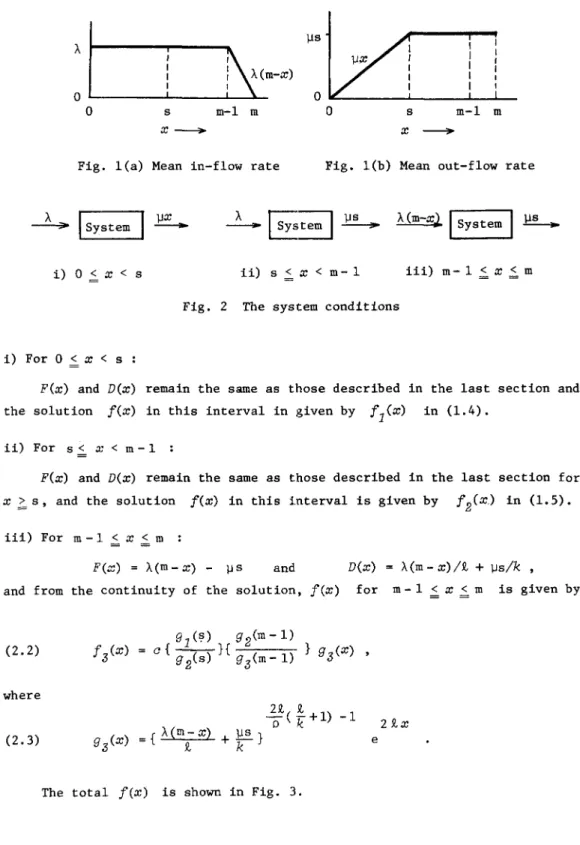
The mean entering rate of customers to the system remains equal to the mean arrival rate A until n becomes equal to m - 1 and then it drops to zero at n =m. In order to represent this situation from the standpoint of continuous model, we assume that the mean in-flow rate and its variance de-crease linearly to zero in the region (m -1, m) (see Fig. 1(a)). On the other hand, the mean service rate is ~ n for n,:;, s , and ~ s for n ~ s . Hence, the mean out-flow rate for the continuous model may be assumed as shown in Fig. l(b).
Approximation for Multi-Server Finite Queue
o
L -_ _ _ _ _ _ ~ _ _ _ _ - L _ _ ~o
sx _
m-I mx _
Fig. lea) Mean in-flow rate Fig. l(b) Mean out-flow rate
~
I
System i) 0 ~ x < s i) For 0 ~ x < s : A C=:::l]Js -E~~ ii) s ~ x < m- 1 A(m-x~
I
System ---~ ]Js iii) m-I ~ x < mFig. 2 The system conditions
117
F(x) and D(x) remain the same as those described in the last section and the solution lex) in this interval in given by ! / x ) in (1.4).
ii) For s ~ x < m-I
F(x) and D(x) remain the same as those described in the last section for x ~ s, and the solution lex) in this interval is given by !2(x) in (1.5).
iii) For m -1 ~ x ~ m :
F(x) = A(m-x) - ]Js and D(x)
=
A (m - x)/R-
+
]Js/k , and from the continuity of the solution, lex) for m - 1 < x < m is given by(2.2) !3(X)
where
2R-x
(2.3) e
118 T. Sunaga, S. K. Biswas and N. Nishida
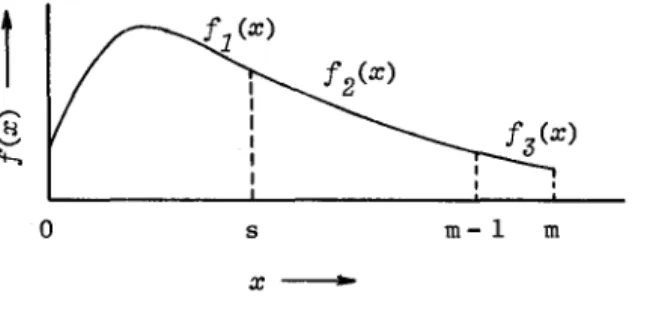
o
s m-I mx
-Fig. 3 The total solution
The constant c is determined so that the integrated value of f(x) over the region (0, m) is unity, i.e.,
(2.4)
1An approximate value of the probability of finding n customers in the system in the steady state can be obtained by discretizing f(x} as
(2.5)
f
n+. 5 f(x) dx n-.5
(1 ~ n ~ m-1)
Then, an approximate formula Ll for the. mean number of customers in the system is derived from
(1.4), (1.5), (2.2), (2.4)
and(2.5)
as(2.6)
m
L
n Pn n=lwhere the approximation
(2.7) Pm =
If(X)
dx m-.5 [J m-l Jm- 5 ] Jm + (m-I)f
2(x) dx+f
3(x) dx + mf
3(x) dx , m-1.5 m-I m-.5is used. The above formula (2.6) is valid for m > s+ 2 the terms with
f
2(x) vanish.Approximation for Multi-8erver Finite Queue
An approximate formula D1 for the mean number of departing customers per unit time after receiving service is given by
(2.8) s-l LJ.lrl P
+
n=1 n mL
].lS P n n=s 119which may be written in a form similar to (2.6). Hence, an approximate formula NI for the mean number of lost customers per mean service time is obtained by the relation
(2.9)
(B) The case s=
m > 2 AI
SI
j.lX A (m-x) ...I
SystemI
~-~ ystem ~ - _ _ ~n
0 ~ x < s - 1 ii) s - 1 ~ x ~ s (= m) Fig. 4 The system conditionsi) For 0 ~ x < S - 1
F(x) and D(x) remain the same as those described in Section 1 and the solution f(J:) in this interval is given by f
1(x) in (1.4).
ii) For s - 1 ~ x ~ s (= m)
F(x)
=
A(m-x) - j.lx and D(x) = A(m-x)/9-+
j.lx/kFrom the continuity of the solution,
f(x)
in this interval is given byf~1 (x) gl(s-l) (2.10) c{ g4(s-1) where (2.11) g/x) ={ A(m-x) 9-
+
U - 2 (a+
1) - al9-+
Ilk } g/x) H j.lx} k and Ux ew
2 ma (1/9-+
l/k) (-a/9-+ l/k )2 Ll, Dl and NI can be obtained by the procedure shown in (A).
120 T. Sunaga, S. K. BillWas and N. Nishida
3. Modifications of the Boundary Conditions
The discretization (2.5) is not applicable for n = 0 and n = m if reflecting boundaries are set at x = 0 and at x = m In [7], different types of assumptions were made for Po and Pm in solving two stage cyclic queueing problem by the diffusion approximation method.
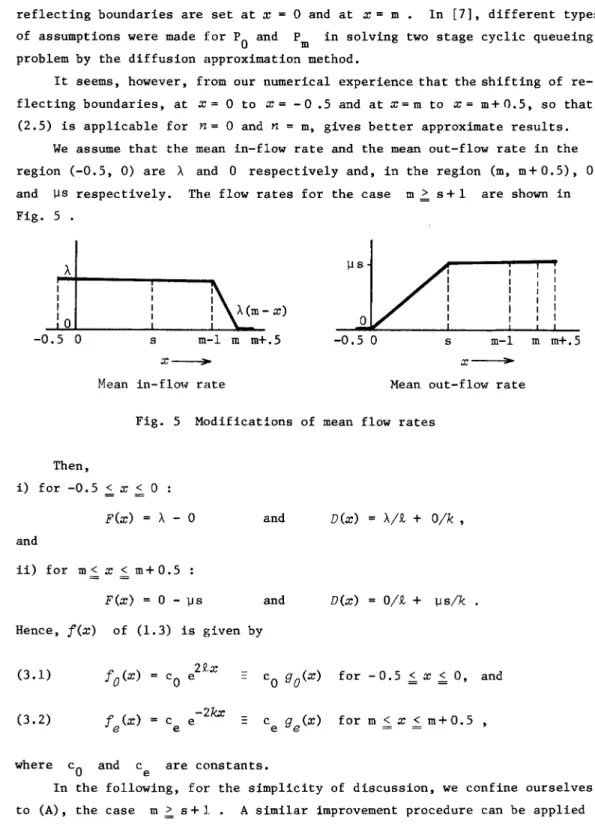
It seems, however, from our numerical experience that the shifting of re-flecting boundaries, at X= 0 to X= -0.5 and at X=m to X= m+O.5, so that
(2.5) is applicable for n = 0 and n = m, gives better approximate results. We assume that the mean in-flow rate and the mean out-flow rate in the region (-0.5, 0) are A and 0 respectively and, in the region (m, m+ 0.5), 0 and ~s respectively. The flow rates for the case m ~ s + 1 are shown in Fig. 5 . ~s I I
,
'0 -0.5 0 s m-I mm+.s
x -Mean in-flow' rate Mean out-flow rateFig. 5 Modifications of mean flow rates
Then, i) for -0.5
,;;,x,;;,O
:F(x)
= A - 0 andD(x)
V£+ O/k,
and ii) for m';;'x,;;,
m+0.5 :F(x)
= 0 - ~s andD(x)
0/£ + ~s/k Hence,f(x)
of (1. 3) is given by(3.1)
fo(x)
Co e2Q.x
- CogO(x)
for - 0.5,;;, x';;' 0,
andf (x)
c e-2kx
- cge(x)
for m,;;,x';;'m+0.5e
e e(3.2)
where Co and c
e are constants.
In the following, for the simplicity of discussion, we confine ourselves to (A), the case m ~ s + 1
A
similar improvement procedure can be appliedApproximlltion for Multi-Server Finite Queue 121
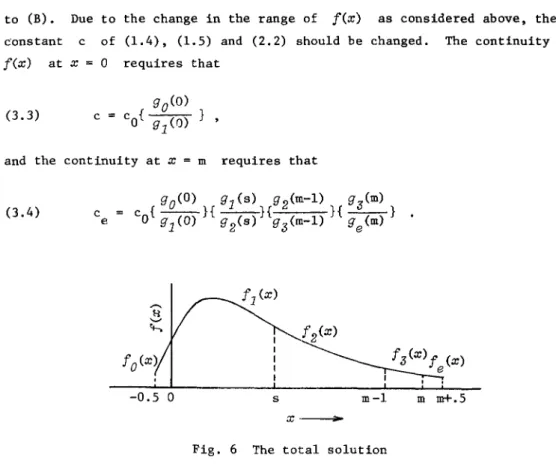
to (B). Due to the change in the range of f(x) as considered above, the c'onstant c of (1.4), (1.5) and (2.2) should be changed. The continuity of f(x) at x
=
0 requires that(3.3) c
=
and the continuity at x
=
m requires that(3.4)
ce
s m-1
x · _ Fig. 6 The total solution
m m+.5
The normalization criterion that the integrated value of f(x) over the region (- 0.5, m+ 0.5) is unity, is needl~d to find out the value of the constant
Co .
The approximate formula L1 of (2.6), for the mean number of customers in the system, is then modified as
m
(3.5)
I
n Pn=l n
where f(x) is shown in Fig. 6 . D1 and N1 can be modified in a similar manner.
4.
Numerical Examples
The proposed approximation method has been tested for eleven different EQ,/Ek/S (m) systems, namely M/M/s (m), M/E2/ s (m), E2/M/s (m) ,
E
122 T. Sunaga, S. K. Biswas and N. Nishida
E10/D/S (rn) and D/E10/S (rn) , with the following different values of s, m and p.
s 2, 5, 10 m s, 2s, Ss, 10s
P
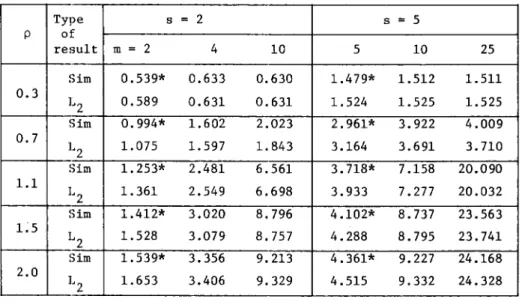
0.3, 0.5, 0.7, 1.0, 1.1, 1.5, 2.0Some of the calculated values are shown in Table 1 - 4. In Table 1, values of both Ll and L2 are compared with exact values for M/M/s (rn) system [6]. From this table, it is seen that L2 gives better approximation in all cases. In Tables 2 - 4, L2 values are compared with simulation or exact results. Since the simulated values are unstable at and in the vicinity of p
=
1, those values are not included in tables except in Table 1. In the tables'E'
stands for exact values and 'Sim' for simulated ones, but'*'
in the rows of 'Sim' stands for exact values.Numerical integration is generally needed for the calculation of approxi-mate formulas. We used Gauss's formula for numerical integration which is available in FACOM M200 computer. It will be worth to note the following point in the calculation of approximate values.
form
(4.1)
Function
g.(x)
is of the1..
whose value occasionally becomes very large g'iving overflow problem in numeri-cal integration.
function.
(4.2)
g1(x)
1..So, instead of
g.(x)
we used the following exponential1..
where xl is such a fixed value of x that overflow does not occur in the cal-culation of
gi(x)
in the considered region ofx.
The proposed approximate formulas can easily be re1.-ritten to contain this particular form.There is another general method for the numerical calculation which is also described below. Since our calculation is based on the numerical inte-gration of positive functions, we can use a method based on the logarithmic principles, where values of integrated functions are transformed into loga-rithms and summations of function values are performed in a manner such as: if logea = a. , logeb =
S
and a 2, b > 0, then a.+
loge (1+ eS
-a. ) = loge (a+b) ,where the underflow of e
S -
a. (,;;;, 1) can be detected before its calc.ulation and if so, it is regarded as zero.Approximation for Mulli-Server Finite Queue 123
equations (1.4), (2.3), (3.1) and (3.2) can not directly be used in the calcu-lation. In such cases, the corresponding equations can easily be derived using
(1. 3) •
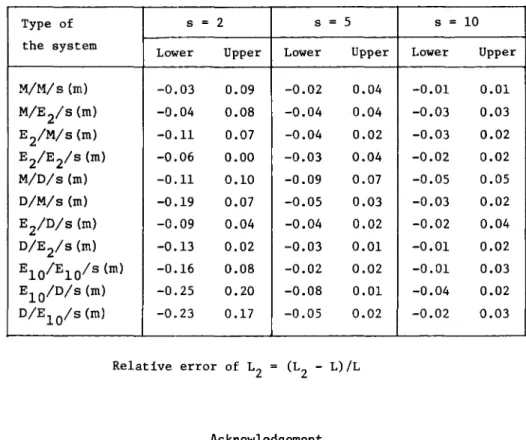
Table 5 shows the upper and lower bounds of relative errors of L2 compared with exact or simulated values for all of the eleven systems described above. Each upper bound is the maximum value and each lower bound is the minimum value among all the relative error values for all values of m and p except for p
=
1, which are listed above, for a particular value of s.5. Conclusion
A diffusion approximation method for the solution of multi-server finite queueing problems has been proposed. Since, the diffusion equation depends only on the means and variances of the arrival and service processes, this method is easIly applicable to problems having general independent inter·-arrival time and general service time distributions.
The approximate formulas are simplE! and values of the system parameters can be easily calculated using a small c:omputer. The calculation time is extremely short in comparison with the simulation time to calculate the same values. Moreover, from Table 5, it is seen that the relative errors of the approximate values are within the tolerable range especially for greater values of s . So, we conclude that the proposed approximation method is useful, rather than time consuming simulation procedures, to solve practical finite queueing problems where exact results are not available.
For single server queues, approximate values L2 and N2 can be also cal-culated by our method with small modifieations, but, guessing from our numeri-cal results, the errors will be comparatively larger.
124 T. Sunoga, S. K. Biswas and N. Nishida
Table 1. Mean number of customers in the system in M/M/s (rn) system
Type s
=
2 s - 5 P of result m=
2 4 10 5 10 25 E 0.539 0.641 0.659 1.479 1.509 1.509 0.3 L2 0.555 0.687 0.718 1.516 1.560 1.560 L1 0.662 0.848 0.897 1.608 1.668 1.669 E 0.994 1.614 2.493 2.961 3.965 4.377 0.7 L2 0.993 1.631 2.558 2.929 3.972 4.414 L1 1.002 1.670 2.677 2.870 3.971 4.447 E 1.200 2.222 5.238 3.576 6.175 13.720 1.0 L2 1.188 2.207 5.222 3.520 6.127 13.675 L1 1.149 2.148 5.152 3.395 5.997 13.539 E 1.253 2.385 6.101 3.718 6.782 17.802 1.1 L2 1.238 2.362 6.059 3.659 6.721 17.715 L1 1.188 2.278 5.924 3.520 6.554 17.485 E 1.412 2.867 8.153 4.102 8.291 23.002 1.5 L2 1.393 2.826 8.069 4.040 8.211 22.902 L1 1.308 2.672 7.824 3.867 7.971 22.632 E 1.539 3.213 9.008 4.361 9.028 24.000 2.0 L2 1.520 3.168 8.930 4.304 8.954 23.920 L1 1.412 2.977 8.678 4.114 8.706 23.665Table 2. Mean number of customers in the system in E
2/E2/s(rn) system Type s
=
2 s=
5 P of result m=
2 4 10 5 10 25 Sim 0.575 0.615 0.611 1.484 1.508 1.504 0.3 L2 0.541 0.591 0.592 1.498 1.502 1.502 Sim 1.084 1.619 1.972 3.129 3.825 3.869 0.7 L2 1.047 1.569 1.901 3.143 3.722 3.765 Sim 1.354 2.577 6.849 3.912 7.269 19.488 1.1 L2 1.317 2.496 6.645 3.928 7.231 20.082 Sim 1.505 3.125 8.861 4.286 8.837 23.713 1.5 L2 1.483 3.046 8.802 4.280 8.824 23.796 Sim 1.630 3.431 9.378 4.499 9.336 24.278 2.0 L2 1.615 3.388 9.348 4.504 9.349 24.348Approximation for Multi-Server Finite Queue 125
Table 3. Hean number of customers in the system in
MIDis
(rn) systemType s
=
2 s=
5 P of result m=
2 4 10 5 10 25 Sim 0.539* 0.633 0.630 1.479* 1.512 1.511 0.3 L2 0.589 0.631 0.631 1.524 1.525 1.525 Sim 0.994* 1.602 2.023 2.961* 3.922 4.009 0.7 1.2 1.075 1.597 1.843 3.164 3.691 3.710 Sim 1.253* 2.481 6.561 3.718* 7.158 20.090 1.1 1.2 1.361 2.549 6.698 3.933 7.277 20.032 Sim 1.412* 3.020 8.796 4.102* 8.737 23.563 L5 1.2 1.528 3.079 8.757 4.288 8.795 23.741 Sim 1.539* 3.356 9.2l3 4.361* 9.227 24.168 2.0 1.2 1.653 3.406 9.329 4.515 9.332 24.328Table 4. Hean number of customers in the system in D/~1/s (rn) system
Type s
=
2 s=
5 P of result m=
2 4 10 5 10 25 Sim 0.599 0.602 0.604 1.495 1.491 1.507 0.3 1.2 0.486 0.556 0.564 1.495 1.507 1.507 Sim 1.187 1.624 1.844 3.273 3.773 3.746 0.7 1.2 1.048 1.549 1.968 3.121 3.746 3.824 Sim 1.473 2.681 6.789 4.111 7.388 20.183 1.1 1.2 1.305 2.445 6.595 3.929 7.182 20.l38 Sim 1.618 3.241 8.946 4.454 8.995 23.926 1.5 1.2 1.447 3.024 8.857 4.277 8.866 23.855 Sim 1.720 3.525 9.465 4.638 9.497 24.429 2.0 1.2 1.567 3.376 9.363 4.485 9.363 24.363126 T. Sunaga, S. K. BillWfls and N. NishidiJ
Table 5. Bounds of relative errors for different systems for L2
Type of s
=
2 s=
5 s=
10the system Lower Upper Lower Upper Lower Upper
M/~Vs (m) -0.03 0.09 -0.02 0.04 -0.01 0.01 M/E2
/S
(m) -0.04 0.08 -0.04 0.04 -0.03 0.03 E2/M/s (m) -0.11 0.07 -0.04 0.02 -0.03 0.02 E2/E2/s{m) -0.06 0.00 -0.03 0.04 -0.02 0.02 M/D/s{m) -0.11 0.10 -0.09 0.07 -0.05 0.05 D/M/s{m) -0.19 0.07 -0.05 0.03 -0.03 0.02 EZ/D/S (m) -0.09 0.04 -0.04 0.02 -0.02 0.04 D/E2/S
(m) -0.13 0.02 -0.03 0.01 -0.01 0.02 E1O/E1O/s{m) -0.16 0.08 -0.02 0.02 -0.01 0.03 E1O/D/s{m) -0.25 0.20 -0.08 0.01 -0.04 0.02 D/E1O/s(m) -0.23 0.17 -0.05 0.02 -0.02 0.03 Relative error of L2 (L2 - L)/LAcknowledgement
We are thankful to the anonymous referees for their helpful comments and suggestions.
References
[1] Bhat, U. N., Shalaby, M. and Fischer, M.
J.:
Approximation Techniques in the Solution of Queueing Problems. Naval Research [, ogist ics Quart erly, Vol.26, No.2 (1979), 311-326.[2] Feller, W.: The Parabolic Differential Equations and the Associated Semi-Groups of Transformations. Annals of Mathematics, Vol.55 (1952), 468-519. [3] Feller, W.: Diffusion Processes in One Dimension. Transactions of
American Mathematica~ Society, Vol. 77 (1954), 1-31.
[4] Gaver, D. P. and Shedler, G. S.: Processor Utilization in Multiprogramming Systems via Diffusion Approximations. operations Research, Vol.21 (1973), 569-576.
T. Sunaga, S. K. Biswas and N. Nishida
[5] Ge1enbe, E.: On Approximate Computer System Models. Journal of the Association of Computing Maahinary, Vol.22 (1975), 261-269.
[6] Gross, D. and Harris, M.: Fundamentals of Queueing Theory, John Wi1ey and Sons, 1975, 64-67, 109-112, 275.
127
[7] Ha1achmi, B. and Franta, W. R.: A Diffusion Approximate Solution to the G/G/k Queueing Systems. Computers and Operations Research, Vol.4 (1977), 37-46.
[8] Halachmi, B. and Franta, W. R.: A Diffusion Approximation to the Mu1ti-Server Queue. Management Science, vol.24, No.5 (1978), 522-529. [9] Kobayashi, H.: Application of the Diffusion Approximation to Queueing
Networks 1. Journal of the Associat ion of Comput ing Machinary, Vol. 21 (1974), 316-328.
[lOJ Newel1, G. F.: Applications of Queueing Theory, Chapman and Hall, London, 1971, 68-74, 101-140.
[llJ Sunaga, T., Kondo, E. and Biswas, S. K.: An Approximation Method Using Continuous Models for Queueing Problems. Journal of the Oper>at ions Research Society of Japan, Vo1.2l, No.l (1978), 29-42.
[12] Sunaga, T. and Biswas, S. K.: An Approximation Method Using Continuous Models for Finite Queueing Problems. Abstracts of Spring Research Conference of the operations Research Society of Japan in Hiroshima,
October, 1977 (In Japanese).
Teruo SUNAGA: Department of Mechanical Engineering, Faculty of Engineering, Kyushu University, Hakozaki 6 - 10 - 1, Higashi-ku, Fukuoka, 812, Japan.