Bulletin of Plankton Eco-Engineering Research
第 1 号
2021 年 6 月
プランクトン工学研究
創価大学
Soka University
Number 1
ISSN 2436-4878◆
「プランクトン工学研究」発刊にあたり
古谷研 ◆総説
光合成能を有するプランクトンを利用した次世代省エネルギー型 廃水処理技術の研究動向 秋月真一・ヘルマン クエバス - ロドリーゲス 抱卵型カイアシ類Oithona oculata のバイオリアクターを用いた試験的培養 髙山佳樹・山本翼・戸田龍樹 間欠的な曝気撹拌が海産珪藻Chaetoceros gracilis の生産性に与える影響 大竹正弘・家後幸一・平原南萌・ファティマ ユソフ・戸田龍樹 メタン発酵消化液を用いた微細藻類培養とバイオガス精製同時プロセス 岸正敏・尾内秀美・田中健児・吉田あかり・戸田龍樹 ◆原著論文
Preparation and characterization of poly(vinyl alcohol)/sodium
alginate/TEMPO-oxidized cellulose nanofiber hydrogel for dye removal Wing Shan Chan, Yuichi Shibata, Kento Nishi, Tatsushi Matsuyama, Junichi Ida
Magnesium-modified biochars for nitrate adsorption and removal in continuous flow system
Joo Yun Qi, Shinjiro Sato
. . . 1 . . . 2 . . . 14 . . . 22 . . . 32 . . . . 48 . . . 58
創価大学プランクトン工学研究所紀要「プランクトン工学研究」は原著論文、総説、短報、研究情報、その他編集委員会が認めた原稿 を掲載する。このうち原著論文、総説、短報は他の学術誌に印刷されたことがなく、また印刷予定のないものとし、責任ある研究活動の 成果について研究倫理を遵守してとりまとめられたものでなければならない(参考「科学の健全な発展のために−誠実な科学者の心得 −」日本学術振興会 (2015)、https://www.jsps.go.jp/j-kousei/data/rinri.pdf)。すでに印刷された図表ならびに本文 200 語以上の引用にあ たっては著者の責任において版権所有者の許諾を得るものとする。原稿は図表を含め編集委員長宛(古谷 研 [email protected])に送付 すること。掲載されたすべての報文の著作権は創価大学プランクトン工学研究所が所有する。 原稿(以降テキスト部分を原稿と呼ぶ)の用語は和文とするが英文も受け付ける。和文論文では、要旨と図表の説明文には必ず英語 を用いる。その他の原稿の図表の説明文はこの限りではない。A4 判で作成し、行間を 1.5 行とし、全ページにページ番号と行番号を 付する。本文のフォントは明朝体系フォント12 ポイントを、英文、学名、数値、単位、数式等については欧文用セリフ系フォント12 ポ イントを用いる。全角の英文フォントは用いない。 原稿第 1 ページ目には,表題、著者氏名、所属、住所を和英両文で書き、柱用の表題略語を和文 35 文字以下で指定する。また、 責任著者の電子メールアドレスを書く。連名の著者が異なる所属である場合は、著者順に所属に連番を付して著者名の右肩に所属 番号を付して区別する。 第 2 ページ目には要旨を書く。要旨には必ず英語を用い、報文全体の概要がやや詳しく示されるように 500 語程度にする。要旨 の下に 5 つ以内のキーワード(英語)をアルファベット順に併記する。 本文はページを改めて書き始める。原著論文では緒言(序言、はじめに等)材料と方法、結果、考察、謝辞、引用文献、図の説明の 順とし、総説では必要に応じて章立てを行い、短報では緒言から謝辞までをわけずに書く。 学名は斜体とし、その表記は藻類においては最新の国際藻類・菌類・植物命名規約,動物においては最新の国際動物命名規 約に従う。属名は緒言、材料と方法、結果、考察のそれぞれの初出、および文頭では略さず表記する。 単位は原則として SI 単位(第 9 版)を用いる。慣例により非 SI 単位を用いることがある。単位は次のように表記することとする: m−2、m−3、L、L−1、mL、mL−1、ind. L−1、inds. m−2、mM、µM、nM、cm s−1、cm min−1、km h−1、µg C m−2 d−1、g C m−2 y−1、µmol (photons) s−1 m−2
など。単位と数値の間、演算記号の前後、単位の積における単位同士の間は半角スペース空ける。 表は一つずつページを改め、上欄にそれぞれの説明文(英文に限る)を付した後、番号順に引用文献の次におく。確率等の説明は説 明文に入れる。例外的な事項の説明には、表中に肩記号を付して脚注に補足説明を置くことができる。図の説明文(英文に限る)は、 本文を参照することなくそれ自体で一応の意味がわかるように書き、表の次にページを改めて一括して列挙する。図や写真は A4 版で 受付ける。図中の説明は英文で作成する。図中の数字,記号,説明等のフォントは欧文用サンセリフ系フォントを用い、主要な文字や記 号のサイズは 18 ポイント、最小でも12 ポイント以上とすることを推奨する。
本文中の文献引用は、著者が複数で 2 名のときは佐藤・斉藤 (1980) または (Sato & Saito 1980)、3 名以上のときは(佐藤ほか 1980)または Sato et al. (1980) のようにする。カッコ内の著者名と出版年の間は半角スペースで区切る。複数の論文を引用するときは, (佐藤ほか 1980, 山田ほか 2010)のように半角カンマと半角スペースで区切り、出版年、筆頭著者の姓のアルファベット順とする。 投稿中の論文は引用できないが、(私信)または (personal comm.) か、(未発表)または (unpubl.) とすることができる。卒業論文, 修士論文,学会講演要旨集は引用不可とする。 引用文献リストの書き方は別項を参照すること。その他の不明の事項については本紀要の最新号に掲載の報文を参考にするか、 編集委員に問い合わせること。
「プ ラ ン ク ト ン 工 学 研 究」 編 集 委 員
秋月真一(プランクトン工学研究所)
岸 正敏(プランクトン工学研究所)
桑原ビクター伸一(教育学部)
佐々木諭(看護学部)
伴 修平(滋賀県立大学)
古谷 研(大学院理工学研究科・プランクトン工学研究所)編集委員長
「プランクトン工学研究」投稿規定 表紙写真:相模湾に生息する内湾性カイアシ類 Acartia steueri (撮影者:髙山佳樹)著者名や年号が不明なインターネット上の情報は本文中でその URL と参照年月日を記述する. 1. 筆頭著者が同じ場合,単著,共著の順とする.
2. 著者が 11 名を超える文献は,順に 10 名までを記述し,11 名以降は「∼ほか」または「et al.」と表記する.
3. アルファベットの著者名は,Family name を先に,given name や middle name のイニシャルを後に記述する.(例:Smith KL Jr,
van der Wal EJ, Marshall J-A)
4. 姓か名が漢字1文字の場合は,姓と名の間を全角1字あける(例:吉水 翔,岸 正敏).
5. 和文雑誌名は原則として省略しない.欧文雑誌名は CAS Source Index (CASSI) (https://cassi.cas.org/search.jsp) に登録され た略称をピリオドを省いて記載する.CASSI に出ていないタイトルの略語については ISSN International Centre の List of Title Word Abbreviation (LTWA) (http://www.issn.org/services/online-services/access-to-the-ltwa/) に準拠する.例外的に Nature 誌は Nature,Science 誌は Science と表記する.
6. 英語以外の外国語で書かれた文献は末尾に (in Chinese) のようにし,英文要旨がある場合は,(in Greek with English abstract) のように記載する.
[ 例 ] 論文
中尾賢志 (2019) 閉鎖性水域における栄養塩類管理を目的とした下水高度処理の運転管理 . 用水と廃水 61: 655–661.
Cervantes-Avilés P, Keller AA (2021) Incidence of metal-based nanoparticles in the conventional wastewater treatment process. Water Res 189: 116603.(論文番号のみの場合)
Wangpraseurt D, You S, Azam F, Jacucci G, Gaidarenko O, Hildebrand M, Kühl M., Smith AG et al. (2020) Bionic 3D printed corals. Nat Commun 11: 1748.(著者が 8 人以上の場合)
Bakraoui M, Karouach F, Ouhammou B, Aggour M, Essamri A, El Bari H (2020). Biogas production from recycled paper mill w a s t e w a t e r b y UA S B d i g e s t e r : O p t i m a l a n d m e s o p h i l i c c o n d i t i o n s . B i o t e c h n o l R e p o r t s 2 5: e 0 0 4 0 2 , doi.org/10.1016/j.btre.2019.e00402(電子版のみの場合)
単行本
小久保清治 (1932) 浮游生物分類学 . 恒星社厚生閣 , 東京 , 394 pp, 34 pls. 高原義昌(編著)(1980) 廃水の生物処理 . 地球社 , 東京 , 384 pp.
Speece RE (1996) Anaerobic Biotechnology for Industrial Wastewaters. Archae Press, Tennessee, 393 pp.
Pimental DR (ed) (2002) Biological Invasions: Economic and Environmental Costs of Alien Plant, Animal, and Microbe Species. CRC Press, Boca Raton, 369 pp.
単行本の章
田中剛・嶋田礼迪 (2020) 海洋微細藻による燃料・化成品生産技術 . 脱石油に向けた CO2 資源化技術−化学・生物プロセス を中心に−(湯川英明編). シーエムシー出版 , 東京 , pp. 293–309.
学位論文
阿部憲一 (2012) 生物膜型廃水処理における亜硝酸化の制御 . 長岡技術大学大学院工学研究科学位論文 .
Katayama T (2015) Photoprotective acclimation of xanthophyll pigments to high light in marine diatoms. PhD thesis, Soka University, Japan.
報告書
水産庁九州漁業調整事務所 (1993) 平成 4 年九州海域の赤潮 . 水産庁, 67 pp.
United Nations World Water Assessment Programme (WWAP) (2017) The United Nations World Water Development Report 2017. Wastewater: The Untapped Resource. UNESCO, Paris, 180 pp.
インターネット上の公開データベース等の引用
WoRMS Editorial Board (2019) World Register of Marine Species. http://www.marinespecies.org(2019 年 6 月 10 日アクセス) 2021 年 6 月 28 日発行 発行所 創価大学プランクトン工学研究所 〒192-8577 東京都八王子市丹木町 1-236 E-mail: [email protected] URL: https://www.soka.ac.jp/perc (株)プリンテック 〒193-0835 東京都八王子市千人町 2-8-20 Tel: 042-629-9231 印刷所
Bulletin of Plankton Eco-Engineering Research
No. 1
June 2021
Contents
Preface Ken Furuya ··· 1
Review
Next-generation energy-saving wastewater treatment technologies based on photosynthetic capacity of
phytoplankton
Shinichi Akizuki and Germán Cuevas-Rodríguez ··· 2
Original papers
Preparation and characterization of poly(vinyl alcohol)/sodium alginate/TEMPO-oxidized cellulose
nanofiber hydrogel for dye removal
Wing Shan Chan, Yuichi Shibata, Kento Nishi, Tatsushi Matsuyama and Junichi Ida ···14
Experimental cultivation of the egg-carrying copepod Oithona oculata in a pilot bioreactor
Yoshiki Takayama, Tsubasa Yamamoto and Tatsuki Toda ··· 22
Magnesium-modified biochars for nitrate adsorption and removal in continuous flow system
Joo Yun Qi and Shinjiro Sato ··· 32
Effect of intermittent agitation on the productivity of the marine diatom Chaetoceros gracilis
Masahiro Ohtake, Kouichi Yago, Minamo Hirahara, Fatimah Md. Yusoff and Tatsuki Toda ··· 48
Simultaneous microalgal culture and biogas upgrading using anaerobic digestion effluent
「プランクトン工学研究」発刊にあたり
限られた資源を効率よく使い、循環的な利用を図ることは持続可能な社会をつくるための第一歩です。自然界で は様々な物質が多様な生物の間を循環して安定な生態系が形作られており、絶えず物質は循環してそこには廃棄物 はありません。一方、人間社会では不要物は経済的価値が無いものとして廃棄され、自然の浄化作用に委ねるが ままにされてきました。このため、人間活動が巨大化して自然の浄化力が追いつかなくなり環境を大きく圧迫する 今日では、自然が浄化できない人工物の問題も重なり、循環技術の開発が様々な分野で急務となっています。 プランクトン工学はプランクトンがもつ様々な機能を適切に組み合わせて廃棄物から有価物を生産したり環境問題 を解決するための技術開発とそれに関連した基礎研究を行う新しい学問分野です。創価大学では、プランクトン工 学を推進するために学内共同利用施設としてプランクトン工学研究開発センターを 2018 年 5 月に立ち上げました。 その後、センターの機能をさらに充実させるためにセンターを発展的に改組して、2020 年 9 月にプランクトン工学研 究所を設立しました。研究所の発足に伴い、その成果を公表する場として紀要「プランクトン工学研究」を刊行す ることになりました。当研究所の成果を原著論文、短報あるいは総説として刊行いたします。一般学術誌での公表、 図書の刊行とともに本研究所の活動の成果をご覧いただければ幸いです。プランクトン工学は多くの要素技術が関 連しますので、直接プランクトンを扱わない論文も掲載の対象になります。また、プランクトン工学に含まれるのは 生物系、理工系分野だけではありません。生物の機能を社会実装に結びつけるためには、社会のニーズを把握し、 生産システムを社会制度に適合させることが不可欠であり、また、経済的合理性がなければ持続性は担保されませ ん。このため、人文・社会科学分野も掲載対象となります。 こうした多様な分野がプランクトンという生物群をキーにして循環型社会の構築に向けて協働いたします。これか らの社会のあり方に関わるビジョンの形成に本誌が貢献することを願っています。皆様のご理解とご支援をお願い する次第です。 「プランクトン工学研究」編集委員長 古谷 研Bull. Plankton Eco-Eng. Res. 1: 2-13, 2021
プランクトン工学研究
©Institute of Plankton Eco-Engineering
光合成能を有するプランクトンを利用した
次世代省エネルギー型廃水処理技術の研究動向
秋月真一
1)*,ヘルマン クエバス -ロドリーゲス
2)1) 創価大学プランクトン工学研究所 〒 192-8577 東京都八王子市丹木町 1-236
2) グアナファト大学工学部 36000 メキシコ合衆国グアナファト州グアナファト市フアレス通り 77
Next-generation energy-saving wastewater treatment
technologies based on photosynthetic capacity of
phytoplankton
Shinichi Akizuki
1)*, Germán Cuevas-Rodríguez
2)1) Institute of Plankton Eco-engineering, Soka University, 1-236, Tangi-cho, Hachioji, Tokyo, 192-8577, Japan 2) Division of Engineering, University of Guanajuato, Av. Juárez 77, CP 36000, Guanajuato, GTO, México * Corresponding author: [email protected]
2021 年 4 月17 日受付, 2021 年 4 月 30 日受理
Abstract
Over the last century, wastewater treatment technologies have evolved greatly along
with demographic expansion and in accordance with the development of legislation. Plankton,
de-fined as organisms that drift in aquatic environments, play an important role in wastewater
treat-ment systems. For example, diverse types of bacterio-plankton have the ability to stabilize
pollut-ants in wastewaters. Wastewater treatment technologies have been developed mainly in advanced
economies such as in Europe and North America to address environmental pollution in aquatic
ecosystems near human populations. Conventional wastewater treatment is primarily based on
the activated sludge process and its modifications, which require high energy consumption for
aeration and high cost for sludge disposal. These processes are not appropriate in emerging
econ-omies where the budget allocated for environmental protection is limited.
Recently, wastewater treatment based on phototrophic plankton, including microalgae and
cy-anobacteria (purple phototrophic bacteria), have attracted increasing attention because they can
utilize natural sunlight as an energy source, and carbon and nutrients, e.g. ammonium and
phos-phate, as their biomass increases. In addition, many types of phototrophic plankton can produce
useful metabolic products such as protein, carbohydrate, polyhydroxyalkanoate and carotenoids
from wastewater.
In this paper, we focus on the current status and prospects of phototrophic plankton-based
wastewater treatment technologies. We focus first on the history of the development of
wastewa-ter treatment technologies during the last century and several key technologies including
activat-ed sludge, trickling filter, denitrification-nitrification, anaerobic digestion and upflow anaerobic
sludge blanket processes (Section 1). Thereafter, the contents are organized as follows: current
status and bottlenecks of conventional plankton-based wastewater treatment technologies (Section
2), research trends of wastewater treatment technologies based on microalgal-bacterial
consor-tium (Section 3), case study one (1) treatment of anaerobic digestion effluent by
microalgal-ni-trifying bacterial consortium (Section 4), research trends of wastewater treatment technologies
based on purple phototrophic bacteria (Section 5), case study two (2) treatment of slaughterhouse
wastewater by purple phototrophic bacteria (Section 6), and towards implementation in sunbelt
regions (Section 7). The case study sections (Sections 4 and 6) include our recent published and
unpublished works to facilitate better understanding of the current status and the effectiveness of
phototrophic plankton-based wastewater treatment technologies.
Keywords:
biological wastewater treatment; microalgal-bacterial consortium; purple
phototro-phic bacteria; sunbelt region; high-strength wastewaters
1. はじめに 水の流れに逆って、自らの位置を保てない生物を 総じてプランクトンと呼ぶ。プランクトンには、クラ ゲのように比較的大きな生物から、ウイルスのように ナノメートルスケールの極めて小さな生物まで対象と して含まれるが、概ね顕微鏡的な大きさである。プ ランクトンの中には、適切な環境下で管理すること で、水中に含まれる汚濁物質を効果的に除去できる 種が多く存在し、人類は古くからその恩恵を受けて きている。例えば、1900 年代初頭にイギリス・マン チェスター州 Davyhulme下水道研究所の Arden & Lockett (1914)により提案された活性汚泥法では、
Zoogloea 属、Bucillus 属、Pseudomonas 属等の好
気性のバクテリオプランクトンを利用して廃水中の有 機汚濁物質を除去している。これは、槽底部から散 気管を通じて空気を供給する曝気槽内に好気性バク テリアを高濃度で生育させ、そこに廃水を供給して、 廃水中の有機物と一部の無機栄養塩類を除去する 手法である。活性汚泥法は、現在に至るまで、都 市下水処理を担う主要な技術の一つとして世界各地 で利用され続けている。他にも、プランクトンを用い た廃水処理法には以下の手法が例として挙げられる
(Lofrano & Brown 2010):
- 散水ろ床法 : 廃水をろ過材に散布し、ろ過材表面 に形成された微生物膜との接触反応により、有機 性汚濁物質を除去する手法(1890 年頃~)。 - 硝化—脱窒素法 : 廃水中のアンモニア成分を、硝 化関連バクテリアにより好気環境下で窒素酸化物 に酸化する硝化反応と、窒素酸化物を脱窒素関連 バクテリアにより無酸素環境下で窒素ガスまで還 元する脱窒素反応の組み合わせにより除去する手 法(1950 年頃~)。 - 嫌気性消化法(メタン発酵): 嫌気性環境下で働く 加水分解菌、酸生成菌、メタン生成菌等のバクテ リアおよび古細菌(以下、アーキア)の連続代謝に より、高濃度有機性汚濁物質を、メタンを含むバ イオガスに転換可能な手法(1900 年頃~導入開始、 初期は Travis Tank、Imhoff Tank の呼称が有名)。 - 上向流 嫌 気性 汚 泥 床(Upflow anaerobic sludge blankt: UASB)法 : メタン発酵に関与する嫌気性バ クテリアおよびアーキアの持つ自己凝集機能を利用 して沈降性の優れた数 mm 程度の顆粒状凝集態 (グラニュール)を形成し、槽内にバイオマスを高密 度で保持することで、高有機物負荷での処理を可 能とする手法(1970 年頃~)
4 秋月ほか,光合成能を有するプランクトンによる廃水処理技術の動向 人間の活動と廃水の発生は分かち難い関係で、適切 な廃水処理は、周辺環境の水質汚染と富栄養化を防ぐ ために不可欠である。プランクトンは、我々人類が安 全で豊かな生活を維持するための重要な役割を担って いる。 近年、従来のバクテリアに代わり、微細藻類や紅色 光合成バクテリア等の光合成能を有するプランクトンを 利用した廃水処理が注目を集め、国内外を問わず活発 な研究活動が行われている(Muñoz & Guieysse 2006, Hülsen et al. 2014, Capson-Tojo et al. 2020)。プランクト ンの光合成能を利用した廃水処理に関する研究は、そ の起源を辿ると1960 年前後にまで遡る。当時も一部 の研究者の間で関心が集められていたが、後述するよ うに従来の廃水処理法の常識からくる誤解や失敗も多 く(嶋田・高市 2020)、廃水処理のメインストリームに はならなかった。現代は、人類社会の急激な拡大によ り、地球上の資源の有限性が世界の共通認識となりつ つある。その中で、光合成能を利用した廃水処理は、 太陽光という無限に近いエネルギーを利用できるため、 数十年の時を経て再び関心が高まってきた。本論文で は、“ 光合成能を有するプランクトンを利用した省エネル ギー型廃水処理 ” に焦点を当て、その研究動向につい て著者らの研究成果を交えて紹介し、合わせて今後の 展望を報告する。 2. プランクトンを利用した廃水処理の現状と課題 先述の活性汚泥法を皮切りとして、20 世紀はバクテ リアやアーキアの機能を利用した廃水処理法の開発と 普及が進められてきた。これまでに、異なるバクテリ アとアーキアの汚濁物質除去能を明らかにするために、 温度、pH、溶存酸素濃度、酸化還元電位等の環境 要因と処理性能の関係、流入有機物負荷速度の許容 範囲とショック応答、反応槽構造の最適化等に関す る基礎的な知見が集積され、都市下水から産業廃水 に至るまでの多様な廃水の処理効果が実証された。 しかし、既存の廃水処理技術は、経済的基盤が安 定し、環境保全対策に費用を投じられる先進国を中 心に普及したものであり、環境保全よりも経済成長 が喫緊の課題となっている開発途上国にそのまま導 入することが難しい。そのため、多くの開発途上国 では、未だ廃水処理施設の普及率が乏しいのが現 状である。例えば、Liao et al. (2021)は、2010 年の 国民一人当たりの平均 GDP と廃水処理普及率の間 に強い正の相関が見られることを示し、日本、シン ガポール、米国等の 45000 USドルを超える高 GDP 国では 70% 以上の普及率である一方で、ベトナム、 フィリピン等の低 GDP 国の普及率は 15% にも満た ないと報告している。2030 年に向けて国連で定めた SDGs (Sustainable Development Goals: 持 続 可能 な開発目標)では、“ 未処理の廃水の割合半減(目標 6.3)” が掲げられている。開発途上国でも効果的か つ持続的に利用可能な廃水処理技術は、今後益々 重要性が増すと考えられる。 従来の廃水処理法の多くは、好気的な環境下で 働くバクテリアを利用する手法であり、浄化機能を 最大限活用するためには機械的な曝気が必要であっ た。この曝気動力は非常に膨大で、廃水処理施設 全体のエネルギー消費量の 45 ~ 75% を占めるとも 報告されている(Rosso et al. 2008)。さらに、処理 過程で生成したバイオマス(余剰汚泥)が有機性廃 棄物となり、別途処分が必要になることも課題であ る。嫌気性環境下で働くバクテリアとアーキアを利用 するメタン発酵では、曝気動力が不必要であり、汚 泥生成量が少なく、加えてメタンを高濃度に含むバイ オガスが回収できる利点がある。しかし、栄養塩類 (窒素、リン等)の除去が行われず二次処理が必要 であることや、都市下水等の低濃度有機性汚濁物質 の処理では効果的な処理が見込まないこと等のネガ ティブな特徴を持ち、従来の好気性処理の代替とは ならない。そのため、従来の廃水処理法とは異なる 視点からのアプローチが必要である。
3. 微細藻類―バクテリア共存系による 廃水処理技術の研究動向 カリフォルニア大学バークレー校の Oswald の研究 グループ は、1957 年に発表した論文 “Photosynthesis in sewage treatment” の中で、微細藻類と好気性バクテ リアの共存系による下水処理法を提案した(Oswald & Gotaas 1957)。共存系による処理システム内では、廃 水中の有機物を好気性バクテリアにより分解し、二酸 化炭素(CO2)、無機栄養塩(NH4+, PO43-)と水へと変 換され、これらは全て微細藻類の光合成で利用でき る。微細藻類—バクテリア共存系による廃水処理に 関する網羅的な文献調査に基づき Muñoz & Guieysse (2006)は、有機物量の指標である生物化学的酸素要 求量(BOD)と、栄養塩類の除去に加え、廃水中の 多様な重金属類(Zn, Cr, Cd, Co, Al 等)の吸着または 吸収や、病原菌の除去能について整理されている。異 なる研究者により、これまで湖沼・河川等の身近な 水圏環境に生息する微細藻類の多くが廃水処理に 利用できることが明らかとなっている。代表的な属に 限 って も、Chlorella 属、 Scenedesmus 属、 Dunaliella 属、 Neochloris 属、 Chlamydomonas 属、 Nitzschia 属、
Cosmarium 属、 Oedogonium 属等の有用性が示されて
い る(Muñoz & Guieysse 2006, Mehrabadi et al. 2015, Gonçalves et al. 2017, Udaiyappan et al. 2017)。 特 に
Chlorella 属は幅広い pH・温度環境で生育可能で、溶 存態有機物への耐性も高いことから、廃水処理に頻繁 に用いられている。 微細藻類—バクテリア共存系による廃水処理の実 用化に向けた試みは、一部の廃水を対象とし進められ つつある。例えばスペインでは Aqualia 社を中心とし た All-Gas Project が立ち上げられ、HRAP (High rate algal pond)と呼ばれる共存系培養槽を用いたデモプラ ント施設により、現在日量 2000 m3の規模での都市下 水処理が行われている(All-Gas Project 2019)。デモプ ラントは、地中海性気候で比較的温暖なスペイン南部 のカディスに建設され、年間を通じて安定した処理が 行われている。さらに、培養槽から排出される余剰バ イオマスはメタン発酵によって嫌気的に分解・バイオガ ス化し、濃縮したメタンは車両を動かすバイオ燃料とし て有効利用されている。 2010 年以降、Karya et al. (2013)を始めとして、微細 藻類—バクテリア共存系による高濃度アンモニア含有 廃水処理に関する研究が数多く報告されている(Vargas et al. 2016, Kwon et al. 2019, Sepehri et al. 2020)。アン モニアは、食品製造業に加えて、電子部品製造業、化 学薬品・医薬品製造業、メタン発酵施設等の多様な産 業施設で発生する廃水に高濃度に含まれ、富栄養化を 引き起こす主要な要素であるため、特に適正処理が求 められるものの一つである。現状では硝化—脱窒素法 による処理が主流であるが、硝化反応に膨大な曝気動 力を要し、脱窒素反応にはメタノール等の有機炭素剤 の添加が必要となるため、持続的に利用可能な手法で はない(Fig. 1a)。微細藻類—バクテリア共存系におい て、バクテリア源として硝化関連菌を豊富に含む播種源 を利用することで、微細藻類と硝化反応を担う硝化菌 との共存系が形成できる。播種源としては、硝化—脱 窒素法の好気性汚泥に加え、廃水処理工程の中に硝 化反応を組み込んでいる嫌気無酸素好気(Anaerobic-Anoxic-Oxic: A2O)法(Mishima et al. 1996)やオキシデー
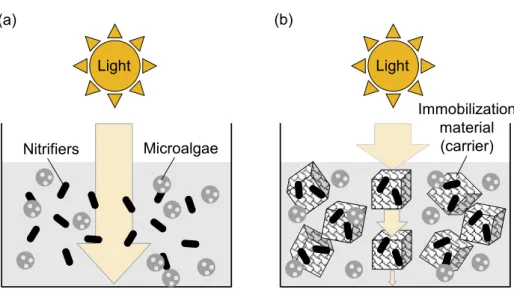
ションディッチ(OD)法(Rittmann & Langeland 1985) の好気性汚泥等が挙げられる。この微細藻類—硝化 関連バクテリア共存系においては、機械的な曝気の代 わりに、微細藻類の光合成による酸素供給により硝化 反応が進行し、曝気動力が大幅に削減できる。また、 光合成に伴う微細藻類による部分的な栄養塩除去が進 み、脱窒素反応時の窒素負荷を軽減できることから、 有機炭素剤の削減も期待できる(Fig. 1b)。 ここで、従来の微細藻類—バクテリア共存系と微細 藻類—硝化関連バクテリア共存系におけるアンモニア 耐性の違いについて述べたい。従来の共存系では、従 属栄養性バクテリアが主要なバクテリア構成員を占める ことが多く、廃水中の有機物の無機化と炭素分の除去 が得意とされていた。一方で、有機物濃度が低く、無
6 秋月ほか,光合成能を有するプランクトンによる廃水処理技術の動向
Fig. 1. Conventional nitrification-denitrification processes (a) and consortium of microalgae and nitrifying bacteria (b) for ammonia-containing wastewater treatment.
機化されたアンモニアが高濃度に含有される廃水を対 象とした場合、しばしば処理が破綻することが報告さ れている(Collos & Harrison 2014, Gutierrez et al. 2016, Xia & Murphy 2016)。これは、Anthonisen et al. (1976) による以下の式(1)で表される遊離アンモニア(NH3)濃 度が一定レベルに達すると、葉緑体における光リン酸 化反応の脱共役阻害が生じ(Crofts 1966)、微細藻類 の活性が低下するためである。 (1) 光合成が進むと、重炭酸イオン(HCO3-)の減少に伴 い pH が上昇し、NH3濃度が増加することで、結果と して微細藻類の活性が低下し共存系の崩壊に繋がる。 従属栄養性バクテリアの代わりに硝化関連バクテリア を利用することで、アンモニウムイオンが硝化反応を経 て硝酸(NO3-)に酸化される。さらに硝化反応ではプ ロトンが生成するため pH が減少する。そのため、微 細藻類—硝化関連バクテリア共存系では、例え廃水 中のアンモニア濃度が高い場合でも、共存系内で NH3 濃度が増加せず、安定した廃水処理が見込める。 4. ケーススタディー(1): 微細藻類—硝化関連 バクテリア共存系によるメタン発酵消化液処理 メタン発酵は、下水処理過程で発生する余剰汚泥、 家畜糞尿、生ごみ、醸造廃水等の多様な高濃度有機 性廃棄物と廃水からバイオガスを回収できる技術とし て成熟し、既に先進国・開発途上国を問わず、各地 で導入が進められている(Pike Research 2012, Lora Grando et al. 2017)。しかし、発酵槽から排出される 消化液中には、栄養塩類(特にアンモニア)が高濃度 に残存するため、別途、硝化—脱窒素法等による後 段処理を施す必要がある。著者らはこれまで、消化液 を対象とした微細藻類—硝化関連バクテリア共存系の 有用性評価に関する研究を進めてきた(Akizuki et al.
2019, Akizuki et al. 2020a, Akizuki et al. 2021)。既存 の微細藻類—硝化関連バクテリア共存系の研究では、 温度・pH・光照射強度といった環境要因を制御した実 験室内での研究例が大部分を占めている(Karya et al. 2013, Vargas et al. 2016, Rada-Ariza et al. 2017)。しか し、実際の廃水処理は屋外環境下で行うことが想定さ れ、これらの環境要因は季節と時間帯によって大きく 変動する。本手法の確立には、屋外環境下で共存系 がどのように機能するのかについて知見の集積が必要 である。そのため、著者らは屋外環境下における共存 系の消化液処理性能を評価し、課題点の抽出と改善 策の検討を行った。ここでは、これまでに得られた主 要な研究成果について紹介する。 2016 年と 2017 年の夏に、メキシコ・グアナファト大 学工学部の研究施設において、微細藻類—硝化関連 バクテリア共存系によるメタン発酵消化液処理実験を 実施した。消化液には、事前に孔径 0.45 µm のフィル ターでろ過後、純水で希釈したものを用いた。実験の 播種試料として混合藻類(Chlorella sp., Scenedesmus sp. および珪藻)とオキシデーションディッチ法の好気性 汚泥を用い、0. 5 L のガラス製三角フラスコを用いた回 分処理を実施した。温度 25 ± 2 oC と光照射強度 140 µmol photons m-2 s-1に制御した実験室内と屋外環境 下での処理性能を比較した。その結果、実験室内で は 7 割を超える高いアンモニア除去率が得られ、NO3 -の生成が確認された。一方屋外環境下ではアンモニ アが高濃度で残存し、NO3-の生成もほとんど見られな かった(Akizuki et al. 2019)。これは、硝化関連バク テリアが光照射に脆弱であり、太陽光照射下で活性 が著しく低下したことが主要な原因と考えらえる。例え ば、Merbt et al. (2012)は、硝化関連バクテリアである
Nitrosomonas europaea と Nitrosospira multiformis の
活性が、500 µmol photons m-2 s-1の光照射強度下でほ とんど 100% 阻害を受けたことを報告している。メキシ コのように太陽光が豊富に降り注ぐ地域では、日中の 光照射強度は高く、夏場では 2000 µmol photons m-2 s-1 を越える(Fig. 2)。そのため、屋外環境下で安定し 0 500 1000 1500 2000 2500 24 28 32 36 40 44 48 Li gh t i nt en si ty (μ m ol pho to ns m -2s -1) 0 4 8 12 16 20 24 Time (hour)
Fig. 2. Diurnal variation in light intensity (photo-synthetically active radiation:PAR) at laboratory of Division of Engineering, University of Guanajuato (August, 2017). て硝化反応を進行させるためには、硝化菌への光阻害 を軽減できる何らかの手法を検討する必要がある。 著者らは、硝化関連バクテリアへの光阻害を緩和さ せるために、微生物固定化担体が利用できるのではな いかと考えた(秋月ほか 2020)。微生物固定化担体は、 一般的に水に近い比重の材質で空隙構造を取り、微生 物がその表面・内部に高密度で付着することで高い廃 水処理能力を示す。例えば人間であれば、日差しが強 い場合は、カーテンを閉めたり、木陰に隠れたり、家 の中にいることで直射日光を避けることができる。バク テリアの場合は、担体が言わばこのような木陰・住処 のような役割を持つと期待した(Fig. 3)。そこで、直径 10 mm 程度のポリウレタン製スポンジを担体として用 い、0 から1600 µmol photons m-2 s-1の異なる光照射強 度条件下で、回分実験による硝化活性評価を行った。 その結果、通常の分散状硝化関連バクテリアを用い た系列では光照射強度の増加と共に硝化活性が著しく 低下した一方で、担体を利用した系列では、1600 µmol photons m-2 s-1の条件でも暗所と同程度の活性を維持 した。 次に、微細藻類と硝化関連バクテリアを固定化した 担体を有効容積 35 L(深さ10 cm)のパドル撹拌型培 養槽に投入し、メタン発酵消化液の連続処理を実験 室内と屋外環境下で実施した(Akizuki et al. 2021)。
8 秋月ほか,光合成能を有するプランクトンによる廃水処理技術の動向
Fig. 3. Light stress on nitrification process (a) and mitigation of light stress by immobilization materials (b). メタン発酵消化液には、脱水後の上澄みを純水で希 釈したものを用いた。実験室内での入射光照射強度 を 1000 µmol photons m-2 s-1とし、 明 暗 周 期 12 時 間、温度 25 ± 1 oC で運転を行った。水理学的滞留 時間(HRT)を 5 日とし、担体を投入した系列と、通 常の分散状硝化関連バクテリアを投入した系列での 処理性能を比較した。その結果、担体投入系列で は安定した硝化が見られ、最終的に投入窒素の約 4 割が NO3-へと変換された。一方で、分散状系列で は、硝化反応の中間体生成物である亜硝酸(NO2-) が高濃度に蓄積した。硝化反応は、NH4+を NO2-ま で酸化するアンモニア酸化細菌(Ammonia oxidizing bacteria: AOB)と NO2-を NO3-まで酸化する亜硝酸
酸化細菌(Nitrite oxidizing bacteria: NOB)の連続代 謝によって進む。NOB は AOB と比較して光照射によ る阻害を強く受けることが知られており(Diab & Shilo 1988)、分散状系列では NOB に対する光阻害が顕著 に表れたと考えられる。結果として、担体投入系列で は分散状系列と比較して約 10 倍の高い硝化活性を示 し、担体による光阻害の緩和効果が確認された。 担体投入により培養槽内の光照射強度がどの程度 減衰するかを明らかにするために、ランベルト・ベー ルの法則を元に、担体投入系列と分散状系列におけ る槽深度毎の光照射強度を算出する以下の式を設定 した。 (2) (3) ここで、Ixは培養槽の各深度における光強度(単
位 :µmol photons m-2 s-1)、I
0は入射光強度、Ncarrierは
培養槽の単位容積(cm3)あたりの理論的担体存在量、
Calgaeと Cnitrifiersはそれぞれ培養槽内の微細藻類と硝
化バクテリア濃度、αcarrier、αalgaeおよびαnitrifiersはそ
れぞれ担体、微細藻類および硝化バクテリアの光減 衰係数、depth は培養槽深度を示す。両系列の槽深 度毎の光照射強度を算出した結果、分散状系列では 槽底部でも 985 µmol photons m-2 s-1の光照射強度と なり、入射光強度がほとんど減衰せずに底まで到達 していた。一方で、担体投入系列では、槽底部の光 照射強度は 64 µmol photons m-2 s-1であり、担体が光 を遮る役目を果たしていたことが明らかとなった(Fig. 4)。このような光阻害の緩和効果は、担体だけに限 らず、硝化関連バクテリアのグラニュール化(Akizuki et al. 2020b)や、ブラックカーボンを添加した遮光ゲ ルによる固定化(Nishi et al. 2020)によっても得られる ことが明らかとなっている。 次に、屋外実験を 2019 年の夏場(7 月~ 9 月)に創
Fig. 4. Penetration of incident light in dispersed nitrifiers reactor (a) and microalgae-immobilized nitrifiers reactor (b).
価大学理工学部棟の一角で実施した。屋内実験と同 型の培養槽に担体を投入し、メタン発酵消化液の連 続処理を実施した。光照射強度が 1500 µmol photons m-2 s-1を越える快晴日が続いたが、実験期間後半には
安定した NO3-の蓄積が見られ、屋外環境下でも安定
した硝化の進行が確認された(Akizuki et al. 2020a)。 一方で、屋外環境下で半年~ 1 年以上の長期的に運転 した際のプロセス安定性や、温度・光照射強度等の環 境要因の変動と処理性能の関係性に関する知見は少な く、今後はこれらについての研究に取り組む必要があ る。 5. 紅色光合成バクテリアを 利用した廃水処理の研究動向 紅色光合成バクテリアは光合成細菌に含まれ、嫌気 または好気的環境下において、特に赤外光波長域の光 を照射することで有機性廃水中の炭素、窒素、リンを 同時に除去する機能を持つ。さらに、廃水処理過程で 生成するバイオマス中には、高濃度のタンパク質、炭 水化物、脂質や、微生物産生プラスチック成分(ポリヒ ドロキシアルカン酸エステル : PHA)、カロテノイド等の 有用物質を蓄積することも可能である(Capson-Tojo et al. 2020)。紅色光合成バクテリアを利用した廃水処理 に関する研究は、近年オーストラリア・クイーンズランド 大学 Hülsen らの研究が発端となり火が付き、これま でに都市下水、養鶏場廃水、酪農場廃水、製薬工場 廃水等の多様な廃水処理への有用性が報告されている (Hülsen et al. 2014, 2016, 2018, Lu et al. 2019)。
実は紅色光合成バクテリアを用いた廃水処理は、世 界に先駆けて 1960 ~ 70 年代にかけて日本で開発 が進められてきた技術であり(Kobayashi et al. 1966, Kobayashi & Tchan 1973)、1980 年 代 には、 国 内 で 10 か所近い実処理施設が稼働していた(嶋田・高市 2020)。しかし、当時主流であった活性汚泥法の経験 により培われた生物学的廃水処理技術の常識から運 転管理に関する誤解が生じ、紅色光合成バクテリアを 用いた廃水処理技術がその後広がりを見せることはな かった。嶋田・高市(2020)はその一つとして、高有機 物濃度廃水を活性汚泥法の経験に合わせて意図的に 希釈し低有機物濃度にして処理を続けることで、槽内 に紅色光合成バクテリアバイオマスが維持できなかっ た点を挙げている。1980 年代から現在に至るまで廃水 処理技術は急速に発展し、活性汚泥法以外の様々な 手法が社会に広く普及した。その過程で、廃水処理に 関与する多種多様なプランクトンの機能に対する知見と
10 秋月ほか,光合成能を有するプランクトンによる廃水処理技術の動向 理解が飛躍的に深まり、先のような誤解による失敗も 起き難くなったと考えられる。紅色光合成バクテリアは 光合成能を持つプランクトンとして、今後微細藻類と同 様に、廃水処理のメインストリームの一つになる可能性 を秘めている。 6. ケーススタディー(2): 紅色光合成バクテリアによる屠殺場廃水処理 人口増加に伴い食肉の需要は高まることは必然であ り1970 年代から現在にかけて、世界の食肉消費量は 約 3 倍に増加している(FAO 2017)。食肉需要の増加 は、屠殺場での屠畜解体作業に伴い発生する、血液 や残渣を含む廃水の発生量増加に直結する。屠殺場 廃水は、有機物に加えて、窒素やリン等の栄養塩類、 ウイルス、病原菌を含むため、適正な処理を施す必要 がある。しかし、中南米・東南アジア・アフリカ等の 地域では、未処理か粗放的な処理に留まる事例が多 い。例えばメキシコでは、年間 800 万トンの屠殺場廃 水が発生しているが、その約 7 割は未処理で下水管や 河川に直接放流されている(Hernández et al. 2018)。紅 色光合成バクテリアは、屠殺場廃水のような栄養塩類 を高濃度に含む有機性廃水の処理に適すると報告され ている(Hülsen et al. 2016)。しかし、これまで紅色光 合成バクテリアを利用した屠殺場廃水処理に関する研 究報告例は無かった。 そこで著者らは、グアナファト大学工学部の実験室 で事前に培養した紅色光合成バクテリアを播種試料と して、グアナファト州の食肉処理施設の屠殺場廃水処 理を行った。温度 25 ± 2 oC で、培養槽側面から波 長 850 nm の赤外光を照射した系列と暗所系列の 2 系 列を比較する回分処理を実施した。その結果、赤外 光照射系列では、処理開始から 5 日程度で化学的酸 素要求量(Chemical oxygen demand: COD)、リン酸 (PO43-)、溶存態窒素が効果的に除去され、最終的 な除去率は COD と PO43-で 9 割、溶存態窒素で 7 割 を超える結果が得られた。暗所系列では、8 割前後の COD と PO43-除去は見られたものの、除去速度は赤外 光照射系列と比較して約 1/5 であり、赤外光照射によ り紅色光合成バクテリアの廃水処理性能が飛躍的に向 上することが示された(未発表)。暗所系列でも一定の COD と PO43-除去が得られた理由として、紅色光合成 バクテリアの多様な代謝経路が挙げられる。実験で用 いた紅色光合成バクテリアは、元々実廃水(ビール工 場廃水のメタン発酵消化液)に太陽光を照射し長期に 渡り順養したものであり、複数の紅色光合成バクテリ ア種が混在していたと考えられる。紅色光合成バクテ リアには光合成従属栄養性以外にも、光合成独立栄 養性、化学合成従属栄養性等の異なる代謝を取る種 が存在し、暗所系列では、播種試料に内在していた化 学合成従属栄養性の紅色光合成バクテリア種が機能し たと推察された。 実処理を屋外環境下で実施する場合、夜間の光照 射の有無は、エネルギー消費量の増減に関わる重要な 要素である。本実験により、暗所下においても一定の 割合で屠殺場廃水中の汚濁物質処理は進むが、その 処理性能は光照射下と比較して低下することが明らか となった。屋外環境下において自然光のみで廃水処理 を行う場合は、夜間の処理水質が劣化する可能性があ る。そのため夜間は、(1)処理槽への廃水供給速度を 低下する、(2)赤外光照射装置を用いて別途光エネル ギーを供給する、等の対策が必要と考えられる。 7. サンベルト地域での導入を目指して 光合成能を有するプランクトンを利用した廃水処理 は、従来の機械的な曝気を伴う好気性バクテリアを主 流とした廃水処理と比較し、省エネルギーでかつ有用 物質を生産可能な技術として今後さらに重要性が高ま ると期待される。このような光エネルギーを利用した技 術は、特に地球上の北緯 35 度から南緯 35 度の範囲 に位置する比較的温暖で太陽光が豊富な “ サンベルト 地域 ” での利用に最も適している。サンベルト地域には、 廃水処理施設の普及率が低い東南アジア、中南米、ア
35oN
0oN
35 oS
Fig. 5. Sewage treatment coverage levels in dif-ferent cities around the world (Year: 2014). White symbols: high coverage city (>85%); black sym-bols: low coverage city (<70%). Data source: UESI (2021). フリカ等の開発途上国が集約している(Fig. 5)。本技 術に関する研究を進め、知見とノウハウを蓄積すること で、経済的基盤の有無に関わらず導入可能な次世代型 廃水処理技術として成熟する可能性がある。 今後は、これまでモデル地域として研究を進めてき たメキシコに加え、現在、本学が科学技術振興機構 (JST)および国際協力機構(JICA)による地球規模環 境課題対応国際科学技術協力プログラム(SATREPS) の支援を受けて国際共同研究を進めているエチオピア をモデル地域の一つとして選定し、本技術に関する共 同研究開発に積極的に取り組みたいと考えている。 謝辞 本研究の一部は、日本学術振興会の科学研究費助 成事業(若手研究(B) 17K12851)および矢崎科学技 術振興記念財団の国際交流援助(2017 年度 共同研究 (前期))の支援により実施された。研究で用いたバクテ リア試料は、横浜市北部汚泥資源化センターおよびグ アナファト市下水処理場から提供を受けたものであり、 関係者の皆さまに厚く御礼申し上げる。 引用文献
Akizuki S, Cuevas-Rodríguez G, Toda T (2019) Mi-croalgal-nitrifying bacterial consortium for
ener-gy-saving ammonia removal from anaerobic digestate of slaughterhouse wastewater. J Water Process Eng 31: 100753.
Akizuki S, Cuevas-Rodríguez G, Toda T (2020a) Anaer-obic digestion effluent treatment using microalgae and nitrifiers in an outdoor raceway pond with fluidized carriers. Water Sci Technol 82(6): 1081–1091.
Akizuki S, Natori N, Cuevas-Rodríguez G, Toda T (2020b) Application of nitrifying granular sludge for stable ammonium oxidation under intensive light. Biochem Eng J 160: 107631.
Akizuki S, Cuevas-Rodríguez G, Toda T (2021) Nitri-fication of anaerobic digestate using a consortium of microalgae and nitrifiers in an open photobioreactor with moving bed carriers. Chemosphere 263: 127948. 秋月真一・西健斗・戸田龍樹・井田旬一 (2020) 硝化菌
の光阻害緩和を目的とした固定化技術. ケミカルエン ジニヤリング 65(1): 19–24.
All-Gas Project (2019) Project website information. http://www.all-gas.eu/en/ (2021年 4月16日アクセス) Anthonisen et al. (1976) Inhibition of nitrification by ammonia and nitrous acid. J Water Pollut Control Fed 57: 835–852.
Arden E, Lockett WT (1914) Experiments in the oxida-tion of sewage without the aid of filters. J Soc Chem Ind 33: 523–539.
Capson-Tojo G, Batstone DJ, Grassino M, Vlaeminck SE, Puyol D, Verstraete W, Kleerebezem R, Oehmen A, Ghimire A, Pikaar I et al. (2020) Purple phototro-phic bacteria for resource recovery: Challenges and opportunities. Biotechnol Adv 43: 1075657.
Collos Y, Harrison PJ (2014) Acclimation and toxicity of high ammonium concentrations to unicellular algae. Mar Pollut Bull 80: 8–23.
Crofts AR (1966) Uptake of ammonium ion by chloro-plasts, and the mechanism of amine uncoupling. Bio-chem Biophys Res Commun 24: 127–134.
Diab S, Shilo M (1988) Effect of light on the activity and survival of Nitrosomonas sp. and Nitrobacter sp. isolates from flsh ponds. Bamidgeh 40: 50–56.
Food and Agricultural Organization of the United Na-tions (FAO) (2017) The future of food and agriculture: Trends and challenges. FAO, Rome, Italy, 180 pp.
12 秋月ほか,光合成能を有するプランクトンによる廃水処理技術の動向
Gonçalves AL, Pires JCM, Simões M (2017) A review on the use of microalgal consortia for wastewater treatment. Algal Res 24: 403–415.
Gutierrez J, Kwan TA, Zimmerman JB, Peccia J (2016) Ammonia inhibition in oleaginous microalgae. Algal Res 19: 123–127.
Hernández SC, Jiménez LD, Bueno García JA (2018) Potential of energy production from slaughterhouse wastewater. Interciencia 43: 558–565.
Hülsen T, Barry EM, Lu Y, Puyol D, Keller J, Batstone DJ (2016) Domestic wastewater treatment with purple phototrophic bacteria using a novel continuous photo anaerobic membrane bioreactor. Water Res 100: 486– 495.
Hülsen T, Batstone DJ, Keller J (2014) Phototrophic bac-teria for nutrient recovery from domestic wastewater. Water Res 50: 18–26.
Hülsen T, Hsieh K, Tait S, Barry EM, Puyol D, Batstone DJ (2018) White and infrared light continuous pho-tobioreactors for resourcerecovery from poultry pro-cessing wastewatere – A comparison. Water Res 144: 665–676.
Karya NGAI, van der Steen NP, Lens PNL (2013) Pho-to-oxygenation to support nitrification in an algal-bac-terial consortium treating artificial wastewater. Biore-sour Technol 134: 244–250.
Kobayashi M, Matsumoto H, Okuda A (1966) Distribu-tion and significance of photosynthetic bacteria. J Sci Soil Manure 37: 447–450.
Kobayashi M, Tchan YT (1973) Treatment of industrial waste solutions and production of useful by-products using a photosynthetic bacterial method. Water Res 7: 1219–1224.
Kwon G, Kim H, Song C, Jahng D (2019) Co-culture of microalgae and enriched nitrifying bacteria for ener-gy-efficient nitrification. Biochem Eng J 152: 107385. Liao Z, Chen Z, Wu Y, Xu A, Liu J, Hu H-Y (2021)
Identification of development potentials and routes of wastewater treatment and reuse for Asian countries by key influential factors and prediction models. Resour Conserv Recy 168: 105259.
Lofano G, Brown J (2010) Wastewater management through the ages: A history of mankind. Sci Total
En-viron 408: 5254–5264.
Lora Grando R, de Souza Antune AM, de Fonseca FV, Sánchez A, Barrena R, Font X (2017) Technology overview of biogas production in anaerobic digestion plants: A European evaluation of research and devel-opment. Renew. Sustain. Energy Rev 80: 44–53. Lu H, Zhang G, Zheng Z, Meng F, Du T, He S (2019)
Bio-conversion of photosynthetic bacteria from non-toxic wastewater to realize wastewater treatment and bioresource recovery: A review. Bioresour Tech-nol 278: 383–399.
Mehrabadi A, Craggs R, Farid MM (2015) Wastewater treatment high rate algal ponds (WWT HRAP) for low-cost biofuel production. Bioresour Technol 184: 202–214.
Merbt SN, Stahl DA, Casamayor EO, Martí E, Nicol GW, Prosser JI (2012) Differential photoinhibition of bacterial and archaeal ammonia oxidation. FEMS Mi-crobiol Lett 327: 41–46.
Mishima K, Nishimura T, Goi M, Katsukura N (1996) Characteristics of nitrification and denitrification of the media-anaerobic-anoxic-oxic process. Water Sci Technol 34: 137–143.
Muñoz R, Guieysse B (2006) Algal-bacterial processes for the treatment of hazardous contaminants: A re-view. Water Res 40: 2799–2815.
Nishi K, Akizuki S, Toda T, Matsuyama T, Ida J (2020) Development of light-shielding hydrogel for nitrifying bacteria to prevent photoinhibition under strong light irradiation. Process Biochem 94: 359–364.
Oswald W, Gotass H (1957) Photosynthesis in sewage treatment. Trans Am Soc Civ Eng 122: 73–105. Pike research (2012) Methane recovery and utilization
in landfills and anaerobic digesters: Municipal solid waste, agricultural, industrial, and wastewater market report on analysis and forecasts. Pike Research, Boul-der, USA, 87 pp.
Rada-Ariza AM, Lopez-Vazquez CM, van der Steen NP, Lens PNL (2017) Nitrification by microalgal-bacterial consortia for ammonium removal in flat panel se-quencing batch photo-bioreactors. Bioresour Technol 245: 81–89.
de-nitrification with de-nitrification in single-channel oxida-tion ditches. J Water Pollut Control Fed 57: 300–308. Rosso D, Stenstrom M, Larson L (2008) Aeration of
large-scale municipal wastewater treatment plants: state of the art. Water Sci Technol 57: 973–978. Sepehri A, Sarrafzadeh M-H, Avateffazeli M (2020)
Interaction between Chlorella vulgaris and nitri-fying-enriched activated sludge in the treatment of wastewater with low C/N ratio. J Clean Prod 247: 119164.
嶋田敬三・高市真一 (2020) 光合成細菌の利用 . “ 光合 成細菌—酸素を出さない光合成—”. 裳華房 , 東京 , pp. 261–272.
Udaiyappan AFM, Hasan HA, Takriff MS, Abdullah SRS (2017) A review of the potentials, challenges and
current status of microalgae biomass applications in industrial wastewater treatment. J Water Process Eng 184: 202–214.
Urban Environment and Social Inclusion (UESI) (2019) Water and equity: results of pilot cities. https://data-drivenlab.org/urban/issue-profiles/water/ (2021 年 4 月17 日アクセス)
Vargas G, Donoso-Bravo A, Vergara C, Ruiz-Filippi G (2016) Assessment of microalgae and nitrifiers activ-ity in a consortium in a continuous operation and the effect of oxygen depletion. Electron J Biotechnol 23: 63–68.
Xia A, Murphy JD (2016) Microalgal cultivation in treating liquid digestate from biogas systems. Trends Biotechnol 23: 265–275.
Bull. Plankton Eco-Eng. Res. 1: 14-21, 2021
プランクトン工学研究
©Institute of Plankton Eco-Engineering
Preparation and characterization of poly(vinyl alcohol)/
sodium alginate/TEMPO-oxidized cellulose nanofiber
hydrogel for dye removal
Wing Shan Chan
1), Yuichi Shibata
1), Kento Nishi
1), Tatsushi Matsuyama
2), Junichi Ida
2)*
1) Graduate School of Science and Engineering, Soka University, 1-236, Tangi-cho, Hachioji, Tokyo, 192-8577, Japan 2) Faculty of Science and Engineering, Soka University, 1-236, Tangi-cho, Hachioji, Tokyo, 192-8577, Japan * Corresponding author: [email protected]
Received May 4 2021, Accepted May 7 2021
Abstract The composite hydrogel of poly(vinyl alcohol) (PVA)/sodium alginate
(SA)/TEM-PO-oxidized cellulose nanofiber (CNF) was prepared and employed as an effective adsorbent
for dye removal. The effect of the weight ratio of incorporated SA and CNF components on the
mechanical and dye removal properties of the hydrogel was examined in detail. While the PVA
concentration and the SA + CNF concentration were maintained as constant (7.5 and 1.0 wt%,
respectively), the weight ratios of SA:CNF were changed from 10:0 to 7:3. Cross-linking of PVA,
SA, and CNF were carried out by using boric acid/borax and calcium chloride. The mechanical
properties of prepared hydrogels were investigated by a compressive stress test and a durability
test under severe agitation in a solution.
The PVA/SA hydrogel with no CNF addition (the 10:0 hydrogel) showed the highest
compres-sive strength, and the elastic modulus is approximately 40 times greater than the highest reported
value of the conventional PVA hydrogel cross-linked by glutaraldehyde (GA). The hydrogel
pre-pared with SA:CNF ratio of 9:1 (the 9:1 hydrogel) showed the second-highest elastic modulus. In
terms of durability, the 9:1 hydrogel was the highest. While the breakage ratio of the 9:1 hydrogel
under very severe agitation condition of 2750 rpm was essentially negligible, it was reported that
the conventional PVA hydrogel crosslinked with sodium sulfate was completely broken. Even
un-der 3000 rpm, only 12% of the beads were broken for the 9:1 hydrogel.
Dye removal experiment was carried out by using methylene blue (MB) as a model dye. The
result shows that the highest MB adsorption capacity of 243.9 mg g
-1was obtained for the 9:1
hy-drogel. The value was 1.4 times higher than that of the highest reported value for the
convention-al PVA-based adsorbent. With superior mechanicconvention-al and dye adsorption properties, the developed
PVA/SA/CNF hydrogel can be considered as a potential alternative for dye removal.
Keywords:
cellulose nanofibers, composite hydrogel, dye removal, methylene blue, poly(vinyl
al-cohol)
1. Introduction
Synthetic dyes are generally used in various indus-tries due to their easy application and inexpensive prop-erties. However, dye effluents have become a growing concern due to their hazards to the environment and living things. Approximately 100 tones of dye effluent per year are discharged from the textile industry alone (Katheresan et al. 2018). Ingestion of dyes can cause serious health problems. For example, since cationic dyes (e.g. methylene blue) can interact with negatively charged cell membrane surfaces, these can enter cells easily, leading to long-lasting influences on the human organism (Li 2010). The adsorption dye removal method offers various advantages, such as the ability to treat a wide variety of dyes, easy operation, no formation of toxic by-products and secondary wastes (Katheresan et al. 2018). Therefore, it is one of the preferred techniques of dye removal.
Poly(vinyl alcohol) (PVA) hydrogels have been stud-ied as dye adsorbents by many researchers due to their low cost, non-toxic, high chemical stability, and porous characteristics (Sinha & Chakma 2019). However, their poor mechanical strength and tendency to agglomerate are the main drawbacks in dye removal applications (Wu & Wisecarver 1991). Various modification methodol-ogies have been tried to improve the physicochemical characteristics of PVA hydrogels. Dinh & Bach (2014) tried to change the surface properties of PVA hydrogel by incorporating sodium alginate (SA) and successful-ly suppressed the agglomeration of gel particles (Dinh & Bach 2014). To improve the mechanical strength of PVA hydrogel, nanocellulose is often used to synthesize composite hydrogels. Cellulose nanofiber (CNF) is a nanocellulose obtained from a plant cell wall in a form of filamentous fragments. It contains both amorphous and crystalline domains with dimensions of 5-30 nm
in width and an aspect ratio of over 50 (Nascimento et al. 2018). Moreover, oxidation of CNF using 2,2,6,6-te-tramethylpiperidine-1-oxy (TEMPO) radical converts C6 primary hydroxyl groups into carboxylate groups, which introduces negative charges to the cellulose sur-face (Saito & Isogai 2006). Due to its high stiffness, high aspect ratio, and surface carboxylate groups, TEM-PO-oxidized CNF can be a good candidate to be used as a reinforcing agent to improve the weak mechanical properties of the PVA hydrogel. Zhang et al. (2018) have prepared SA/CNF hydrogel using calcium chloride as a crosslinking agent and improved the mechanical stabil-ity of the hydrogel. Han et al. (2013) synthesized borax cross-linked PVA hydrogels with CNF and examined the effects of particle size, aspect ratio, crystal structure, and crystallinity of CNFs on the compression property of the hydrogels. The results showed that the compres-sive strength of CNF reinforced hydrogel was 21 times greater than that of the pure PVA hydrogel (Han et al. 2013). However, synthesis and application for dye re-moval of the composite hydrogel consisting of PVA, SA, and TEMPO-oxidized CNF have not been reported yet.
In this study, by incorporating both SA and TEM-PO-oxidized CNF, the PVA/SA/CNF hydrogels were prepared and the effects of weight ratios of SA and CNF on the mechanical properties and dye adsorption per-formance were examined. The mechanical properties of prepared hydrogels were investigated by a compressive stress test and a durability test. Also, a dye adsorption experiment was performed by using methylene blue (MB) as a model dye.
2. Materials and Methods 2.1 Materials
Sodium alginate (SA) powder, boric acid, and calcium chloride were purchased from FUJIFILM Wako Pure
16 Chan et al., PVA/SA/CNF hydrogel for dye removal
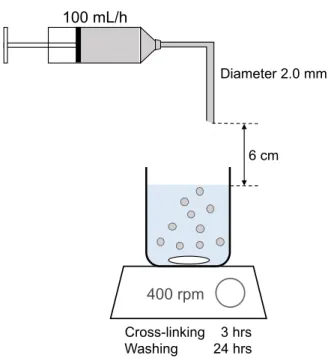
Fig. 1. Experimental set up for the preparation of PVA/SA/CNF hydrogels.
Chemical Corporation. Poly(vinyl alcohol) (PVA) (Kur-aray, Japan), TEMPO-oxidized CNF dispersion (Nippon Paper Group, Japan), and borax (KENEI Pharmaceutical Co., Ltd.) were also used in the experiments.
2.2 Preparation of PVA/SA/CNF Hydrogel
Four different 50 mL of polymers solutions con-taining PVA, SA, and CNF were prepared by chang-ing each component concentration as shown in Table 1. In this study, while the PVA concentration and the (SA + CNF) concentration were maintained as constant (7.5 and 1.0 wt%, respectively), the weight ratio of SA:CNF was changed from 10:0 to 7:3. Dif-ferent amounts of SA powder (0.5, 0.45, 0.4, and 0.35 g) were dissolved in deionized water. After 0.75 g of PVA was added into the solution, the mixture was transferred to an autoclave (TOMY, SX-500). It was heated at 121°C for 20 min, followed by stirring at 80°C in a water bath for 50 min. Different amounts of 1 wt% CNF dispersion (0, 5, 10, and 15 g) were
Table 1. Compositions of PVA/SA/CNF hydrogels used in this study.
added into the solution and stirred at 80°C for 10 min. Then, the suspension was mixed using a ho-mogenizer (Ika T 25, Germany) for 3 min to ob-tain a homogeneous suspension. Air bubbles that remained in the suspension were removed using a centrifuge (HITACHI SCT 5B, Japan) at 3000 rpm for 10 min. By dripping the obtained PVA/SA/ CNF mixture into 500 mL of cross-linking agent solution containing 5 wt% boric acid/borax and 3 wt% calcium chloride at a dripping rate of 100 mL h-1, hydrogel beads were obtained. The beads were
washed with 400 mL of deionized water for 24 h with stirring and stored in 3 wt% calcium chlo-ride solution. The prepared PVA/SA/CNF hydrogel samples are referred to as “SA weight ratio”:“CNF weight ratio”. For example, the sample prepared with the weight ratio of SA:CNF of 9:1 is referred to as the 9:1 hydrogel.
2.3 Mechanical Strength 2.3.1 Elastic modulus
The mechanical property of hydrogels was ana-lyzed with a tabletop testing machine (A&D STB-1225S, Japan) using a 50 N load cell. The compres-sive strength tests were performed with a crosshead speed of 10 mm min-1. The elastic modulus was
strain range by using the following equation from the Hertz model:
(1)
where F is the compressive load (N), E is the elastic modulus (MPa), D is the diameter of the hydrogel bead, and ∆D is the displacement (mm). 5 specimens were tested for each sample and the average data was used.
2.3.2 Durability
The durability of the hydrogels was examined using a Tornade overhead stirring system (As One SM-101, Japan). 100 hydrogel beads were dispersed in 1.0 L of deionized water and stirred strongly at an agitating speed of 2250 to 3500 rpm for 5 min. Then, the number of hydrogel beads without any damage (unbroken hydrogel beads) was counted. The breakage ratio was calculated by the following equation:
(2)
where Na is the number of hydrogel beads added and Nu
is the number of unbroken hydrogel beads.
2.4 Dye Adsorption Experiment
Dye adsorption isotherms on the hydrogels were ex-amined by using MB as a model synthetic dye in batch processes. MB is a cationic dye widely used in textile industries.
Twenty hydrogel beads were added into 40 mL of MB solutions with a concentration range of 100 to 1000 ppm. The MB concentration at adsorption equilibrium was measured after 6 days. The data were analyzed by the Langmuir isotherm model to investigate the adsorp-tion mechanism.
3. Results 3.1 Elastic modulus
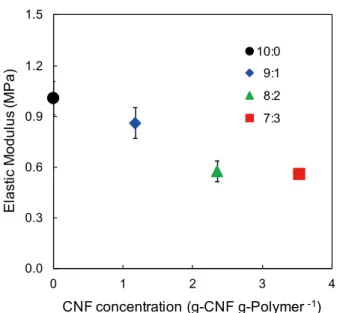
The elastic modulus of hydrogels determined based on the results of compressive stress tests was shown in Fig. 2. The compressive strength of hydro-gels was high in the order of 10:0 > 9:1 > 8:2 > 7:3. The 10:0 hydrogel shows the highest elastic modu-lus of 1.0 MPa, and the value is approximately 1.8 times larger than that of the 7:3 hydrogel, showing the lowest value. The results indicate that the PVA/ SA hydrogel with no CNF addition shows the great-est compressive strength, and the addition of CNF decreased the strength. It should be noted here that compared to the conventional PVA hydrogel cross-linked by glutaraldehyde (GA), the elastic modu-lus of the 10:0 hydrogel is approximately 40 times greater and even the lowest elastic modulus for the 7:2 hydrogel is approximately 22 times greater than that for the PVA hydrogel.
Fig. 2. Elastic modulus of the 7:3, 8:2, 9:1 and 10:0 hydrogels determined by a compressive stress test.
18 Chan et al., PVA/SA/CNF hydrogel for dye removal
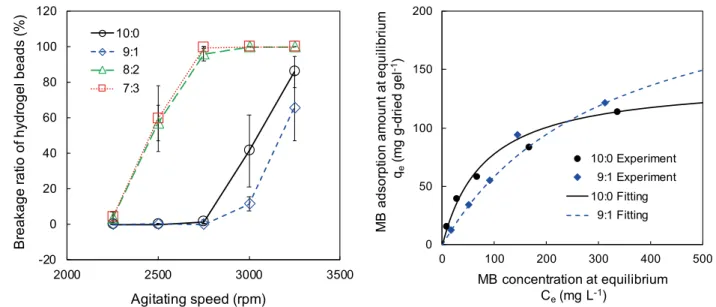
Fig. 3. Breakage ratio of hydrogel beads for the 7:3, 8:2, 9:1 and 10:0 hydrogels under severe agitation conditions of 2250-3250 rpm in a solution.
3.2 Durability
The breakage ratios of the hydrogels under severe agitation from 2250 to 3250 rpm in solution are shown in Fig. 3. According to the results at the maximum agi-tating speed of 3250 rpm, the durability of hydrogels is high in the order of 9:1 > 10:0 > 8:2 = 7:3. For the 8:2 and 7:3 hydrogels, all the hydrogel beads were broken after being agitated at 3000 rpm for 5 min. Under the same condition, approximately 42% of the beads were broken for the 10:0 hydrogel. On the other hand, only 12% of the beads were broken for the 9:1 hydrogel. The results indicate that to improve the durability of the PVA hydrogel for agitation, the addition of an appropriate ra-tio of SA and CNF is necessary and that is 9:1 under the condition used in this study.
For the later dye adsorption experiments, the 10:0 and the 9:1 hydrogels were selected since they exhibited high mechanical strength and durability.
3.3 Adsorption Isotherm Model
The adsorption isotherms of MB on the 10:0 and the
Fig. 4. Methylene blue adsorption isotherm on the 10:0 and the 9:1 hydrogel adsorbent at 25°C. 9:1 hydrogels were determined at 25°C and shown in Fig. 4. The results were analyzed by the Langmuir Eq. (3).
(3) where qe and Ce are the amount of MB adsorbed (mg g-1)
and the MB concentration (mg L-1) at equilibrium, q
m is
the saturated adsorption capacity for MB adsorption (mg g-1), K
L is Langmuir isotherm constant (L mg-1).
Parameters obtained by each adsorption isotherm equation are shown in Table 3. The coefficients of determination for the Langmuir equation, R2 were >
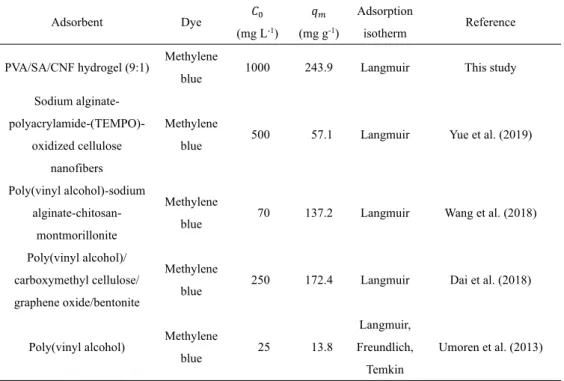
0.996 for both samples, indicating the MB adsorp-tion results are in good agreement with the Langmuir model. Therefore, the adsorption process can be de-scribed as monolayer adsorption on the surface of adsorbents with relatively homogeneous sites. The saturated adsorption capacity for the 9:1 hydrogel is 243.9 mg g-1, which is approximately 1.7 times higher
than that for the 10:0 hydrogel. However, since the MB concentration range used in this study is limited to less than 350 mg L-1 at equilibrium, the maximum adsorption