Effects of Predecisional Justification toward
Purchasing on Consumers’ Attribute Weights at
the Point of Purchase
journal or
publication title
International review of business
number
14
page range
1-23
year
2014-03
1. INTRODUCTION
The biggest difference between evaluation and actual purchase is that the former involves no pain while the latter involves paying a price. Before paying the price, the consumer must battle with the possibility that a better option may exist. The “better option” may be a different brand or product, a different way of satisfying the same need, or a decision to defer the purchase. Therefore, to purchase a product, the consumer first needs to justify the purchase. This cognitive process (by which consumers give themselves a push toward purchase) is what this research calls “predecisional justification toward purchasing.”
This study assumes that there are two types of purchase justification factors. One is related to the timing of the purchase. If there is a reason for purchasing a product at a given time, the consumer can justify the purchase. The other type of purchase justification factor is related to the object of the purchase. If the benefits to be derived from a product are enduring, the consumer would find it easy to psychologically justify its purchase.
At the point of purchase, the consumer’s desire to justify his or her purchase action is very strong (Mukhopadhyay and Johar 2009; Okada, 2005). Therefore, there is a stronger bias toward the type of factor that makes it easier to justify the purchase in a given scenario
on Consumers’ Attribute Weights at the Point of Purchase
Tsutomu SUNAGA*, Hiroaki ISHII**
Abstract
This article aims to demonstrate the effects of predecisional justification toward purchasing on consumers’ attribute weights at the point of purchase. The results of two studies show that consumers’ construal level at the point of purchase is not always low-level, and that high-level and low-level construals are not always compensatory. Moreover, the current research provides evidence to suggest that there may be separate mechanisms (dual process) through which psychological distance affects high-level and low-level construals. This study represents the first attempt to apply construal level theory (CLT) to explore the predecisional justification effect and includes implications for the planning and practice of in-store promotions.
* School of Business Administration, Kwansei Gakuin University ** Faculty of Service Innovation, Chiba University of Commerce
if the consumer is more aware of that factor. For instance, a consumer would hesitate to pay a high price for a product that will only last a brief time, because the purchase cannot be justified from the point of view of the second factor, i.e., deriving enduring benefits from the product. However, if the consumer is still driven by the impulse to purchase, he or she will try to justify the purchase action based on the first factor, by finding a reason to make the purchase “now” (i.e., “If I do not buy it now, I will not have another chance”) and focusing on this reason. Attention is thus diverted away from the fact that the benefit derived from the product will not endure. This is a kind of confirmation bias, or tendency to solely or primarily seek evidence that confirms the hypothesis under consideration (Dawson et al. 2002; Klayman and Ha 1987).
Predecisional justification toward purchasing relates to the consumer’s construal level. Previous studies on construal level theory (CLT) have neglected to explore purchase justification. The current study throws new light on CLT and reveals the hitherto unperceived relationship that exists between psychological distance and construal level.
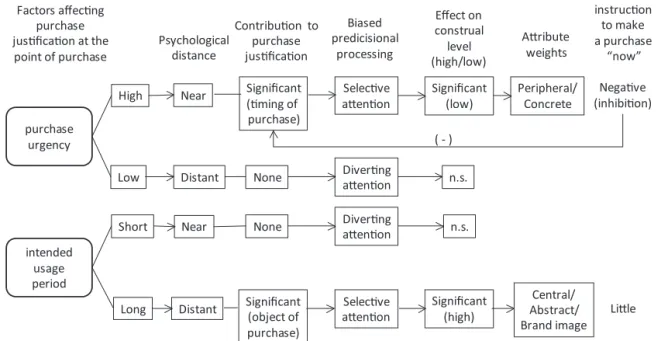
This paper begins with a theoretical framework for the effects of predecisional justification toward purchasing on consumers’ attribute weights (Figure 1 shows the conceptual framework of the research). It then reports the results of two studies that provide complementary evidence to support our hypotheses. The research explores multiple operationalizations of construal level (peripheral vs. central attribute and concrete vs.
abstract attribute/brand image) and explores divergent product categories (winter outerwear and suitcases) to increase the generalizability of the results. Study 1 demonstrates that purchase urgency and intended usage period have an asymmetric effect on consumers’ attribute weights. Study 2 shows that the impact of urgency on consumers’ attribute weights is attenuated as a result of subadditivity and a ceiling effect. Finally, contributions and implications of the findings are discussed.
2. THEORETICAL BACKGROUND
2.1 Construal Level Theory
A number of studies on CLT have examined how consumers evaluate or choose particular events with different psychological distances. CLT asserts that psychological distance systematically changes the level of abstraction at which events are construed (Trope and Liberman 2000, 2003). According to CLT, whereas people represent near future events in concrete terms, they represent distant future events more abstractly and, in turn, these representational differences lead to changes in attribute weights (Liberman and Trope 1998). In recent years, the application of CLT has been extended to a broader and multifaceted psychological distance, which includes dimensions of temporal distance, social distance, spatial distance, and the degree of outcome certainty.
CLT is of particular importance not only for understanding consumer behavior, but for developing marketing strategies as well. For example, in a study of the relationship between advertising and construal level, Martin et al. (2009) confirmed that temporally distant consumers focused more on primary attributes while consumers who are temporally close prioritized secondary attributes. In addition, according to Hong and Lee (2010), advertisements that portray conflicting emotions (e.g., pleased but sad) are positively evaluated by consumers with a high level of construal, but negatively evaluated by consumers with a low level of construal.
Alexander et al. (2008) speculated on how purchase intentions of really new products (RNPs) and incrementally new products (INPs) change. A comparison of the two groups showed that while RNPs provide benefits that increase a product’s desirability (which corresponds to high-level construals) they are lacking in feasibility (which corresponds to low-level construals) because their prices and constraints are higher. Despite increased purchase intention for RNPs (as a result of high-level construals and a focus on the product’s desirability), consumers are less likely to actually buy the products if the temporal distance to the decision is reduced. This phenomenon occurs because, with the passage of time, low-level construals are evoked and consumers place more significance on feasibility.
Several research papers focused on the relationship between CLT and in-store marketing. Roehm and Roehm (2011) indicated that concrete features, such as the face value of an
offer or its mode of presentation (as a monetary figure or as a percentage discount), are prominent for immediate incentives but not for future incentives. They also observed that abstract features, such as the “incentive’s goal congruity” or fit with personal values, are more likely to influence responses when an incentive has a long redemption time frame. In addition, Goodman and Malkoc (2012) suggested that construal level has a moderating role on assortment size preferences. They confirmed that psychological distance generally decreases preference for the large assortment whereas, if desirability/feasibility trade-off is salient, psychological distance increases preference for the large assortment.
Work by Mogilner et al. (2008) also demonstrated that construal differences operate as a function of temporal distance. They showed that, while participants who imagined making a purchase decision in the near future evaluated preventive messages for the avoidance of negative outcomes more favorably, participants who imagined a purchase decision in the distant future evaluated promotional messages for the attainment of positive outcomes more favorably. In research by Khan et al. (2011) that focused on context effects and choice behavior, high-(vs. low-) construals significantly increase the attraction effect and decrease the compromise and background-contrast effects. They argued that, when their construal levels are high, consumers do not care about trade-offs, nor do they make attribute-level comparisons. This finding suggests that low-level construals yield bottom-up processing, whereas high-level construals lead to top-down processing.
Urgency is likely to have a negative impact on the psychological distance perceived by the consumer while the intended usage period has a positive impact. Therefore, when applying the findings of previous CLT studies to predecisional justification toward purchasing factors (the focus of this study), the following kinds of relationships can essentially be assumed. There exists a positive relationship between urgency to buy a product and the influence of that product’s peripheral/concrete attributes, on the other hand, there exists a negative relationship between urgency and the influence of the central/abstract attributes. In contrast, an inverse relationship exists between the intended usage period of a product and that product’s attributes. The basic assumptions that support these relationships are well-established. However, current research assumes that “justification bias” intervenes in these assumptions. In this case, the consumer may be conscious of a given factor only when that factor contributes to predecisional justification toward purchasing.
2.2 Justification through Biased Predecision Processing
Decision-makers engage in biased predecision processing, as they restructure their mental representation of the decision environment prior to making their choice (Brownstein 2003). Action control theory (Kuhl 1984) argues that action control processes, which are used to bolster an intention, include selectively attending to or encoding information that supports
the intended action. This directly increases the expected value of the intended action, creates optimal conditions for maintaining that intention, and facilitates the conclusion of cognitive processing before a contradictory intention can be strengthened (Kuhl 1984). Beckmann and Kuhl (1984) suggested that, after identifying an alternative with a high expected value, decision-makers form an intention to choose that alternative and then engage in action control processes to bolster that intention. This process continues until the intentions are sufficiently strong to prompt the actual choosing of the favored alternative. In addition, Kunda (1990) suggested that people who are motivated to reach a particular conclusion may ask themselves directional questions that facilitate their access to cognitive elements that support the conclusion they seek.
In this way, because a consumer has a strong desire to justify his or her own action, he or she is likely to selectively focus on cognitive elements that justify the purchase when driven by the desire to purchase. In biased predecision processing, decision-makers not only think of reasons that favor their preferred alternative, but also neglect to think of reasons that favor other alternatives. By doing so, a decision-maker reinforces the justification for choosing the favored alternative (Brownstein 2003). Similarly, in the case of factors related to predecisional justification, a consumer is likely to focus on them in cases where they lead to justification, but ignore them in cases where they do not.
We assume that urgency and the intended usage period are closely associated with justification. Urgency provides a definite reason for acquiring a certain product at a given time, thereby increasing the justification for the purchase action. The intended usage period of a product plays a similar role in increasing the justification for the purchase action by allowing consumers to convince themselves that a product is worth its price due to the benefits that can be derived from it over the long term. Therefore, when urgency is high, consumers may focus on this factor, but when urgency is low, they may not be conscious of this factor. Similarly, if the intended usage period is long, consumers may focus on it, but if it is short, they may not be conscious of this factor.
Hence, it seems that an asymmetric influence is exerted on consumer construal levels. In other words, when the urgency of the purchase is high, it expects to have an influence in terms of facilitating a low construal level. However, when the urgency is low, it is simply that the influence exerted by high urgency (low construal level) is no longer exerted. No active influence from low urgency (such as facilitating a high construal level) may be exerted. Similarly, when the intended usage period is long, it expects to have an influence (in terms of facilitating a high construal level), but when the intended usage period is short, it is simply that the influence exerted by a long intended usage period (high construal level) is no longer exerted. No active influence from a short intended usage period, such as facilitating a low construal level, may be exerted.
In other words, there would be a positive correlation between urgency and a low construal level on the one hand, and the intended usage period and a high construal level on the other. However, contrary to conventional wisdom, there would be no negative correlation between urgency and a high construal level on the one hand, and the intended usage period and a low construal level on the other. Therefore, the following two hypotheses are derived:
H1: Purchase urgency positively affects the weight consumers attach to product attributes associated with low-level construals, but does not affect the weight consumers attach to product attributes associated with high-level construals.
H2: Intended usage period positively affects the weight consumers attach to product attributes associated with high-level construals, but does not affect the weight consumers attach to product attributes associated with low-level construals.
2.3 Multiple Psychological Distance Dimensions
Past studies on CLT suggest that consumers are prone to low-level construals immediately before making a purchase. However, even if the temporal distance to purchase is short, the psychological distance could be long in terms of the social dimension when the purchase is for someone else. Studies of the influence exerted by multiple dimensions of psychological distance are extremely important in terms of strengthening CLT as well as their potential application in marketing. However, this is a relatively unexplored area.
In one of the few examples of such studies, Zhao and Xie (2011) demonstrated that the recommendations of others are perceived to be more relevant when there is a match between social and temporal distance. Recommendations from close others have more influence over near-future preferences than those offered by strangers, and recommendations from strangers have more influence over distant-future preferences than recommendations from close acquaintances. These findings suggest that the external factor becomes more influential when its level of representation is congruent with the natural construal level of the decision-maker.
In contrast, Kim et al. (2008) revealed an interaction effect of temporal distance and social distance on product evaluations. Specifically, they found that when both dimensions are proximal, consumer evaluations are more influenced by low-level construals relative to when either or both dimensions are distal. When either or both dimensions are distal, consumer evaluations are more influenced by high-level construals. This suggests that when multiple psychological distance dimensions are considered, a consumer’s perception of psychological distance is not linearly related to other distance dimensions. The impact of distance induced by one dimension on the perceived distance of an event will diminish as the distance from the other dimensions increases. Therefore, in the case of a consumer who
perceives at least one dimension in which the psychological distance is great, there is not much impact on their construal level from any additional dimensions of the great psychological distance perceived.
In experiments conducted within studies on CLT, the point of purchase is often fixed by the researcher in advance. For instance, experiments where the purchase time is set to “now” are controlled to include only the “psychological nearness” of the participants. In such cases, as a result of the subadditivity indicated by Kim et al. (2008) or due to a ceiling effect, even if factors exist that could further reduce the psychological distance, their influence would be weakened. In other words, when a consumer’s perceived psychological distance to a purchase is short, additionally perceived factors that contribute to a further reduction of the psychological distance do not exert a linearly increasing influence but rather one with a diminishing margin. As a result, in such cases, the predecisional justification toward purchasing effect of urgency would probably not be felt. In contrast, the purchase justification effect of the intended usage period is likely to be confirmed (as there is no influence from subadditivity or a ceiling effect) in those designs where the purchase time has been set to “now.” Accordingly, the following hypothesis is derived:
H3: In cases where the purchase time is set to “now,” purchase urgency does not affect consumers’ attribute weights. On the other hand, even if the purchase time is set to “now,” the intended usage period positively affects the weight consumers attach to product attributes associated with high-level construals, but does not affect the weight consumers attach to product attributes associated with low-level construals.
3. STUDY 1
3.1 Method
To test H1 and H2, an online survey was conducted in January 2011. Study methods that involve asking consumers about purchases they have actually made, pose a variety of problems related to memory. However, it is preferable to study actual purchases (where the desire to justify a purchase is most needed) when measuring the effect of purchase justification on attribute weights. This explains why any effects of predecisional justification toward purchasing have so far not been confirmed by studies. Therefore, this survey method is adopted here.
The study used “winter outerwear you use most often” as the target product in the survey. The sample consisted of 1,032 consumers who purchased the target product (the ratio of males to females was 1:1). In the survey, participants were asked to indicate when the product was purchased, the product’s price, where they purchased it, and the name of the product’s manufacturer or brand. Subsequently, participants were asked 12 questions
about their reasons for purchasing the product. Four questions were included to gauge participants’ intentions regarding how long they would use the product. All items were presented on a five-point scale ranging from 1 (I do not think so) to 5 (I think so). Finally, respondents were asked how much weight they attached to 15 specific attributes when they purchased the product. These items were also presented on a five-point scale ranging from 1 (not at all) to 5 (extremely).
3.2 Results
Multiple statistical reduction techniques were performed to compile measures for purchase urgency, period of intended usage, and central/peripheral attributes. First, a principal component extraction factor analysis was conducted using Promax rotation. From the responses to the 12 questions related to purchase reasoning, this analysis identified common psychological factors among respondents at the point of purchase. Items that had a communality value of less than 0.4 and did not have a factor loading of more than 0.5 were eliminated. Three factors were extracted from the analysis and respectively named time pressure, boredom, and necessity (see Table 1A). However, boredom was considered to be fundamentally different from urgency, and was thus excluded from the analysis.
Following the initial factor analysis, a second factor analysis was performed on the Table 1. Factor analysis results
A. Reason for purchase Factor
Time Pressure Boredom Necessity Degree of Communality The products were available
only in limited quantities The products were available
only for a limited time I was afraid that it would sell
out if I didn’t buy now
I got tired of what I was wearing What I had been wearing was
out of fashion
I didn’t have it and I needed it right away
I couldn’t wear what I had been wearing anymore 0.91 0.88 0.62 -0.05 0.08 -0.03 0.01 -0.01 -0.05 0.08 0.82 0.74 -0.04 0.03 -0.03 0.00 0.02 -0.13 0.14 0.78 0.77 0.819 0.747 0.421 0.664 0.619 0.594 0.593 Variance explained (%)
Cumulative variance explained (%)
32.394 17.112 49.506
14.152 63.657
responses to the four questions related to intended usage period. Extraction methods, rotation methods, and numerical thresholds were identical to those used for the factor analysis of the purchase urgency items. This analysis extracted only one factor (see Table 1 B) which was treated as a uniform measure for intended usage period.
Finally, to extract common attribute types, a factor analysis was performed on the 15 items related to product attribute weights. The extraction method, rotation method, and numerical thresholds were identical to those employed for the purchase urgency and intended usage period factor analyses. Three factors were extracted from the data and were
B. Intended usage period Factor Intended Usage Period
Degree of Communality I intend to use it with care
I intend to use it for a long time
0.86 0.86 0.739 Variance explained (%) 73.921 C. Attribute weights Factor
Practicality Functionality Ancillary Degree of Communality It increases the options for
dressing fashionably
It’s easy to match it with the clothes I own
I can wear it in a wide range of occasions I look good in it Design Ventilation or insulation Material Sewing Comfortable Easy to store
Easy to wash (i.e., it can be washed at home, etc.)
0.85 0.84 0.70 0.66 0.54 -0.15 -0.02 0.08 0.17 0.01 0.01 -0.10 -0.03 -0.09 0.13 0.17 0.78 0.77 0.62 0.61 0.05 0.05 0.14 0.00 0.17 -0.18 -0.22 0.02 0.02 0.15 -0.05 0.85 0.74 0.687 0.687 0.489 0.549 0.417 0.527 0.583 0.483 0.496 0.732 0.553 Variance explained (%) Cumulative variance explained (%)
33.393 12.839 46.233
10.158 56.391
respectively named practicality, functionality, and ancillary attributes (see Table 1C).
Functionality can be associated with central attributes, and ancillary attributes can be associated with peripheral attributes. However, with regard to practicality, items closer to central attributes (“I look good in it” or “design”), as well as those closer to peripheral attributes (“It increases the options for dressing fashionably” or “It’s easy to match it with the clothes I own”) were mixed. Since the focus of this study was to find the relationship with construal levels, practicality was excluded from the analysis.
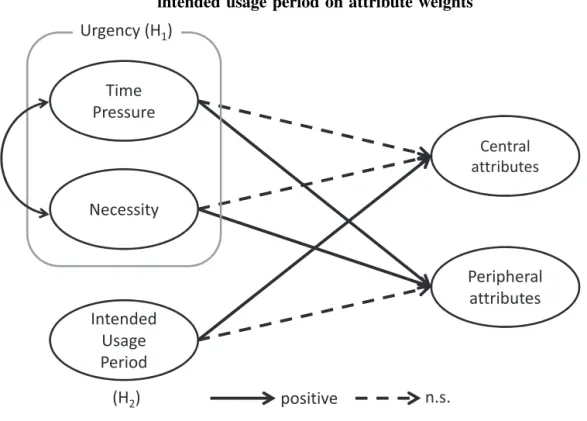
To test H1 and H2, structural equation modeling (SEM) was employed. Figure 2 shows the variables and paths in the model. Although Figure 2 neglects to include elements that correspond to the measurement equations, a confirmatory factor analysis was performed to reinforce the results of the explanatory factor analyses (Table 1). Paths between the latent variables represent the relationships described in H1 and H2.
Within the literature on SEM, several statistical standards have been proposed as indicative of a model’s fit to the data. These standards include a non-significant chi-square (χ2) test, comparative fit index (CFI), Tucker-Lewis Index (TLI), normed fit index (NFI)
scores equal to or greater than .95, and a root mean square error of approximation
Figure 2. Path model to assess the effect of urgency and intended usage period on attribute weights
(RMSEA) lower than .06 (see Hu and Bentler 1999; Iacobucci 2010).
Although the χ2 is significant (χ2 = 232.640, df = 58, p < .01), it is well established that
the test is sensitive to sample size (Gerbing and Anderson1985) such that an increase in sample size yields a corresponding increase in χ2. As a result, nearly all studies that employ
a large sample (and thus attain substantial statistical power) will yield a significant χ2 test
(Iacobucci 2010). Therefore, it would be useful to refer to the other indices to gauge the degree to which the data fits the model. The other standard fit indices indicate that the model shown in Figure 2 fits the data quite well (CFI = .964, TLI = .952, NFI = .953, RMSEA = .054).
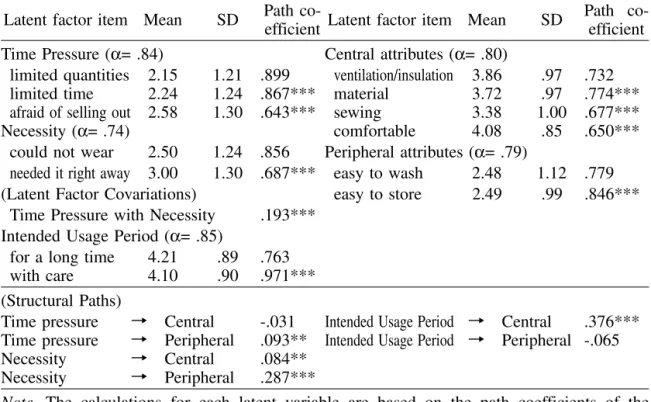
The model’s path coefficients are outlined in the lower half of Table 2. Time pressure (.093, p < .05) and necessity (.287, p < .01) both positively affect peripheral attributes. This indicates that the greater the degree to which a consumer feels pressure to purchase a product as a result of time or necessity, the more that consumer focuses on peripheral attributes of the product. Time pressure does not affect the degree to which consumers focus on central attributes. However, contrary to the hypothesis (H1), necessity (.084, p < .05)
Table 2. Means, standard deviations, and standardized path coefficients in Study 1 Latent factor item Mean SD Path
co-efficient Latent factor item Mean SD
Path co-efficient Time Pressure (α= .84) Central attributes (α= .80)
limited quantities limited time afraid of selling out Necessity (α= .74) 2.15 2.24 2.58 1.21 1.24 1.30 .899 .867*** .643*** ventilation/insulation material sewing comfortable 3.86 3.72 3.38 4.08 .97 .97 1.00 .85 .732 .774*** .677*** .650*** could not wear 2.50 1.24 .856 Peripheral attributes (α= .79)
needed it right away 3.00 1.30 .687*** easy to wash 2.48 1.12 .779 (Latent Factor Covariations) easy to store 2.49 .99 .846***
Time Pressure with Necessity .193*** Intended Usage Period (α= .85)
for a long time with care 4.21 4.10 .89 .90 .763 .971*** (Structural Paths) Time pressure Time pressure Necessity Necessity ! Central ! Peripheral ! Central ! Peripheral -.031 .093** .084** .287***
Intended Usage Period Intended Usage Period
! Central
! Peripheral .376***-.065
Note. The calculations for each latent variable are based on the path coefficients of the observable variable listed at the top, which are set to 1.
positively affected central attributes, indicating that greater necessity yields a focus on the central attributes of products. Given these results, H1 was only partially supported.
Intended usage period (.376, p < .01) was shown to positively affect focus on central attributes but not peripheral attributes. These results indicate that the longer consumers intend to use a product, the more they will focus on the central attributes of that product. In contrast, the amount of time consumers plan to use a product does not influence their focus on peripheral attributes. Thus, H2 was supported.
The model shown in Figure 2 was re-analyzed after including another model, for which the non-significant paths (i.e., paths from the two latent variables representing urgency to central attributes and from the intended usage period to peripheral attributes) were set to 0. This model was then compared with the original model.
As a result of SEM, the model, for which those path parameters expressing significant relationships (shown by the solid line in Figure 2) were freed while the non-significant path parameters(shown by dotted lines in Figure 2) were set to 0, fits the data in almost exactly the same way as the original model for which all path parameters were freed (CFI = .963, TLI = .953, NFI = .951, RMSEA = .054, χ2 = 241.122, df = 61, p < .01). For this new
model, all relations are significant, and both time pressure (.095, p < .05) and necessity (.286, p <. 01) have positive influences on peripheral attributes while intended usage period (.375, p <. 01) has positive influences on central attributes.
Comparing the goodness of fit of the original model with the model on which restrictions were placed, revealed that both models fit the data in almost the same manner, with the latter showing a better fit (Bayesian Information Criterion: BIC = 461.635 vs. 449.300; Consistent Akaike Information Criterion: CAIC = 494.635 vs. 479.300). In terms of parsimony that penalizes more complex models (those that have more parameters and use up more degrees of freedom), the new model can be accepted (Parsimonious Normed Fit Index: PNFI = .709 vs. .744; Parsimonious Comparative Fit Index: PCFI = .717 vs. .753). From this point of view, it can be said that both H1 and H2 are supported.
3.3 Discussion and the Need for Study 2
In Study 1, H1 was partially supported and H2 was fully supported. Through these analyses, the presence of an asymmetric relationship between psychological distance and consumers’ construal level was confirmed. These findings provide a new perspective on CLT and a deeper understanding of consumers’ construal levels at the point of purchase, than had previously been known. However, there were some limitations associated with the study.
First, the choice of the product of focus (i.e., winter outerwear) may have some problems. There exist significant differences among consumers in terms of their interests,
knowledge levels, and usage. In addition, winter outerwear is in greater demand in cold regions, relative to warm ones. Given these characteristics of the target product, the external validity of the findings in Study 1 is in doubt.
Second, because the classification scheme for psychological distance was based on the memories of the respondents, there is no guarantee that they truly felt urgency at the time of the purchase or that they intended to use the product for a long time. As indicated previously, to measure the effect of predecisional justification toward purchasing, it is most desirable to use actual purchases as the subjects of the experiment. However, as this study emphasizes, a consumer is strongly motivated to justify the purchase. There is the danger of consumers making up answers about their psychology at the time of purchase to match their actual actions. To allow for these issues, a second study employing a new survey was designed.
4. STUDY 2
4.1 Method
In Study 2, an online scenario survey was conducted in November 2011 to control for the independent variables and the potential association between product involvement and intended usage period as experienced in Study 1. The survey also tested H3. The product of focus in Study 2 was “a suitcase.” A total of 832 individuals (44.2% males, 55.8% females) over the age of 20, who (a) had purchased a suitcase at some point in the past and (b) resided in Japan, participated in the survey.
To test the main and interaction effects of urgency and intended usage period, four condition scenarios were developed on the basis of the 2 (urgency: high vs. low) × 2 (intended usage period: short vs. long) study design into which participants were equally divided (i.e., 208 participants per condition). The scenarios described an experience in which participants rent a suitcase to go on three trips. The number of trips for which the suitcase was to be used was held constant to mitigate the confounding influence of purchase involvement. All four scenarios were written using identical language, with the exception of the descriptions of how much time remained until the first, second, and third trips. For example, participants in the high urgency and short intended usage period condition were asked to read the following scenario:
You’ve decided to take a vacation abroad for seven days. You chose Europe as your destination. You have one week until departure. In addition, after this trip in one week, you intend to go on trips again two weeks later and then one month later, to North America, then Europe, respectively. You expect the duration to be about one week for each trip. You do not own a suitcase, so you have been researching them and have learned that you can
rent one. Since you wouldn’t have to worry about where to store the suitcase after your trips, you have decided to use a rental service. After looking into the details, you found a service providing a set of three rental tickets that you can use for the three trips, and so decided to purchase it. But with this rental ticket, you must use the same type of suitcase for each trip.
Participants in the low urgency condition were told that they had two months until departure. Participants in the long intended usage period condition were told that following their initial trip, they intended to travel two months later and then again in a year.
After reading one of the four versions of the scenario, participants were asked to indicate how much they would consider 19 attributes. All items were presented as five-point scales ranging from 1 (not at all) to 5 (extremely). Next, participants evaluated how concrete they perceived each attribute. Their evaluations were measured on four-point scales from 1 (concrete) to 4 (not concrete). Participants were then asked whether a suitcase was of interest to them with a single five-point scale from 1 (I do not think so) to 5 (I think so). Finally, participants were asked to judge whether they thought the decision to rent the product was based on high urgency or extended long-term usage. These two items were intended to verify differences among the four conditions, and both were presented as five-point scales from1 (I do not think so) to 5 (I think so).
4.2 Results
Manipulation Check
The manipulation check had two objectives. The first objective was to demonstrate that participants in the high-urgency condition perceived a greater sense of purchase urgency than participants in the low-urgency condition. The second objective was to show that participants in the long-usage condition perceived a longer intended period of usage relative to participants in the short-usage condition.
To perform these checks, two planned contrasts were conducted. As expected, participants in the high-urgency condition perceived a greater sense of purchase urgency than their low-urgency counterparts. Contrary to expectation, however, the participants in the long-usage condition did not perceive a longer usage period than those in the short-usage condition. To address this issue, outlying data were removed. Specifically, participants in the short-usage condition, who perceived that they would be using the suitcase for a “very long” time (n = 17), and participants in the long-usage condition who perceived that they would be using the suitcase “not long at all” (n = 15), were eliminated. Similarly, participants in the high-urgency condition, who perceived the urgency to be “not high at all” (n = 10), and participants in the low-urgency condition, who perceived purchase urgency to be “very
high” (n = 17), were removed.
Following the removal of these outliers, a 2 (urgency) × 2 (intended usage period) analysis of variance (ANOVA) was conducted to serve as a manipulation check. This analysis demonstrated a main effect for urgency. That is, there is a significant difference between participants in the high- (Mhigh = 3.44) and low- (Mlow = 2.96; F (1,770) = 54.14, p
< .01) urgency conditions with respect to their perceptions of purchase urgency. Similarly, there was a main effect for intended usage period with respect to their perceived intended usage period. Participants in the long-intended usage period condition (Mlong = 3.38)
perceived intended usage to be longer than those participants in the short-intended usage condition (Mshort = 3.15; F (1,770) = 12.94, p < .01). These results suggest that the
manipulations were successful.
There were no significant differences in levels of interest in the product category between any of the group pairings.
Attribute Types
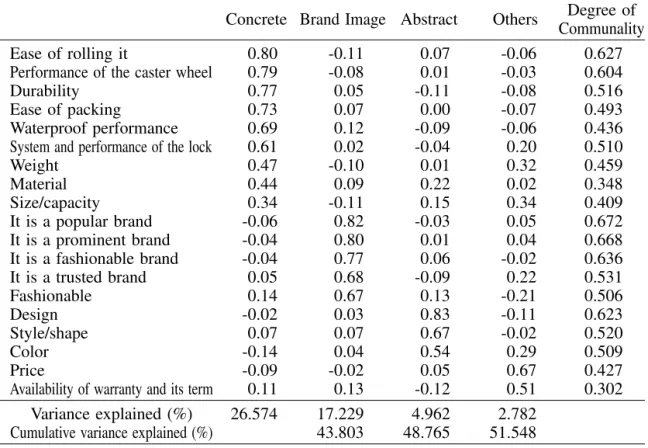
A principal component extraction factor analysis with Promax rotation was conducted on the responses to questions related to the concreteness of the attributes. The analysis extracted four factors, which were named concrete, brand image, abstract, and others based on their factor loadings (see Table 3).
Brand image represents overall perception of the brand, which is formed by using information about the brand and past experience (Assael 1981, p.604). As such, a brand image is a highly abstract representation that summarizes a vast range of information about the brand. Due to its level of abstraction, brand images tend to omit small features and instead, assimilate high-level pieces of information about the brand. Thus, current research considers the brand image factor to be another form of abstract attribute.
The Predecisional Justification Effects
A 2 (urgency: high vs. low) × 2 (intended usage period: short vs. long) × 3 (attribute type: concrete vs. brand image vs. abstract) mixed ANOVA, treating attribute type as a repeated factor, was conducted. Because the number of items used to measure each attribute type varied, the mean of the average importance scores for each item per attribute type was used as the dependent variable. Reliability estimates for the items related to the concrete factor (α= .877), the brand image factor (α= .763), and the abstract factor (α= .874) were relatively high.
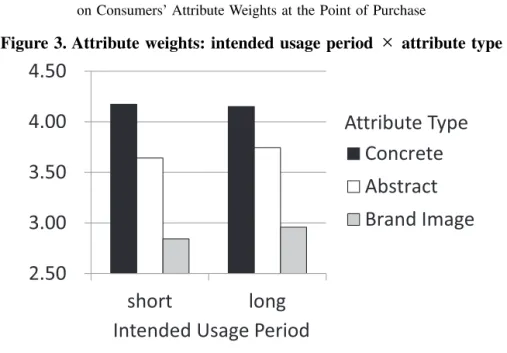
The analysis revealed a main effect for attribute type; F(2, 1540) = 1205.95, p < .01. Among the three attributes, concrete attributes were weighted most heavily; Mconcrete = 4.17,
all participants was close.
Replicating the result found in Study 1 (i.e., support for H2), the analysis also demonstrated a two-way interaction between intended usage period and attribute type; F(2, 1540) = 4.32,p < .05. As shown in Figure 3, there was no significant difference in weight attributed to concrete attributes as a function of intended usage period;Mshort = 4.17, Mlong=
4.16, t (772) = .671. However, weights attached to the abstract attributes and brand image were greater; t (772) =1.91, 2.17, p < .10, p < .05, respectively in the long usage period condition (Mlong = 3.74, 2.96, respectively) than in the short usage period condition (Mshort =
3.64, 2.84, respectively). This demonstrates that the period of intended usage has no effect on consumers’ focus on concrete attributes, but when the intended usage period is long, consumers tend to focus more heavily on abstract attributes and brand image.
In contrast, there were no main or interaction effects associated with urgency. This demonstrated that regardless of the urgency with which a consumer needed a suitcase, there were no significant differences in the weights attached to concrete attributes, abstract
Table 3. Factor analysis results (concreteness of the attribute for suitcase) Factor
Concrete Brand Image Abstract Others Degree of Communality Ease of rolling it
Performance of the caster wheel Durability
Ease of packing
Waterproof performance System and performance of the lock Weight Material Size/capacity It is a popular brand It is a prominent brand It is a fashionable brand It is a trusted brand Fashionable Design Style/shape Color Price
Availability of warranty and its term
0.80 0.79 0.77 0.73 0.69 0.61 0.47 0.44 0.34 -0.06 -0.04 -0.04 0.05 0.14 -0.02 0.07 -0.14 -0.09 0.11 -0.11 -0.08 0.05 0.07 0.12 0.02 -0.10 0.09 -0.11 0.82 0.80 0.77 0.68 0.67 0.03 0.07 0.04 -0.02 0.13 0.07 0.01 -0.11 0.00 -0.09 -0.04 0.01 0.22 0.15 -0.03 0.01 0.06 -0.09 0.13 0.83 0.67 0.54 0.05 -0.12 -0.06 -0.03 -0.08 -0.07 -0.06 0.20 0.32 0.02 0.34 0.05 0.04 -0.02 0.22 -0.21 -0.11 -0.02 0.29 0.67 0.51 0.627 0.604 0.516 0.493 0.436 0.510 0.459 0.348 0.409 0.672 0.668 0.636 0.531 0.506 0.623 0.520 0.509 0.427 0.302 Variance explained (%)
Cumulative variance explained (%)
26.574 17.229 43.803 4.962 48.765 2.782 51.548
attributes, or brand image (Mhigh= 4.16, 3.71, 2.92, Mlow = 4.17, 3.67, 2.88, respectively, F
(2, 1540) = .583). Thus, H3 was supported.
4.3 Discussion
As predicted, the effect of predecisional justification toward purchasing was weakened in a scenario study where instructions had been given to make a purchase. In the scenario used in Study 2, participants had been instructed to “make a purchase now,” so there was no need for them to justify their purchase, especially in terms of purchase timing. For this reason, the urgency factor, which plays the role of justifying a purchase action at a given time, was rendered ineffective. The result underscores the hypothesis that the effect of urgency does not arise simply as a result of the closeness of psychological distance, but also due to the effect of predecisional justification toward purchasing.
In the scenario used in Study 2, the purchase time was set to “now,” so the psychological distance of all participants was considered to have been close. This is shown by the fact that, of three types of attributes, participants attached the most weight to concrete attributes. As a result, it is thought that the effect of urgency was weakened due to subadditivity (Kim et al. 2008) or the ceiling effect.
However, even in a scenario where the purchase time has been set to “now,” it was confirmed that the predecisional justification toward purchasing effect of the intended usage period remained as strong. It must be noted that the number of times that the product could be used was restricted to three times in the scenario used in the current experiment. In other words, the actual benefit that participants would derive from the product did not vary
depending on the intended usage period. The only difference arising from a difference in the intended usage period was the length of time going forward until the benefits of the product could be derived. This potentially increased the perceived risk, but as the scenario required that the purchase be made, this factor was probably actively used for predecisional justification toward purchasing.
5. GENERAL DISCUSSION
5.1 Conclusions and Academic Implications
Taken together, the two studies revealed that predecisional justification toward purchasing affects the attributes consumers focus on at the point of purchase. The results of this research suggest that the relationship between construal level and psychological distance may differ from the way it is traditionally understood. This study has provided evidence to suggest that there could be separate mechanisms through which psychological distance affects level and low-level consumer construals (see Figure 1). In other words, high-level and low-high-level construals do not always operate as a perfect inverse tandem, and there can be dual process.
As consumers are constantly seeking their own accountability, they conduct biased predecision processing by focusing on a certain factor when that factor leads to purchase justification, but are not conscious of the factor when it does not lead to purchase justification.
To the authors’ knowledge, this study represents the first attempt to apply CLT to exploring the effects of predecisional justification toward purchasing. The present study focused on urgency and the intended usage period as factors leading to predecisional justification. Although purchase urgency has been touched upon in some research (e.g., Khan et al. 2011), intended usage period has been ignored in previous studies. The application of CLT to examine the relationship between intended usage period and consumers’ attribute weights may provide fertile ground for further academic research and discussion.
This study also presents new findings relating to the effects of multiple psychological distances on consumers’ construal level. Until now, concepts have been presented such as subadditivity (Kim et al. 2008), blocking (Malkoc and Zauberman 2006), and match in multiple dimensions (Zhao and Xie 2010). However, all of these studies were made under the implicit assumption that consumer construal levels and psychological distance have a one-dimensional relationship, and high-level and low-level construals are compensatory. This study, however, demonstrates that short psychological distance (low-level construals) does not always have negative influence on the weight consumers attach to product attributes associated with high-level construals. Equally, long psychological distance (high-level
construals) does not always have negative influence on the weight consumers attach to product attributes associated with low-level construals. The concept of the predecisional justification toward purchasing effect has made it possible to explain the presence of real-life consumers who simultaneously create high and low construal levels (these are consumers for whom the urgency is high and the intended usage period is long). In other words, this study has shown that theories based on CLT can also be used to explain the existence of consumers who extensively process information by weighting a diverse variety of attributes at both high and low construal levels.
The findings of this study neither contradict nor deny the findings of existing studies on CLT but instead, add to them, and should not be ignored due to their potential application to in-store marketing management.
5.2 Practical Implications
In addition to its contributions to the academic literature, this study also provides practical methods for developing in-store promotions. According to previous studies on CLT, in-store promotions should seek to appeal to consumers with a proclivity toward low levels of construal. While useful, this conclusion does not account for the fact that the respective psychological states of consumers at the point of purchase vary. In some cases, in-store promotions that do not account for product- or store-based characteristics may not produce tangible results. Therefore, a consideration of the store’s characteristics (particularly those related to spatial and temporal distances to the products) and the average amount of time for which products will be used may enable the store to create more effective promotions.
For example, fast food restaurants, coffee shops, or restaurants, whose concept is “feeling at ease,” should promote themselves in terms of central attributes such as taste, quality, and ingredients (e.g., healthy, organic, etc.). On the other hand, those that meet customers’ needs to eat quickly, should promote themselves in terms of peripheral attributes such as having many tables, roominess, etc., as well as offering some kind of limited time menu or the store’s original menu.
The change in the level of emphasis on a brand with respect to the construal level at the point of purchase is likely to provide implications for practical operations. An in-store promotion that makes potential customers feel that the estimated usage period of a brand is long is likely to be effective for a brand with a favorable image. Conversely, an in-store promotion that heightens the urgency to purchase a particular brand is suitable for a brand that does not have a favorable image.
This study has indicated that the type of psychological distance elicited by promotions should vary as a function of the attribute that store managers wish to emphasize. Regardless of which factors are manipulated to decrease psychological distance, the consumer may still
not focus on low-level attributes. For example, sales pitches that encourage short usage periods by claiming that “you do not need to consider future use because new products will be released soon” are unlikely to promote low-level construals. To facilitate low-level construals, the psychological distance that affects them must be reduced (e.g., making the product a “limited time offer”). Conversely, to encourage a focus on high-level attributes (e. g., brand image), marketing strategies that emphasize the product’s longevity will likely be more effective than reducing purchase urgency.
Such purchase justification effects are of great significance in practical marketing, especially with regard to retailers. In the famous gourmet jam experiment conducted by Iyengar and Lepper (2000), many consumers were attracted to the extensive array of products in an upscale grocery store. However, they were confused by the number of the choices, and when it came down to making a purchase, were unable to wipe out the option of letting go, and ended up walking away without purchasing anything. These consumers were unable to justify their own purchase action, and it is important for store managers to encourage them so that they are able to justify their own purchase action in advance.
5.3 Limitations and Future Research
There are several limitations. First, although Study 2 incorporated control variables that were absent from Study 1, it remained possible that respondents did not possess the same mindset when answering the questions as they would when making a purchase. In other words, despite attempts to allow for external factors the scenarios that were developed using current study methods may not have comprehensively reproduced the consumers’ psychological reality.
Second, although Study 2 used a product of focus for which there was little variation in consumers’ levels of involvement (i.e., a suitcase), the relationship between consumer involvement and construal levels requires clarification. Fujita et al. (2008) demonstrated that personal relevance and psychological distance independently influence construal level, but the extent to which psychological distance and involvement overlap each other remains unclear. If consumers who are highly involved with a particular product can be considered to possess a short psychological distance, CLT would predict that they will focus on the peripheral attributes of the product. However, according to the Elaboration Likelihood Model (Petty and Cacioppo 1986), highly involved consumers tend to be more motivated to consider products in greater depth. Thus, highly involved consumers are expected to focus more closely on the central attributes of a product.
This study took up urgency and intended usage period as predecisional justification factors. However, there may be other factors. Future studies should investigate what factors consumers pay attention to when they engage in predecisional justification toward
purchasing, and which factors have a relatively stronger effect on the predecisional justification.
Previous CLT studies reported that consumers who engage in high levels of construals, focus on primary attributes. Brand image is not often thought to be a primary attribute, but an abstract one. Given that the different construal levels are explained by multiple dimensions (e.g., abstraction, primacy, and goal-relevance), it is possible for contradictions to occur. To further refine the CLT, these inter-dimensional relationships require further study.
Acknowledgement:
The authors would like to thank Shuzo Abe, Takeshi Moriguchi, and Naoto Onzo for their helpful comments on a previous draft of this article, and Waseda University Research Initiatives and Grants-in-Aid for Scientific Research for their financial help (Grant #09b, B 22330134, respectively).
References
Alexander, David L., John G. Lynch Jr., and Qing Wang (2008), “As Time Goes By: Do Cold Feet Follow Warm Intentions for Really New Versus Incrementally New Products?” Journal of Marketing Research, 45 (3), 307-19.
Assael, Henry (1981), Consumer Behavior and Marketing Action, Kent Publishing Company, Boston, Mass.
Beckmann, Jürgen, and Julius Kuhl (1984), “Altering Information to Gain Action Control: Functional Aspects of Human Information Processing in Decision Making,” Journal of Research in Personality, 18 (2), 224-37.
Bettman, James R., Mary Frances Luce, and John W. Payne (1998), “Constructive Consumer Choice Processes,” Journal of Consumer Research, 25 (3), 187-217.
Brownstein, Aaron L. (2003), “Biased Predecision Processing,” Psychological Bulletin, 129 (4), 545-68. Dawson, Erica, Thomas Gilovich, and Dennis T. Regan (2002), “Motivated Reasoning and Performance on
the Wason Selection Task,” Personality and Social Psychology Bulletin, 28 (10), 1379-87.
Fujita, Kentaro, Tal Eyal, Shelly Chaiken, Yaacov Trope, and Nira Liberman (2008), “Influencing Attitudes toward Near and Distant Objects,” Journal of Experimental Social Psychology, 44 (3), 562-72.
Gerbing, David W. and James C. Anderson (1985), “The Effects of Sampling Error and Model Characteristics on Parameter Estimation for Maximum Likelihood Confirmatory Factor Analysis,” Multivariate Behavioral Research, 20, 255-71.
Goodman, Joseph K. and Selin A. Malkoc (2012), “Choosing Here and Now versus There and Later: The Moderating Role of Psychological Distance on Assortment Size Preferences,” Journal of Consumer Research, 39 (4), 751-68.
Hong, Jiewen and Angela Y. Lee (2010), “Feeling Mixed but Not Torn: The Moderating Role of Construal Level in Mixed Emotions Appeals,” Journal of Consumer Research, 37 (3), 456-72.
Hu, Li-tze and Peter M. Bentler (1999), “Cutoff Criteria for Fit Indexes in Covariance Structure Analysis: Conventional Criteria Versus New Alternatives,” Structural Equation Modeling, 6 (1), 1-55.
Iacobucci, Dawn (2010), “Structural Equations Modeling: Fit Indices, Sample Size, and Advanced Topics,” Journal of Consumer Psychology, 20 (1), 90-98.
Iyengar, Sheena S. and Mark R. Lepper (2000), “When Choice is Demotivating: Can One Desire Too Much of a Good Thing?” Journal of Personality and Social Psychology, 79 (6), 995-1006.
Khan, Uzma, Meng Zhu, and Ajay Kalra (2011), “When Trade-Offs Matter: The Effect of Choice Construal on Context Effects,” Journal of Marketing Research, 48 (1), 62-71.
Kim, Kyeongheui, Meng Zhang, and Xiuping Li (2008), “Effects of Temporal and Social Distance on Consumer Evaluations,” Journal of Consumer Research, 35 (4), 706-13.
Klayman, Joshua and Young-Won Ha (1987). “Confirmation, Disconfirmation, and Information in Hypothesis Testing.” Psychological Review, 94 (2), 211-28.
Kuhl, Julius (1984), “Volitional aspects of Achievement Motivation and Learned Helplessness: Toward a Comprehensive Theory of Action Control,” Progress in Experimental Personality Research, 13, 99-171. Kunda, Ziva (1990), “The Case for Motivated Reasoning,” Psychological Bulletin, 108 (3), 480-98. Liberman, Nira and Yaacov Trope (1998), “The Role of Feasibility and Desirability Considerations in Near
and Distant Future Decisions: A Test of Temporal Construal Theory,” Journal of Personality and Social Psychology, 75 (1), 5-18.
Malkoc, Selin A. and Gal Zauberman (2006), “Deferring Versus Expediting Consumption: The Effect of Outcome Concreteness on Sensitivity to Time Horizon,” Journal of Marketing Research, 43 (4), 618-27.
Martin, Brett A. S., Juergen Gnoth, and Carolyn Strong (2009), “Temporal Construal in Advertising: The Moderating Role of Temporal Orientation and Attribute Importance in Consumer Evaluations,” Journal of Advertising, 38 (3), 5-19.
Mills, Judson (1968), “Interest in Supporting and Discrepant Information,” in R. P. Abelson, E. Aronson, W. J. McGuire, T. M. Newcomb, M. J. Rosenberg, and P. H. Tannenbaum (Eds.), Theories of Cognitive Consistency: A Source Book, Rand McNally, Chicago, IL, 771-76.
Mogilner, Cassie, Jennifer L. Aaker, and Ginger L. Pennington (2008), “Time Will Tell: The Distant Appeal of Promotion and Imminent Appeal of Prevention,” Journal of Consumer Research, 34 (5), 670 -81.
Okada, Erica Mina (2005), “Justification Effects on Consumer Choice of Hedonic and Utilitarian Goods,” Journal of Marketing Research, 42 (1), 45-53.
Petty, Richard E. and John T. Cacioppo (1986), Communication and Persuasion: Central and Peripheral Routes to Attitude Change, Springer-Verlag, New York, NY.
Roehm, Michelle L. and Harper A. Roehm Jr. (2011), “The Influence of Redemption Time Frame on Responses to Incentives,” Journal of the Academy of Marketing Science,” 39 (3), 363-75.
Russo, J. Edward, Margaret G. Meloy, and Victoria Husted Medvec (1998), “Predecisional Distortion of Product Information,” Journal of Marketing Research, 35 (4), 438-52.
Shafir, Eldar, Itamar Simonson, and Amos Tversky (1993), “Reason-based Choice,” Cognition, 49, 11-36. Simon, Dan, Daniel C. Krawczyk, and Keith J. Holyoak (2004), “Construction of Preferences by
Constraint Satisfaction,” Psychological Science, 15 (5), 331-36.
Trope, Yaacov and Nira Liberman (2000), “Temporal Construal and Time-Dependent Changes in Preference,” Journal of Personality and Social Psychology, 79 (6), 876-89.
Trope, Yaacov and Nira Liberman (2003), “Temporal Construal,” Psychological Review, 110 (3), 403-21. Zhao, Min and Jinhong Xie (2011), “Effects of Social and Temporal Distance on Consumers’ Responses to