English Songs Analysis for EFL Learning Engagement
-A Research on Foreign Language Activities for PrimaryEducation-小学校外国語教育におけるリスニング学習法
-英語の歌分析と活動の指導法-WALSH, Anthony
アンソニー・ウォルシュ
1OCHANTE, Carlos
オチャンテ・カルロス
2 要旨: 小学校における外国語教科化によって英語の早期的な指導が始まっている。新学習指導要領の移行期間 中である現在、「外国語活動」において英語の「聞く」、「話す」に慣れさせる様々な指導法によって行われ ている。その中では、デジタル教材を用いて会話のリスニングやチャンツを含むオーラシー指導も行われ ている。英語の歌を児童に聞かせ、歌わせることで発音発達への効果のみならず、英語の音楽への興味な ども期待される。本稿では英語の歌(歌詞)を分析しながら、歌詞でみる語彙及び文法の内容をどのよう に歌以外の活動で実践的な指導ができるかを試みる。取り上げた歌として、語彙と文法の関係を含む指導 を行う大切へ強調し、歌の内容によって様々な異文化が含まれ、豊かな指導を行うことが可能になり、児 童の外国語とその文化への興味・好奇心を促進する効果が得られると考察している。Keywords: Foreign Language Activities, Listening instruction, Syntax, EFL.
1. Introduction
Curriculum and time management are always important when it comes to students' motivation in class. Leaving time left after finishing the designated class may result in trouble for the instructor. It is beneficial for all involved to solve this issue with the creation of a very flexible curriculum or textbook so the teacher can have more freedom to explore new teaching techniques. This inquiry will demonstrate how children’s melodies can serve as a core element in the English Foreign Language (EFL) within early primary education in Japan. The traditional nursery rhyme ‘Old McDonald had a farm’ with its animals and animal sounds being the focus on vocabulary development. The approach
1 General Education Organization Language Center St. Andrews University(桃山学院大学外国語教育センター) 2 Faculty of Education for Human Growth Naragakuen University(奈良学園大学人間教育学部)
outlined will assist language instructors and teachers of younger learners up to the age of eight years old. Mentioned in the Tokyo International Communication Committee for the Japanese school system, elementary starts from six years of age on the day of or after April 1st. Therefore, in years 1 and 2, students are making the transition from learning through playing to a more formal style of learning. Despite, the move from kindergarten at age five where play was the central theme, as Assistant Language Teachers, they are often instructed by their school to provide ‘Genki’ lessons. This term describes uplifting, high tempo aspects of learning. For those EFL instructors along with their Native Japanese counterparts, the pedagogical considerations within this paper would be most suitable for the principles of lesson design and methodology. Through transcripts of teacher discourse, diagrams of grammar forms and pronunciation aspects of intonation while also targeting error correction, the previously mentioned teachers can use these examples within their preparation for overtly recognizing target language.
2. Conceptualizing Language Acquisition
Listening material in primary EFL classes has been covered by the current textbook. Currently, the textbook has a widely used digital version which includes audio-visual contents to assist the teacher with the listening activities. Listening activities not only cover English dialogues but also English “Chants”. Almost any teaching unit includes English Chant audio. The inclusion of chants in the Japanese textbook shows the importance teachers and researchers have put into the new curriculum which aims to cover all 4-5 English skills.
At the first stage of primary school, the reason for selecting the song ‘Old McDonald had a farm’, is because it is rich with logical vocabulary and grammar with just a few points which need explaining. Krashen (1981) believes ‘Comprehensible Input’ is the key source for acquiring Second Language Acquisition (SLA). The term ‘Input’ refers to reading and listening skills whereas ‘output’ describes spoken and written language forms of communication. This ‘Comprehensible Input’ theory has been refuted by Swain (1985) who disagrees by suggesting ‘Output’ is the essential element to becoming fluent. This proposal claims that without speaking and writing skills, the learner has not properly mastered the language. Even though both theories have merit, it would be beneficial to respect the need to have input and output skills. Therefore, within teaching practice for younger learners, it would be advantageous to provide a holistic approach. Nation (2007) states the four stands which include reading, writing, speaking and listening are paramount in a balanced course. All four skills are critical and should not be overlooked. Each area has its own quality and requires equal exposure.
Lesson planning for listening activities must be parallel with participants’ interest and should follow certain parameters of auditory measurements (Revell and Norman, 1997).
Gardner (1983) illustrates ‘multiple intelligences’ or ‘MI theory’ which points out each person displays tendencies to favor a particular ability or abilities which include mathematical (being logical in thinking), kinesthetic, interpersonal, intrapersonal, naturalistic, linguistic and finally rhythmical (musical). The latter two connecting to the purpose of using music and language simultaneously. Therein, this practice aims to build language suitable for younger learners while exploiting communication practices. Piaget (1926, cited in McInerney & McInerney, 2006) coined the term ‘schema’. Young people are improving their level of vocabulary and ability to articulate their model of the world around themselves. The activities incorporating from the lyrics from ‘Old McDonald had a farm’ teaches engaging content. More specifically, mastering the patterns of the song practically, can broaden the learner’s schema, so they are able to express themselves.
3. Form, Function of Language Use
Willis (1990) explains building vocabulary in chunks or phrases as the ‘Lexical Approach’. A teacher can do this by using various word combinations. Below is the first verse of the nursery rhyme ‘Old MacDonald had a farm’ which this research analysis breaks down. The traditional song with its animal sounds has been used with younger learners extensively. Those animals and their onomatopoeia change with each verse. An example of the sound animals make and the Japanese equivalent is provided in Sample 1. You will notice a cow makes the sound ‘moo’ in English and ‘mo’ in Japanese. This is similar however the sound of a chicken in English ‘cluck cluck’ is very different from Japanese ‘こけこっこ’. Not only in the sounds of animals are Japanese sounds different, yet the whole phonetic units which make up the sounds. McCawley (1968) observed the characteristic of Japanese as a ‘Mora’ language. A person speaking in standard dialect would pronounce each syllable with the same stress. Whereas, in English the intonation within word changes. In sample 1 the words highlighted indicate stress words within the verse.
Sample 1. Old MacDonald had a farm first verse:
“Old MACDONALD had a farm, E-I-E-I-O. And on his farm, he had a cow, E-I-E-I-O. With a moo moo here, And a moo moo there. Here a moo, there a moo, Everywhere a moo moo.
Old MacDonald had a farm. E-I-E-I-O. “
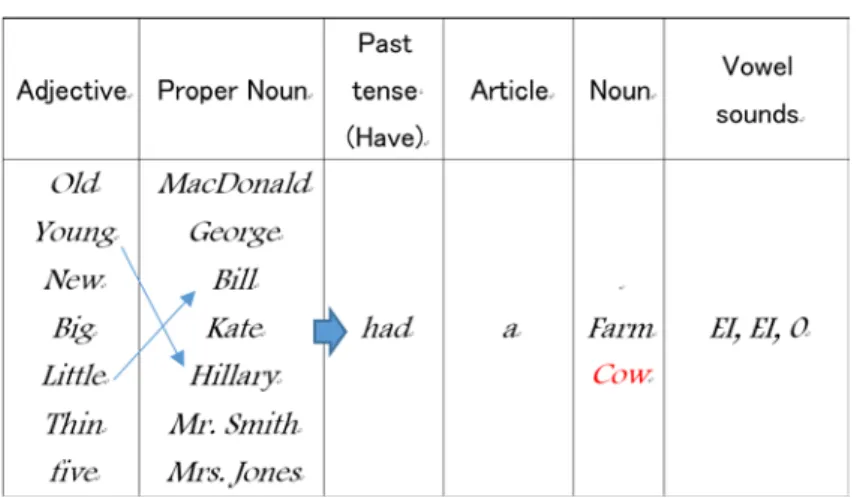
Figure 1. Grammar (The language form)
(
Adjective +Proper Noun +Past tense verb of have + Noun + Vowel sounds)Teachers can apply the previously mentioned ‘Lexical Approach’ to break down vocabulary into chunks. They would group adjectives together as shown in the first vocabulary group in Figure 1. In the younger years of learning language, numbers, colors, shapes, and sizes are classified. These describing words also talk about ages old and young. Students are taught the difference between the two terms new and young. A boy or girl is young, on the other hand, a bicycle is new, and grammatically it would be incorrect to say ‘young bicycle’. However, playing with vocabulary meanings can be a fun activity once the students thoroughly grasp the language. In the works on practical English teaching Nunan (2003) advocates second language learners require structuring thoughts in a logical sequence. Therefore, during the time a teacher is practicing adjectives, this is also a time they can structure numbers, and it would also be useful to incorporate complete fixed phrases. These fragments make up various other grammar points and sentence usages. If the teacher asks the child, “How old are you?” the child will respond in turn saying their age. A common response a student will make is saying a single unit number, such as six, seven or eight. The teacher should try to work on students provided full answers at this point, by responding with six-years-old. A follow-up question such as, “Are you young or old?” naturally the student will be young. Nonetheless, in this example, the term old is used. So, ‘Old MacDonald’ is now halfway clearly made perfectly clear. Moving onto the proper noun ‘McDonald’ which can be used to ask students their family names. Learning first names, family names, and titles Mr., Mrs., Miss, etc. Students should also be taught here the appropriate time to use the term ‘old’ is better to use titles, especially with teachers. Although, many English teachers in Japan go by their first names whereas their Japanese counterparts often refer to themselves as ‘sensei’ (Teacher).
In Figure 1 the term ‘had’ refers to the third person. Before teaching ‘had’, it would be an easier task for the student to understand the first person verb ‘have’. Farnselow (1976) insists language instructors should scrutinize and explores methods through unconventional teaching methods. In Japan, there was a YouTube hit sung by PIKOTARO called ‘PPAP’ with the phrase “I have an apple, I have a pen” is an
unorthodox yet effective way to learn the syntax. With currently two hundred and ninety million hits this skit is amusing and catchy. Students can easily take hold of the have/has grammar. Nevertheless, it is three years old and in future classes, this routine would become outdated. A more traditional way of teaching ‘I have…’ is through visual displays or using movement. Asher (1966) mentions ‘Total Physical Response’ or ‘TPR’ as an effective method for teaching younger learners. Those movements draw on physical senses to remember actions. ‘I have… ‘can be performed by putting a hand over your chest saying ‘I’ then clenching your fist and saying ‘have’. This method also requires pronouns to introduce the third person. ‘He has…’, ‘she has…’, and ‘it has...’ all should be done in a group activity. Some students will make an error with ‘have’ and ‘has’, yet, they will pick up the correct tense after some practice. “They have/has” will then be explained as ‘had’, the past tense of “have”. These grammatical verb structures can be confusing, so the teacher will need to create a fun environment to learn in. The article and noun ‘farm’ can be used together when playing games. The card game ‘Karuta’ in Japan is popular and requires little explanation to the students, variations to the game and other card games are required depending on the number of students. Finally, within the sentence, the ‘EI EI O’ rhythm provides prosody for the song. Thornbury (2002) suggests many styles of teaching pronunciation, which include sentence stress, syllables, connected-speech, sounds, and intonation. In Figure 3.2 examples of the noise or noises animals make are displayed. The teacher may choose to teach vowels a, e, i, o, u and also compare the sounds of uppercase and lowercase sounds. Along with showing the comparison between the Japanese and English terms.
Sample 2. Animals and their sounds in Japanese and English
It should be noted, English is not a set system of language forms, and as a result, learners are required to activate dynamic patterns of communication. High-frequency phrases such as, “one, two, three”, or “once upon a time, in a land far away”, or “are you ready to Rock’n Roll” are repetitive essentially in music and storytelling. Combining high-frequency phrases with low-frequency expressions assists in building language forms, so children can expand their regular usages by adding to these phrases for different situations (Ellis, 2002a).
Anim al
Onomatopoeia w ith Japanese translation
cow
Moo (Eng)
もー
pig
Oink (Eng)
ぶーぶー
duck
Quack (Eng)
がーがー
horse
Neigh (Eng)
ひひ
―
ん
lamb
Baa baa (Eng)
めーめー
Sample 3. Student extension task Part A. IPA British transcript’
/ əʊld məkˈdɒnəld hæd ə fɑːm iː-aɪ, iː-aɪ, əʊ / Part B. Dictionary.com IPA transcript
/ ohld muh k-don-uh ld had uh fahrm ee ahy ee ahy Oh /
Analyze this versification metric can be in either United States pronunciation or in the case of Sample 3 Part A, the British English transcript. Unless students are familiar with The International Phonetic Alphabet (IPA) then an alternative is to use the online dictionary for translation into the sound of spoken English. Each word has been individually translated to create Sample 3 Part B. Thornbury (2002) suggests many styles of teaching pronunciation, which include sentence stress, syllables, connected-speech, sounds, and intonation. In doing so, using modern technology, changing the speed is one method. Otherwise, assisting with more or less information changes the dynamic of the activity. In Figure 2 this process is put together to make a plan of action.
Figure 2. Lesson Sequencing Plan
4. Areas for Future Inquiry and Issues Arising from this Study
In the future, further research into the impact of music on the designs of lesson plans would assist in creating more engaging pedagogies. To achieve this, even experienced practitioners will need to keep track of new methods. Concurrently, the principles of second language acquisition may remain unless there are new findings. Understanding the avenue of technological systems of communication will continue to evolve. Under those circumstances of change it will be important to keep up with not only the technological advances in the education system and its uses. Another issue will be on how we use proper nouns in society. Using Mr., Mrs. or Miss may become a thing of the past. Even addressing a person as Son, Kun or Chan in Japanese culture may become a worldwide question of debate. Therefore,
1. Pre-listening activity 2. Task 3. Listening activity
4. Paired or
group check. 5. Response Numbers, Colors,
Shapes, Proper nouns, Vowels Phonics practice,
1st person/ 3rd person verb have,
past tense verb have/ had, titles, nouns (locations)
Listen to the song ‘Old MacDonald had a farm'
Students listen again and sing
along.
Students take leadership roles and play different parts of the song.
Students talk about animals sounds and compare Japanese and English onomatopoeia
traditional songs such as ‘Old MacDonald had a farm’ may not be an appropriate selection to use inside the modern-day classroom. Other traditional songs like ‘BaBa Black Sheep’ are naturally considered politically incorrect and would not be seen inside a classroom. The realms of possibly are generally for respecting all members to create a just education for future generations.
5. Conclusion
Having an understanding of the words within lyrics makes music so much more enjoyable to sing along to. Using the Willis (1990) ‘Lexical Approach’ to break down parts of fixed speech provides students with easy to understand language. This naturally takes the frustration out of learning a second language. On top of that, working on the fundamentals of pronunciation which Thornbury (2002) insists requires work, otherwise will not have the right sound. Notwithstanding, without a program that respects the participants would need to have comprehensible input as well as output. Both Krashen’s (1981) ‘Input’ and Swain’s (1985) ‘Output’ hypothesis are both respected and given equal precedence. To complete a theoretically well-rounded program which Nation (2007) points out the four strands of both the input and output forms of communication are present. Therein, the instructor can see the linguistic richness of a nursery rhyme and look at it as a way to base their younger learners’ program in primary school.
References
Asher, J. J (1966). The Learning Strategy of the Total Physical Response: A Review. The Modern Language Journal. Vol 53 No. 1 PP. 3-17 JSTOR.
Brown, R. (1973). A First Language. Cambridge, MA: Harvard University Press
Ellis, N. C. (2002a). Frequency effects in language processing: A review with implications for theories of implicit and explicit language acquisition. Studies in Second Language Acquisition 24, 2, 143-88 Fanselow, J. F. (1976). Breaking the Rules of the Classroom Game through Self
Analysis.
Ingram, D. (1986). Phonological development: production. In P. Fletcher and P. Garman (Eds.), Language Acquisition, 2nd ed. (pp. 223-239). Cambridge: Cambridge University Press.
Krashen, S.D. (1981). Second Language Acquisition and Second Language Learning. Oxford: Pergamon. McCawley, J. D. (1968). The phonological component of a grammar of Japanese. The Hague: Mouton.
(N.B. the above is not a grammar mistake)
Nation, I. S. P. (2007). The four strands. Innovation in Language Learning and Teaching, 1(1), 1-12. Nunan, D. (2003) Practical English Language Teaching. International Edition, McGraw-Hill, Singapore, 88.
Jonassen, D.H. (1999). Designing constructivist learning environments. In C.M. Reigeluth (Ed.), Instructional-design theories and models, 2nd Ed. Mahwah, NJ: Lawrence Erlbaum Associates.
Revell, J & Norman, S (1997) In Your Hands: Saffire Press.
Swain, M. (1985) Communicative competence: Some roles of comprehensible input and comprehensible output in its development. In Gass, S. and Madden, C. (Eds.), Input in Second Language Acquisition, pp. 235-256. New York: Newbury House.
Thornbury, S (2002) How to Teach Vocabulary Essex: Longman Willis, D. (1990) The Lexical Syllabus: Collins ELT.
Websites:
Online converter of English text to IPA phonetic transcription https://tophonetics.com/
“Old Macdonald Had a Farm”