to the World Natural Heritage Listing of Amami
著者
KUWAHARA Sueo
journal or
publication title
南太平洋研究=South Pacific Study
volume
31
number
2
page range
81-92
Notes
Development and Conservation Issues Relevant
to the World Natural Heritage Listing of Amami
KUWAHARA Sueo
Faculty of Law, Economics and Humanities, Kagoshima University 1-21-30 Korimoto, Kagoshima, 890-0065 Japan
Email: [email protected] jp
Abstract
In 1993, Yakushima (Yaku Island) and Shirakami-sanchi (Shirakami Mountain Range) were designated as the first World Natural Heritage Sites in Japan. Ten years later, the Nansei Group of Islands (the Tokara, Amami and Ryukyu Islands) were listed together with Shiretoko Peninsula (Hokkaido) and the Ogasawara Islands (Tokyo) as candidate sites for new World Natural Heritage listings. Then, in 2005, Shiretoko was designated as the third World Natural Heritage Site in Japan. Subsequently, in 2007, the Ogasawara Islands were added to the interim lists of World Natural Heritage Site in Japan.
The Nansei Islands are expected to be designated as World Natural Heritage sites in 2011. People in the Amami Islands have been conducting various activities in support of the nomination. Over the last fifty years, the Japanese government has injected huge amount of money into the Amami Islands as part of a special development and promotional fund, which has brought a big controversy between pro-development and anti-development/ environmental protection groups.
The paper provides a short history of development in Amami and then discusses how the nomination of World Natural Heritage Site relates to the lives and thinking of Amami people over the issue of development vs environment.
Key words: Amami rabbit, development, environment, the Amami Islands, the Nansei Islands, World Natural Heritage
Introduction
In 1993, Yakushima (Yaku Island, Kagoshima Prefecture) and Shirakami-sanchi (Shirakami Mountain Range, Aomori Prefecture and Akita Prefecture) were designated as the first World Natural Heritage Sites in Japan. Ten years later, the Nansei Group of Islands (comprising the Tokara Islands, Amami Islands and Ryukyu Islands) were listed together with Shiretoko (Hokkaido) and the Ogasawara Islands (Tokyo) by the Japanese government as candidate sites for new World Natural Heritage listings. Then, in 2005, Shiretoko was
Received: 19 January, 2011 Accepted: 7 February, 2011
designated as the third World Natural Heritage Site in Japan. Subsequently, in 2007, the Ogasawara Islands were added to the interim lists of World Natural Heritage Sitea in Japan. The Nansei Islands were expected to be added to the interim lists in 2009 1 and to be designated as World Natural Heritage sites in 2011. People in the Amami Islands have been conducting various activities in support of the nomination. Over the last fifty years, the Japanese government has injected almost 2 trillion yen (20 billion US dollars) into the Amami Islands as part of a special development and promotional fund. And there has long been a controversy between pro-development and anti-development/environmental protection groups.
There are some but not many studies of World Natural Heritage issues in Japan as a whole (OKANO 2008, OKUBO 2008, TSUKAGOSHI 2006, UMEZU 2008, WATANABE et al. 2008), and these studies are mainly from environmental and tourism viewpoints. There also are studies focusing on particular sites such as Yakushima (ICHIKAWA 2008, OHSAWA et al. 2006, ONODERA 2009a, SAKAI 2008, SHIBASAKI et al. 2008), Kitakami-sanchi (KoKITA 2008), Shiretoko (MURATA 2008, OYASUSHI 2008, SAKURAI and MATSUDA 2009. YAMANAKA 2008), and Ogasawara (OKOUCHI 2008). However, with regard to Amami Islands, there are only a few studies, among which is a report by the Kagoshima Prefectural Office on future regional development of Amami Islands in relation to the possibility of the World Natural Heritage site (KAGOSHIMA-KEN KIKAKU-BU RITOUSHINKOU-KA 2008). Suzuki reported on Amami people's various awareness activities toward the future registration of a World Natural Heritage site (SUZUKl 2006). Kagoshima University held a symposium on the significance of the registration for sustainable development of the Amami Islands (YAMADA 2007). However, there is almost no discussion about the Amami Islands and World Natural Heritage from a theoretical perspective.
This paper provides a short history of development in Amami and then discusses how the nomination of a World Natural Heritage Site relates to the lives and thinking of Amami people over the issue of development vs. environment. The focus of the paper is on describing the historical and social context of the efforts towards listing the World Natural Heritage site.
The Nature of the Amami Islands
Various natural environments
Amami Oshima has an area of about 720 square kilometers and a population of 74,000 people (Fig. 1). Next to Okinawa and Sado, Amami Oshima is the third largest of Japan's remote islands; combined with Kakeroma, Uke and Yoro, which are its three small neighboring islands, the total area is about 820 square kilometers.
Mountains that reach over 400 meters in height run north-south on the island, with Mt. Yuwan, at 694 meters, as the highest peak. Zigzagging shorelines that hug the mountains
Fig. 1. Map of World Natural Heritage sites in Japan and Amami Oshima.
provide the coasts of Amami Oshima with many good harbors. Interspersed in the many small areas of flatland found around bay areas are isolated communities that have many differences in language and folk customs 2.
Biodiversity in Amami
The Ryukyu chain — also known as the Nansei Islands — stretch 1,000 kilometers from Taiwan to Kyushu, and were once part of the Asian continent. However, about 1.5 million years ago, the Nansei Islands were divided into several large areas'. The land repeatedly rose and subsided as a result of active tectonic movements. The low areas then subsided into the ocean and the high areas became islands, which include Amami Oshima, Tokunoshima, Okinawa, Ishigaki and Iriomote. Coral reefs developed in the low areas, 2 There are a number of articles and books on the Amami Islands in Japanese but very few in English. For general
information on history, culture, people, society and nature, see AMAMI ACCESS CENTRE COMMITTEE 2007 and AOYAMA 2001.
3 Most of my description here is based on the information from Kagoshima Prefectural Office (http://www.amami.or.jp/isan/index_e.html).
some of which subsided in the ocean while others were uplifted to become the coral reef islands of Kikaijima, Okinoerabujima and Yoronjima.
Numerous Asian animals and plants were stranded on Amami Oshima after its separation from the mainland. This isolation, in combination with environmental circumstances, resulted in the survival of large undeveloped areas that have remained to the present. Thus Amami has retained a number of mainland Asian plant and animal "living fossils" that have disappeared on the Asian mainland itself. For example, it is estimated that there are 500 species of mammals, birds, reptiles and amphibian in the Nansei Islands, out of which at least 96 species (about 19%) is said to be endemic species or subspecies, whereas in the Galapagos Islands of South America, there are 68 species, and about 20 to 25% of them is said to be endemic species or subspecies (SAMEJIMA 1995). Thus the Amami Islands is often called "Galapagos of the East."
The Amami rabbit4 (also called the Amami hare), which has become a symbolic animal of Amami Oshima, is on Japan's protected species list. The Lidth's jay, which is also on the list, is the emblematic bird of Kagoshima Prefecture and is endemic to Amami Oshima. As with the Amami rabbit and the Anderson's newt, the Lidth' jay is a species that survived from the age when the islands were part of the continent, but it has evolved to adapt to the unique ecosystem of Amami Oshima.
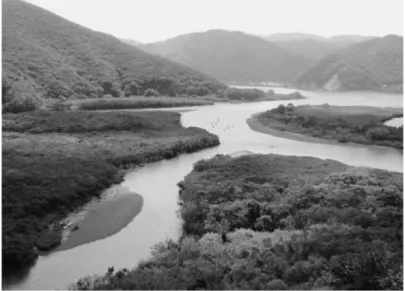
Other wild birds such as the Ryukyu robin and the white-backed woodpecker are found almost exclusively on Amami Oshima. So are other Nansei Islands endemic species such as the Kenaga mouse and the Ryukyu sweetfish. Amami Oshima also has the second largest acreage of primeval mangrove forest in Japan (Fig. 2). Amami Oshima is thus a treasure trove of plants and animals that are uncommon to the rest of Japan and to the world.
Fig. 2. Mangrove forest in Amami Island.
Steps towards the Registration of Heritage
Efforts towards establishing a National Park
The protected areas of the Amami Islands, which have a status similar to that of a National Park, are mostly seashores. By contrast, there are few protected inland areas although those areas also contain endangered species. In order to present a convincing case for a World Natural Heritage Listing, it is necessary to improve the present situation and enlarge the protected areas. In Yakushima, which became the first World Natural Heritage in Japan in 1993, 80% of the forest is national forest and there is also a special protected area, Yaku National Park, which is part of Kirishima (OHSAWA et al. 2006, ONODERA 2009b). By contrast, in Amami Oshima, national forest only comprises 6% of forested areas, with the rest owned by private individuals and by companies.
Kagoshima Prefectural government established a research committee for examining important ecological areas in 2002, and the committee conducted field research and collected basic data on distribution of rare and endangered animals with the purpose of deciding areas that merited protection. By 2005, the committee had met seven time, and identified the protected areas and the animals and plants that would be specified in a World Natural Heritage listing application 5.
The Prefectural government also established three other committees to assist in the establishing of National Park status for non-urban areas of the Amami Islands as a first step towards World Natural Heritage listing.
Awareness campaign
Kagoshima prefectural administration has held numerous symposiums, open seminars and lectures in connection with the proposed World Natural Heritage listing of the Amami Islands, and has conducted various awareness campaigns such as distributing learning materials for elementary and junior high schools in the Amami Islands, to be used as a part
of integrated learning 6.
A series of open lectures was held by the prefectural administration to communicate the value of the nature of the Amami Islands and to prepare for World Natural Heritage listing. An administrator of Shiretoko in Hokkaido was invited and asked to talk about the process by which Shiretoko succeeded with their World Natural Heritage nomination. The administrator emphasized the importance of raising the awareness of Amami people on World Heritage 7.
The Ministry of the Environment hosted an open symposium on "Where Amami rabbits came from" as part of an awareness campaign in Amami City on March 29 in 2008, and discussed the present situation and future of rare and endangered species of the Amami
5 Minaminihon Shinbun (South Japan Newspaper) 16 June 2004.
6 The book Nature of Amami Islands was published by Kagoshima Prefectural Office. Minaminihon Shinbun (South Japan Newspaper) 3 August 2005, SUZUKI 2006.
Islands. Some panelists expressed the view that World Heritage should not be the goal in itself but should be a starting point to think about the general future of the Amami Islands 8.
It was also stated by some guest speakers at an open lecture held as part of the awareness campaign that Amami rabbits are not a "nuisance for development" - as some people have cast them - but rather "the symbol of Amami Island's nature," and argued that it is important to start by deepening islanders' understanding about nature and raising the consciousness of protection 9.
There was a symposium organized by Kagoshima University on "World Natural Heritage and sustainable development" in 2006 at Amami City. Environmental groups, university professors, and administrators discussed approaches to development that enable coexistence with nature (YAMADA 2007). The Ministry of the Environment also hosted a symposium with the title of "Coexistence of Amami with the Earth." 10 A number of panel discussions were also held with titles such as "Thinking about the future of the islands with World Heritage as a starting point," and "Ryukyu arc nature forum in Amami." 11
The actions of environmental groups
In Amami Oshima, there are eight active environmental groups, including the Amami Mammalian Research Association, Amami Wild Bird Association, Environmental Network in Amami, Association for Thinking about the Nature of Amami, and Association for Amami Rabbits. These groups called on the Amami Oshima branch office of the Kagoshima prefectural administration to preserve and protect the native plants and animals of Amami Oshima. These three groups, which have been campaigning for registration of World Natural Heritage of Amami, submitted a petition to the prefectural branch office to make it compulsory for all domestic dogs and cats to wear tracking micro-chips to protect
the endangered wild animals in Amami 12.
As part of their specific activities, the Amami Wild Bird Association compiled an important ecological map of Amami Oshima based on the results of research on the habitat of some endangered birds 13. The Association for Amami Rabbits also has been conducting activities for protecting Amami rabbits in combination with eco-tourism 14.
Controversies over Development and Environment
Oil storage base
Amami Oshima once abounded with lush woods teeming with Lidth's jays and a
8 Minaminihon Shinbun (South Japan Newspaper) 25 April 2008. 9 Minaminihon Shinbun (South Japan Newspaper) 16 June 2004. 10 Minaminihon Shinbun (South Japan Newspaper) 25 April 2008. 11 Minaminihon Shinbun (South Japan Newspaper) 4 February 2009. 12 Minaminihon Shinbun (South Japan Newspaper) 25 June 2008. 13 Minaminihon Shinbun (South Japan Newspaper) 26 September 2008. 14 Minaminihon Shinbun (South Japan Newspaper) 2 September 2008.
myriad of other wild birds and other endemic animals. The lush woods provided all the native wildlife with a safe and secure sanctuary. But since the end of World War II, these woods have been rapidly disappearing as a result of commercial development. The only remaining virgin forest is Kinsakubaru, which contains slightly less than half of the natural
forest acreage of the past on the island (Fig. 3).
Fig. 3. Kinsakubaru forest in Amami Island.
Since the end of World War II, much of the woodlands on Amami Oshima have undergone massive deforestation as a result of a rising trend to develop the islands commonly known as "Amashin (Special Measure Law for Amami Islands Development)." Trees were chopped down, crisscrossing forest roads were paved, tunnels were dug, and mountains were cleared. Human presence was felt even in the depth of the woods.
In the early 1970s, a large-scale development project planned for an island called Edatekujima, which is part of the village of Uken on Amami Oshima, divided the village and the rest of the islanders into two factions either supporting or opposing the project. The project was planned to reclaim the shore of Edatekujima and construct a large-scale oil reserve base there. However, as the result of several years of intense protest campaigns by local and outside organizations established to conserve nature or to protect the environment, the project was called off 15.
Development of golf courses
An incident occurred in the1990s that typified human conflict with woodland animals. A dispute over the construction of golf course broke out and gave rise to an unprecedented
lawsuit known as the "Amami rabbit case" (SONO 2005). The dispute divided the islanders into two factions, one supporting commercial development and the other supporting nature preservation 16. The lawsuit became the focus of attention throughout the nation because it was the first time in Japan the plaintiffs were the spokesperson for wild animals, which in
this case were Amami rabbits.
An area on Amami Oshima called Ichizaki was known as one of the regions heavily populated by Amami rabbits (SONO 2005). The area includes a site slated to become the Sumiyo village golf course. In 1992, some people became concerned that the golf site development might adversely affect the habitat of the Amami rabbits, so they went to observe the development site and the peripheral area. They found Amami rabbit droppings and other traces that proved that Amami rabbits indeed inhabit the area.
As the spokesperson for the Amami rabbits and the natural environment of Amami Oshima, one nature conservation group and its twenty-two members filed a suit against the golf site developers 17 (SONO 2005). However, the main point at issue in this trial was which party could be judged as qualified to act as plaintiff within the framework of the laws in force. The trial would establish whether a corporation without juridical personality could be a spokesperson for wildlife. The corporation was established to protect the natural environment. At the same time, the trial would also establish whether individuals with serious concern for conservation of the natural environment could be spokespersons for natural entities.
In 1999, the court ruled that such entities were not qualified as plaintiffs. The judgment was based on the legislation and judicial precedents concerning plaintiff qualifications up
to then. So the animals lost the suit in the first trial 18.
Since the end of World War II, harbor, road and embankment construction and other public works have been progressing rapidly, destroying the natural environment. Nature conservation campaigns and other movements have arisen to directly oppose the large-scale development projects that destroy the valuable forests and waters of the island.
Since the end of World War II, Amami Oshima depended on large appropriations from the national government as financial aid for island development. And because island development destroys nature, antagonism has been extremely intense between supporters of development and supporters of nature conservation.
Resolving Dichotomies and Opposition
The post-war history of development and natural protection has been heated and divisive by focusing on dichotomous questions such as "Who is more important, Amami rabbit or humans?" 19 For example, a large-scale development project plan to reclaim the
16 There are a number of articles on this dispute in the local newspaper of Amami. For example, see Nankainichinichi Shinbun (Nankai Daily Newspaper) 28, 30 March, 19 April, 27 June, 24 November 1991, 24
January, 29 April, 13, 23 May, 3 June 1992.
17 Minaminihon Shinbun (South Japan Newspaper) 20 March 1995. 18 Minaminihon Shinbun (South Japan Newspaper) 23 January 2001. 19 Minaminihon Shinbun (South Japan Newspaper) 18 July 2003.
shore of the island Edatekujima and construct a large-scale oil reserve base led to several years of intense protest campaigns by local and external ecological organizations. In this so-called Edateke struggle, the domain in dispute was the `sea', and involved an intense confrontation between two factions over the issue of development or natural protection, pitting families, kin groups, and villages against one another.
In the Amami rabbit case involving development of a golf course in Sumiyo village, the domain in dispute was `land', leading to an intense confrontation between two opposing factions.
In disputes over the `Special Measures Law for Amami Islands Development' or `Amashin'
, there has been intense opposition since the 1980s between the pro-development groups and anti-development groups over the issue of development or natural protection (KAGOSHIMA UNIVERSITY PROJECT 2004, KUWAHARA 2005).
In the campaign for the World Natural Heritage listing of Amami, while the disputed domain is both `land and sea', where the endangered species and biodiversity are the focal point, the old lines of opposition based on the dichotomy of `development versus natural protection' have been, to some extent, resolved in favor of efforts towards coexistence and the balance of both development and nature. Thus, Amami rabbits are no longer viewed as a `nuisance for development' but as `the symbol of the nature of Amami' 20.
In this way, with regards to the World Natural Heritage listing of Amami, both advocates for development and for natural protection voiced their approval of the project. The case for natural protection can be summarized as follows 21.
1. The listing leads to protection of natural resources.
2. The listing can enable the group to play a central role in nature protection delegated by Japanese government.
3. The group could play an active role in the administration of environmental tion instead of a serving merely as a voluntary active group, which could also bring
them economically more stable life.
On the other hand, the advocates for development give the following reasons for their approval 22.
1. The development in relation to "Amashin", such as the construction of roads, ports, harbors, tunnels, etc. is almost complete. For example, in Amami Oshima, there are
31 tunnels, of which two are more than two kilometers long, seven more than one kilometer long, and four more than five hundred meters long.
2. Developers look toward the World Natural Heritage listing-related projects for a new source of orders and job opportunities.
20 Minaminihon Shinbun (South Japan Newspaper) 16 June 2004.
21 From the personal communication with a chief member of Amami Wild Bird Association. 22 From the personal talk with staff of Amami City Hall.
For people in Amami, what do the above-mentioned development issues mean? Mainly, the issues of development versus nature protection have had the effect of raising environmental awareness of Amami people, and triggering the establishment of a number of environmental groups, as well as lively and important activities and campaigns.
Conclusion
The issue of World Natural Heritage listing has brought crucial momentum not only to the environmental groups but also to the advocates of development and Amami people at large. A number of panelists, lecturers and speakers who contributed to awareness campaigns emphasized that World Natural Heritage is not only a goal of nature protection but also a departure point for confronting the complex issues of the natural environment of Amami, and that the most important thing is for Amami people to realize that they must be the leading players in this. The process of Heritage listing offers a very good opportunity to change the consciousness of people toward the natural environment, and the candidacy of the Nansei Islands for World Natural Heritage listing could be an opportunity to review Amami's dependency on public works, funded investment and employment, and to look for
other options.
Amami people's understanding and awareness of environmental issues has benefited from contextualizing local Heritage listing issues within the history of development in Amami. A further approach would be to look at the precedents of the successful nomination of Yakushima, Kitakami-sanchi, Shiretoko, and the Ogasawara Islands. This comparison would provide more interesting material for both Amami and Japanese island locations in general. That is, by comparison, we would be able to know what kind of action or campaign each site took toward the realization of World Natural Heritage nomination, what kind of nature cognition they have and how it has changed through the process of their movement for the nomination, and also what are the differences in the nature of movement and the characteristic in the problems of each site.
References
AMAMI ACCESS CENTRE COMMITTEE (ed.) 2007. The Amami Islands: Their People, Culture and Development, 88 pp., Amami Access Centre Committee, Kagoshima University,
Kagoshima.
AOYAMA, T. (ed.) 2001. Beyond Satsuma: Satsunan Islands Accepting the 21" Century Challenge, 136 pp., Kagoshima University Research Center for the Pacific Islands,
Kagoshima.
ICHIKAWA, S. 2008. Issues and the Present Situation Of Eco-TOurism in Yakushima after the Registration of World Natural Heritage. Chikyu kankyo [Global Environmental
Research], 13(1): 61-70 (in Japanese).
KAGOSHIMA UNIVERSITY PROJECT (ed.) 2004. Amami to kaihatsu [Amami and ment], 326 pp., Nanposhinsha, Kagoshima (in Japanese).
KAGOSHIMA-KEN KIKAKU-BU RITOUSHINKOU-KA 2008. Proposed Site for World Natural Heritage Amami and toward Its Self-Sustaining Development: A Survey Report on
Amami Islands Development. Hito to kokudo 21 [Man and National Land 21], 34(3):
10-13 (in Japanese).
KOKITA, T. 2008. World Heritage Forest Now: Shirakami-Sanchi (3) From the Conservation
Movement of Beech Old-Growth Forest to World Natural Heritage, Akita. Green Power, 359: 8-9 (in Japanese).
KUWAHARA, S. 2001. Amami Oshima. In: Beyond Satsuma: Satsunan Islands Accepting the 21st Century Challenge (Ed. AOYAMA, T.), 64-77, Kagoshima University Research
Center for the Pacific Islands, Kagoshima.
KUWAHARA, S. 2005. Amami kaihatsu saikou [Rethinking Amami Development]. In: Amami sengoshi [The Amami Post-War History] (Ed. KAGOSHIMA PREFECTURAL
RESEARCH CENTER FOR LOCAL AUTONOMY), 185-220, Nanposhinsha, Kagoshima (in Japanese).
MURATA, R. 2008. Change in Shiretoko by the Registration of World Natural Heritage. Chikyu kankyo [Global Environmental Research], 13(1): 81-87 (in Japanese).
OHSAWA, M., TAGAWA, H. and YAMAGIWA, J. (ed.) 2006. Sekai isan Yakushima [World Natural Heritage Yakushima], 278 pp., Asakura Shoten, Tokyo (in Japanese). OKANO, T. 2008. World Natural Heritage in Japan: Its Role and Issues. Chikyu kankyo
[Global Environmental Research], 13(1): 3-14 (in Japanese).
OKOUCHI, I. 2008. Reportage: Addressing the Challenges of Inscribing the Ogasawara
Islands to the World Heritage List. Kankyo to kogai [Research on Environmental
Disruption], 38(2): 44-50 (in Japanese).
OKUBO, N. 2008. Natural Heritage Conservation and Management Systems: Significance
and Challenges as Seen from Nature Protection Laws. Kankyo to kogai [Research on Environmental Disruption], 38(2): 16-22 (in Japanese).
ONODERA, H. 2009a. Yakushima ron [A Study on Yakushima]. In: Kagoshima kankyogaku
1 [Kagoshima Environmentology 1] (Ed. KAGOSHIMA UNIVERSITY STUDY GROUP FOR KAGOSHIMA ENVIRONMENTOLOGY), 48-60, Nanposhinsha, Kagoshima (in Japanese). ONODERA, H. 2009b. Amami ron [A Study on Amami]. In: Kagoshima kankyogaku 1
[Kagoshima Environmentology 1] (Ed. KAGOSHIMA UNIVERSITY STUDY GROUP FOR
KAGOSHIMA ENVIRONMENTOLOGY), 60-69, Nanposhinsha, Kagoshima (in Japanese). OYASUSHI, N. 2008. Scientific Value and Scientific Management Plan of World Natural
Heritage Shiretoko. Chikyu kankyo [Global Environmental Research], 13(1): 101-112
(in Japanese).
SAKAI, H. 2008. Sustainable Development of World Heritage Tourism and Environmental
Conservation in Yakushima. Kyoyo kenkyu [Kyushu International University Studies of Liberal Arts], 15(1): 63-79 (in Japanese).
SAKURAI, Y. and MATSUDA, H. 2009. Conservation of the Marine Ecosystem and the Sustainable Use of Marine Living Resources in the Shiretoko World Natural Heritage
(Ecosystem Service and Aquatic Industries, Special Symposium). Bulletin of the Japanese Society of Scientific Fisheries, 75(1): 99-101 (in Japanese).
SAMEJIMA, M. 1995. Toyo no Galapagos: Amami no shizen to ikimonotachi [Galapagos
of the East: the Nature and Organisms of Amami], 7, Minaminihon Shimbunsha.
Kagoshima (in Japanese).
SHIBASAKI, S., SHOUJI, Y. and TAKUSHOKU, T. 2008. The Possibility of Community
Participation in World Heritage Management: Searching from the Poll of Yakushima Islanders in Kagoshima Prefecture. Chikyu kankyo [Global Environmental Research].
13(1): 71-80 (in Japanese).
SONO, H. 2005. Hukkigo no Amami no henyo [The Changes of Amami after the Reversion
of Amami Islands to Japan. In: Amami sengoshi [The Amami Post-War History] (Ed. KAGOSHIMA PREFECTURAL RESEARCH CENTER FOR LOCAL AUTONOMY), 274-307.
Nanposhinsha, Kagoshima (in Japanese).
SUZUKI, T. 2006. Awareness Activities to Local Residents in Amami Islands: Toward the Registration of World Natural Heritage. Hoken no kagaku [Health Science], 48(6):
404-408 (in Japanese).
TSUKAGOSHI, M. 2006. World Natural Heritage and Developing Tourist Sites. Sapporo International University's Annals of Tourism Education and Research, (5.6): 19-24 (in Japanese).
UMEZU, Y. 2008. A Study on the Issues in Islands' Eco-Tourism. Chikyu kankyo [Global Environmental Research], 13(1): 89-100 (in Japanese).
WATANABE, T., UMEZU, Y. and KACHI, N. 2008. World Natural Heritage from the Viewpoint of Tourism (Approaches to World Natural Heritage in Japan). Chikyn
kankyo [Global Environmental Research], 13(1): 123-132 (in Japanese).
YAMADA, M. 2007. The Significance of Registration as a World Natural Heritage Site and Sustainable Development. Amami News Letter, 30: 41-45 (in Japanese).
YAMANAKA, M. 2008. Reportage: Inscription of Shiretoko National Park to the World Heritage List: Challenges and Prospects. Kankyo to kogai [Research on Environmental
Disruption], 38(2): 37-43 (in Japanese).