Some Observations of the Textural Properties
of Marine Myosystem Foods
著者
OHTA Fuyuo, HOKANISHI Suzuko, KONO Michiko
journal or
publication title
鹿児島大学水産学部紀要=Memoirs of Faculty of
Fisheries Kagoshima University
volume
26
page range
103-110
別言語のタイトル
水産筋肉系食品のテクスチャー性状の観察
Some Observations of the Textural Properties
of Marine Myosystem Foods
Fuyuo Ohta*1, Suzuko Hokanishi*2 and Michiko Kono*1
Abstract
The susceptibility of myosystem foods to low homogenizing stress were examined by means of the microscopic observation of the fragments separated from the muscle homogenates and of the determination of ratio of protein extractability. 1) Appreciable difference in the fragil ity of raw muscle was observed between fish and live-stock on the market and within the res pective group as well. 2) Photomicrographs of the fragments from thawed fish muscle showed the less disintegratability of its muscular structure, which was supported by a increase of the volume of settled fragments and by a decrease of the ratio of protein extractability. 3) The
fish muscle was made less disintegratable by means of cooking or salting, but the character istic difference was observed in the separated fragments of each muscle differently processed.
The relation of textural alteration in those foods and their sensory palatability, and the
mechanism of the alteration were discussed.
The texture of foods has been well known to be one of important characteristics
affecting their sensory quality.
But the studies of the textural properties of marine
foods, particularly of raw and thawed fish, are comparatively scarce.
It has been
considered to be due greatly to the difficulty in observing objectively the textural
properties of fish muscle1"3).
And also the difficulty above has been regarded as
cribed to the characteristic properties offish muscle fibers themselves4).
A considerable number of studies made on the quality-change of frozen fish, have
shown the increased toughness of fish muscle during its storage5-7).
However, an
adequate understanding of the mechanisms involved in the toughness change has
not yet been reached.
The present report describes the results of preliminary investigation made on the
susceptibility of myosystem foods, particularly of thawed fish, to low homogenizing
stress.
Materials and Methods
Preparation of sample muscle cubes
Eight species of fresh fish on the mar
ket were used as materials (Mackerel, Scomber japonicus; Tuna, yellowfin Thunnus albacares, blue fin Thunnus thunnus, big eye Thunnus obesus; Skipjack, Katsuwonus
*l Faculty of Fisheries, Kagoshima University
104 Mem. Fac. Fish., Kagoshima Univ. Vol. 26 (1977)
pelamis; "Hamadai", Etelis carbunculus; "Himedai", Pristipomoides sieboldi; "Takabe",
Labracoglossa argentiventris). The dorsal portion of each fish was cut into small cubes
(ca.10 mm3) and subjected to the test. One portion of sample cubes was freeze-stored
at -10°C and thawed at 0°C.
Other two portions were wrapped in a coarse cloth respectively, and the former was
cooked in waters of different temperatures and the latter immersed in salt solutions of
different concentrations.
The susceptibility of treated samples to homogenizing was
examined and compared with the untreated ones. Three species of live-stock muscle
(lean) on the market were submitted to a part of reference test.
Examination of the susceptibility to homogenizing
On refferring to the re
ports of Love et al.4-8) and Cowie et al.9), the following procedures were used.
Five grams of the sample cubes were homogenized in 100 ml of the cold water at
3,000 or 6,000 rpm for 30 sec.
The homogenates were taken in a large test tube and
500 ml of water was allowed to flow into the bottom of the tube at the rate of about
70 ml/min. Then, the muscle fragments that remained in the tube were transferred
into a small measuring tube, and the volume of the fragments settled under gravity
in the measuring tube under a given condition was measured. And also the appear
ance of settled fragments was observed under a microscope.
In a part of the test, the extractable protein under the low strength
tion was determined to be compared with that under the full strength
homogeniza-tion. The determination was done by a modification of Dyer's method5).
Results
Raw fish and live-stock muscle
Fig. 1 is photomicrographs of the fragments
obtained from the muscle homogenates of 3 species offish on the market. The muscle
fragments from mackerel and "takabe" were of single and complex pieces of muscle
fiber respectively, in which the characteristic patterns of cross-striation were seen.
However, the fragments of "hamadai" could not be identified as of fiber pieces struc
ture because those were fluffy and had no cross-banding. On the other hand, the
fragments from live-stock muscle were in appearance of single fiber structure or their
clusters (Fig. 2).
The foregoing facts show that there were appreciable difference in
the susceptibility of myosystems to disruption between fish and live-stock, and even within the respective group.
Thawed fish muscle As seen in Fig. 3, the fragments from thawed muscle of
any species of fish, are distinctly larger in appearance than those of the respective
control (unfrozen) muscle.
Especially the fragments of skipjack and bream group
were much longer and wider, and also those of tuna fine and markedly longer.
In
addition to this, photomicrographs of the fragments from thawed muscle showed
that the fibers of muscle and their bundles considerably survived homogenization
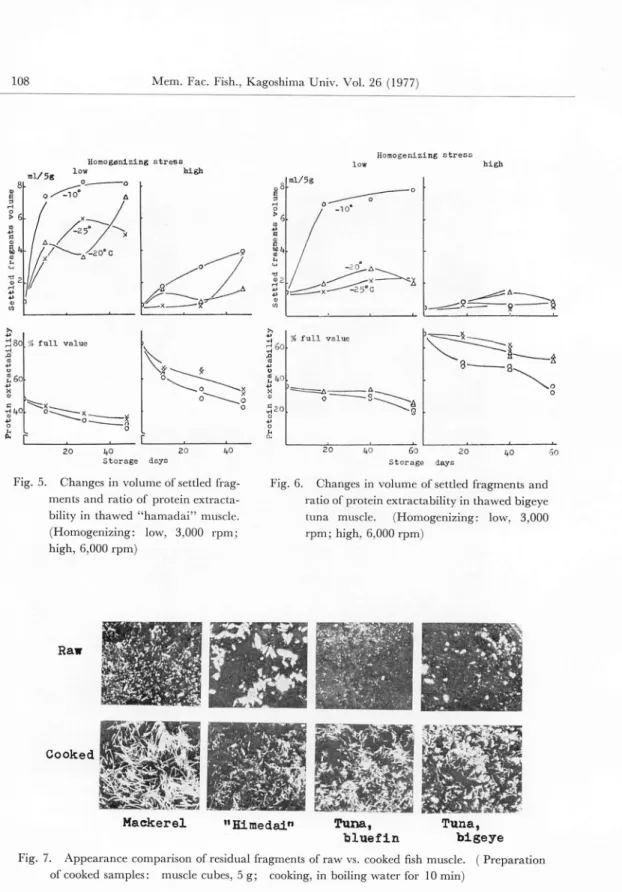
(Fig. 4). Such less susceptibility of thawed muscle to disruption was also found in Figs. 5 and 6, which show that when the muscle cubes were freeze-stored at relatively
Mackerel 'Hamadai" &md " Takabe"
^
**
- -A^^aL^§
Fig. 1. Photomicrographs of residual fragments from the homogenates of raw fish muscle on the market. (Magnification: I, xl; 2, x50; 3, X 600)
Chicken Beef Pork
fj-fp
m
rirv; ;i'
'ysp>w
^fjA "'0kw
Fig. 2. Photoniicrographs of residual fragments from the homogenates of raw livestock muscle. (Magnification: 1, xl; 2, X50; 3, x 600)
106 "Hamadai" Mackerel Tuna, yellowfin Skipjack "Takabe"
Mem. Fac. Fish., Kagoshima Univ. Vol. 26 (1977)
Unfrozen (control) Frozen, -10°c,28 days Frozen, -10°C,48days
Fig. 3. Appearance of residual fragments from the homogenates of thawed fish muscle.
high temperatures, the settled volume of fragments from thawed muscle was greater and the ratio of protein extractability was smaller. Those findings indicate that the changes in textural property of the muscle have occurred during the freeze-storage
of tested fish.
Cooked and salted fish muscle Fig. 7 shows comparison of the fragments from raw and cooked fish muscle cubes. The fragments of cooked muscle was fibrous or slender in appearance nearly in any case of the tested fish, differing markedly from
those of uncooked muscle. And also both the proximate size and settled volume of
the fragments were greater than those of raw muscle. The tendencies as stated above
were found in the case of salted muscle, too, (Fig. 8), though its fragments were small
er in size and more fleshy in colour than in the case of cooked one. Especially the fragments of salted tuna muscle was characteristically more fine and flexible compared
with those of cooked tuna. The facts show not only that the muscle tissue became
less susceptible to disruption owing to cooking and salting, but also that the effect of
those treatments on the muscle structure have considerably differed in its mode ac
Mf--1 •'''.'; t >;••• MackerelR
~f .y"y"\
El,:&
•f*^&„.V
A
Frozen, -10"C,28doys Frozen, -10"c,<t8daysFig. 4. Photomicrographs of residual fragments from the homogenates of thawed fish muscle.
108 Mem. Fac. Fish., Kagoshima Univ. Vol. 26 (1977)
Homogenizing stress ml/5g
Fig. 5. Changes in volume of settled frag
ments and ratio of protein extracta bility in thawed "hamadai" muscle. (Homogenizing: low, 3.000 rpm; high, 6,000 rpm) Raw Cooked Homogenizing stress ml/5g % full value 60 40j A_^^ o"" ——S—^ \ " 6 8 20 kO 60 20 1,0 £ Storage days
Fig. 6. Changes in volume of settled fragments and ratio of protein extractability in thawed bigeye
tuna muscle. (Homogenizing: low, 3,000 rpm; high. 6,000 rpm)
Mackerel "Himedal" Tuna,
bigeye
Fig. 7. Appearance comparison of residual fragments of raw vs. cooked fish muscle. ( Preparation of cooked samples: muscle cubes, 5 g; cooking, in boiling water for 10 min)
Tuna, b l u e f i n
"Himedal"
Raw Cooked Salted, Salted,
in 8 % in 2/+ %
Fig. 8. Appearance comparison of residual fragments of cooked vs. salted fish muscle. (Cooking, in boiling water for 10 min; Salting, in salt solution overnight at 10°C)
Discussion.
The extent and mode of disintegratability observed in the raw muscle cubes seemed to be related to the difference in the sensory texture, so-called firmness,
empirically-known of those muscle foods. On the other hand, it was noticeable that the differ
ence of disintegratability of raw muscle was observed not only in its cooked and salted muscles but also in thawed muscle as the textural changes. Those findings are sup ported by the reports of Shimizu et al.10) and Takahashi et al.n) They have indi cated that the firmness of fish muscle may be one factor affecting the rate of its spoil age and that the different fragility of cooked muscle is resulted from the difference in the protein distribution in the fish muscle.
The alteration of muscle structure in the thawed fish, which might lead to "tough
ening" of cooked thawed muscle found in certain species offish, such as cod, was ob served in the fish used for the present experiment. Accordingly the alteration seems to have occurred through the mechanism similar to that of toughening already pro posed by some studies12-1'". According to them the alteration is considered to have been due mainly to the microstructural changes and/or myofibrillar protein dena-turation. The present experimental results, too, suggest thai the microstructure change has occurred in the thawed muscle, and has brought about its less suscepti bility. The present subject is left for further study to be done in connection with the protein denaturation in fish muscle and the changes of its organoleptic quality. The less disintegratability of cooked or salted muscles appears to show becoming tough due to the dehydration and/or protein denaturation, as well known already15'. Concurrently, it seems to be worthy of rcmarkes from the qualitative view point of processed myosystem food that the effect of processing on the muscle structure have considerably differed in its extent and mode in accordance with a difference of pro cessing condition and ofmaterial muscle to be processed. The fact could be enhanced
110 Mem. Fac. Fish., Kagoshima Univ. Vol. 26 (1977)
by Duerr et al.'s paper16), in which the relation of salt content in the salted fish to its protein denaturation has been explained.
References
1) Dason, John A., Lynne, G. Mackee and Richard, W. Nelson (1962): Food Technol, 16 (3),
108-110.
2) Buttkus, Hans and H. L. A. Tarr (1962): Food Technol, 16 (8), 84-88.
3) Cutting, C. L. and R. Spencer (1968): "Quality Control in the Food Industry" (ed. by S.
M. Herschdoerfer et al.), Vol. 2, pp. 317, (Academic Press, London). 4) Love, R. M. and Elender M. Mackay (1962): /. Sci. Food Agric, 13, 200-212.
5) Dyer, W. J. (1951): FoodRes., 16, 522-527.
6) Love, R. M. (1956): Nature, 178, 988.
7) Heen, E. and O. Karsti (1965): "Fish as Food" (ed. by George Borgstrom), IV, pp. 360
(Academic Press, New York).
8) Love, R. M. (1962): /. Sci. Food Agric, 13, 269-278.
9) Cowie, W. P. and I. M. Mackie (1968): /. Sci. Food Agric, 19, 698-700.
10) Shimizu, W. and S. Hibiki (1954): Bull Jap. Sci. Fish., 20, 392-395. (in Japanese)
11) Takahashi, T. (1966): "Marine Food Science (Suisan Shokuhin-gaku)" (ed. by J. Nonaka
et al.), pp. 119 (Koseisha-Koseikaku, Tokyo), (in Japanese)
12) Olley, E. Stephen, J. Farmer and I. Robertson (1967): /. Food Technol, 2, 207-216. 13) Tanaka, T. (1966): "Marine Technology of Fish Utilization" (ed. by R. Kreuzer), pp. 121
(Fishing News Ltd., London).
14) Connell, L. L. (1968): "Low Temperature Biology of Foodstuffs" (ed. by John Hawathor
et al.), pp. 347-348 (Pergamon Press, London).
15) Matz, Samuel A. (1962): "Food Texture", pp.235 (AVI Publish. Co. Inc., Westport,
Con-nectcut).