Crab, Scopimera globosa DE HAAN, at Tomioka
Bay, West Kyushu I : Seasonal Changes of
Population Structure
著者
SUZUKI Hiroshi
journal or
publication title
鹿児島大学水産学部紀要=Memoirs of Faculty of
Fisheries Kagoshima University
volume
32
page range
55-69
別言語のタイトル
天草富岡湾産コメツキガニ, Scopimera globosa DE
HAAN, の生活史 I : 個体群構造の季節変化
Mem. Fac. Fish., Kagoshima Univ.
Vol. 32 pp. 55- 69(1983)
Studies on the Life History of Sand Bubble Crab,
Scopimera globosa DE HAAN, at
Tomioka Bay, West Kyushu — I
Seasonal Changes of Population Structure
Hiroshi Suzuki"Abstract
It is necessary for studying the life history of marine benthos to clarify the seasonal variation of size-frequency of its local population. Field studies were conducted on seasonal variation of density, breeding cycle and recruitment of Scopimera globosa in Tomioka, West Kyushu, from May of 1980 to September of 1981. The density of individuals was highest in autumn with new recruitment and was lowest in summer after the breeding periods. The density has been stable during winter through early spring. The ovigerous females consisted of larger crabs over 5.0 mm of carapace length in early reproductive season and subsequently the smaller crabs took part in reproduction. It is assumed that S. globosa females breed once duringreproductive season, except for large size crabs, some of whichbreed at least two times during the season. The recruitment occurred concentrically in late summer in both 1980 and
1981.
Introduction
It is essential that studies on marine benthos population obtain many knowledges of
ecological aspects, for example; the distribution and abundance of the species in rela
tion to environmental conditions of its habitats, growth and maturity, sexual behavior,
reproductive season and amount of eggs produced, dynamics of population and process of
mortality, recruitmental season and its numbers, and so on. Up to date, many investiga
tors have studied the ecology of marine benthos, but few quantitative investigations
have been done on their life history incluidng pelagic larval stage which is one of theimportant features.
The author has studied on ecology of sand bubble crab, Scopimera globosa DE
HAAN, inhabited in higher tidal zone with the purpose of proving quantitatively the life
history, including the dynamics of adult population, density distribution and recruitment
of larval population, and settlement of megalopa.The population ecology of S. globosa has been studied by many researchers.
The
seasonal changes of population structure and density were studied by Yamaguchi and
* Present address: Faculty of Fisheries, University of Kagoshima, 4-50-20 Shimoarata, KagoTanaka (1974) and Wada (1981); the regulatory mechanism at high population density
by Harada and Kawanabe (1955), Ono (1965) and Yamaguchi, Ogawara and Noguchi
(1978); sexual behavior by Yamaguchi, Noguchi and Ogawara (1979) and Wada (1982
b); significance of wandering individuals by Sugiyama (1961), Ono (1965) and Yama
guchi and Tanaka (1975); habitat preference with special reference to sediment texture
and elevation by Ono (1962, 1965), Wada and Tsuchiya (1975) and Wada (1976) ; and
behavioral activity by Wada (1983). Wada (1982 a) studied on substratum preference
in relation to feeding efficiency in S. globosa and Ilyoplax pusillus which is related
species.
In Tomioka Bay, S. globosa has a small enclosed population and a favorable situation
that it is unnecessary for imagining the origin of pelagic larvae appeared in this bay to
consider the exchange between another local population.
Because, there are no popula
tions at the area within radius 10 km.
In a series of studies that has been conducted,
the author was interested in population dynamics of this species, distributive situation
at pelagic larval stages, and stability of recruitment.
It was found necessary for these
subjects not only to deal with the exchanges of density and population structure based
on the results from a few selected sampling points, but also to estimate the population
size of entire local population, total amount of larvae released, and total amount of
newly settled juveniles, based on the data from quantitative sampling which covered
whole of study area.
In this paper, the purpose is to show the seasonal changes in the population structure
of the sand bubble crab, S. globosa, which is the basic knowledge to the study on
ecological aspects at each local population.Study Area
The investigations were carried out at the southeast area of sand flat beach called
the Higashi H'ama at Tomioka headland, Amakusa, West Kyushu, which is near the
mouth of Mie river (Fig. 1).
The river is so small that the outflux of freshwater
throughout the year is small except for rainy season (middle of June to middle of July)
and irregular torrential season (September to October).
The mouth of river is de
marcated from this area with sand or gravel mound accumulated by wave. The author assumes, therefore, that the freshwater could not affect the area S. globosa inhabited.S. globosa population inhabits only in the limited space at the higher littoral zone.
The habitat measured 120 meters long and 100 meters wide.
The survey had been
executed within the habitat. This habitat is located at a distance 500 meters from the
line of MLWS (Mean Low Water of Spring tides), and is separated from land by the
concrete wall (Fig. 2).
The study area is located on the innermost parts of the beach,
-32°32'N
-32°3I'N
130° i'E
SUZUKI : Life History of Scopimera globosa — I 57
TOMIOKA BAY I30°2'E _ i m I30^E j Fig. 1 The map shows the location of study area and topography of its vicinity.
The area occupied by S. globosa, has no individuals of related species, Ilyoplax
pusillus and Macrophtalmus japonicus. But Callianassa japonica is found in the southern southwest part of this area (Fig. 2). Appearance of Umbonium moniliferum
is observed at the lower littoral zone naer MLWS.
Materials and Methods
In the upper shore two sets of parallel lines at 20 m interval were drawn perpendicular ly to each other, the sampling stations were set up at every crossing of 20 m grid. To cover the whole habitat of S. globosa, 30 sampling stations were selected, the position of those stations were denoted with the combination of alphabetical row and numerical column.
To follow the seasonal population dynamics of the crab, monthly sampling had been carried out at low spring tide from May 1980 to September 1981. Fortnightly, sampling had been performed from May 1981 to September 1981, that is the season of reproduction and recruitment.
Fig. 2 The map shows the habitat of Scopimera globosa, the sampling stations and topography of its vicinity. Solid circles indicate the sampling stations. % ;
S. globosa inhabiting, © ; Callianassa japonica inhabiting, <flD ; Umbonium
moniliferum inhabiting, and © ; stone area. **** shows the position of
SUZUKI : Life History of Scopimera globosa — I 59
At each sampling station, two quadrat samples were taken. Using the square
metal frame and shovel, definite volume of sediment (25 cmX25 cm, 15cm deep) were
dug up, and sifted out by the sieve with 0.8 mm mesh opening.
Among the retained
matter, only the crab S. globosa was selected for study.
The crabs were brought to
the laboratory, and carapace length was measured, subsequently sex and presence or
absence of eggs were checked and recorded.
If the female crab was ovigerous, the eggs
were detached and preserved for fertility study. The proportion of ovigerous female was calculated from the number of ovigerous female dividing by total number of femaleswith carapace length over 2.5 mm.
The underground temperature were continuously measured with the maximum-mini
mum thermometer which was buried at 10 cm below the ground surface.Results
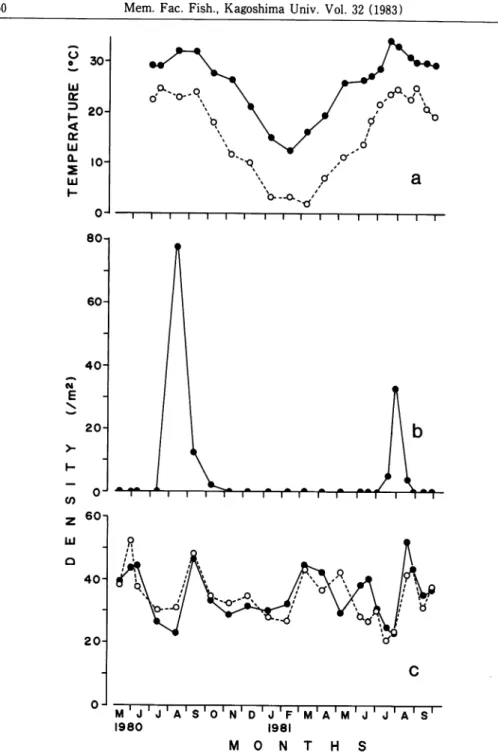
The seasonal variations in the average density of male, female, juvenile, and tempera
ture is shown in Fig. 3. The fluctuative patterns of male and female are similar with
each other.
The density was high from spring to early summer, and then rapidly
decreased in middle of summer. From late summer to early autumn, the density wasdramatically increased by recruitment of newly settled juveniles. Sequently, from late
autumn to early winter the density again decreased to the level found in spring season.
The temperature started to fall down in October, subsequently decreased and reached
to a minimum in February, but increased through July.
During the winter season, S.
globosa decreased its activity bylow temperature and continued to enter in burrow nest,
but considerable decrease was not observed.
The author calculated and graphed the density of each carapace length size from size
frequency and density data for understanding seasonal variation of population structure
(Fig. 4).Sexual difference is apparent at large size. The female crabs disappeared in range above 6.0 mm size. On the contrary females with carapace length of 4.0 mm to 6.0 mm were always found in larger quantity than males of the same size.
One ovigerous female, 0.7 % of total females, was caught in the middle of May and ten
females (4.5 %) were observed to breed in late May in 1980 (Fig. 5). In 1981, however,no ovigerous females were observed from May 6th to 7th and the first time of catching
ovigerous females was in early June. So, the start of breeding seemed to be in late May.
The proportion of ovigerous females increased through June (36.3 %) to July (59.9%) in
1980, and rapidly decreased to 24.0% in middle of August. The same tendency was
observed in 1981.The proportion of breeding females increased to peak of 58.4% from July
2nd to 3rd through 51.0% from June 18th to 19th, and sequently decreased to 27.0% in
? 30 20 »-< or UJ o. UJ 10-0J 80 60 40-E 20 >•
z °
z 60n UJ Q 40 20-0---O.. ~i i I i i i i i i—i—i—i—i—i—i—r l I i r r r r r r rm w m'j' j'a's'o'n'd'j'f'm'a'mV j'a's' 1980 1981 M O N T H SFig. 3 Seasonal variations in the average density of S. globosa, and temperature under 10 cm depth. Fig. 3 a shows the variation of temperature. Solid circles and open circles indicate severally maximum and minimum temperature. Fig. 3 b
shows the variation of newly settled juveniles. In fig. 3 c, solid and open circles indicate male and female, respectively.
SUZUKI : Life History of Scopimera globosa — I 61 240i 220 200 180 160 140 120 100 80 60 40 20 0J 0 20H 40 60 80 I00J 80- 60-40" 20" 0-On 20 40-60 U.WJMKV!.\\KKW»AVM\w**.ww±i7m 1980 MAY 12-16 AUG.11-13 £{$&• •''•aw
M
-vw
n. r^—1-£ SEP.8-10 r^ \1j™
H
CARAPACE
LENGTH
(mm)
Fig. 4 Seasonal variation of the size-frequency distribution of the S. globosa population. Specimens are separated in males (upper) and females (lower). (1)J * 1 s » ;IM| 7T
CARAPACE LENGTH (mm)
40 20 0 0 20 40 20-0 0 CM F 40-o 140 (Z UJ 120 cl 100 a) < 80 3 Q
60-S
SO
0SUZUKI • Life History of Scopimera globosa — I 63
JUL. 2-3 JUL. 19-20
/ ^ > W
3 . 5 ^ 7 , 9 N e t ' •— JUL. 30-31m v^am^.
60- 40- 20- 40-AUG.29-30jUV^,
SEP. 2 8 - 2 9-J^hTuuv
Pm| OVIGEROUS FEMALE
1 SPAWNED FEMALE
1 NON-SEXUAL JUVENILE
1 MEGALOPA
STAGE
CARAPACE LENGTH (mm) Fig. 4 (3)lOOn 3 80-if** UJ O 60-< UJ 40-u (Z UJ
°- 20
0-* -"-1—i—i—i • i —r~—r~—r~—i" r—i™—1~—i—i 1—i
M J J A S O ' N D J F M A M J J A S
1980 1981
M O N T H S
Fig. 5 Seasonal variations of the proportions of ovigerous, non-ovigerous, and spawned females. Solid, open circles and open squares show the ovigerous, non-ovigerous, and spawned females, respectively.
0--0--0--0---0--0—0--0--Q
The spawned females were checked and counted in 1981 only. The spawned females were easily distinguished from non-ovigerous ones by having disordered hairs of pleo-pods. They appeared from July 2nd to 3rd with 25.7 % of females and reached to a peak of 56.4 % and 40.9 % from July 19th to 20th and from July 30th to 31th, respectively. The peak of spawned females ratio was delated about half-month from the peak of ovigerous females. The proportions of ovigerous and spawned females decreased and reached to 0.9 % in middle of September and to 8.0 % in late September, respectively.
Reproductive season seemed to be from late May through early September with its main peak during middle of June to middle of July.
The females with about 5.0 mm of carapace length were observed to breed in early
reproductive season in 1980. Subsequently, the both larger and smaller crabs had taken part in the reproduction and smaller individuals remained to appear in the late reproduc tive season. The minimum size of ovigerous female reached to 2.75 mm. This value was smaller than those reported by Yamaguchi and Tanaka (1974) and Wada (1981). In 1981, the tendency was differentiated in detail. The females with carapace length
SUZUKI : Life History of Scopimera globosa — I 65
over 5.0 mm had taken part in reproduction from June 18th to 19th, and subsequently females under 5.0 mm took part in reproduction from July 2nd to 3rd. These larger crabs
had continued to breed untill late reproductive season.
The spawned females also appeared in range over 5.0 mm of carapace length from July 2nd to 3rd, and subsequently spreaded in all range of size classes. Towards the end of the reproductive season, the larger spawned females still remained to appear from
September 28th to 29th.
Megalopa and newly settled juveniles, whose carapace length were under 2.0 mm, concentrically appeared on August 11th and 13th in 1980. The sum of density per 10 m2
was 780 individuals. The megalopa also appeared with high density of 205 individuals at the same time. The number of megalopa and juveniles decreased sharply from September to October. In 1981, megalopa and newly settled juveniles were observed in the middle of July, and subsequently juveniles dramatically appeared on July 30th and 31th with density of 330 individuals. In the middle of August, the settled juveniles rapidly decreased. The first settlement, therefore, occurred at middle of July and its peak appeared from late July to early August. In both 1980 and 1981, the peak of settlement occurred a month after the peak of incidence of ovigers, and occurred
concentrically in summer only.
Discussion
It is necessary for ecological study on marine benthos to clarify the seasonal varia tion of size-frequency of its local population. For sand bubble crabs, Scopimera
globosa, this subject had been studied by Yamaguchi and Tanaka (1974) at Amakusa,
and by Wada (1981) at Waka river, middle of Japan. Such study of each local population must be conducted before investigation of ecological studies.It is said that the seasonal variation of density is affected by mortality and period and amount of recruitment. While the size-frequency distribution of carapace length is temporarilly altered as sum of growth rate in each size, mortality rate in each size, and
an amount of recruitment.
In Tomioka Bay, the seasonal variation of density consisted of three parts (Fig. 3);
first was a stable and non-growing periods from winter through spring, second was
decreasing periods in summer, and third was increasing periods in late summer. These phemonena are generally similar to those that Yamaguchi and Tanaka (1974) and Wada(1981) had described.
But, they attached importance to differences among some
habitats and/or relationships between S.
globosa and related species, Ilyoplax
pusillus. It is considered that the sufficient discussion for seasonal variation had notbeen performed in the whole of population which occupied a certain area.
cm depth, substrate temperature below 13°C, prevents their surface activity in Uca
lactea (Yamaguchi, 1970). In Tomioka Bay, the temperature started to fall down in October, subsequently decreased and reached to minimum of 3.25°C-12.5°C in February, and increased through July. In winter, S. globosa continued to rest in burrow nest and had not grown without feeding because of temperature decline. So, the density in theoretically stable ' as the number during winter season, except for the decrease by mortality. It is apparent that the increase in density is due to the recruitment. The
recruitment in S. globosa had never been observed in spring season. So, the increase of density in this season might be affected by sampling error, which resulted from the increase of captured chance owed to increase of activity with temperature increase. In fact, many opening of burrow nest and mobile individuals were observed from March
7th to 8th. Thus, the phenomenum of density increasing at this time did not seem to be influenced by absolute increase of individual numbers.
The main predators for S. globosa have not been observed, but a few observation of bird feeding on this crabs were carried out in early summer. These predation, however, did not seem to give an extreme damage for entire population of this crabs. The author
had never observed to the severe fluctuation of atmospheric and hydrological conditions
to survival of individuals in both the summers. The period of density decrease coincided with the reproductive period. The decrease of density, therefore, might not have resulted from the predation and abnormal meteorological conditions, but from reproduc
tion. In other words, the matured crabs might die in a part after reproduction and resulted to decrease their density.
The recruitment occurred dramatically from late July to early August in both 1980 and 1981. It is apparent that the increase of density in late summer are owed to these recruitment. No difference of the recruitment periods was recognized between 1980 and 1981. It occurred during middle of July through early August as mentioned by
Yamaguchi and Tanaka (1974) and by Wada (1981). But, the average density of newly settled juveniles in 1980 were about twice of that in 1981. Yamaguchi and Tanaka (1974) discussed that the balance between mortality and recruitment is necessary for the stability of population dynamics, and if thesumof recruitment decreased in a certain year, the population size should decrease with large damage in the year. Therefore, the
density of adults in autumn of 1981 was theoretically expected to be lower than that of 1980. The density of adult crabs in autumn of 1981, however, were nearly equal to that of 1980. The lowest density values in the summers of 1980 and 1981 were also similar.
The author had never observed extreme fluctuation of environmental conditions affect
ing to survival of crabs in autumn of 1980 after settlement, and never observed longer settlement periods in 1981. Harada and Kawanabe (1955) described that the feeding situation was influenced by individual density, and that the high density prevented the
SUZUKI '. Life History of Scopimera globosa — I 67
that the survival rate of individuals is dependent on their density. The recruitment occurred more concentrically in 1980 than in 1981. Therefore, the author expected that the juveniles inhabited with higher density in 1980. In fact, the author observed the distribution pattern with high density in the year (Suzuki, unpublished). It is antici pated that the high density produces high mortality ratio in S. globosa. The density equal to that of 1981, therefore, are considered to result from the high mortality rate which depended on high density distribution. Taking into consideration the above mentioned, the large amount of recruitment is not always beneficial to its population. If the large amount of recruitment occurred, the density should be higher and this would result in higher mortality rate. Eventually, the number of survived individuals might be equal from year to year. The absolute number of annual survival might be constantly determined in this region irrespectively of the amount of settled juveniles.
For male, the pattern of size-frequency distribution seemed to consist of individuals more than two year-classes in spring season. The large size class consisted of individu als which had settled during the year before last or two years before last. The small
size crabs consisted of individuals which settled in autumn of last year. The crabs
larger than 5.0 mm carapace length grew slowly to 7.0 mm-8.0 mm from late spring through autumn. And, the largest crabs might stop to grow during spring and die in
summer. The small size individuals grew rapidly from spring through early summer, and reached large size class in summer. Thus, the pattern of size-frequency in summer
seems to be unimodal with wide range. In autumn, the newly settled juveniles occurred in a range of small size, the juveniles have grown to 3.0 mm of carapace length untill
early winter and sequently stopped to grow through next spring.
The pattern of female crabs was minutely different from that of male. The pattern
of female showed one peak from spring through summer, and two peaks from autumn through winter. This pattern seemed to have resulted from the fact that the newly settled juveniles in autumn stopped to grow from winter to spring and grew rapidly with increased feeding activities from spring to summer while the larger crabs over 5.0 mm
of carapace length might stop to grow through the year. The larger crabs appeared to give their energy to reproduction only rather than growth. This fact is assumed from the seasonal variations of ovigerous females size. The larger crabs over 5.0 mm of
carapace length were breeded at the first time in reproductive season, sequently the
smaller individuals took part in reproduction and finally the larger ones remained to breed in the late spawning season. The seasonal variations in number of spawned females also supported this pattern. These facts might support the assumption that the smaller crabs spend their energy for growth in spring and for reproduction in summer, and the larger crabs spend it for reproduction only as mentioned by Yamaguchi and
Tanaka (1974), and might suggest that the small individuals breeded once during the
s a m e season.
In this paper the author studied the seasonal variations of density, size-frequency and ovigerous females. In future, the distribution patterns of each age, the total amount of eggs producted, the extent of recruitment, and ecological study of planktonic larvae must be conducted for the investigation on the life history of S. globosa.
Acknowledgement
The author is grateful to Dr. T. Kikuchi of the Amakusa Marine Biological Laborato ry, Kyushu University, for his kind advice and valuable information during the survey.
He wishes also to Dr. T. Saisho and Mr. Jai Raj Prasad of Faculty of Fisheries,
Kagoshima University, for their critical reading of the manuscript. This work was partly supported by the Grant-in-Aid for scientific research 57340036 from the Ministryof Education.
References
Harada, E. and H. KAWANABE (1955): The behavior of the sand-crab, Scopimera globosa De HAAN, with special reference to the problem of coaction between individuals. Jap. J. EcoL, 4, 162-165. (in Japanese)
Ono, Y. (1962): On the habitat preferences of ocypoid crabs I. Mem. Fac. Sci. Kyushu Univ., Ser.
E (Biol.), 3, 143-162.
Ono, Y. (1965): On the ecological distribution of ocypoid crabs in the estuary. Mem. Fac. Sci.
Kyushu Univ., Ser. E (Biol.), 4, 1-60.
SUGIYAMA,Y. (1961): The social structure of a sand-crab, Scopimera globosa DE HAAN, with
special reference to its population. Physiol. Ecol. Japan, 10, 10-17. (in Japanese)
WADA, K., and M. TSUCHIYA (1975): Distribution of ocypoid crabs in relation to tidal level and substratum in the Gamo lagoon. Jap. J. EcoL, 25, 235-238. (in Japanese)
Wada, K. (1976): The distribution of three species of ocypodid crabs in the estuary of Waka river, mainly examined in relation to the granularity of substratum. Physiol. Ecol. Japan, 17, 321-326.
(in Japasese)
WADA, K. (1981): Growth, breeding, and recruitment in Scopimera globosa and Ilypolax pusillus (Crustacea: Ocypodidae) in the estuary of Waka river, middle Japan. Publ. Seto Mar. Biol. Lab., 26, 243-259.
Wada, K. (1982 a): Substratum preferenceand feeding activity in Scopimeraglobosa De HAAN and
Ilyoplax pusillus (De Haan). Benthos Res., 23. 14-26. (in Japanese)
Wada, K. (1982 b): Sexual behavior of Scopimeraglobosa De Ha AN. Nanki-seibutsu, 24, 43-46. (in
Japanese)
Wada, K. (1983): Movement of burrow location in Scopimera globosa and Ilyoplax pusillus. Physiol. Ecol. Japan, 20, 1-21.
YAMAGUCHI, T. (1970): Ecology of a fiddler crab (Uca lactea)-\. Calanus, 2, 5-30. (in Japanese) YAMAGUCHI, T. and M. TANAKA (1974) : Studies on the ecology of a sand bubbler crab, Scopimera
globosa De Haan-I Seasonal variation of population structure. Jap. J. EcoL, 24, 165-174. (in
SUZUKI : Life History of Scopimera globosa — I 69
YAMAGUCHI, T., N. OGAWARA and Y. NOGUCHI (1978): Experimental analysis of the regulatory mechanism at high population density of the sand bubbler crab, Scopimera globosa De Haan (Preliminary report). Bonthos Res., 15/16, 18-22. (in Japanese)
YAMAGUCHI, T., Y. NOGUCHI and N. OGAWARA (1979): Studies of the courtship behavior and
copulation of the sand bubbler crab, Scopimera globosa. Publ. Amakusa Mar. Biol. Lab.,