Effects of chemical composition and stereoregularity on phase-transition behaviors
of aqueous solutions of copolymers composed of N-isopropylacrylamide and
N-n-propylacrylamide
Tomohiro Hirano*, Hiroaki Yamamoto, and Koichi Ute
Department of Chemical Science and Technology, Institute of Technology and Science, The University of Tokushima, Minamijosanjima 2-1, Tokushima 770-8506, Japan
*Corresponding author. Tel.: +81-88-656-7403; Fax: +81-88-656-7404 E-mail address: [email protected] (T. Hirano)
Abstract
Radical copolymerizations of N-isopropylacrylamide (NIPAAm) and N-n-propylacrylamide (NNPAAm) in various ratios were carried out in toluene at –40 °C in the presence of 3-methyl-3-pentanol to prepare syndiotactic copolymers with racemo dyad contents of ca. 70%. It was revealed that copolymers containing more than 92.5 mol% NNPAAm units exhibited large phase-transition hysteresis of their aqueous
© 2011. This manuscript version is made available under the CC-BY-NC-ND 4.0 license http://creativecommons.org/licenses/by-nc-nd/4.0/ The published version is available via https://doi.org/10.1016/j.polymer.2011.09.039.
solutions. Sequence analysis suggested that intramolecular hydrogen-bonding of contiguous NNPAAm units in syndiotactic stereosequences in the dehydrated state were responsible for induction of the large hysteresis.
Keywords: Syndiotactic N-alkylacrylamide copolymers; Chemical composition;
Phase-transition behavior
1. Introduction
Aqueous solutions of poly(N-isopropylacrylamide) [poly(NIPAAm)], which is a representative temperature-responsive polymer, shows a soluble-to-insoluble transition at ca. 32 °C [1-3]. This transition is known to occur rapidly and reversibly in response to a temperature change. However, a small retardation in the cooling process versus the heating process, i.e., hysteresis, is usually observed [4,5].
Recently, it was reported that the stereoregularity of poly(NIPAAm) influenced both the phase-transition temperature and the hysteresis. For example, an increase in isotacticity made poly(NIPAAm) insoluble in water [6–8], whereas an increase in syndiotacticity sharpened the phase transition at slightly higher temperatures and reduced the hysteresis [9]. Furthermore, an increase in heterotacticity sharpened the phase
transition and reduced the hysteresis, and the phase-transition temperature depended on the content of racemo (r) dyads. Stereosequence analysis of poly(NIPAAm)s revealed that the phase-transition temperature in the heating process depended on the r-dyad content, and the hysteresis increased with increasing average length of the meso (m) dyads [10].
Poly(N-n-propylacrylamide) [poly(NNPAAm)] is also known to be a temperature-responsive polymer [11–14]. The phase-transition temperature of an aqueous solution of poly(NNPAAm) is lower than that of poly(NIPAAm). An increase in the syndiotacticity of poly(NNPAAm) resulted in significantly enlarged hysteresis, and the
sharpness of the phase transition in the heating process was enhanced at slightly higher temperatures [15]. It should be noted that the effect of syndiotacticity on the hysteresis of the phase-transition behavior of an aqueous solution of poly(NNPAAm) is opposite to the effect on poly(NIPAAm).
As well as syndiotactic poly(NNPAAm), several vinyl polymers have been reported to show large hysteresis [16–21]. These unique solution properties are expected to be useful in new applications of these polymers. In this study, we examined the effects of the stereoregularities and chemical compositions of copolymers composed of NIPAAm and NNPAAm on the phase-transition behavior of their aqueous solutions to investigate the origins of the large hysteresis observed in the phase transition of aqueous solutions of syndiotactic poly(NNPAAm). We report the importance of the average length of r dyads consisting of contiguous NNPAAm units in inducing large hysteresis.
2. Experimental
2.1. Materials
NIPAAm (Tokyo Chemical Industry Co., Ltd, Tokyo, Japan) was recrystallized from a hexane–toluene mixture. NNPAAm was prepared using a previously reported method [15]. Dimethyl 2,2’-azobisisobutyrate (MAIB) (supplied by Otsuka Chemical Co.,
Ltd, Osaka, Japan) was recrystallized from methanol. Toluene was purified by washing with sulfuric acid, water, and 5% aqueous NaOH, followed by fractional distillation. Anhydrous methanol (MeOH), anhydrous ethanol (EtOH) (Kanto Chemical Co., Inc., Tokyo, Japan), isopropyl alcohol (iPrOH), and 3-methyl-3-pentanol (3Me3PenOH) (Tokyo Chemical Industry Co., Ltd) were used without further purification.
2.2. Copolymerization
A typical copolymerization procedure was as follows. NIPAAm (0.0248 g, 0.22 mmol), NNPAAm (0.2583 g, 2.30 mmol), 3Me3PenOH (1.0221 g, 10.00 mmol), and MAIB (0.0056 g, 2.43 × 10⁻² mmol) were diluted with toluene to a total volume of 5 mL, and 4 mL of this solution were transferred to a glass ampoule and cooled to –40 °C. The glass ampoule was degassed and filled with nitrogen three times. The mixture was irradiated at a distance of ~5 cm by a UV-LED lamp (375 nm, Optocode Co., Tokyo, Japan) to initiate photocopolymerization. After 20 min, the reaction mixture was poured into diethyl ether (200 mL). The precipitated copolymer was collected by filtration or centrifugation, and dried in vacuo. The copolymer yield was determined gravimetrically.
The 400 MHz 1H NMR spectra were obtained using an EX-400 spectrometer (JEOL Ltd, Tokyo, Japan). The dyad tacticity of the copolymers obtained was determined from the 1H NMR signals of the methine groups in the main chain and one of the signals of the in-chain methylene groups with the m configuration, observed at a lower magnetic field, in deuterated dimethyl sulfoxide (DMSO-d6) at 150 °C; the signal from the
methylene groups in the side chains of the NNPAm units overlapped with the signals of the in-chain methylene groups with the r configuration, and with one of the signals of those with the m configuration, observed at a higher magnetic field [22].
The molecular weights and molecular-weight distributions of the polymers were determined by size-exclusion chromatography (SEC), using polystyrene samples as molecular-weight standards. SEC was performed with an HLC 8220 chromatograph (Tosoh Corp., Tokyo, Japan) equipped with TSK gel columns (SuperHM-M, 6.5 mm ID × 150 mm, and SuperHM-H, 6.5 mm ID × 150 mm, Tosoh Corp., Tokyo, Japan). Dimethylformamide containing LiBr (10 mmol L−1) was used as the eluent, at 40 °C, with a flow rate of 0.35 mL min−1. The initial polymer concentration was 1.0 mg mL−1.
The transmittance of an aqueous solution of the copolymers (0.1 w/v%) was monitored at 500 nm as a function of temperature with a UV/VIS spectrophotometer (V-550, JASCO, Tokyo, Japan) equipped with a Peltier thermostated single-cell holder
(ETC-505, JASCO, Tokyo, Japan). The temperature was changed at a rate of 0.5 °C min–
1 from 2 °C to 70 °C, held at 70 °C for ca. 15 min, then changed at a rate of 0.5 °C min–1
from 70 °C to 2 °C. The cloud point (Tc) in the heating and cooling processes was taken
as the temperature at which the transmittance was 50%. When some transparency remained even above the phase transition temperature, the Tc was defined as the
temperature at which the average transmittance before and after the phase transition was observed.
3. Results and Discussion
3.1. Phase-transition behaviors of aqueous solutions of copolymers composed of NIPAAm
and NNPAAm
Radical (co)polymerizations of NIPAAm and NNPAAm in toluene at –40 °C for 20 min in the presence of 3Me3PenOH were carried out to prepare syndiotactic poly(NIPAAm-co-NNPAAm)s with various chemical compositions (Table 1) [9,15]. The chemical compositions of the NNPAAm units in the copolymers agreed well with the NNPAAm fractions in the feed, although the copolymerizations were quenched before the monomers were completely consumed. The r-dyad contents of the copolymers also agreed well with those of the corresponding homopolymers, regardless of the chemical
compositions. These results suggest that radical copolymerizations of NIPAAm and NNPAAm proceeded in an almost random manner, and that the syndiotactic specificity induced by 3Me3PenOH did not depend to any great extent on the monomer ratio in the feed.
<Table 1>
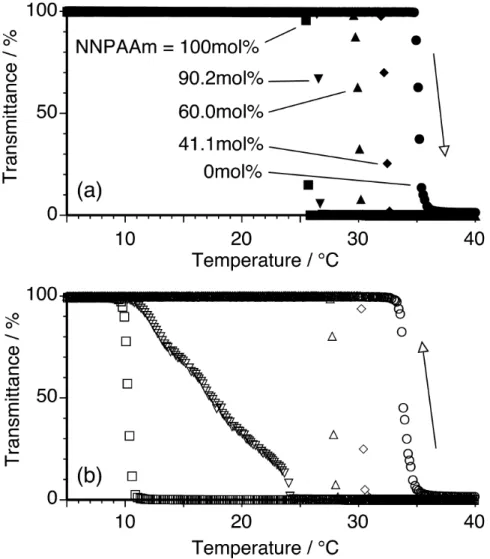
Fig. 1a shows the temperature dependences of the transmittances (500 nm) of aqueous solutions of poly(NIPAAm), poly(NNPAAm), and poly(NIPAAm-co-NNPAAm)s, containing 41.1 mol%, 60.0 mol%, and 90.2 mol% NNPAAm units, respectively, in the heating processes (see Table 1, runs 1, 3, 5, 9, and 14). The phase-transition temperature decreased gradually as the number of NNPAAm units increased.
<Fig. 1>
The phase-transition temperature in the cooling processes also decreased gradually with increasing numbers of NNPAAm units for the (co)polymers with lower amounts of NNPAAm units (Fig. 1b). However, the phase-transition behavior of the
copolymer with 90.2 mol% NNPAAm units broadened significantly [23]. Then, high sharpness was recovered for poly(NNPAAm), accompanied by a large decrease in the phase-transition temperature. This result indicates that the hysteresis did not gradually increase, depending on the fraction of the NNPAAm units.
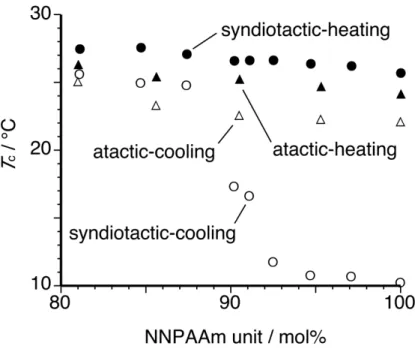
Fig. 2 shows the relationship between the Tc and the chemical composition of
the NNPAAm units in syndiotactic copolymers. The data for atactic copolymers, which were prepared by radical copolymerization in methanol at –40 °C (Table 2), were also plotted [24,25]. Greatly increased hysteresis was observed for syndiotactic copolymers containing over ca. 90 mol% NNPAAm units, whereas the Tcs in both the heating and
cooling processes decreased gradually with increasing numbers of NNPAAm units in the case of atactic copolymers. These results suggest that contiguous NNPAAm units in the syndiotactic stereosequences are the key to inducing large hysteresis of the phase-transition behavior of N-alkylacrylamide copolymers.
<Fig. 2> <Table 2>
Because the copolymerizations of NIPAAm and NNPAAm proceeded in an almost random manner, the dyad monomer sequence distribution (NNPAAm–NNPPAm units, NN; NNPAAm–NIPAAm units, NI; and NIPAAm-NIPPAm units, II) in the copolymers can be estimated using the following equations:
NN = PN2, NI = 2 × PN × PI, II = PI2
where PN and PI are the chemical compositions of the NNPAAm and NIPAAm units,
respectively. Then, the average length of the NNPAAm units (n–N) can be estimated using
the following equation [26]:
n–N = (NN + NI/2)/(NI/2)
Based on the facts that the triad tacticity distribution in poly(NIPAAm) prepared in toluene at –80 °C in the presence of ethanol was reported to obey Bernoullian statistics [24] and that the syndiotactic specificity induced by 3Me3PenOH was scarcely affected by the monomer ratio in the feed, the triad tacticity distributions (mm, mr, and rr) and the average length of an r dyad (n–r) in the copolymers can be estimated using the
following equations:
mm = Pm2, mr = 2 × Pm × Pr, rr = Pr2
n–r = (rr + mr/2)/(mr/2)
Sequence analysis of copolymers needs to consider the monomer sequence and stereoregularity simultaneously. For example, there are six kinds of rr triad: NNPAAm-centered (NrNrN, NrNrI, and IrNrI) and NIPAAm-centered (IrIrI, NrIrI, and NrIrN). However, when both the monomer sequence and tacticity distribution obey Bernoullian statistics, these triads can be estimated as follows:
NrNrN = Pr2 × PN3, NrNrI = 2 × Pr2 × PN2 × PI, IrNrI = Pr2 × PN × PI2,
IrIrI = Pr2 × PI3, NrIrI = 2 × Pr2 × PN × PI2, NrIrN = Pr2 × PN2 × PI
Furthermore, the average length of an r dyad with contiguous NNPAAm units (n–r-N) can be estimated from the triad fractions containing NN dyads with the r
configuration (NrN) as follows:
n–r-N = [NrNrN + (NrNrI + NrNmN + NrNmI)/2]/[(NrNrI + NrNmN + NrNmI)/2]
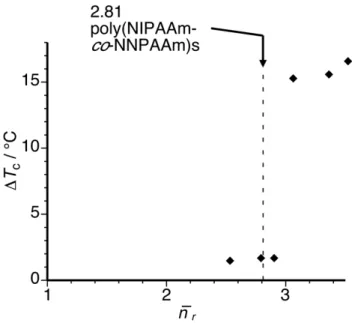
The n–r-N values of individual copolymers were estimated using dyad tacticities
and chemical compositions, and plotted with the difference in Tc between the heating and
cooling processes (∆Tc), as shown in Fig. 3. Only copolymers with n–r-N over 2.81 clearly
exhibited large hysteresis (see Table 1, runs 11–14), whereas copolymers with n–r-N below
2.57 exhibited small hysteresis (see Table 1, runs 1–8). The copolymers with n–r-N = 2.67
and 2.73, which exhibited gradual phase transitions in the cooling processes, showed moderate hysteresis (see Table 1, runs 9 and 10). The n–r-N values of atactic copolymers,
which showed only small hysteresis, regardless of the chemical composition, were calculated to be below 2.81 (see Table 2). These results reconfirm the importance of contiguous NNPAAm units in the syndiotactic stereosequences.
<Fig. 3>
3.3. Origin of the large hysteresis in the phase-transition behaviors of aqueous solutions
of N-alkylacrylamide copolymers
To confirm that the n–r-N values are responsible for inducing large hysteresis,
poly(NNPAAm)s with various r-dyad contents were prepared by changing the added alcohol and/or the polymerization temperature (Table 3) [9,15]. Fig. 4 shows the relationship between the ∆Tc and the n–r values calculated for the poly(NNPAAm)s.
Poly(NNPAAm)s with n–r over 3.06 exhibited large hysteresis (see Table 3, runs 4–6).
The value (3.06) agreed well with the critical n–r-N value for the copolymers (2.81), taking
into account that the n–r-N values were estimated using dyad tacticities and the chemical
compositions of the copolymers, on the assumption that both the triad tacticity distribution and monomer sequence distribution obey Bernoullian statistics.
<Table 3> <Fig. 4>
In a previous paper [27], we reported that the phase transitions of aqueous solutions of poly(NNPAAm)s in the heating process sharpened with increasing r-dyad content, as shown by high-sensitivity differential scanning calorimetry (DSC) and FT-IR spectroscopy. In the DSC traces, the endothermic peaks resulting from dehydration of the polymer chains were broad for poly(NNPAAm)s with r-dyad contents of 52% and 57%, for which the n–r values were 2.08 and 2.22, respectively, but became significantly sharper
for poly(NNPAAm)s with r-dyad contents over 66%, for which the n–r values were over
3.02. Furthermore, in the region of the amide I band in the FT-IR spectra of the poly(NNPAAm)s in dehydrated states, the fraction resulting from intra/intermolecular hydrogen-bonded C=O was higher for the polymer with r = 71% than for the polymer with r = 52%. We therefore suggested that intramolecular hydrogen-bonding among the amide groups of adjacent monomeric units in the syndiotactic stereosequences were responsible for the enhanced sharpness of the phase transitions of aqueous solutions of poly(NNPAAm)s in the heating processes; this was supported by quantum chemical calculations for a syndiotactic octamer.
If the hypothesis that n–r-N values over 2.81 are responsible for inducing large
hysteresis is acceptable, it can be assumed that the intramolecular hydrogen-bonding among the amide groups of adjacent monomeric units in the syndiotactic stereosequences will also play an important role in large hysteresis. In other words, the formation of intramolecular hydrogen-bonds by 3.81 monomeric units, on average, in the syndiotactic stereosequences makes dehydrated copolymers more hydrophobic. As a result, aggregation of syndiotactic copolymers in dehydrated states was stronger than aggregation of atactic copolymers and syndiotactic copolymers with the n–r-N values
below 2.81. It is assumed that the large hysteresis originates from this enhanced aggregation resulting from hydrophobic interactions between the dehydrated copolymers.
Poly(NIPAAm) with r = 70%, for which the n–r value was 3.33, exhibited sharp
phase-transition behavior, but smaller hysteresis than that for poly(NIPAAm) with r = 53% [9], suggesting that N-isopropyl groups, which are more hydrophilic than N-n-propyl groups, allowed rapid rehydration of dehydrated poly(NIPAAm)s. Consequently, the hysteresis in the phase-transition behaviors of aqueous solutions of N-alkylacrylamide copolymers depended not only on the formation of intramolecular hydrogen-bonds among the amide groups of adjacent monomeric units in the syndiotactic stereosequences, but also on the hydrophobicity of the N-substituents in the amide groups forming the
intramolecular hydrogen-bonds.
4. Conclusions
The effects of the stereoregularities and chemical compositions of poly(NIPAAm-co-NNPAAm)s on the phase-transition behaviors of their aqueous solutions were investigated. The copolymers with n–r-N values over 2.81 exhibited large
hysteresis. This result suggested that intramolecular hydrogen-bonding of 3.81 contiguous NNPAAm units, on average, in syndiotactic stereosequences in the dehydrated state induced the large hysteresis, probably because the intramolecular hydrogen-bonding made the dehydrated copolymers more hydrophobic, resulting in acceleration of their aggregation.
In this study, however, we observed kinetically enlarged hysteresis of phase-transition behaviors, because the phase phase-transition in the cooling process should depend on the aggregation state of the dehydrated copolymers. Furthermore, we used unfractionated samples with regard to molecular weight because the phase-transition behavior should be affected by stereoregularity and chemical composition more than by molecular weight [28]. Further investigation of the effects of concentration, scanning rate, and molecular weight on the phase-transition behavior is now under way, along with
investigation of the effects of combinations of N-substituents other than N-isopropyl and N-n-propyl groups on the phase-transition behavior.
References and Note
[1] Heskins M, Guillet JE. J Macromol Sci Chem A2 1968;2:1441-1455. [2] Fujishige S, Kubota K, and Ando I. J Phys Chem 1989;93:3311-3. [3] Schild HG. Prog Polym Sci 1992;17:163-249.
[4] Wu C and Wang X. Phys Rev Lett 1998;80:4092.
[5] Ding Y, Ye X, and Zhang G. Macromolecules 2005;38:904-8.
[6] Ray B, Okamoto Y, Kamigaito M, Sawamoto M, Seno K-i, Kanaoka S, and Aoshima S. Polym J 2005;37:234-7.
[7] Kitayama T, Shibuya W, and Katsukawa K-i. Polym J 2002;34:405.
[8] Ito M and Ishizone T. J Polym Sci, Part A: Polym Chem 2006;44:4832-45. [9] Hirano T, Okumura Y, Kitajima H, Seno M, and Sato T. J Polym Sci, Part A:
Polym Chem 2006;44:4450-60.
[10] Hirano T, Kamikubo T, Okumura Y, Bando Y, Yamaoka R, Mori T, and Ute K. J Polym Sci, Part A: Polym Chem 2009;47:2539-50.
[11] Ito S. Kobunshi Ronbunshu 1989;46:437-43.
[12] Ito D and Kubota K. Macromolecules 1997;30:7828-34. [13] Ito D and Kubota K. Polym J 1999;31:254-7.
[15] Hirano T, Nakamura K, Kamikubo T, Ishii S, Tani K, Mori T, and Sato T. J Polym Sci, Part A: Polym Chem 2008;46:4575-83.
[16] Habaue S, Isobe Y, and Okamoto Y. Tetrahedron 2002;58:8205-9. [17] Hirano T, Miki H, Seno M, and Sato T. Polymer 2005;46:5501-5.
[18] Kobayashi M, Ishizone T, and Nakahama S. J Polym Sci, Part A: Polym Chem 2000;38:4677-85.
[19] Aoki T, Muramatsu M, Torii T, Sanui K, and Ogata N. Macromolecules 2001;34:3118-9.
[20] Mori T, Beppu S, Berber MR, Mori H, Makimura T, Tsukamoto A, Minagawa K, Hirano T, Tanaka M, Niidome T, Katayama Y, Hirano T, and Maeda Y. Langmuir 2010;26:9224-32.
[21] Berber MR, Mori H, Hafez IH, Minagawa K, Tanaka M, Niidome T, Katayama Y, Maruyama A, Hirano T, Maeda Y, and Mori T. The Journal of Physical Chemistry B 2010;114:7784-90.
[22] Hirano T, Ishizu H, Yamaoka R, Ute K, and Sato T. Polymer 2009;50:3522-7. [23] Distributions of stereoregularity and monomer sequence would be responsible for
the broad phase-transition behavior of the copolymer with 90.2 mol% NNPAAm units, because the copolymer should be mixture of macromolecules with different
lengths of r dyad with contiguous NNPAAm units.
[24] Hirano T, Morikami A, Fujioka Y, and Ute K. Polymer 2011;52:629-34.
[25] The chemical composition of NNPAAm unit in the atactic copolymers agreed well with the NNPAAm fractions in feed, although the copolymerizations were
quenched before the monomers were completely consumed. The r dyad contents of the copolymers agreed well with that of poly(NNPAAm). These results suggest that radical copolymerization in methanol also proceeded in an almost random manner and stereospecificity scarcely depended on the monomer ratio in feed. [26] Randall JC. Macromolecules 1978;11:592-7.
[27] Mori T, Hirano T, Maruyama A, Katayama Y, Niidome T, Bando Y, Ute K, Takaku S, and Maeda Y. Langmuir 2008;25:48-50.
[28] Furyk S, Zhang Y, Ortiz-Acosta D, Cremer PS, and Bergbreiter DE. J Polym Sci, Part A: Polym Chem 2006;44:1492-501.
Fig. 1 Effects of chemical composition on temperature dependence of the light transmittance (500 nm) of syndiotactic poly(NIPAAm-co-NNPAAm): (a) heating and (b) cooling processes; 0.1 w/v%, heating and cooling rates = 0.5 °C min–1.
Fig. 2 Relationship between Tc and NNPAAm composition in syndiotactic and atactic
Table 1.
Radical copolymerization of NNPAAm and NIPAAm in toluene at –40 °C for 20 min in the presence of 3Me3PenOH
Run NNPAAm unit Yield Tacticity / %a n–
r-Nb Mnc Mw/Mn c Tc / °C in feed mol% in copolymer mol% / % m r × 10–4 heating cooling 1 2 3 4 5 6 7 8 9 10 11 12 13 14 0.0 20.9 39.9 50.1 59.6 80.2 85.0 87.1 90.0 91.2 92.5 95.0 97.4 100.0 0.0 22.1 41.1 51.0 60.0 81.1 84.7 87.4 90.2 91.1 92.5 94.7 97.1 100.0 71 69 67 72 73 90 61 50 67 54 57 53 65 74 31.5 31.6 31.1 31.5 31.5 30.5 31.0 30.1 30.6 30.5 30.3 30.2 31.1 29.8 68.5 68.4 68.9 68.5 68.5 69.5 69.0 69.9 69.4 69.5 69.7 69.8 68.9 70.2 - 1.18 1.40 1.54 1.70 2.29 2.41 2.57 2.67 2.73 2.81 2.95 3.02 3.36 8.4 16.7 13.7 12.6 19.5 11.4 9.9 14.1 12.0 18.2 16.2 17.8 11.4 13.9 2.0 1.8 2.3 1.9 2.1 2.2 2.6 2.4 2.1 2.0 2.2 2.4 2.3 1.9 35.4 33.8 32.3 31.2 30.0 27.5 27.6 27.1 26.6 26.6 26.6 26.4 26.2 25.7 34.2 32.2 30.4 29.3 27.9 25.6 25.0 24.8 17.3 16.6 11.8 10.8 10.7 10.2 [NNPAAm+NIPAAm]0=0.5 mol l–1, [MAIB]0=0.5×10⁻² mol l–1, [3Me3PenOH]0=2.0 mol l–1.
a. Determined by 1H NMR signals of the main-chain methylene groups.
b. Average length of r dyad with contiguous NNPAAm units. c. Determined by SEC (polystyrene standards).
Table 2.
Radical copolymerization of NNPAAm and NIPAAm in methanol at –40 °C for 4 h
Run NNPAAm unit Yield Tacticity / %a n–
r-Nb Mnc Mw/Mn c Tc / °C in feed mol% in copolymer mol% / % m r × 10–4 heating cooling 1 2 3 4 5 79.8 84.7 89.9 94.9 100.0 81.0 85.6 90.5 95.3 100.0 39 42 46 45 40 44.0 43.8 44.1 43.9 43.8 56.0 56.2 55.9 56.1 56.2 1.83 1.93 2.02 2.15 2.28 2.7 3.8 3.1 3.8 3.1 2.9 1.7 1.6 2.1 2.3 26.4 25.5 25.3 24.8 24.2 25.1 23.3 22.6 22.3 22.1 [NNPAAm+NIPAAm]0=0.5 mol l–1, [MAIB]0=0.5×10⁻² mol l–1.
a. Determined by 1H NMR signals of the main-chain methylene groups.
b. Average length of r dyad with contiguous NNPAAm units. c. Determined by SEC (polystyrene standards).
Table 3.
Radical polymerization of NNPAAm in toluene at low temperatures for 4 h in the presence of alcohols
Run Added Temp. Yield Tacticity / %a n–
rb Mnc Mw/Mn c Tc / °C
alcohol / °C / % m r × 10–4 heating cooling
1 2 3 4 5 6 MeOH EtOH iPrOH 3Me3PenOH 3Me3PenOH 3Me3PenOH –40 –40 –40 0 –20 –40 74 75 85 >99 >99 97 39.6 35.9 34.5 32.7 29.8 28.4 60.4 64.1 65.5 67.3 70.2 71.6 2.53 2.79 2.90 3.06 3.36 3.52 5.5 5.1 4.3 8.3 9.8 8.8 1.9 1.9 2.1 3.3 3.6 3.2 24.6 24.8 25.1 25.0 25.4 25.5 23.1 23.1 23.4 9.7 9.8 8.9 [NNPAAm]0=0.5 mol l–1, [MAIB]0=0.5×10⁻² mol l–1, [alcohol]0=2.0 mol l–1.
a. Determined by 1H NMR signals of the main-chain methylene groups.
b. Average length of r dyad.