x59
ANALYTICAL SCIENCES 2008, VOL. 24 x59
2008 © The Japan Society for Analytical Chemistry
Recent studies have shown that thiourea derivatives have potential coordination behavior with transition metals. The complexation capacity of thiourea derivatives has been reported.1 The biological activities of complexes with thiourea
derivatives have been successfully screened.2 In addition,
thioureas have been shown to possess antibacterial, antifungal, antitubercular, antithyroid and insecticidal properties.3 Also,
these compounds have been widely used in enantioselective synthesis,4 such as in nitro-Mannich reactions, aza-Henry
reaction, Michael Addition and so on. In this paper, we show the crystal structure of (S)-1-(4-chlorobenzoyl)-3-(1-hydroxy-3-phenylpropan-2-yl)thiourea. A chemical diagram of the complex is shown in Fig. 1.
The compound was prepared by the following method. To a solution of 4-chlorobenzoyl chloride (1 mmol) in CH2Cl2 (5 mL)
was added ammonium thiocyanate (1.3 mmol) and PEG-400 (0.1 mmol). The mixture was then stirred at room temperature for 60 min and cooled to 0˚C, and the solution of (S)-2-amino-3-phenylpropan-1-ol (0.9 mmol) in CH2Cl2 (2 mL) was added.
The mixture was continuously stirred for 30 min. After completion of the reaction, water (10 mL) was added. The organic phase was dried with Na2SO4. The solvent was removed
in a vacuum and the residue was purified by flash chromatography to give a white solid. Yield, 93%. Found: C, 58.67; H, 5.02; N, 7.95: calculated for C17H17ClN2O2S: C, 58.53;
X-ray Structure Analysis Online
Crystal Structure of (S)-1-(4-Chlorobenzoyl)-3-(1-hydroxy-3-phenylpropan-
2-yl)thiourea
Junke W
ang,* Zhi-jin L
u,* Junfeng B
ai,**
†and Yi P
an*
,**
†*School of Chemistry and Chemical Engineering, Nanjing University, Nanjing 210093, P. R. China
**State Key Laboratory of Coordination Chemistry, Nanjing University, Nanjing 210093, P. R. China
(S)-1-(4-Chlorobenzoyl)-3-(1-hydroxy-3-phenylpropan-2-yl)thiourea was synthesized and the crystal structure was determined by single-crystal X-ray diffractometry. The carbonyl and thiocarbonyl moieties are pointing in approximately opposite directions, The unit-cell dimensions are a = 7.2302(13)Å, b = 7.4899(15)Å, c = 16.265(3)Å with α = 93.6190(12)˚, β = 90.035(2)˚, γ = 90.0520(13)˚ and V = 879.1(3)Å.
(Received October 26, 2007; accepted January 28, 2008; Published on web april 2, 2008)
† To whom correspondence should be addressed.
E-mail: [email protected]
Fig. 1 Chemical structure of (S)-1-(4-chlorobenzoyl)-3-(1-hydroxy-3-phenylpropan-2-yl)thiourea.
Fig. 2 Molecular structure of the complex with atom labeling.
Table 1 Crystallographic data and experimental detail
CCDC 672088
Empirical formula C17H17ClN2O2S Formula weight 348.84 Crystal system triclinic Space group P1
Unit cell dimensions a = 7.2302(13)Å
b = 7.4899(15)Å c = 16.265(3)Å = 93.6190(12)˚ = 90.035(2)˚ = 90.0520(13)˚ Volume 879.1(3)Å3 Temperature 291(2)K Z, Calculated density 2, 1.318 g/cm3 (Mo Kα) 0.346 mm–1 F(0 0 0) 364 Crystal size 0.22 × 0.24 × 0.28 mm Wavelength 0.71073 Å
range for data collection 2.51 26.00˚ Reflections collected/unique 4778/3379[R(int) = 0.015] Measurements Bruker Smart Apex CCD Program system SHELXTL
Structure determination direct methods Refinement method full-matrix least-squares Final R indices 0.0427
R indices (all data) 0.0581
Limiting indices –8 h 8,–9 k 9, –20 l 7 < < < < < < < < μ θ α β γ θ
x60 ANALYTICAL SCIENCES 2008, VOL. 24
H, 4.91; N, 8.03. A single crystal suitable for X-ray characterization was obtained by slow evaporation of ethanol for about one week. The single crystals were collected via filtration, washed with cold ethanol, and dried at room temperature.
A single crystal of the complex with approximate dimensions of 0.22 × 0.24 × 0.28 mm was mounted in air. Reflection data were collected on a Bruker Smart Apex CCD area detector using φ–ω scans. The structure was solved by the direct method using SHELXS and refined by the full-matrix least-squares method by SHELXL.
H atoms bonded to N and O atoms were located in a difference map and refined with distance restraints of O–H = 0.87(3) and N–H = 0.89(3) – 0.90(2), and with Uiso(H) = 1.2eq(N,O). Other
H atoms were positioned geometrically and refined using a riding model with C–H = 0.93 – 0.98 Å and with Uiso(H) = 1.2eq.
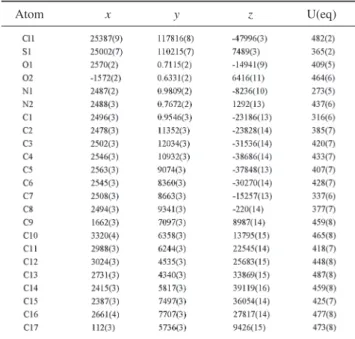
Crystallographic data and experimental details for structural analyses are summarized in Table 1. The atomic coordinates and equivalent isotropic displacement parameters for the nonhydrogen atoms are listed in Table 2.
In the crystal structure, the direction of the carbonyl is
opposite to that of thiocarbonyl. The existence of hydrogen bonds in a benzoylthiourea molecular provides evidence for the coordination properties, suggesting the possibility of an intramolecular hydrogen-bond-controlled coordination behaviour of these ligands. For example,5 in the compound
cis-bis(N-benzoyl-N′-propylthiourea)dichloroplatinum, the S atoms of two ligands are coordination to Pt(II), while the carbonyl O atom is still bound to N2–H, which is similar to a free ligand. The molecules also feature intra & intermolecular N–H·O hydrogen bonds (See hydrogen-bond geometry Table 3).
acknowledgements
Financial support from the 863 High Technology Program, the Qing-Lan program of Jiangsu Province, Kua-Shi-Ji program of Education Ministry of China (for Pan), the Talent Foundation of Jiangsu Province (BK2006513), the Major State Basic Research Development Program (Grant No. 2006CB806104), and Twenty-one Century Talent Foundation of the Ministry of Education is acknowledged.
References
1. M. Schuster, B. Kugler, and K. H. Konig, Fresenius' J. Anal. Chem., 1990, 338, 717.
2. F. A. Frech, E. J. Blanz, J. R. D. Amaral, and D. A. French, J. Med. Chem., 1970, 13, 1117.
3. V. K. Madan and A. D. Taneja, J. Indian Chem. Soc., 1991, 68, 471.
4. (a) T. P. Yoon and E. N. Jacobsen, Angew. Chem. Int. Ed., 2005, 44, 466. (b) T. Okino, S. Nakamura, T. Furukawa, and Y. Takemoto, Org. Lett., 2004, 6, 625. (c) H. Huang and E. N. Jacobsen, J. Am. Chem. Soc. 2006, 128, 7170. 5. S. Bourne and K. R. Koch, J. Chem. Soc. Dalton Trans.,
1993, 2071.
Table 2 Atomic coordinates (×105) and equivalent isotropic displacement parameters (Å2 × 10⁴) for (S)-1-(4-chloro- benzoyl)-3-(1-hydroxy-3-phenylpropan-2-yl)thiourea
Atom x y z U(eq)
Table 3 Hydrogen-bonding geometry (Å, ˚)
D-H...A D-H H...A D...A D-H...A N1-H1B...O2 0.90(2) 2.37(2) 2.963(2) 123.6(17) N2-H2B...O1 0.89(3) 2.01(3) 2.648(3) 128(2) N2-H2B...O2 0.89(3) 2.60(3) 3.244(2) 129(2) O2-H2C...O1 0.87(3) 2.58(3) 3.091(2) 119(2)