
Methane Hydrate in Marine Sands: Its Reservoir Properties, Gas Production Behaviors, and Enhanced Recovery Methods
10
0
0
全文
(2) 114. and very fine sand) reservoir5)∼7). The China Geological Survey conducted production tests at clayey silt reservoirs in the South China Sea in 2017 and 2019-2020 and also confirmed continuous gas production 8),9). Other countries, including the USA, India, and New Zealand, have also conducted exploration for methane hydrate in marine sands. Studies of reservoir properties and gas production behaviors of methane hydrate in marine sands have progressed extensively during the past two decades. Research projects in the Nankai Trough were undertaken by the Research Consortium for Methane Hydrate Resources in Japan (also known as MH21) from FY 2001 to FY 2018 and had been carried on by the MH21-S R&D consortium from FY 2019 onward. Herein, we summarize findings about methane hydrate in marine sands obtained mainly from the MH21 research project. We first show the reservoir properties of the Nankai Trough and related findings. Secondly, we explain key findings regarding the gas production behavior of methane hydrate in marine sands obtained from numerical and experimental studies. Finally, we introduce stateof-the-art enhanced recovery methods for methane hydrate in marine sands and look toward future commercial production. 2.. Reservoir Properties. 2. 1. Pore-filling Hydrate in Marine Sands Naturally occurring oceanic methane hydrate varies according to interactions between methane flux and the surrounding environment. Pore-filling hydrate occurs in coarse sands whereas veined or nodule-type hydrate is more common in fine-grained sediments10). Seafloor hydrate can exist in areas of active gas seepage11). The Ministry of International Trade and Industry (MITI), presently the Ministry of Economy, Trade, and Industry (METI), planned an exploratory well named “Nankai Trough,” which was conducted as a part of the 8th Five-Year Plan for Domestic Petroleum and Natural Gas Resource Development by the Japanese government, launched in fiscal year 1995. In late 1999, the MITI Nankai Trough wells confirmed the presence of methane hydrate in the intergranular pores of turbiditic sands12). The METI announced “Japan’s Methane Hydrate R&D Program” in FY 2001 and established the MH21 R&D consortium, which initiated an ongoing comprehensive study of the reservoir properties of pore-filling hydrate in marine sands. The discovery of pore-filling hydrate in marine sands in 1999 led to related research projects around the world. At present, pore-filling hydrates in marine sand/silt have been identified in the Gulf of Mexico, the Krishna-Godavari Basin (offshore India), the Black Sea, the Shenhu area of the South China Sea, the Tsushima Basin in the Sea of Japan, and the Hikurangi margin of New Zealand,. among others. 2. 2. Reservoir Properties of Pore-filling Hydrate in Marine Sands In this section, we summarize the reservoir properties of the eastern Nankai Trough for the first and the second offshore production test sites as well as related findings from pore-filling hydrate in marine sands. To obtain basic information for methane hydrate reservoir characterization at the first offshore production test site, located on the northwestern slope of the Daini-Atsumi Knoll in the eastern Nankai Trough, extensive geophysical logging and pressure coring were conducted in 201213). Pressure coring is a technology by which sediment samples (core) are obtained under in-situ pressure to avoid hydrate dissociation during coring. This technology first appeared in the 1980s-1990s, when it was used to successfully collect hydrate-bearing sediment samples14),15). In the project of the eastern Nankai Trough in 2012, a cutting edge coring system (the Hybrid Pressure Coring System) was used16). Figure 1 compares geophysical logging data obtained in the AT1-MC well with core analysis results from the AT1-C well13). Hydrate-bearing sediment comprises thin alternations of sand and mud layers in the upper part (lobe/sheet-type sand sequences composed of more than 20 thin sand layers with thicknesses of 30-70 cm) and relatively thick sand-dominated sequences in the lower part (channel-type sand sequences with thicknesses ranging from several tens of cm to 2 m). Detailed lithological features were described via conventional core and postdissociation pressure core analyses17),18). Semi-quantitative bulk minerals included quartz, orthoclase, plagioclase, mica, hornblende, smectite, chlorite, kaolinite, organic calcium carbonate (mostly calcareous nannofossils), and pyrite19). Total porosity was calculated from geophysical logging data by correcting for the influence of washout and compaction; the total porosity was found to be 40-50 % 20), which matches pressure core-derived porosities. Hydrate saturation inside pores of 50-80 % was observed in the upper and lower sandy layers, which was confirmed by comparing geophysical logging data with pressure core-derived values. Chemical and crystallographic analyses of methane hydrate and dissociated gas derived from pressure cores showed that the gas hydrate mainly contained microbial methane in structure I with a hydration number of 6.1, and that more than 99 % of the gas present was methane21). In this exploration, state-of-the-art pressure core analysis technologies were developed and extensively used for pore-filling hydrate in marine sands. Until 2004, when core sample pressure was reduced to atmospheric conditions, the core was treated with liquid nitrogen to enable the preservation of hydrate and analyzed in onshore laboratories 22). This process. J. Jpn. Petrol. Inst., Vol. 64,. No. 3, 2021.
(3) 115. Fig. 1 Geophysical Logging Data Obtained in the AT1-MC Well and Comparison with Core Analysis Results from the AT1-C Well13) Reprinted from Marine and Petroleum Geology, 66, (2), Tetsuya Fujii, Kiyofumi Suzuki, Tokujiro Takayama, Machiko Tamaki, Yuhei Komatsu, Yoshihiro Konno, Jun Yoneda, Koji Yamamoto, Jiro Nagao, Geological setting and characterization of a methane hydrate reservoir distributed at the first offshore production test site on the Daini-Atsumi Knoll in the eastern Nankai Trough, Japan, 310-322, Copyright 2015 The Authors. Published by Elsevier Ltd. under the CC BY-NC-ND license (http://creativecommons.org/licenses/ by-nc-nd/4.0/).. inevitably damages the core sample due to both pressure release and liquid nitrogen treatment. To mitigate this problem, it is proposed to use pressure core analysis technology to measure pressure core samples without pressure release or liquid nitrogen treatment. Consequently, petrophysical properties, such as the permeability and mechanical strength of hydrate-bearing sediments, can be analyzed while minimizing the influence of core handling and treatment. Among the most important findings obtained from pressure core analysis was that hydrate-bearing sands have greater permeability than expected. The effective permeability of hydrate-bearing sandy sediments was in the range. of 1-100 md, 2-3 orders of magnitude higher than conventional estimates23). These values were obtained using three different cutting edge pressure core analysis tools developed by the Geotek Ltd. (UK) in collaboration with the University of Calgary, Georgia Institute of Technology and the U.S. Geological Survey, and the National Institute of Advanced Industrial Science and Technology (AIST) of Japan 24)∼26). In addition, a large volume of data concerning the mechanical properties of hydrate-bearing sandy sediments and hydrate morphologies in their pore spaces were obtained using this technology22),27)∼29). An analysis scheme for evaluating the reservoir prop-. J. Jpn. Petrol. Inst., Vol. 64,. No. 3, 2021.
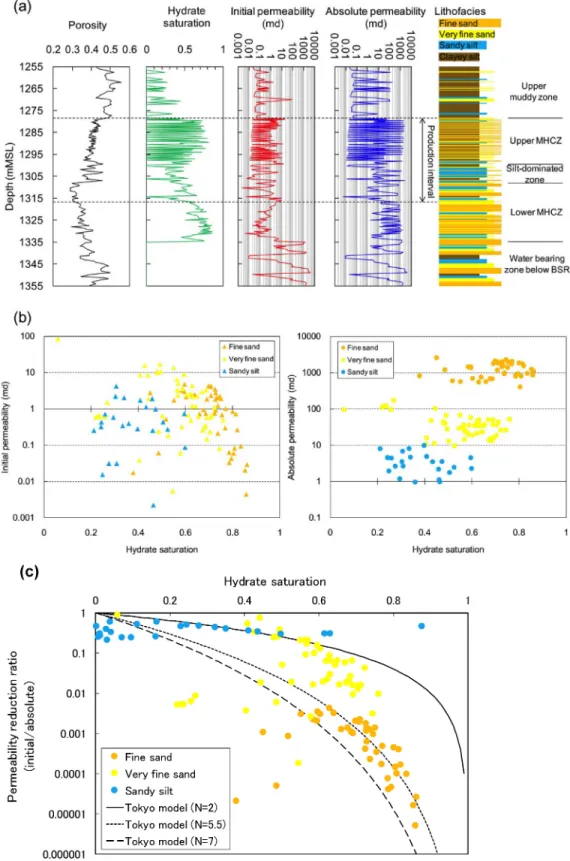
(4) 116. erties of pore-filling hydrates in marine sands was established during the Nankai Trough project and applied to India’s National Gas Hydrate Program Expedition (NGHP) 02 in 2015 as part of a collaboration between India, the USA, and Japan. Comprehensive geochemical and geophysical data were obtained from pressure cores recovered from the Krishna-Godavari Basin and compared with the results of the Nankai Trough30)∼37). Petrophysical properties such as permeability obtained from the NGHP-02 were consistent with results from the Nankai Trough. Currently, an analysis scheme combining geophysical logging with pressure core analysis has become standard in the exploration of methane hydrate-bearing sands. 2. 3. Reservoir Modeling for Numerical Simulations One of the most important reasons for analyzing reservoir properties is the development of reservoir models for numerical simulation in order to predict and analyze gas production behavior. In the first and second production tests conducted at the Nankai Trough, a reservoir model supported by geophysical logging and pressure core analysis was developed and modified through history-matching simulations with production test data. Figure 2 shows the reservoir model constructed for the first production test at the Nankai Trough6),38). The lithofacies were categorized by fine sand, very fine sand, sandy silt, and clayey silt. Initial effective permeability (water permeability in the presence of hydrate) showed similar values in different lithofacies and hydrate saturation states. Hydrate saturation exhibited a positive correlation with absolute permeability (permeability without hydrate), indicating that hydrate accumulation was controlled by absolute permeability, which is linked to lithofacies, and terminated when effective permeability reached a certain value. Permeability reduction ratio (the ratio of initial to absolute permeability) depends on hydrate saturation and lithofacies. The permeability reduction index N of the Tokyo model proposed by Masuda et al. 39) and frequently used in reservoir modeling ranges from approximately 2 to 7. The Tokyo model is expressed as kd=kd 0 (1−Sh)N, where, kd, kd 0, and Sh are effective permeability, absolute permeability, and hydrate saturation, respectively. In this study, a value of 5.5 shows good agreement with highly hydrate-saturated fine sand. Note that the value of N changes according to both discretization of the model (grid size) and specific physical properties. Reservoir models of the Krishna-Godavari Basin were also constructed based on geophysical logging and pressure core analyses of the NGHP-02 and used for the prediction of gas production behavior in planned production tests40),41). Knowledge of reservoir properties and modeling obtained from research projects in the. Nankai Trough and Krishna-Godavari Basin have served as an international code comparison study of coupled thermal, hydrologic, and geomechanical processes in natural gas hydrate-bearing sediments42). 3.. Gas Production Behavior. 3. 1. Production Methods Gas production from methane hydrate in marine sands is feasible when using systems developed for the oil and gas industry. Methane hydrate is a solid phase and has no mobility; thus, it should be dissociated in sediments prior to gas production. Depressurization, thermal injection, and inhibitor injection are the three common methods of hydrate dissociation proposed by Makogon43). Depressurization decreases the pressure below the three-phase equilibrium condition. Thermal injection supplies heat by thermal fluid injection or heat conduction and increases the temperature above the three-phase equilibrium condition. Inhibitor injection changes the three-phase equilibrium condition itself toward low temperature and high pressure conditions via the injection of hydrate inhibitors such as methanol. In addition, CO2 injection has been proposed since the mid-1990s44),45), in which hydrate CO2 is injected to form hydrate for heat generation and enable the dissociation of methane hydrate. Methane gas generated from dissociated hydrate is obtained through the production well according to any production method. Thus far, depressurization is considered to be the most promising method due to its simplicity, high energy efficiency, and low environmental load. 3. 2. Rate-determining Factor In any production method, gas production from methane hydrate reservoirs is determined by the kinetics of hydrate dissociation, heat transfer, and mass transfer (fluid flow). The kinetics of hydrate dissociation determine the release speed of methane molecules from hydrate water cavities; in other words, this denotes the collapse speed of hydrate. As an endothermic reaction, heat transfer controls hydrate dissociation. Fluid flow also controls hydrate dissociation by limiting the removal rate of methane molecules from the hydrate surface and their flow speed toward the production well. The relative importance of these three factors determines the overall gas production rate from methane hydrate reservoirs. Thus far, numerical and experimental analyses have demonstrated that heat transfer and fluid flow are the predominant factors, whereas the effects of hydrate dissociation kinetics are very limited46). Figure 3 shows the results of numerical simulations of gas productivity on the depressurization of a class 3 hydrate reservoir when the flowing bottom hole pressure (FBHP) is decreased to 4 MPa47). Class 3 hydrate reservoirs are isolated hydrate reservoirs which are not in contact with any hydrate-free zones with mobile. J. Jpn. Petrol. Inst., Vol. 64,. No. 3, 2021.
(5) 117. Fig. 2 Reservoir Model Constructed for the First Production Test at the Eastern Nankai Trough: (a) depth profiles of effective porosity, hydrate saturation, and initial effective and absolute permeabilities with lithofacies, (b) relation between initial/absolute permeability and hydrate saturation, and (c) relation between permeability reduction ratio (ratio of initial effective permeability and absolute permeability) and hydrate saturation6),38) Fig. (a) and (b): Reprinted with permission from Yoshihiro Konno, Tetsuya Fujii, Akihiko Sato, Koya Akamine, Motoyoshi Naiki, Yoshihiro Masuda, Koji Yamamoto, and Jiro Nagao: Key Findings of the World’s First Offshore Methane Hydrate Production Test off the Coast of Japan: Toward Future Commercial Production. Energy & Fuels, 31, (3), 2607-2616, DOI: 10.1021/acs.energyfuels.6b03143. Copyright 2017 American Chemical Society. Fig. (c): Modified from Konno et al.38). J. Jpn. Petrol. Inst., Vol. 64,. No. 3, 2021.
(6) 118. Productivity function (PF) is an indicator of gas productivity, which is a function of gas production rate, water production rate, discount rate, and price of gas. PF is a kind of net present value of cumulative gas produced by one production well. A high value of PF indicates high gas productivity. Fig. 3 Productivity Function Contour Map of Class 3 (FBHP: 4 MPa)47) Reprinted with permission from Yoshihiro Konno, Yoshihiro Masuda, Yosuke Hariguchi, Masanori Kurihara, and Hisanao Ouchi: Key Factors for Depressurization-Induced Gas Production from Oceanic Methane Hydrates. Energy & Fuels, 24, (3), 1736-1744, DOI: 10.1021/ef901115h. Copyright 2010 American Chemical Society.. fluids; this is common in oceanic hydrates 48). Obtained results demonstrate that gas productivity increases with the initial reservoir temperature provided that the initial effective permeability (water permeability of hydrate-bearing sediment) is higher than a certain threshold value. The threshold permeability was estimated to be between 1 mD and 10 mD. Gas production rates became extremely low, failing to meet commercial requirements when the initial effective permeability was lower than the threshold value. This occurred because hydrate dissociation took place only at the surface of the hydrate-bearing zone under weak pressure propagation and indicates that fluid flow is the most important rate-determining factor in reservoirscale gas production. If the initial effective permeability was higher than the threshold value, gas productivity was proportional to the initial reservoir temperature. Figure 4 shows a schematic of gas production behavior under depressurization49). High initial reservoir temperatures generate a large amount of sensible heat when reservoir temperatures decrease owing to the endothermic hydrate dissociation reaction. The sensible heat generated drives hydrate dissociation during the early production stage. When sensible heat is exhausted, gas production is controlled instead by a weak heat supply from overburden and underburden. In this stage of production, heat transfer becomes the rate-determining factor. On the other hand, laboratory experiments showed that gas production was almost entirely controlled by heat transfer50). This is because the pressure reduction is immediately propagated from end to end of the core due to short core lengths of a few centimeters. Thus,. Fig. 4 Schematic of Production Behavior Using Depressurization Method49) [Experimental evaluation of the gas recovery factor of methane hydrate in sandy sediment, Yoshihiro Konno, Yusuke Jin, Kazunori Shinjou and Jiro Nagao, RSC Adv., 4, 51666-51675 (2014). DOI: 10.1039/C4RA08822K] - Reproduced by permission of The Royal Society of Chemistry.. core-scale laboratory experiments are not appropriate alternative analyses to determine gas production behaviors. To overcome this problem, we propose a unique large-scale pressure vessel referred to as the High-pressure Giant Unit for Methane hydrate Analyses (HiGUMA), designed based on a numerical analysis to obtain flow-dominant gas production 51). HiGUMA has an inner diameter of 1.0 m and uses a sample height of 1.1 m. It has been used for the analysis of production behavior and applied to the development of enhanced recovery methods49). 3. 3. Production Rate and Recovery Factor As described above, gas production rates and the recovery factor are determined by fluid flow and heat transfer. As shown in Fig. 4, the gas production rate in the early production stage is controlled by the permeability of hydrate-bearing sediments and is considered to increase with time over several years according to the sensible heat of the reservoir. This increase occurs because the effective permeability of hydrate-bearing sediments also increases with hydrate dissociation. This phenomenon has been observed in flow-dominant laboratory experiments and numerical simulations; however, it has not yet been confirmed by gas production tests in natural fields. Discrepancies between synthesized and real conditions may result from the relative shortness of field test time or complex physical phenomena that are not fully taken into consideration. Longterm production tests (around one year) can be used to evaluate the former. To assess the latter, phenomena such as fine migration around the production well, the swelling of clay minerals by freshwater generation originating from hydrate dissociation, sediment compaction, relative permeability change, and secondary hydrate formation may hinder the increase of permeability and gas production rate.. J. Jpn. Petrol. Inst., Vol. 64,. No. 3, 2021.
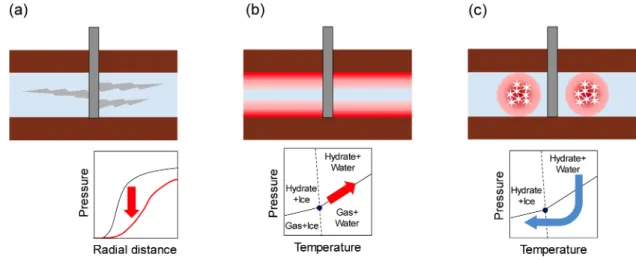
(7) 119. The ultimate recovery factor of methane hydrate could be almost equivalent to that of natural gas (∼80 %) provided that all methane hydrate dissociates; however, a lower recovery factor is considered more realistic. Numerical and experimental studies have shown that the potential economic recovery factor is around 40 % when applying depressurization. This value is defined by the sensible heat of the reservoir. Thin alternations between layers of sand and mud are beneficial because mud layers rapidly supply heat to methane hydrate in neighboring sand layers; however, the heat of the reservoir is insufficient to dissociate all hydrate when considering the temperature range of the hydrate stability zone and the temperature of dissociation above the quadruple point of methane hydrate. Fig. 5 Schematic of Production Behavior Change when Applying Enhanced Recovery. (2.56 MPa, 273 K). Although all hydrate can ultimately dissociate using heat transferred from the overburden and underburden (i.e., outside the hydrate-concentrated zone), the production rate determined by heat transfer is extremely low and not economically feasible. 4.. Enhanced Recovery Methods. Depressurization is considered to be a primary production method; however, enhanced recovery methods will become necessary to ensure the commercial viability of methane hydrate production. As described above, fluid flow and heat transfer control gas production rate and recovery factor. Thus, enhanced recovery of methane hydrate reservoirs should entail enhancements of permeability and usable heat for hydrate dissociation. As shown in Fig. 5, permeability enhancement basically increases gas production rate owing to rapid pressure propagation and enlargement of the hydrate dissociation zone. Heat supply enhancement, on the other hand, causes an increase in the amount of dissociable hydrate, resulting in an increase of recovery factor, ultimately to that of conventional natural gas. 4. 1. Permeability Enhancement Similar to the production of shale gas, the primary method for permeability enhancement is hydraulic fracturing. Hydraulic fracturing of hydrate reservoirs is applied prior to and during production (Fig. 6(a)). The purpose of hydraulic fracturing prior to production is the expansion of the drainage radius inducing increasing production rate at an early stage. Hydraulic fracturing during production is applied to eliminate reservoir formation damage around the well52). The fracturing behavior of hydrate-bearing sediments was not revealed until recently. Our research group. Hydraulic fracturing increases drainage radius and enhances production rate. Cyclic depressurization stops production until temperature recovers via geothermal processes and depressurization restarts. Deep depressurization supplies heat from ice formation by intentionally decreasing pressures below the quadruple point of methane hydrate. The latter two methods enhance the recovery factor. Fig. 6 Possible Enhanced Recovery Methods: (a) hydraulic fracturing, (b) cyclic depressurization, and (c) deep depressurization J. Jpn. Petrol. Inst., Vol. 64,. No. 3, 2021.
(8) 120. conducted laboratory experiments to confirm the viability of hydraulic fracturing in hydrate-bearing sediments53). These results demonstrated that fracture behavior yielded a consolidated-rock-like fracturing mode, i.e., the tensile failure mode at which the fracturing pressure was 2.9-3.9 MPa above the minimum principal stress. Permeability was increased after fracturing and maintained even after re-confining and closing the fractures. This indicates that hydraulic fracturing can be applied to enhance the permeability of methane hydrate reservoirs. Supportive data have subsequently been reported by other research groups54),55) and microfracturing was put into practice in the offshore production test in the South China Sea to overcome the low permeability of clayey silt hydrate reservoirs8). Fractures obtained in tensile failure mode were oriented perpendicular to the minimum principal stress, indicating that fractures in hydrate-bearing marine sediments may occur parallel to the seafloor when horizontal stresses exceed vertical stresses in shallow marine sediments. 4. 2. Heat Supply Enhancement Normal depressurization cannot dissociate all hydrate present; thus, a heat supply is necessary to increase the recovery factor. Nonetheless, an artificial heat supply decreases the energy efficiency of production, which is known as Energy Return on Investment (EROI). EROI is defined as the ratio of the amount of energy delivered from energy resources to the amount of energy used to obtain the energy resource. The MH21 R&D consortium evaluated the EROI for depressurization-induced gas production from oceanic methane hydrates. For offshore platforms and subsea to land systems, the EROI was estimated at around 10-16, i.e., inferior to those of imported coal and crude oil but almost the same as those of heavy oil56). Although this calculation is subject to many uncertainties, its results indicate that there is limited additional energy available for generating heat to enhance recovery. One possible solution for this problem is the use of geothermal energy. We proposed the Cyclic Depressurization method, which uses alternating depressurization and shut-in periods over decades to effectively harness the geothermal heat fluxes from the overburden and underburden (Fig. 6(b)) 57). It is ineffective to continue gas production determined by heat transfers because the gas production rate is too low to technically and economically maintain the production system. Thus, the Cyclic Depressurization method ceases production after exhausting the sensible heat of the reservoir and enables the storage of geothermal heat for decades. Numerical studies showed that the recovery factor of a hypothetical field increased from 42.4 to 71.5 % when an appropriate shut-in period was chosen. Using variable shut-in periods, it was found that 20 years of shut-in is the most effective for the next de-. pressurization cycles in this study. Additionally, the number of operating wells in each field was reduced to less than one-third (51 wells at most in a conceptual operation plan) compared with the operation using the normal depressurization method only without decreasing the field production rate. Cyclic Depressurization entails a multi-well operating strategy of methane hydrate field development. The modifications of this method may include aggressive water injection pumped from warm sediments at depth. The other novel solution is the enhancement of ice formation by decreasing the production pressure below the quadruple point of methane hydrate (Fig. 6(c))49),58). When the pressure decreases below the quadruple point, methane hydrate dissociates into gas and ice instead of gas and liquid water. In terms of thermodynamics, ice formation is desirable because the dissociation heat under the ice formation regime is approximately onethird of that under the water generation regime at the freezing point of water. However, according to fluid dynamics, the presence of ice may reduce the permeability of sediments, reducing gas productivity58). We have evaluated the positive and negative effects of ice formation both experimentally and numerically. Corescale experiments and their history-matching simulations showed that ice formation enhances the gas production rate58). The present large-scale (flow-dominant) experiment using HiGUMA also demonstrated that ice formation enhances hydrate dissociation and positively influences gas production. It was found that 65 % of in-place methane could be produced when the production pressure was decreased to 2.1 MPa, which is below the quadruple point49). This method, named Deep Depressurization, will provide another solution for enhanced recovery after depletion of sensible heat. 5.. Conclusions. In this study, we summarized recent research progress on reservoir properties, gas production behavior, and enhanced recovery methods for methane hydrate in marine sands. Reservoir evaluation combined with geophysical logging and pressure core analysis revealed that methane-hydrate-bearing marine sands are characterized by an initial effective permeability that is favorable to depressurization-induced gas production. The feasibility of depressurization-induced gas production for this type of reservoir has been confirmed by numerical simulations, laboratory experiments, and field tests over timescale of around one month; however, enhanced recovery methods are necessary to improve economic efficiency. Securing a positive EROI is a constraint conditional on enhanced recovery methods. Among many proposed methods, hydraulic fracturing and extension of depressurization methods, such as Cyclic Depressurization and Deep Depressurization, are prom-. J. Jpn. Petrol. Inst., Vol. 64,. No. 3, 2021.
(9) 121. ising methods for the enhancement of production rates and recovery factors without decreasing the EROI. Although it is beyond the scope of this study, securing a stable production is a crucial future issue for commercial production. This includes water management, sand management, and well survivability during geomechanical reservoir responses by production. Understanding dynamic changes in physical properties such as permeability will be key to mitigate these issues. Laboratory and numerical research should be conducted based on observation from longterm (about a year) field tests in the future. Furthermore, the development of a total production system is necessary (e.g., well system, subsea system, platform, and flowline). The production system requires the expertise of various disciplines, including petroleum engineering, ocean engineering, and subsea engineering. In addition to technical aspects, the system should be defined taking in consideration the many stakeholders involved, ranging from governments to local communities59). Such systems have architectural uncertainty and should be evaluated across a wide tradespace in order to explore promising concepts and critical technologies59). In conclusion, there are still many challenges to overcome in the proposed technologies; however, these challenges should be resolvable using an interdisciplinary approach. The application of the technologies described herein should enable commercial gas production from methane hydrate in marine sands.. 10). 11) 12) 13). 14) 15) 16) 17) 18). 19). 20) 21). 22). Acknowledgment Most of this paper is based on the studies funded by the Ministry of Economy, Trade and Industry (METI), Japan through the MH21/MH21-S R&D consortium. We gratefully acknowledge the financial support and permission to publish this paper. References. 23). 24). 25) 26). 1) Sloan Jr., E. D., Koh, C. A., “Clathrate hydrates of natural gases,” CRC press, (2007). 2) Sloan, E. D. F., Nature, 426, (6964), 353 (2003). 3) Boswell, R., Collett, T. S., Energy & Environmental Science, 4, (4), 1206 (2011). 4) Boswell, R., Science, 325, (5943), 957 (2009). 5) Yamamoto, K., Kanno, T., Wang, X. X., Tamaki, M., Fujii, T., Chee, S. S., Wang, X.-W., Pimenov, V., Shako, V., RSC Advances, 7, (10), 5554 (2017). 6) Konno, Y., Fujii, T., Sato, A., Akamine, K., Naiki, M., Masuda, Y., Yamamoto, K., Nagao, J., Energy & Fuels, 31, (3), 2607 (2017). 7) Yamamoto, K., Wang, X. X., Tamaki, M., Suzuki, K., RSC Advances, 9, (45), 25987 (2019). 8) Li, J. F., Ye, J. L., Qin, X. W., Qiu, H. J., Wu, N. Y., Lu, H. L., Xie, W. W., Lu, J. A., Peng, F., Xu, Z. Q., Lu, C., Kuang, Z. G., Wei, J. G., Liang, Q. Y., Lu, H. F., Kou, B. B., China Geology, 1, (1), 5 (2018). 9) Ye, J. L., Qin, X. W., Xie, W. W., Lu, H. L., Ma, B. J., Qiu, H. J., Liang, J. Q., Lu, J. A., Kuang, Z. G., Lu, C., Liang, Q. Y., Wei,. 27). 28). 29). 30). 31). 32). 33). J. Jpn. Petrol. Inst., Vol. 64,. S. P., Yu, Y. J., Liu, C. S., Li, B., Shen, K. X., Shi, H. X., Lu, Q. P., Li, J., Kou, B. B., Song, G., Li, B., Zhang, H. E., Lu, H. F., Ma, C., Dong, Y. F., Bian, H., China Geology, 3, (2), 197 (2020). Waite, W. F., Santamarina, J. C., Cortes, D. D., Dugan, B., Espinoza, D. N., Germaine, J., Jang, J., Jung, J. W., Kneafsey, T. J., Shin, H., Soga, K., Winters, W. J., Yun, T.-S., Reviews of Geophysics, 47, (4), (2009). Ruppel, C. D., Waite, W. F., Journal of Geophysical Research: Solid Earth, 125, (8), (2020). Tsuji, Y., Ishida, H., Nakamizu, M., Matsumoto, R., Shimizu, S., Resource Geology, 54, (1), 3 (2004). Fujii, T., Suzuki, K., Takayama, T., Tamaki, M., Komatsu, Y., Konno, Y., Yoneda, J., Yamamoto, K., Nagao, J., Marine and Petroleum Geology, 66, 310 (2015). Kvenvolden, K. A., Cameron, D., Initial Reports of the DSDP, 76, 367 (1983). Dickens, G. R., Paull, C. K., Wallace, P., Nature, 385, (6615), 426 (1997). Inada, N., Yamamoto, K., Marine and Petroleum Geology, 66, 323 (2015). Komatsu, Y., Suzuki, K., Fujii, T., Marine and Petroleum Geology, 66, 358 (2015). Ito, T., Komatsu, Y., Fujii, T., Suzuki, K., Egawa, K., Nakatsuka, Y., Konno, Y., Yoneda, J., Jin, Y., Kida, M., Nagao, J., Minagawa, H., Marine and Petroleum Geology, 66, 368 (2015). Egawa, K., Nishimura, O., Izumi, S., Fukami, E., Jin, Y., Kida, M., Konno, Y., Yoneda, J., Ito, T., Suzuki, K., Nakatsuka, Y., Nagao, J., Marine and Petroleum Geology, 66, 379 (2015). Suzuki, K., Takayama, T., Fujii, T., Marine and Petroleum Geology, 66, 388 (2015). Kida, M., Jin, Y., Watanabe, M., Konno, Y., Yoneda, J., Egawa, K., Ito, T., Nakatsuka, Y., Suzuki, K., Fujii, T., Nagao, J., Marine and Petroleum Geology, 66, 396 (2015). Jin, Y., Konno, Y., Yoneda, J., Kida, M., Nagao, J., Energy & Fuels, 30, (7), 5547 (2016). Konno, Y., Yoneda, J., Egawa, K., Ito, T., Jin, Y., Kida, M., Suzuki, K., Fujii, T., Nagao, J., Marine and Petroleum Geology, 66, 487 (2015). Santamarina, J. C., Dai, S., Terzariol, M., Jang, J., Waite, W. F., Winters, W. J., Nagao, J., Yoneda, J., Konno, Y., Fujii, T., Suzuki, K., Marine and Petroleum Geology, 66, 434 (2015). Priest, J. A., Druce, M., Roberts, J., Schultheiss, P., Nakatsuka, Y., Suzuki, K., Marine and Petroleum Geology, 66, 460 (2015). Yoneda, J., Masui, A., Konno, Y., Jin, Y., Kida, M., Katagiri, J., Nagao, J., Tenma, N., Marine and Petroleum Geology, 86, 1 (2017). Yoneda, J., Masui, A., Konno, Y., Jin, Y., Egawa, K., Kida, M., Ito, T., Nagao, J., Tenma, N., Marine and Petroleum Geology, 66, 451 (2015). Yoneda, J., Masui, A., Konno, Y., Jin, Y., Egawa, K., Kida, M., Ito, T., Nagao, J., Tenma, N., Marine and Petroleum Geology, 66, 471 (2015). Konno, Y., Jin, Y., Yoneda, J., Kida, M., Egawa, K., Ito, T., Suzuki, K., Nagao, J., Marine and Petroleum Geology, 66, 425 (2015). Muraoka, M., Ohtake, M., Susuki, N., Morita, H., Oshima, M., Yamamoto, Y., Marine and Petroleum Geology, 108, 321 (2019). Oshima, M., Suzuki, K., Yoneda, J., Kato, A., Kida, M., Konno, Y., Muraoka, M., Jin, Y., Nagao, J., Tenma, N., Marine and Petroleum Geology, 108, 439 (2019). Kida, M., Jin, Y., Yoneda, J., Oshima, M., Kato, A., Konno, Y., Nagao, J., Tenma, N., Marine and Petroleum Geology, 108, 471 (2019). Yoneda, J., Oshima, M., Kida, M., Kato, A., Konno, Y., Jin, Y., No. 3, 2021.
(10) 122 Jang, J., Waite, W. F., Kumar, P., Tenma, N., Marine and Petroleum Geology, 108, 482 (2019). Kato, A., Konno, Y., Yoneda, J., Kida, M., Oshima, M., Jin, Y., Nagao, J., Tenma, N., Marine and Petroleum Geology, 108, 502 (2019). Yoneda, J., Oshima, M., Kida, M., Kato, A., Konno, Y., Jin, Y., Tenma, N., Marine and Petroleum Geology, 108, 512 (2019). Yoneda, J., Oshima, M., Kida, M., Kato, A., Konno, Y., Jin, Y., Jang, J., Waite, W. F., Kumar, P., Tenma, N., Marine and Petroleum Geology, 108, 524 (2019). Jang, J., Dai, S., Yoneda, J., Waite, W. F., Stern, L. A., Boze, L. G., Collett, T. S., Kumar, P., Marine and Petroleum Geology, 108, 537 (2019). Konno, Y., Jin, Y., Yoneda, J., Kida, M., Katagiri, J., Fujii, T., Sato, A., Nagao, J., Proceedings of the 9th International Conference on Gas Hydrates, Denver, Colorado, USA, 25-30 June, (2017). Masuda, Y., Naganawa, S., Ando, S., Sato, K., Proceedings of SPE Asia Pacific Oil & Gas Conference and Exhibition, (1997), #38291. Boswell, R., Myshakin, E., Moridis, G., Konno, Y., Collett, T. S., Reagan, M., Ajayi, T., Seol, Y., Marine and Petroleum Geology, 108, 154 (2019). Konno, Y., Kato, A., Yoneda, J., Oshima, M., Kida, M., Jin, Y., Nagao, J., Tenma, N., Marine and Petroleum Geology, 108, 731 (2019). White, M. D., Kneafsey, T. J., Seol, Y., Waite, W. F., Uchida, S., Lin, J. S., Myshakin, E. M., Gai, X., Gupta, S., Reagan, M. T., Queiruga, A. F., Kimoto, S., IGHCCS2 Participants, Marine and Petroleum Geology, 120, 104566 (2020). Makogon, Y. F., “Hydrates of Hydrocarbons,” Pennwell Books, (1997). Ebinuma, T., U.S. Pat. No. 5,261,490 (1993).. 34). 35) 36). 37). 38). 39). 40). 41). 42). 43) 44). 45) Ohgaki, K., Takano, K., Sangawa, H., Matsubara, T., Nakano, S., J. Chem. Eng. Jpn., 29, (3), 478 (1996). 46) Konno, Y., Masuda, Y., Oyama, H., Kurihara, M., Ouchi, H., J. Jpn. Assoc. Petrol. Technol., 74, (2), 165 (2009). 47) Konno, Y., Masuda, Y., Hariguchi, Y., Kurihara, M., Ouchi, H., Energy & Fuels, 24, (3), 1736 (2010). 48) Moridis, G. J., Kowalsky, M. B., Pruess, K., SPE Reservoir Evaluation & Engineering, 10, (5), 458 (2007). 49) Konno, Y., Jin, Y., Shinjou, K., Nagao, J., RSC Advances, 4, (93), 51666 (2014). 50) Oyama, H., Konno, Y., Masuda, Y., Narita, H., Energy & Fuels, 23, (10), 4995 (2009). 51) Nagao, J., Synthesiology, 5, (2), 89 (2012). 52) Ito, T., Igarashi, A., Suzuki, K., Nagakubo, S., Matsuzawa, M., Yamamoto, K., Proceedings of the 2008 Offshore Technology Conference, Houston, Texas, USA, 5-8 May, (2008). 53) Konno, Y., Jin, Y., Yoneda, J., Uchiumi, T., Shinjou, K., Nagao, J., RSC Advances, 6, (77), 73148 (2016). 54) Too, J. L., Cheng, A., Khoo, B. C., Palmer, A., Linga, P., J. Natural Gas Sci. Eng., 52, 619 (2018). 55) Zhang, W., Shi, X., Jiang, S., Cao, Q., Wang, F., Wang, Z., Ge, Y., Du, Y., J. Natural Gas Sci. Eng., 79, 103338 (2020). 56) Research Consortium for Methane Hydrate Resources in Japan, Comprehensive Report of Phase 2&3 Research Results, (2019). 57) Konno, Y., Masuda, Y., Akamine, K., Naiki, M., Nagao, J., Energy Conversion and Management, 108, 439 (2016). 58) Konno, Y., Uchiumi, T., Oyama, H., Jin, Y., Nagao, J., Masuda, Y., Ouchi, H., Energy & Fuels, 26, (7), 4310 (2012). 59) Matsudaira, Y., Wada, R., Konno, Y., Hashimoto, G., Takagi, K., Proceedings of the 26th ISTE International Conference on Transdisciplinary Engineering, July 30-August 1, (2019), 10, 242, IOS Press, (2019).. 要 旨 海洋砂層中のメタンハイドレート―その貯留層特性,ガス生産挙動,増進回収法― 今野 義浩†1),†2),長尾 二郎†2) †1). 東京大学大学院新領域創成科学研究科海洋技術環境学専攻,277-8561 千葉県柏市柏の葉5-1-5. (国研)産業技術総合研究所 エネルギー・環境領域エネルギープロセス研究部門,062-8517 札幌市豊平区月寒東2条17-2-1. †2). 1999 年の海洋砂層におけるメタンハイドレートの発見以降,. 律速されることを示している。その意味において,砂層型メタ. メタンハイドレート胚胎堆積物に関する我々の理解は急速に進. ンハイドレートが高浸透率を有することは,一次回収としての. 展している。南海トラフのメタンハイドレート貯留層に対して. 減圧法の適用可能性を示唆しているが,減圧法では熱の不足に. 行われた包括的な研究は,この研究に大きく貢献している。検. よりハイドレート分解が制限され,その結果,回収率は 40 %. 層と圧力コア解析を組合せた貯留層評価は,砂層型メタンハイ. 程度に留まってしまう。そのため,商業化の実現性を高めるに. ドレートの探査において標準的な手法となっており,これによ. は増進回収法が必須である。実験および数値計算による研究に. りハイドレート飽和率が 50 ∼ 80 % もの高飽和率に達する場合. よって,水圧破砕は生産レートを高め,地熱を利用する繰り返. でも,有効浸透率が 1 ∼ 100 md の範囲におさまることが明ら. し減圧法や氷の生成潜熱を利用する強減圧法は,エネルギー効. かになった。ガス生産に関する数値計算および実験研究は,減. 率を維持したまま回収率を高めることが明らかになっている。. 圧法によるフィールドスケールのガス生産が流動および伝熱に. J. Jpn. Petrol. Inst., Vol. 64,. No. 3, 2021.
(11)
図


関連したドキュメント