TUMSAT-OACIS Repository - Tokyo University of Marine Science and Technology (東京海洋大学)
Distributions of land hermit crabs (Decapoda:
Coenobitidae) on the coast of the tidal
lagoon, Nagura Amparu, on Ishigakijima Island,
Japan.
著者
Hamasaki Katsuyuki, Fujikawa Shunsuke, Sanda
Tetsuya, Tsuru Takuma, Kitada Shuichi
journal or
publication title
Biogeography : international journal of
biogeography, phylogeny, taxonomy, ecology,
biodiversity, evolution, and conservation
biology
volume
19
page range
142-149
year
2017-10-30
権利
(c) 2017 The Biogeographical Society of Japan.
Posted with approval of the Biogeographical
Society of Japan. It is posted here for your
personal use.
Biogeography 19.
Distributions of land hermit crabs (Decapoda: Coenobitidae) on the coast of
the tidal lagoon, Nagura Amparu, on Ishigakijima Island, Japan
Katsuyuki Hamasaki, Shunsuke Fujikawa, Tetsuya Sanda, Takuma Tsuru and Shuichi Kitada
Department of Marine Biosciences, Tokyo University of Marine Science and Technology, 4-5-7 Konan, Minato, Tokyo 108-8477, Japan
Introduction
Land hermit crabs are mainly distributed in sub-tropical and sub-tropical coastal regions (Hartnoll, 1988). In Japan, five land hermit crab species, including
Coenobita brevimanus Dana, 1852, C. cavipes
Stimpson, 1858, C. purpureus Stimpson, 1858, C.
rugosus H. Milne-Edwards, 1837, and C. violascens
Heller, 1862, are commonly found in the Ryukyu Archipelago and the Bonin Islands (Nakasone, 1988; Asakura, 2004). Land hermit crabs have been a Natural Monument Animal since 1970 in Japan, and some species have been listed as “near threatened” on the Red Lists by the Ministry of the Environment of Japan. In Okinawa Prefecture, however, land
hermit crabs have been traditionally collected as fishing bait and/or ornamental animals, so that even now some traders are collecting land hermit crabs on Okinawajima Island for trade as ornamental animals throughout the entire country under permission of the Agency for Culture Affairs, Ministry of Educa-tion, Culture, Sports, Science and Technology of Japan.
Knowledge on the distributions of land hermit crab species on the islands is indispensable for the in situ conservation of these animals. We investigated the distributional characteristics of land hermit crabs along the coasts of Ishigakijima Island and Iriomote-jima Island in the Ryukyu Archipelago and revealed that the distribution of C. violascens was restricted to the vicinity of the river, mainly in the mangrove estuaries (Fujikawa et al., 2017; Hamasaki et al., in ———————————————————————
*Corresponding author: [email protected]
Abstract. We investigated the distributions of land hermit crabs on the coast of the tidal lagoon, Nagura Amparu, on Ishigakijima Island, Japan, through six surveys conducted during the period from October 2011 to September 2013. Nagura Amparu is a brackish estuary system with a tidal flat and mangrove tree area separated from the outer sea bay by a sandbank. Land hermit crabs were captured using bait traps at three sites along the shoreline of the sandbank facing the inner tidal flat and at one site in the coastal forest on the sandbank. Four land hermit crab species, Coenobita brevimanus, C. cavipes, C. rugosus, and C. violascens, were collected. Almost all collected crabs were C. violascens, and a few C. rugosus were collected on the shoreline. On the other hand, C. cavipes was dominant, followed by C. violascens, and a few C. brevimanus were captured in the coastal forest. Coenobita violascens were juveniles and adults, and they widely inhabited the shoreline and coastal forest. All C. cavipes were juveniles, suggesting that this species utilizes the coastal forest as a nursery ground. Our results highlight the importance of the Nagura Amparu as habitat for juveniles and adults of C. violascens and juveniles of C. cavipes.
Key words: biogeography, Coenobita cavipes, Coenobita violascens, juvenile, terrestrial hermit crab 142–149. Sep. 20, 2017
press). Thus, our previous surveys highlighted the importance of protecting mangrove estuaries to con-serve the C. violascens populations.
On Ishigakijima Island, the largest mangrove area extends from the mouth of Naguragawa River on the western island; this area is a brackish estu-ary system called “Nagura Amparu”, with a tidal flat and mangrove tree area separated from the outer bay by a sandbank (Fig. 1). Coenobita violascens is abundant along the shoreline of the sandbank facing the inner tidal flat (Fujikawa et al., 2017; Hamasaki
et al., in press). However, surveys of land hermit
crab distributions have been limited to the shoreline of the sandbank in the Nagura Amparu. In the pres-ent study, as a basis for further understanding the importance of the Nagura Amparu for the in situ conservation of land hermit crabs, we examined the distributions of land hermit crabs in the coastal for-est as well as along shoreline of the sandbank in the Nagura Amparu.
Materials and Methods
Field study
Fujikawa et al. (2017) investigated the distribu-tions of land hermit crabs along the coast of Irio-motejima Island through visual surveys during day-time and nightday-time and using bait traps overnight. They showed that the number of species of collected crabs was similar between visual and bait-trap sur-veys although the species diversity index (Shannon-Wiener Index H’) was high during visual surveys at night. They also showed that bait traps could collect crabs with various body sizes. It was difficult to conduct effective visual surveys in the coastal forest; therefore, we used bait traps for collecting crabs in the present study.
Land hermit crabs were collected at three sites along the shoreline of the sandbank facing the in-ner tidal flat and one site in the coastal forest on the sandbank in the Nagura Amparu (Fig. 1). The shore-line sites were set in the survey area in our previous study (station no. 13 by Fujikawa et al. (2017)). The coastal forest site is the only location where investigators could easily access the interior forest through a small road crossing the sandbank toward the inner tidal flat. The field surveys were conducted six times from October 2011 to September 2013
Fig. 1. Google Earth photographs showing Ishigakijima Island (right panel) and the tidal lagoon, Nagura Amparu, extending from the river mouth of the Naguragawa River (NGR) (left panel). Land hermit crabs were captured using bait traps at three sites along the shoreline of the sandbank facing the inner tidal flat (white circles) and at one site in the coastal forest on the sandbank (white triangle). A white scale bar in the left panel indicates 250 m.
(October 29–30, 2011; June 29–30, 2012; August 25–26, 2012; October 3–4, 2012; June 22–23, 2013; and September 15–16, 2013). One plastic bucket (20 cm depth, 24.5 cm upper diameter, and 18.5 cm lower diameter; 6 L volume) containing poultry feed was buried at the ground level at each site in the evening of the first day of each survey period. In the following morning, the buckets were harvested, and the collected crabs were counted and morphologi-cally identified in accordance with Nakasone (1988), Asakura (2004) and Hamasaki et al. (2017). The shield length (SL) of collected crabs was measured using Vernier calipers to the nearest 0.1 mm accord-ing to Fujikawa et al. (2017). When a crab could not be removed from the mollusk shell to identify the anterior carapace, the dactylus length of the left third pereiopod was measured and converted into the SL value using a formula established for each
Coeno-bita species according to Fujikawa et al. (2017). The
collected crabs were released on-site after the body size measurements.
The mean values of air temperature and relative
humidity measured in the afternoon and the morning during the survey period were as follows: October 29–30, 2011 (28.0°C, 59.0%); June 29–30, 2012 (30.9°C, 74.0%); August 25–26, 2012 (32.5°C, 71.0%); October 3–4, 2012 (29.0°C, 60.5%); June 22–23, 2013 (27.0°C, 78.3%); and September 15–16, 2013 (31.7°C, 63.6%). Statistical analysis
All statistical analyses were performed using the R statistical software (R3.3.1; R Core Team 2016) with a 5% significance level. A Pearson’s chi-squared test was performed to determine whether the species compositions differed between the shoreline and coastal forest using the numbers of C. cavipes and those of other species. The intraspecific varia-tion in SL values in C. violascens and C. cavipes collected at the shoreline and/or coastal forest sites in the six surveys were evaluated with the Kruskal-Wallis test. The SL values of C. violascens collected at the shoreline and coastal forest sites were com-pared with the Wilcoxon rank-sum test.
Fig. 2. Species compositions of land hermit crabs collected at three sites on the shoreline and one site in the coastal forest from 29 to 30 October 2011, 29 to 30 June 2012, 25 to 26 August 2012, 3 to 4 October 2012, 22 to 23 June 2013, and 15 to 16 September 2013. The numbers of crabs collected at three sites on the shoreline were pooled for each survey period. Values on the bars indicate the total number of crabs collected.
Distributions of land hermit crabs (Decapoda: Coenobitidae) on the coast of the tidal lagoon, Nagura Amparu, on Ishigakijima Island, Japan
Results
The species compositions of land hermit crabs collected at the shoreline and coastal forest sites in the six surveys are shown in Fig. 2. On the shoreline, almost all collected crabs were C. violascens, and only three individuals of C. rugosus were captured in the survey in October 2012. Therefore, the num-bers of crabs collected at the three shoreline sites were pooled. In contrast, three land hermit crab spe-cies were collected in the coastal forest; C. cavipes
was dominant, at 65–95% of the total number of col-lected crabs, in each survey (mean, 84%), followed by C. violascens at 0–35% (15%), and one individu-al of C. brevimanus was collected in the surveys of October 2011 and August 2012, while two individu-als of this species were collected in the survey in September 2013. Thus, the species compositions of land hermit crabs collected by bait traps differed sig-nificantly between the shoreline and coastal forest (χ2
= 53.604–240.49, df = 1, P < 0.0001 in all surveys). The number of crabs collected per bait trap in the six
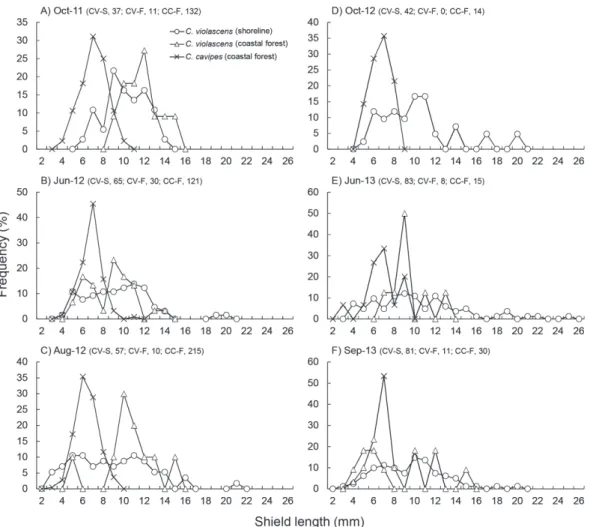
Fig. 3. Size-frequency distributions of C. violascens collected along the shoreline, C. violascens collected in the coastal forest, and C. cavipes collected in the coastal forest from 29 to 30 October 2011 (A), 29 to 30 June 2012 (B), 25 to 26 August 2012 (C), 3 to 4 October 2012 (D), 22 to 23 June 2013 (E), and 15 to 16 September 2013 (F). Numbers of individuals of C. violascens at the shoreline sites (CV-S) and coastal forest site (CV-F) and C. cavipes at the coastal forest site (CC-F) are shown in parentheses in each graph.
Distributions of land hermit crabs (Decapoda: Coenobitidae) on the coast of the tidal lagoon, Nagura Amparu, on Ishigakijima Island, Japan
surveys was 12, 22, 19, 14, 28, and 27 for C.
violas-cens on the shoreline, 11, 30, 10, 0, 8, and 11 for C. violascens in the coastal forest, and 132, 121, 215,
14, 15, and 30 for C. cavipes in the coastal forest, respectively.
The size-frequency distributions of C. violascens collected on the shoreline and those of C. violascens and C. cavipes collected in the coastal forest are shown for the six surveys in Fig. 3. Coenobita
vio-lascens captured on the shoreline mainly occurred in
the size class of less than 16 mm SL and within the range of 2–25 mm, and a significant difference was not found in the SL values among the six surveys (χ2 = 6.3783, df = 5, P = 0.2711). Although the SL
values of C. violascens collected in the coastal
for-est differed significantly among the six surveys (χ2 =
14.664, df = 4, P = 0.0055), a significant difference was not found in the SL values of C. violascens be-tween the shoreline and coastal forest (W = 12793, P = 0.9855). Although a significant difference was also detected in the SL values of C. cavipes collected in the coastal forest among the six surveys (χ2 = 34.044,
df = 5, P < 0.0001), similar unimodal size-frequency distributions with a modal value of 6–7 mm SL were observed throughout the survey periods. The SL val-ues of the three C. rugosus were 2.5 mm, 5.3 mm, and 6.5 mm, and those of the four C. brevimanus were 6.0 mm, 7.1 mm, 9.6 mm, and 11.1 mm.
Of the collected C. violascens, we found small crabs (< around 8–9 mm SL) showing the body color
Fig. 4. Juvenile (A) and adult (B) of C. violascens and juvenile of C. cavipes (C) collected in the present study and adult of C. cavipes (D) collected by one of the authors on Ishigakijima Island.
Distributions of land hermit crabs (Decapoda: Coenobitidae) on the coast of the tidal lagoon, Nagura Amparu, on Ishigakijima Island, Japan
pattern that is specific to the juvenile stage (Hama-saki et al., 2017), i.e., brownish-red pereiopods with white rings at the boundaries between segments (Fig. 4A), and large crabs (> around 8–9 mm SL) showing a grayish-violet body color (Fig. 4B). On the other hand, all individuals of collected C. cavipes showed the juvenile body color pattern (Hamasaki et al., 2017), i.e., brown pereiopods with white rings at the boundaries between segments (Fig. 4C), and large crabs showing a grayish-brown body color were not found (Fig. 4D).
Discussion
In our previous studies, we collected land hermit crabs by hand during the daytime and nighttime via visual surveys along the shoreline of the sandbank facing the inner tidal flat in the Nagura Amparu; three species, C. violascens, C. cavipes, and C.
rugosus, were captured, and C. violascens was the
dominant species, comprising > 90% of the total number of crabs collected in the surveys (Fujikawa
et al., 2017; Hamasaki et al., in press). In the present
study, we collected land hermit crabs using bait traps in the same area in the Nagura Amparu as in our pre-vious studies (Fujikawa et al., 2017; Hamasaki et al., in press); almost all captured crabs were identified as
C. violascens, and a few individuals of C. rugosus
were collected. Thus, the present study confirmed that C. violascens was the dominant species along the shore area in the Nagura Amparu. On the other hand, three land hermit crab species, C. cavipes, C.
violascens, and C. brevimanus, were captured in the
coastal forest, and C. cavipes was abundant among the collected crabs (mean proportion, 84%), followed by C. violascens (15%). Our results demonstrated that the species composition of the land hermit crabs inhabiting the coastal forest was different from that in the shore area in the Nagura Amparu.
The number of crabs collected per bait trap was
similar for C. violascens between the shoreline (12–28 individuals) and coastal forest (8–30 indi-viduals, except for the survey in October 2012, when this species was not collected). Additionally, the body size of C. violascens was not significantly dif-ferent between the shoreline and coastal forest, and juvenile and large-size crabs ranging from 2–25 mm SL were collected. Although we did not examine whether the crab was ovigerous or not in the pres-ent study, it is known that ovigerous females have been observed in C. violascens with > ~8 mm SL on Ishigakijima Island, including the Nagura Amparu (Fujikawa et al., 2017). It has also been reported that early juveniles of C. violascens (< 2 mm SL) com-monly inhabit the shore area of the sandbank facing the inner tidal flat in the Nagura Amparu (Hamasaki
et al., in press). Consequently, it is thought that
megalopae of C. violascens migrate to the Nagura Amparu; then, they settle and acquire empty mol-lusk shells and emigrate from the lagoon onto the land of the sandbank. After migrating onto the land,
C. violascens widely inhabit the shore and coastal
forest areas of the sandbank and grow to reproduce there. In contrast, C. cavipes was only collected in the coastal forest, and all captured crabs had juvenile body color patterns and showed unimodal size fre-quency distributions with a modal value of 6–7 mm SL. It has been reported that ovigerous females of C.
cavipes were commonly observed with > ~7 mm SL
on Ishigakijima Island (Fujikawa et al., 2017). Ad-ditionally, early juveniles (< 2 mm SL) of C. cavipes were found in the shore area of the sandbank facing the inner tidal flat in the Nagura Amparu (Hamasaki
et al., in press). Therefore, it is thought that after
emigrating from the lagoon onto the land, C. cavipes migrate into the costal forest and utilize this area as a nursery ground. Thus, the Nagura Amparu functions as an important habitat for a whole life history of C.
violascens and serves as a nursery for C. cavipes
af-ter migrating onto the land. Additionally, it has been Distributions of land hermit crabs (Decapoda: Coenobitidae) on the coast of
the tidal lagoon, Nagura Amparu, on Ishigakijima Island, Japan
reported that C. rugosus is abundant and spends its whole life history after landing on the shoreline of the sandbank facing the outer sea bay in the Nagura Amparu (Fujikawa et al., 2017; Hamasaki et al., in press). Consequently, the Nagura Amparu is a crucial habitat for the in situ conservation of the land hermit crab species.
The number of C. cavipes and C. violascens col-lected per bait trap ranged from 121 to 215 (mean, 156) and 10 to 30 (mean, 17), respectively, in the surveys conducted from October 2011 to August 2012, and from 14 to 30 (mean, 20) and 0 to 11 (mean, 6), respectively, in the surveys conducted from October 2012 to September 2013. Thus, the number of collected crabs decreased in these survey periods in both species, and the reduction rate in the mean number of crabs captured was higher in
C. cavipes (87%) than in C. violascens (65%). It
has been suggested that C. cavipes is the most in-land dweller (Okinawa Prefecture Board Education, 1987, 2006). Consequently, the decreased number of C. cavipes collected in the coastal forest might be because of the migration of crabs into the inland habitats. The sandbank of the Nagura Amparu is, however, isolated by the river mouths at the northern and southern parts of the lagoon (Fig. 1). Therefore,
C. cavipes that land on the sandbank of the Nagura
Amparu might be isolated as a juvenile population there. Further study is needed to investigate the distributions of land hermit crabs along the entire sandbank as well as in the inland areas adjacent to the Nagura Amparu.
Acknowledgments
We deeply appreciate the Okinawa Prefectural Board of Education and the Agency for Culture Af-fairs, Ministry of Education, Culture, Sports, Sci-ence and Technology of Japan for permission to collect the land hermit crabs (License Certificate No.
4-2058). We thank the members of the laboratory for helping with the field work. We are also grateful to an anonymous reviewer for valuable comments and suggestions, which have improved the manuscript. This study was supported by Grants-in-Aid for Sci-entific Research B24310171 from the Ministry of Education, Culture, Sports, Science and Technology of Japan.
References
Asakura, A., 2004. Recent topics on taxonomy of hermit crabs from Japanese waters – Family Coe-nobitidae. Aquabiology, 26: 83–89. (in Japanese with English abstract)
Fujikawa, S., Hamasaki, K., Sanda, T., Ishiyama, N., Tsuru, T., Dan, S. & Kitada, S., 2017. Dis-tributional characteristics of terrestrial hermit crabs along the coasts of Ishigakijima Island and Iriomotejima Island, Ryukyu Archipelago, Japan.
Bull. biogeogr. Soc. Japan, 71: 25–38. (in
Japa-nese with English abstract)
Hamasaki, K., Tsuru, T., Sanda, T., Fujikawa, S., Dan, S. & Kitada, S., 2017. Ontogenetic change of body color patterns in laboratory-raised juveniles of six terrestrial hermit crab species. Zootaxa,
4226: 521–545.
Hamasaki, K., Fujikawa, S., Iizuka, C., Sanda, T., Tsuru, T., Imai, H. & Kitada, S., in press. Recruit-ment to adult habitats in terrestrial hermit crabs on the coast of Ishigakijima Island, Ryukyu Archi-pelago, Japan. Invertebr. Biol.
Hartnoll, R. G., 1988. Evolution, systematic, and geographical distribution. In Burggren, W. W. & McMahon, B. R. (Eds), Biology of the Land
Crabs: 6–54. Cambridge University Press, New
York, NY.
Nakasone, Y., 1988. Land hermit crabs from the Ryukyus, Japan, with a description of a new spe-cies from the Philippines (Crustacea, Decapoda, Distributions of land hermit crabs (Decapoda: Coenobitidae) on the coast of
the tidal lagoon, Nagura Amparu, on Ishigakijima Island, Japan
Coenobitidae). Zool. Sci., 5: 165–178.
Okinawa Prefectural Board of Education, 1987.
AMAN: A Report on the Distribution and Ecology of Land Hermit Crabs in Okinawa Prefecture. 254
pp. Ryokurindo-Shoten, Ginowan. (in Japanese) Okinawa Prefectural Board of Education, 2006. A
Report on the Distribution and Ecology of Land Hermit Crabs in Okinawa Prefecture – II. 262 pp.
Cultural Assets Division, Okinawa Prefectural Board of Education, Naha. (in Japanese)
(Received July 14, 2017; Accepted August 10, 2017) Distributions of land hermit crabs (Decapoda: Coenobitidae) on the coast of
the tidal lagoon, Nagura Amparu, on Ishigakijima Island, Japan