TUMSAT-OACIS Repository - Tokyo University of Marine Science and Technology (東京海洋大学)
4倍性魚種コイのc-myc遺伝子2タイプの進化
著者
二見 邦彦
学位授与機関
東京水産大学
学位授与年度
2002
URL
http://id.nii.ac.jp/1342/00000748/
4倍性魚類コイのc−zηヅo遺伝子
2タイプの進化
平成14年度
(2002)
誉穣大学附禽紳
紗 お
200300203
浮 4
東京水産大学大学院
水産学研究科
資源育成学専攻
二見邦彦
目次
博士論文内容の要旨....._.,._._9._._.....。...._。_.._.._。_。.._。...._._1 緒論.._..._。...D_。_._置._。...._.。..9._._。.__...,9_..__._..__。...一93 第1章 研究史_。_。._._..._......_。_._。._。__.._.._。....._.,...._。...7 第1節 c一塑アo遺伝子について....._。....._。..._。._......_.,_._.___.8第2節 ゲノムの倍数性と生物進化_____._。______。___。15
第2章 コイc一盟70遺伝子の転写開始点の決定_._、....__..._.._...._.25第3章 コイ漁xのcDNAクローニングと、c−m四との発現の比較..___.43
第4章 コイc−m卿遺伝子2タイプの機能分化_。.._.._。..._..___,._。.68第5章 Bacterialtwo・hybridsystemを用いた新規c−Myc結合タンパク質の網
羅的スクリーニング_...._....,...._.._._._9_._._..._101 総合考察_一.._9_._..、_...._.D........._..._._..._..___...____..113 言射』舌辛.._。_._。_..._.._..........._._。_g_..._.._.,...._...,D....__.117 資料 総説 4倍性魚類コイのc・加ヌo遺伝子2タイプの進化_..._。.._。...118〔課程博士〕
博士論文内容の要旨(No.1)
(2,000字程度)報告番号 課博第
号 氏 名
二見邦彦
(要 旨) 論文題目:「4倍性魚類コイのc・切脚遺伝子2タイプの進化」
生物の進化において遺伝子の重複は極めて重要な過程であり、特にゲノムの倍数性は、5億 年前のカンブリア期における脊椎動物の爆尭的進化(カンブリア爆発)の主役であったと考え られている。魚類における倍数性の解明は、脊椎動物の進化と遺伝子重複との関係の謎を解く 鍵である。ヒトを始め、多くの動物で倍数性は知られているが、高等脊椎動物での倍数性化は かなり昔(数億年前)に起きたもので、重複した遺伝子間の相同性が低くなり、いわゆる4倍 性の2倍性化が進んでいるため、重複した遺伝子の進化を解明することは困難である。しかし、4倍性魚類であるコイは比較的最近(数千万∼1億年前)ゲノムの倍数性化が起きたため、二
つの遺伝子間の相同性はまだ高い。したがって、倍数性化後の遺伝子の進化を研究する上で、ゲノムの倍数化したコイは格好のモデルになるといえる。そのコイではすでに2タイプの
c・加四遺伝子がクローニングされており(c一切yo1とc一加メ02)、しかも、その両方が発現してい ることが明らかにされている。 α澗ア6は、細胞の増殖、分化の抑制、アポトーシスの誘導などに関わる重要な遺伝子であり、 その異常は細胞の癌化を引き起こす。したがって、倍数性化後も少なくとも一つの遺伝子は必 ず保存的である必要があるので、もう一方の遺伝子の進化を保存的な遺伝子の機能と比較して 解析を進めることができる。 これまで、遺伝子の構造から倍数性進化について議論した報告はいくつかあるものあ、遺伝 子発現や機能の側面から研究した報告は少ない。そのため、倍数性進化の仮説に実証を与える までには至っていない。そこで本研究では、c・mアo遺伝子の発現調節機構および機能に関する 研究を行い、遺伝子機能の分化の側面からゲノムの倍数性化による進化の仮説に実証を与える ことを目的とした。コc一ヱ120潰一2
プの一層 ム占のぐ古コイαm脚遺伝子の転写開始点をオリゴキャップ法により解析し、魚類σ切躍のエキソン1
の存在を初めて明らかにした。c一切7dとc一加%2のエキソン1の間の相同性は他のエキソンに 比べて低く、転写開始点の位置や数も異なっていた。このことから、C・Zη躍1とC・m卿2は異な る発現制御機構を持つ可能性が示唆された。コ 〃亥xのcDNAクローニング》ぴc・切o潰一 2
プ の 王の 六 RT・PCRにより各組織でのc・加アoの発現量を定量したところ、発現様式に違いが認められた。博士論文内容の要旨(No.2)
現と共同歩調をとることが分かっているため、1瞼xのcDNAをクローニングし、ノーザ’ンブ
ロットを行ったところ、漁xはc・m四2と同様の発現様式を示したがc−m獲1とは異なった。
系統解析からc一切アolはc−mア02より進化速度が速いことが分かっており、このことからc−my61 はc一切躍としての機能とは別の新しい機能を持つように進化している可能性が推測された。 コ c・1ηo’貴一 2 プの ムb瓜 コイのc一切脚遺伝子2タイプの間にどのような機能の分化が起きているのかを明らかにする ために、培養細胞株を用いてc−Myc蛋白質の生化学的機能の違いについて解析をおこなった。まず、ニシキゴイ由来の培養細胞株であるKFとKGの細胞周期をそれぞれGoに同調させ、
血清刺激後のc・m脚のmRNA量をRT・PCRで定量したところ、KFではc一加脚2の発現が誘
導されたのに対し、KGでは逆にc・盈四1の発現が誘導された。そこで、遺伝子発現制御に影
響を与えると考えられる転写開始段階での機能の違いを明らかにするために、c一加凹の57上流 領域の欠失変異体を作製し、ルシフェラーゼアヅセイを行ったところ、c・加脚1とc・加γ02は 異なる転写制御機構を持つことが分かった。次に、c−MycとMaxの蛋白質間相互作用を調べるために、GST−pull down assayおよび
two・hybrid systemによる解析を行ったところ、進化速度が速いc・Myc1は、Maxとの結合が c・Myc2よりも弱く、加再翻oではほとんど結合しなかった。また、ゲルシフトアヅセイの結果では、両cMycはその標的配列であるE−boxに対して親
和性に違いは見られなかったものの、レポーター遺伝子を用いてのcotransfbctionassayでは、 保存的なc・Myc2はc−Myc1に比べて高い転写活性をもつ傾向が見られた。加百”では、c−Myc の標的遺伝子のうち、丁亙究丁の発現はc・Myc2によってのみ制御されていた。 B&cteri&1two・h brid s stemによるコイc−M c結A の,、,、白・スク1一ニング それぞれのc−Mycと特異的に相互作用する蛋白質を網羅的にスクリーニングするために、 ba.cterial two−hybrid systemをおこなったところ、KF cDNAライブラリーからc・Myc1と c・Myc2に対してそれぞれ異なる11個の候補蛋白質が得られ、相互作用する蛋白質においても2つのcMycの間に違いが認められた。
これらの結果から、c一切アdとc・加ア02の機能はオーバーラップしてはいるものの、この2 つは明らかに区別できるものであった。確証を与えることはできなかったが、ゲノムの倍数性 化後、進化速度の速いc・切四1は発現する組織や細胞を変え、種々の結合蛋白質との組み合わ せで標的遺伝子を変化させている可能性がある。このことは、魚類においても、哺乳類にみら れるような加アoファミリーが形成されつつあることを想定させる。緒言
1970年代に大野乾は、生物の進化において遺伝子の重複は極めて重要で
あり、多細胞生物の多様化、組織の複雑化に密接に関わっているという仮説を
提唱した(Ohno,1970)。遺伝子重複には部分的重複と倍数性とがある。一つ
の遺伝子が重複すると、二つになったうちの一つは新しい機能を持つように進
化する自由が与えられるが、倍数性化は、染色体上のすべての遺伝子座が重複
するため、構造遺伝子と調節遺伝子のバランスが保たれる。そして調節遺伝子
の分岐により、構造遺伝子の発現の組織特異性が向上する。しかし、部分的重
複では必ずしも常に調節遺伝子が含まれるとは限らず、そのため倍数性化は、
部分的重複とは異なる重要1生を進化の過程で持っている。ゲノムの倍数性は、
植物の進化においては重要な働きを果たしてきたことが知られている他、脊椎
動物においても約5億年前のカンブリア期におけるその爆発的進化(“カンブ
リア爆発”、“進化のビッグバン”などとも呼ばれる)の主役であったと考え
られている。魚類における倍数性の解明は、脊椎動物の進化と遺伝子重複との関係の謎を
解く鍵であると考えられている。ヒトを始め、多くの動物で倍数性は知られて
いるが、致死作用があったり、たとえ生存しても健全性を欠くものが多い。そ
れに対し、魚類は現在でも倍数性化の能力を保持しており、異なる属間個体も
比較的容易に交配でき、染色体の可塑性を保持している(小島、1983)。さら
に、高等脊椎動物での倍数性化はかなり昔(数億年前)に起きたもので、重複
した遺伝子間の相同性が低くなり、いわゆる4倍性の2倍性化が進んでいるた
め、重複した遺伝子の進化を解明することは困難である。しかし、魚類におけ
るゲノムの倍数性化は比較的最近(数千万∼1億年前)起きたため、二つの遺伝
子間の相同性はまだ高い(Ohno,1970)。したがって、倍数性化後の遺伝子の
進化を研究する上で、ゲノムの倍数化した魚類は格好のモデルになるといえる。
魚類においては、サケ科やコイ科で多くの倍数性化の例が報告されており、実
際コイから2タイプのc・加躍遺伝子がクローニングされており、しかも、その
両方が発現していることが明らかにされている(Zhangθ6∂Z,1995)。
c一加ヌoは細胞の増殖、分化の抑制、アポトーシスの誘導などに関わる重要な遺
伝子で、その異常が細胞の癌化を引き起こすことから癌遺伝子としても知られ
ている(fbr review,see Osterθ6∂Z,2002)。したがって、倍数化後も少なくと
も一つの遺伝子は必ず保存的である必要があるため、もう一方の遺伝子の進化
を保存的な遺伝子の機能と比較して解析を進めることができる。また、ヒトゲ
ノムには、5種類のメンバーからなる切y6ファミリー(c一塑yo、L一切アo、N・m脚、
s・塑7A B一加アo)が報告されているが、これうの起源、類縁関係はいまだに不明
である。倍数性化により重複したコイのc・加yo遺伝子の研究は、ヒトにおける
m凹ファミリーの形成の解明にも役立つかもしれない。
これまで、遺伝子の構造から倍数性進化について議論した報告は数多くあるも
のの、遺伝子発現や機能の側面から研究した報告は少ない。そのため、倍数性
進化の仮説に実証を与えるまでには至っていない。そこで本研究では、c一加70
遺伝子の発現調節機構および機能に関する研究を行い、遺伝子機能の分化の側
面からゲノムの倍数性化による進化の仮説に実証を与えることを目的とした。
文献
Ohno,S。:Evolution by Gene Duplication.Springer Verlag Press,Heidelberg,NewYork 1970
ラ
小島吉雄:魚類細胞遺伝学.水交社,東京,1983
0ster,S.K.,Ho,C.S.,Soucie,E.L and Penn,L Z。:Theη2y60ncogene:MarvelouslY Complex.A4v.Cαnc87Rεs。ラ84,81−154(2002) Zhang,H.,Okamoto,N。and Ikeda,Y。:Two c−1nyc genes from a tetraploid fish,the common carp(qρ7∫n尻3cαφo).σ8nε,153,231−236(1995)第1節 c・加脚遺伝子について
歴史と概要
核局在性癌遺伝子加躍は最初、ニワトリ骨髄細胞腫ウイルス29
(myelo℃ytomatosis virus29,MC29)というレトロウイルスで同定され、v一加π
と呼ばれた。MC29ウイルスは、骨髄細胞腫、上皮性の悪性腫瘍、肉腫、およびリ
ンパ腫を引き起こす(Cole,1986)。また、他のニワトリレトロウイルス、例えば
MH2、CMII、OK10や、ネコ白血病ウイルスにもm躍が挿入されている(Burckθ6
31,1988)Qc・加70(cellular m7∂)はv一加yoの細胞性ホモログであり、ヒトでは第8染色体
長腕24領域にある(D&11a−Faveraθ6aZ,1982)。今までに、ヒトの染色体では、
cマηアo遺伝子と共通の構造的、機能的特徴を持つ遺伝子がいくつか存在することが
報告されている(Ryanθ6∂Z,1996)。それらはc−m∬、N−m70、L加躍の3種類
の重要な遺伝子の他に、s−mアβ、B・m躍といった計5種類のメンバーによる加理
ファミリーを構成している。各遺伝子の構造は似ているものの、塩基配列およびア
む
ミノ酸配列の相同性は60%以下である。これらの起源、類縁関係は不明である。
加アoファミリーのうち、α切yo、N・切yo、およびL一加アoの3種類の主要な遺伝子
は、ヒトの癌で最も頻繁に活性化の見られる癌遺伝子である。例えば、c・塑躍はバ
ーキットリンパ腫、急性リンパ性白血病、胃癌、肺癌、および大腸癌など多くの癌
でその遺伝子の増幅が見つかっており、N−zηyoは神経芽細胞腫、肺小細胞癌に、
の約3分の1で変異を起こしており(Cole,1986)、現在最もよく研究されている
癌遺伝子のひとつである。
このような経緯から、アンチセンスmアoRNAを用いた癌の治療法の開発が行わ
れており、またαMycにはアポトーシス誘導能が備わっていることから(後述)、
これを利用した癌細胞の殺傷方法が考え出され、脳腫瘍の治療などへの適用が試み
られている(As&iθ6∂z,1994)。c・加脚遺伝子の構造と転写制御機構
哺乳類におけるc一塑躍遺伝子の構造解析によれば、3つのエクソンと2つのイン
トロンの存在が知られている(Batteyθ6a∠,1993)。転写開始点は4ヶ所(PO、
P1、P2およびP3)存在する。主要な転写開始点は2カ所(P1とP2)であるが、
いずれの臓器、細胞種においてもP2からの転写産物の方が多い。一部の癌細胞で、
染色体転座によりエクソン1が失われた場合には、イントロン1内の隠れたプロモ
ーター(P3)から転写が開始される例がある。POからの転写については、その意
義は不明である。Poly(A)付加位置も2ヶ所あり(pA1、pA2)、大部分のmRNA
はpA2で終わる(Ha.yashiθ63Z,1987〉。
c−myo遺伝子の発現調節機構については、哺乳類ではよく研究されており、非コ
ーディング領域であるエクソン1がその制御をしていることが明らかにされてい
る。それは、ヒトのバーキヅトリンパ腫やマウスの形質細胞腫において、c・塑四遺
伝子のエクソン1やその近辺の非コーディング領域に欠損や点変異がしばしばみ
られることから裏付けられる(Burckθ6aZ』1988)。この場合、c一加y6が免疫グロ
ブリンや丁細胞レセプターの遺伝子と相互転座を起こし、免疫グロブリン、丁細胞
レセプター遺伝子の強いエンハンサーの作用でc−z研oが過剰発現する。
培養細胞では、増殖サイクルにある状態ではc・搬yoの発現はE2FやFos/Junな
どの転写制御因子により正および負に調節されてことが指摘されている(林、
1992)。しかし、哺乳類のc・加γo遺伝子では、第1イントロンにもいくつかのタン
パク質結合部位が存在しており(Zaj&c・K&ye and Levans,1990)、この部位で変異
あるいは欠失が起きるとc−m四の発現をコントロールできなくなる(Yhθ6謡,
1993)ことなどから、統一的な解釈は困難である。
通常c一切躍の発現量は低く(Zimmermanθ63∠,1986)、このような遺伝子の定
常的発現量決定にはmRNAの半減期の長短も極めて重要である。c一加アoのmRNA
の代謝回転は極めて速く(半減期約10∼30分)、またその速度は、細胞の生理的
条件によっても変動する(Daniθ6aZ,1984;Daniθ6θZ,1988)。c−myoのこのよ
うな不安定性は、poly(A)付加位置近傍に存在するA+uTich領域が関係している
(Pei&ndCalame,1988;BrewerandRoss,1988)。また、核run−onアヅセイを
用いた実験で、transcription pausing lこよって全長を持つmRNAの発現低下が
もたらされるという結果も報告されている(BentleyandGroudine,19861Nepveu
an(l Marcu,1986)。c−Mycタンパク質の構造と機能
SDS−PAGEでは、ヒトのc・Mycタンパク質は64kDaと67kDaの少なくとも
二つが観察される(N&uθ6∂1,1985)。後者は第1エクソンの3’末端付近に存在す
るCUG(Leu)から翻訳されるが、その生物学的な意義は不明である。尚、Met
以外から始まる哺乳動物細胞遺伝子の翻訳としてはc・Mycの例がはじめてである。
Mycタンパク質はC末端領域に塩基性領域一ヘリヅクス・ループ・ヘリックス
ーロイシンジッパードメイン(b且LH−LZ)といった典型的な転写因子としての構
造をもち、パートナーのMax(皿yc△ssociateProtein刃とロイシンジッパーにお
いて結合し、ヘテロダイマーを形成する(Blackwel1θ6∂1,1990;Blackwood and
:Eizenm&n,1991)。それによってDNA上のCACGTG配列(E−box)の認識とそ
れへの結合が達成され、転写活性化因子として機能する。Maxのホモダイマーも
Myc/M&xと同様の塩基配列に結合するが、転写活性化能はなく、Myc/Maxと拮抗
し転写抑制に働くものと考えられている。Myc/MaxヘテロダイマーはMycによる
形質転換とアポトーシスの両方に極めて重要であるが、最近、N末端領域に結合す
る転写コアクチベーターTRRAPなど、M&x以外のMyc結合タンパク質もいくつ
か報告されてきている(Osterθ6aZ,2002)。
細胞の癌化に重要なcMycタンパク質の標的遺伝子は複数同定されており
(Grandri an母Eisenm&n,19971Cole andMcMahon,1999,0sterθ孟aZ,2002)、
直接細胞の癌化に関わると思われるのは、ODC、eIF4EおよびCDC25Aであろう
と言われている(有賀ら、1997)。また最近、テロメラーゼ遺伝子のプロモーター
領域にもMycの結合部位が見つかり、Mycがテロメラーゼを活性化することもわ
かってきた(Wangθ6∂!,19981Wuθ6aZ,1999)。しかし、Mycは活性化する遺伝
子の組み合わせによって、まったく異なる生物効果を細胞に与える可能性があり、
そのため、Mycによって直接制御される遺伝子を明らかにすることは、非常に難
しいと考えられている(Peters&ndVbusden,1997)。
生体内での正常機能
c・myoはPDGFなどによる増殖刺激で一過性に過剰発現することなどから細胞
周期におけるGo/Gl移行の制御に深く関与し(Kellyθ6a∠,19831Greenbergθ631,
1984)、特に、細胞の増殖、分化の抑制、アポトーシス、トランスフォーメーショ
ン、ゲノムの不安定性、血管新生などに重要な役割を果たす(Osterθ6∂∠,2002〉。
実際、c一加躍のノヅクアウトマウスは胎児期に死亡し、またα加πを過剰発現する
トランスジェニヅクマウスは発現に使うエンハンサーの種類に応じて乳癌やリン
パ腫などを発生する(Henriksson&nd LUscher,1996)。一方、栄養因子除去とい
う特定の条件下で、c一加四の強制発現はアポトーシスを誘導させることも明らかと
なり(Askewθ631,19911Evanθ6謡,1992)、その標的遺伝子としては癌抑制遺
伝子であるp53などが知られている(Hermeking and Eick,19941Wagnerθ6∂!,
1994)。これらのことからc一加y6は、細胞のホメオスタシス維持に重要な役割を果
たしていることがわかってきた。そのため、哺乳類(Hayashiθ6謡,19871Bemard
θ6∂1,19831Wattθ6a!,1983)、鳥類(W&tsonθ63∠,1983)、両生類(Kingθ6∂∠,1986)、魚類(Van Benedenθ6謡,19861SchreiberAgusθ6∂∠,19931Zhangθ6aZ,
19941Zhangθ63Z,1995)、原索動物(二見ら、未発表)、および棘皮動物(Walker
θ‘aZ,1992)の間で同遺伝子はよく保存されており、ショウジョウバエ(Villares
and C&brera,1987)やカキ(M&rsh&nd Chen,1995〉でも類似の配列がクローニ
ングされている。
c一塑四に関する研究は数多く報告されているが、シグナル伝達経路は未解決な部
分が多く、c一加yoの発現や機能の制御は十分に理解されているとは言い難い
(Luscheθ6a∠,2001)。その理由は、c一加70を発現していない細胞株が存在しない
(c・田ア4一)にすると細胞は死んでしまう)ため、外来からの導入c・mアo遺伝子を用
いての機能研究が難しいためといわれている(有賀ら、1997)。今後、c・Mycタン
パク質と複合体形成する蛋白質がつぎつぎにcDNAクローニングされることで、
これらの問題は解決されると考えられる。
魚類におけるこれまでのc−mアo遺伝子の研究
魚類ではc一加アo遺伝子がニジマス(Van Benedenθ6∂Z,1986)、ゼブラフィヅシ
ュ(SchreiberAgus.,1993)、コイ(Zhangθ631,1995)、キンギョ(Zhangθ6θZ,
1994)でクローニングされている。ニジマスでは、イントロン2とエクソン2、3
はすでに明らかにされており、エクソン3がよく保存されているほか、エクソン2
の中のBox AとBの領域も特によく保存されている。エクソン1領域の存在は魚
類ではまだ明らかにされていない。
4倍性魚類であるコイでは2タイプのc・m四(α贈1と0盟2)がクローニン
グされ、mRNAも約2.1kbと約1.5kbの2種類が確認されている(巻末の資料図
1、2参照)。それらは異なる連鎖群に属しており(Sunら,私信)、さらにそれぞ
れ進化速度が異なり、0艦1は0泌42よりも進化速度が1.6倍速いことが分かっ
ている(張、1994)。それらのアミノ酸配列はヒトのcMycと高い相同性をもち、
それぞれ55.3%と56.7%である。倍数化によって生じた2タイプのc盟ア∂遺伝子
である0皿1と0蜘42の間の相同性は94.2%であり、その値からコイにおける4
倍性化は約5,800万年前に起こったと推定されている(Zhangθ6aZ,1995)。魚類
におけるc・加アoと腫瘍との関係に関する研究はほとんどない(岡本ら,1997)。
第2節 ゲノムの倍数性と生物進化
Ohno(大野)の仮説
生物の進化において、遺伝子重複は極めて重要である。特にゲノムの倍数性は、
植物の進化では重要な働きを果たしてきたことが知られているが、近年、脊椎動物
の進化においても重要な過程と考えられるようになった。1960年代末にOhno(大
野)らは、哺乳類と鳥類の細胞当たりのDNA量が魚類や他の脊索動物より多く、
また数多くの遺伝子座が重複していることから、「脊椎動物の進化過程に、少なく
とも一回のゲノム倍数性化が起きた」と提唱した。実際に、約5億年前のカンブリ
ア期に脊椎動物の共通祖先に一回の4倍性化が起きたと推測している(Ohno,
197010hno,196710hno,1968)。さらにゲノム解析技術の発展につれ、哺乳類、
特にヒトやマウスにおいては、原始的な脊索動物から哺乳類までの問に3回めゲノ
ム倍数化が起きたことが示唆された(Lundinθ6∂∠,1993)。
一般的に、倍数性は約5億年前におきた爆発的進化(カンブリア爆発)の主役で
あったと考えられている。一つの遺伝子が重複すると、二つになったうちの一つは
新しい機能を持つように進化する自由が与えられるが、倍数性化はすべての遺伝子
が重複するため、構造遺伝子と調節遺伝子のバランスが保たれる。調節遺伝子の分
岐により、構造遺伝子発現組織の特異性が向上する(Ohno,1970)。
ゲノムの倍数性と魚類
遺伝子重複には部分的重複とゲノムの倍数性とがある(Ohno,1970)。部分的重
複では、すでに成り立っている遺伝的システムに多少の修飾が加えられるに留まる
か、もしくはすでにある遺伝的システムに阻害的な働きをするかもしれない。それ
に対し、ゲノムの倍数性は、システム全体が重複するため、すでに存在している遺
伝的システムを阻害することなく、新たな体制をもった遺伝的システムが構築され
る可能性がある。そのため倍数性化は、部分的重複とは異なる重要性を進化の過程
で持っている。しかし、ヒトを始め、多くの動物で倍数性は知られているが、致死
作用があったり、たとえ生存しても健全性を欠くものが多い。さらに、高等脊椎動
物での倍数性化はかなり昔(数億年前)に起きたもので、重複した遺伝子はすでに
違った機能を獲得したり、偽遺伝子化したりしたため、塩基配列の相同性が低くな
り、いわゆる4倍性の2倍性化が進んでいる。そのため、重複した遺伝子の進化を
解明するのは困難である(Ohno,1993)。それに対し、性決定機構が確立されてい
ない魚類や両生類は今でも倍数性化の能力を保持しており、異なる属の間でも容易
に交雑でき、染色体の可塑性を保持している(Becakθ6∂Z,19661小島、19831
Tumer,1984)。最初の脊椎動物4倍体種として発見されたのはブラジル産のカエル
(Odo加ρρ乃壇α5θ切θ万o∂ηα9であった(Becakθ6∂Z,1966)。しかし、この種の4
倍体化はつい最近起こったもので、4つの相同染色体があり、減数分裂時にこの4
つの染色体が互いに対合して、二つの2価染色体でなく一うの4価染色体を形成す
る(同質4倍体)。4倍体化した瞬時では、遺伝子重複現象は起こらない。なぜな
た状態となっただけだからである。長い年月を経て初めて、1遺伝子座から2遺伝
子座が独立し、それぞれがまた2対立遺伝子をもつ状態に戻れるわけである。した
がって、ブラジル産カエルに続いて見つけたかったのは、それよりもっとずっと以
前に4倍体化した種であった。
コイは数千万∼1億年前に倍数化が起きたとされており、同じコイ科の他の魚の
染色体数が約50であるのに対し、104の染色体数を持つことから、4倍性魚類で
あると考えられている。コイの104の染色体は減数分裂中26の4価染色体を作ら
ず、52個の2価染色体を作る。すなわちこれは重複した遺伝子座の一つ一つが独
立して2個の遺伝子座になっていることを示している。実際、コイにおいてはすで
にc・m躍のほか、補体C3(Nakao,窃3∠,2000)、ミオシン重鎖(Kikuchiθ6∂Z,
1999)など多くの遺伝子が複数クローニングされており、その両方が発現してい
ることが明らかにされている。したがって、コイは倍数化後の重複遺伝子の進化を
研究する上で格好のモデルとなり得るわけで、コイにおける倍数性の解明は、脊椎
動物の進化と遺伝子重複との関係の謎を解く鍵であると考えられている(大野、
1996)。現在、魚類はヒトを含めた脊椎動物の研究に不可欠な実験系となっており
(武田ら,2000)、コイのc・加アo遺伝子の研究は脊椎動物におけるmπファミリ
ーの形成の解明など発癌研究にも役立つかもしれない。
f" i" : ; ," l"J L i myc AJ :rfz ;{r7=) - TJ-. " :f ; '{f j )! EEt II (
EII)u i)" rf ltl 7 J f E3TU, 33, 18-24(1997)
Asal A Mryagl Y Hashimoto H Lee S H Mrshima, K., Sugiyama, A., Tanaka, H.,
Mochizuki T Yasuda, T., Kuchmo Y Modulatron of tumor rmmunogemcrty of rat
glioma cells by s-Myc expression: eradication of rat gliomas in vivo. Cell Growth Dlffere., 5, 1153-1158 (1994)
Askew D S Ashmun, R. A., Simmons, B. C. and Cleveland, J. L.: Constitutive c-myc
expression in an IL-3-dependent myeloid cell line suppresses cell cycle arrest and accelerates apoptosis. Oncogene, 6, 1915-1922 (1991)Battey, J., Moulding, C., Taub, R., Murphy, W., Stewart, T., Potter, H., Lenior, G. and Leder, P.: The human c-myc oncogene: structural consequences of translocation into the lgH Iocus in Burkitt lymphoma. Cell, 34, 779-787 (1983)
Becak, M. L., Becak W and Rabello M N Cytologrcal evidence of constant tetraplordy
in the bisexual South American frog Odontophrynus americanus. Chromosoma, 19,
188-193 (1966)Bentley, D. and Groudine, M.: A block to elongation is largely responsible for decreased transcription of c-myc in differentiated HL60 cells. Nature, 321, 702-706 (1986)
Bernard O Suzanne C Steven G Elizabeth W and Jerry, M. A.: Sequence of the
murine and human cellular myc oncogenes and two modes of myc transcription resulting from chromosome translocation in B Iymphoid turnors. EMBO J., 2, 2375-2383 (1983)
Blackwell T K Kretzner L Blackwood E M Ersenman R. N. and Wemtraub H
Blackwood E M.and Eizenm&n R.N.:Max:A Helix−Loop−Helix Zipper Protein That Forms a Sequence−Specif量c DNA−Binding Complex with Myc。Sc∫6ncε,251ラ1211−1217 (1991) Brewer,G and Ross,J。:Poly(A)shortening and degradation of the31A+U−rich sequences of human c一規yc mRNA in a cel1−free system.〃lo乙Cε1乙βごo乙,8,1697−1708(1988) Burck,K B.,Liu,E.T.ラLarrick,」.W.:Oncogenesl An Introduction to the Concept of Cancer Genes。Springer−Verlag Press,New York,1988 Cole,M.D.:The燗60ncogene:its role in transfomation and differentiation。.Ann麗。Rεv, σεn.20,361−384(1986) ColeラM。D.and McMahon S.B.:The Myc oncoprotein:a critical evaluation of transactivation and target gene regulation。Onco9εn8,18,2916−2924(1999) Dalla−Favera,R.,Gelmam,E P.,Martinotti,S。,Franchini,G。,Papas,T.S.,Gallo R。C. andWong−StaalF。:Cloning and characterization ofdifferenthuman sequences related to the onc gene(v一剛c)of avian myelocytomatosis virus(MC29),P70c.翫∫乙。4cαd36Z。 砥4,79,6497−6501(1982) Dani,C.,Blanchard,J−M。,Piechaczyk,MラEl Sabrouty,S.,MartyラS and Jeanteur,P。: Extreme instability of lny6mRNA in normal and transformed human cells。Pro6.ノVα∫乙 Ac認Sc乙US溢,81,7045−7050(1984) DaniラC。,Mechti,N.,Piechaczyk,M.,Lebleu,B.,Jeanteur,P。and Blanchard,」一M: Increased rate of degradation of c覗yc mRNA in interferon−treated Daudi cells。P70c。 ハ厩乙A6α孤ScZ.U&4,82,4896−4899(1985) Evan,G.L,Wyllie,A。H.,GilbertラC。S.ラLittlewood,T。D。,Land,H。,Brooks,M.,Waters, C.M。,Pem L Z.and Hancock D.C。:Induction of apoptosis in fibroblasts by c−1nyc protein.C811,69,119−128(1992)
Grandri, C. and Eisenman, R. N Myc target genes Trends Brochem Scl 22 177 181
(1997)
Greenberg, M. E. and Ziff, E. B.: Stimulation of 3T3 cells induces transcription of the c-fos proto-oncogene. Nature, 311, 433-438 (1984)
Hayashi, K., Makino, R., Kawamura, H., Arisawa, A, and Yoneda, K.: Characterization of rat c-myc and adjacent regions. Nucleic Acid research, 15, 6419-6436 (1987)
c myc :{ ;1F : ; f :f; f = :_ , 37, 860-861 (1992)
Hennksson, M. and Lilscher, B.: Proteins of the Myc network: essential regulators of cell growth and differentiation. Adv. Cancer Res., 68, 109-182 (1996)
Hermeking, H., Eick, D.: Mediation of c-Myc-induced apoptosis by p53. Science, 265,
2091-2093 (1994)
Kelly, K., Cochran, B. H., Stiles C. D. and Leder P.: Cell-specific regulation of the c-myc gene by lymphocyte mitogens and platelet-derived growth factor. Cell, 35, 603-610 (1983)
Kikuchi, K., Muramatsu, M., Hirayama, Y. and Watabe, S.: Characterization of the carp myosin heavy chain multigene family. Gene, 228, 189-196 (1999)
King, M. W., Roberts, J. M. and Eisenman, R. N.: Expression of the c-myc proto-oncogene during development ofXenopus laevis. Mol. Cell. Biol. , 12, 4499-4508 (1986)
Lundin, L. G.: Evolutron of the vertebrate genome as reflected m paralogous chromosomal regions in man and the house mouse. Genomics, 16, 1-19 (1993)
Luscher, B.: Function and regulation of the transcription factors of the Myc/Max/Mad network. Gene, 277, 1-14 (2001)
Marsh, A. G. and Chen, T. T.: A divergent CDNA homologue of the c-myc proto-oncogene in the eastern oyster Crassostrea virginica: implications for Myc evolution. Mol. Mar.
Nakao,M。,Mutsuro,J,,Obo,R。,Fujiki,K,Nonaka,M.and YanoラT.:Molecular cloning and protein amlysis of divergent forms of the complement component C3from a bony fish,the common carp(qρ7∫n麗8cα1ア10)ラpresence of variants lacking the catalytic histidine・E砿∬1n溺μn・乙,30,858−866(2000) Nau,M.M。,Brooks,B.」.,Battey,J。,Sausville,E.,Gazdar,A。F.,KirschラL R.,McBride, 0。W。,Bertness,V.,Hollis G。F。and Minna J.D。:L−1nyc,a new溺yc−related gene amplified and expressed in human small cell lung canceLハ碗∫麗7ε,318,69−73(1985) Nepveu,A and Marcu,K。:Intragenic pausing and anti−sense transcription within the murine c−1nydocus。EM80ヱ,5,2859−2865(1986) OhnoラS.:Sex Chromosomes an(1Sex−Linked Genes.Springer Verlag Press,Heidelberg, New York,1967 0hno,S.,Wolf,U andAtkin,N.B。:Evolutlon from fish to mammalsby gene duplication。 漉78盈αs,59,169−187(1968) Ohno,S。:Evolut圭on by Gene Duplication.Sp血ger Verlag Press,Heidelberg,New York,
1970
0hno,S.:Pαttems in genome evolution。Cμ蹴ρρ∫n.σεnε乙Z)α.,3,911−914(1993)大野乾:続大いなる仮説一5.4億年前の進化のビヅグバン.羊土社,東京,1996
小島吉雄:魚類細胞遺伝学.水交社,東京,1983
岡本信明・正仁親王:がん遺伝子とがん抑制遺伝子.“魚類のDNA(青木宙・隆島
史夫・平野哲也編).pp.414−423,恒星社厚生閣,東京,1997
0ster,S.K.ラHo,C。S.ラSoucie,E。L and Pem,L Z.:The剛c oncogene:MarvelouslY Complex.A4v,Cαnc87Rεs.,84,81−154(2002) Pei,R.and Calame,K.:Differential stability of c一彫yc mRNAS in a cell−free system。ルfo乙 Cθ1乙Bどo乙,8,2860−2868(1988)Peters, G. and Vousden, H.: Oncogenes and Tumor Suppressors. Oxford University Press,
London, 1997
Ryan, K. M. and Birnie, G. D.: Biochem. J., Myc oncogenes the emgmatrc family 314
713-721 (1996)Schreiber-Agus, N., Horner, J., Torres, R., Fung-Chow Chiu and Depinho. R. A.: Zebra Fish myc and max Genes: Differential Expression and Oncogenic Activity throughout Vertebrate Evolution. Mol. Cell. Biol. , 13, 2765-2775 (1993)
EIIY ; I f.=_'=- ・ . ; . E : : /J¥ ! ! '. . ii ) f E . r ._ :_= : f {i' :_ J 12
FI f f TIJ, 45, p.316 (2000)
Elli - : myc ,f { ' ;: . ; : :*+," : 9 169 172 (1991)
Turner, B. J.: Evolutionary Genetics of fishes. Plenum Press, New York and London, 1984
Van Beneden R. J., Watson, D. K., Chen, T. T., Lautenberger, J.A. and Papas, T. S
Cellular myc (c-myc) in fish (rainbow trout): its relationship to other vertebrate myc genes and to the transforming genes of the MC29 family of viruses. Proc. Natl. Acad. Sci. USA, 83, 3698-3702, (1986)Villares, R. and Cabrera C V The achaete scute gene complex of D melanogaster
conserved domains in a subset of genes required for neurogenesis and their homology to myc. Cell, 50, 415-424 (1987)Wagner, A. J., Kokontis, J. M. and Hay, N.: Myc-mediated apoptosis requires wild-type p53 in a manner independent of cell cycle arrest and the ability of p53 to induce p2lwafl/cipl. Genes Dev., 8, 2817-2830 (1994)
Walker, C. W., Boom J D G and Marsh A G Flrst non vertebrate member of the myc
gene family is seasonally expressed in an invertebrate testis. Oncogene, 7, 2007-2012 (1992)Wang,J。,Xie,L Y,ラAllan,S.,Beach,D。and Hannon,G。J.:Myc activates telomerase. σεnεsαn4Dεv81gρ〃zεnご,12,1769−1774(1998) Watson,D.KラReddy,E P.,Duesberg,P.H。and Papas,T.S.:Nucleotide sequence analysis of the chicken c−1πyc gene reveals homologous and unique coding regions by comparison with the transforming gene of avian myelocytomatosis vims MC29ラdelta
gag一規yc.P7・c翫崩6畝3c乙㎜,80,2i46−2150(1983)
Watt,R,.Nishikura,K.,SorrentinoラJ.,ar−RushdiラA.,CroceヲC.M.and Rovera,G.:The stmcture and nucleotide sequence of the5サend of the human c−7ny60ncogene.P70c. 翫∫ムAc必S砿U鵬,80,6307−6311(1983) Wu,K−J.,Grandri,C。,AmackerラM。,Simon−Vermot,N。,Polack,A.,Lingner,J。and Dalla−Favera,R.:Direct activatlon of TERT transcription by c−MYC.〈履μ78σεnε∫’c3, 21,220−224(1999) Yu,B。W。,Ichinose,L,Bonham,M。A.and Zajac−Kaye,M:Somatic mutations in c一〃3yc intron I cluster in discrete domains that define protein binding sequences訊β10乙Chε規., 268,19586−19592(1993) Zajac−Kaye,M.and Levans,D。:Phosphorylation・dependent binding of a138−kDa〃1yc intron factor to a regulatory element in the first intron of the c一規yc gene.■β∫o乙Chε規., 265,4547−4551(1990)張簑:4倍性コイ科魚類、コイ、フナのc一〃1yc遺伝子の単離とそれを用いた系統進
化.東京水産大学博士論文、1994
Zhang,H。,Zhang,H.,Okamoto,N。an(11ke(1a,Y。:Cloning and Sequencing of a c−1n』yc Gene from Goldfish Cα濯∬∫μs側7砒μs。F∫shε舵3Sc∫召n6εラ60,707−711(1994) Zhang,H.,Okamoto,N.and IkedaラY。:Two c一規yc genes from a tetraploid fish,the common carp(C)ψ7Znμs6α甲∫o)。σεnε,153,231−236(1995)Zimmerman,K A.ラYancopoulos,G。D。,Collum,R,G。,Smith,R.K。ラKohl,N。E。ラDenis,
K.A.ラNau,M.M.,Witte,0.N。,Toran−Allerand,D.,Gee,C.E.,Minna,J.D.,Alt,F.W.:
Differential expression of規yc family genes during murine development。1物卿ε,319,
2 : /r c ¥J
myo ..'1 :
/- FCD
; '
/I
:E A l
JLb¥ '¥
CD
Futami K, Komiya T, Zhang H and Okamoto N: Determination of heterogeneous transcriPtion start points of two c-myc genes from the common carp (Cyprinus carpio)'
Determination ofheterogeneous transcription start points oftwo
c−1ny6genes from the common carp((攻P7∫n配s c曜μo)
κ砂擢or4s’oligo−cappingl the first exonl tetraploidl“TATA−less”promoterKunihiko Futami a,Takem Komiyaa,Huan Zhangb,Nobuaki Okamoto aシ*
αP叩α7〃π8n∫犀、4g照πcβ’os6Z6n683,To@o Un’vε75吻犀F∫3hα∫εs夕Kδnαn4タ ハ41nα∫o一ん㍑,To左yo108−847Z■叩αn わ偲σ01n3伽1己377Eh枷α一3h∫n4εn,ハ∫s碗一ch・,航h’441−3605,■卿n *Corresponding author。Tel:+81354630547,Fax:+813546305521e−mai1: nokamoto@tokyo−u−fish。acjp Abbreviations:bp,base pair(s)l C:41,carp c一〃2ycl encoding c−MYCIl C盟2,carp c一規yc2encoding c−MYC21cDNA,DNAcomplementary to RNAl c一η2yc,gene(s) encoding c−MYCl c−MYCラcellular MYCl nt,nucleotide(s)l oligo, oligodeoxyribonucleotidel PCR,polymerase chain reactionl‘Ψ,transcription start point(s)。ABSTRACT
We determined the heterogeneous transcription start points (tsp) of two c-myc genes from the common carp (Cyprinus carpio), tetraploid teleost, by the oligo-capping method and showed the exrstence of the first exon. This is the first report on the existence of the first exons of fish c-myc gene. Transcription of the two carp c-myc genes started from at least four sites in CAM1, Iocating from -752 to -381 bp upstream of the translation start site, and from twelve sites in CAM2, Iocating from -586 to -413 bp upstrearn respectively. The first intron of CAMI and CAM2 were deduced to be 335 bp and 356 bp, respectively. They shared 86.9% nt identity, Iower than those of the second exons (94.1%), and third exons (92.3%), which suggest that the first exon are evolving faster. No nt identities were found between the c-myc first exons of carp and other vertebrates. The putative promoter regions in CAMI and CAM2 contained no obvious TATA or CC .T boxes in the expected positions.
1. Introduction
Polyploidy is a potentially important process in the evolution of vertebrates (Ohno, 1970; Lundin, 1993). Studies on gene duplication in tetraploid teleosts are important for investigating the evolutionary processes following the tetraploid event (Ohno, 1993).
The proto-oncogene c-myc is thought to be one of the most important genes in
controlling cell proliferation (Roy et al., 1993). It has precise expression (both
specifically and quantitatively), is crucial for cell division and differentiation and is
highly conserved in vertebrates. In mammals, c-myc genes consist of three exons and two introns (Bernard et al., 1983). The first exon is a noncoding exon. It plays a regulatory role in the transcription of the c-myc gene (Saito et al., 1983). The second and third exon together encode the c-MYC protein. It has been reported that the first exon evolved more quickly than the second and third exons (Bernard et al., 1983; Hayashi et al., 1987). Furthermore, the human c-myc gene is transcribed by two promoters (Bernard et al., 1983; Battey et al., 1983). The noncoding exon and the promoter structures have not been reported in the lower vertebrates.
Two c-myc genes in a tetraploid fish have been isolated from the common carp, Cyprinus carpio (Zhang et al., 1995). However, the first exon in the carp c-myc was not detected because of the incompleteness of the cloned carp c-myc CDNA. In addition, no signal was observed when carp genomic DNA was analyzed by Southern hybridization using human exonl as a probe (Zhang et al., 1993). This result suggests that either
exonl is not present in carp c-myc, or it does exist, but its nt sequences are too different
to be detected by human exonl probe. Therefore, in this study, we determined the transcription start points (tsp) of two c-myc genes frorn the common carp by the
oligo-capping method (Maruyama and Sugano, 1994) and demonstrated the existence
2.Materia且sand methods
2。1,壼olα∫’on6ゾ㎜ Due to the fact that c−1n』yc was(1etected in the liver ofrainbow trout(Van Beneden et aL,1986)an(1carp,by preliminary experiment,hepatopancreas was selected for RNA extraction。Extraction was performed uslng Trlzol reagent(Gibco BRL)ラaccording to the manufacturerラs protocoL Poly(A)+mRNA was purified by OligotexTM一(1T30<Super>(TaKaRa). 22.OIZgo−cα即’ng Oligo−capping was performed as described by Maruyama and Sugano(1994) with some modifications.5μg ofpoly(A)+mRNA was brie且y treated with bacterial alkaline phosphatase(BAPl TaKaRa)。After two extraction with phenol:chloroform and ethanol precipitation,the cap structure ofthis poly(A)+mRNAwas removed by tobacco acid pyrophosphatase(TAP HGl Nippon Gene,Toyama,Japan).After phenol:chloroform extraction and ethanol precip量tation,the decapped mRNA was recapped with a chimeric RNA/DNA oligo linker(5’一GAG AGA GAC AGG CCT TGT TGG CCG AGA GG−3’,3’一ribose)using T4RNA ligase(TaKaRa)。 2.3.RT−PCR The first strand cDNA of this oligo−capped mRNA was synthesized with RNaseH−free reverse−transcriptase(SUPERSCRIPT II,Gibco BRL)using anoligo(dT)12.18primer。The PCR reaction was performe〔1in a volume of100μl using
AmpliTaqGoldand10×PCRGoldbuffer(Perkin−ElmerCetus,USA)wlthO。2μM
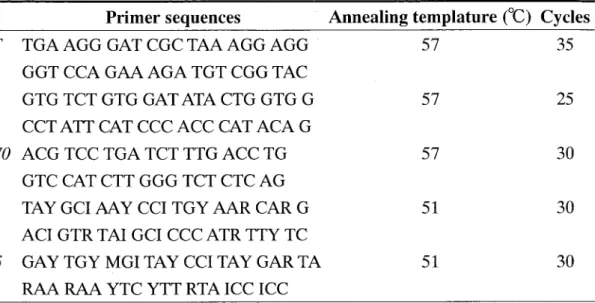
of PCR primers。Zhang et aL(1995)clone(1two c一’nyc genes C阻41an〔1CA〃2ラand determined the nt sequence of their5’upstream regions。Using these nt sequences, c−1n』yc specif孟c primers were designed in the5ラupstream regions、These primers were oligo Iinker−specific primer(LSP−1,5ラーGAG AGA GAC AGG CCT TGT TGG CCG A−3ラ),and two c一〃3yc−specificprimers(Myc−1A,5ラーGTC CTT GCT GAT GGT GATAGAAAT C−3’and Myc−2A,5ラーGTG ACA GAG GCA GGG TGAATA−3’)。PCR
Amplification was started with a12min hold at95。C,followed by35cycles of30s at 94。C,1min at55℃,and l min at72。C with a post−extension of3m圭n at720C.Since a high level ofnonspecific amplification was generatedラthe expected fragments were confirmed by Southem blot hybri(1ization(Sambrook et aL,1989). 2.4.ノ〉8s‘ε4PCR The5ラーend of c一’nyc mRNA was amplified using LSP−2primer(5’一ACA GGCCTT GTT GGC CGAGAG−3ラ)with Myc−1B primer(5’一ATACGC CAAACT CGA
ACT CAC CGG−3’)orwith Myc−2B primer(5ラーATAAATTCT GTA GCT CCC GCG−3’)。The reaction conditions are descr量be(1in section2。3。 25,Sμわclon∫n9αn4sε(7κεncεαnα4y31s The ampl量fied fragments were separated by an agarose gel electrophoresis,and cloned into a home−made T−tailed pBluescriptIISK(一)vectoL Sequences wereanalyzed by dye terminator cycle sequencing using the ABl PRISM310Genetic
3. Results and discussion
3.1. Determination of tsp of two c-myc genes
ldentification of the 5' end of an mRNA is essential for determing the promoter region of a gene, especially when it is a "TATA-less" promoter region, where the tsp are not easily predictable. The oligo-capping method was used here to determine the tsp of two c-myc genes from the cornmon carp.
PCR products amplified using prirner LSP-2 with Myc-1B were cloned and the sequences of 21 positive clones were determined. Using the oligo-capping method, tsp of CAMI were located at -466, -458 and -381 bp upstream of the putative translation initiation codon (The "A" of ATG is numbered as +1 .), while tsp of CAM2 were located at -586, -581, -579, -569, -543, -525, -517, -494, -492, -484, -419 and -413 bp upstream (Fig. 1). Six of the 21 clones were found starting from -581 of CAM2. The sequence at -580 to -574 of CAM2 was homologous to the initiator element (PyPyANA/TPyPy). The major tsp in CAM2 may be at around -581.
Generally, it is difficult to amplify long fragrnents in PCR. So PCR was also performed using primers LSP-2 with Myc-2B which was designed in the upper stream regions. Of 12 clones that were sequenced, all were found to start at -752bp upstream of ATG of CAMI (data not shown).
The sizes of the first introns interrupting the noncoding exonl and exon2 were deduced to be 335 bp in CAMI and 356 bp in CAM2, beginning with GT and ending with AG, respectively (Fig. 2). It is common that TATA box is around 25 bp upstream of tsp, and CCAAT box is around 80 bp upstream of tsp. However, characterization of the 5'-flanking regions indicated that the putative promoter regions in CAMI and
CAM2 contained no obvious TATA or CCAAT box like sequences in the expected
positions, which is different from mammalian c-myc genes. Certainly, the CAM1 promoter contained two TATA sequences (nt -1233, -1200), while there are three in CAM2 (nt -1389, -1254 and -904). However, as these sequences are situated far from any tsp, Iocation of the promoters remains to be determined.3.2. Comparison of the tsp ofCAMI and CAM2
The oligo-capping method indicated that transcription of the two c-myc genes of carp started from at least four sites in CAMI and from twelve sites in CAM2. In human and mouse, the c-myc gene has two tsp (Bernard et al., 1983; Battey et al., 1983). Our results showed more variable clones and raised the possibility of the presence of variable tsp in carp c-myc genes, since the oligo-capping method specifically labels the capped end of mRNAS. Indeed, using the oligo-capping method, variable tsp are obtained from human EF-1 c and TGF- type 11 receptor genes (Maruyama and Sugano, 1994; Yu et al., 1996; Suzuki et al., 1997). The maximum distance between these tsp was 371 bp in CAMI and 173 bp in CAM2 (Fig. 2). The difference in the tsp locations may be related to the modulation of expression.
Using "GENETYX-MAC" computer algorithm developed by Software
Development Co., the nt identities of CAMI and CAM2 were 78.5% in intronl, 86.9% in the first exon (nt -560 to -342 of CAMI and -586 to -364 of CAM2), 94.1% in the second exon, and 92.4% in the third exon. These results suggested that the first exon evolved faster than the second and third exon, which corresponds to the reports of Bernard et al. (1983) and Hayashi et al. (1987). Using the BLAST (Altschul et al., 1990) program, there are no nt identities between the c-myc exonls of carp and other
vertebrates. In mammalian, several protein (MIF-1, MIF-2 and MIF-3) binding sites 10cated at c-myc intronl were identified and are controlling c-myc expression
(Zajac-Kaye and Levens., 1990; Yu, B. W., 1993). But in carp c-myc, these protein binding sites were not observed. Therefore, the c-myc genes of carp may have a
transcription regulation system that is different from that of other vertebrates. Indeed,
high expression of the lower vertebrates c-myc in differentiated tissues contrasts sharply with the low levels observed in mammalian adult tissues (Schreiber-Agus et al., 1993; Schreiber-Agus et al., 1993). These differences may correlate with lower
vertebrate-specific functions, such as tissue regeneration and/or immortalization of cell
lines.
The tetraploid event has been recognized as an important process in the evolution of vertebrates (Ohno, 1970; Lundin, 1993; Ohno, 1993). The present study helps us to understand the transcription function and evolution of c-myc genes in
tetraploid fishes as well as in other vertebrates, besides knowing the differences
between the two c-myc genes. It is suggested that subsequent to the tetraploidization event, one of the 2 duplicated genes may have evolved faster to obtain a new function or become silent (Ohno, 1970). The differences in exonl and the promoter structure between the two c-myc genes of carp suggested that CAMI and CAM2 were evolving to
acquire different functions after the tetraploid event. Further studies are needed to
determine whether the exonl of the carp c-myc genes plays a different role from that of
other vertebrates.
(1) We determined the heterogeneous tsp of two carp c-myc genes by the oligo-capping method and indicated the existence of exonl. There are no nt identities between the c-myc first exons of carp and other vertebrates.
(2) The first exons of the carp c-myc genes are evolving faster than the second and third exons, which corresponds to the reports of Bernard et al. (1983) and Hayashi
et al. (1987).
(3) Characterization of the 5'-flanking regions indicated that the putative prornoter
regions in CAMI and CAM2 contain no obvious TATA or CCAAT boxes in the
expected positions.References
Altschul, S. F., Gish, W., Miller W Myers E Lrpman D J 1990 Basrc local
alignment search tool. J. Mol. Biol. 215, 403-410.Battey, J., Moulding, C., Taub, R., Murphy, W., Stewart, T., Potter, H., Lenoir, G., Leder, P., 1983. The human c-myc oncogene: structural consequences of
translocation into the lgH Iocus in Burkitt lymphoma. Cell 34 779-787.
Bernard, O., Cory, S., Gerondakis, S., Webb, E., Adams, J. M., 1983. Sequence of the murine and human cellular myc oncogenes and two modes of myc transcription resulting from chromosome translocation in B Iymphoid tumors. EMBL J. 2,
2375-2383.
Hayashi, K., Makino, R., Kawamura, H., Arisawa, A., Yoneda, K., 1987. Characterization of rat c-myc and adjacent regions. Nucleic Acids Res. 15.,
6419-6436.
Lundin, L. G., 1993. Evolution of the vertebrate genome as reflected in paralogous chromosomal regions in man and the house mouse. Genomics 16, 1-19.
Maruyama, K., Sugano, S., 1994. Oligo-capping: a simple method to replace the cap structure of eukaryotic mRNAS With oligoribonucleotides. Gene 138, 171-174.
Spnnger Verlag Press, Heidelberg, Ohno, S. (1970). Evolution by gene duplication. '
New York.
Ohno, S., 1993. Patterns in genome evolution. Current Opinion in Genetics and Development 3, 91 1-914.
Roy, A. L., Carruthers, C., Gutjahr, T., Roeder, R. G., 1993. Direct role for Myc in transcription initiation mediated by interactions with TFII - I . Nature 365, 359-361. Saito, H., Hayday A. C., Wiman, K., Hayward, W. S., Tonegawa, S., 1983. Activation
ofthe c一規yc gene by transcription:A mode至for translation controL Proc。NatL Acad。 sci。usA80,7476−7480. Sambrook,J,ラFritsch,E.E,Maniatis,T。,1989.Molecular Cloning。A Laboratory Manual,2nd ed.Cold Sp血g Harbor Laboratory,Cold Spring Harbor,NY。 Schreiber−Agus,N.ラHomerラJ。,Torres,R、,Chiu,F−C.,DePinho,R.A.,1993.Zebra Fish1πyc and lnθx Genes:Differential Expression and Oncogenic Activity throughout Vertebrate Evolution。MoL CelL BioL13,2765−2775. Schreiber−AgusラN.,Torres,R。,Homer,J,,Lau,A。,Jamrich,M.,DePinho,R。A.,1993。 Comparative Analysis of the Expression and OncogenicActivities ofX伽gρμs c一ラ N一ラand L−1nyc Homologs.MoL CeIL BioL13,2456−2468. Suzuki Y。,Yoshitomo−Nagasawa,K,MaruyamaラK.,Suyama,A.ラSugano,S。1997. Construction and characterization of a full length−enriched an(1a5ラーend−enriched cDNA library.Gene20b,149456. VanBeneden,R.J。,Watson,D.K,Chen,T.T.Lautenberger,J。A。ラPapasラT、S。ラ1986. Cellular lnyc(c−1πyc)in fish(rainbow trout):its relationship to other vertebrate規yc genesandto the transforminggenes ofthe MC29family ofviruses。Proc.NatL Acad。 Sci.USA83ラ3698−3702. Yu,B.W.,Ichinose,L,Bonham M。A。,ZajaGKaye,M.,1993。SomaticMutation inc一 ノn』y61ntron I Cluster in Discrete DominantThat Define Protein Binding Sequences. J.BioL Chem.268,19586−19592。 Yu,Y。S.,Suzuki Y。ラYoshitomo,K.,Muramatsu,M。,Yamaguchi,N。,Sugano,S., 1996.The promoter structure of TGF一βtype II receptor revea至ed by “01igo−capping”method and deletion analysis。Biochem。Biophys.Res。Commun. 225ラ302−306. Zajac−Kaye,M.,Levens,D.,Phosphorylation。dependentBinding ofa138−kDalnyc
Intron Factor to a Regulatory Element in the First Intron of the c-myc Gene. J. Biol.
Chem. 265, 4547-4551.
Zhang, H., Okamoto, N., Ikeda, Y., 1995. Two c-myc genes from a tetraploid fish, the common carp (Cyprinus carpio). Gene 153, 231-236.
Zhang, H., Okamoto, N., Yamamoto, N., Ikeda, Y., 1993. Molecular cloning of carp cellular myc (c-myc) CDNA. Gyobyo kenkyu (Fish patbology) 28, 1 1 1-117.
Figure legends
Fig. 1. The 5' end sequences of the oligo-capped CDNA of two carp c-myc genes. The sequences corresponding to the carp c-myc genes were aligned along with the genomic sequences shown above. Dots (.) in CAM2 indicate the same residues as in CAM1. Clones I to 18 and 19 to 21 correspond to CAM2 and CAMI respectively. Gaps (-) shown between the sequence derived from the linker oligo and the sequence corresponding to the carp c-myc genes do not exist in the real sequence. Six clones start from -581 bp upstream of the translation start site of CAM2
Fig. 2. The nt sequences of the 5' upstream regions ofCAMI and CAM2. Sequences in intronl are indicated by lowercase letters, and other sequences are indicated by capital letters. Dots (.) in CAM2 indicate the same residues as in CAM1. Gaps (-) are introduced to optimize identity. The nt residues are numbered at the right. The putative translation start codon ATG is indicated by bold letters. Primers used in oligo-capping are indicated by horizontal arrows. Tsp are indicated by vertical arrows. The initiator (Inr)-like sequence is underlined. The nt sequences of CAM1
and CAM2 have DDBJ accession numbers of D37887 and D37888, respectively.
耀 糾 野 廼 畷 蛾