Numbered Individuals, Digital Traditions, and Individual Rights:
Civil Status Registration in Denmark 1645 to 2010
Karl Jakob KROGNESS*
1. Introduction
Individual civil status registration systems collect and document data on individual identity, family relations and individual civil status changes. As such, they are a fundamental requirement of the modern nation-state and provide documentation that is crucial for the individual registrant. Still, implemented and used in various ways that reflect specific traditions, norms, and historical contingencies, these systems differ from state to state. Each system categorizes and organizes the population in more or less unique ways and by engaging the registrant each system exerts a profound influence on the population it describes. Differences between systems also occur because each state may add specific data categories, utilize the civil registration system differently, or organize the data in certain ways. These systems of individual documentation thus share the same fundamental goals, but as
they differ in setup and usage, they shape societies in various ways.1) Systems of individual
documentation form an important substratum of society, but they remain an emerging area of study (see for example Caplan and Torpey 2001). The number of studies more specifically focusing on individual civil status registration systems is likewise rather limited. Further, Civil status registration systems that assign their registrants individual numbers constitute a subset
that also has yet to attract wider scholarly attention.2)
* Associate researcher, Nordic Institute of Asian Studies. 2008-2010, postdoctoral research fellow, Graduate School of Law, Ritsumeikan University. I am very grateful for the support of the Japan Society for the Promotion of Science, which facilitated my postdoctoral research and the present article. I am also deeply indebted to my host researcher Professor NINOMIYA Shūhei, who generously extended to me his knowledge, kindness, and patience. I would also like to thank those scholars, professionals and officials, who contributed to this article, particularly, Else Hansen, Asbjørn R. Thomsen, Anna Barfoed, Carsten Grage, Michael Dupont, Jens Sejrup, Pia Sindbjerg, and Anders Sølling. I am, of course, responsible for any factual or analytical deficiencies.
1) Registration variables can include the scope of registration (e.g. citizens or legal residents), data types (e.g. ethnicity, legitimacy), the method of data collection (e.g. individual notifications or via public authorities), extent of public accessibility (ranging from free access to no access), and the various auxiliary purposes of the registration system (e.g. identify ethnic subdivisions or administrative households).
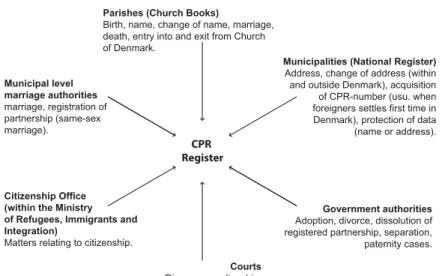
Centralized-computerized systems using individual numbering are efficient and flexible, both for the state within a wide range of administrative services and for the registrants in their interaction with various institutions. With these advantages and the ongoing technological progress, the number of such systems may increase in the near future. The Japanese government, for example, announced recently that it aims to introduce ‘the highly convenient’ citizen numbering type registration system, patterned after the Swedish model (Mainichi JP 2010). These numbering systems are prevalent in the Nordic countries, and this paper will present a brief outline of one such system - the Danish civil registration system which today comprises three interconnected electronic systems of registration: the Church Book, the National Register, and the Central Person Register. The Central Person Register, or CPR, which was also initially inspired by the earlier Swedish numbering system, is today the ‘base register’ that collects individual civil status data (as well as other types of data) from the Church Book and the National Register, as well as various public authorities, and also, as needed, supplies these data to public and private entities. The main focus of this article is the historical, structural and functional interrelations of these three registers that constitute Danish civil registration. This paper also includes a discussion of some existing and emerging problem areas that relate to freedom of religion, protection of personal information, and the limits of efficient data storage and data use. As such, this article represents a contribution to individual civil status registration studies in general, and more specifically it is a contribution to the knowledge of the relatively few centralized-computerized civil registration systems that exist today.
1 Types of Civil Registration in Europe
According to a 2008 report from the European Commission, European Union (EU), we find in Europe three main types of civil status registration systems. Those of England, France and Greece, for example, are ‘events-based’ systems that record individual events in the locality where they take place. Another type is the ‘person-based’ system of registration that likewise collects individual data at local registration offices and then forwards these data to a central national civil status register. Examples of such systems are found in Slovenia, Turkey, and Switzerland. Finally, a number of smaller EU countries – Sweden, Finland, the three Baltic states, and Denmark that have populations under 10 million – have so-called centralized-computerized ‘population registers.’ The central population registers are characterized by assigning to each registrant a unique identification number and attaching to these numbers relevant data from a variety of registers, including their civil status register. Population
↘ As Watson also notes, the authorities in charge of such registration are often good sources of their particular system’s history, structure and functions. In the Scandinavian countries, for example we have
CPR-kontoret in Denmark, (whose resources have been extensively used in the present paper) and the
tax agencies of Sweden (Skatteverket) (for example Riksskatteverket 2003, Skatteverket 2007) and Norway (Skatteetaten) (for example Skatteetaten 2000).
register data thus encompasses much more than individual civil status data and since these central registers are also continually updated they can provide up-to-the-minute data on the size and the characteristics of the population. Although the population registers are much more flexible and precise, larger states with events-based and person-based systems have not adopted them (Feldtmann et al. 2008). The report notes that such systems may be too expensive in countries with larger populations, and we have seen that the idea of individual numbering itself is controversial, for example in England, USA, Australia, India, and Japan. Hungary and Germany have even deemed it unconstitutional, and Portugal has gone as far as to proscribe such identification in the constitution (Watson 2010: 2,29). More practically, to what extent does the flexibility and precision of a new population register justify large-scale and radical reforms of existing, functioning infrastructures that underpin and are interconnected with the existing registration system? Having emerged over decades, if not centuries, these existing infrastructures can, moreover, have more intangible value as they may represent and underpin longstanding traditions and norms. Still, a country like Japan which has traditional and complex systems of registration is considering such a population register, referred to as a ‘common numbering system’ (kyōtsū bangō seido) (Mainichi JP 2010).
The Danish individual civil status registration system is both remarkable and unremarkable within the European region. Like most European states, Denmark registers by the unit of the individual, but the registration of central matters such as birth, marriage, name change and death have not become secularized as they have practically throughout Europe. These matters are entered into Church Books (kirkebøger) managed by the Danish National Church (Den
danske Folkekirke),3) which is enshrined in the Constitution (Grundloven).4) Compared to the other Nordic states, Denmark is also both unremarkable and different. Like Sweden, Norway,
3) The Danish National Church is Evangelical-Lutheran and had as of 1 January 2005 about 4.5 million members, or 83% of the total population (in Copenhagen less than 70%). Membership is gained through baptism. Foreigners baptized in an Evangelical-Lutheran congregation automatically become members when moving to Denmark, unless they state they do not wish to become members. Membership provides the right to confirmation, church marriage, and to receive an ecclesiastical burial or cremation. Membership dues are paid through Church taxes. Individuals can from age 15 decide for themselves whether to enter or leave the National Church. Discontinuance of membership is notified to the CPR register and the liability to pay Church taxes ends. Members belong to the parish in which they live. The supreme authority of the National Church is the Queen of Denmark and the Parliament (Folketinget). The church’s income in 2004 was about 6 billion Danish kroner whereof 4.8 billion derives from church taxes paid by the members. About 630 million Danish kroner of the income are subsidies deriving from state taxes levied from the general population, including non-members. For more in English on the National Church, see http://www.folkekirken.dk/om-folkekirken/english/
4) The Danish Constitution on religion: Art. 4 The Evangelical-Lutheran church is the national church
of Denmark and is, as such, supported by the Danish state. Art. 6: The King shall belong to the Evangelical-Lutheran church. Art. 67 Citizens are free to unite in congregations to worship God in a manner the suits their conviction, but nothing shall be taught or done that is contrary to morals or public order.
Iceland, and Finland, the Danish Central Person Register (Centrale Person Register, or CPR) assigns a unique identification number to each individual resident upon birth (or when they become legal residents), and this identification number is used conspicuously in daily life and is quite accepted by the populations. But the Danes, who will readily recite their CPR-number when asked by private businesses or at public offices, are far from the Icelanders, who practically treat their personal identifying number like an alternate name, using it to sign petitions or letters to the editor, for example. Countries such as Germany and Portugal, and the Nordic countries are in this respect like night and day.
Danish administrative civil registration can largely be divided into three periods demarcated by the advent of these three registers and their gradual integration. Civil registration from about 1500 until 1924 is centered on the Church Books that listed births, marriages, and deaths, as well as other ecclesiastical events. The second period is from 1924, when the municipal index card-based National Register was established and operated alongside the Church Books, until 1968. The third period begins with the introduction of the centralized, electronic CPR system, which assigned each member of the population a personal number and began using that number to organize individual civil status data. The CPR Register began tying data it received from the Church Books, the National Register, as well as other sources to the CPR numbers of the person they relate to. These data are, in turn supplied to a range of administrative registers and institutions. At this juncture, the National Register’s role changed radically. Data was converted to electronic form and its index card system was abolished in 1978. The Church Book system, too, became electronic in 2003. Largely adhering to these three periods, this article outlines Danish civil status registration focuses by presenting the Church Book from 1465 to 2008, the National Register from 1924 to 2008, and the CPR system from 1968 to 2008.
2 Early Registration
Administrative registration of individuals has existed in Denmark for several hundred years and has generally been motivated by tax collection. An early example of administrative registration is a land register (jordebog) written in Latin from about 1300. The first censuses (mandtal) were held in 1787, 1801, and 1834. Thereafter, they were held roughly every ten or 15 years until 1970, shortly after CPR was introduced (Romvig Thomsen 2005: 51, Hansen et al. 2006: 69).
There were also other register types and they were all typically sequential; that is to say, chronological and often subdivided by, for example, topic or topography. They were also usually in book form and therefore rather inflexible. The introduction of index card systems in the early twentieth century made registers somewhat more dynamic. Still, ledgers and card boxes could usually not be removed from their storage location, so paper-based registration tended to limit a registry to serve one specific purpose within one specific administrative institution. The electronic registries that emerged in the mid-twentieth century were not
geographically bound and thus not limited to internal use. Extremely flexible, electronic registration facilitated the storage and processing of vast amounts of data and it also made it possible to apply data to a wider range of uses among an unlimited array of institutions (Hansen et al. 2006: 11-12). The advent of electronic registration in the early 1960s freed administrative data from its geographical restrictions. Data became transferrable and reusable. Registration systems began to be designed so as to maximize the benefits of data sharing between authorities. Data could now have a variety of user groups and thus be used for a variety of purposes. This electronic revolution also facilitated administrative structural change. Where administrative institutions had been stiff and separate entities, they began adopting more integrated cooperative procedures as well as focusing on planning and coordination. This administrative shift was also greatly helped as other new electronic registers emerged. The CPR register became the base register (basisregister), serving as a common database for many branches of the public administration. (Hansen et al. 2006: 12). So over the centuries as registration technology has changed, the population has variously been identified as parishioners, as municipal residents, and now, as numbered individuals. With the advent of electronic data processing, data can be quickly retrieved and recombined, and data is increasingly aggregated under single numerical identifiers, such as the personal CPR number.
2. Church Books 1645-2010
In Europe the church was traditionally in charge of official registration, partly because it was used for administrative work, and partly because it had an interest in keeping ledgers over ecclesiastical events, such as baptisms and burials. In Europe the church and state began separating during the 18th and 19th century and the official duties of the church, such as birth and marriage registration, were generally transferred to the state. But this separation did not occur in Denmark where the Danish National Church has retained these duties up until today.
The earliest Danish Church Books are from the 15th century. They were maintained by the church without involvement from the state, but on 20 May 1645 the king ordered in a letter to the Bishop of Zeeland (Sjælland) that pastors were to ‘keep a proper church book with day and date for how many are born in the parish and for how many are married and dies.’ The purpose was individual taxation. Then, on 17 May 1646, a royal edict obliged the bishops of Denmark to maintain a Church Book (kirkebog) listing birth, marriage, and death, as well as other religious rites performed within the parish. These stipulations were repeated in Danish
Laws (Danske Lov) from 1683 and remain fundamentally in force today. (Personregistrering
2009, Hansen et al. 2006: 68, Romvig Thomsen 2005: 51).
The early Church Books thus contained data on the person, delineating events recorded by the pastor relating to birth, confirmation, marriage, and burial. Later the Church Book received additional duties. In 1652, for example, the Church Book became the basis for
conscription and had to list all rural males aged 16-40 (Personregistrering 2009). Until the 1812 revision of the Church Book system there were few instructions on how to make these registrations. Each pastor was free to organize his records as he wished. Some listed all events chronologically, others chose to list births and marriage separately, for example. There are also examples of illegitimate children being registered separately at the end of the Church Book. The 1812 reform introduced a new Church Book with preprinted columns specifying the required data, as well as the order in which it should be entered: newborn boys, newborn girls, confirmed boys, confirmed girls, marriages, deceased men, deceased women (Hansen et al. 2006: 9-10, Landsarkivet 2009, Romvig Thomsen 2005: 42). To stress the official status of the Church Book, they were now referred to as ‘ministerial books’ (ministerialbøger), which were to exist in two copies: a main ministerial book kept by the pastor and a ‘counter-ministerial book’ (kontra‘counter-ministerialbog) kept by the deacon or the school master. To keep them safe from fires, it was instructed that ‘they shall never for one night be under the same roof’ (Hertzberg and Taranger 1919: 931, Romvig Thomsen 2005: 45, Personregistrering 2009). All changes of address also had to be recorded, so from 1812 until 1875 Church Books included entry and exit lists (til- og afgangslister). From 1822, however, address records were limited to servants, lodgers, and vagrants.
After 1812, the efficiency of the Church Books only improved slowly. On 31 October 1891 new forms and instructions regarding Church Book registration were announced (Hertzberg and Taranger 1919: 931), but since Church Books remained topological and chronological they were inconvenient for looking up data by individual name. Even if the place and the time of an event was known, the entry could be so brief so as to elide the name of the principal of an event. The burial of a woman might just state ‘the wife of Niels Nielsen.’ The full name of a child was at first only occasionally entered in the Church Books at the time of baptism, a practice which from 1824 became the norm. Another problem with names was that children born in the countryside typically received a name comprising their own personal name and a patronymic; a surname derived from the personal name of their father. For example, the surname of Peter Jensen’s son Peter would become ‘Petersen’ (‘-sen’ meaning ‘son’), making him Peter Petersen. Since the number of male and female first names was rather limited (about 64 per cent of the population in the 17th century shared the six most popular male and female first names), very prevalent surnames such as Jensen or Petersen were therefore not very helpful in identifying family relations (Romvig Thomsen 2005:
42-43).5) Given these issues, some pastors found it helpful to establish and maintain for their
own purposes – and to better service his parishioners – a separate name registry on index
5) It was not unusual for illegitimate children to receive a patronymic surname based on the personal name of the alleged father – even when the alleged father made a sworn oath denying his paternity. The patronymic surname of an illegitimate child could change later if their mother married another man. Even in the case of a sworn oath from the alleged father that he is not the biological father, the child would still receive a patronymic based on his name (Romvig Thomsen 2005: 42-43)
cards so as to find more easily past events that relate to particular individuals. One Church Book registrar explains in his reminisces that he kept such a name index to quickly check if, for example, a man claiming to be married was indeed married (En forhenv. kirkebogfører [Viggo Holm] 1912). The problem of addresses and names were resolved with the National Register when it was established as an additional register alongside the Church Book system. 1 Debates on the Church Book system and freedom of religion
In the decades before and after 1900 there were suggestions that there ought to be a new and separate registry of the population so as to achieve a more precise registration of names, as well as former, current, and new addresses, (Toft Hansen 2002: 13-16, Personregistrering 2009). In the late nineteenth century and in the early decades of the twentieth century there were also debates on whether or not to abolish the Church Book system and organize a system outside the church. The early debates on the Church Book were part of a larger discussion of the deficiencies of the existing system and later in the twentieth century the debate began focusing on the inefficiency of having the separate Church Book system. Recently, however, this debate has centered on the issue of freedom of religion. Before proceeding with this debate, however, we should note that there exists non-secular civil registration in southern Jutland by the Danish-German border.
When Denmark lost the regions Slesvig and Holsten to Germany in 1864, the German non-secular system of registration was introduced there. Then, after these regions were reunited with Denmark in 1920, this type of registration continued with the expectation that such registration would be introduced in the rest of the country. This never happened, and it has not been until the debate began focusing on freedom of religion after 2000 that some fundamental changes have begun to emerge.
The National Register that emerged in 1924 did not displace the Church Book system, but the idea of incorporating the Church Book in the National Register did not go away. In the following decades, representatives of the Ministry of Ecclesiastical Affairs, which is in charge of the Church Book system, has successfully avoided any changes, arguing variously that this registration form is relatively cheap, and that since it secures a personal relation between the pastor and the parishioners its demise would lead to a general secularization of society. In 1972, when this issue resurfaced, the Church Book system prevailed despite a report suggesting that the abolition of Church Book registration would reduce costs by several million Danish kroner (Hansen et al. 2006: 76-77). With the introduction in 1968 of the CPR system the duty of the citizens to report births and deaths to the Church Book registrars was affirmed by law: this registration of birth, name, and death is considered valid proof that these events took place (Personregistrering 2009).
On 5 December 2003, the Church Book system went on-line. All parishes are now connected to the so-called New Church Book (Den Ny Kirkebog), which collects all Church Book data in one place. The electronic New Church Book is, in turn, integrated with CPR so
the data entered locally by the Church Book registrars gets transferred directly into CPR.6) The Church Book registrars can, in turn, print out certificates by accessing CPR via the New Church Book (Hansen et al. 2006: 77). The Church Book, then, is now a completely integrated part of the CPR system, supplying a subset of individual civil status data. The professional and content-related responsibility of these civil registrations remain within the purview of the Ministry of Ecclesiastical Affairs (Jerlach 2009: 31).
Throughout the twentieth century, then, Church Book registration of births has remained a matter of course. As late as 1996, a large majority of the parliament rejected to allow for birth registration forms lacking the heading ‘The Danish National Church’. Still, such neutral forms were introduced within the first decade of the twenty-first century. The church office has, moreover, gradually been displaced as a site of birth registration, first by the establishment of an alternative secular office, then a post office box and online registrations, until suddenly the requirement that parents register births was abolished in 2010. These sudden and rapid changes stemmed from human rights based protests by parents who belonged to religious groups other than the National Church and who did not want to step into the National Church offices, much less have their children registered in the Church Books.
In early 2000, faith-based criticism of Church Book registration of births emerged, asserting that it is discriminatory in terms of freedom of religion. Unwilling to enter their local national church offices, four Baptist families refused in 2004 to register their children. One of the families was reported to the police for neglecting to make the necessary birth registration. The Ministry of Ecclesiastical Affairs responded, however, in 2005 by establishing a non-ecclesiastical central office for birth registration. One Baptist found this solution ‘sensible’, but added that it was ‘only a step on the way to completely remove civil registration from the national church’ (Politiken 2005). Subsequently a Christian Iraqi-born Danish citizen, who was a member of a Danish Catholic congregation, brought a lawsuit against the Ministry of Ecclesiastical Affairs. When he properly registered the child’s birth, the national church office official had asked him about this religious affiliation and if it would not be a good idea anyway to baptize the child in the Danish national church. The thrust of his lawsuit was, however, that the child would permanently remain the object of registration of the national church. This lawsuit reached the Supreme Court, which ruled against the claimants.
Still, during its preparations for this Supreme Court case, the Ministry of Ecclesiastical Affairs chose to widen the scope of ‘non-church office’ registration, establishing a postal box address whereto birth registrations could be sent by mail. This development was criticized by Catholic officials as simply a ‘cosmetic solution’ that did not prevent these registrations from ultimately winding up in the Church Book (Politiken 2007a).
In connection with the nationwide establishment of new residents’ service offices
6) Congregations other than those of the State Church, however, still maintain handwritten ledgers and their data is subsequently entered into CPR (Personregistrering 2009).
(Borgerservice) and the introduction of the website borger.dk – a central digital portal to the public sector, on 2 January 2005, KL (Kommunernes Landsforening), the national union of municipalities (kommune), offered to take over birth registrations as it would be ‘much more logical that the municipalities have all duties, and then send a mail to the national church.’ The minister of Ecclesiastical Affairs immediately responded solomonically that people now could make birth registrations online via the websites of either church office or municipality (Politiken 2007b, Kommunernes Landsforening 2007). Then, 16 March 2009, KL suggested that the reporting of birth to the Church Book office that parents are obliged to perform should instead be added to the midwives’ duties. This would be more efficient since the midwives would then not need to report the birth of a child to both the municipality and the church office. Further, since the public administration already acquires the required data via the midwife, the parents’ duty to report the birth is superfluous (see the section on CPR for more details). To simplify registration (and possibly also to mitigate the dissatisfaction among other religious faiths), then, the Ministry of Ecclesiastical Affairs submitted 8 June 2009 a bill that transfer the duty of birth registration from the church offices to the hospitals, and in the process, parents are also relieved of the duty to report a birth. Acknowledging that the new law will be a good development for members of other faiths, some pastors regretted this loss of contact with their parishioners. Still, others noted that this loss of contact is not likely to have much impact, as most birth notifications today already arrive by postal or electronic mail (Berlingske 2010, Kristeligt Dagblad 2010).
The new law was adopted in March 2010, but Mandana Zarrehparvar of the Danish Institute for Human Rights found the development both un-ambitious and non-inclusive as it does not accommodate members of other faiths, atheists, or agnostics since registration of births and deaths remain within the national church. She pointed out that the alternative system of civil registration of births at the municipality, which has existed for members of the German minority in southern Jutland since the early 1920s, is an excellent example of how a much more inclusive administrative system could be introduced relative easily, and suggested that the Ministry of Ecclesiastical Affairs considers a more suitable legislative model. One obvious solution could be that since the midwife has to contact the National Register to fetch a CPR number anyway, then the registration can just as well take place directly to the national registry (menneskeret.dk 2010a, menneskeret.dk 2010b).
In sum, these rapid changes in the Church Book system over the last few year may well indicate a coming changeover to a wholly secular registration system.
3. The National Register
Before 1924, information on the population had to be sought partly in the Church Books and partly in the somewhat regular national or county-wide censuses (Villumsen 1999: 4-6). The existing registration systems were inadequate for the local municipalities. It was costly
in terms of money and work hours spent on fulfilling central municipal duties relating to taxation, poverty relief and support, and elections. Further, lacking reliable and precise records on population movement meant that many untraceable individuals were not put on the yearly tax lists. This meant local tax loss and also increased local expenditure because the municipality had to pay the missing state tax. Poverty relief and support was another local administration matter where the municipalities had to make up for any missing child support from fathers, who evaded their financial duty by not notifying their change of address. Finally, to prepare local and state election lists, the local administration needed to determine the right to vote and to this end, it needed data on the residents’ age, gender, citizenship, residence and income. Assembling these data was costly in terms of time, rather than money (Hansen et al. 2006: 69-70). (CPR-Kontoret 2010a)
The National Register (folkeregisteret) was modeled on the existing rationing card registers
(ernæringskortregistre) that had been established in 1916 in connection with World War 1.7)
Rationing had required stricter controls on changes of address, and households were here listed individually for the purpose of distributing, for example, sugar cards. The rationing card register also recorded movement in and out of administrative jurisdictions. After WW1 (1914-1918), these registers were extended in 1918 and 1920, but the population’s willingness to cooperate with this registration scheme dropped significantly after the rationing of food ended (Toft Hansen 2002: 7-8). It was mainly municipalities who wanted a better registration system and it was, in fact, because of their experience with rationing system that the city council of Bogense in 1916 urged the state government to legislate a comprehensive registry of the population and its movement. A federation of larger municipalities later discussed the merits of ‘mandatory notification of municipal entry and exit,’ and shortly after a union of parish councils also decided to request the Ministry of the Interior to make entry and exit notifications a basic civic duty. In January 1917 the federation of larger municipalities informed the Ministry that lack of precise address data made tax collection and election rolls difficult to manage – especially in relation to servants. This request was forwarded to various ministries but nothing came of it. Other local administrators and cities later made similar suggestions, and the city council of the capital of Copenhagen urged separately in November 1917 that a general ‘national registry office’ should be established for the city. Copenhagen based its proposal on a Norwegian model and the main focus of the proposal was address registrations. In October 1919, the Ministry of Justice suggested the establishment of a commission to consider the introduction of a National Register and in 1920 the Ministry of the Interior formed the National Register of Persons Commission. The commission comprised
7) The ‘national register’ and ‘national registration’ are the English renditions of ‘folkeregistrering’ and ‘folkeregistre’ (CPR-Kontoret 2010a), but here we must keep in mind that ‘national’ refers to ‘population’ or ‘inhabitants, not ‘citizens’ or ‘state.’ Similar in meaning to the German term Volk, the Danish term
folk generally refers to a group of people with some shared characteristic(s), and is not necessarily
limited to specify Danish citizens. In this specific case folk refers to the group of individuals who are registered as legally residing within the Danish territories.
representatives from parish councils, federations of smaller and larger municipalities, as well as the city of Copenhagen, the Ministry of Ecclesiastical Affairs, and the police. It also had representatives from the Ministry of the Interior, and the Statistical Department, as well as the National Health Council, which was represented because medical doctors had expressed a great interest in a National Register. There were thus economical, electoral, statistical, genealogical, biological and anthropological reasons for the coming National Register (Villumsen 1999: 7-8). There were critics among the parliamentarians, mainly on the economic aspect and one legislator even argued that comprehensive registration would inhibit individual freedom of movement (bevægelsesfrihed). The 1920 Commission released its findings in 1922 and the National Registration Law was enacted 14 March 1924. The existing Rationing Card Register Law was extended until the new National Registration Law was in place, but in the capital of Copenhagen and its vicinity, local governments already began compiling the new registers based on a census carried out on 1 February 1923 within these jurisdictions (Toft Hansen 2002: 13-16, Villumsen 1999: 4-6).
1 The National Register 1924-2008
The commission’s report proposed a National Registration Act, drafts for an executive order on national registration, a notice to the municipalities on the establishment of national registration procedures, and instructions for the registrars who would work with the new system. The commission further recommended that the notification of change of address should become a civic duty (Villumsen 1999: 7-8). The Church Book would be retained as their abolishment would most likely meet strong resistance and thus impede the introduction of a functioning address registry. Another reason not to unite the Church Book with the national registry was to prevent mismanaged registries by not placing undue strain on the municipalities (Villumsen 1999: 7-9).
2 Establishment of the National Register
The new national registry arose from a nationwide census carried out on 5 November 1924. A specific form was distributed and the municipalities promptly wrote the data on the census forms onto main register cards and name register cards; the two card systems that structured the new National Register.
To identify the residents, it was necessary also to know the municipal births and deaths. Therefore the Church Book authorities were obliged to report these events to the National Register. The time limit for such reports was set to three days. The birth reports included data on gender, birth date, birthplace, residence, and the name and residence of the parents (or the mother in case of extra-marital birth). Incidentally, the need for accurate birth data required the abolition of the confidentiality that for over 175 years had been extended to
women who sought to keep their pregnancy and child’s birth secret.8) The National Register recorded, of course, a host of standard civil status items such as marriage, divorce, separation, name change, and adoption, but to be an efficient tool in relation to voter rolls, tax roll, etc, it also required data reporting from a variety of other authorities because voting rights were influenced by bankruptcy, criminal punishment, restoration of honor, poverty relief, and tax payments (Villumsen 1999: 8-9).
3 Revisions to the National Register
The 1924 National Registration Law9) was a so-called frame-law, its stipulations are further
specified in separate orders and notices, and it therefore underwent a number of changes and larger revisions. A minor revision in 1956 was mainly motivated by the damages the register incurred during World War 2. The 10 June 1968 revision made in connection with
the introduction of CPR had greater impact.10) As CPR gradually took over the functions
of the national registry an order handed down in 1973 reduced the National Registration
Offices to simply process address changes and supply data to the Central Person Register.11)
A 8 June 1978 revision12) introduced CPR-Histor (see below) – a repository for non-current
registrations that abolished the local administrations’ duty to store historical registration data within the National Register. From that year, also, personal data was accessed from CPR (Toft Hansen 2002: 17). Presently national registration, i.e. changes of address takes place at
municipal service offices called Citizens’ Service (Borgerservice).13)
4 Structure of the National Register
The National Register comprises three registers – a main register (hovedregister), an exit
register (afgangsregister) and a name register (navneregister), and it uses two types of index 8) Such confidentiality had been secured via the Birth Foundation (fødselsstiftelsen), which offered anonymous births and free medical assistance. Established by the King in 1750 to prevent secret births and the killing of newborns.
9) Lov nr. 55 af 14 marts 1924 om folkeregistre (Law no. 55 of 14 March 1924 regarding national registers).
10) Lov nr. 239 af 10. juni 1968 om folkeregistre (Law no. 239 of 10 June 1968 regarding national
registers).
11) Cirkulære nr. 2 af 5 januar 1973 vedrørende de nye folkeregistreringsregler (Circular notice no. 2 of
5. January 1973 regarding the new national registration rules). Bekendtgørelse nr. 5 af 5. Januar 1973
om folkeregistre (Announcement no. 5 of 5 January 1973 regarding national registers). Instruks nr. 3 af 5. Januar 1973 for førelse af folkeregistre, herunder om folkeregistrenes medvirken ved driften af det centrale personregister (CPR) (Instruction no. 3 of 5 January 1973 regarding the management of
national register, including the role of national registration in relation to the operation of the central person register (CPR)).
12) Lov nr. 304 af 8. Juni 1978 om ændring af lov om folkeregistrering (Law no. 304 of 8 June 1978
regarding revision of law on national registration). Bekendtgørelse nr. 508 or 509 af 14. September 1978
om lov om folkeregistrering (Announcement no. 508 and 509 of 14 September 1978 of revision of the
law on national registration).
13) Again, borger (similar to the German Burger), refers to the inhabitants of a municipality, not holders of Danish nationality/citizenship.
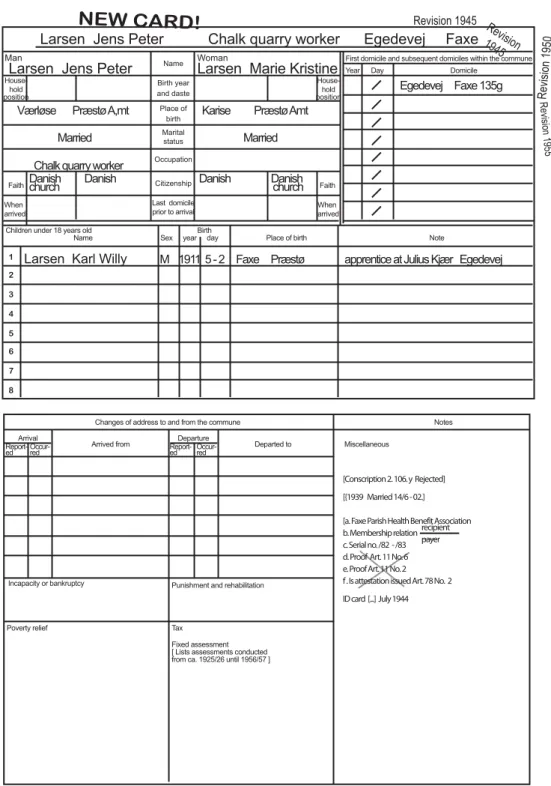
1 2 3 4 5 6 7 8
NEW CARD!
Revision 1945Revision 1950 Revision 1955
Revision 1945
Man Name Woman
Birth year and daste Place of birth Marital status Occupation Citizenship Last domicile prior to arrival House-hold position Faith When arrived When arrived Children under 18 years old Birth
Place of birth Note Sex year day
Year
First domicile and subsequent domiciles within the commune Day Domicile Name Faith House-hold position
Larsen Jens Peter Chalk quarry worker Egedevej Faxe Larsen Jens Peter
Larsen Karl Willy M 1911 5 - 2 Faxe Præstø apprentice at Julius Kjær Egedevej
Larsen Marie Kristine
Værløse Præstø A,mt Karise Præstø Amt Married Married Chalk quarry worker
Danish Danish Danish Danish church church
Egedevej Faxe 135g
Arrival Departure
Arrived from Departed to
Changes of address to and from the commune Notes Report-ed Occur-red Occur-red Report-ed [Conscription 2. 106. y Rejected] [{1939 Married 14/6 - 02.] [a. Faxe Parish Health Benefit Association b. Membership relation c. Serial no. /82 - /83 d. Proof Art. 11 No. 6 e. Proof Art. 11 No. 2 f . Is attestation issued Art. 78 No. 2 ID card [...] July 1944 recipient payer 1 testa o. 6 1N 1 issu of A t 11 Incapacity or bankruptcy
Poverty relief Tax Fixed assessment [ Lists assessments conducted from ca. 1925/26 until 1956/57 ]
Miscellaneous
Punishment and rehabilitation
Figure 1: National Registration system. Main card (front and back).
The most recent data on this card is only 50 years old, but it can be reproduced because all registrants have passed away. Adapted from Efter Bemyndigelse (Nørr and Mikkelsen 2008: 607-608).
cards – a main card (hovedkort) and a name card (navnekort). Figure 1 illustrates the front and the back of the main card.
The main register delineates the current population within a municipality and the exit register lists the municipality’s former residents. The main register lists its current residents by current address and the name register, finally, provides a tool for finding these current residents by listing them alphabetically by name on name cards. The exit register is also organized by name, not address. The main register and the exit register use the main cards, and the name register uses name cards. The main card is referred to as a family card (familiekort) when it lists a household and a single card (enkeltkort) if it lists a single individual. Main cards are thus used in the main register and the exit register to list both families and individuals (Toft Hansen 2002: 20). The exit register receives main register cards as families or individuals move to other municipalities, die, or are reported missing by the Department of Statistics. 5 The main register and the exit register
Cards in the main register are organized after street name, house number, and, possibly, by entrance and floor number. In certain cases parish, town, and cadastral number can also order them. (Toft Hansen 2002: 20). The main register cards are categorized as either family cards or single cards, depending on the individual who is listed first. A family card will list the ‘principal’ (hovedperson) of a family, whereas a single card only lists one individual. On family cards this principal is the husband, and under his name are registered the wife and children under 15 years old who live at home (under 16 years old from 1956). This included adopted children (but not foster children), as well as extra-marital children under 15 years old who resided with their mother. In case of the husband’s death, the surviving wife is entered at the top of the card as its principal. The principal on a single card is the individual in question, and this individual can be a child over the age of 15, a foster child, other resident members of a household, such as maids, more distant relatives, assistants, boarders, etc. The system as such remained largely unchanged, but few changes have been made to the columns of the main register card over time (Toft Hansen 2002: 18,20). Figure 2 illustrates one important change: that the CPR number displaced the household role references of ‘husband’ and ‘wife.’
An historical register organized alphabetically by name, the exit register contains the main register cards of those who no longer reside within the municipality. Additionally, this register also has the single cards of women, who upon marriage have transferred to the husband’s family card, as well as the cards of children who have been adopted by others (Toft Hansen 2002: 22).
6 The name register
To facilitate access to the main register via names, the name register contains name cards written out for every principal listed at the top of a family card and for every individual
listed on a single card. The name card refers to the current address of the individual as it appears on their main card. It was also possible to compile name cards for wives and other subordinates listed on family cards (Toft Hansen 2002: 23). Women were listed as subordinates, but a 1956 instruction allowed women, who had married to also have a name card. The objective was not to achieve gender equality but simply to increase the efficiency of the name register. Women, who were or had been married, were also allowed to request the National Register to list them under their maiden name; a request that constituted a legal change of name. Further, the instruction rose the age for individual registration of children to 16. The reason for this was that tax deductions for families with children were available until the sixteenth year (Villumsen 1999).
7 Maintenance of address data
The law stipulates that individuals are obliged to report permanent address changes and temporary address changes in excess of three months. In case of a change of address within the jurisdiction, the new address was recorded in the existing cards. In case of moves to another jurisdiction, the jurisdiction of departure sent to the jurisdiction of arrival a notification of movement that contained all data relevant for the new jurisdiction. The registers were revised via national censuses compiled every five years and could also be revised via yearly local censuses. Counterfactual reporting to the National Registry Office could invoke fines (Toft
Husband
MAIN FAMILY CARD BEFORE CPR (detail) MAIN FAMILY CARD AFTER CPR (detail)
180728-0593
Figure 2: National Registration system. Main card (detail). Adapted from Efter Bemyndigelse (Nørr and Mikkelsen 2008: 607)
Hansen 2002: 18).
In case of relocation between two administrative localities, the locality of exit prepared a relocation notification that was forwarded to the locality of entry. The new address was entered in the main card’s ‘movements to and from local administration’ column. The former address was struck off with a thin line and the card placed in the exit register. The name card was also furnished with the new address. The local administration of entry recorded the address from which the person in question arrived from in the ‘Movements to and from local administration’ column and placed the card in the main register under the new address and created a name card. In case of movement within the jurisdiction, the old address was struck off, and the new address entered in the ‘First residence and movements within the jurisdiction’ column. Then the card was placed in the main register under this new address. The new address is also entered into the name card (Toft Hansen 2002: 31-32).
In case of incarceration, military service, boarding schools etc., the person in question was not registered in the local administration of these institutions. Rather, the stay was noted in the ‘First residence and movements within the jurisdiction’ column in the register of the local administration where he or she had residence prior to the stay. In case of temporary stay in a local administration over 3 months (e.g. in case of admission to a state hospital), a main registry card and a name card was established in the local administration where the temporary stay took place, with the note ‘temporary stay.’ Notifications of relocation were not drawn up. Missing persons were notified to the Department of Statistics. On the main registry card was written ‘notified to Statistical Department’ or ‘missing’ whereupon it was placed in the exit register (Toft Hansen 2002: 31-32).
The National Registration Law also stipulated that the municipalities every quarter report population movements to the Department of Statistics. For this purpose many municipalities kept ledgers of movement (or the so-called entry- and exit lists), and they also contained data pertaining to tax-assessment and the public health fund (sygekasse). These ledgers were not mandatory (Toft Hansen 2002: 23).
8 Movement between cards and registers
In case of death, the data was struck off with a thin line on both the main registry card and
the name registry card, and the date of death noted. If the person in question was listed in a family card and left a spouse behind, then the card remained in the main register. If the bereaved was a widow, a new name card was issued for her, and her name and any new address was entered in the name card of the deceased as a reference. If there was no spouse, but children under 15 (or later 16) years of age, these children were entered on single cards and also provided with name cards, and the family card transferred to the exit register. In
case of marriage where the spouses move in together, the wife was transferred from her
present single card to the husband’s family card along with all the data relevant for National Registration. Her existing single card was then transferred to the exit register. In the name
register the woman was entered under her husbands surname. If the woman maintained her maiden name, then name cards were issued for both the maiden name and the husband’s surname. Upon divorce, the woman was again entered on her own single card (or, possibly, family card if she gained custody over the children). Furthermore, a card was issued for the name register if such a card did not exist already. In case of adoption, the adoptive child was deleted from the card on which it was recorded prior to the adoption, and transferred to the card of the adoptive parents. If the child was entered on a single card (e.g. as a foster child) this was transferred to the exit register. When a child who resides with the parent(s) reached the age of 15 (16), a new single card was established. On the family card was written ‘single card established (date)’ and, possibly, the names of the parents are given under ‘remarks’ on the single card of the child (Toft Hansen 2002: 31-32).
9 Reliability of the data:
Data in the National Register was collected by National Register itself and other data arrived from outside authorities. Data submissions from public institutions, such as civil status data (name, place and date of birth, marital status, citizenship), faith-related data, legal incapacity, and criminal punishment, are quite reliable. There can, however, be doubts if all relevant data were transferred, especially in relation to criminal history because legislation on these types of data was ambiguous. Data transferred by the local administrative offices are also quite reliable, for example tax, retirement pay, poverty relief, and franchise. Obliged to report the public health fund membership of incoming registrants and supplying data for the conscription rolls, the National Register had a considerable control function so the data relating to the public health fund and conscription are also quite reliable. Less reliable were data that derived from the individual citizen, for example employment title. An individual could have several professions or have provided one degree but be working within another field. Unemployment also affected the reliability of these data. It was not required to report change of job, so such changes were only entered when there was a change of address. The cornerstone of the National Register remained, however, the address data. As noted above, a notification of change of address involved the local administrations of exit and of entry. Landlords were required to ensure that their renters possessed a ‘proof of relocation’ (flyttebevis) and if they did not, the landlords were to fill one out such a form on their behalf and send it to the National Register. Incorrect data or neglect to submit data to the National Register was, and remain today, subject to fine. Still, the national registries were, of course, incomplete. People who could not be traced were recorded as ‘missing’ (forsvundne). The number of ‘missing’ individuals were highest in the early years of the system, growing from 13,000 in 1924/25 to almost 19,000 in 1927/28, but then the numbers fell to a couple of thousand individuals by 1939. From the 1950’s onwards, the number of individuals who escape the fine mesh of National Registration has oscillated around 1000 (Toft Hansen 2002: 30).
4. The CPR register
Serving the public, the central public administration, as well as the municipal taxation offices and social services, the work load of the National Register had by 1960 reached a level where it was difficult for these manual index card registers to keep up with the ever-increasing demand for data. Some municipalities had in the early nineteen fifties begun to automatize many work processes using punch card systems and many of these systems were in the mid-nineteen fifties and in the nineteen sixties merged into larger shared punch card centrals. Most of these centrals also acquired electronic data processing machines that facilitated magnetic tape data storage, so by 1967 there already existed electronic national registration data on about 4 million out of the 4.7 million inhabitants. Still, since the legal basis for registration remained the manual paper-based registers, these electronic advances had only had little impact on the organizational structure of national registration. The existence of much data in electronic form was of course important for the realization of CPR but this mass of electronic data was not in itself the reason for the introduction of CPR.
1 The road towards CPR
The 1922 national registration commission had considered a centralized manual registration system, but this idea was abandoned due to high cost and it would, most likely have been impossible to maintain such a huge manual register adequately (Hansen et al. 2006: 73-74). The advent of electronic data processing made a centralized register more feasible, and the Ministry of the Interior established 22 February 1961 a commission to investigate how the municipal National Registers and the punch card centers (hulkortcentraler) might support the implementation of electronic data processing in the public administration. The commission should also investigate how National Register data could be used in other administrative branches, and whether or not it would it be advisable to assign a specific serial number to each individual member of the population.
An individual number could serve as an efficient ‘key’ for accessing personal data in various registers, but it could turn out to be unacceptable for the Danish population to become ‘mere numbers’. Sweden had already in 1947 introduced such a ‘key’ in the form of a 9-digit
person number (personnummer).14) Norway introduced their ‘birth number’ (fødselsnummer)
system in 1964,15) and also England and the US had introduced ‘numbers’ without much
14) The 9-digit format introduced in Sweden in 1947 was YYMMDD-SSG, where the first six digits represent birth year (Y), month (M), day (D), and the latter three comprise two serial digits (S) referring to the birth date and the third digit (G) indicating gender – even for females and uneven for males. In 1967 a tenth control digit was introduced, changing to the following 10-digit format: YYMMDD-SSGC. The hyphen between the sixth and the seventh digit is changed to a plus (+) when the person in question turns 100 years old (Riksskatteverket 2003: 99,105, Skatteverket 2007).
negative reaction from the public. Still, Holland had had to abandon individual numbers due to protests. Also, the Danish authorities were unsure if it was advisable to introduce a citizens’ card, given the Danish populations’ recent experience with the ID cards issued by the German occupation forces during WW2.
The main motive for introducing the personal number was the coming introduction of the ‘source tax’ where taxes are withheld by the employer – a system also known as P.A.Y.E. (pay-as-you-earn). The Danish authorities referred to the envisaged individual number variously as an ‘account number’ (kontonummer) or a ‘citizen number’ (borgernummer) and determined to introduce it, not as a technical and ‘hidden’ number but rather with as wide an acceptance as possible. It was even discussed if it might give the individual number a better ‘image’ by initially connecting it to a right, such as social services, rather than a duty, such as taxes (Hansen et al. 2006: 85-88).
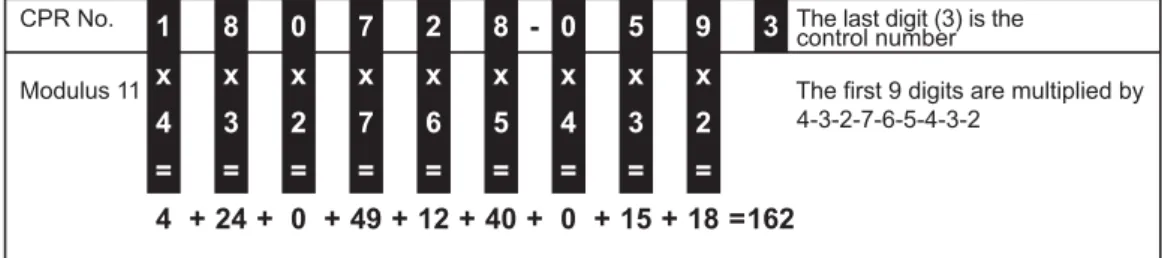
The individual number scheme that was adopted in 1965 consisted of 10 digits DDMMYY-SSSC, six digits for the day, (D), month (M), and year (Y) of birth, followed by three digits indicating a serial number (S), and a final digit (C) that function as a control number to catch erroneous or false numbers. This control number would also specify gender, with even numbers indicating females and uneven numbers indicating males. The day-month-year order of the first 6 digits is not ideal from an archival viewpoint, but it was chosen because it would feel more ‘natural’ as it conforms with spoken Danish and also be less error-prone in everyday usage (Hansen et al. 2006: 88-89). The sequence ‘180728-0593’ is an example of a CPR number for a person born 18 July 1928 with the final uneven control number ‘3’ indicating that the holder is male. The control number is found via a ‘modulus 11’ calculation, and figure 3 illustrates how the validity of a given CPR number can be checked
↘ DDMMYY-SSSCC represent the birth date, followed by a three-digit serial number and a two-digit control number (Skatteetaten 2000).
1 x 4 = 4 + 8 x 3 = 24 + 0 x 2 = 0 + 7 x 7 = 49 + 2 x 6 = 12 + 8 x 5 = 40 -+ 0 x 4 = 0 + 5 x 3 = 15 + 9 x 2 = 18
CPR No. The last digit (3) is the
control number
Modulus 11 The first 9 digits are multiplied by
4-3-2-7-6-5-4-3-2
Calculating a control number for the sequence 180728-059:
Divide 162 (the sum of all subtotals) by 11. The sum is 14 with the remainder 8. Subtracting 8 from 11 gives 189728-059 the control number 3.
Verifying the CPR number 180728-0593:
Add the control number 3 to the sum 162. 165 is divided by 11, giving the sum 15. Leaving no remainder, the CPR number is valid.
=
3
162
using a reverse ‘modulus 11’ calculation.
This CPR number format was introduced without being explicitly mentioned in a law, but it was not introduced in secret. In October 1968, individual number certificates (personnummerbevis) were sent by mail to each resident (except children born 1967 and 1968 who would receive their certificate later). In this way people would become familiar with
their own particular number, as well as check for any errors.16) The certificate itself could,
furthermore, be used as an ID card (Hansen et al. 2006: 91). The use of this certificate as ID never caught on. What did become generally used as ID in everyday transactions was the yellow the national health care card (see figure 4), which displays the holder’s name, current residential address, and CPR number.
2 The CPR system
With the introduction of CPR, the responsibility for maintaining the registration of the Danish population was transferred from the municipalities to the Ministry of the Interior’s Secretariat for Individual Registration (Sekretariat for Personregistrering), the current CPR office
(CPR-kontor).17) This Secretariat was established for this purpose in 1965 and has ever since been responsible for the development of the CPR system.
16) The CPR data listed on the individual number certificate was his or her CPR number, occupation, and address, as well as the name of the municipal national register the individual was registered in (Villumsen 1999).
17) Since 23 February 2010, the Ministry of the Interior has been named the Ministry of Interior and Health (Indenrigs- og Sundhedsministeriet).
Figure 4: A specimen of the Health Card.
In addition to the CPR number, full name, and current address of the holder, the health card also lists municipality and the holder’s general practitioner.
3 The CPR system - registration and structure
The purpose of the Danish Act on the Civil Registration System is to ensure that any person, who is officially registered as residing within Denmark on the grounds of birth or relocation from abroad, are supplied with an individual civil registry number (Sections 1.1 and 3.1). The CPR system thus contains data on all Danish citizens, as well as all foreign individuals who have resided legally in Denmark after 2 April 1968 (in Greenland as of 1 May 1972) and have been registered in a Danish county (kommune). CPR also registers certain individuals in foreign countries who are liable for taxation in Denmark or who should be registered in a Danish Church Book. Individuals remain within CPR upon death, emigration and disappearance. As of 2009 CPR had data on about 8.4 million people, the data probably amounting to less than 50 GB. The population of Denmark was 5.5 million as of 1 January 2009. The CPR is updated daily by the municipalities and these updates amounted in 2009 to an annual 850,000 changes of address, 25,000 name changes, 60,000-70,000 births and deaths, etc (CPR-Kontoret 2009).
4 Numbering newborns
Most residents in Denmark enter the CPR system at birth. Every birth (whether live or stillborn) must be reported to the civil authorities, and this reporting involves the midwife who assisted the birth and, until 2010, the child’s parents. The following are the reporting requirements as of 2010 for all of Denmark, except southern Jutland (Sundhedsstyrelsen
2001).18) The midwife usually makes the report upon completion of the birth via a data
system called ‘GS open’ (GS åben), which communicates directly with the CPR office, which in turn issues a CPR number. If the system is down, GS open will provide a so-called
replacement CPR number to be used until the system is up and running again.19) Bracelets
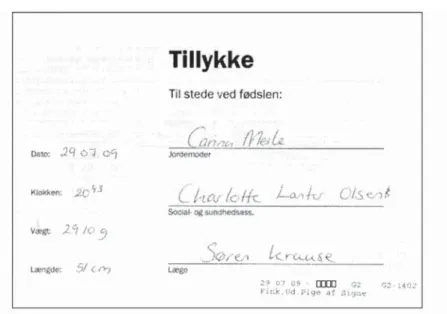
are then attached to the mother and child, each carrying identical data in written and barcode form pertaining to the newborn. This data identical to the data is seen in the lower right corner of the document in Figure 5. In case of a home birth, the midwife fills out a form and the CPR number is issued later. (The midwife will usually upon leaving the house of birth go to a hospital to log on to CPR regarding the birth.) Nursing aides and social health care assistants can also conduct this ‘establishment’ of the newborn, but it remains the responsibility of the midwife to make the report. The issuance of the CPR number is today
18) Birth report procedures in southern Jutland is made by one of the parents or by another person authorized to make such a report to the registrar of the municipality where the mother resides. However, when the child is born at a clinic or hospital, the duty to make the report rests solely on that institution (Sundhedsstyrelsen 2001).
19) When a real CPR number for some reason cannot be issued, a replacement CPR number can be used by private and public institutions. Its 10-digit structure resembles the CPR-number, but to distinguish real CPR numbers from replacement CPR numbers, the value of the first digit is raised by 6. Birth dates such as 07, 17, and 27, for example, will thus appear in replacement CPR numbers as 67, 77, and 87, respectively (CPR-Kontoret 2010c).
a natural part of the parent’s expectations regarding birth the duties of the midwife, who
may comment positively on an easy-to-remember CPR number.20) It has been the parents
duty to make a birth registration at the parish office. If this is neglected the authorities, who know about the birth due to the post-birth CPR registration, will fine the parents and will, if necessary, unilaterally complete the birth registration. With the coming reforms of the birth reporting system, it will most likely become the midwife’s duty to report the birth to the Church Book system.
5 Registers within CPR
To optimize the use of the individual numbering system, the CPR system encompasses several registers so as to attach to the individual number other additional data that are directly or indirectly relevant to these residents.
1. The civil register contains current civil registrations on each citizen, including the personal identity number, as well as former (historical) data pertaining to addressee, name, civil status and citizenship.
2. The road system register has current data on Danish roads. Each road is assigned a code, a name, and data pertaining to its particular administrative relationship to
20) The midwife Anna Barfoed, explained these procedures to me via e-mail correspondence during 3-4 November 2010.
Figure 5: Intial birth document.
The Danish text is as follows: Congratulations. Present at the birth: midwife (name), social health care assistants (name), doctor (name), date and time of birth, weight and length. In the lower right corner (as well as on the newborn’s and the mother’s bracelet) is given the newborn’s CPR number 290709-XXXX, and that it is ‘daughter of Signe’. (Signe is the first name of the mother.) The CPR number is anonymized by the author for the purpose of this article.
parishes, as well as postal and voter districts. As an example, this register supplies the civil register’s road code with road names.
3. The housing register contains all addresses and localities, sorted by an address code. A housing code specifies the utilization of a specific dwelling. This register is used when it is practical or necessary to use the address as data entry, for example to check if individuals are moving into an approved dwelling type.
4. The register of authorities contains all authorities that are in contact with the CPR, listing their addresses, and phone/fax numbers, as well as their relation to other authorities. These authorities each have an identifying four digit code, and any relevant administrative change within an authority must also be reported to CPR (e.g. amalgamation of parishes or counties) (CPR-Kontoret 2001).
In 2001, for example, CPR listed 106,000 roads, 2.9 million dwellings, and 3000 authorities (CPR-Kontoret 2001). Within this scheme, these registers rely on each other and need to be calibrated in order for CPR to function. For example, when the number of municipalities in Denmark was reduced from 270 to 98 on 1 January 2007, all roads that came under a new county were given new codes and the address codes for a great deal of the population also had to be updated.
6 CPR’s civil register data
With the introduction of CPR, the 1340 municipal National Registration offices began serving this single electronic system, and CPR, in turn, gradually took over from the National Register duties such as supplying data to the tax authorities, to other public authorities, and to private citizens, as well as supplying statistical information, preparing election rolls, etc. Instead of being recorded locally in the manual registers, data was now reported directly to CPR. The paper-based National Registers were not abolished right away, however. By 1978 the CPR register was so developed that the paper-based National Registers were not essential, and by 1991 it became possible for the National Registers to dispense with paper registrations and the duty to maintain index card registers was abolished (Hansen et al. 2006: 68,71-73). The individual civil status data within CPR is largely identical to that found within the manual National Register. CPR does have unique data, as well as other items needed to serve other authorities (Hansen et al. 2006: 99). Figure 6 gives an overview of data found in only the National Register, in both the National Register and CPR, and only in CPR.
There have before been discussions on appropriate and inappropriate CPR data. The 1961 commission suggested including data on, for example, criminal investigations and contagious diseases. Later discussions have questioned the suitability of data on membership of the Danish national church, registered partnership, and incapacity, which all have been deemed appropriate; data on membership of the Danish state church was retained for tax and