
トップページ - 横浜国立大学学術情報リポジトリ
21
0
0
全文
(2) MENGLUN REGION, XISHUANGBANNA. Figure 1. The Menglun Region of Xishuangbanna, southernmost Yunnan Province. Menglun is located near a loop in the Luosuojiang (Xiaohejiang) River, on the highway from Mengyang t o Mengla (southernmost Xishuangbanna). Most " ' of the land between rivers i s mountainous (see topographic m a p by Urushibara-Yoshino and Nagatsuka 1989 b u t note t h a t "Mengla" is in fact Menglun). The Menglun Nature Reserve has two sections (diagonal pattern), including the Man-Ka mountain area northwest of Menglun and the limestone area southeast of Menglun. Larger nature reserves a r e also shown, near Mengyang (mainly montane forest) and near Mengla (seasonal rain forest) (Yunnan University 1960).. latitude. This region along the Burmese-Yunnan border shows some of the highest values of satellite-sensed surface greenness (AVHRR "greenness index", Box et al. 1989a) and represents perhaps the most northward extension of tropical rainforest in the Northern Hemisphere. The botanical and biogeographical significance of Xishuangbanna, and indeed of Yunnan itself, has long been appreciated (e.g. Brandis 1895, Handel-Mazzetti 1921, Merrill1923, Wilson 1931, Wang 1939, Jiang 1980). For studies of both natural vegetation and potential crop species, the Tropical Botanical Garden a t Menglun has served for many years a s a base of operations and as an experiment station for introductions of new species into the region. Menglun is also centrally located relative to the four long-standing nature conservation areas in Xishuangbanna, namely Da Menglung (near the Burmese border), Mengyang, Menglun, and Mengla (see Figure 1 ). The area around Menglun contains a variety of landscapes.
(3) and vegetation types, ranging from the agricultural Jinghong Basin to the various montane belts (cf . Xu et al. 1989, Urushibara and Nagatsuka 1989, Yoshino 1989). Four main forest types are well represented: seasonal evergreen forest, montane evergreen broad-leaved forest, valley rainforest, and forests on limestone. These forest types are described in an early conservation report (Yunnan Univ. 1960), by Zhu et al. (1986, 1987), and to some extent, in English, by Wang (1961). Our short time in Xishuangbanna permitted description of only three of the four forest types, all a t sites within 30 km of Menglun. The three forests studied were almost totally different in their composition. The purpose of this paper is to present the composition and structure of these forests and attempt an initial understanding of their dynamic status and biogeographic position.. Regional Climate and Vegetation The study areas around Menglun and other locations are shown in Figure 1. Jinghong, the largest town, is a t about 550 m elevation in the center of the Jinghong Basin, reached by road from Simao to the north. The Lancang (Mekong) River runs through the basin and on southeastward into Laos and eventually Vietnam. Mengla is a t about 640 m in the hills along the Laotian border in extreme southern Xishuangbanna. The climate of the somewhat drier Jinghong Basin is shown by the climate diagram in ' Figure 2, which represents the monsoon seasonality for the whole region. Precipitation increases to the southeast, though, from the 1200 mm at Jinghong to over 1500 mm at Mengla (Zhu et al., 1986). The climate diagram shows the high rainfall in summer and significant dry season in winter, with pleasant winter temperatures but significant evapotranspiration. This seasonality and the winter dry season are somewhat more extreme than in comparable areas of southeastern China, closer to the coast. Light frost may occur in winter a t Simao (to -1.7" C) and at Mengla (to -0.5" C) . Frost does not occur a t Menglun or throughout lowland Xishuangbanna, but temperature inversions, with near-freezing temperatures and fog, are common in winter (Nomoto et al. 1989, cf . Yasunari and Tian 1989, Yoshino 1989).. Jinghong (552 m). 21tg0 1196mm. Figure 2. Climate Diagram of Jinghong, the Regional Center of the Jinghong Basin of Xishuangbanna..
(4) The main, general vegetation types of Xishuangbanna (mainly forest types) are shown in Table 1, a s recognized in the main vegetation description for Yunnan, the "Vegetation of Yunnan" (Zhu et al. 1987). Perhumid tropical rainforests remained (as of 1981, "Yunnan Vegetation Map" 1987) only along the Yuanjiang (Vietnamese Red) River valley near the Vietnamese border, while "seasonal rainforests" are shown a s occurring mainly in upland areas of southernmost Xishuangbanna (mainly TerminaliaPometia type), with a small area of the Shorea-Dipterocarpus type along the Burmese border a t almost 25" N (see also Wang et al. 1985, Makita and Chujo 1989). The montane rainforest types are shown mainly in southeastern Yunnan (Yuanjiang and Guangxi border areas), while more seasonal semi-evergreen forests (especially Ficus-Chukrasia type) and raingreen deciduous forests (especially Bombax-Albizia types) are shown in southern Xishuangbanna and along the border with Burma (to almost 25" N) . Areas above about 1000-1200m are covered by evergreen broad-leaved forests (plus degradation stages) and conifer forests (mainly Pinus kesiya var. langbianensis to the north and P. yunnanensis in the south). There are also large agricultural areas and large areas of savanna, plus "economic forests" (tree plantations). Special sclerophyll (Quercus) forests and xeric scrub occur in some hot, dry river valleys, but these are mainly to the north on the escarpment. Some large areas of bamboo forest are shown in southernmost Xishuangbanna.. Study Sites Menglun itself is on the Luosuo River (a tributary of the Lancang) a t about 540 m elevation but separated from the Jinghong Basin by low mountains reaching over 1000 m in elevation. Two of the study sites were in this mountain area, near Man-Ka village, while the other site was on limestone in a small conservation area south of Menglun. A preliminary description of these conservation areas is given in "A Survey of Plane Communities of the Nature Conservation Stations in the Tropical and Subtropical Regions of Yunnan Province, China" (Yunnan University l960), prepared for the Yunnan provincial government. Climatic characteristics for Simao, Jinghong, and Mengla are summarized in Table 2. From these data the climatic conditions a t Menglun and the study sites are estimated, based on normal temperature lapse rates and the precipitation map by Zhu et al. (1986). Temperatures a t Menglun may be more or less similar to those a t Jinghong, but the greater precipitation gives Menglun a more favorable water balance, even in the lowland. Nevertheless, there is still a dry season of 3-4months in late winter to early spring, during which time the climatic water deficit must be met by water reserves in the soil. This results in significant differences in moisture stress between deeper and shallower soils. The two sites on Man-Ka mountain are separated by several kilometers but are both on a more or less north-facing slope and differ in elevation by less than 400 meters, one a t about 700 m and the other a t about 1070 m. The other site, on limestone, is a t about the same elevation a s Menglun and has similar macroclimatic conditions..
(5) Table 1. Main Vegetation Types of Xishuangbanna. The vegetation types a r e summarized from the "Vegetation of Yunnan" (Zhu et al. 19871, which describes vegetation types for all of Yunnan. Names of vegetation types a r e direct translations from the Chinese a s f a r a s possible and generally correspond to English type names. Seasonal rainforest ($BE%),though, occurs with a short but significant dry season, contains fewer epiphytes and lianas, and is thus usually called 'tropical seasonal evergreen forest' in English, rather than rainforest. Seasonal forests (Chinese: seasonal rain forests, 3 @@), on the other hand, a r e a t most only semi - evergreen, due to stronger seasonality of the rainfall. Tropical Evergreen Forests Perhumid Rainforest: Dipterocarpus, Hopea, Crypteronia, etc. Seasonal Rainforest (=tropical seasonal evergreen forest) - Shorea - Dipterocarpus (with Arenga understorey) - Antiaris - Pouteria - Canarium (with Gironniera, Garcinia, etc.) - Terminalia - Pometia (with Knema, Garcinia, Epiprinus, etc.) - Parashorea chinensis (with Myristica, Barringtonia, etc.) Montane Rainforest - Alstonia - Paramichelia (with Castanopsis, Actinodaphne, etc.) - Dysoxylon - Semecarpus - Phoebe (with Xanthophyllum, Schima, Calophyllum) - Madhuca - Altingia (with Semecarpus) - Manglietia wangii (with Ficus etc.) Seasonal Forests ( "seasonal rain forests" ) Semi - Evergreen Seasonal Forests - Ficus - Chukrasia (with Saraca, Dimocarpus, etc.) - Mesua ferrea (with Mangifera, Knema, Ficus, Mallotus, Castanopsis) - Cassia siamea (with Microcos, Mallotus, etc.) Raingreen Forests ("deciduous seasonal rain forests") - Bombax - Albizia (with Lysidice, Garuga, Erythrina, Michelia, Dysoxylon) - Terminalia - Erythrina (with Tetrameles, Sapium, Ulmus, etc.) - Protium - Castanopsis (with Gmelina, Dillenia, Aporusa) - Pterocarya tonkinensis, Tectona grandis, and Bauhinia variegata types Limestone Forests: Tetrameles - Garuga - Ulmus (with Cleistanthus, Celtis, etc.) Evergreen Broad - Leaved Forests Monsoonal Evergreen Broad - Leaved Forests (Castanopsis - Lithocarpus, Persea - Castanopsis, Quercus-Podocarpus, and Cyclo balanopsis - Manglietia types) Semi-Moist Evergreen Broad - Leaved Forests (Cyclobalanopsis and Castanopsis types) Mid-Montane Mesic Evergreen Broad - Leaved Forests (Lithocarpus, Castanopsis, Cyclobalanopsis, Lauraceae, etc.) Upper-Montane Mossy Forests (Rhodoleia, Persea, Lithocarpus, etc.) Summit Mossy Dwarf - Forests (elfin woodlands): Rhododendron, Lithocarpus, etc. Evergreen Sclerophyll Forests (Quercus spp., etc., in hot dry river valleys) Needle - Leaved Forests (mainly Pinus kesiya var. langbianensis, also Calocedrus macrolepis) Bamboo Forests (Dendrocalamus strictus, Bambusa sinospinosa, Lingnania chungii types) Savannas Hot (lowland) areas: medium and tall - grass types with Bombax, Ficus, etc. Warm (Low - montane): short, medium, and tall - grass types with Pinus, etc. Shrublands and Scrub Hot Xeric River - Valley Scrub (Sophora, Cotinus, Vitex, Desmodium, etc.) Warm - climate Limestone Scrub (Myrsine, Rosa, Zanthoxylon, etc.) Hot Riparian Sand Scrub (Homonoia riparia).
(6) Table 2. Climatic D a t a in Xishuangbanna and Projected Conditions for Menglun and the Relev6 Sites. Temperatures Location. Zone. Lat.. Elev.. Water Balance (annual). warmest. coldest. annual. abs.. annual. month. month. min.. min.. transition. 22.8. 1302. 17.7". 21.7". 13.1". 0.9". Jinghong. tropical. 21.9. 552. 21.7". 25.6". 15.5". 5.7". Mengla. tropical. 21.5. 639. 20.9". 24.6". 15.2". 5.6". Sirnao. -1.7" 2.7" -0.5". Precip.. PET. MI. Deficit. 1548. 1043. 1.48. 51. 1197. 1283. 0.93. 148. 1532. 1234. 1.24. 81. Projected values for Menglun and vicinity:. Menglun. tropical. 21.8. 540. 20.9". 25.0". 15.2". 5.6". 2.6". -1500. 1230. -1.2. 86. Man - Ka. colline. 21.9. 700. 20.2". 24.2". 14.8". 5.2". 2.3". -1600. 1190. -1.3. 65. montane. 21.9. 1070. 17.7". 21.7". 13.6". 4.0". 1.0". ) 1600. 1040. ) 1.5. 60. The long-term average temperatures (annual, warmest and coldest months, annual minimum) and the annual precipitation values for Simao, Jinghong, and Mengla are from "Yunnan Forests" (Zhu & Committee 1986, pp. 15, 21). Absolute minimum temperatures are from Wu (1980) for Simao, J i a n g (1988) for Jinghong, and from Wang et al. (1986) for Mengla, probably based on different periods of measurement. Potential evapotranspiration ( P E T ) is estimated by the Holdridge (1959) method. The moisture balance (MI) is annual precipitation divided by annual PET, and climatic water deficit is estimated by standard water-budget methodology (based on Thornthwaite 1957). Menglun lies roughly halfway between Jinghong and Mengla, and Man-Ka mountain is 20-30 km north of Menglun. The annual precipitation (1500 mm) a t Menglun was suggested by the m a p of Zhu & Committee (1986, p. 14). All other climatic values for Menglun and Man-Ka are projected using estimated lapse rates (based on Zhu et al. 1984, cf. Yoshino 1989).. The significance of just a few hundred meters of elevation in tropical mountains can be seen clearly in the moisture-balance estimates for these two Man-Ka sites. The boundary between tropical lowland and montane lucidophyllous forest involves changes in both temperature and water balance, and seems to occur near an annual moistureindex value of about 1.4 (see Table 2; cf. Box et al. 1989b, and Box, in press). In Yunnan this boundary generally occurs between about 1000m and 1200m elevation (Zhu et al. 1986, 1987; Jiang 1980; Wang et al. 1985; Jin 1979, 1983). This corresponds roughly with vertical zonation in other parts of tropical Asia (cf . Whit more 1984). The three forests were sampled by the Braun-Blanquet method (Braun-Blanquet 1964; see Fujiwara 1987 or Westhoff & van der Maarel 1973), which gives a complete description of stand composition and structure. No quantitative calculations are necessary in the field, making this method relatively rapid and suitable for wide-ranging, comparative geographic work. Species were identified by Qiu, Wu, and Zhang, based partly on earlier work in the area. Species names follow Yunnan Institute (1984). The Seasonal Evergreen Forest a t Man-Ka A fairly extensive area of seasonal evergreen forest on a steep north-facing slope.
(7) Figure 3. The Seasonal Evergreen Forest a t 700 m Elevation on a 40" Slope a t Man-Ka Mountain.. near Man-Ka, just off the Xiaolun Highway 20 km north of Menglun, provided an opportunity to study this forest type. The exact site is well studied by the Chinese authors, who have data f o r the numbers, dimensions, and life form of the individual trees (unpublished). The forest (Figure 3) occurs on a roughly 40°slope and has a canopy height of about 40 m. Five strata could be recognized, a s in many tropical forests (e.g. Richards 1952, Whitmore 19841, but the two "shrub" layers, a t 6 and 2 meters, are a bit lower than in most tropical rainforests. The composition and structure of the forest are shown in Table 3, a s represented by a Braun-Blanquet relev6 slightly rewritten to emphasize the different plant growth forms. The overstorey cover, a t 75%, is a bit lower than in typical East Asian evergreen broad-leaved forests, but the understoreys all show consequently greater development, all with a t least 40% cover..
(8) Table 3.. TI Tz S1 Sz H T I:. 40m 15m 6m 2m 1m. 3 3 2 2 1 1 1. 3 2 2 1 1 1 1. 75% 45% 40% 40% 50%. Releve Sample of "Seasonal Evergreen Forest" a t Man - Ka Mountain forest inventory site (about 750 m). 10 Nov. 1988 Elevation 750m Slope 40" to N 3Ox20m KF, Qiu, Wu, Zhang, EB. Polyalthia cheliensis (Annonac.) (DBH 70cm) Amoora (=Aglaia) dasyclada (Meliac.) (57cm) (EG) Pometia tomentosa ( S a ~ i n d a c . () 2 m buttress) (EG) Machilus ( =Persea) rnelanophylla (80cm) (EG) Knema erratica (Myristicac.) Gironniera subaequalis ( ~ l m a c . (EG) ) (40cm) Polyalthia spz. (47cm). lianas: 1 2 Bauhinia genuflexa (Leg.) (20cm diam., on ground) Cocculus laurifolia ( ~ e n i s p e r m a c .() 4 cm) 1 2 Piper flaviflorum ( 5 cm) vine:. +. T :. 2 2 2 2 2 1 1 1. 2 2 2 2 1 1 1 1. + + + + +.. +. Gironniera subaequalis (T 1 ) Pometia tomentosa (TI) Garcinia cowa (Guttif.) Barringtonia pendula (Lecythidac.) Lasiococca comberi var. pseudoverticillata ( E u ~ h o r b . ) Pouteria grandifolia (Sapotac.) Knema furfuracea (35cm) Myristica yunnanensis Polyalthia cheliensis (T 1 ) Baccaurea ramiflora ( ~ u ~ h o r b . 1 Trigonostemon thyrsoideum (Euphorb.) Chisocheton siamense(Me1iac.) Sumbaviopsis albicans (Euphorb.) Tarenna sylvestris (Rubiac.). lianas: 1 2 Combretum yunnanensis (Combretac.) + Strychnos nitida (Loganiac.) + Byttneria grandifolia (Sterculiac.) (30m horizontally) epiphyte: + Orchidae sp. (Paphiopedilium concolor?). SI:. 3 2 1 1 1. 3 2 2 2 2 1 2 1 1 2 2 + 2 +- 2 + 2. + +. + +. vines: 1 2. +. Lasiococca comberi var. pseudoverticillata (Tz) Pometia tomentosa (TI) Horsfieldia pandurifolia ( M ~ r i s t . ) Amoora dasyclada (TI) Xanthophyllum siamense (Xanth.) Barringtonia pendula (Tz) Antiaris toxicaria (Morac.) Sumbaviopsis albicans (Tz) Litsea garrettii (Laurac.) Aglaia abbreviata (Meliac.) Schefflera (?) sp. Pittosporopsis kerrii (Icacinac.) Knema erratica ( T I ) Tarenna sylvestris Chisocheton siamense (Tz) Diospyros nigrocartex (Ebenac.) Litsea lancifolia (Laurac.) (Tz) Salacia aurantica (Celastrac.) Aphanamixis grandifolia (Meliac.) Saporosma ternatum (Rubiac.) Ficus auriculata (Morac.) Stephania brachyandra (Menis~ermac.) Millettia s p ~ .(Leg.) Gironniera subaequalis (TI) Millettia sp. z Garcinia cowa (Tz). + + + + + + +. + + +. + +. Strychnos nitida (Tz) Combretum yunnanense (Tz). + +. Beaumontia murtonii (Apocynac.) Rhaphidophora hongkongensis (Arac.). 1.
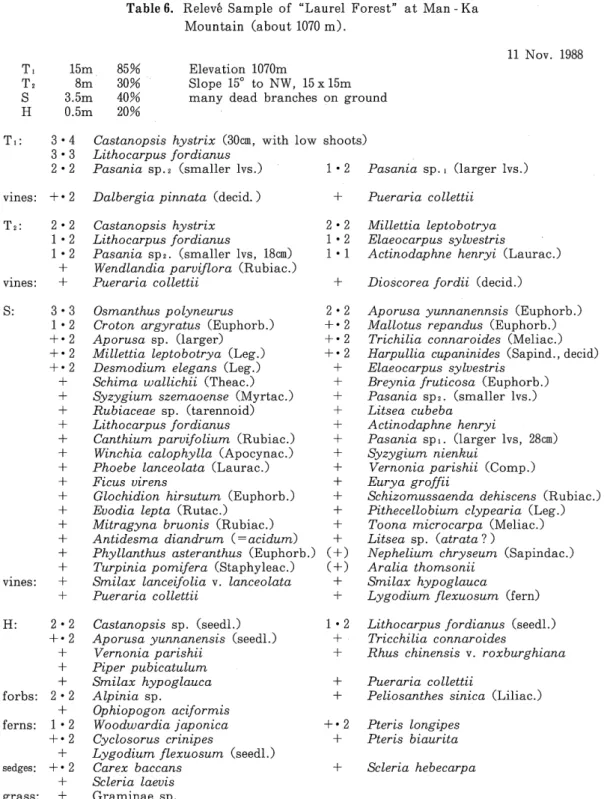
(9) Sz:. I. + + + + + + + + + + +. Lasiococca comberi v. pseudovert. Cleidion bracteosum ( ~ u ~ h o r b . ) Knema erratica ( T I ) Pometia tomentosa (T 1) Psychotria henryi (Rubiac.) Xanthophyllum siamense Ixonanthes cochinchinensis Lasianthus kerrii Pterospermum menglunense (end.) Pandanus pekinensis Myristica yunnanensis (T 2) Eurya acuminata (Theac.) Syzygium polypetaloideum Capparis assamica Stereospermum tetragonum (Bign.) Ardisia quinquegona Oreocnide obouata (Urtic.) Millettia sp. Saprosma ternatum Acacia pennata Psychotria yunnanensis. +. Phrynium capitatum ( 2 m). 2.3 2.2 1.2 +-2 +*2 +-2 +-2 +*2 +*2 +*2. forb:. vine: 1 1. H:. 1 2. + +. 2 2. + +. +. vines:. +. 2. + +. ferns: 2 2 I. +*2 +*2. +. forbs: 2 2 i. /. Piper flaviflorum. +. epiphyte:. +*2. Strychnos nitida (T 2) Amoora dasyclada (T 1 ) Mitrephora thorelii (Anonac.) Sumbaviopsis albicans (Tz) Beaumontia murtonii Litsea lancifolia Symplocos cochinchinensis Salacia polysperma Suregada glomerulata (Euphorb.) Polyalthia cheliensis (T 1) Artocarpus lakoocha (Morac.) Parabarium sp. 1 (Apocynac.) Dysoxylon sinensis (Meliac.) Ventilago calyculata (Rhamnac .) (decid.) Ficus sp. Aphananthe nitida (Ulmac., decid.) Castanopsis sp. Antiaris toxicaria Elaeocarpus austro - yunnanensis Lasianthus conspicuus Flemingia macrophylla (Legum.). Bolbites heteroclita (fern) Pometia tomentosa Cleidion bracteosum Mitrephora thorelii Syzygium polypetaloideum Psychotria pilifera Pipersp.2 Piper flaviflorum (TI) Erythropalum scandens (Olac.) Streptocaulon javentas Bolbites heteroclita Pleiocnemia wentii (height: 1m) Abacopteris triphylla Pronephrium megacuspe Phrynium capitatum (Mar ant) Aspidistra typica (Lil.) Pollia secundiflora (Comm.). 1 2 Amoora dasyclada ( T I ). + + + +. Barringtonia pendula (T 2 ) Illigera orbiculata (Hernandiac.) Garuga pinnata (Burserac.) Piper sarmentosum. + + +. Combretum yunnanense (Tz) Epipremnum pinnatum (Arac.) Tetrastigma obovatum (15m on ground) 1.2 Pteropteris sp. + 2 Allantodia aspera Angiopteris c a u d a t i f ~ r m i s. +. +* +*. 2 Goodyera procera 2 Pilea bracteata (Urticac.). Level symbols in parentheses indicate level potentials where these could be estimated; EG=evergreen, decid. = deciduous..
(10) The canopy is dominated jointly by Polyalthia cheliensis (Annonaceae) , Amoora ( = Aglaia) dasyclada (Meliaceae) , and Pometia t oment osa (Sapindaceae) , all three. from families which are much more common in the tropics than in extra-tropical forests. Additional canopy species are Machilus (=Persea) melanophylla (a species not encountered in Persea forests further north), Knema erratica (Myristicaceae) , Gironniera subaequalis (a subtropical to tropical Ulmaceae species occurring also in southeastern China), and a second, undetermined species of Polyalt hia. Pometia (with buttresses measuring 2 m across), Persea (80 cm diameter), and Gironniera are evergreen, but a t least some of the other species may be deciduous. (Many species in Yunnan are unique to the region and are not included in the Chinese floristic manual (Institute of Botany 1972-85), which gives seasonal foliation habit .) In addition, Bauhinia genuflexa (Leguminosae, 20 cm diameter), Cocculus laurifolia (Menispermaceae) , and Piper flaviflorum reach the canopy as larger or smaller lianas. The tree and shrub understoreys include many of the canopy species plus a large number of other woody species, including other vines but only a very few epiphytes (which are especially sensitive to an extended dry season). Both shrub layers are at least co-dominated by Lasiococca comberi var. pseudoverticillata (Euphorbiaceae). Cover in the herb layer is mainly by Bolbites heteroclita and other ferns plus Phrynium capitatum (Marantaceae), but some woody seedlings also occur. The numbers of individual trees over 10 cm in diameter, in each layer, are shown in Table 4. The total numbers of non-vine arborescent and frutescent species in each layer, and the corresponding occurrences of those species in lower layers, are shown in Table 5. Of the seven tree species in the canopy layer, all but Persea and the second Polyalthia species occur as younger trees or arborescents in lower layers, especially Pometia, Gironniera, and Amoora. This plus the somewhat greater cover in understorey layers suggests that this forest may still be recovering from some distupbance. Furthermore, the canopy composition does not really match that of any of the types identified in Table 1. Compared with evergreen broad-leaved forests dominated by Fagaceae, etc., this Man-Ka forest shows a slightly higher number of species in the canopy and in the herb layer. This may be due to the occurrence of deciduous trees in the overstorey, also permitting more light to reach the forest floor. Table 5 also suggests some aspects of the potential dynamics of this tropical seasonal forest stand. Five of the seven canopy species show regeneration in lower layers, while seven of the 14 tree species of the Tz-layer show regeneration (some of which may be potential canopy species, cf. Zhu et al. 1987). Only three large tree species have seedlings in the herb layer (Pometia, Amoora, and Barringtonia), but such seedlings are not necessarily numerous, given the long periods of 'time that seedlings often must wait before being "released" by formation of a canopy gap (cf. Swaine et al. 1987, Turner 1990). Pometia tomentosa is a co-dominant of the TerminaliaPometia forest type recognized by Zhu et al. (1987), but Terminalia was not found a t Man-Ka..
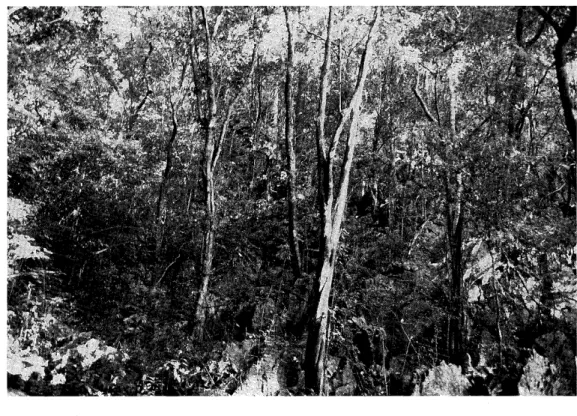
(11) Table 4. Numbers of Individual Trees over 10cm in Diameter (DBH) in the Seasonal Evergreen Forest Relev6 (Man - Ka).. Diameter breast-height. Overstorey (TI layer). Tree Understorey (Tz layer). Shrub Layer (S layer). Overstorey Trees Polyalthia cheliensis Amoora (=Aglaia) dasyclada Pometia tomentosa Gironniera subaequalis Machilus melanophylla Polyalthia spz. Knema erratica ( *buttress - root diameter) Trees in Understorey Garcinia cowa Pouteria grandifolia Barringtonia pendula Lasiococca comberi v. pseudoverticillata Knema furfuracea Tarenna sylvestris Sumbaviopsis albicans Chisocheton siamense Baccaurea ramif lora Trigonostemon thyrsoideum. 35 cm. The relev6 area was 500 d on a 40" slope and represents a site for which additional data on individual trees are available (Liu et al., unpublished). Plus signs indicate occurrence of individuals smaller than 10 cm DBH (diameter a t breast height). In addition, one individual each (DBH over 10 cm) of Aglaia abbreviata, Pittosporops is kerrii, Litsea lancifolia, and Saporosma ternatum occurred in the S1 layer.. Table 5. Numbers of Potential Tree Species by Forest Layer in the Seasonal Evergreen Forest a t Man - Ka.. Layer T I (canopy tree) T (tree understorey) Sr (arboresc. /shrub) S z (typical shrub) H (ground herb) Total. Total no. of species 10 18 30 45 29 106. No. of arboresc. species. No.of arb. T I species. No.of arb. Tz species. No.of arb. S I species. No.of arb. S Z species. -. -. -. -. -. -. 6. -. -. 42. 3 4 4. -. 11. 2. 83. 5. 10 0 10. -. 7 14. 26. 2 1 7. 6 6. Of the seven canopy tree species, five occur a s younger individuals in lower layers: Gironniera subaequalis, Pometia tomentosa, and Polyalthia cheliensis in the Tz and a t least one lower layer, and Amoora dasyalada and Knema erratica in the S I and S Zlayers. Pometia and Amoora also have seedlings in the herb layer. Of the 14 tree species in the T Zlayer, seven occur also in lower layers: Barringtonia, Sumbaviopsis, Lasiococca, Tarenna, Garcinia, and Chisocheton in the S I (and lower) layer, and Myristica in the Sz layer (see Table 3 for species names). Among the vines and lianas (not included above), Piper flaviflorum (TI ) occurs also in the S Zand H layers, while Combretum yunnanensis and Strychnos nitida ( T z) also occur in a t least one lower layer..
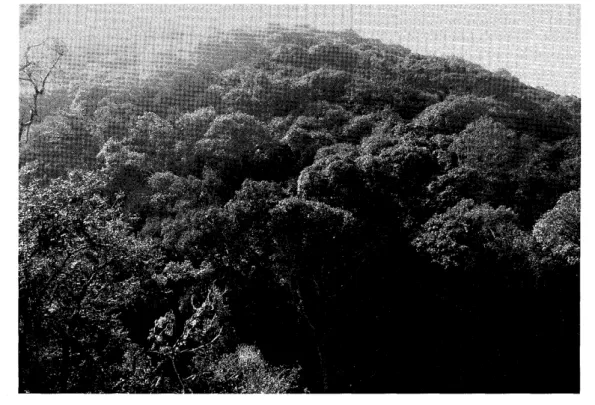
(12) The Montane Evergreen Broad-Leaved Forest An evergreen broad-leaved lucidophyllous or "laurel type" forest (see Figure 4) occurred on a 15" NW-facing slope less than 400 m higher than the seasonal evergreen forest. This montane evergreen broad-leaved forest was dominated by Castanopsis hyst rix and Lit hocarpus f ordianus, with two undetermined Pasania (cf Lithocarpus) species also in the canopy layer. The canopy was low (15 m) but closed (85%), and the understorey layers showed a t most 40% cover, with many dead branches on the ground. The understorey tree layer contained the same genera plus Millettia leptobotrya (Leguminosae) , Elaeocarpus sylvestris, and Actinodaphne henryi (Lauraceae) , a s well a s Wendlandia paruiflora (Rubiaceae, not common further north). The complete composition and structure of this forest are shown in Table 6. A1though most species seem to be local species, the tree-layer dominance by evergreen Fagaceae (with Lauraceae and Elaeocarpus) and the general distribution of species diversity (by f a r greatest in the shrub layer) make this forest quite similar to evergreen broad-leaved "laurel" forests familiar from the warm-temperate and subtropical parts of humid East Asia, including southern Japan and southernmost Korea a s well a s eastern China (e.g. Fujiwara 1981-86, Song 1988, Box et al. 1990). Castanopsis and Lithocarpus show regeneration in the herb layer, and the two Pasania species are present sparingly in the shrub layer (as is Lithocarpus). Other common lucidophyllous forest genera also occur in the shrub layer, including Osmanthus (the shrub-layer dominant), Schima, Litsea, and Syzygium (mainly subtropical). On the other hand, many of the shrub-layer genera are not so typical of lucidophyllous forests but. Figure 4. The Montane Evergreen Broad -Leaved Forest (Castanopsis) a t 1070 m Elevation on Man - K a Mountain..
(13) rather suggest tropical affinities, for example Croton, Glochidion, Aporusa and other Euphorbiaceae, Toona and Trichilia (Meliaceae), Harpullia and Nephelium (Sapindaceae), Pithecellobium (Leguminosae), and others. Vines occur sparsely in all layers, notably Pueraria collettii, but no epiphytes were recorded. The sparse herb layer (20%) involves woody seedlings plus mainly Alpinia and Woodwardia japonica. Table 6. RelevS Sample of "Laurel Forest" a t Man - Ka Mountain (about 1070 m ) . 11 Nov. 1988 T1 Tz S H. 15m 8m 3.5m 0.5m. 85% 30% 40% 20%. Elevation 1070m Slope 15" to NW, 15 x 15m many dead branches on ground. Castanopsis hystrix (30cm, with low shoots) Lithocarpus fordianus 1 2 Pasania sp. 1 (larger lvs.) Pasania sp. 2 (smaller lvs .). +. vines:. + *2. Dalbergia pinnata (decid. ). Tz:. 2 2 1.2 1.2. Castanopsis hystrix Lithocarpus fordianus Pasania spz. (smaller lvs, 18cm) Wendlandia parviflora (Rubiac.) Pueraria collettii. 2 2 1 2 1 1. Osmanthus polyneurus Croton argyratus ( E u ~ h o r b . ) Aporusa sp. (larger) Millettia leptobotrya (Leg.) Desmodium elegans (Leg.) Schima wallichii (Theac.) Syzygium szemaoense ( M ~ r t a c . 1 Rubiaceae sp. (tarennoid) Lithocarpus fordianus Canthium parvifolium (Rubiac.) Winchia calophylla ( A p o c ~ n a c . ) Phoebe lanceolata (Laurac.) Ficus virens Glochidion hirsutum (Euphorb.) Evodia lepta (Rutac.) Mitragyna bruonis (Rubiac.) Antidesma diandrum (= acidum) Phyllanthus asteranthus (Euphorb.) Turpinia pomifera (Staphyleac.) Smilax lanceifolia v. lanceolata Pueraria collettii. 2.2 +*2 +*2 +*2. r. +. vines: S:. vines:. H:. forbs: ferns: sedges: grass:. + 3.3 1.2 +*2 + *2 +-2. + + + + + + + + + + + + + + + +. 2.2 +*2. + + + 2 2 +. 1 2 +*2. + + 2 + +. Castanopsis sp. (seedl.) Aporusa yunnanensis (seedl.) Vernonia parishii Piper pubicatulum Smilax hypoglauca Alpinia sp. Ophiopogon aciformis Woodwardia japonica Cyclosorus crinipes Lygodium flexuosum (seedl.) Carex baccans Scleria laevis Graminae sp.. +. Pueraria collettii Millettia leptobotrya Elaeocarpus sylvestris Actinodaphne henryi (Laurac.) Dioscorea fordii (decid.). Aporusa yunnanennsis (Euphorb .) Mallotus repandus (Euphorb.) Trichilia connaroides (Meliac.) Harpullia cupaninides (Sapind., decid) Elaeocarpus sy lvestris Breynia fruticosa (Euphorb.) Pasania sp 2. (smaller lvs.) Litsea cubeba Actinodaphne henryi + Pasania sp 1. (larger lvs, 28cm) Syzygium nienkui Vernonia parishii (Comp.) Eurya groffii + Schizomussaenda dehiscens (Rubiac.) Pithecellobium clypearia (Leg.) Toona microcarpa (Meliac.) + Litsea sp. (atrata ? ) (+) Nephelium chryseum (Sapindac.) Aralia thomsonii (+I Smilax hypoglauca Lygodium flexuosum (fern). + + + + + + + + + + + +. Lithocarpus fordianus (seedl.) Tricchilia connaroides Rhus chinensis v. roxburghiana Pueraria collettii Peliosanthes sinica (Liliac.) Pteris longipes Pteris biaurita Scleria hebecarpa.
(14) The total number of species (61) is a bit high for a typical East Asian "laurel" forest, but the lower latitude, proximity to other forest types in a transitional region, and some evidence of disturbance may be responsible for this. This forest seemed to represent a subtropical montane analog of East Asian evergreen broad-leaved (lucidophyllous) forests, but with characteristic Yunnan species, some of them tropical.. The Forest on Limestone A forested outcropping of jagged limestone boulders occurs about 1 km off the main road less than 5 km south of the Menglun botanical garden. The area sampled (20 x 30 m) included the lower slopes of both sides of a ravine which sloped about 15"to the southwest, with slopes to 30" on the sides of the ravine. The composition and structure of the forest are shown in Table 7. The physiognomy of the forest, including its dense network of vines and the wide buttresses of the dominant species, Tetrameles nudiflora (Datiscaceae), are shown in Figures 5 and 6. Table 7. Relev6 Sample of " Limestone Forest Menglum (about 690 m). TI. 35m 15m 5m 0.8m. Tz S H. T I:. T :. 3 2 2 2. 3. 2 1. 1. 5 4. 1 2 S:. 2.2 1.2. + + + + +. vines:. 2 2 1.1. +. vines:. + 2 +. +. forns: 1 1 forbs:. +. +. (+). 50% 80% 40% 30%. ". near. Limestone (rough, jagged boulders) Elevation 690m Slope 15" to SW, both sides of ravine (ravine slopes to 30"). Tetrameles nudiflora (Datiscac.) (buttress to 3 m DBH) (decid.) Toona ciliata (Meliac.) (90cm DBH) (decid.) Cleistanthus sumatranus ( E u ~ h o r b i a c . )(EG) Celtis wightii (Ulmac.) (85cm DBH) Cleistanthus sumatranus Lasiococca comberi var. pseudoverticillata (Euphorbiac.) Celtis wightii Lasiococca comb. v. pseud. Sumbaviopsis albicans (Euphorb.) Celtis cinnamomea Chloranthus (Chlor.) Helicia nilagirica (Proteac.) Radermachera microcalyx (Bign.) Jasminum lanceolatum (Oleac.) vine sp. (Millettia sp. ? ) Dregea volubilis ( A s c l e ~ i a d . ). 2.2 1.2. Cleistanthus sumatranus (seedl.) Acacia sp. (seedl.). 1 2. Rhaphidophora hongkonensis Rhaphidophora megaphylla Hoya pottsii (Asclep.) Tectaria polymorpha Chlorophytum malayense (Lil.) Polygonatum cirrhifolium Oreocnide rubescens (Urticac.). (EG =evergreen, decid. =deciduous). +. + + 4-. +. Cleistanthus sumatranus Sageretia pauciflora (Rhamnac.) Cleidion spiciflorum ( E u ~ h o r b . 1 _ Rauvolfia yunnanensis (Apocynac.) Suregada glomerulata ( E u ~ h o r b . 1 Tarenna incerta (Rubiac.) Clausenia dunniana (Rutac.). +. Celtis wightii (seedl.) Walsura robusta (Meliac.) (seedl.). + +. Rhaphidophora decursiva Tetrastigma planicaulum. +- 2 + +. Adiantum philippense Begonia dryadis (Begoniac.) Arisaema sp..
(15) Figure 5. The Limestone Forest near Menglun, with Deciduous and Evergreen Trees on Shallow (Variable) Soil over Jagged Limestone.. Like many forests on limestone, the composition is much simpler than that of the adjacent forest. The canopy is dominated by Tetrameles nudiflora (deciduous) and includes only three other species : Cleist ant hus sumat ranus (Euphorbiaceae, with reddish bark, a modular trunk structure, and thin, glossy evergreen leaves), Toona ciliata (Meliaceae, deciduous, with trunk diameter to 90 cm a t breast height ) , and Celtis wightii (Ulmaceae, 85 cm DBH, perhaps deciduous). The understorey tree layer is almost completely composed of Celtis wightii (15 m, 80%), along with some Lasiococca comberi var. pseudoverticillata (Euphorbiac.), which was also the main species in both shrub layers a t the Man-Ka seasonal forest site. Celtis and Cleistanthus also dominate the shrub and herb layers, accompanied by other species which were mostly not seen in the other two forest samples. The total number of species is only 34, with 14 occurring only in the herb layer and 13 only in the shrub layer. The occurrence of Tetrameles a s the canopy dominant, with no apparent regeneration, and the fact that it is considered to be a main dominant species of limestone forests in the region suggest that the forest is mature. It also suggests that this forest is fairly typical of limestone forests in Xishuangbanna, which are described (Zhu et al. 1987, pp. 188) a s involving also Celtis spp. and Cleistanthus (but Cl. saichihii) , a s well a s Sumbaviopsis, Clausenia, Adiant um, etc. Although the accompanying species composition differs from the descriptions of Zhu et al. (1987), this forest appears to conform to the Tetrameles type of limestone forest. It is unusually tall (35m) compared with the forests of coastal and island limestone areas of East Asia (e.g. Okinawa, southern Taiwan) . Otherwise, the dominance by deciduous species,.
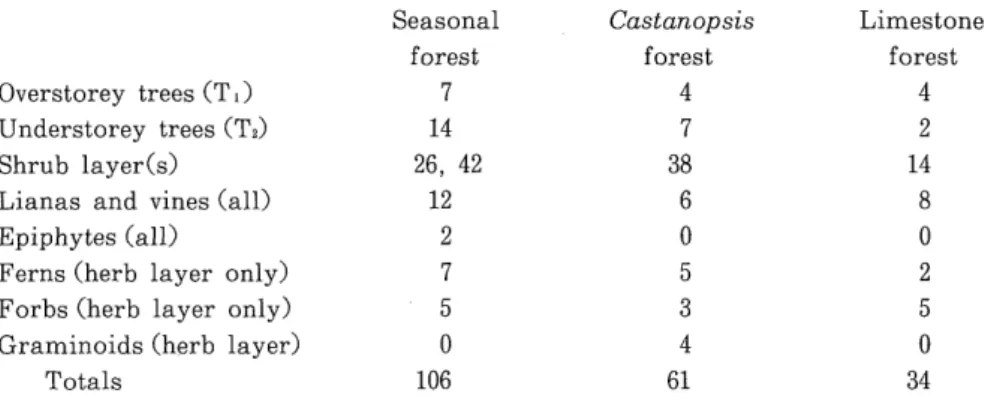
(16) Figure 6. Large Buttress Roots of Tetrameles nudiflora with Tangle of Lianas in the Limestone Forest near Menglun.. concentration of cover a t around 15 m height and less understorey are similar to other n forests on limestone.. Forest Richness The species richness of the three forests, by stratum and growth form, is shown in Table 8. The truly tropical, seasonal forest a t Man-Ka (700 m) shows more species in all categories except graminoids than either of the other forests. All three forests have much of their total species richness concentrated in the shrub layer(s), with relatively few species in the herb layer. Forests on rough limestone often have fewer species, but not always. Kelly et al. (1988), for example, report that Jamaican forests on limestone, though shorter, generally have as many species as other, comparable Caribbean forests. Dissimilarity of the Three Forests The most striking feature of the three forests studied is their almost complete dissimilarity in composition, as shown in Table 9. No species occurs a s a tree in all three relev&, and only four species occur in two of the three relevks, all four in the two lower-elevation, truly tropical forests ( Man-Ka a t 750 m and the limestone forest, a t 690 m). One of these species, Lasiococca comberi var. pseudoverticillata, is the only species which occurs as a tree in more than one of the three relevks. The other three species common to the tropical seasonal and limestone forests are Sumbaviopsis albicans ( a Tz tree at Man-Ka but in the shrub layer on the limestone),.
(17) Table 8. Numbers of Species in Each Layer of the Three Forests Sampled.. Overstorey trees (T 1 ) Understorey trees (Tz) Shrub layer(s) Lianas and vines (all) Epiphytes (all) Ferns (herb layer only) Forbs (herb layer only) Graminoids (herb layer) Totals. Seasonal forest 7 14 26, 42 12 2 7 5 0 106. Castanopsis forest 4 7 38 6 0 5 3 4 61. Limestone forest 4 2. The shrub layer(s) include shrubs, arborescents, and potential taller trees. In the seasonal forest, two shrub layers were recognized.. Table 9. Numbers of Total and Common Genera in the Three Forests near Menglun.. I. I. Total Genera. Location. Common Genera Man - K a. Man - Ka. Man-Ka. Man- Ka. Lime-. 1070m. All 3. 700m. 1070m. stone. limestone. relev6s. Overstorey trees (TI) Understorey trees (T 2 ) Shrub layer(s) Lianas and vines (all) Ferns (herb layer only) Forbs (herb layer only) Totals. Man-Ka 700m is the seasonal evergreen forest (mainly tropical t a x a ) , while Man-Ka 1070m is the Castanopsis forest. Numbers in parentheses indicate numbers of genera common to more than one forest stand sampled but present only in a lower stratum in a t least one of the locations. Only one genus, Lasiococca, occurs a s a tree in more than one of the forest stands.. Suregada glornerulata (also Euphorbiaceae, a shrub in both relevbs), and Rhaphidophora hongkongensis (Araceae), a shrub-layer vine a t Man-Ka (700 m) and one of three Rhaphidophora vine species in the herb layer of the limestone forest. There are also few common genera. Only one genus, Millettia (Leguminosae), occurs in all three relevbs. No genus other than Lasiococca occurs as a tree in more than one relevb , though two canopy genera (Castanopsis and Toona) occur in the shrub layer of a second relevi: (as a single individual). Castanopsis and Elaeocarpus from the Fagaceae forest a t Man-Ka are represented also in the lower shrub.
(18) layer of the tropical seasonal forest a t Man-Ka, while in the shrub layers, various species of Litsea, Ficus, Eurya, and Syzygium occur sparingly (+ 02 or less) in both forests. Piper flaviflorum is a fairly common canopy and understorey vine in the tropical seasonal forest, while P. pubicat ulum occurs a s scattered individuals in the herb layer of the Fagaceae forest. Tarenna sylvestris occurs a s an understorey tree in the tropical seasonal forest, while Tarenna incerta occurs in the limestone forest. In addition, four other genera occur in both the tropical seasonal and the limestone forests (in addition to the four common species mentioned above): Cleidion (Euphorbiaceae), Oreocnide (Urticaceae), Acacia (Leguminosae, seedlings), and Tetrastigma (Vitaceae). Toona (different species) is the only genus common to the Fagaceae forest and the limestone forest samples. The common subtropical genera Psychotria, Ardisia, and Symplocos occurred in the tropical seasonal forest but not in the other relevhs. No non-woody genus occurred in more than one of the three relevks.. Interpretation There is generally a certain amount of overlap, of species as well a s genera, creating a transition band between different forest zones. In East Asian forests, such genera as Persea, Castanopsis and other Fagaceae, Schima, Syzygium, Psychotria, Ardisia, Cinnamomum, and various other woody tree and shrub genera occur widely throughout the subtropical forests and are known to occur also in both warm-temperate and tropical forests to a lesser extent. Of course it is well known (e.g. Richards 1952, Whitmore 1984, Ashton 1967) that tropical forests are quite different taxonomically from extra-tropical forests. Nevertheless, the almost complete dissimilarity in species and even genus composition of the three forests studied seems striking. This is especially so in the case of the two forests a t Man-Ka, both on the north side of the mountain (perhaps 5 km apart) and separated by less than 400 meters in elevation. * As already described, the Fagaceae forest a t Man-Ka and the limestone forest could both be recognized a s fairly typical examples of forest types described by Zhu et al. (1987) in their classification of Yunnan vegetation. The tropical seasonal forest a t Man-Ka, however, could not be placed so easily, and we were told by Kunming personnel afterward that it was not a typical forest. The dynamic position of this forest thus becomes an interesting question and is being studied by the Kunming Institute of Ecology. A register of individual trees at the site is available, and litterfall studies are also being conducted. The tropical seasonal forest (see Table 3) seems to be most closely related to the Antiaris-Pout eria-Canarium and Terminalia-Pometia types of "seasonal rain forest" described by Zhu et al. (1987)(Table I), in which Gironniera subaequalis and Pometia tomentosa are especially important and in which Garcinia cowa and Knema furfuracea (all in the Man-Ka relevk) also occur. Other main trees a t Man-Ka are represented in these two forest types by other species of the same genera, e.g. Polyalthia, Aglaia (Amoora) , Barringt onia, and Baccaurea. On the other hand, the two dominant genera in Table 3, Polyalthia and Amoora, are not prominent in the types described by Zhu et al. (1987), and the species of these genera which are mentioned by Zhu et al. seem not to be canopy species. Persea (80 cm DBH a t Man-Ka) is not mentioned a t all by Zhu et al. All of this suggests two things, namely a rather marginal position for the Man-.
(19) I. (. 1 I. I I I. (. I. I I. Ka seasonal forest (near its upper elevational limit) and/or that the Man-Ka seasonal forest may still be recovering from some disturbance. The Man-Ka tropical seasonal forest shows more or less equal similarity, in terms of potential overstorey tree species, to the Terminalia-Pometia and the Antiaris-Pout eria-Canarium types of Zhu et al. (1987). Perhaps most interesting, though, is that even as a fragment near another forest type, the tropical seasonal forest contains almost no species or even genera from the adjacent Castanopsis forest. Some Kunming personnel felt that the Castanopsis forest was a t an unusually low elevation, perhaps descending along a ridge (shallower, drier soil). This is supported by the strong admixture of tropical elements in the Cast anopsis (lucidophyllous) forest. In the more truly tropical seasonal forest none of the Castanopsis forest dominants remain a s important elements, if a t all. This rapid replacement of extra-tropical dominants by tropical ones (but not the reverse going northward) seems to be a characteristic of the boundaries of the tropical forest zone.. Acknowledgement The authors would especially like to express their thanks to Zhang Jian-hou, director of the Tropical Botanical Garden a t Menglun, and to Wu Bang-xing, taxonomist, for their taxonomic and logistical assistance during our work around Menglun: Thanks also to Jiang Han-qiao, Jin Zhen-zhou and Liu Lun-hui (Kunming), who provided literature and helpful scientific advice, and who also facilitated our work in Xishangbanna (as well a s other parts of Yunnan). Finally, special thanks also to our intrepid interpreter, Miss Zhao Jing, for her tireless assistance.. I. References Ashton, P . S. 1967. Climate versus soil in the classification of Southeast Asian tropical lowland vegetation. J . Ecol., 55:67. Ashton, P. S. 1978. Crown Characteristics of Tropical Trees. In: Tropical Trees a s Living Systems (P. S. Tomlinson and M. H. Zimmermann, eds.). Cambridge University Press. Box, E. O., B. N. Holben, and V. Kalb 1989a. Accuracy of the AVHRR Vegetation Index a s a predictor of biomass, primary productivity and net COz flux. Vegetatio, 80:71-89. Box, E. O., K. Fujiwara, Hao Y., Zhong Y., Fu Q., and Xiao B. 1989b. A tropical montane evergreen forest and other vegetation on Hainan Island, southern China. Bull. Inst. Environm. Sci. Techn. Yokohama Nat. Univ., 16:75-94. Box, E. O., Song Y., A. Miyawaki and K. Fujiwara 1990. An evergreen broad-leaved forest in transitional eastern China. Bull. Inst. Environm. Sci. Techn. Yokohama Nat. Univ.,. 17. Box, E. 0 . (in press). Japanese Vegetation in Global Perspective. In: Vegetation and Environments of Japan. (A. Miyawaki e t al., e d ~ . ) . Shibund6 /Kluwer. Brandis, D. 1895. An enumeration of the Dipterocarpaceae. J. Linn. Soc. Bot., 29:l-148. Central Meteorological Bureau 1979. Zhongguo Renmin Gongheguo Qihou Tuji. (Climatic Atlas of the People's Republic of China.) Beijing: Map Press. (In Chinese.) Champion, H. G., and S. K. Seth 1968. A Revised Survey of the Forest Types of India. Delhi : Government Printer. China Natural Geography Editorial Committee (eds.) 1984. (China Natural Geography: Climate.) Beijing: Academia Sinica and Science Press. 161 pp (in Chinese). Fujiwara, K. 1981-86. (Phytosociological investigation of the evergreen broad-leaved forests.
(20) of Japan, I-IV.) Bull. Inst. Environm. Sci. Techn. Yokohama Nat. Univ., 7:67-133, 8: 121-150, 9:159-160, 13:99-149 (in Japanese, with Engl. synopsis in p a r t IV). Handel-Mazzetti, H. 1921. ~ b e r s i c h t iiber die wichtigsten Vegetationsstufen und -Formationen von Yunnan und SW-Setschuan. Bot. Jahrb. Engler, 56: 578-597. Holdridge, L. R. 1959. A simple method f o r determining potential evapotranspiration from temperature data. Science, 130: 572. Institute of Botany 1972-85. (Iconographia Cormophytorum Sinicorum.) 5 vols. plus two appendices, each about 1000 pp. Beijing: Science Press. (In Chinese, with Latin indices.) Iwatsuki, K., and M. Mizutani 1972. (Coloured Illustrations of Bryophytes of Japan.) Osaka: Hoikusha. 405 pp (in Japanese, with Latin index). Jiang Han-qiao 1980. (Distributional features and zonal regularity of vegetation in Yunnan.) Acta Botanica Yunnanica, 2 :20-32, 142-151 (in Chinese). Jiang Ai-liang 1988. Climate and natural production of rubber (Hevea brasilensis) in Xishuangbanna, southern part of Yunnan province, China. Intern. J . Biometeorol., 32: 280-282. Jin Z.-Z. 1979. (The types and characteristics of evergreen broadleaf forests in Yunnan.) Acta Botanica Yunnanica, 1:90-105 (in Chinese). Jin Z.-Z. 1983. (On the fundamental features of tropical rainforest and monsoon forest in Yunnan.) J . Yunnan Univ. (Nat. Sci. edition), 1,2: 197-205 (in Chinese). Kelly, D. L., E. V. J . Tanner, V. Kapos, T. A. Dickinson, G. A. Goodfriend, and P . Fairbairn 1988. Jamaican limestone forests: floristics, structure and environment of three examples along a rainfall gradient. J . Tropical Ecology, 4 :121-156. Kunming Institute of Botany (eds.) 1977-86. (Flora Yunnanica.) 4 vols. Academia Sinica. Beijing : Science Press. (In Chinese, with Latin index.) Liu L. and Yu Y. 1983. (The distribution and floristic composition characteristic t o tropical forest in Yunnan.) Acta Botanica ~ u n n a n i c a ,5: 187-196 (in Chinese). Makita, H., and H. Chujo 1989. Vegetation of Yunnan and Hainan Provinces, China. Geogr. Rev. Japan, ser. B., 62:116-126. Merrill, E. D. 1923. Distribution of the Dipterocarpaceae. Philippine J . Sci., 23 :1-33. a Nomoto, S., Du M.-Y., and K. Ueno 1989. Some characteristics of cold-air lakes and fog in the Jinghong and Mengyang Basins, Xishuangbanna, China. Geogr. Rev. Japan, ser. B, 62 :137-148. Richards, P. W. 1952. The Tropical R a i n Forest. London: Cambridge Univ. Press. Song Y.-Ch. 1988. Broad-leaved ever,green forests in central Japan in comparison with eastern China. VerBff Geobot. Inst. Riibel (Zurich), 98: 197-224. Swaine, M. D., D. Lieberman, and F. E. Putz 1987. The dynamics of tree populations in tropical forest: a review. J. Trop. Ecol., 3:359-366. Thornthwaite, C. W., and J. R. Mather 1957. Instructions and Tables f o r Computing Potential Evapotranspiration and the Water Balance. Publ. in Climatol., 10 ( 3 ) :185-311 (Drexel Inst. Technol., Centerton, New Jersey). Turner, I. M . 1990. Tree seedling growth and survival in a Malaysian rain forest. Biotropica, 22 :146-154. Urushibara, K., and S. Nagatsuka 1989. Climatic conditions and vertical zonality of soil distribution in South Yunnan, China. Geogr. Rev. Japan, ser. B, 62:127-136. Wang Chi-Wu 1939. A preliminary study of the vegetation of Yunnan. Bull. Fan Mem. Inst. Biol. Bot., 9:65-123. Wang Chi-Wu 1961. The Forests of China, with a Survey of Grassland and Desert Vegetation. Cabot Foundation publ. no. 5. Cambridge (Massachusetts): Harvard University, 313 pp. Wang D.-M., Yang Sh.-Z., and Zhu Y.-X. 1985. (The Dipterocarpaceae forests in Yunnan Province.) Acta Phytoecol. Geobotan. Sinica, 9 :32-45 .(in Chinese, with English summary)..
(21) Whitmore, T. C. 1984. Tropical Rain Forests of the Far East. 2nd edition. Oxford: Clarendon Press. Wilson, E. H. 1913. A Naturalist in Western China. 2 vols. 251 229 pp. Wu Zh.-Y. and committee (ed.) 1980. Zhongguo Zhibei (Vegetation of China). Beijing: Science Press. 1375 pp (in Chinese). Wu Zh.-Y. and co-workers (eds.) 1984. (Index Florae Yunnanensis.) Kunming Institute of Botany, Academia Sinica. Kunming: People's Publishing House. 2 vols., 2259 pp (in Chinese, with Latin index). Xu W.-D., Sh. Shirasaka, and T. Ichikawa 1989. Farming system and settlements in Xishuangbanna, Yunnan Province, China. Geogr. Rev. Japan, ser. B, 62 :104-115. Yasunari, T., and Tian Sh.-F. 1989. Large-scale atmospheric circulation patterns associated with the cold surges in Yunnan Province, China. Geogr. Rev. Japan, ser. B, 62:161-169. Yoshino, M. M. 1989. Problems of climates and agroclimates for mountain development in Xishuangbanna, South Yunnan, China. Geogr. Rev. Japan, 62:149-160. Yunnan Institute of Tropical Botany (eds.) 1984. (List of Plants in Xishuangbanna.) Kunming: Yunnan Nationalities Press. 509 pp (in Chinese). Yunnan University 1960. (A survey of plant communities of the nature conservation stations in the tropical and subtropical regions of Yunnan Province, China.) Prepared for Yunnan Government. 166 pp (in Chinese, with English summary). Zhu Y.-Ch. and committee (eds.) 1986. Yunnan Senlin (Yunnan Forests). Kunming: Yunnan Science-Technology Press; and Beijing: Chinese Forestry Press. 572 pp, with forest map and 123 photos (in Chinese, with Latin species glossary). Zhu Y.-Ch. and committee (eds.) 1987. Yunnan Zhibei (Yunnan Vegetation). Beijing: Science Press. 1024 pp, with veg. map (in Chinese, with Chinese and Latin species indices).. +.
(22)
図


+7


関連したドキュメント
The answer, I think, must be, the principle or law, called usually the Law of Least Action; suggested by questionable views, but established on the widest induction, and embracing
Other important features of the model are the regulation mechanisms, like autoregulation, CO 2 ¼ reactivity and NO reactivity, which regulate the cerebral blood flow under changes
[r]
A similar program for Drinfeld modular curves was started in [10], whose main results were the construction of the Jacobian J of M through non-Archimedean theta functions ( !;;z )
where G denotes the species of (simple) graphs, C , that of connected graphs, and E, the species of Sets (in French: Ensembles ). A connected graph is called 2-connected if it has
For Army cutworm, Armyworm species, Cutworm species, Stalkborer, or True armyworm, apply as a 5- to 7-inch band over the row on the soil surface, a 5- to 7-inch band over the
For Army cutworm, Armyworm species, Cutworm species, Stalkborer, or True armyworm, apply as a 5- to 7-inch band over the row on the soil surface, a 5- to 7-inch band over the
Aphid species 2,3 Armyworm Beet Armyworm 1,3 Corn Earworm Diamondback Moth 3 Fall Armyworm 1 Flea Beetle species Grasshopper species Japanese Beetle (Adult) Leafhopper species
