Yae Sano
1Abstract
Japanese political actors face difficult challenges in the management of wildlife in Japan. There are various interest groups who influence wildlife management, and evidence suggests that in many cases agricultural interests rather than environmental interests tend to dominate the policymaking process. A strong policy bias in favor of the interests of farmers has resulted in the adoption of suboptimal conservation policies. Although some citizen groups in favor of nature conservation are gradually exerting some influence over these policies, they are not unified. This situation has left politicians with rather weak incentives to increase their environmental credentials, while incentives to support the demands of the agricultural lobby remain strong.
Keywords: Wildlife management, Nuisance control, Conservation policy, Political actors, Japan
Introduction
Japanese people are increasingly coming into contact with wild animals such as deer, monkeys and wild boars, which often cause large damages to agriculture. Some wildlife, such as bears, poses a direct threat to people, occasionally causing bodily injury and sometimes even human death. Somewhat sensationally, the Japanese media outlets have picked up on this trend and are excited to provide reports on a lone bear or deer wandering into a village or, increasingly, into larger towns as well.
Preventing property damage and human injury and death is becoming an increasingly important policy concern for both the national and local governments. As animal habitats become smaller and scarcer, this is likely to provide an even greater source of worry in the near future. However, while preserving the welfare of communities and individuals is perhaps the primary consideration of the government at all levels, there is a growing recognition that preservation of biodiversity and the natural environment are also important policy objectives. Populations of certain species of wildlife in some areas of Japan, such as the Asian black bears in Shikoku and Chugoku areas, are endangered, while the numbers of other wildlife species in some areas of Japan are increasing. Examples of the latter trend include shika deer in most parts of the country and wild boars in Kanto, Chubu, Shikoku, Kyushu and Okinawa (Biodiversity Center of Japan, 2004). A difficult challenge for the Japanese government is how to balance the demands of rural communities and agricultural interest groups for the elimination of the threats from wild animals, with the demands of conservation groups and an increasingly environmentally aware segment of the general population to conserve the Japanese wildlife. In terms of Japan's wildlife management policy, the well-known support of agricultural interests rather than environmental interests by the Liberal Democratic Party (LDP) dominated the policymaking process for over five decades until their defeat in the 2009 elections. As a result, a strong policy bias already exists in favor of the interests of local farmers in remote areas, resulting in a suboptimal conservation policy. The agricultural constituency has been much more powerful than those in favor of nature conservation throughout the postwar Japanese history, and this is reflected in terms of public policy. The Democratic Party of Japan (DPJ), the current administration, has also fundamentally followed the LDP’s line in supporting agricultural interests the evidence of which can be seen in the massive difference in the requested budgets for the fiscal year 2011 by the two government ministries for comparable
1
purposes. The Ministry of Agriculture, Forestry and Fisheries (MAFF) allocated 11.2 billion yen of its total requested budget of 2,278 billion yen specifically to save agriculture from wildlife damage, while the Ministry of the Environment allocated a sum of 118 million yen from a much smaller budget of 207 billion yen for projects mitigating human nuisance. Although some citizen groups in favor of nature conservation have gradually increased their influence over policy-making in recent years, environmental credentials for Japanese politicians are not in priority. Thus, it appears that politicians have rather weak incentives to increase their support for environmental issues while maintaining strong incentives to support the demands of the agricultural lobby. The policy implications are clear – what happens to the natural environment when agricultural interests dominate the policymaking process?
Methodology
This paper discusses the challenges faced by Japanese political actors involved in the management of wildlife in Japan. Using documentary evidence from government reports, the scientific literature, publications by non-governmental organizations (NGOs) and the media, I have examined how various interest groups that are influential in wildlife management are attempting to follow their sometimes competing objectives through public policy. The analysis of this paper depends on written materials that are publicly accessible. These include research reports, meeting minutes, budget documents and census data released by the national government agencies as well as reports, statements, and magazine articles produced by political associations and NGOs.
The government agencies concerned with wildlife management are the Ministry of the Environment which is responsible for nature conservation and MAFF which has administrative authority over agriculture, forestry and fisheries. The political associations and NGOs documents of which are used in this analysis are all organized at the national level. They include the Central Union of Agricultural Cooperatives, the National Association of Towns and Villages, LDP’s National Union for the Promotion of Rural Communities, the Nature Conservation Society of Japan, the WWF Japan and the Wild Bird Society of Japan. These sources provided comprehensive data and information in order to examine various interest groups that are influential in public policy for wildlife management. Although the methodology used in this paper is primarily descriptive, it may provide a significant contribution to a policy area that has not been widely studied by the scholars of public policy in Japan.
Discussion
1. Human – wildlife conflicts in Japan
Damage caused by wildlife to agricultural crops has rapidly increased since the 1980s. Figure 1 shows the recent trend of agricultural damage caused by four representative medium-to-large size terrestrial mammal species. Among these,
shikadeer, wild boar and monkeys are considered the three largest nuisances to agriculture. In particular, damage caused by shika deer is rapidly increasing; the total damage in the fiscal year (FY) 2010 was worth 7,750 million yen over an area of 691,000 ha. They also have a substantial impact on the ecosystems of 16 out of 28 national parks , 13 of which demonstrate degradation of vegetation within the natural park area (Ministry of the Environment, 2005).
Despite the fact that their damage to crops is relatively low compared to other animals, bears are considered a nuisance because of the danger they pose to humans. Figure 2 presents the number of injuries and deaths caused by Asian black bears in the past 30 years. While the number of deaths has remained fairly constant (maximum three people per year), with more bears coming into contact with people, the number of injuries has increased twenty-eight times, from five cases in 1980 to 140 in 2006, and 142 in 2010.
While it is generally accepted that approximately 20% of all mammal species and slightly more than 10% of all bird species face the threat of becoming endangered (Ministry of the Environment, 2007), a comparison of the results from the National Surveys on the Natural Environment of 1978 and 2003-2005 surprisingly suggests that all seven representative large-medium size terrestrial mammal species in Japan (shika deer, wild boars, monkeys, raccoon dogs, Japanese serow, Asian black bears and brown bears) have expanded their distribution over the past two decades (Ministry of the Environment, 2005). While a scientific study has suggested a relationship between the number of bear encounters and the growth of wild acorns, one of their main sources of food in the mountains (Oka, 2006), three major causes were identified by the Ministry of the Environment for the expansion of wildlife distributions (Japan Wildlife Research Center, 2007): decrease in number of hunters, changes in forest habitats, and changes in land use and social structure in rural communities.
Figure 1. Wildlife Damage to Agriculture (1989-2009) (Thousand hectares)
Source: Ministry of Agriculture, Forestry and Fisheries
Figure 2. Human accidents with Asian black bear (number of persons)
a. Decrease in number of hunters
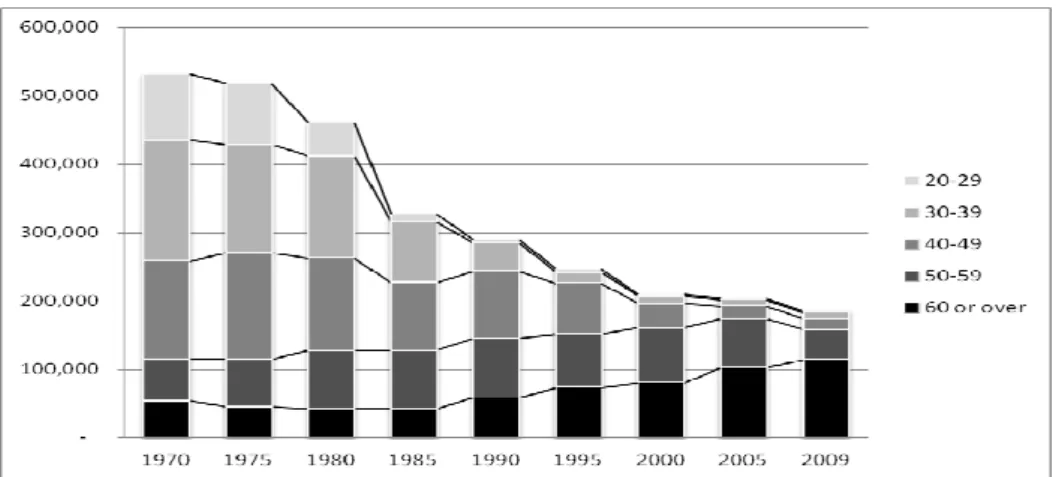
While an argument exists that the increase in the number of shika deer may be due to the extinction of their major predator, the Japanese wolf, in 1905, the general consensus is that the decreasing number of hunters is the main factor. Figure 3 shows the trend in the number of registered hunters. While the number of trap users is slightly increasing, the number of licenses issued for gun use, which includes recreational hunters, has steadily decreased since the 1970s. This is attributed to a cumbersome procedure for registration that requires annual inspection of guns and license renewal every three years (The Kii Minpou, 13 December 2006). The Japan Hunters Association (Dainihon Ryoyukai, 2002) has identified further possible reasons for the decline, including: growing demands for wildlife protection among the general public; a dominant urban lifestyle that does not require hunting as a means of subsistence and livelihood; a prevailing negative image of hunting; and the lack of public awareness on hunting as a means of wildlife management and balancing wildlife with human livelihood.
b. Changes in forest habitat
Until the early 1960s, the forest products industry was a major manufacturing sector, particularly in Japan’s mountainous areas. Loggers, truckers, and other workers frequently entered forests, causing noise and activity that alerted wildlife to take precautions against humans. This conditioned them to avoid unnecessary contact with people, and so they kept away from rural communities. However, since its peak in the late 1970s, domestic forestry production has steadily decreased as overseas imports have increased. In particular, after the use of fuel wood was replaced by oil and gas, forests and woods near local communities have been abandoned. As a result, several species of wildlife have lost their fear of humans.
c. Changes in land use and social structure in rural communities
Increase of abandoned farmlands due to aging and depopulation of rural areas often create conditions favorable for wildlife that are considered a reason for the expansion of the distribution of bears and other animals (Ministry of the Environment, 2004). For example, grass in abandoned rice fields makes excellent material for nest making by wild boars (Tokida et al., 2004). Abandoned farmland has increased from 131,000 ha in 1975 to 217,000 ha in 1990, and to 386,000 ha in 2005 (Census of Agriculture and Forestry). Among 1,317 municipalities, 485 of them reported damage caused by wildlife to property or humans in abandoned farmland (Ministry of Agriculture, Forestry and Fisheries, 1995). Abandoned farmland is farmland with no plantation in the last year and no plan for plantation in the coming few years.
Figure 3. Trend in hunters’ numbers and age structure (person)
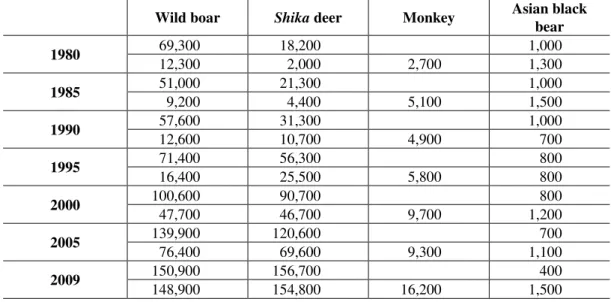
As the damage caused by wildlife increases, the demands of rural communities and agricultural interests to eliminate the animals are growing. In order to meet these demands, killing nuisance animals is legally allowed, but requires permission. Culling started in 1999 as a measure to control the population of particular species according to prefectural wildlife management plans. As a result, the number of animals killed has increased as shown in Table 1. Among these, populations of shika deer, wild boar and monkeys are considered to be too high, and most scientists agree with the need for population control. However, in contrast, some species in some areas are considered to be in a critical condition (Fujimori et al., 1999). In particular, populations of Asian black bears, especially in Shikoku and Chugoku, face the danger of extinction due to isolation from other populations. Furthermore, as the fertility level of bears is lower than that of the other three species, scientists fear that the annual killing of over 2,000 of an estimated population of 10,000 individuals may lead to a critical status for this species in Japan.
2. Key actors in wildlife management
a. Ministry of the Environment
The history of environmental administration in Japan started with enactments of national legislations on pollution control. While the national park system was authorized in 1931, environmental protection was not a major political concern until serious large scale pollution problems were revealed as a negative outcome of postwar years of rapid economic growth. After court decisions supporting pollution victims were made in the 1960s and the public gained awareness on the environment, the extraordinary diet session of November 1970 passed 14 pollution related laws and Prime Minister Eisaku Sato’s cabinet established the Environmental Agency in 1971 in order to coordinate and regulate pollution and administrate nature conservation. Wildlife management has been under the jurisdiction of the Environmental Agency since its inception in 1971. Although the Agency was upgraded to the ministry status in 2001, it remains weak compared to other bureaucracies. Figure 4 shows the national budget allocation of 11 ministries and one agency for the fiscal year of 2011. It is not difficult to see that the budget allocated to the Ministry of the Environment was the smallest of all organizations.
Table 1. Hunting and nuisance killing of four problematic species(upper row: Hunting; lower row: Nuisance)
Wild boar Shika deer Monkey Asian black bear 1980 69,300 18,200 1,000 12,300 2,000 2,700 1,300 1985 51,000 21,300 1,000 9,200 4,400 5,100 1,500 1990 57,600 31,300 1,000 12,600 10,700 4,900 700 1995 71,400 56,300 800 16,400 25,500 5,800 800 2000 100,600 90,700 800 47,700 46,700 9,700 1,200 2005 139,900 120,600 700 76,400 69,600 9,300 1,100 2009 150,900 156,700 400 148,900 154,800 16,200 1,500
Figure 4. National budget allocation of 2011 (in billion yen)
Source: Ministry of Finance
The nature of the Ministry of Environment’s operations has also reduced its authority in environmental administration. The Environmental Agency was initially created to coordinate those environmental matters formally administered by different national agencies. Initially, 504 staff members from 12 different ministries and agencies were appointed to the new agency. The critical head positions of each division were held by staff on rotation from other ministries. Should the interests of the Environment Agency and the interests of these staff members’ “home” ministry ever conflict, they were unlikely to take the side of the Environment Agency (Oyadomari, 1989). It was only in 2001 that the first ‘born-and-bred’ official from the Environmental Agency was appointed to head the Natural Environment Bureau.
b. The Ministry of Agriculture, Forestry and Fisheries (MAFF)
Prior to the establishment of the Environmental Agency in 1971, the Ministry of Agriculture and Forestry administered hunting activities as a means of controlling animals considered to be a nuisance to agriculture. While MAFF no longer has legislative authority over the management of wildlife, it still appears to have some influence in policymaking. The goal of the Ministry is to protect the agricultural, forestry and fisheries production from potentially harmful animals. It may be interesting to know that the term ‘nuisance’ rather than ‘wildlife management’ is used in the titles of the Ministry’s projects and documents. The Ministry is a member of the Inter-Agency Network on Conservation and Management of Wildlife, which is administered by the Ministry of the Environment. The Inter-division Network on Promoting Nuisance Control was established in 1996 among four divisions of MAFF, the Agriculture, Forestry and Fisheries Council, Forestry Agency, and Fisheries Agency.
c. Prefectures and municipalities
After the 1999 revision of the Wildlife Protection and Hunting Law, 47 prefectural governments were given jurisdiction over wildlife management. According to a survey conducted by MAFF (Committee on Countering Wildlife Damage to Agriculture, 2005), thirty-nine prefectures had prepared a total of 65 Specified Wildlife Conservation and Management Plans. The other 8 prefectures did not have such plans due to a lack of expertise and budget. This was improved by April 2011, when 46 prefectures had a total of 117 Plans.
By 2002, 41 prefectures had further delegated authority (for example, issuing hunting permits for the nuisance control of certain species) to municipal governments, including cities, towns and villages (Ministry of the Environment, 2002). Some municipalities are actively engaged in activities for nuisance control, such as appointing resident leaders for nuisance control, promoting hunting licenses, raising awareness of residents and farmers, and promoting the commercial use of meat from hunted animals (Committee on Countering Wildlife Damage to Agriculture, 2005). The Special Measures Act on Countering Nuisance Wildlife of 2008 provides a legal basis for devolution of nuisance control to municipalities. Municipalities with nuisance management plans receive national subsidies for controlling nuisance, such as hiring hunters or setting up fences.
d. Politicians
Although MAFF does not have authority over wildlife management, politicians supported by farmers’ groups have demonstrated strong interests in and influence over policy making in wildlife management. In particular, the Liberal Democratic Party’s (LDP) Alliance for Nuisance Wildlife Control was created on 7 Dec 1995 by 20 diet members to gain financial, technical and other support in reducing wildlife damage to agriculture (Agriculture News 9 Dec 1995 and 23 July 1997). The members are called Nogyo-zoku [agricultural group], and come mainly from regions where agriculture and forestry industries have suffered damage caused by nuisance wildlife. Accordingly, the national government started a project on nuisance control in 1996 in coordination with MAFF, the Forestry Agency, and the Environment Agency. In December 1997, the Alliance prepared a model proposal for revising the Wildlife Protection and Hunting Law in order to relax hunting regulations and to introduce culling to control animal populations.
In March 2007, in cooperation with the LDP’s Committee on the Promotion of Rural Communities, the Alliance set up the Group for Countering Nuisance Wildlife. They prepared recommendations including further delegation of authority to municipalities in making management plans for the population control of nuisance animals (LDP Group for Countering Nuisance Wildlife, 2007). This turned into a bill proposing the Special Measures Act on Countering Nuisance Wildlife that was submitted to the Diet for an extraordinary session in autumn 2007 and came into force in February 2008. In February 2011, LDP members who share specific interests in nuisance control organized a new group called the Alliance of Urgent Action for Game Hunting. The major objective of the Alliance was to amend the nuisance related laws. Their proposal of August 26, 2011 included relaxing the registration procedures of rifles in order to increase the hunters’ number and stipulating national subsidies to local governments to cover their nuisance control costs.
e. Interest groups
Conservation NGOs: Oyadomari (1989) suggests that citizen-based conservation groups in Japan are politically weak
and not influential in policy making due to a lack of funds and advocacy skills. More than 20 years ever since, the total number of such groups has increased, but the same problem remains. A survey on environmental NGOs conducted by
the Environmental Restoration and Conservation Agency in 2008 2 revealed that 2,267 environmental organizations/groups belong to the category known in Japan as hojin (juridical person, a legal entity), including zaidan
hojin (foundation juridical entity), shadan hojin (corporate juridical entity) and NPO hojin (incorporated nonprofit organization). Meanwhile, 2,265 voluntary groups are not accredited at the grass-roots level. Adequate finances seem to be a common constraint for the activities of these groups: while 17.8% have an annual budget of over 10 million yen (3.9% of them over 100 million per year), 51% of all the environmental organizations/groups have an annual budget less than 1 million yen. From among the 4,532 organizations/groups, 1,792 (40%) work in the field of nature conservation. Some information about the major NGOs that are advocates for the conservation of nature and wildlife is displayed in Table 2.
Table 2. Major NGOs advocating wildlife management
Establishment Status Annual Revenue The Nature Conservation Society of
Japan 1951 Zaidan hojin 308 million yen (FY2009) WWF Japan 1971 Zaidan hojin 857 million yen (FY2009) Wild Bird Society of Japan 1934 Zaidan hojin 854 million yen (FY2010)
When the Environmental Agency proposed the 1999 revision of the Wildlife Protection and Hunting Law, conservation NGOs strongly opposed the proposal, particularly the clause delegating authority to prefectural governments (Murakami and Ohi, 2007). The Wild Bird Society of Japan (1997) feared that the relaxation of hunting regulations combined with the delegation of authority to prefectural governments would result in overhunting. The Nature Conservation Society of Japan (1999) argues that while prefectural governments lack an incentive to develop breeding plans for rare species, they have high incentives for preparing hunting plans to reduce damage to agriculture. Their suggested solution was either to return to the national government from prefectural governments the authority for managing certain species, such as the Asian black bear, or to create a subsidy system for the prefectural government when developing conservation plans.
The “Network to Establish a Veritable Wildlife Protection Law” was organized by the above NGOs and other citizen groups as a direct counteraction to the 1999 revision of the Wildlife Protection and Hunting Law, and continues wildlife protection advocacy. The Network argues that Japan should change its current perspective about wildlife which focuses too much on nuisance control and should look to more comprehensive wildlife management from a biodiversity perspective. Members also argue that a new law is necessary (Network to Establish a Veritable Wildlife Protection Law, 2003).
Agriculture interest groups: Numerous groups promote the interests of the agricultural and forestry sectors.
Agricultural co-operatives made an appeal to the Ministry of the Environment in November 2006 to get assistance for farmers and their villages where the impact of nuisance wildlife was serious, while still acknowledging the importance of wildlife protection (Central Union of Agricultural Co-operatives, 2007). In its annual appeals for national budgetary planning and policy measures, the National Association of Towns and Villages consistently requests that the national government take necessary measures to prevent wildlife damage to agriculture, forestry and fisheries (for example, National Association of Towns and Villages, 2007).
2
A questionnaire was distributed to 16,137 civil societies and 4,532 responses were listed as environmental NGOs (http://www.erca.go.jp/jfge/shosai; accessed 01/05/2012).
The National Union for the Promotion of Rural Communities, consisting of 176 LDP diet members, 697 municipalities and 41 prefectural governments, has shown continuous interest in wildlife management. Their Internet homepage (http://www.sanson.or.jp/index12.html) contains a great deal of information on wildlife management, such as laws, policies, scientific information (for example, the ecology of animals) and successful cases of damage prevention. Although the information they disseminate appears as balanced between conservation interests and damage reduction, it is interesting to note that the Union counts all wildlife related government budget as allocated for the purpose of enhancing rural communities. This could imply that wildlife management is not simply an environmental issue, nor even an agricultural issue, but rather one of the means for rural communities to capture a larger share of the national budget.
f. Relevant laws and policies
Laws: The major laws concerning wildlife management in Japan are: the Wildlife Protection and Appropriate Hunting
Law, and the Law for Conservation of Endangered Species of Wild Fauna and Flora (Species Conservation Law). For our purposes, the first is the more important of the two because it is directed towards the control of wildlife that cause damage to property and human life, while the latter concerns programs for the protection and management of rare species of wild fauna and flora. To simplify, the Wildlife Protection law covers only game animals (mammals and birds) while the Species Conservation Law is the core legislation for the comprehensive management of rare species from the perspective of biodiversity conservation.
The Wildlife Protection and Appropriate Hunting Law has its origin in the Hunting Law of 1895. It was amended and renamed the Wildlife Protection in 1963, with further major revisions made in June 1999. Murakami (2000) critically reviewed the Law before 1999 arguing that it was problematic because the law: (1) specified the hunting permit system as only a control measure for nuisance animals with no overall goal set to manage wildlife; (2) does not require assessment of control effects; (3) does not require a transparent decision making process in nuisance control and does not involve stakeholders; and (4) is concerned only about individual cases of damage but not larger scale management.
Some of these problems were alleviated by the 1999 revisions. A noteworthy point in the revisions was the introduction of the concept of 'management' of wildlife, emphasizing conservation and management based on science. The 1999 revision introduced the Specified Hunting Method Prohibited Zone System to exercise the control of wildlife through zoning as the first attempt to proactively control wildlife populations. Another important point of the revisions was that the management goal was to be achieved by delegating authority over wildlife management, monitoring and evaluation of the management to the prefectural government, and to loosen regulations promoting hunting. With a view to promote decentralization after the enactment of the Promoting Decentralization Acts of 1999, authority over wildlife management has been largely delegated to local governments at the prefecture level or, in some cases, the municipality level. While conservation groups opposed the delegation, conservation scientists supported it (Murakami and Ohi, 2007). The Law was renamed again in July 2002 as the Wildlife Protection and Appropriate Hunting Law. The conservation of biodiversity through the protection of wildlife was added as one of the objectives of the Law as a response to Japan's accession to the Convention on Biological Diversity on 28 May 1993. Further revisions were made in 2006 to reinforce the propagation of wildlife species in the Wildlife Protection Areas.
Although not the main legislation in wildlife management, two other laws include articles favoring agriculture, forestry and fisheries in relation to nature conservation and wildlife protection. The Nature Conservation Law of 1972 requires the government to take into consideration the stability and welfare of residents engaged in agriculture, forestry
and fisheries in areas designated specifically for conserving its environment (Article 35 and Article 46). The Law for the Advancement of Mountain Villages of 1965 was revised in March 2005 by adding a section to Article 21 requiring the national government and local governments to take appropriate measures for the prevention of wildlife damage in order to secure the welfare of the residents and to enhance agriculture, forestry and fisheries. The Special Measures Act on Countering Nuisance Wildlife, which specifically concerns nuisance control, entered into force in February 2008. This Act is under jurisdiction of MAFF and favors the benefits of agriculture and forestry rather than wildlife.
Policies: Since 1963, Wildlife Protection Project Plans are prepared every five years to regulate and plan protected
areas, the distribution of hunting permits, and awareness programs. The Plans used to be prepared by the Ministry of the Environment; after decentralization in 1999, prefectural governments have been responsible for planning according to the guidelines set by the Ministry to provide general administrative guidelines for wildlife management. Since April 2007, the 10th Wildlife Protection Project is being implemented. The Plan designates Wildlife Protection Areas and bans all hunting activities within the prescribed areas.
For some species, the prefectural government can develop a Specified Wildlife Conservation and Management Plan to take special measures to enhance their population in cases where a species is considered endangered or reduce the population when a species causes damage to human property. Monitoring is required to evaluate the effectiveness and appropriateness of the plan. While the plans are expected to balance the demands of conservationists and the agricultural lobby, and take local conditions into consideration, they have the potential to favor agriculture since a governor has the authority to reduce protection regulations such as hunting bans set by the Minister of the Environment when a Specified Wildlife Conservation and Management Plan is being prepared for his/her prefecture.
Different types of funding are made available to prefectural governments by the national government for the purpose of wildlife management. The Ministry of the Environment provides a fund of 5 million yen or more to a prefecture, under its Specified Wildlife Conservation and Management Plan, so that they can implement activities for enhancing rare species and/or reducing a population in areas of increased nuisance wildlife. The former activities include plantations for habitat creation, in-situ breeding and biological and ecological research, while the latter includes implementing culls and setting up fences around farmlands.
Financial opportunities to support the agriculture sector are more diverse and larger in amount. For the fiscal year of 2007, MAFF had a budget of 180 million yen specifically to reduce wildlife damage to agriculture. While damage mapping and research projects for technology development were being implemented, a 44 million yen grant from the above budget was given to publicly selected groups concerned with the reduction of nuisance animals. Eighteen of the 20 groups awarded were municipality organized councils for nuisance control, consisting of representatives from farmers’ cooperatives, hunters’ groups and rangers employed by the municipal government. One farmer’s cooperative and a single nonprofit group were also selected as recipients. The grant is to be used to organize and train ‘nuisance busters’ and to purchase necessary equipment for capturing wildlife.
In addition to the above budget, part of the budget for other projects is also used for subsidies to prevent agricultural damage from wildlife. For example, as one of 13 policies supported by Subsidies for Strengthening Agriculture with a budget of 405 billion, subsidies are provided to individual farmers to set up electric fences around their farmland. The total number of projects that receive a portion of this budget for nuisance control is 17, with the total amount of 235,861 million yen under MAFF. Five of these 17 projects provide subsidies to improve facilities for preventing damage to agriculture, forestry and fisheries, while another four support research to improve prevention measures. MAFF also has prepared manuals to reduce crop damage and has registered 99 advisors with knowledge and
expertise on wildlife and the reduction of its damage. Furthermore, agriculture is protected by the Agricultural Insurance Scheme which was established in 1947 and based on the Law on Agricultural Disaster Compensation. The damage to agriculture by wildlife is compensated through mutual relief, with the national government responsible for approximately 50% of indemnities.
In 2007, MAFF requested a much larger budget than before to control nuisance wildlife and to support farmers trying to prevent damage in FY 2008. They proposed a new project entitled the ‘Comprehensive Project for Prevention of Wildlife Damage’ and requested 2.8 billion yen for its budget in order to implement different types of activities, such as culling, the purchase of hunting equipment, establishing facilities for the treatment of hunted animals, fence installation, caring for deciduous forests as habitat creation, and research and experiments on wildlife control.
As Figure 5 shows, specifically allocated budgets to the Ministry of Agriculture for wildlife control started only from FY 2006. Part of the budget was for projects with a more general title, such as the project for the restoration and enhancement of agricultural villages but had been used as a financial source of subsidies to prevent wildlife damage. MAFF requested a massive budget for FY 2008 that far exceeded the tiny sums of the past eight years of budgets allocated to the Ministry of the Environment. This was the outcome of the Special Measures Act on Countering Nuisance Wildlife in 2008, which provided legal grounds on financial support from national government to local municipalities for nuisance control. Furthermore, MAFF received a budget of 11.3 billion yen in FY 2011 to cover the increased subsidies to local governments for nuisance control. A large proportion of a budget of 9.5 billion continued to be allocated to MAFF for FY 2012.
Figure 5: Budget specified for game management and nuisance control (million yen)
Conclusion
Our review of the series of documents and the historical trend suggests that agricultural interests dominate Japan's wildlife management policymaking process, mainly through MAFF. It also appears that a strong and long-term support for LDP has shaped a policy bias that clearly favors the interests of local residents, especially farmers in rural areas, and has resulted in policies that give little consideration to the benefits of environmental conservation. However, this conflict should not be seen as a black and white battle between those who wish to protect agriculture and those who wish to protect nature. The Ministry of the Environment, conservation scientists, and even many conservation groups agree that the control of wildlife populations is necessary to balance human welfare with wildlife welfare, as well as to protect fragile ecosystems. Living in a small mountainous island nation, wildlife species have developed their habits and life cycles in close relationship with humans. Meanwhile, humans have influenced the natural environment through urban development, along with agriculture, forestry and hunting. Throughout Japan’s history, this intervention has contributed to the building of an imaginary border between wildlife and people, albeit one with a certain level of tension.
Trying to maintain biodiversity, while protecting the interests of those most affected in rural areas, requires policies that involve a vast array of interests and levels of government. This is an area of future research that demands great attention and one that until now has been seriously understudied. Furthermore, the implications of how Japan manages its wildlife may be useful for all countries that have large rural communities with declining natural habitats where wildlife is coming into increasing contact with humans. The rapid changes in the economy and social structure of Japan since the 1960s, and the little understood changes this has caused in the natural environment, have resulted in the disruption of the delicate balance between wildlife and humans. How Japan deals with this serious challenge depends on the result of the convergence of policies that favor conservation with policies that favor local interests, if it is to succeed.
References
Anonymous. 2006. Shuryo hunter gensho [Reduction in hunters]. The Kii Minpou, 13 December 2006.
Biodiversity Center of Japan 2004. Dai 6 kai shizen kankyo hozen kisochosa, honyurui bunpu chosa houkokusyo [Report on mammal distribution: the 6th National Surveys on the Natural Environment]. Tokyo: Japan Wildlife Reseach Center.
Central Union of Agricultural Co-Operatives 2007. Annual report: 1 April 2006 to 31 March 2007. Tokyo.
Committee on Countering Wildlife Damage to Agriculture, Forestry and Fisheries 2005. Chojyu niyoru norin suisangyo higai taisaku ni kansuru kentokai houkokusyo [Report on meeting for countering wildlife damage to agriculture, forestry and fisheries]. Tokyo: Ministry of Agriculture, Forestry and Fisheries.
Dainihon Ryoyukai 2002. Syuryo ryoyukai no kasseika taisaku kentou houkokusyo [Report on promoting hunting and hunting association]. Tokyo.
Fujimori, Takao, Masatoshi Yui & Nobuo Ishii 1999. Shinrin ni okeru yaseiseibutsu no hogokanri [Wildlife
management in forest] Tokyo, Nihon Ringyo Chosakai.
Japan Wildlife Research Center 2007. Kumarui Shutsubotsu Manual [Manual for encountering bears]. Tokyo: Ministry of the Environment [unpublished report].
LDP Group for Countering Nuisance Wildlife 2007. Norin gyogyo yugai chojyu taisaku no bappon kyoka ni kansuru kinkyu teigen [A proposal for fundamental measures to counter wildlife damage to agriculture, forestry and fisheries]. Tokyo.
Ministry of Agriculture, Forestry and Fisheries 1995. Census of Agriculture and Forestry.
Ministry of the Environment 2002. Dai 5 kai yasei chojyu hogokannri kentokai, chojyu no hogo to syuryo no tekiseika niokeru gyosei no yakuwari [The 5th meeting of committee on conservation and management of wildlife: roles of government in wildlife management and promotion of appropriate hunting]. Tokyo.
Ministry of the Environment 2004. Ministry of the Environment Press Release 10 Dec 2004.
Ministry of the Environment 2005. Chuo Kankyo Shingikai Yaseiseibutsu Bukai, Dai 1 kai Chojyu Hogokanri syoiinkai, Chojyu hogo oyobi Shuryo no tekiseika ni kakaru genjyo to kadai [Sub-group on Management of Game Species, Wildlife Group, Central Environmental Council: Discussion paper for 1st meeting 'Status of Wildlife Protection and Appropriate Hunting. Tokyo.
Ministry of the Environment 2007. Kankyo hakusho [White Paper: Annual Report on the Environment and the Sound Material-Cycle Society in Japan 2007. Tokyo.
Murakami & Ohi 2007. Tokutei chojyu hogo kanri keikaku no genjyo to kadai [Status of Specific Wildlife Conservation and Management Plan]. Mammalogical Society of Japan.
Murakami, Okimasa 2000. The effectiveness of amendment (Law No. 160 of 1999) on Wildlife Protetion and Hunting Law. Seibutsu Kagaku, 52, 132-140.
National Association of Towns and Villages 2007. Heisei 24 nendo kuni no yosan hensei narabini sesaku ni kansuru yobo [A request for national budgeting for the fiscal year of 2008].
Network to Establish a Veritable Wildlife Protection Law 2003. A statement of request to establish Wildlife Protection Law, June 2003. Tokyo.
Oka, Teruki 2006. Regional concurrence in the number of culled Asiatic black bears, Ursus thibetanus. Mammal
Study,31, 79-85.
Oyadomari, Motoko 1989. The rise and fall of the nature conservation movement in Japan in relation to some cultural values. Environmental Management, 13, 23-33.
The Nature Conservation Society of Japan 1999. Dai 8 ji chojyu hogo jigyo keikaku sakutei kijyun kaitei soan ni taisuru iken [A statement of an opinion on draft guidelines for the 8th Wildlife Conservation and Management Project Plan ]. Tokyo.
Tokida, Kunihiko, Nobuo Kanzaki & Yuji Kodera 2004. Toshi to chusankanchiiki ni okeru hito to yasei chojyu no kyozon no tameno higaiboshi oyobi kotaigun kanri no hosaku ni kansuru kenkyu (II) [A study on reduction of wildlife damage and population control for coexistence of human and wildlife in cities and rural areas (II)]
Research on management of Japanese wild boar in rural areas [Chusankanchiiki niokeru nihon inoshishi kanri ni kansuru kenkyu].Tokyo: Ministry of the Environment.
Wild Bird Society of Japan 1997. Chojyu hogoho kaisei no ugoki ni tsuite [Revisions to the Wildlife Protection Law].