* Professor of Linguistics at the Faculty of International Studies, Kindai University. E-mail: [email protected]
©2016 Emma Tămâianu-Morita
Emma Tămâianu-Morita*
ABSTRACT: The paper examines the principle of the « double semiotic relation » in discourse, which states that, when a text is produced and interpreted, the significations and designations of units belonging to the level of individual languages are assigned the role of signifiers for a second-degree content – textual sense. After a critical review of four representative interpretations of this principle (É. Benveniste, Y Ikegami, P. Charaudeau, F. Rastier), it is argued that a more coherent reformulation is possible within the framework of E. Coseriu’s « integral text linguistics », in a hermeneutic perspective, by defining not only a specific type of textual content, but also specific components of textual expression, which, though linguistic in nature, do not coincide with and do not directly derive from idiomatic units and rules.
KEY WORDS: Textual hermeneutics, Integral linguistics, Eugenio Coseriu, Textual signified, Textual signifier
1. Introductory considerations
[…] en todo momento, lo que efectivamente se dice es menos de lo que
se expresa y se entiende. (Coseriu 1955-1956: 308)
[...] todo discurso, todo lo que se dice, tiene no sólo designación y significado, tiene también sentido. (Coseriu 1987a: 22)
[...] auch dieses Sich-einfach-auf-eine-empirische-Wirklichkeit- Beziehen, dieses Keinen-darüber-hinausgehenden-fiktiven-Sinn-Haben, ist eine Art von Sinn. (Coseriu 1981: 49)
The question I propose to tackle in this paper is, in the simplest and most straightforward formulation possible: Do all texts have sense? To clarify the purport and scope of this question, let me add the following emphasis: Do ALL texts have
SENSE ?
For a concatenation of verbal segments to be acknowledged as a piece of discourse is it necessary that it should possess a specific type of content, different in
nature from the content(s) of units taken up from individual languages and used as building blocks? The question comprises two aspects.
(A) Is the ‘SENSE’ of texts an autonomous inherent type of meaning – one that does not originate in the external conditions of communicative acts, and cannot be explained as a mere combination / inter-linkage / fusion etc. of the meanings of component lexemes and grammatical constructions?
(B) Does ‘SENSE’ thus defined exist for all (types of) texts, or only for some privileged ones, such as texts with an aesthetic function (creative / artistic / poetic / literary etc.), whereas texts employed in ordinary factual or practical communication can be fully explained at the level of the languages involved? The question is by no means trivial1, and the stakes are high. It is the answer to this question that determines whether or not a linguistics of discourse / texts is necessary and possible as an autonomous discipline, different both from the linguistics of languages, and from adjacent sciences that also investigate the structure and functions of verbal texts (pragmatics, poetics, stylistics, literary theory and criticism, philology, sociology of language, anthropology, cognitive psychology etc.).
The operative principle that has been proposed in order to explain the relation between (the units of) particular languages and (the units of) discourse / texts is the principle of the “double semiotic relation”: When producing and interpreting a text, the significations and designations of the units belonging to the level of particular languages are assigned the role of signifiers for a second-degree content, which is textual sense. The principle thus reflects the hypothesis of a functional split in the realm of the activity of speaking, accounting for a qualitative difference between the two levels, as different orders of semiosis, or different mechanisms in the process of meaning construction – construction of significata in languages, and construction of
sense in texts.
The roots of this view can be found in the semiotics of culture: with language as the primary modelling system, all the other sign systems are hierarchically organized around it as “secondary modelling systems”. Verbal cultural texts belong to the latter sphere, performing their function as a superimposed structure on that of a natural language (Lotman 1970/1974). In Barthes’ standard formulation, the signs of a primary semiotic system become signifiers for a further signification, in a second-order semiotic system, such as myth (Barthes 1957). This mechanism of double semiotic articulation also
1 In an issue of Langages dedicated to a multifaceted inquiry into the problem of text and its
components, Dominique Legallois brings to the foreground, at the beginning of his editorial statement, the daunting difficulties that encumber such a pursuit: “[…] l’identification des plus petites unités et leur articulation jusqu’au tout est un invariant de la science linguistique [...] Mais lorsque la linguistique se donne le texte pour objet, force est d’admettre que la
question des unités demeure une énigme insoluble. La raison principale tient au phénomène
bien connu de la construction de l’objet par le point de vue.” (Legallois 2006: 3; emphasis mine, E.T.-M.)
functions in literature, where connotations arise when signs from the primary system represented by language in its denotative use become signifiers employed to signify a second-order type of content (Barthes 1964).
In the present paper, however, non-linguistic semiotic systems will be left aside, and the discussion will be focused exclusively on the relationship between the semantic organization in languages2 as historically-constituted traditions of speech, and discourse / texts as manifestations of speech at the individual level – contextually situated and ensuing from the expressive intentionality of the individual subject.
The lack of conceptual unity in the domain of discourse and textuality studies, despite significant advances, since the 1970s, as regards the techniques for authentic data collection and description, is, I believe, a warning sign: the time has come to put on hold, for a moment, the busy tasks of description, classification and data analysis, in order to reconsider the foundations of our discipline. The principle of the double semiotic relation in discourse is, without a doubt, the cornerstone of this meta-theoretical undertaking. The present paper will sketch some coordinates for a critical reconsideration, by rendering explicit a set of sub-questions that can help clarify the (sometimes undeclared) epistemological stance underlying various models and descriptions of textuality:
(1) Do we need a ‘linguistics of textual sense’, different from the linguistics of languages and from universal linguistics, but one that is still a linguistics – and not literary theory, pragmatics, theory of social institutions, cognitive psychology etc.?
(2) Where does ‘language’ end and ‘text’ begin? How can we establish the borderline – at the same time an interface –, between linguistic units and the higher textual units – if they exist?
(3) What is the status of poetic texts vs. ‘ordinary’ texts? Do we need a linguistics of sense only for poetic texts, and can purely factual texts be covered in a satisfactory manner by a universal linguistics and a linguistics of particular languages?
2 From a terminological point of view, English is poorly equipped for dealing with the issue
at hand. The term ‘language’ covers both language in general, as a universally-human activity, and individual languages – Japanese, French, Latin etc. In other languages the conceptual distinction is easy to convey because we have at our disposal different denominations (e.g. Fr. ‘langage’ and ‘langue’, Sp. ‘lenguaje’ and ‘lengua’, It. ‘linguaggio’ and ‘lingua’ etc.) More dynamic terms can also be constructed and are perfectly natural: for instance, Germ. ‘das Sprechen’ and Sp. ‘el hablar’ (lit. ‘the speaking’, for speaking in general) as contrasted to ‘die Einzelsprache’, ‘el idioma’. In the present paper the distinction will inevitably have to be made by somewhat cumbersome phrases: “speaking in general” for the universally-human activity of speech, and “particular language(s)” for the historically-constituted traditions of speech. The term ‘sense’ will be used consistently as an equivalent of Sp. sentido, Fr. sens, It. senso, Germ. Sinn, for designating the type of meaning specific to discourse.
(4) What kind of methodology is appropriate for elaborating a general model of textuality? Is an incremental approach justified, starting from simple texts of a practical or factual nature and gradually extending the model to include more complex texts like literary works? Or is a reversal of perspective more in keeping with the authentic nature of language? Is it perhaps also more effective to start from a maximal model of textuality, by identifying a wide variety of devices and functions in poetic texts, with the understanding that practical / factual texts can be characterized by processes of de-actualization of some of those functions?
I will start by examining a selection of four representative models, in a retrospective assessment of the ways in which the double semiotic relation has been conceived over the span of several decades (Section 2.). The next step will be a textual analysis meant to highlight the full complexity of the problem (Section 3.). Finally, the main lines of an alternative – more coherent – framework will be discussed (Section 4).
2. Scope and implications of the problem: a retrospective look 2.1. “La double signifiance de la langue” (Benveniste)
In the area of linguistic studies, a crucial moment for establishing the concept of dual semiotic regimens is Benveniste’s tenet, from “Sémiologie de la langue” [1969], that language occupies a central position among the semiotic systems: “[…] la langue est l’organisation sémiotique par excellence. Elle donne l’idée de ce qu’est une fonction de signe, et elle est seule à en offrir une formule exemplaire” (1974: 62-63)3. This privileged status of language as a signifying system is not justified merely by its practical effectiveness as an instrument of interpersonal communication, but stems from the unique complexity of the characteristic mechanisms of signification that language displays. Thus, in Benveniste’s view, the emergence and organization of meaning in language evidences two different modalities: the “semiotic mode”, specific to linguistic signs as part of the system of a language, and the “semantic mode”, specific to discourse.
[…] la langue signifie d’une manière spécifique et qui n’est qu’à elle, d’une manière qu’aucun autre système ne reproduit. Elle est investie d’une DOUBLE SIGNIFIANCE. C’est là proprement dit un modèle sans analogue. La langue combine deux modes distincts de signifiance, que nous appelons le mode SÉMIOTIQUE d’une part, le mode SÉMANTIQUE de l’autre. (Benveniste 1974: 63)
One cannot help but notice the apparent contradiction in this line of argumentation: while language is held to be the semiotic system par excellence, a
3 For an in-depth analysis of the relations between the 1969 study and some of Benveniste’s
prototype for all others, its semiotic nature is unique, in that only language encompasses two different modes of signifying. Anticipating the solution that will be presented in Section 4., I will briefly note here that it is perfectly possible to resolve the conundrum, and indeed grasp Benveniste’s valid intuition in this matter, if we reinterpret the above statement in dynamic terms: language offers a maximal model for the processes of semiosis, in that these processes, with their specific strategies and techniques, only display their full manifestation in language, whereas in other semiotic systems they may be attenuated or absent.
I believe the key point in Benveniste’s proposal is the tenet that in the “semantic mode” meaning is not created in an additive or compositional fashion. On the contrary, this mode of signifying rests upon a holistic process whereby the global sense of a discourse, inextricable from its referential and contextual anchorage, endows the text’s component units (linguistic signs) with a new function – that of
expression for the intended sense (“l’intenté”):
[…] le message ne se réduit pas a une succession d’unités à identifier séparément; ce n’est pas une addition de signes qui produit le sens, c’est au
contraire le sens (l’« intenté »), conçu globalement, qui se réalise et se divise en « signes » particuliers, qui sont les MOTS. En deuxième lieu, le
sémantique prend nécessairement en charge l’ensemble des référents, tandis que le sémiotique est par principe retranché et indépendant de toute référence.
L’ordre sémantique s’identifie au monde de l’énonciation et à l’univers du discours. (Benveniste 1974: 64; emphasis mine-E.T.-M.)
To be sure, this idea was not new. Benveniste’s formulation draws directly upon Humboldtian sources4, and its significance, from the standpoint of a history of the disciplines of discourse, may reside precisely in the fact that it brings the notion of the holistic and dynamic nature of textual meaning once more to the attention of contemporary linguists, putting it on a par, in terms of importance, with the semantics of languages, as pursued by mainstream structuralist approaches at the time. It is also noteworthy that, by postulating the “semantic mode” as essentially different from the “semiotic mode”, Benveniste’s view also undermines the dominant methodological paths adopted at the time, which were primarily based on or derived from the semiotics of culture of Lotmanian descent, and took the structuralist account of meaning organization according to oppositive relations as a model for explaining the construction of meaning in texts as well.
Since the two domains of language are defined by distinct modes of signifying, the conceptual frameworks for describing and explaining them must also be different. While the structuralist approach is considered valid as a basis for the investigation of linguistic signs, a new type of conceptual apparatus must be elaborated for the investigation of meaning in discourse (Benveniste 1974: 65).
4 See Humboldt 1836/1988: 49, 51, and esp. 70: “Speech flows on […] with unbroken
continuity […] In reality, speech is not compounded out of words that have preceded it; the words, on the contrary, emerge from the totality of speech.”
Benveniste’s contribution is decisive because it states unambiguously that texts have to be defined through an autonomous type of content, “l’intenté du discours”, understood as a signifying finality (purposiveness) put into action by the speaking subject. However, a series of limitations remain in place. One ensues precisely from the reductionist view of the “semiotic mode” (the organization of significata in particular languages), according to a Saussurean conception of purely oppositive static rapports. In other words, the validity of a structuralist approach in the case of particular languages is never questioned. As a consequence, the two modes of signifying, posited as radically different, appear detached from each other, though somehow cohabiting within the same domain, that of “la langue” as a semiotic system. Another lingering problem is the fact that, although a distinct type of meaning in discourse is postulated, and the need for an adequate conceptual apparatus is highlighted, the units of expression for sense are still taken to be “les mots” – linguistic signs as such. Therefore, the question whether one also needs to define a distinct type of units of textual expression remains unaddressed.
2.2. Text as a “higher-order structure”: a gradual scale perhaps? (Ikegami) In “The linguistic method and the study of literature” (1974), an early study from what would become a methodical endeavor, unfolded over four decades, to broaden the scope of linguistic investigation by integrating in it new objectual areas (such as poetic texts) and new theoretical perspectives (mainly the semiotics of culture), Yoshihiko Ikegami probes into the relation between particular language and text, tackling the issue of the double semiotic relation in a direct and explicit manner.
The existence of a “higher-order structure”, with higher-order signifiants and signifiés, is acknowledged only in the case of artistic texts: a “work of literature” is “a structure constituted by something which is itself a structure [language]” (Ikegami 1974: 87). The implication is that the sense of non-fictional texts, for example texts used in practical communication situations, can be fully derived from the ‘first-order’ organization – that of the language in which the text is constructed.
Ikegami regards the “higher-order structure” of the literary work not merely as different in nature from the structure of language, but as actually representing a distinct, superordinated, level of semiotic organization. Similar to Benveniste’s outlook, the consequence is that investigating this level may require a new analytic framework, with different “categories and rules” than the ones employed in linguistics. What can be borrowed from linguistics, however, is the methodology by which the new framework should be established:
Three kinds of operation will in particular be involved: (i) the definition of the ‘signifiants’ at the higher level, (ii) the definition of the ‘signifiés’ carried by those ‘signifiants’, and (iii) the definition of the rules by which those ‘signifiants’ as carriers of meaning are combined. (Ikegami 1974: 89) It must be noted that there is no actual question here about whether or not one can attest the existence of specific principles of articulation of the textual signifiés, as distinct from the combination of the textual signifiants, the units of textual expression. Thus, despite the superficial similarity with Benveniste’s position, with
Ikegami the crucial point in the elaboration of the new framework is different. First, Ikegami shifts the focus away from the content, bringing to the forefront the question of expression units. Second, the relevant domain of manifestation for the “higher-order” structure is restricted to “artistic” texts, whereas Benveniste defines the “semantic mode” of signifying as a characteristic of all discourse, not only of literary or artistic texts. In fact, as will be shown below, once the steps for elaborating the new analytic framework are pursued in a concrete way, the focus on identifying the textual signifiants, in conjunction with the expectation that the “higher-order structure” can account for the artistic nature of texts, will entail introducing a further limitation of the object of study.
Comparing the applicability of this method for various types of literary texts, Ikegami finds that the method may be very difficult or even impossible to apply in the case of poetry, because in poems there is no constant correlation between a certain unit of expression and one and the same unit of content:
A poetically significant meaning may equally well be carried by a sound, a word, a phrase or a sentence; it may also be carried by a sequence of any number of these units; and it may further be carried by a whole work […]. On the other hand, a particular unit carrying a certain poetic meaning in a particular passage cannot necessarily be expected to be a carrier of the same poetic meaning (or of any poetic meaning, for that matter) in all of its other occurrences in the work. (Ikegami 1974: 89)
In other words, although the higher-order structure is to be found only in artistic texts, and poems are prototypical artistic texts, the method modelled on (structuralist) linguistic analysis cannot be of use, because the structuralist principle of unity between signifiant and signifié does not hold in poetry. Therefore, Ikegami concludes that the linguistic method has better chances of success in the case of narrative texts, because here the actantial structure or the configuration of narrative functions are apt to provide the units of expression one is trying to find for the higher-order structure. The actantial units would simply be verbalized in surface structures whose explanation would then no longer require a specific semantics, but could be relegated to the field of “stylistics” (Ikegami 1974: 97-98), as a kind of external packaging and circumstantial embellishment of those units of expression.
Having thus delineated a very narrow area of application, Ikegami introduces some nuances and proposes a gradual scale in the range of narrative genres. At one end, we have myth, where narrative functions are merely signifiants which carry a relatively constant, pre-established, ‘symbolic meaning’, and it is this symbolic meaning that constitutes their signifié at the higher level. At the other end, we have purely factual narratives like police records, where discrete narrative functions like Propp’s can be defined, but we need not worry at all about any kind of symbolic meaning, which amounts to saying that we do not need to search for any specific
textual signifiés. Somewhere in-between we have folktales, Propp’s original object
of investigation, where Ikegami finds the “linguistic method” to be “fairly successful” (1974: 98).
Ikegami’s conclusion, formulated at the end of a perfectly coherent line of reasoning, is truly paradoxical. Although the specificity of the artistic text resides in a structuring layer of a higher rank, which makes use of language as its constitutive material, in poetry, where “poetic meaning” is all-important, this structure remains elusive and cannot be captured by a methodology modelled on the linguistic approach. On the other hand, where such a methodology can be applied, i.e. in narrative texts, textual meaning can either be dispensed with altogether, or is given in advance, totally conventionalized by a tradition outside the individual text itself. It is obvious that the idea of graduality alone is too weak to solve the internal contradictions of this explanatory model. It is perhaps not surprising that Ikegami largely abandoned this view in later studies, unfortunately without the critical reexamination that would have been in order, and went on to propose, instead, the hypothesis of “semiotic homology” between language, text and culture, for which he is better known both in Japan and in the West.
Drawing on systematic differences he finds between Japanese and English on the one hand, and Japanese culture and “Western” culture on the other hand, Ikegami advances the hypothesis of an axis with two poles of contrasting orientations in culture, homologous with an axis with two poles of contrasting typological orientations in language, or “ways of linguistic representation”. These are detailed and variously illustrated throughout his later work5.
For example, Japanese (language, texts, culture) instantiate(s) a tendency towards “blurred semiotic articulation”, favoring complementarity rather than contrast, subject-object fusion rather than subject-object opposition, non-discreetness or continuum (“koto”) rather than discreetness or individuum (“mono”), de-agentivization rather than high agentivity etc. The conceptual and structural characteristics of the Japanese language are held to be a prototypical instantiation of these features, widely found in numerous areas of Japanese culture, in contrast to the English language and “Western” culture. I will not insist here on this side of the tripartite rapport (the homology between language and its associated culture). Of particular interest for the theme of the present paper is the other side of the triangle, i.e. the homology between a language and texts, especially literary texts, constructed in that language, namely Ikegami’s tenet that literary texts are prototypical instantiations of the characteristics of the respective language, and thus it may be possible “to identify the characteristic features of a language by checking the literary form characteristically developed by the language” (1989: 394).
It is evident that the principle of homology understood in this way places the artistic text on the same level with the particular language in question, surreptitiously
5 See esp. Ikegami 1981, 1988-1989, 1989. To be sure, there are fundamental theoretical
difficulties with Ikegami’s homology hypothesis. The grid of “contrasting orientations” cannot accurately and fully reflect the overall Gestaltung principles of a language, the global orientation of sense-construction in a text, or, for that matter, the underlying unity of a culture. In a way, Ikegami’s model appears to me as a simplified and radicalized form of Lotman’s typology of cultures. A detailed critical analysis, with extensive bibliographical references, can be found in Tămâianu-Morita 2006.
setting aside the earlier tenet of the existence of a higher-order structure, defined through other types of principles than those of linguistic structuring per se.
Is this theoretical choice correct? Is it objectively justified to do away with the very premise of the existence of a “higher-order structure” in texts in general, or at least in artistic texts? The difficulties faced by the earlier model do not invalidate the notion of double semiotic relation in itself, but may conceivably arise from the ‘surrounding’ assumptions: that the “linguistic method” is necessarily a structuralist one, and that such a method, applied to literary texts, should be able to justify the
artistic nature of the text. It is these tacit assumptions that need to be re-analyzed and,
perhaps, discarded, in order to make way for a coherent linguistic reconceptualization of the “higher-order structure” in (literary) texts.
2.3. “Sentido de lengua vs. sentido de discurso” (Charaudeau)
In Patrick Charaudeau’s “semiolinguistic” theory, the principles of semantic organization at the level of particular languages and the principles of semantic organization in discourse are distinct, and engender two different types of meaning, designated in a straightforward oppositive manner, by the terms ‘sens de langue’ vs. ‘sens de discours’. In a synthesis of the fundamental issues that a linguistics of discourse must confront, Charaudeau (2000: 50-51) puts forth three categories of differences, or analytic dimensions along which the specificity of each type of meaning can be attested.
The first of these is “the very nature” of the sense: “El sentido de lengua está en las mismas palabras y en la frase. El sentido de discurso está en el acto global de comunicación.” The second, closely related, dimension is the manner in which the notions of “competence” and “subject” are defined in the two cases. On the one hand, we have “linguistic competence” based on the code of the language (knowledge of the meaning of words and their rules of combination). According to Charaudeau, when dealing with this level we do not need a theory of the subject, because “linguistic sense” is given inside the language in relation with the referential world, so that a notion of “ideal speaker-hearer” is sufficient, or perhaps the notion of (speaking) ‘subject’ can even be dispensed with completely. On the other hand, we have “discourse competence”, which goes beyond the language code, by integrating other types of knowledge derived from the situational anchorage and pragmatic conditioning of discourse acts. In order to determine “discursive sense”, one needs a theory of the subject that treats the locutor and interlocutor as distinct agents, and defines each by virtue of manifold intersubjective relations.
These two dimensions evidence a common point with the models discussed under 2.1. and 2.2. Despite the lapse of three decades, the semantic organization of the particular language, with its associated type of meaning, is still conceived in structuralist lineage, as a code, with the added idea, in generativist lineage, that a semantics of languages can be elaborated in the absence of a theory of the culturally- and historically-situated subject. This reductionist view automatically entails a rift between linguistic Gestaltung and discursive Gestaltung, and the specificity of the latter has to be sought for in the realm of the outer circumstances of speech: in Charaudeau’s case, in the realm of socio-communicative action.
In fact, “intersubjective” relations as internal orientations of linguistic competence, as an opening of the speaking subject towards alterity, are an inseparable part – indeed the very foundation – of the constitution and development of a particular language as a historically-determined tradition of speech. The linguistics of languages is not restricted to the study of a homogeneous variant, but includes all the varieties of each language (diachronic, dialectal, diastratic, diaphasic). It is only this linguistics of languages, a discipline focusing on languages as they are in reality, that is relevant for the study of texts and needs to be placed in an explicit connection with discourse linguistics, and not the linguistics of an idealized simplified variant, unattestable in the speakers’ knowledge. Conversely, in the absence of such an objectively grounded linguistics of languages, any attempt at building a discourse linguistics will end up either taking over components and elements that do not belong in a linguistics proper, or dissolving completely into its adjacent disciplines (sociology of language, psycholinguistics, pragmatics etc.). With Charaudeau, this potentially contradictory consequence remains unsolved.
The third dimension advanced by Charaudeau is the internal configuration of the sign, i.e. the relation between form and content in linguistic signs vs. textual signs:
El sentido de lengua […] es esencialmente referencial, o sea que remite al mundo referecial por medio de un signo cuya relación entre significante y significado, aunque es arbitraria, es transparente. El sentido de discurso es esencialmente enunciativo, o sea que remite a un mundo hecho de discursos por medio de signos cuya relación entre significante y significado no puede ser bi-univoca y no constituye una unidad. Así que entre el plano de la forma y el plano del contenido sólo hay relaciones de opacidad, de oblicuidad, de indirección, o come dice Roland Barthes de « disfracción ». (Charaudeau 2000: 51)
The first statement from this passage, regarding the relation between signifier and signified in linguistic signs, contains a conceptual confusion that needs to be clarified. While it is true that the signification of linguistic signs is predominantly arbitrary, its “transparency”, by which Charaudeau probably means its ability to function as a shared dimension of linguistic knowledge in a certain community of speakers, cannot be explained by a direct “referential” connection, but must be attributed to its ‘representational’ function, i.e. to the fact that linguistic significata are defined in constellations of paradigmatic relations which provide the primary conceptualization of the world for that community of speakers. Linguistic signs can perform a “referential” function in the genuine acceptation of the term only when employed in discourse acts, through operations of actualization and contextual determination.
I believe that the second statement, regarding the nature of discursive sense, is the core tenet in Charaudeau’s explanation, and constitutes an important advance towards acknowledging that in a linguistics of texts we need a different definition of
both signifying units and signified units, whose relation is, in principle, neither
means of expression or fixed formulae in certain textual traditions or discourse genres.
Another noteworthy aspect is that Charaudeau shifts the discussion back to the whole domain of textuality, since all texts are held to possess a type of meaning organization that goes beyond the semantic organization of linguistic signs as such. However, whether the relation between textual expression units and textual sense units is always “opaque”, “oblique” or “indirect” remains open to further discussion. There is no reason of principle to prevent the existence of texts or fragments of texts constructed precisely according to a principle of “transparency”, i.e. in such a modality that its units of expression and sense are posited by the text itself in a univocal relation – a fashion of speaking in an ‘objectively-grounded mode’ –, as some texts in the natural sciences do. This remaining problem suggests that the typological layer of the text has to be recovered and factored in the equation of sense-construction.
2.4. A radically different concept of ‘sign’ for the level of discourse: “le passage” (Rastier)
François Rastier initiates his contribution to the special issue of Langages (2006)6 by examining whether or not it is possible to define textual units by analogy with linguistic (= particular-language) units. The following conclusion is drawn:
[L]es unités sémantiques textuelles n’ont pas de signifiants isolables comme des parties du discours; elles sont constituées par des connexions de signifiés
des paliers inférieurs de la période, du syntagme, de la sémie. Ces connexions
ne constituent pas un réseau uniforme: certaines sont mises en saillance, valorisées, modalisées. (Rastier 2006: 101; emphasis mine, E.T-.M.)
While the acknowledgement of the non-univocal and fluid relation between the units of textual expression and the units of textual sense is similar to Ikegami’s and Charaudeau’s stance, Rastier takes a bold step forward towards elaborating a model on radically different epistemological bases. Thus, Rastier redefines the concept of ‘sign’ for the purpose of text analysis as “un passage” without fixed, pre-determined borders, entirely dependent on the point of view from which it is selected, explicitly arguing that the identification of textual units can only be pursued in a hermeneutic framework. The “passage” has a signifier termed “extrait” and a signified termed “fragment” – where the signifier is typically non-continuous, comprising “co-occurring” semantic elements of varying depth and range. Rastier’s model coherently develops a full analytic apparatus, with layers of analysis and dynamic procedures connecting the layers under the auspices of typologically validated “interpretive paths”, grounded in the premise that it is the content of linguistic signs that functions as expression for a higher-order type of content – textual sense.
Without going into a detailed discussion here, I will briefly point out that Rastier’s contribution to the issue is crucial in that, by legitimizing the hermeneutic perspective in the study of discourse in general, it completely changes the epistemological grounding and the methodological requirements for investigating textuality in a proper semantics that can be coherently connected to the semantics of languages, while maintaining its specific differences. One wonders, however, if – or to what extent – some of the operational notions defined in the model (e.g. ‘semic molecules’, ‘contours of semantic forms’, ‘partial lexicalization of semantic forms’ etc.) correspond to attestable components of the speakers’ own knowledge as
speakers (their own textual competence). In other words, although the model is
internally coherent and also relevant as an axiomatic model of analysis, it does not necessarily seem to reflect the norms and strategies for text construction as they are actually organized in the speaker’s own knowledge.
2.5. The need for an alternative approach
Ideally, text linguistics, as indeed linguistics in general, should explain and justify the speakers’ own knowledge manifested in their activity of speaking and interpreting speech. The objectivity of a science resides in remaining faithful to the nature of its object of investigation, trying to avoid not only inadvertent falsifications, but also reductions and partializations of the object’s nature. In the case of linguistics, the only genuine object of study is the activity of speech and the speakers’ competence that underlies it. The products of that activity (idiomatic traditions captured in dictionaries and grammar books, written and spoken texts preservable in various media and so on) are nothing more than a gateway towards this object of study, no matter how elusive it may prove to be.
The task of the linguist is to provide a grounded explanation, or a justification at the level of epistemic knowledge, of the speaker’s intuitive knowledge manifested in the activity of speech as such7:
[…] une discipline rationaliste et réaliste (ce qui, au fond, est la même chose) […] correspond – ou aspire à correspondre – à la réalité des faits linguistiques eux-mêmes et à l'intuition des sujets parlants (non pas à l'intuition qu'ils peuvent manifester de façon explicite, mais à l'intuition qu'ils manifestent dans leur activité même de parler et de comprendre. (Coseriu 1983: 148)
The four theoretical proposals presented in this section, chosen for their representativity, are partially coincident and partially divergent. Each contains a core of valid explanation about the existence of a second semiotic relation at the level of texts, but such intuitions are often obscured by conceptual confusions or internal contradictions. Exploring the possibility of a more coherent and realistic model is therefore a pressing task. Before suggesting a possible solution in Section 4., it might be useful to offer some concrete clues as to the amplitude, depth and difficulty of the problem, by analyzing a selection of genuine textual samples.
3. From language to text, and no easy way out: an illustration 3.1. The text: its constitutive linguistic units and some possible sense functions The textual fragment from which some examples will be selected is a stanza from the hermetic poem Mod [‘Mode’] by Ion Barbu8.
O ceasuri verticale, frunţi tîrzii! Cer simplu, timpul. Dimensiunea, două; Iar sufletul impur, în calorii,
Şi ochiul, unghi şi lumea aceasta – nouă. [O vertical {hours/clocks}, belated foreheads! Simple sky, the time. The dimension, two;
{Besides / on the other hand // again} the impure soul, in calories, And the eye, angle and this world – {nine / new / to us}.]
As can be seen from the gloss, the procedures that stand out in the linguistic expression of the text are (a) the lexico-grammatical plurivalence of words like
ceasuri, iar and nouă, and (b) elliptical constructions that allow for a plurality of
construals.
For example, ceasuri can designate both ‘hours’ as time intervals, and ‘clocks’ – the physical instruments that measure time. The interpretation as ‘vertical clocks’ creates the image of a longcase clock visually delineating a spatial axis, and the interpretation as ‘vertical hours’ implies retrieving the missing units in an elliptical construction: ‘hours [when the sun is on the] vertical [axis of a certain location]’, i.e. the time of noon. Through the phrase “ceasuri verticale” a textual world disjunct from empirical experience is instituted: a world where time and bi-dimensional space (a surface-space) are topologically entangled.
Next, let us focus on the segment “lumea aceasta – nouă”. An examination of the poem’s successive variants reveals that the atemporal surface-space evokes the icons painted on the walls of Romanian Orthodox churches, with ascetic figures of saints (‘belated foreheads’) and the symbol of divinity (‘the eye-angle’9). Thematically, the poem thus presents the inner conflict of man (‘the impure soul’) caught between carnality (‘in calories’) and a strive towards spirituality (God’s ‘eye’). However, this theme does not represent, in and by itself, the sense of the text. The theme of inner conflict is used as expression for a higher-degree meaning, by integration with the segment “lumea aceasta – nouă”, which can be ascribed three
8 Pen name of Dan Barbilian (1895-1961), Romanian mathematician and poet, known
especially for the striking linguistic innovations effected in his hermetic poetry. In mathematics his main contributions pertain to the domain of non-Euclidian geometry.
9 Incidentally, this phrase also activates simultaneously two conflicting cultural contexts: on
totally different construals, thus engendering three radically different paths for sense-construction.
The form “nouă” covers three homophones: the numeral ‘nine’, reinforced by the rhyme with the numeral “două” (‘two’); the feminine singular of the adjective ‘new’, motivated by grammatical agreement with the noun “lumea”; the dative of the personal pronoun noi (‘to us’). In the first case, ‘this world’ of spirituality is nine-dimensional, and therefore inaccessible to the cognitive capabilities of human beings. In the second case, by an intertextual evocation10 of Shakespeare’s Tempest (“brave new world”), it is implied that humans can achieve salvation and become part of this new and wondrous world of the spirit. In the third case, ‘this world’ refers to the material world which ‘[is given / left] to us’ (= meant for us), forever separated from the spiritual world.
While from a linguistic standpoint this procedure of lexical and grammatical ambi(/pluri-)valence is no different from the one we might find illustrated in puns and absurd jokes, in Barbu’s text the device is subordinated to a consistent textual strategy I have defined as « synergy of configurational schemes » (Tămâianu 1992): two or more conflicting textual worlds are projected on the same textual point and continue to coexist in irreconcilable tension, without any possibility to give precedence to one or another.
Because the manifold paths for sense construction are generated through the use of peculiar significational configurations of the Romanian language, it is very difficult indeed to construct the text in the same way in another language (for example by translation). From this point of view, it can certainly be said that Barbu makes full use of all the potentialities offered by the (Romanian) language. It is true that language units are the ‘raw material’ of the text, but we are dealing here with a type of (poetic) text where the ‘raw material’ is all-important in the construction of sense.
3.2. Discussion
Would it be accurate to say that the sense of this (type of) text is completely determined by (or dependent upon) the significata of the linguistic signs employed in it, and that no higher level of meaning is involved?
I believe the answer is precisely the opposite: texts constructed in this way actually provide the strongest arguments in favor of an autonomous second-degree layer of sense. The significata of linguistic units, with their associated designata, are torn apart, so to speak, from their specific Gestaltung within the language in question, and are used as building blocks for the text according to innovative combinatorial rules that are themselves uniquely textual, exceeding anything that may be found in the language itself.
10 “Evocative functions (relations) of the sign actualized in discourse” are semiotic strategies
for hermeneutically connecting signs present in different points of the same text, and also signs from the given text with (systems of) signs from outside that text. A classification, definitions and illustrations can be found in Coseriu 1971/1977: 202, 1981: 68-102, 1987a: 25-29.
This strategy can also operate cross-linguistically, engendering a form of covert bilingualism identifiable only at the level of sense as an evocative relation (evocation of one language by means of the units of another language), while the material constitution of the text remains monolingual.
Ion Barbu’s original translation of Shakespeare’s “King Richard III”, a work he considered to be the culmination of his life-long endeavor to create a form of “supreme” poetry, offers striking examples of the poets’s strategy of absorbing completely what he called the “force lines” of the original into the translation, so that the Romanian version becomes hermeneutically inseparable from the English original, and the two appear bound together in a semantically unitary text of a higher rank.
For instance, the verse “The heavens have bless’d you with a goodly son” (I: iii, 9) becomes “C-un fiu vru bine un cer să te cuvinte” (lit. ‘With a son meant well a heaven to speak upon you’), a strange formulation that makes the reader pause and wonder what the function of this textual segment may be, by virtue of an implicit contrast with an ordinary translation like “Cerurile te-au binecuvîntat cu un fiu bun (/ un vrednic fiu)”. A designational equivalent of bless would be the compound verb a binecuvînta, a dead metaphor signifying ‘to speak well upon’. This compound is re-divided into its two components, the verb a cuvînta thereby bringing into the text its original archaic connotation, neutralized in the compound. The anteposition of the adverb bine (‘well’) before the subject un cer (‘a heaven’) breaks a systemic rule of syntactic construction, and possibly also contradicts a typological characteristic of Romanian. This spectacular syntactic procedure creates a fracture in the surface of the text, prompting the reader to look for a hidden or ‘missing’ component, which needs to be retrieved before attempting an interpretation of the sense11 – in this case the ‘absent’ linguistic units of the English original. Simultaneously, the procedure perfoms another function: the resulting rhythm matches closely that of the Shakespearean verse, and is perceived in Romanian as similar to liturgical texts, thus reinforcing the idea of ‘blessing’ in an overarching iconic configuration – an effect impossible to achieve in the ordinary translation.
Thus, instead of being taken as a finite linguistic product (a sentence ready-made in English), the original verse is divided into component units, and reorganized according to radically innovative rules analogous to mathematical operations: permutation of bless and goodly, translingual conversion of goodly (the adjective whose material form looks as if it were an adverb is transformed into the adverb bine), categorial inversion of heavens (from a plural with the definite article to a singular marked with the indefinite article, un cer, a form that does not appear in normal usage). All these transformations of the linguistic material of the original are generated by an underlying principle: that translation should no longer proceed uni-directionally, from source language to target language, but bi-directionally, with the target version acting as a retroactive force guiding the creation of equivalences.
11 This is the textual procedure of “expressive gaps” (Ausdruckslücke) defined in Coseriu
The examples brought under 3.1. and 3.2. instantiate extreme – and therefore easily observable – strategies that can be applied when a text is constructed out of the material of one or several particular languages. These strategies are definitely ‘semantic’ in nature, but clearly go beyond the level of idiomatic Gestaltung. A text linguistics faithful to its object of study has to account for such complex textual processes, as well as for simpler ones, in a way that can be consistently articulated with the linguistics of languages.
4. Towards a coherent theoretical solution: Eugenio Coseriu’s « integral text linguistics »
4.1. General framework
To my knowledge, the only fully coherent framework which can account for the relationship between linguistic significata (the organization of meaning in particular languages) and textual sense (the organization of meaning in individual instances of discourse activity), with their functional autonomy on the one hand, and their dynamic articulation on the other, is provided by the theoretical perspective of « Text linguistics as a linguistics of sense » (Textlinguistik als Linguistik des Sinns), outlined by Eugenio Coseriu in the second half of the 20th century (anticipated in Coseriu 1948, outlined in 1955-1956, and then fully developed in numerous studies, the most important of which, for the present topic, are Coseriu 1971/1977, 1981 and 1988). This text-linguistic model is part of a triadic perspective on the nature and organization of language, which encompasses all the forms and manifestations of language as a cultural activity, distinct in nature both from the biological (neuro-physiological) infrastructure on which it is grafted, and from the socio-pragmatic environment in which it unfolds. In this respect, the triadic model represents the ground plan for the edification of an « integral linguistics »12.
This framework13 was developed by Coseriu starting from two “general observations”:
(A) that language is (1) a generally-human activity (Tätigkeit), carried out by individuals (2) as representatives of communitary traditions of speech competence (Sprechen-können) (3) at an individual level;
(B) that any cultural activity, including the activity of speaking, can be regarded (a) as activity as such (enérgeia), (b) as the knowledge or competence underlying the activity (dynamis), and (c) as the product of that activity (ergon).
12 For the justification of this term and an analysis of its implications, see Kabatek & Murguía
(1997, Ch. 7, esp. pp. 158-163).
13 For the outline given here, see Coseriu 1955-56: 285-287, 1973/1981, Ch. 10, and 1988: 59,
70-75 (with the table at p. 75 – translation mine, E.T.-M.). For the evaluations of speech, see esp. 1981: 41-43; for a subcategorization of the judgments of adequacy (Angemessenheit), see also 1988: 179-181. An overview and discussion, with comprehensive bibliographical references, can be found in Tămâianu(-Morita) 2001: 15-60, 2012a and 2015.
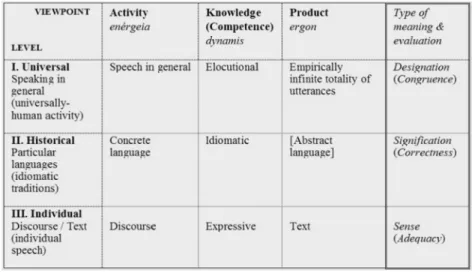
The two triads (three levels of manifestation and three points of view) delineate nine aspects of language as a creative cultural activity, aspects which, according to Coseriu, can also be found as such in the intuitive knowledge of speakers. Thus, the ground tenet of integral linguistics is that language – or, rather:
speaking, “el hablar”, “das Sprechen” – is an activity of creation of meaning, based,
at each level of manifestation (universal, historical, individual), on a specific
competence14 (elocutional, idiomatic, expressive) and resulting in specific products, subjected to specific judgments of conformity (congruence, correctness, adequacy) (Table 1).
Table 1. Eugenio Coseriu’s triadic model: Levels and forms of language, with their associated
evaluations
Albeit inseparable in the genuine activity of the speaking subject, the three levels (with their respective competences, types of meaning and evaluations) are functionally autonomous and must be investigated in their specificity by three different disciplines: a linguistics of speech in general, i.e. a linguistics of designative processes and the contextualizations that make designation possible, a linguistics of particular languages, focused on the peculiar ways each language conceptualizes the world though specific networks of significations, and a linguistics of discourse, dealing with the mechanisms of sense construction. The three disciplines, further subdivided according to more determined objects of study within each level, constitute, in conjunction, the integral study of language – or « integral linguistics ».
14 Coseriu introduces the notion of linguistic competence as “el saber lingüístico”(lit. “the
linguistic known” – the ensemble of techniques for producing and interpreting speech, known to the speaking subject), as early as 1955-1956, by reconceptualizing the Aristotelian notion of “dynamis”, the ability or technique that underlies a cultural creative activity. In later studies, especially those written in German and English, the term ‘Sprachkompetenz’, ‘linguistic competence’, is also used in parallel for designating this viewpoint.
The topic dealt with in this paper, namely the double semiotic relation in texts, concerns Level III, in particular its dissociation from Level II. Coseriu’s main arguments for the autonomy of Level III are the following15:
(1) A text can be constructed in more than one language16.
(2) Texts can deviate from the units and rules of a language (the phenomenon of “suspending” [Aufhebung] incorrectness through adequacy, according to the norms of certain text types and genres).
(3) In contrast to languages, texts are always connected to the universe of discourse and to the situational context.
(4) Texts have their own traditions, which do not ensue from those of the particular languages.
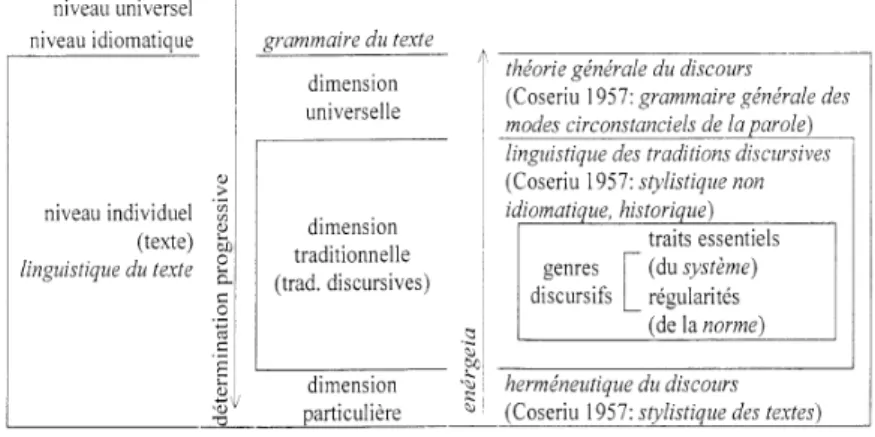
Table 2. Óscar Loureda’s map for the « integral » investigation of texts within Coseriu’s
theoretical framework
Valorizing an early Coserian source17, Óscar Loureda (2007) puts forward a more detailed account of Level III, showing the relative positioning of the various sub-disciplines of discourse according to the nature of their object of study (Table 2).
15 See Coseriu 1973/1981, Ch.10 and 1981: 37-40.
16 This refers not only to cases of mere compositionality or concatenation, but also to cases of
genuine semantic integration of units and rules taken from different linguistic traditions, like the phenomena presented in section 3.2.
17 La corección idiomática (1957) was elaborated in the Montevideo period of Coseriu’s work,
up to a quasi-final form. Although later submitted to Gredos, the text remained unpublished at the time, and circulated in manuscript form inside the community of Coseriu’s direct and indirect disciples, being currently re-edited for publication (cf. Kabatek 2002: 116-120).
It must be emphasized, however, that the central area of text linguistics is the very last sub-domain from this conventional representation: the hermeneutics of genuine texts viewed in their integrality and with their actual constitution and contextual determinations. The other two dimensions and the corresponding components of textual competence are rationally ulterior and can be discovered on the basis of the results of the hermeneutics of texts.
4.2. Textual components on Level II: Text as a structural layer of the particular language
While text linguistics proper takes as its object ‘text’ as an autonomous level of speech, phenomena traditionally studied by transphrastic grammar concern ‘text’ in a completely different acceptation, as a structural layer of particular languages (Level II).
The existence of a “textual” layer in the structuring of a given language can be attested if we can find units, devices and rules specialized for the purpose of text-constitution. While “transphrastic” devices have most commonly been treated as manifestations of ‘text’ in this acceptation, Coseriu (1988: 168) emphasizes that idiomatic knowledge on the construction of texts pertains not only to the grammar, but also to the lexicology of languages. Roughly speaking, two categories of phenomena have to be taken into account in this respect:
(1) prevailing orientation of certain grammatical or lexical significata towards the realization of certain textual functions;
(2) restriction of certain text-constitutional norms through the possibilities of a language18.
To invoke only two examples of the first category, with Coseriu’s suggested interpretations: (i) lexical units like Germ. meckern, It. (avere da) ridire, Fr. (trouver
à) redire, are specialized for the textual functions of ‘raising an objection’ or
‘refuting (unjustified) criticism or reproaches’; (ii) the subject–predicate inversion in French is correlated with the textual genre ‘stage directions’(e.g. “Entre Don Carlos, le manteau sur le nez...”).
These are not textual “significata” per se, but supplementary or additional determinations of the idiomatic significata, as a preferential orientation of lexical or grammatical significata towards certain textual functions or contextualized uses that have been integrated in the norm(s) of that language.
Let us consider the example of linguistic procedures for the enumeration of ideas or sections in a text. The following type of expressions comes to mind: Engl. “first, second, third ,…” or “first, next, …, finally”; Jp. “itten-me (一 点 目) /
hitotsu-me (一つ目), niten-me (二点目) / futatsu-me (二つ目), …” or “saisho ni (最初 に), tsugi ni (次に), …, saigo ni (最後に)”, Ro. “în primul rînd, în al doilea rînd, …, în ultimul rînd”. Despite differences in material composition, all have a similar
18 For (1), see Coseriu 1981: 17-22, 31-33; 1984: 7-8, 1988: 168-169; 1976: 210-211. For (2),
semantic configuration: they are formed by applying a universal principle of thought from Level I, that of progressive or quantitative addition (the quantity ‘1’is followed by ‘2’, ‘2’ is followed by ‘3’, ‘the end’ comes after ‘the beginning’ and not the other way round). However, in Japanese we can also find another procedure, which contradicts this principle, or, more exactly, suspends it. The text in Figure 1 is an enumeration of rules to be observed by visitors at a Shintoist shrine. Literally, the text reads: “hitotsu [one] do not enter with vehicles / hitotsu [one] do not catch the fishes and birds / hitotsu [one] do not cut the bamboo and trees”.
Figure 1. Signboard with rules for visitors at Hie Hachiman Shrine in Akita City, Japan
This is an idiomatic-specific procedure of enumeration that defies designational (common sense) logic. Through it the lexeme hitotsu [‘one entity’] receives a supplementary determination: the requirements of logical coherence are suspended in order to express a different textual function than the other (logically coherent) procedures, namely « an enumeration where all the terms are assigned equal importance ». Also, this special function is preferentially correlated with a certain textual genre: official codes or collections of rules and regulations. Of course, English or Romanian can also express a similar textual function, but they will do so by applying universal rules of coherence (“one thing,… another thing”, “un aspect, … alt aspect” etc.) and without any privileged correlation with a textual genre. Thus, we can see that one language (Japanese) does have an idiomatic-specific text-constitutional procedure for enumeration, whereas other languages (English, Romanian) do not. The existence or absence of idiomatic procedures specialized for the constitution of texts has to be verified descriptively in each language, and cannot be predicted by or deduced from any kind of general norms19.
19 Incidentally, Romanian has an idiomatic-specific procedure for indicating the ‘most
important thing of all’: “în primul și-n primul rînd”, lit. ‘in the first and first place’, usually introducing only one element, no longer followed by others. In English the means of
The lexematic content of the unit hitotsu (the significatum in itself) is indeed defined by oppositive relations in the system of Japanese (hitotsu is something that is homogeneous with futatsu [‘two entities’], mittsu [‘three entities’] etc., but different from all these other units belonging to the same functional series). However, the supplementary determination « for use in enumerations of equally important entities » cannot be described oppositively. In Japanese there is no procedure of enumeration with “futatsu, futatsu, futatsu…”. Also, for “hitotsu, hitotsu, hitotsu…” there is no other associated textual function than the one described above. Thus, the supplementary associated determination need not be placed in or defined on the basis of a systemic paradigmatic structure. The principle of oppositive distinction only applies to a very limited (though central) part in the Gestaltung of particular languages – the sub-layer of the system of a functional language –, whereas the rest is organized according to very different principles20.
The identification, description and categorization of units preferentially correlated with certain textual functions is certainly relevant and necessary as part of the linguistics of languages, and may be called the “textual grammar” (and “textual lexicology”) of a particular language, but does not represent a linguistics of discourse / texts in its authentic acceptation.
Let us return to the case of hitotsu. Its lexical significatum, together with the supplementary determination as a procedure traditionally established for a certain type of enumeration, can be used in the composition of a genuine text in a serious modality, i.e. as a signal for placing that text within a certain genre (formal regulations and statutes), but can also be used in texts of a totally different orientation, for instance in an ordinary dialogue between friends, in a humorous or ironic manner. Used in discourse, the lexeme and its semantic content from the system and norm of the Japanese language become the expression for a higher-level, text-semantic function. In the first situation, of use in conformity with the idiomatic status, it is a marker of genre and may signal that a ‘factual’ interpretation is in order21. In the second situation, a two-fold strategy is applied: the unit is taken out of its usual norm and placed in an incompatible context, thereby simultaneously evoking the original norm, and marking its suspension (Aufhebung), in order to
expression for this function (“first of all” – with one only one occurrence of the word first, or “first and foremost” – with a split between the categories of ‘order’ and ‘importance’) simply apply the universal rules of thought. Thus, the significatum of the lexeme first does not have any special supplementary determination for a text-constitutional function.
20 In Coseriu’s linguistic theory, a ‘functional language’ is a variant of the historical language
homogeneous from the dialectal, diastratic, and diaphasic points of view, organized on three sub-levels: type, system and norm. The oppositive principle does not hold for the sub-levels of type and norm. Nor does it hold for everything that is methodologically set aside in the process of defining a functional language: the diachrony of the historical language, fixed expressions and phrases that no longer manifest a “free technique” of speech, folk and scientific terminologies, whose organization reflects extralinguistic criteria, etc.
21 Naturally, even when used in conformity with its idiomatic status, the unit may serve as
expression for a non-factual sense. In the text from Hie Hachiman Shrine, the three enumerated rules of equal importance signify the sacrality of the natural space of the shrine, which should remain untainted by human intervention.
achieve the humorous or ironic effect. It is only when we focus on this perspective of analysis that the level of a text linguistics proper is reached.
4.3. Text as an autonomous level of speech (Level III): When ‘content’ becomes ‘expression’
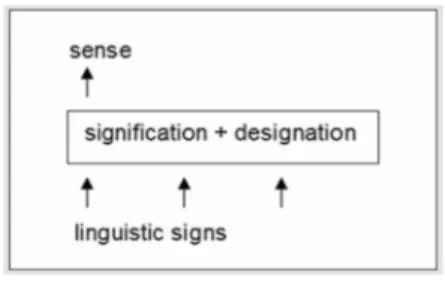
In integral linguistics, Discourse / Text in its proper acceptation (Level III) is defined as the autonomous linguistic level of sense-construction, the level where the significata and designata of linguistic units acquire the role of a new, second degree, signifier – a signifier for textual sense22. In Coseriu (1981: 48) the double semiotic relation, which represents the foundation of Level III, is schematically represented as follows:
Figure 2. The double semiotic relation in texts
Figure 2 should not be interpreted as a fixed configuration of necessary and
sufficient elements that make up a text in a concrete fashion, but rather as a conventional representation of the semiotic mechanism of the double articulation of meaning in discourse. I have argued elsewhere (Tămâianu[-Morita] 2001, 2012a, 2014) that a more straightforward formulation, focused on the mechanism as such, can be represented as in Figure 3.
Figure 3. The double semiotic relation viewed as a semiotic mechanism of
sense-construction
22 See especially Coseriu 1948, 1955-56, 1973/1981, Ch. 10, section 7.3., 1979/2012, 1981:
The foremost task of text linguistics will be hermeneutic in nature – “justifying” (i.e. providing an objectively grounded motivation for) the sense of texts, by tracing back units of sense, already understood intuitively, to certain configurations of expression units:
Den Sinn im Text zu rechtfertigen, bedeutet […] den bereits verstandenen Inhalt zu einen bestimmten Ausdruck zurückzuführen, zu zeigen, dass dem
signifié des Makrozeichens im Text ein spezifischer Ausdruck entspricht. In
dieser Hinsicht ist also die hier behandelte Textlinguistik Interpretation, Hermeneutik. (Coseriu 1981: 150-151)
Thus, in text linguistics our primary working question is: What is textual
expression and how is it organized? Starting from the sense already intuited /
interpreted, we will attempt to trace it back to specific elements of textual expression, to identify what units and devices, in what kind of organization, make the construction of sense possible, and then guide or channel its interpretation23.
In fact, even from a purely practical point of view, text-linguistic investigation cannot be carried out in the absence of a genuine hermeneutic perspective. For building an analytical model, and also for applying it to the description of texts, in reality one can never start from the units of (textual) expression as such. The very identification and segmentation of units of expression, and even the simplest provisional inventory of such units taken as raw data, without or before analysis and interpretation, are inevitably based on an initial intuition of the corresponding contents, even if this fact remains unacknowledged, or if linguists who embrace a positivistic epistemological stance remain unaware of it.
4.4. Components of textual expression (Textkonstitution)
We can conceive the expression of texts as being represented by two categories of elements, which I have proposed to dissociate into ‘text-constitutive units’ and ‘text-constitutive procedures/devices’, according to a simple operational criterion that corresponds to the intuitive knowledge of the speakers themselves: how these elements are situated in relation to the individual text in which they appear24.
The ‘units’ are ‘pre-textual’, in the sense that their identity is established prior
to the construction of the individual text: some are found at the elocutional and
idiomatic levels of linguistic organization (the latter – idiomatic signs, with the constellation of all their paradigmatic and syntagmatic relations in the given language and their supplementary text-oriented determinations); others are fixed formulae for realizing specific textual functions in various conventionalized textual genres, or previous (fragments of) texts, taken up as such in a new text. On the other
23 This is an important difference from Benveniste’s (1974) model: the units of expression for
textual sense are not “words” (linguistic signs) pure and simple. Text linguistics has to operate not with only a different type of meaning, but also with a different conception of what the expression for that meaning is.
24 For a discussion in comparison with other models and a tentative list, see